Blue and Pink were really late arriving, and were much amused by the cheers and applause when they came through the door. Slightly embarrassed, and after a quick explanation, everyone started splitting into groups. First was the “Feature Game“, the Fantasies & Futures expansion for one of our more popular, heavier games, Tapestry. On the surface, Tapestry has simple mechanisms, but they combine to make a complex game. Basically, on their turn, players move one step along one of the four Civilisation tracks around the board: Science, Exploration, Military, Technology and carry out the action (or actions associated with it). Each space requires payment of resources, and the further along the track, the more expensive the spaces become.
 |
| – Image by boardGOATS |
If a player cannot afford to pay (or chooses not to), then they instead take income, which gives them more resources. They also gain points and play a tapestry card, which usually provides a power for the next round. So, at its heart, Tapestry is an engine building and resource management game: players carry out actions and get resources so they can get more resources and ultimately, points. We have played the first two expansions, Plans and Ploys and Arts & Architecture, but this time the “Feature Game” was the Fantasies & Futures expansion, which is the smallest, adding new Fantasy Civilizations, advanced Capital City mats, new Tapestry and Tech cards.
 |
| – Image by boardGOATS |
Ivory was joined by Green, Plum and Byzantium. Along with the Fantasies & Futures expansion, the group decided to add the “Plans” from the Plans and Ploys expansion as a sort of mini expansion, a private goal, where players get their own, special building they can build. They also left the Tapestry cards and Civilisations in the mix from the first two expansions and really only left out Arts Advancement track from the Arts & Architecture expansion as they thought it would add too much complexity to the game overall.
 |
| – Image by boardGOATS |
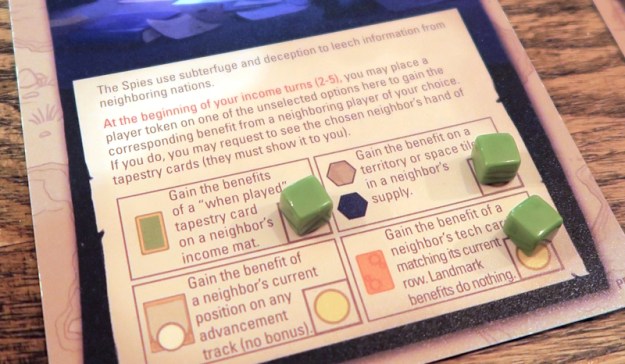
Tapestry is one of those games that sometimes comes in for criticism for being multiplayer solitaire. Although that’s not true, there is a strong element of players “getting on with their own thing”. Although they were each very much playing their own game, there was still quite a bit of interaction which definitely gave the game teeth. Green’s Civilisation (“Spies”), had him perusing over his neighbours positions and cards each income turn. Luckily for him Ivory’s Civilisation (“Aliens”) gave him four starting space tiles, and one bonus he could choose was the benefit on an unused tile in a neighbours supply which gave a nice healthy early bonus.
 |
| – Image by boardGOATS |
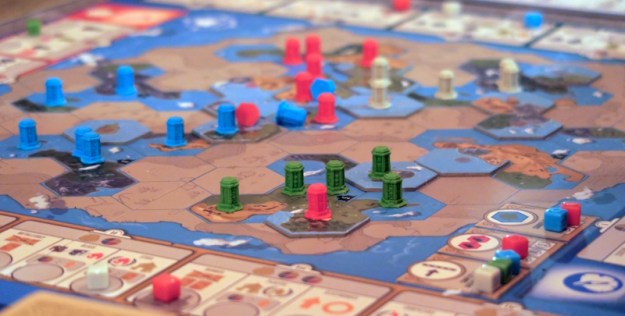
Plum’s “Islanders” Civilisation was focused on collecting area tiles and placing them on her Civilisation mat. So she started out prioritising collecting landscape tiles, looking for ones with water on more edges as these would give her more points in the final income phase. She got a bit lucky right from the start getting two out of three. From there she went for an expansionists strategy as did Byzantium (with his “Riverfolk” Civilisation), and from there, throughout the game they found themselves trying to conquer each others territories on the central island.
 |
| – Image by boardGOATS |
Plum started the game with two Tapestry cards, so chose to use the standard one for her first era. The second was from one of the expansions and “charmed”, so much to Byzantium’s annoyance when he tried to topple Plum’s Tower in the middle of the map, his attempt was thwarted by Plum’s Trap card which also gave her an extra benefit. When Plum later attempted to Conquer Byzantium’s tile, he was delighted to be able to repay the earlier battle with his own Trap card. That satisfaction didn’t last, however, as Plum proceeded to play her charmed Anti-trap card which not only stopped the trap dead, but also gave her yet another bonus.
 |
| – Image by boardGOATS |
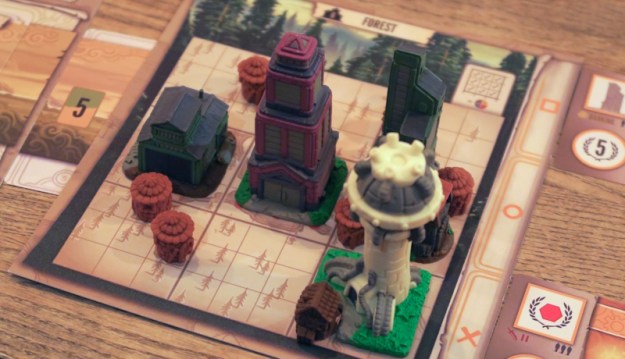
That bonus was a random Tapestry card from Byzantium’s hand—he had two, and the one she picked just happened to be the one he had been working towards maximising the effect of (moving up each track once and getting the bonus action for free). Plum felt pretty bad about picking it, but it was too late by then. So, all round, it was quite a frustrating game for Byzantium, who started the game with a large forty-eight point bonus from his landscape board (“Forest”), and his first conquering dice rolls, time after time, gave him the choice between a resource or seven points—quite a dilemma in the early part of the game. Initially he took the seven points (the highest that dice could give him), but found he wasn’t getting as many turns as the others, so later switched to taking the resource.
 |
| – Image by boardGOATS |
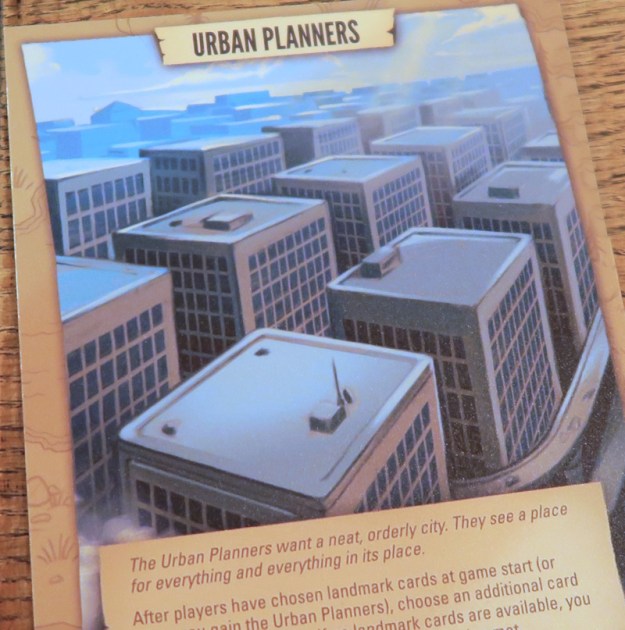
Ivory, meanwhile, managed to make good use of the charmed Tapestry cards, keeping himself well stocked with resources throughout the game. The rest of the group barely saw any charmed Tapestry cards (aside from Plum’s Trap and Anti-trap cards), but did find the new Civilisations and Landscape boards quite an interesting addition. As the endgame approached, Green was last man standing, and for his last few turns he was able to grab an extra Civilisation (“Urban Planner”) which was to reward him handsomely.
 |
| – Image by boardGOATS |
The game which had been a quite sedate affair, started speeding up a little towards the end. Pretty much everyone did something that if they had thought just a little a bit more would have gained them another point or so—Green put a cube on another player’s map, Plum put a building somewhere where it could have completed a row if she’d considered a little longer. As the game came to a close, Ivory and Plum counted their remaining income scores to amazingly find themselves both on two-hundred and thirty-five points.
 |
| – Image by boardGOATS |
Then Green counted his final points, giving him the lead by a solitary point. That was until he realised that he’d added thirty-six to one hundred and ninety-nine and discovered he was part of a three-way tie with Ivory and Plum! Nobody was quite sure how they all managed to have an identical score in such a high scoring game. If the tie-break had been resources remaining, then Green would have won and if it was Tapestry cards remaining, then Plum would have been the victor. However, a quick check of the rules suggested the tie-break was in favour of the player with the tallest building (which everyone agreed that was a rubbish tie break), and although Ivory narrowly had a taller building that Green, he graciously agreed that everyone should just share victory.
 |
| – Image by boardGOATS |
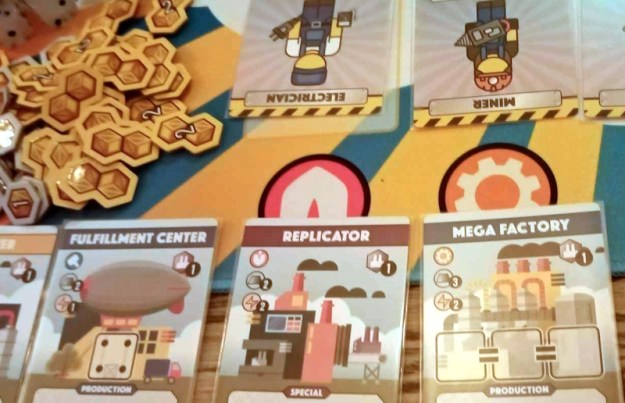
While Tapestry was setting up, on the next table Jade was introducing Black, Purple and Pine (who chose to spectate) to Fantastic Factories. This is a game where players compete against each other trying to build the most efficient set of factories as quickly as possible. Players have to carefully manage their blueprints, train their workers, and manufacture as many goods as possible in order to achieve industrial dominance. Each round consists of two phases: the market phase and the work phase. In the market phase each player in turn order can either gain a blueprint card from the four available in the market or hire a contractor.
 |
| – Image by boardGOATS |
To hire a contractor players must pay one card (that matches the tool symbol associated with the contractor’s location on the board) and any additional costs listed. Contractors have various benefits mostly related to gaining extra resources or extra dice workers for the work phase later in the round. In the work phase, all players perform actions in their play area simultaneously starting by rolling their four coloured dice (and any additional ones gained from contractors). Players can use their actions to build cards (which cost various resources matching the building type); while players can build as many cards as they wish in a turn, they may one of each type of building.
 |
| – Image by boardGOATS |
Dice can be used to take actions on a player’s main Headquarter board or on building cards you have constructed. A player’s Headquarter board allows them to generate metal and energy. Players can also activate their buildings once per round. If any player has built ten buildings or produced twelve goods that triggers the end of the game and one final round takes place before end game scoring. Players add up the prestige value of their buildings to their produced goods and the winner is the player with the highest total. The game was a fairly typical learning game, but was quite close. Both Purple and Black took thirteen points for their buildings, and while Purple was yet to get her engine going, Black took nine points for his goods.
 |
| – Image by boardGOATS |
Jade, on the other hand, had fewer points for his buildings (nine), but they were functioning more efficiently. His total of twenty-three was just one point more than Black who took second. While they were packing up, the group chatted and Jade showed off Vaalbara, another of his acquisitions from UK Games Expo, which he described this as a nice little set collection, and semi-interactive card game. Then they chatted while they waited for Tapestry to finish. And waited some more as the clock ticked and it turned out that Tapestry was no-where as near to finishing as everyone had thought…
 |
| – Image by boardGOATS |
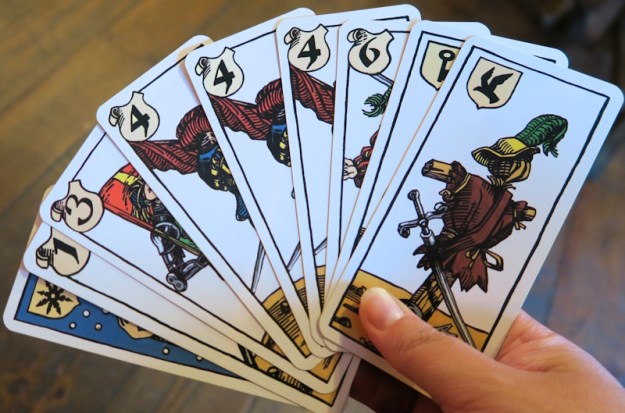
Meanwhile, Teal was introducing Blue, Pink and Lime to a much older game, Condottiere. This is a sort of trick taking, battle game. Set in 13th century Italy, where the wealthy city-states had weak armies. The Condottiere were veteran English soldiers returned from the Crusades who were contracted to fight for individual city-states by an agreement known as a condotta, the most elite fighters were the mercenary leaders known as the Condottiere. During each round, control of a State is put up for auction, and players bid the number of troops they are willing to lose in order to win the province. Players bid with cards that represent Mercenaries, Seasons, Scarecrows, and Political Figures, in an effort to try to take control of four adjacent States.
 |
| – Image by boardGOATS |
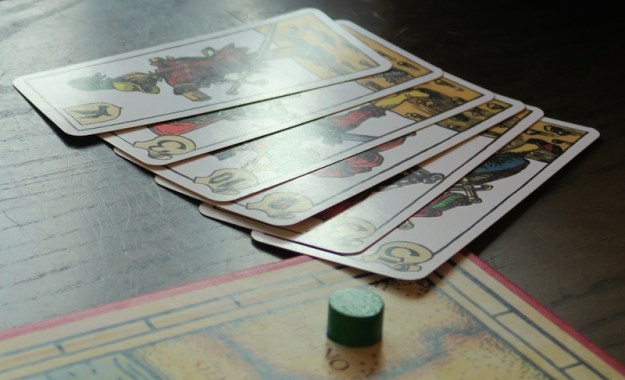
Each player starts with a hand of cards, and one player starts the bidding by choosing a State and a starting bid, playing the card or cards from their hand, face up on the table. Other players follow, playing cards each round. When a player either cannot play another card (or chooses not to), they “stick”, but unlike many other auctions, in which only the highest bidder loses their bid, at the end, everyone loses all the cards they played, whether they finish with the highest value hand or not. Mercenary cards have values one to six or ten, while the other cards have special powers that take effect when they are played, but it is how the cards work together that is key.
 |
| – Image by boardGOATS |
For example, the Drums double’s the value of all that player’s Mercenary cards, but this effect can be offset by another player placing a Winter card reduce every Mercenary card played to a value of one, while a Scarecrow can be used to return a card to its owner’s hand, making it available to play later. There is also the Heroine, which is untouched by either the Drums or Winter, but also cannot be returned by the Scarecrow. Perhaps the cleverest cards, however, are the Surrender and Bishop cards; the Surrender ends the battle immediately (with the current leader winning the battle), and the Bishop ends the battle in peace with no-one winning.
 |
| – Image by boardGOATS |
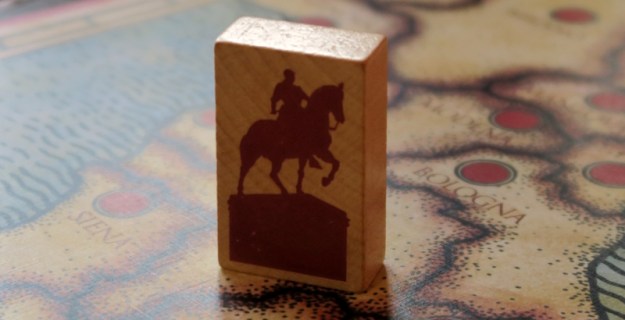
While there are some clear uses for some cards (the Bishop is only likely to be played by someone who is losing badly, and the Surrender card is usually played when the active player holds the lead), the meta-game is also important. Although winning is obviously the aim of the game, as battles become head-to-head, players sometimes end up playing with emotion rather than strategy. Once a battle has been won, the winner chooses the next city-state to be auctioned and starts the bidding. Unlike other games, however, play continues with the cards they have left until all players but one have run out of cards, and only then do players get more cards (before they start the next battle).
 |
| – Image by boardGOATS |
Teal explained the game, and that, although he understood the rules, he had no idea how to win. Indeed, despite having played Condottiere a lot in the weeks since he acquired it at UK Games Expo, he had never won, a situation that was destined not to change this time. Teal and Lime won a couple of States, giving them extra cards in the refresh. Blue and Pink realised they were at a disadvantage, so set out to rectify things. They took a couple of States and redressed the balance. Then Pink stole a march when he forced Lime to lead out in a battle he could not win. With this giving him three adjacent states, the writing was on the wall. Lime, Teal and Blue tried to work together to prevent Pink from taking the last one, but without success.
 |
| – Image by boardGOATS |
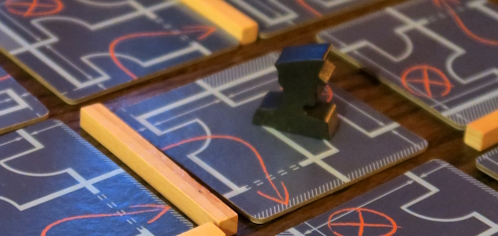
It had been a very enjoyable game, and given its success, the group went on to play another of Teal’s UK Games Expo acquisitions—Burgle Bros.. This is a cooperative game, a style the group traditionally eschew, though recently have played more often (including Scotland Yard last year, The Lost Expedition about six months ago, Zoo Break twice in quick succession, and Forbidden Dessert a couple of weeks ago). Burgle Bros. works in a similar way to the other games of this type. Players are a team of robbers, attempting to enter a building from the ground floor, raiding the safes on each floor before escaping by helicopter from the roof. In addition to finding and cracking the safes, players also have to avoid the Security Guards that patrol the building.
 |
| – Image by boardGOATS |
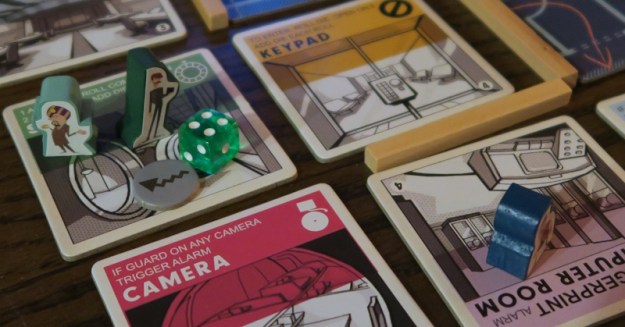
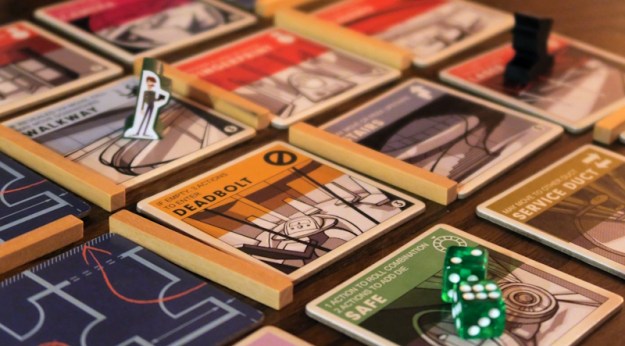
In the game, players each have three Stealth tokens. Whenever they are on the same tile with a Guard, they lose one and if any player is caught without a stealth token, the game is over. On their turn, players have four actions (move, preparing a safe for cracking by putting some dice on its tile, rolling dice to attempt to crack the code etc.). Once the player has taken their turn, the Guard takes their turn, moving towards their target room (assigned by the route deck and marked with an orange die). So to win, players first have to find the safe and then crack the code and all without triggering the motion detectors, heat sensors, fingerprint scanners, laser fields, open walkways, deadbolt rooms, and of course avoiding the guards…
 |
| – Image by boardGOATS |
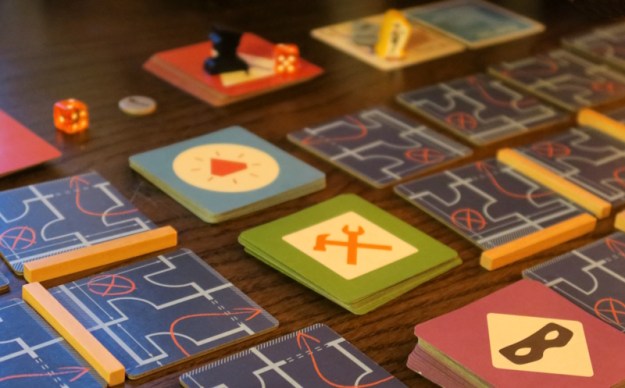
The group decided to play on the beginner’s level which meant they only had two floors to explore before they could escape the building. They got lucky right at the start as they popped up from the ground floor right next to the safe. That meant they only had to reveal all the orthogonal tiles and then roll dice to match the code. They were luckier still as the security guard was on the other side of the building and there were very few walls obstructing their way. As a general rule, cooperative games of this type give each player unique special powers and using these effectively is usually critical to success.
 |
| – Image by boardGOATS |
So, Pink (who was “The Hacker” and didn’t trigger alarms) was sent off to reveal tiles while Blue (“The Spotter”) started setting up the safe for Lime, who was “The Peterman” and got to roll an additional die when trying to crack the safe. Before long, things on the first floor looked pretty much under control with just the last few numbers left to crack the safe, so Teal (“The Juicer”) took himself off to the second floor to start hunting for the safe there. This was a risky strategy as it triggered the Guard moving on the second floor. However, with fewer people on both floors, the Guards effectively moved slower and gave players more chance to avoid them.
 |
| – Image by boardGOATS |
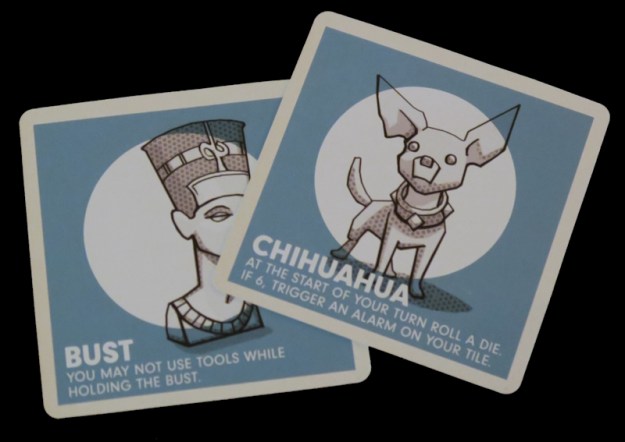
Things were slightly more challenging on the second floor—the Security Guard was a little more proactive, stepping it out more and, of course, the group didn’t find the safe at the top of the stairs this time. It didn’t take him long to find it though, and with nothing better to do, Pink joined Teal on the second floor, ducking under the risky laser trap at the top of the stairs. Meanwhile, Lime had finally managed to crack the safe, so Blue headed up the stairs only to find the second floor security guard heading her way, so she escaped to the roof toting their loot (a very annoying large and heavy bust and a particularly yappy dog) .
 |
| – Image by boardGOATS |
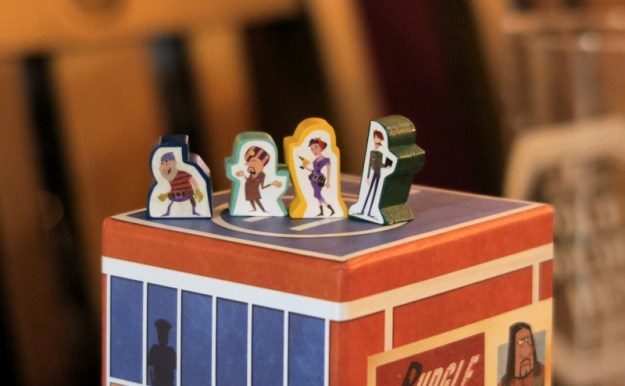
There was a bit of shenanigans as Lime joined Teal and Pink and also dodged the Security Guard (and lost a couple of Stealth tokens), but although there were a couple of near misses, it wasn’t long before all four were on the roof awaiting their lift to safety. It was another fun game, but with time marching, Lime and Teal headed for home, leaving Blue and Pink to join Jade, Purple and Black who were still waiting for Tapestry to finish. It was nice to chat though, and eventually Tapestry did finish and everyone who needed one got their lift home (without having to climb on to the roof…).
 |
| – Image by boardGOATS |
Learning Outcome: New games are fun, but there are lots of good, slightly older games to be had as well at places like Expo.
 boardGOATS