When Blue, Pink and Cobalt arrived for food, the pub was really busy and they struggled to find a table, ending up in the Bar. Their food had arrived by the time the others started to turn up, and although there was another free table by this time, it wasn’t conducive to playing games. Green, who we’d been missing in recent weeks arrived with Lilac for the first time in absolutely ages so there was a lot of catching up to do. It wasn’t long before more tables began to clear, and the group managed to find several together in the restaurant area, and once the feeders had bolted the remains of their supper they joined the group and everyone began to decide what they’d play.
 |
| – Image by boardGOATS |
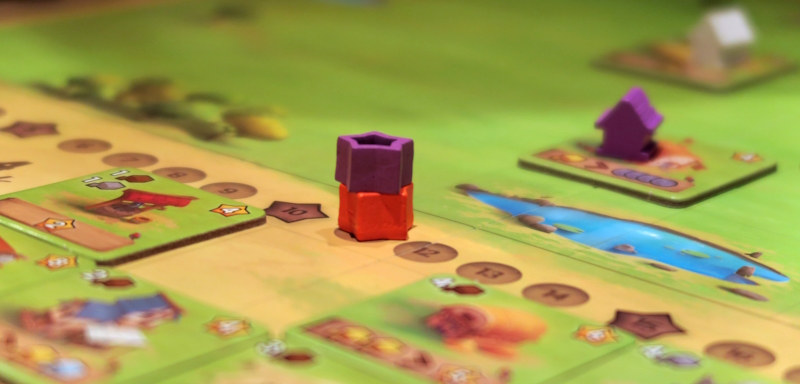
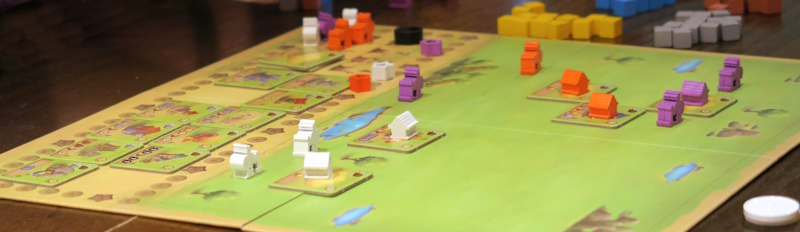
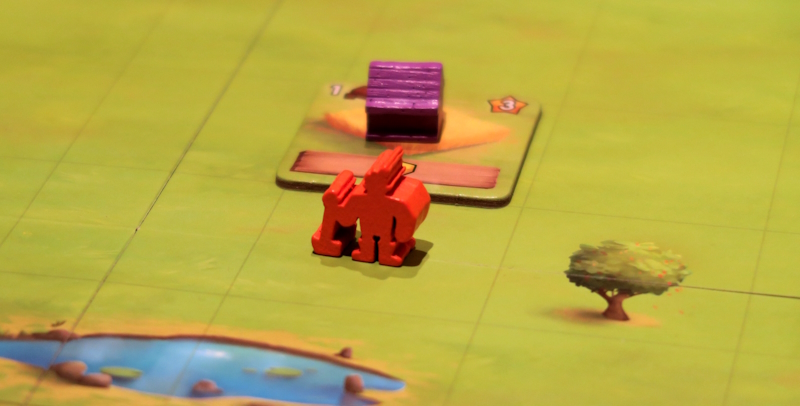
First up was the “Feature Game“, Little Town, a resource management, worker placement and tile placement game where players take on the role of architects guiding teams building a small town. There were two games of this—one with Blue, Pink and Teal, and the other with Black Purple and Lime. It is quite a simple little game: players start with a set number of Workers (four in the three-player game) and building Markers (six for three players). On their turn, they can place a Worker in an empty space on the central player board/map, or spend resources and build a Construction, placing a Marker on it.
 |
| – Image by boardGOATS |
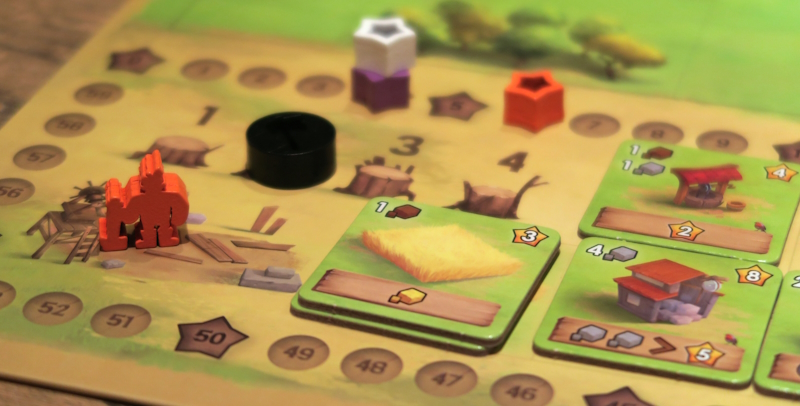
When they place a Worker, the player activates the eight spaces surrounding it. These can include Woodland, Mountain, or Lake to get Wood, Rock or Fish. Wood and Rock are useful to build, while Fish is important for players to feed their Workers at the end of the round (one Fish or Wheat per Worker, every round). Players can also activate Constructions, their own for free, and another player’s by paying them one Coin. There are twelve Buildings and five Wheat fields available for construction at the start of the game—once they are built, they are not replaced.
 |
| – Image by boardGOATS |
There are twenty-nine buildings in the base game which can be drawn at random, but this time, both groups used the basic set (marked with a robin). This meant that some of the Objective cards which are Building dependent could not be used, so in the end, only the cards that didn’t require specific Buildings were used. The Objectives therefore included things like “Gather at least five resources in the same turn” or “Have more Buildings than Workers”—these are scored during the game. Buildings come in two types: Those that give Resources when activated, and those that can be used to convert Resources into other Resources, Coins or Points. The game lasts four rounds, after which players score for each of their Buildings and one point for any three unused Coins.
 |
| – Image by boardGOATS |
Once the rules had been outlined, both groups started playing. Before they’d got more than a turn in, however, Cobalt commented that he was surprised that Blue hadn’t got metal coins to go with the game, at which point, Blue produced her utility set and both groups swiftly made the substitution. Unfortunately, these new coins were a little slippery leading to a couple of rounds of “Hunt the Game Piece”. Little Town is a really good little game though, accessible, but with meaningful decisions and one that doesn’t outstay its welcome. Despite starting with essentially the same setup, the two games, progressed quite differently.
 |
| – Image by boardGOATS |
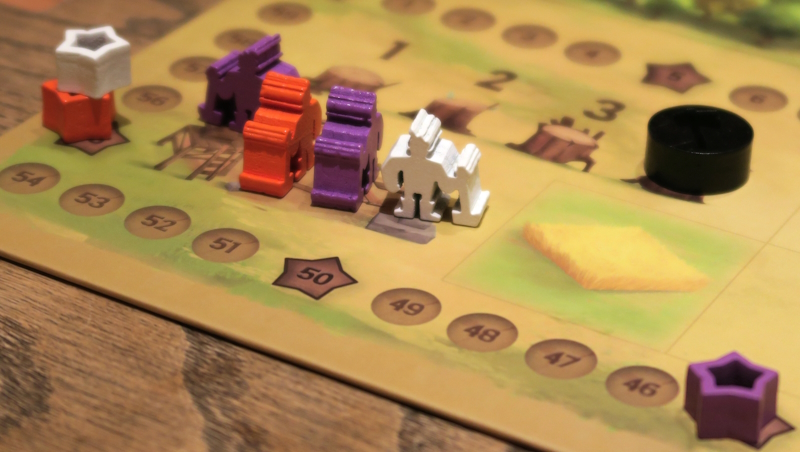
Pink and Blue built Points engines converting Coins and Wheat respectively, while Cobalt converted a Coin into Wheat and Fish, then and Wheat into lots of Coins. On the neighbouring table, however, the Coin to Wheat and Wheat to Coins buildings were owned by different people, Black and Lime respectively while Purple was busy converting Wood into Points. Both games were quite tight, with Lime’s forty-two beating Black into second place by just two points. The other game was even tighter though. Pink rolled back his final move following a suggestion by Blue to pick up an extra point, but she would have done better to keep her mouth shut as that extra point meant he tied for the lead with Blue on fifty-five.
 |
| – Image by boardGOATS |
It was as players were discussing the game and starting to pack away that Pink spotted a way of getting another extra point, but this was deemed too late and the game was deemed a tie. Packing away, there was some confusion as the manifest indicated there should be twenty-nine Objective cards, whereas Blue’s copy had thirty. Despite several recounts (and confirmation that there weren’t any in the Goodie Buildings mini expansion), the issue couldn’t be solved, and the group came to the conclusion that one more than expected was better than one less…
 |
| – Image by boardGOATS |
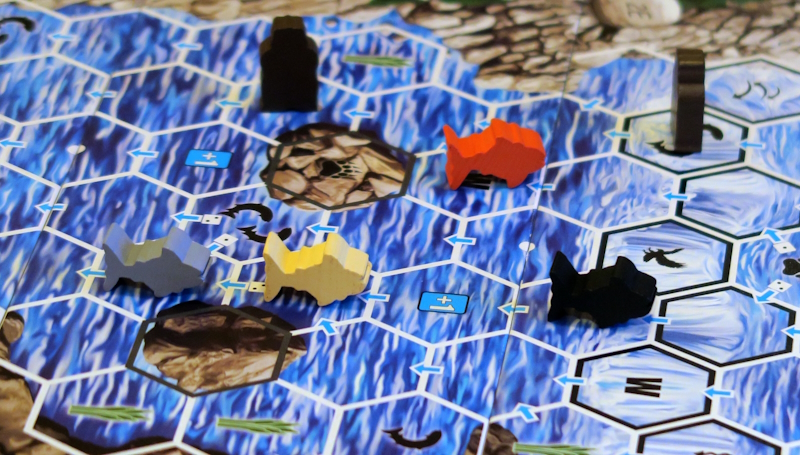
Meanwhile, on the next table Teal was leading a game of Salmon Run with Green, Pine and Lilac. This is a game that was played quite a few times in the group some years ago when it was first released, but the last time it got an outing was in 2015—nearly ten years ago. Teal had decided that his copy had been sitting on the shelf unplayed and unloved for too long and it was time for it to move on. It got a stay of execution though, and as a result, it got a Tuesday night outing. A fast paced, deck-building, race game, Salmon Run is a sort of cross between Dominion and Flamme Rouge. Although the game is not particularly complex, the first game was a learning game.
 |
| – Image by boardGOATS |
The idea is players are Salmon, racing to be first to get to the Spawning Pool. The board is modular and therefore the River can be changed to give variety and replayability. Players start with a deck of cards containing three Swim Forward, three Swim Right, three Swim Left, one Wild and one Bear and draw four of these. On their turn, players can play up to three cards, however, playing three means they will draw a Fatigue card. These will ultimately reduce players’ choice and slow their Salmon down, so mostly players stick to playing two, replenishing their hand to four cards at the end of their turn.
 |
| – Image by boardGOATS |
Depending on the modules used, the River includes obstacles like Rocks, Currents and Rapids, as well as special spaces which allow players to pick up special cards (that can be used to counter Currents, Rapids and Eagles) to add to their Swim deck. Teal began by moving a Bear onto the space with Pine’s Salmon, giving him a Fatigue card. Then, much to Pine’s annoyance, Lilac and then Green did the same before fianally Lilac did it again. Pine was very unimpressed—for one who loves wildlife, he really wasn’t happy about repeated visits from all those bears!
 |
| – Image by boardGOATS |
Green I played a Rapids card and there was some discussion where the card should be discarded to, but in the end there was no catching Teal, who was first to the Spawning Pool, and was some four spaces ahead Lilac, his closest challenger. As Little Town was still going on both tables, the group decided to play a second time now they knew how to play as they thought they’d be quicker (which they were). The River was a changed a little to make it a bit more challenging and then the Salmon began their second run. This time, Pine, Teal and Lilac went one way round the rapids, while Green went the other.
 |
| – Image by boardGOATS |
This time the bear was moved away from players by Teal so nobody got caught. As the River took a bend to the right, Green ended up with only Swim Left cards so had to just discard and bang his salmonny head against the rocks, falling behind. Teal and Pine had both picked up a lot of Fatigue cards, but they both got to the Spawning Pool. As Pine had one less though, he was the winner of the second game. It had been a lot of fun (despite the Bear attacks, and the headaches from banging against the rocky bank), so maybe the stay of execution deserves to be extended a while longer.
 |
| – Image by boardGOATS |
With both games finished and the late start, there wasn’t time for something long, so as is often the case in such circumstances, instead of lots of discussion, the group decided to play the old favourite, 6 Nimmt!. With ten, the group decided to play the game over one round, which meant everyone started with ten cards, a lot more than usual. This didn’t seem to improve the quality, however, a sentiment that was epitomised by one comment, “These are all bad with a capital F…” The first few rounds were a little slower than usual as everyone had more cards to choose from than usual.
 |
| – Image by boardGOATS |
Once everyone had chosen their card, they were simultaneously revealed and added to the end of the appropriate row, with players picking up cards when theirs was the sixth card to be added. Nobody managed to avoid picking up cards, but unusually, the scores were all quite close—so close that the winners, Green and Blue, tied with nine, while Pink took third place with eleven and Cobalt top-scored with twenty-three. One game is rarely enough when it comes to 6 Nimmt!, and everyone was keen for another mad ten-player game. This time the scores were more diverse: Lilac succeeded in avoiding the chaos and won with a clear round, while Teal added thirty-six to his first round twenty two to finish with the most points overall (Cobalt only took seventeen in the second game).
 |
| – Image by boardGOATS |
Blue took second place in the second game with five (giving her the best combined game total of fourteen), while Pine came in third with ten points. Green was the most consistent with nine and eleven, but Lilac claimed the nearest to a “Mike Game” with one exceptional round and one awful one, though her bad wasn’t as bad as his usually were. Everyone was just packing up when the evening came to a smashing end as the wine glass that Lime had carefully put safely to one side bit the dust. Oh well, less washing up…
 |
| – Image by boardGOATS |
Learning Outcome: Little Towns can give quite big games.
 boardGOATS