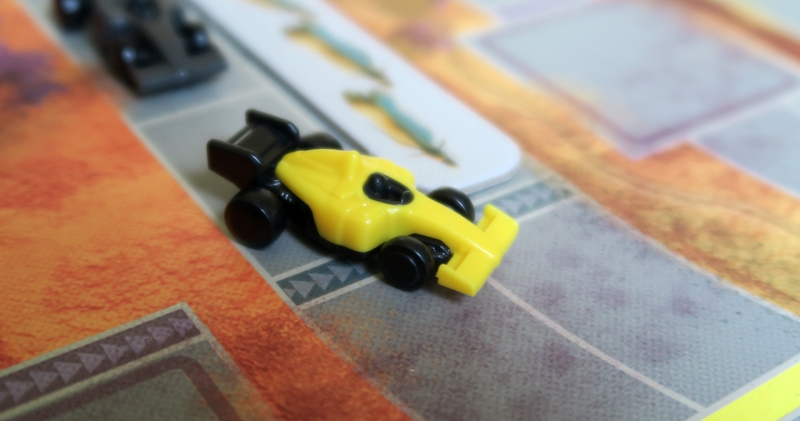
Being an extraordinary Monday meeting and only two days before Christmas, we didn’t really know who or what to expect, so didn’t have a “Feature Game” planned. In the event, almost everyone expected turned up and we played some of our all-time favourite games. Pink was first out of the traps, and persuaded Black, Lime and Pine to join him in a game of his favourite race game, Downforce. This is a fun car racing game where players bet on cars as well as try to win the race. What makes it special is that players play cards, but, whereas in other race games players can only influence their own car, in Downforce, the cards can be used to play anything from only the player’s own card, to every car on the track (depending on the card).
 |
| – Image by boardGOATS |
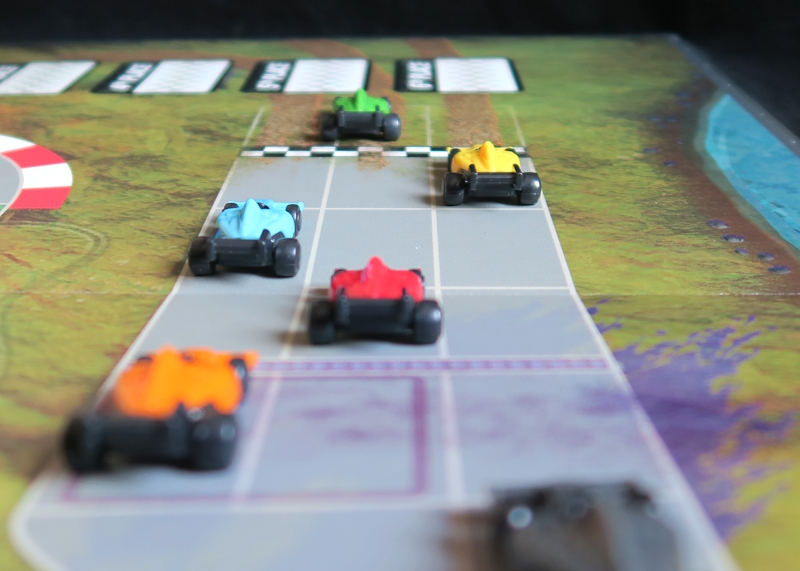
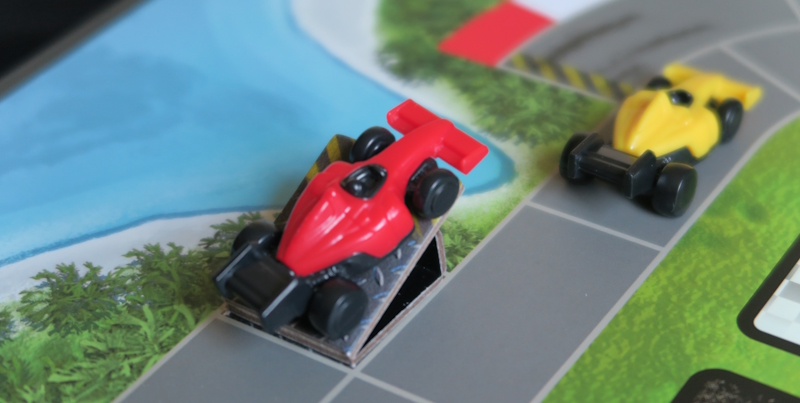
This time, the group played with the Aloha Sands track from the Wild Ride expansion which features water jumps. Cars can use these ramps if they are moving fast enough which lets players pass other cars and move more efficiently. Thus, hand management to take full advantage of the different speed cards is crucial. The game begins with an auction of cars. This is after players have been dealt their hand of cards, and this time, the blue car was popular and went to “determined” Lime, who outbid “cunning” Pink. With six cars on the grid, and four players, there is the possibility of some getting more than one vehicle—although one car (green) went unclaimed, Lime ended up with orange as a second.
 |
| – Image by boardGOATS |
The Aloha Sands only has two betting lines, and the group chose to use the first two featuring on the betting variant score sheet. In this “odds” variant, players get better “odds” for a car that is at placed less well than one that is currently winning. The red car, owned by Pine took an early lead, but by the time the cars made it to the second (and final) betting line, it had dropped to third. Pink had a fist full of cards that favoured to the blue car, and although he had been outbid for it, he had decided to push it along anyhow and bet on it. As a result, with both Lime and Pink favouring it, the blue car moved through the field (aided by some double jumps) and crossed the finishing line first.
 |
| – Image by boardGOATS |
Second place went to Black’s little black car with Pine’s red roadster completing the podium. Betting and car costs have a huge impact on the final scores though, as can the initial outlay for the vehicle. In this case, despite paying for two cars at the start, the fact that Lime owned the winning car and had also bet on it, meant he had an unassailable twenty-one million dollars, eight million more than Pink in second place. With the race over, the quartet chose to move onto a more festive game, Jokkmokk—a cute little set collecting game that went down really well when it got its first outing last year.
 |
| – Image by boardGOATS |
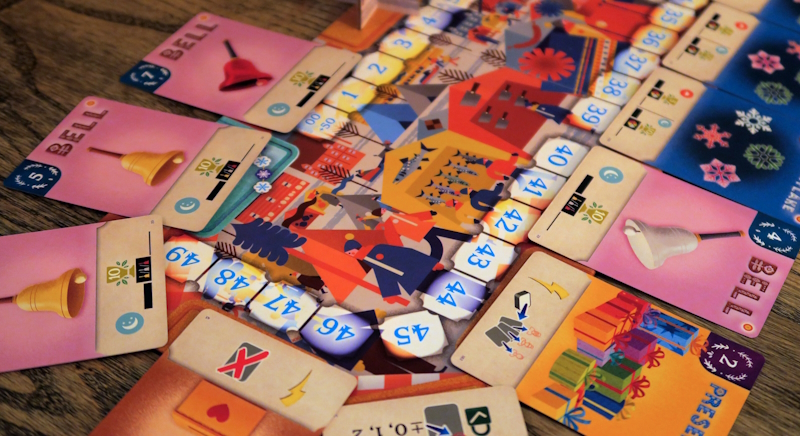
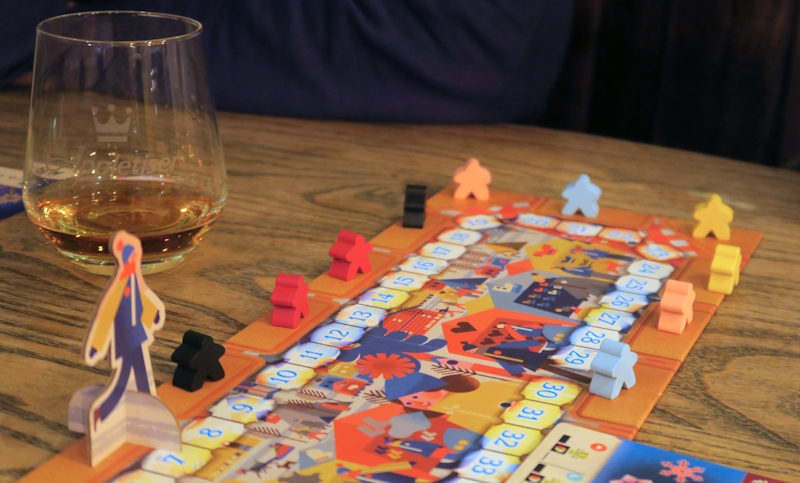
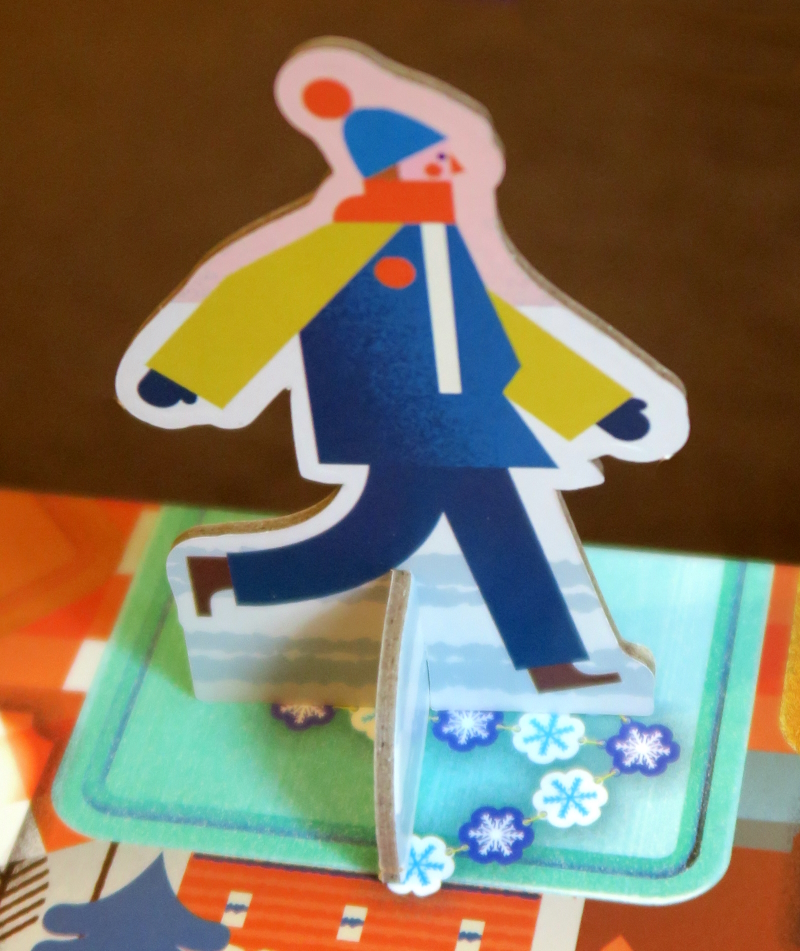
In this game, players move one of their two family members, the one furthest back, to an empty space and claim the associated card before resoling its effect and refilling the empty space. Some cards score points in the middle, others only at the end, so the sets of cards used can really change the game. As this was the second game, the group chose to use the “Second Game” set, featuring the Fika (a Swedish custom of enjoying a coffee and a treat with friends), Aurora Borealis, Snowflake, Patchwork, Mystery Box decks. Of these, the Snowflake cards scored during the game giving Black and early lead with fifteen points, five more than Pine in second.
 |
| – Image by boardGOATS |
The mid-game points were chicken-feed compared to the end game scoring, however, with lots of points available for Fika and Patchwork scoring and for the face value of the cards themselves. The winner was Pine with a total of one hundred and twenty-eight, eight more than Pink in second and eighteen more than Black in third. Everyone had enjoyed the game so much, that when Lime inevitably suggested playing again, everyone else agreed. This time the group used the “Gift of Giving” set of cards, including the Donation, Bell, Sparkler, Snowflake, Mystery Box and Presents decks.
 |
| – Image by boardGOATS |
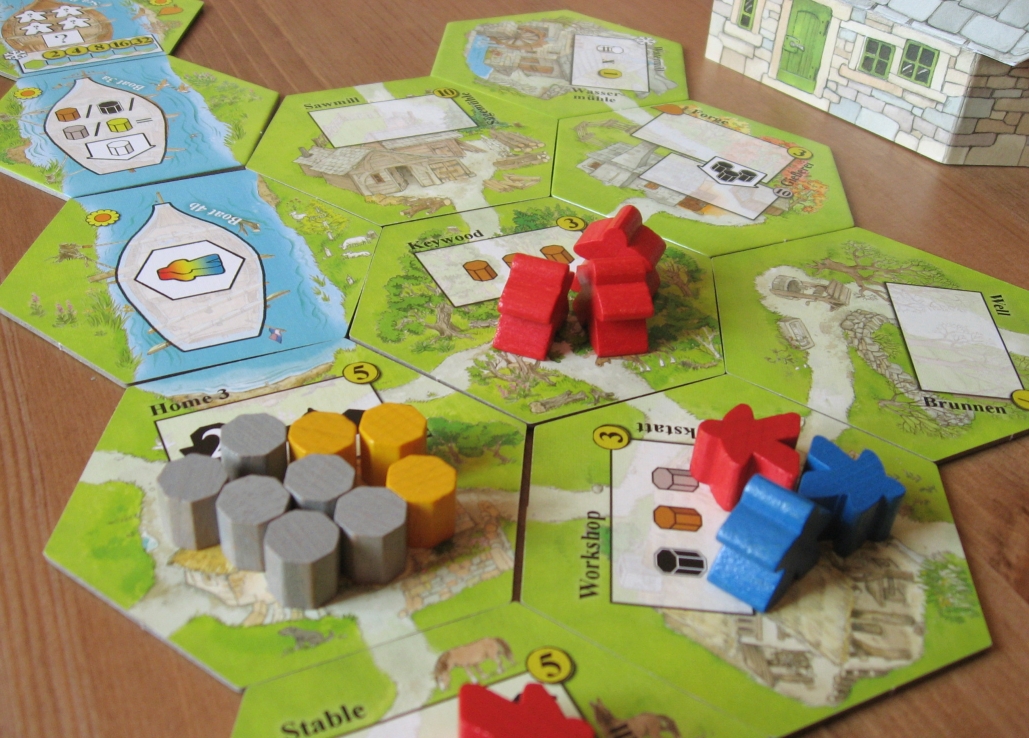
The game followed a similar pattern to the first, with Black and leading at the midpoint with Pine in second and Pine taking overall victory. This time, Lime was the runner-up, however, with Black taking third again. Meanwhile, on the next table, Blue, Plum, Byzantium and Purple were playing Blue’s favourite game, Keyflower. This is it’s second outing of the year, but Plum and Byzantium had missed out last time. They had played it before, but had felt that it didn’t shine with two players and were keen to see how it played with more.
 |
| – Image by boardGOATS |
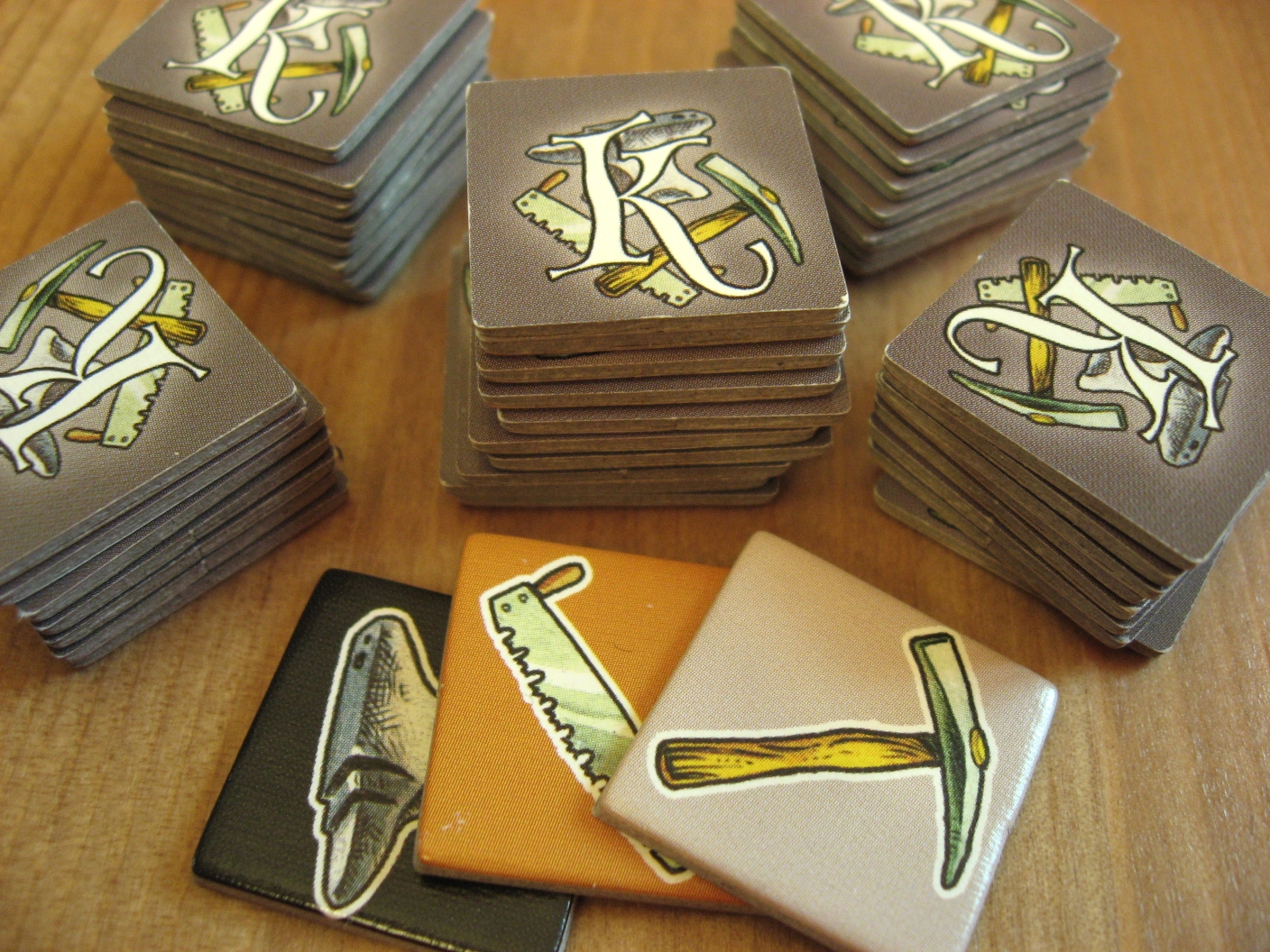
Keyflower is an auction and worker placement, with elements of set collection and even network building. Although everyone had played it before, Blue went through the rules. The idea is that players use meeples to bid on tiles, but can also use them to activate tiles to gain their benefit (usually Resources, Skill tiles or the ability to move resources around their Village). At the end of each of the four rounds players add the tiles they have won to their Village and get any meeples back that were used to activate tiles in their own village.
 |
| – Image by boardGOATS |
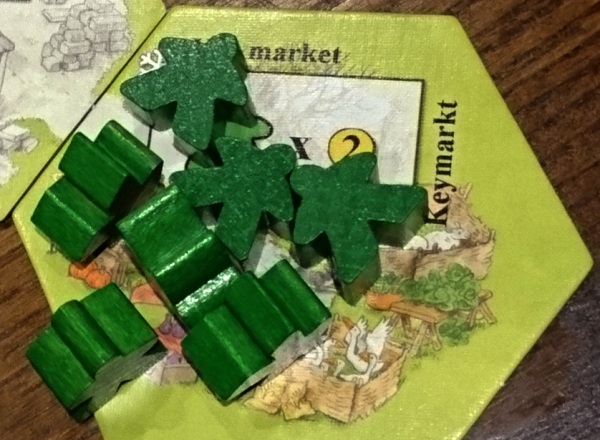
One of the key aspects of the game is the colour of the meeples, as players have to “follow” when bidding or activating a tile. As a result controlling the number of blue, red and yellow meeples they have is a key part of the game. More, green meeples, which are special and can only be acquired by activating specific tiles, can be really valuable. Blue had a Winter tile that gave points for having green meeples at the end of the game, so started bidding on the Peddlar which came out in Spring. Byzantium had other ideas, however, and outbid Blue. In fact, that was just the start of a tight game where there was a lot of competition for many tiles.
 |
| – Image by boardGOATS |
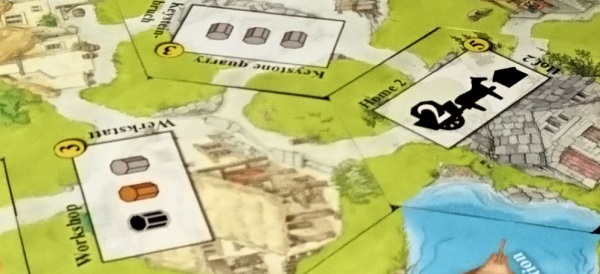
Keyflower is a game that typically rewards players who keep their options open, but this time, Blue found her options quickly narrowed and ended up going for sets of three Skills tiles. This can be lucrative, but can also be difficult to make work, so like many things in Keyflower is a bit of a gamble and with all her eggs in the one basket, she had no choice but to ensure she won the Scribes tile by ensuring she went first in the final round and had a large pile of red meeples to back it up. Tension mounted as players fought for the tiles they needed. The Keythedral changed hands several times, and the Jeweller, the Village Hall and the Watermill were all strongly contested.
 |
| – Image by boardGOATS |
In the final scoring, it was clear that the Scribes tiles made all the difference, with Blue finishing with eighty-six points, fifteen more than Byzantium in second with Plum taking third. As the tiles were packed away, there was some discussion about the game, with Plum and Byzantium commenting that the balance of tiles is less swingy in four-player Keyflower than with two While they were packing up, the second of two games on the next table was coming to an end. In the first of these, Jade led Sapphire and Cobalt in the hot-off-the-press game, Fromage, a worker placement game about cheese-making in France.
 |
| – Image by boardGOATS |
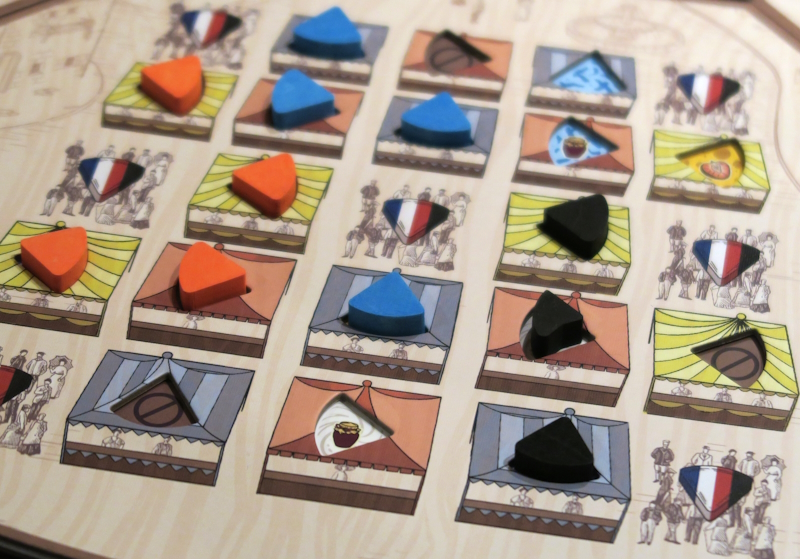
This is a clever game with a “time” element, similar in feel to Tzolk’in. In both these games, workers left on the board for longer give more valuable actions, however, in Tzolk’in, players place their workers and the options become better the longer they stay on the board with players making the decision as to what they get when they remove workers from the board. Players can also only place workers or remove them, not both. In Fromage, there is more flexibility, and the action is carried out when the workers are placed and then remain on the board for longer for the more valuable actions.
 |
| – Image by boardGOATS |
Game play is simultaneous, with all players placing their workers at the same time working on their quarter of the board. Once everyone has finished, the board is rotated, and any workers who have finished their spell on the board are returned to their owner to be placed again in the next round. Workers can stay on the board for one, two or three turns, so a key part of the game is planning and with only three workers, making sure that players don’t end up with all of them stuck on the board. This was another tight game with players scoring fairly evenly in the four areas of the board, the Bistro, Festival, Fromagerie and Ville.
 |
| – Image by boardGOATS |
Cobalt just edged it on Fruit and Orders, however, giving him a four-point victory over Jade in second with Sapphire not far behind. There was just time for one last game and the choice was another recent popular game, Looot. This is a clever management game, using a double placement mechanism where Vikings conquer territory on the central player board, allowing players to gain resources, buildings and objective tiles while they build their village on their personal board using tiles from the common board to gain victory points. This was another tight game, especially between first and second place.
 |
| – Image by boardGOATS |
It was backwards and forwards between Cobalt and Jade and finished with just two points between them. Once again though, Cobalt just had the edge, his hundred and six points just pushing Jade into second again. It had been a good night though and a fitting end to the evening, and the last meeting of the year at the pub. As the last Christmas cards were handed out and final Season’s Greetings shared, people headed off into the darkness and with just two sleeps till the big day.
 |
| – Image by boardGOATS |
Learning outcome: You don’t have to play Festive games at Christmas to have fun.
 boardGOATS