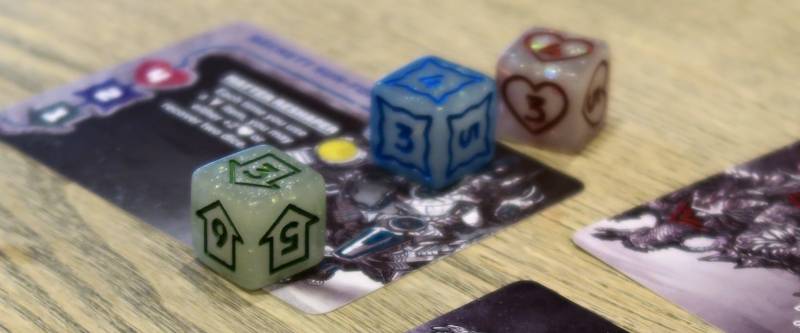
By the time everyone else started to arrive, Cobalt was already most of the way through losing his game of 20 Strong. This is a solo-player deck-based game where the object is to progress through a shuffled deck of cards, each of which bears a unique challenge. This challenge could be in the form of an enemy, a unique scenario, or some other requirement which are completed by rolling a set of seventeen dice with different odds for a hit. These dice, along with three adjustable stat dice, make up titular twenty dice. Cobalt continued rolling his dice while others ordered food, chatted and ate.
 |
| – Image by boardGOATS |
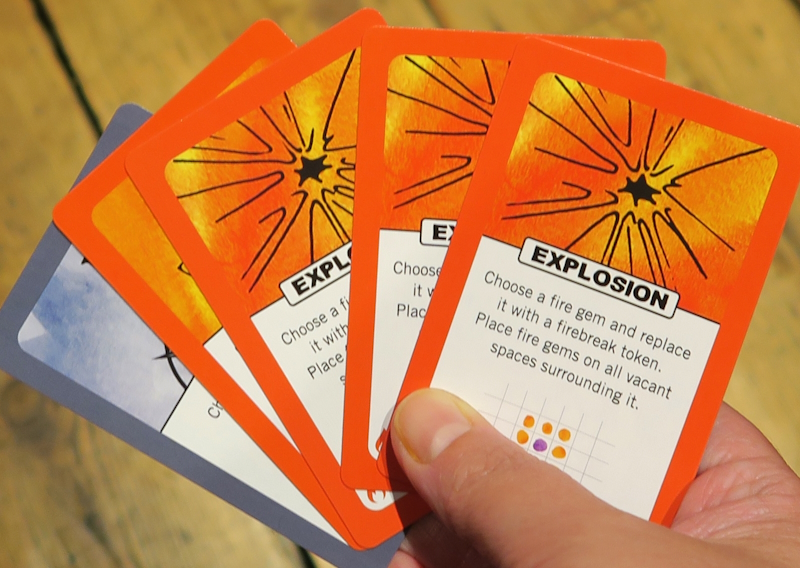
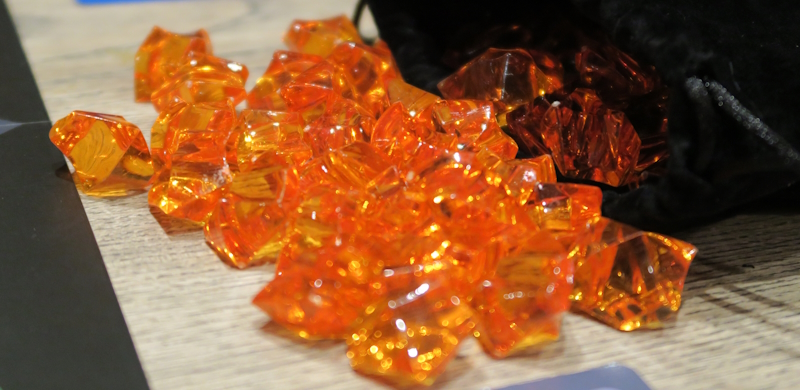
Before long players began splitting into groups, deciding what to play. The first group was Blue, Pine, Mint and Pink playing the “Feature Game” which was to be Fire Tower. This is a competitive game where players order air drops of water, and plan the building of firebreaks in order to combat a woodland blaze. The rules are very simple: players begin their turn by spreading the fire in the current wind direction then play one card from their hand (or discard all their cards) and replenish their hand. There are four different types of cards, Wind, Fire, Water, and Firebreak cards. Wind cards can be used to change the Direction of the Wind which affects which direction the fire spreads in.
 |
| – Image by boardGOATS |
This can either be by playing the card and changing the Wind Direction to that on the card, or by rolling the Wind die and leaving it up to fate. Alternatively, the player may place a fire gem on one empty space orthogonally adjacent to an existing fire space (or the central Eternal Flame), in the wind direction indicated on the card. Fire, Water and Firebreak cards give a pattern of spaces that the fire must either spread in, is removed from, or fire break tokens can be placed in. Firebreaks prevent fire from landing on or jumping over the spaces they occupy and can only be removed using a card that includes the De/Reforest action and cannot be placed in orthogonally adjacent to another Firebreak token.
 |
| – Image by boardGOATS |
Each player took the Fire Tower on one corner of the board with Pine sitting opposite Blue and Mint opposite Pink. Blue went first followed by Mint, then Pine and finally Pink. The base game is an elimination game, with the winner the being the last player who’s Fire Tower has not be burnt down. The group decided to play without the events and keep the game as simple as possible to see how things worked. Pink was the first to get knocked out with Firestorms proving to be disastrous for his Tower. Pine quickly followed with before there was a long, determined rear-guard action by Blue.
 |
| – Image by boardGOATS |
Unfortunately, Mint started in a better position and despite her best efforts, eventually Blue’s Tower was also a moldering ruin. Since Pink and Pine had spent quite a lot of time as spectators, the group decided to give it a second go, but this time working in pairs. This time, Blue’s Tower was first to be destroyed with Mint’s next. Eventually, only Pink’s tower was still standing giving a second victory to Mint, which was shared with Pink. The game had been quite enjoyable, if very different to the usual fare. There was still plenty of time left for something else though, so the group had a rummage in the bags and came up with Draftosaurus.
 |
| – Image by boardGOATS |
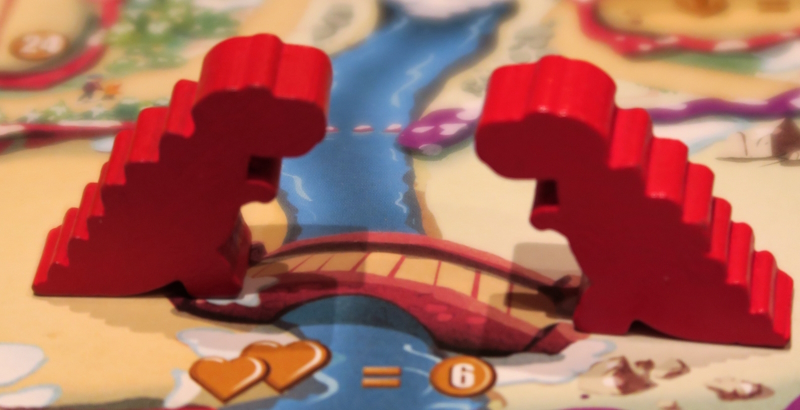
This is a very popular game where players start with a hand of dino-meeples, choose one and pass the rest on before placing them in their dinosaur park. It frequently gets outings within the group, but on this occasion, for variety, the group decided to play with the winter setting which gives slightly different pens with slightly different placement conditions. It was very tight, but as is often the case, Pine, who just seems to “get” this game emerged the victor with thirty-six points. He was only one point ahead of Mint and Pink though, who tied for second place.
 |
| – Image by boardGOATS |
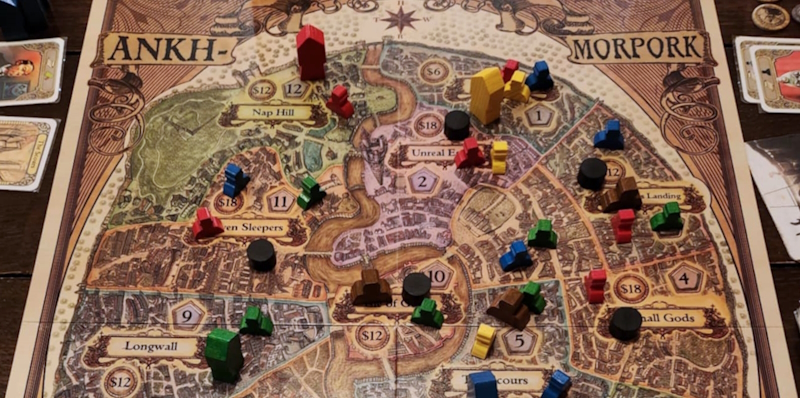
Meanwhile, on the next table, Green putting in a rare, but welcome appearance, was leading Black, Purple and Plum in a game of Discworld: Ankh-Morpork. In this game, Lord Vetinari has disappeared and players control different factions which are trying to take control of the city. Game play is quite quick and simple with players playing a card and doing what it says. Most cards have more than one action on them, and players can choose to do some or all of these actions. Some cards also allow people to play a second card, so they can chain actions together.
 |
| – Image by boardGOATS |
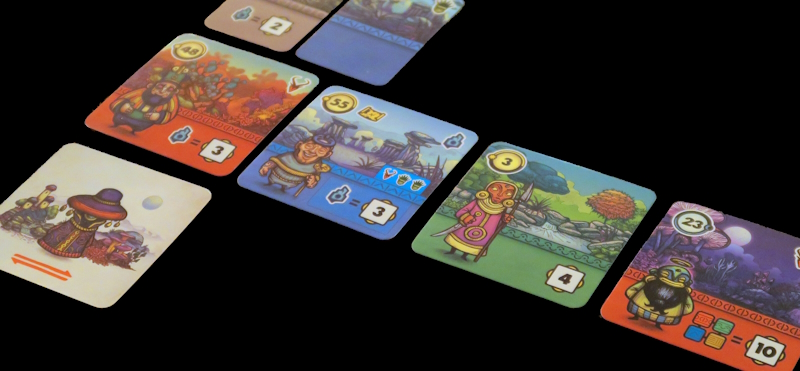
In this game, Black was the Dragon King of Arms, looking for trouble, Green was Chrysoprase, trying to amass lots of money, Plum was Commander Vimes who was trying to play through the deck and Purple was Lord Rust, with an area control remit. The game was over quite quickly with Black running out the winner in a game that is much under-rated and sadly very out of print due to IP issues. This copy was a much cherished one, as it had belonged to Burgundy so it was nice for it to get another outing within the group. There was time for a second game and this ended up being Faraway, a very clever, much more recent, card-driven game that has had a few outings since its release last year.
 |
| – Image by boardGOATS |
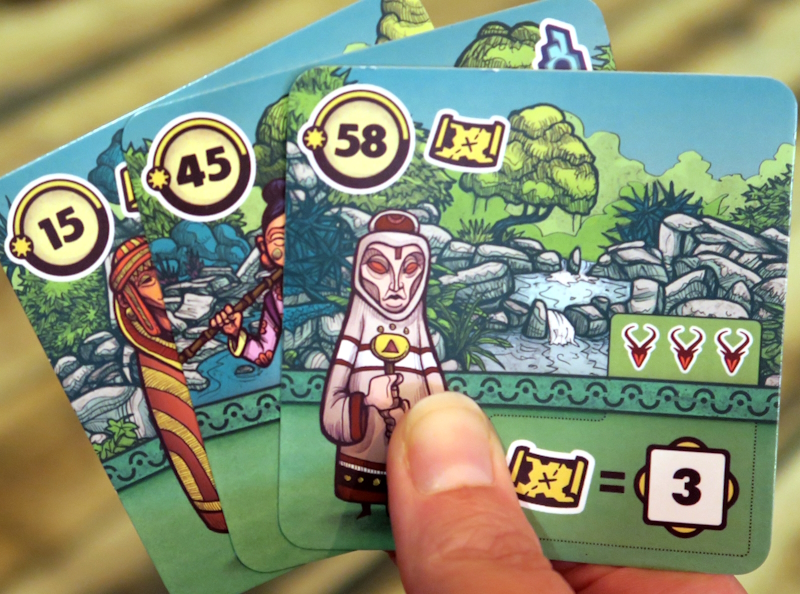
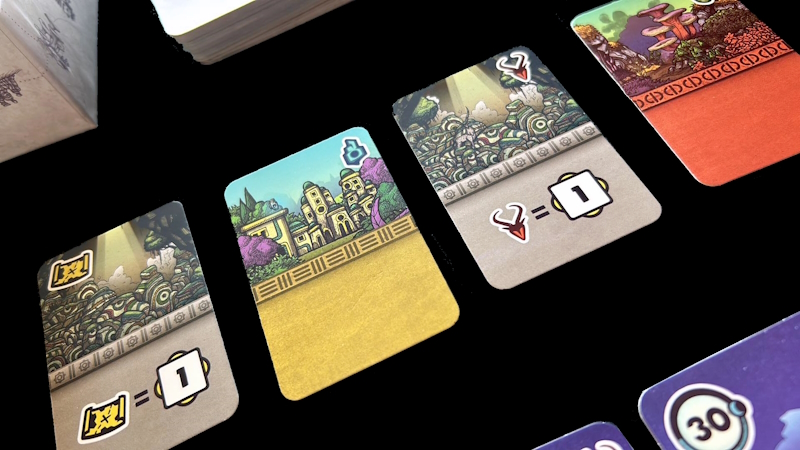
The idea is that players simultaneously chose one of the numbered cards from their hand and starting with the the player that played the lowest card (similar to 6 Nimmt! or Kingdomino), everyone takes it in turns to choose one from the market to add to their hand. Players then simultaneously choose another card, and again, choose one to add to their hand. The game ends after everyone has played a total of eight cards, and then everyone scores. The clever part is that the cards are played left to right, but the scoring is from right to left.
 |
| – Image by boardGOATS |
At first glance, this looks like it makes things easy, because early in the game players find out what they need to get points and can then focus on getting the resources they need as the game progresses, but of course that is not the case. This time, Purple had a really bad run where she kept getting the highest number cards, which meant she picked last, and then picked up the higher number cards left by others. Once again, the winner was Black making it two out of two for him, while Plum was second by seven points with Green a little way behind her.
 |
| – Image by boardGOATS |
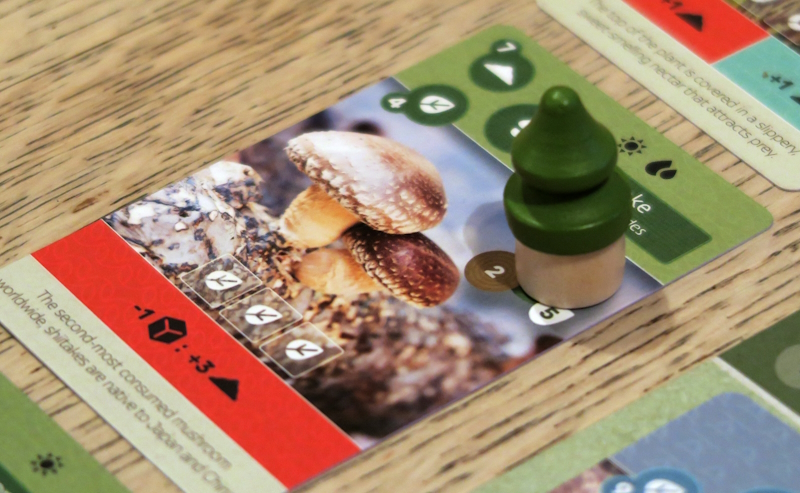
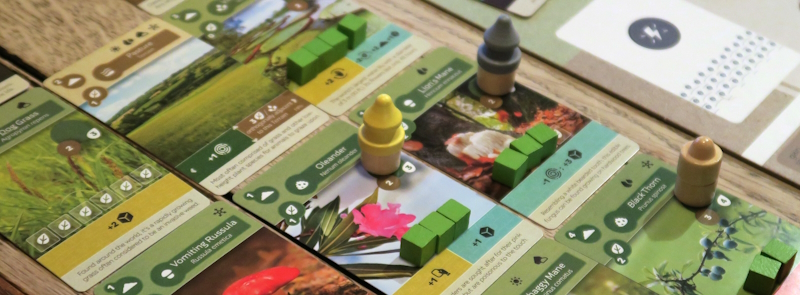
Meanwhile, the third group comprising Jade (fresh from his birthday celebrations), Sapphire, Teal, Byzantium and Cobalt spent the evening playing a five-playergame of Earth. This is a is a sumptuously illustrated card-driven engine-builder game that is often compared to Wingspan, where players are building themselves an ecosystem. The game itself is not actually all that complicated. Players are building a four by four grid of Flora and Terrain cards which represents their island and during the game they will plant flora, water it and allow it to grow. On their turn, players do one of four things: Planting (paying the cost in Soil tokens), Composting (gaining Soil and placing cards from the deck in their discard pile), Watering (place Sprouts and gain Soil) & Growing (draw new cards and place growth tokens).
 |
| – Image by boardGOATS |
A bit like Puerto Rico, once the active player has chosen which action they are taking, everyone else gets to do a subsidiary, slightly weaker version of the same action. Once everyone has completed the action for the turn, everyone activates all the cards in their island that match the colour of the action chosen, starting with the card in the top left and working across each row in turn. At the end of the game (triggered when one player has completed their island), players score points for each flora card, any Trunks and Canopies they have grown, their Sprouts and their pile of “Composted” or discarded cards. Players also score points for achieving objectives on the Fauna cards revealed at the start of the game and for completing their island first.
 |
| – Image by boardGOATS |
During the game, Cobalt built up the most points; his forty-two were some five ahead of Byzantium. By far the most points come in the end-game scoring however. A bit of a point salad there are seven scoring sections: Teal scored best for Compost; Jade scored most highly for completing his Canopies; Byzantium top-scored for Terrain, and Cobalt out-scored everyone else for his Fauna. As well as getting the most points for his Sprouts and Ecosystem Objectives, Sapphire also scored well in many of the other categories giving him a clear victory with one hundred and sixty-eight points, thirteen more than Byzantium who pipped Cobalt for second by a single point.
 |
| – Image by boardGOATS |
Learning outcome: Playing with fire may be fun, but you risk getting burnt.
 boardGOATS