Next Meeting, 28th Movember 2023

Our next meeting will be Tuesday 28th Movember 2023.  As usual, we will start playing shorter games from 7.30pm as people arrive, until 8pm when we will start something a little longer.  The pub is doing food, and the table is booked from 6.30pm for those that would like to eat first.

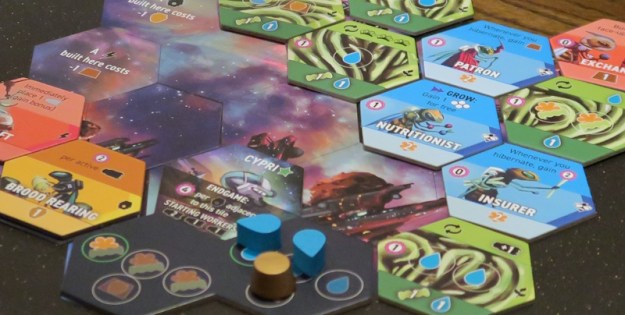
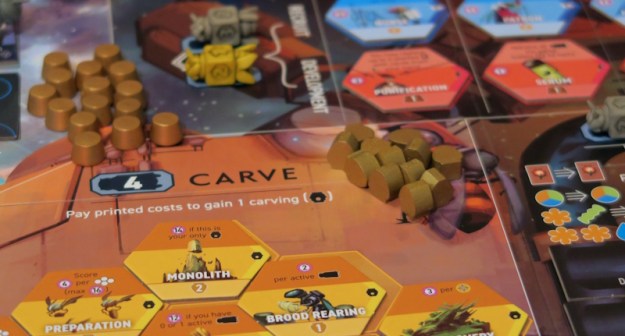
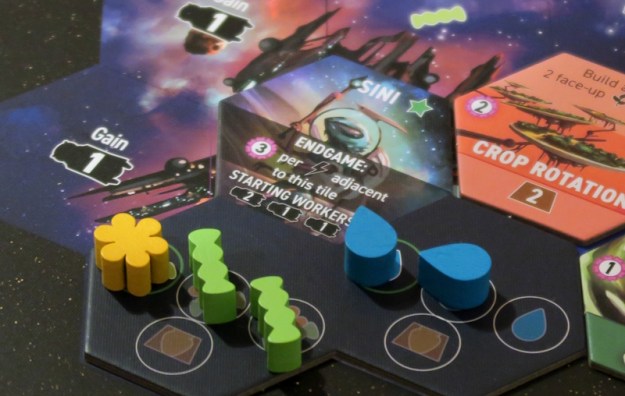
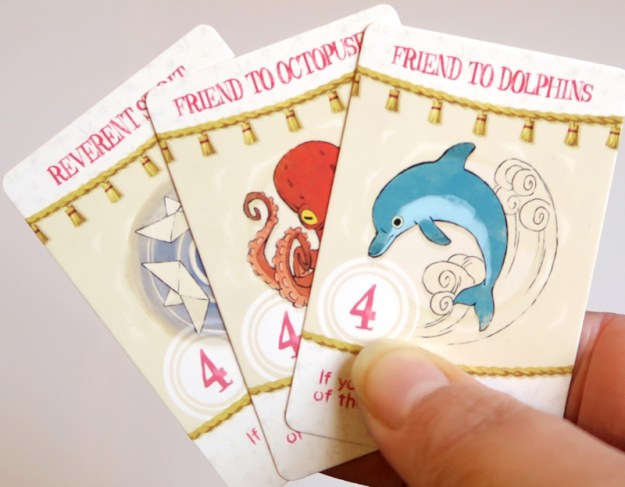
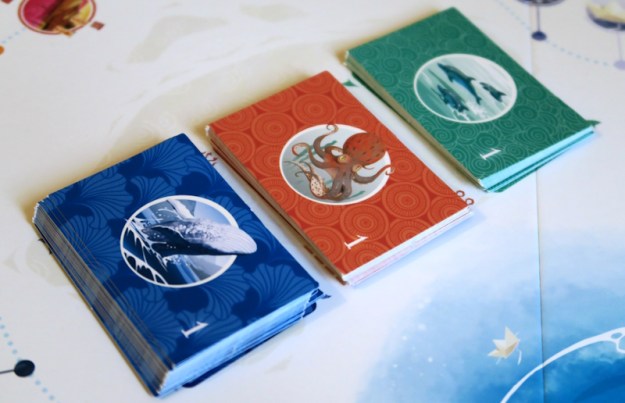
This week, the “Feature Game” will be Apiary (rules, review and play-through video), which is a worker-placement, hive-building game where players explore planets, gather resources, develop technologies, and create carvings to demonstrate their faction’s strengths before the end of the year when it is time to hibernate.
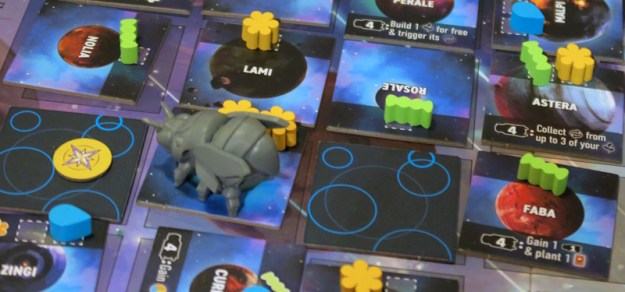
Apiary
– Image from stonemaiergames.com

Speaking of bees…

One morning, Jeff was chatting to his mate Joe in the village coffee shop, telling him about a recent encounter.

“…she just walked in and I knew we had a future together,” he said.

“So tell me about her then,” Joe asked.

“Well, she was wearing a white jacket covered in bee stings, and smelled sweet, like honey,” explained Jeff.

And then he added, “But somehow, I just knew she was a keeper…”

14th Movember 2023

With Black, Teal, Pink, Green and Lime all away, it was looking like it was going to be a very quiet night.  In the event, however, the numbers remained good with the slightly unexpected arrival of Plum, Byzantium, Jade and Sapphire.  When Green dropped off Purple and stayed for a while, it became clear that we’d need something short to play alongside Kites, the “Feature Game“.  Kites is a real-time, cooperative game where players are playing cards and flipping egg-timers to keep the air display going.  A single play-through doesn’t take very long, but it is the sort of game that tends to get played through a couple of times in succession.

Kites
– Image by boardGOATS

The idea is that that the Team have to launch six Kites, each represented by sand timers, and keep them flying by preventing the timers from running out.  Game play is very simple:  Players start with a hand of cards and must play one on their turn before replenishing their hand from the draw deck.  The cards all show either one or two coloured symbols on the corner, which correspond to the six coloured egg-timers in red, orange, yellow, blue, purple and white/rainbow colours that represent the different Kites.  When a card with two symbols on it is played, both egg-timers in those colours must be turned, however, a card with one just one symbol allows the active player to choose whether to turn the timer in that colour or to flip the white/rainbow coloured timer instead.

Kites
– Image by boardGOATS

The game ends when either all the cards are played out (the Team win), or when one of the timers runs out of sand (the Team loses).  There are a couple of additional “features”.  Firstly, the different coloured timers each have different amounts of sand in them—the purple lasts the longest at ninety seconds with red running fastest lasting just thirty seconds.  This catches out the unwary, and indeed it caught out the group composed of Jade, Plum, Blue, Purple, Pine and Byzantium on their first try when they succeeded in playing just four out of the fifty-three cards in the deck.  The second attempt wasn’t much better, ending with just six cards played.

Kites
– Image by boardGOATS

The game has an “easy start” mode where players start with just three coloured Kites (plus the white/rainbow one), but nobody was keen to take cards out of the deck.  So, to make things a little easier, instead of starting with three cards in hand as per the rules, the group started with a hand of four cards, giving them a little more in the way of choice on their turn.  With this “House Rule” they were a little more successful, but it was at the fourth attempt, that things clicked, and the group finished with only twelve unplayed cards.  And it was then that the second “feature” caught out the group—when the draw deck has been exhausted, players can no-longer turn the white/rainbow timer.

Kites
– Image by boardGOATS

Having done well with four cards in hand, it was then that the group decided to revert to the rules “as written” and play with three cards in hand.  This made things more difficult during the early part of the game, but had the advantage of leaving players with fewer cards to play once the draw deck had been exhausted.  At that fifth attempt, the players were left with just six cards unplayed, and on the sixth try, they had eight left.  They were so close, they could feel it, and everyone in the group was determined not to stop before they’d won, which turned out to be on the seventh play.

Kites
– Image by boardGOATS

Kites is not the usual sort of fare for many in the group, being both cooperative and featureing real-time play.  It had been interesting and fun, however, with players learning how to work together and what information they needed to share.  Two people took responsibility for turning the timers and everyone else made sure they let people know when they spotted a timer running low.  Perhaps the biggest impact was the realisation that waiting was sometimes more powerful than playing quickly, and certainly more haste often brought less speed.  With the successful game, everyone felt they’d had enough, and while the other table finished their game, the group moved on to another party-style game, the simple little memory game, That’s Not a Hat.

That's Not a Hat
– Image by boardGOATS

Each player starts with a single card and shows it to all the other players before turning it face down.  One player then draws an extra card shows it to all the other players and passes their original card to the left or right (as per the arrow on the back of the card), announcing what they think it is.  The receiving player can either accept the card as it is, or challenge the declaration.  If a challenge is incorrect, the recipient keeps the card as a penalty point, whereas a correct challenge leaves the card/penalty point with the gifter.  It seems very simple, and doesn’t sound promising when described, however, after a couple of turns, when someone realises they can’t remember the card they’ve got in front of them and is forced to guess, the tension mounts and everyone suddenly appreciates the game.

That's Not a Hat
– Image by boardGOATS

Byzantium, Plum and Jade had played the game before and knew what to expect, but it was new to everyone else.  Most people thought they knew what card everyone had, only to discover that wasn’t the case after a couple of swaps.  Blue and Purple picked up just the one penalty, while Plum and Jade picked up a couple each.  After the game, there was some discussion about challenges needed to be accompanied with the correct card identity (which is how Plum had played it it HandyCon).  With this, it actually paid to try to bluff/confuse people who couldn’t identify the correct gift.  Inspired by this, there was some discussion about a possible “House Rule” to introduce a bit more jeopardy:  the challenger could optionally attempt to name the gift with the carrot of forcing another point on their gifter, and an incorrect guess reversing the effect of the challenge.

That's Not a Hat
– Image by boardGOATS

That was for another day.  This time, the winners, were Pine and Byzantium who avoided any penalties, though whether that was by luck or judgement wasn’t entirely clear and indeed, was unimportant.  That was especially true as the game was brought to an abrupt end by the game ending on the next table.  That was 7 Wonders—Green only wanted to play something short that he was familiar with and this fitted the bill.  7 Wonders is a card-drafting game, but has a bit of a “Marmite Factor” and is very unpopular with a significant number in the group, so rarely gets played.  This time though, Cobalt, Ivory and Sapphire were all happy to join Green and give 7 Wonders an outing.
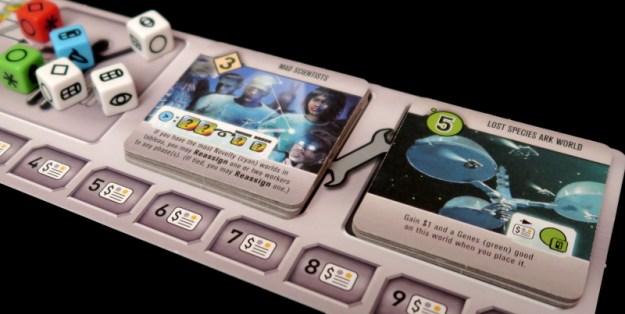
7 Wonders
– Image by boardGOATS

In 7 Wonders, players take the role of leader of one of the seven great cities of the Ancient World (Alexandria, Babylon, Ephesus, Giza, Halicarnassus, Olympia and Rhodes), gathering Resources, developing commercial routes, and developing their Military, build their City and erecting an architectural Wonder.  In each round or age, players receive seven cards and draft them, that is choose one card, then pass the remainder to their neighbour (much like Sushi Go! or Draftosaurus).  Players then reveal their cards simultaneously, paying Resources if required, collecting Resources or interacting with other players according to the cards played ant their player board (which gives special powers).

7 Wonders
– Image by boardGOATS

7 Wonders is essentially a card development game:  Some cards have immediate effects, while others provide bonuses or upgrades later in the game.  Some cards provide discounts on future purchases while others provide Military strength to overpower neighbors and some cards give nothing but victory points. Each card is played immediately after being drafted, so everyone knows which cards their neighbor is receiving and how their choices might affect what they’ve already built.  Players continue to draft cards until everyone has six cards (discarding the seventh).  The game ends after three rounds or ages.

7 Wonders
– Image by boardGOATS

7 Wonders is quite a famous game that Cobalt had heard about it and wanted to try, though he was the only one from the group who was unfamiliar with it.  It is one of those games where it seems like there is a lot to take in, but actually it is really quite simple and easy to pick up (though players do tend to require a round to see how it all plays, and there are only three in the whole game).  Everyone chose their respective Sides of Wonder.  Ivory who had Giza, elected to go for Side B, which has a four-piece Wonder and would give lots of points if he could complete it; Cobalt (Halicarnassus) chose to go for the simpler Side A, which would give him points and a chance to rifle through the discard deck for a card if he managed the second stage.

7 Wonders
– Image by boardGOATS

Sapphire (Ephesus) felt both sides were the same, money & points, just in different ways, while Green (Olympia) went for his Side B where he could have the option of copying a neighbour’s end game purple scoring card and the ability to buy Resources for only one coin each instead of two.  As expected the first round was a little slow as Cobalt felt his way around the cards and options, with help from the rest of the group, particularly from Ivory who was sat next to him and was initially passing his cards to Sapphire (so he could show Ivory the deck for some explanations without giving anything away).

7 Wonders
– Image by boardGOATS

The first round was gentle. Ivory and Sapphire lost out in the fight to Cobalt and Green.  In the second round Cobalt had to use his “Muppet Allowance” and swap a card he had kept when others pointed out he should have taken the other one.  Green was building up his army and building his Wonder with a lot of his own Resource (even though he had the Wonder benefit). Cobalt and Sapphire were beginning to specialise in the green Science cards.  Ivory was not really sure where he was going as he was beginning to lose out by not having access to the vast amount of Resources he needed to build his epic Wonder.

7 Wonders
– Image by boardGOATS

By the third and final round we everyone had the problems associated with trying to choose the best of a good bunch of cards.  Green and Cobalt ended up in an army fight, with six points at stake and already a reasonable army, it wasn’t a battle either of them wanted to give up on. The result was that they both let other good cards pass by.  By the end there were not many purple cards left, as it seemed a few had been used to build the Wonders, so Green’s “Copy” did not score heavily, although he did win the battle with Ivory (and subsequently with Sapphire too). Sapphire managed to get a full set of Science and a couple of single type multipliers, thus learning the power of Science in 7 Wonders (which is often hard to achieve).

7 Wonders
– Image by boardGOATS

By the end scoring, it seemed that Ivory, unusually for him, had indeed been boxed into a corner and ended up some way adrift of the rest of the group.  That aside, it was a very close contest between Cobalt, Green and Sapphire, with only a couple of points between each of them, but it was new player Cobalt who took the Laurels of victory.  Everyone enjoyed the game, so it might get another outing soon for which Green would be particularly grateful as it had always been a firm favourite of his.  With all the early games over at the same time, it was possible to swap the groups about as Green took an early night.  Jade was keen to introduce people to After Us, a game he had picked up at the UK Games Expo and hadn’t yet had the opportunity to introduce the group.

After Us
– Image by boardGOATS

After Us is a deck-building, Resource management, engine building game featuring an original card-combo mechanism.  The story is set in 2083 and mankind has died out leaving only apes which have kept evolving. As the leader of a tribe, players try to guide it towards collective intelligence, by adding new Primate Cards to their starting deck of tamarins. Primate Cards have three rows of “Effects”—the top row will award resources, the middle row will give points (often at the cost of resources) and the the bottom row will have abilities related to the primate type. At the start of a round, players draw four Primate Cards from their deck to be laid out in a row making “Connections”.

After Us
– Image by BGG contributor The Innocent

The aim is to get the most out of the Connections by closing the open ended “Frames” along the sides of the cards by butting them up against adjacent cards that also have open ended Frames. Players then resolve the now closed Frames following the order of top left to bottom right, trying to gain as many bonuses as they can.  Once everyone has simultaneously collected their Resources they can then use them to buy Primate Cards which are added to the top of the draw deck (and thus they come into use on the very next turn). In this way, they are improving the quality of their deck.  The Frames have been resolved, the players simultaneously chose one of their Action Discs denoting which primate type they want to recruit.

After Us
– Image by boardGOATS

The Action Disc chosen will also gives the player a bonus. When recruiting, players have an option to pay three or six Resource (fruit, flowers or grain) to gain a Card. Players can additionally spend two Resource during this phase to copy one of their neighbours’ Action Disc bonus.  Once everyone has resolved their Action Disks and bonuses, players discard their cards and draw four new ones and start again.  The game starts slowly with players building their tribe, but it can end in a sudden rush when one player breaks into a gallop and charges past eighty points triggering the end of the round.  In the shuffle, Cobalt joined Byzantium, Jade, Blue and Purple playing After Us.  Jade and Byzantium led the way (both being familiar with the game), while the others felt their way.

After Us
– Image by boardGOATS

Arranging the cards to make the Connections proved the biggest challenge initially, especially when frustratingly, it wasn’t possible to make use of a really good half Frame.  Blue, Purple and Cobalt just started collecting cards as well as they could, but Jade showed everyone an alternative, shedding all his starting cards until he had no tamarins at all.  It was then that  Byzantium suddenly started surging forward on the points track—having picked up a small number of good quality primate cards and shed a few tamarins he just turned the handle on his engine and it was too late for anyone else to do anything about it.  And he was the first to cross the eighty point finish line, with Blue (who had put on a bit of a spurt) in second.

After Us
– Image by boardGOATS

Meanwhile, Ivory, Plum, Pine and Sapphire settled down to to play the new Scandinavian edition of Ticket to Ride, Northern Lights.  Like all the other editions, players take it in turns to either take two coloured cards from the market, pay cards to place trains or take more ticket cards.  Like all the different versions, Norther Lights has a small number of special rules, but unfortunately, the rules in the box are in Danish, Swedish, Finish and Norwegian, and nobody in the group is a speaker, worse, although we played it about three months ago, nobody could remember the rules, so it was out with the phones to get translations.  The biggest difference boiled down to the addition of bonus cards, four of which are drawn at random at the start of the game and give extra points at the end.

Ticket to Ride: Northern Lights
– Image by boardGOATS

Additionally, there are some triple routes (which only take effect with five players) and some routes have a “+X” next to them which give players who build them X train cards from the face down pile.  Finally, for all routes Locomotive cards can replace any other card and for ferry routes Locomotive cards can be replaced with a pair of the same colour (and as a result, unlike most of the other versions, if there are three or more face-up Locomotive cards in the market, the market is not refreshed).  This time, the bonus cards drawn at random gave points for the most stations in Norway, the most stations in the arctic circle, the most successfully completed small Tickets, and the longest continuous connected train route.

Ticket to Ride: Northern Lights
– Image by boardGOATS

While everyone else seemed to be taking more and more tickets, Plum focused on completing her three starting Tickets, two fairly long ones running north-south, and a short one across the top.  It was a tight game for the podium places, though with Ivory, Pine and Plum vying for the lead.  Ticket to ride is often a high-risk, big-reward game though and if Plum had taken Tickets on her final turn instead of placing a single train for one point, she would have gained two more tickets and an additional twenty point which would likely have given her victory.  As it was, she finished in third, behind Ivory in second and Pine the worthy winner with a hundred and twenty-five points.

Ticket to Ride: Northern Lights
– Image by boardGOATS

Learning Outcome: Keeping kites flying takes teamwork.

Next Meeting, 14th Movember 2023

Our next meeting will be Tuesday 14th Movember 2023.  As usual, we will start playing shorter games from 7.30pm as people arrive, until 8pm when we will start something a little longer.  The pub is doing food, and the table is booked from 6.30pm for those that would like to eat first.

This week, the “Feature Game” will be Kites (rules, review and play-through video), which is a cooperative real-time game where players are playing cards and flipping egg-timers to keep the air display going.

Kites
– Image by boardGOATS

Speaking of kites…

One morning, Jeff was in his garden drinking a cup of tea when he spotted something in the sky and wondered what it was.

“Is it a bird?” he asked himself. “No, I think not—it doesn’t have wings.”

Jeff went on, “Neither is a plane, it is too circular, so I’m very sure its not a plane.”

He continued his musings, “It’s not a kite because it doesn’t move around…”

And it was then that Jeff noticed a very important detail—as he watched, it was growing larger and larger.

Then it hit him.

31st October 2023

With it being Halloween, there were lots of treats and some very fine spooky-themed attire to go along with the “Feature Game“, Betrayal at Mystery Mansion.  This is a Scooby-Doo themed re-implementation of Betrayal at House on the Hill, a semi-cooperative game, where players work together until there is a haunting and one player takes on the role of the bad guy.  So, the first task for the evening was to decide who was going to take on the roles of Mystery Inc., which precipitated lots of discussion about which was the best character.  Scrappy got short-shift from Pink, though others were less dismissive.  In any case, Scrappy was not an option, and before long, Sapphire, Pink and Pine joined Jade to solve the mystery.

Betrayal at Mystery Mansion
– Image by boardGOATS

Jade, as the group leader, took the role of Fred, while Pink and Pine enthusiastically engaged in the game as Scooby Doo and Shaggy.  That left Sapphire to choose from Velma or Daphne and he went for brains over bimbette.  The group spent quite a bit of time exploring the mansion collecting clues and the like, before the haunt finally started.  As Sapphire was the one to trigger the haunt, Velma was “temporarily lost in the woods” as he took on the roles of the bad guys, a Spectre and a female character called Sharon who was being possessed and controlled by the Spectre.  As the game progressed, it became apparent that the Spectre was her great uncle who was trying to control her to gain access to documents that would enable him to take control of the family fortune.

Betrayal at Mystery Mansion
– Image by boardGOATS

The Scooby Gang (minus Scrappy Doo, Daphne and the now lost Velma) had to track down and battle the Spectre and try break the spell controlling Sharon.  As the villain, Sapphire rolled very well and it was very hard for the Gang to pin him down.  Fred ended up stunned at one point, but thankfully revived after missing a turn.  Shaggy scoffed piles of Scooby Snacks in order to re-roll, but the dice weren’t with him.  Scooby himself, however, did very well and survived his battle with the Spectre then was able to recharge in one of the special rooms of the mansion.  In the end the Mystery Inc. won the day and the great uncle was unmasked and announced that he “would’ve gotten away with it if it weren’t for you pesky kids”!

Betrayal at Mystery Mansion
– Image by boardGOATS

Meanwhile, there were two other games underway on the neighbouring tables.  Blue, Plum and Byzantium eschewed Witch’s Brew (which plays better with more people) and opted for the slightly bigger, beefier, boardgame version of the same game, Broom Service.  Both games rely on the players having a personal deck of Character cards and a lead and follow mechanism.  Each player starts by choosing a set number of Characters from their deck, each with different actions.  The first player then chooses one to lead with and announces that they are either “Brave” or “Cowardly”.  If they choose Cowardly, they can take the action straight away, whereas, if they choose Brave, they must wait until everyone has played to see if they can take the more powerful action.

Broom Service
– Image by boardGOATS

The next player must follow if they have the card in hand, and has the same decision to make—be a Coward and take the weaker action, or be Brave, and risk being gazumped by a later player, as there can only be one Brave player taking the powerful action.  The Brave player (or the most recent Brave player) then leads with another card.  In the card game, Witch’s Brew, players are collecting tokens to give them points, however, in Broom Service, there is an additional “Travelling Salesman” pick-up and deliver type of mechanism.  Players have two Witch-meeples which travel the land collecting potions and delivering them locations to get points.  This time, it was a really, really close game, despite everyone doing different things.

Broom Service
– Image by boardGOATS

Byzantium prioritised collecting Lightening Bolts and Blue concentrated on collecting potions and delivering them.  While they both headed south and contrived to get in each-other’s way, Plum headed north and fell foul of one of the events which left her stuck with no good move in the final round.  Blue kept forgetting about the “Bewitched Roles” which can be used but with a hefty three point penalty and lost six points as a result.  Byzantium assumed he would be the only one to consciously choose to take the hit and thus guarantee he could be Brave, but happened to do that exactly when Blue picked them as well and lost the advantage when he led with those roles.

Broom Service
– Image by boardGOATS

As the game came to a close, it was clear it was going to be close with Blue ahead by a single point with sixty points scored during the game.  She lots of resources left while Byzantium had none but lots of Lightening Bolts, and Plum had some of both.  Initially, Blue and Byzantium tied with seventy-three, just two points ahead of Plum.  That gave Blue victory with the tie break (the most left over resources), but that was only until the miss-count was spotted and Blue lost one point and with it her Winning Witch Medal, instead taking second place by a single point.

Broom Service
– Image by boardGOATS

While the first two tables were playing spooky-themed games, Black and Purple led Teal and Cobalt in the monster-mad Finstere Flure (aka Fearsome Floors).  This is a game where players are trying to escape from Fürst Fieso before the castle collapses and without getting eaten.  The idea is very simple: first players move all their pieces the number of spaces shown on their visible side, then the Monster moves.  The Monster moves according to a stack of tiles, either moving a set number or moving until he eats.  The Monster moves one step forwards then looks straight ahead, left and then right. If he sees a player, he turns and moves towards them.

Finstere Flure
– Image by boardGOATS

Thus, the Monster looks, moves, looks, moves until he either runs out of spaces to move, or eats someone.  The game ends after fifteen rounds.  It is simple enough, but there are a few little elements that add to the fun.  Firstly, each player piece moves a total of seven spaces over two turns, but while some alternate three and four space moves, others are more variable, with the most extreme moving six spaces and then one space on the next turn; these different pieces require different tactics.  Players can’t land on another player, if they walk into a rock they push it and if you step in a pool of blood, they slide across it.

Finstere Flure
– Image by boardGOATS

Finally, if the Monster walks into a wall he appears elsewhere on the board adding a further layer of unpredictability.  The game opened with a bang when the first Monster tile revealed was a “Two Kill”, that is to say, the monster keeps moving until he’s eaten twice.  From there, it was carnage.  Everyone had someone eaten, with some multiple times.  There were people who managed to escape from Fürst Fieso, though it wasn’t easy of course.  Everyone managed to get at least one piece out of the castle, with Purple and Cobalt managing to get two pieces out.  The winner, however, was Black who liberated three of his people.

Finstere Flure
– Image by boardGOATS

They were the first to finish, so moved on to play the recent release, Ticket to Ride: Ghost Train.  This is really just a variant of First Journey, a simpler version of the group favourite, Ticket to Ride, aimed at children and non-gamers with super-sized pieces.  Like the original game, players take it in turns to either take “two parade float” cards (in this case blind), or pay cards to place trains on the map.  However, instead of scoring points for placing trains, the game is essentially a race game.  Players start with three Tickets and every time they complete one, they draw a replacement.  The winner is the player who completes the most Tickets.

Ticket to Ride: Ghost Train
– Image by boardGOATS

This time, Teal took an early night, but Black, Purple and Cobalt went at it with spooky enthusiasm.  As a different take on the original, they found this a very enjoyable alternative.  As well as Tickets, players can also win “Trick or Treat” bonuses for connecting the Dark Forest region to the Seashore region.  Black and Purple both took a “Trick or Treat” bonus, but the winner was Cobalt who finished with six Tickets, one more than Purple who would have taken another if she’d had just a little more time.  That wasn’t the only Ticket to Ride game of the night however, as the Scooby Gang played a quick game of Ticket to Ride: Berlin once they had solved their mystery.

Ticket to Ride: Ghost Train
– Image by boardGOATS

Ticket to Ride: Berlin is one of the mini versions, and there was a little chat about these and which ones people had played.  The first mini version was a “demo” game the publisher used to introduce people to the game at conventions.  Since then, there have been a series of City versions, with New York, London, Amsterdam and San Francisco all featuring and Berlin being the most recent (with Paris to come next year).  These all feature the same basic mechanism as the original game (including the scoring of points for placing trains unlike the First Journey type games), but they have fewer train pieces and a smaller map.  The Berlin map, is long and thin, but the big difference is that players have mixture of Trams and U-Bahn pieces.

Ticket to Ride: Berlin
– Image by boardGOATS

Tram and U-Bahn routes are paid for in similar ways, though only one U-Bahn piece is needed to mark them and they score slightly more points.  Once the differences had been highlighted by Pine and Pink (who played this together a few weeks back), everyone got down to business.  Jade and Sapphire dominated the West while Pink and Pine concentrated on the East, though the geography of the map meant everyone had to include East-West connections in their network.  It was a hard-faught close game with both Jade and Sapphire taking negative points due to incomplete Tickets.  Pine completed five Tickets and Pink finished six.

Ticket to Ride: Berlin
– Image by boardGOATS

Pine’s Tickets were more lucrative, however, and he took victory with sixty-one points, while Jade with forty-nine just pipped Pink by two points in the struggle for second place.  Everyone had enjoyed the game, and Jade commented that it was one of his favourite renditions of Ticket to Ride so far—indeed, the addition of a second set of transport seems to have been much more successful in this mini version than it was in the full-sized Rail & Sails where it made it longer and more fiddly without making it significantly better.  While everyone else was playing and then discussing the merits of different versions of Ticket to Ride, the Crafty Trio, Plum, Blue and Byzantium had finished Broom Service and squeezed in a quick game of Dinosaur Drafting with Draftosaurus.

Draftosaurus
– Image by boardGOATS

This is a fun little game that we play quite a bit, where players choose one Dinosaur from a handful, add it to their Park and then pass the rest on.  Dino-placement is slightly restricted by the roll of a die, with everyone getting points for how they occupy their pens.  Usually, the group plays with the Summer board, but with the cold weather, the group decided to play with the alternate, Winter board which introduces new and different pens.  These include the Well-Ordered Wood (Dinosaur types must alternate); Lovers’ Bridge (giving six points for each pair of Dinosaurs separated by the bridge); the Lookout (contains one Dinosaur and scores two points for each one of that type in their right neighbour’s pen).

Draftosaurus
– Image by boardGOATS

The most challenging, however is the Pyramid, which holds up to six Dinosaurs in a layered structure, but dinosaurs of the same species may not be placed adjacent to each other (horizontally or vertically).  Blue got into a mess with this, and was stuck with a Dinosaur she could not place at the end as a result.  Plum and Byzantium did slightly better and were able to capitalise more on the Quarantine Zone, which allows players to move the single occupant at the end of the game.  In the end, it was a tight game (though not as tight as Broom Service), in which Plum ran out the victor, three points ahead of Byzantium.

Draftosaurus
– Image by boardGOATS

Learning outcome: They’d have got away with it if it weren’t for those pesky kids!

Next Meeting, 31st October 2023

Our next meeting will be Tuesday 31st October 2023.  As usual, we will start playing shorter games from 7.30pm as people arrive, until 8pm when we will start something a little longer.  The pub is doing food, and the table is booked from 6.30pm for those that would like to eat first.

This week, as it is Halloween, the “Feature Game” will be Betrayal at Mystery Mansion (rules, review and play-through video), which is a Scooby-Doo themed re-implementation of Betrayal at House on the Hill.  Betrayal at Mystery Mansion is a semi-cooperative game, where players work together until there is a haunting and one player takes on the role of the bad guy.  As well as this game other games with a witch, wizard, ghoul or ghost theme will also be available together with the odd trick or treat…

– Image by BGG contributor kalchio

Speaking of Halloween…

Vampire Jeff came in from the night covered in fresh red blood and settled down in his coffin for a rest.

Before long, all the other vampires in the area smelled the sweet scent of blood and began hassling him about where he’d got it.

He told them to go away and let him get some rest, but they persisted until finally he gave in.

“Alright then,” he said, “Follow me,” and left the crypt enthusiastically followed by all the other vampires.

Down through the valley they went, across the river and into the dark forest. Finally, he slowed down and all the other vampires excitedly milled around him.

“Now,” Jeff said, “Do you see that tree over there?”

“Yes, Yes, Yes!” the vampires all screamed together in a frenzy.

“Good,” replied Jeff, “Because I sure as hell didn’t!”

17th October 2023

Being the first meeting after SPIEL, there was a lot of chatter about Essen and how things had changed since the last time anyone from the group went, some four or five years ago.  Lots of people from the group have been over the years, and others have been to other conventions like UKGE or HandyCon, so have something to compare it to.  Eventually, the group settled down to play games and five very quickly volunteered to play the “Feature Game“, which was Forest Shuffle, a new Essen release.  This is a card game where players are trying to build combinations of animals around trees to score points.

Forest Shuffle
– Image by boardGOATS

Game play is quite simple:  players start with a hand of cards and, on their turn draw two cards from the market (or “Clearing”) or play one to their tableau.  There are two sorts of card, Trees and “Critters”.  Before playing a Critter, players must have played a Tree, which then has spaces on all four sides.  Birds and Butterflies are played to the canopy, Fungi and Amphibians are played at the bottom of the tree and Mammals are played either side.  The clever part is that Critter cards are split so they show two critters (either left and right or top and bottom), so players choose which they would like to play, and therefore where, tucking the other side under the tree, making the unplayed half invisible.

Forest Shuffle
– Image by boardGOATS

Players have to pay the cost of playing a card into the fact up Clearing, making those cards available to other players (and even sometimes themselves).  Most cards have an effect associated with them, usually this is a one-off special action, but in the case of Fungi, they are special powers that last for the rest of the game.  If the card played matches the colour of the cards used to pay for it, sometimes there is an additional bonus (e.g. take an extra turn, or extra cards, play a card for free etc.).  These can be extremely powerful as they allow players to, for example, pay with cards they can then pick back up, or play a sequence of cards together.

Forest Shuffle
– Image by boardGOATS

The game ends abruptly when the third “Winter is Coming” card is drawn from the deck and the player with the most points is the winner.  Players score points for Trees and for Critters, but it is how players get their cards combining together that really makes the difference.  Thus it is a game of strategy and tactics, but also of timing, which relies on very simple rules.  Blue outlined the rules and explained how some of the cards work together, then ??? started by choosing a card from the market.  There was a little confusion when the Dürer-Fledermaus/Feldhase card came out with the text all in German, but otherwise, everyone got the hang of the basics quite quickly, though playing well can take a little longer.

Forest Shuffle
– Image by boardGOATS

Pine got into a bit of a tussle with Blue and Black for Linden Trees, while Blue spent a long time setting up a “super-move” to play a Brown Bear and place lots of cards from the Clearing into her cave.  Ivory started collecting bats, more bats and even more bats, which coupled with a few gnats gave him lots of points.  His Fungi also gave him a extra cards as he built his forest, making him look like the player to beat.  Meanwhile, Teal was collecting hares (including the Dürer-Feldhase) and before long had down of them.  Then he switched his tactics somewhat after picking up a Roe deer.  This was a critical moment, because from there her started adding lynxes, which give ten points each if there is a Roe deer in the forest.

Forest Shuffle
– Image by boardGOATS

With five, Forest Shuffle drags a little, particularly when everyone is new to the game as they have to read all the cards and try to work out which combinations work well together.  It was an enjoyable game in spite of that, though most people played it in a very multi-player solitaire way, concentrating on their own game rather then keeping an eye on what others want and avoiding gifting people points.  That said, everyone became more aware of what was going on in their neighbour’s forest as the game progressed.  Nobody really had a feel for how well everyone was doing though because of the way the cards combined.  So it was a little bit of a surprise how disparate the scores were.

Forest Shuffle
– Image by boardGOATS

In the end, it was “The Lynx Effect” that made the difference, with Teal taking victory with a hundred and nine points, nearly twenty ahead of Ivory and his bats, with Pine a distant third.  Teal had an early start the next day, so flushed with success, he headed off leaving Ivory to consider leaving as well.  However, when presented with the possibility of playing Draftosaurus, he was tempted into staying—despite it being one of the most popular games in the group, Ivory had only played once before.  He felt he hadn’t really got to grips with it that time, so was keen to give it a quick try now.

Draftosaurus
– Image by boardGOATS

Pine was interested in playing with the Marina Expansion again, but given Ivory had only played it once before, the group decided to save that for anther time.  Without that, Draftosaurus is a simple enough game of drafting wooden dino-meeples with players starting with a hand of six, choosing one and passing the rest on.  Players also take it in turns to roll a die and that dictates where players can place their chosen dino-meeple in their Dinosaur Park.  The parks have pens that score points under certain conditions (e.g. the “Woody Trio” scores seven point if if contains exactly three dino-meeples) and the player with the most points after two rounds of drafting is the winner.

Draftosaurus
– Image by boardGOATS

In contrast to Forest Shuffle, Draftosaurus was an extremely close game—everyone picked up seven points for the “King of the Jungle” and fifteen points for their “Meadow of Differences”.  Everywhere else, where one player had an advantage, others picked up points elsewhere.  Purple and Blue picked up points for their “Woody Trio”, Pine for his “Solitary Island” and Ivory had an extra loved up couple.  In the end, Purple and Pine tied for third with thirty-five points, and Blue just pipped them to second place by a single point.  It was Ivory who was the victor, just two points ahead, perhaps thanks to his extra tyrannosaurs giving him an extra point each; it is safe to say, that he’s definitely got to grips with the game now…

Draftosaurus
– Image by boardGOATS

Meanwhile, on the next table, Green’s suggestion of Terraforming Mars (with the Prelude Expansion) was turned down since the group didn’t want to play a complex and potentially longer game. For the same reason, the group eschewed Village although it has been a long time since the group played it (Green commented on how the original artwork is very pretty, but the new version is horrible!).  In the end, since last time Green had agreed to play one of Cobalt’s games, the group ended up playing Barcelona, a game that is both complex and quite long.  With hindsight, perhaps looking for something else entirely might have been sensible as everyone except Cobalt needed to learn it, and even with experienced players it can take a while.
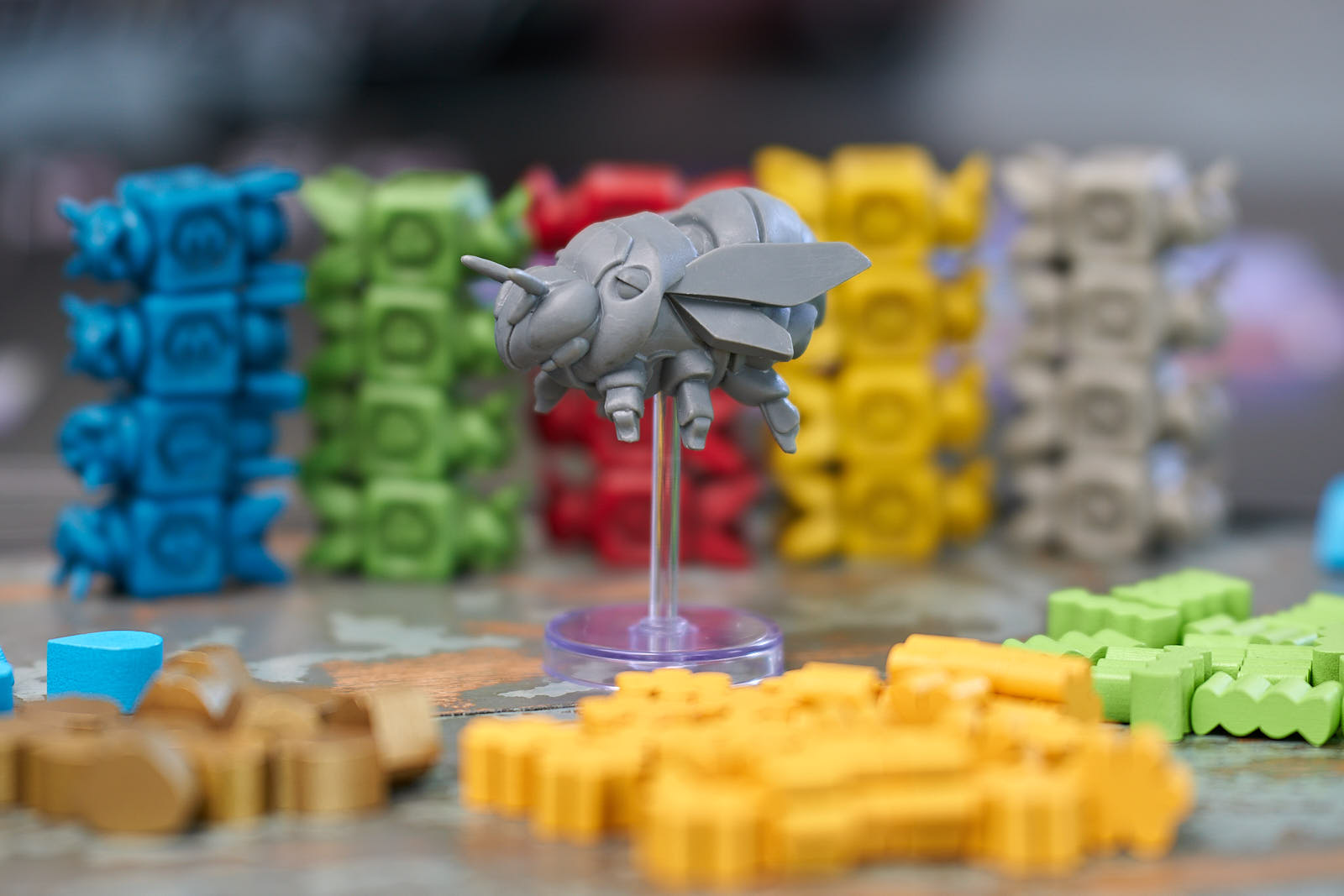
Barcelona
– Image by boardGOATS

Barcelona is a game where players take on the role of builders in nineteenth century Barcelona who are working on the new expansion to the city following the destruction of old city walls.  Each round, each player takes a single turn consisting of two or more actions, a building phase, and then preparation for their next turn.  Players start with two random Citizen tokens which are placed in a stack onto a chosen unoccupied intersection. Unusually, players can place anywhere they want (no adjacency restrictions as seen in other games).

Barcelona
– Image by boardGOATS

Choosing an intersection is the guts of the game that has significant consequences, initially the type of actions the player can carry out in that round, which are indicated by the streets selected.  At the end of their turn, players must construct a single building if they can which depends on the Citizens adjacent to the building spot selected.  There are four types of buildings: corners and normal shaped Level One buildings require any two adjacent citizens while Level Two building require at least one of them to belong to the middle class and Level Three buildings require three adjacent citizens, one of which must be a member of the upper class.

Barcelona
– Image by boardGOATS

As well as moving players along the Cerdà track, Level Two buildings also allow them to progress on their own Sagrada track giving Sagrada bonus tiles with rewards increasing the more they progress.  Level Three buildings move players two steps on their Sagrada track and give them seven pooints, but will also move players down two steps on the Cerdà track.  All the citizens required for buildings have to come from intersections adjacent to the building spots and are removed from the board and placed on their respective progress tracks according to their colour. Once the first citizen is placed on the end segment of a track, that segment’s Cerdà scoring is triggered and players gain points based on the criteria shown on the tile.

Barcelona
– Image by boardGOATS

This value is then multiplied by players’ positions on the Cerdà track, which represents whether or not players build according to the original intentions of Ildefons Cerdà (now considered the inventor of urbanism).  The game is then played over a variable number of rounds interrupted by three scoring phases before a final scoring phase, after which, the player with the most points wins.  Cobalt started first and went straight in, knowing exactly what the best thing to do was, but being first he couldn’t buy a building with only one stack of citizens. Everyone else was much more uncertain of what to do.

Barcelona
– Image by boardGOATS

At the outset Black chose to follow a policy of not buying buildings if he could get away with it (the rules are you must buy after your turn if you can), while Green had decided to work to getting the best result for each stage scoring, and Lime for a while was really confused and did not really know what he was doing at all.  Lime managed to trigger the first stage scoring, meaning that while he, Cobalt and Black had two turns before scoring, Green had only one turn—so much for his game plan and he soon found himself falling behind the others. Going last seemed to be a significant disadvantage, something Cobalt said has been mentioned before in forums, especially for four player game.

Barcelona
– Image by boardGOATS

And so the game continued. Cobalt knew what he was doing, while Black was trying not to buy buildings, but to get as many points along the way from other means as he could—as he put it, the game was a bit of a “points salad”. Green fared a little better at the second round scoring, but he was still a turn behind the rest (as was Lime for the second stage).  By this time he had decided to get his tram moving as much as possible as well, which was helping him to catch up on the score board.  Lime was still struggling, and gaining a lot of help and advice from Cobalt. It seemed to be working though as he was scoring nearly as well as Cobalt himself.

Barcelona
– Image by boardGOATS

The final stage of the game took a bit longer to complete, but was mostly just more of the same. By the final scoring, Lime took the lead to win the game while Cobalt’s experience had helped him compete and take second place, just three points behind. Green had caught up a bit and took third, while Black’s strategy of not buying really hampered him as he dropped further and further behind. He admitted that it probably wasn’t a good strategy as the later building buys really brought home a lot of points due to the points that also came with each purchase.  It had been an interesting game though, not so much about building a points engine, but looking for a good haul of points on each turn.  Having played once though, next time it might feel more like players are scoring from the game rather than the game scoring for them.

Barcelona
– Image by boardGOATS

Learning Outcome:  Nobody can resist the Lynx Effect.

Next Meeting, 17th October 2023

Our next meeting will be Tuesday 17th October 2023.  As usual, we will start playing shorter games from 7.30pm as people arrive, until 8pm when we will start something a little longer.  The pub is doing food, and the table is booked from 6.30pm for those that would like to eat first.

This week, the “Feature Game” will be Forest Shuffle (rules, review and how to play video).  This card game is a new release from the SPIEL in Essen, where players are trying to build combinations of animals around trees to score points.

– Image by BGG contributor W EricMartin

Speaking of forests…

Jeff lived in the a forest. As he grew older and older, he started losing his hair, until one day, on his deathbed, he was completely bald. That day, he called his children to a meeting…

He said, “Look at my hair. It used to be so magnificent, but it’s completely gone now. My hair can’t be saved. But look outside at the forest. It’s such a lovely forest with so many trees, but sooner or later they’ll all be cut down and this forest will look as bald as my hair.”

“What I want you to do,” Jeff continued, “Is, every time a tree is cut down or dies, plant a new one in my memory. Tell your descendants to do the same. It shall be our family’s duty to keep this forest strong.”

And so they did. Each time the forest lost a tree, the children replanted one, and so did their children, and their children after them. And for centuries, the forest remained as lush and pretty as it once was, all because of Jeff and his re-seeding heirline.

3rd October 2023

Black, Purple, Byzantium, Plum, Blue and Pink all arrived early for food, and were soon joined by Pine, Lime and finally Ivory.  The “Feature Game“, was to be Crappy Birthday, a party game where players give each other comedy birthday presents and the recipient has to decide who gave them the best and worst gifts.  A bit like the better known game, Dixit, the idea is to be the master of non-mediocrity, with the best and worst gifts netting points for the person who gave them.  It was our birthday party, so as is now traditional, everyone shared cake (this year, meeple topped carrot cup cakes), before Plum started off the year of GOATS crappy birthdays, receiving her first gift from Byzantium.

2023 Birthday Cupcakes
– Image by boardGOATS

This year we discovered that Plum fancied a custom chopper, Byzantium liked the idea of visiting a radioactive swamp (so long as it wasn’t too active) and Lime would gratefully accept a gift Monster Truck weekend.  Unusually, Pine didn’t get horses and a pile of meat, and picked skiing in Alaska (finding the Alaska bit more appealing than the skiing), and Black chose a Safari as his favourite gift.  Plum picked a chick-flick marathon over a litter of puppies and Ivory opted for a catapult over several space-based options.  Finally, much to everyone’s surprise, Blue picked a garden chess set and Pink chose a set of cuddly penguins over a pet vulture (who is very friendly, but stares at you while you are sleeping).

Crappy Birthday
– Image by boardGOATS

Less popular were singing the national anthem a the baseball, extreme bungee jumping, face piercing, a flexible trainer, and perkiness training.  The horrific baby sculpture was pretty much guaranteed to be rejected (and Lime had the opportunity for a second time), but others were more specific.  For example, Purple eschewed the drive across the Sahara because she dislikes the heat while others felt they would quite like a visit to the desert.  Similarly, Pink couldn’t imagine anything worse than mime camp, although most of the others couldn’t really see his problem.  Most people managed at least one or two loved or loathed gifts, nobody came close to matching Plum, who took a massive six points—a remarkable seventy-five percent of her potential maximum, quite a record for a worthy winner.

Crappy Birthday
– Image by boardGOATS

With our birthday suitably marked, the question was whether to continue to play light, large-group games or to break the group up and play something slightly more serious.  Pink suggested Niagara, and although Blue, Black and Purple warned against it, Plum showed an interest and that suckered in Byzantium, Lime and Pine.  The idea of Niagara is that players are rowing their canoes along the river to collect gems and then safely row them back to shore.  Players do this by simultaneously choosing a Paddle tile to play, then taking it in turns to activate their chosen Paddle to move their canoe (or canoes), trying to avoid losing them over the cataract and turning them into match-wood.  The winner is the player who manages to get seven different coloured gems or five gems of the same colour safely to shore.

Niagara
– Image by boardGOATS

The reason for the warnings and large amount of reticence form some of the group was after an online game some two years ago when Pink had the temerity to steal gems from everyone else and collective punishment failed to correct his appalling behaviour, winning the game in spite of it all.  This time, fore-warned and fore-armed the game started mean and got meaner, with the gem stealing starting in the very first round.  As a result, three out of the five finished the game with nothing.  Although Pink ended the game with two red gems, at least he didn’t win—that honour went to Byzantium, who by hook or by crook (mostly crook to be honest), managed to get five purple gems and ended the game.

Niagara
– Image by boardGOATS

Meanwhile, on the next table, Black and Purple were introducing Blue and Ivory to Little Town.  Despite the similarity in names (and inevitable resulting confusion), this is nothing to do with Tiny Towns. In this game, players acquire resources like wood, stone, fish, and wheat from the surrounding squares by placing workers on the board. When a worker is placed, the owner acquires the resources available from all eight surrounding spaces. They can then build buildings by using these resources, and the owner (or indeed any other player), can gain the effect of the building when they place a worker next to it, although when claiming a resource from a building owned by another player, they must pay a them a coin.

Little Town
– Image by boardGOATS

The game is deliciously tight—each player gets one action per turn, three turns per round and the game lasts just four rounds. Players collect victory points by using the powers of buildings, by constructing buildings taken from the market (which is not refilled), and by achieving goals dealt to them at the beginning of the game. After the fourth and final round, whoever has the most victory points wins.  Ivory started building an engine based on turning money into points, but then he realised the flaw in his plan:  there was no additional source of money in the game, so once he’d spent his cash, he was reliant on others paying to use his facilities, a source that rapidly diminished.  So he moved on to collecting wheat instead.

Little Town
– Image by boardGOATS

Blue built an engine to turn fish and wheat into points.  Black also built a wheat into points engine and pinched the last wheat field that both Blue and Ivory had their eye on.  Purple on the other hand did something completely different, converting resources into other resources to satisfy her goal card.  Ultimately though, none of it really mattered as the game was really, really tight and all four players finished within three points of each other.  Black’s experience with the game told and his thirty-two points just edged him one point clear of Blue who took second and she in turn finished one point ahead of Ivory.  It had been an enjoyable game though, definitely deserving of another outing, especially as the variety in the buildings would make it play very differently every time.

Little Town
– Image by boardGOATS

While the Little Town was being explored, Niagara had already finished and Lime, Plum and Byzantium rowed their respective ways home, leaving Pine and Pink to play a quick game of the new mini-version of Ticket to Ride, Berlin.  This is the latest in the “City Series”, smaller versions of the game that play more quickly, but still keep the essence of the original game.  Each game (full-sized or smaller), has some unique “hook” as well as a new map and features designed to bring a flavour of the new location.  Like all the other game, players have a choice on their turn to either take coloured cards from the market, or pay cards to place pieces on the map.

Ticket to Ride: Berlin
– Image by boardGOATS

In the Berlin version, players have both subway trains and trams to place. Tram routes are claimed in the usual way, but only one underground carriage is placed to claim a Subway or U-bahn route. When a player has one or none of their pieces left in their supply (either Tram or U-bahn carriages), each player, including that player, gets one last turn, then tickets are scored as usual.  One of the differences between this game and the other variants is the shape of the map, with it being very elongated in the east/west direction.  Pine built his routes along the north side and into the centre while Pink stretched his network along the south bank and into the centre.

Ticket to Ride: Berlin
– Image by boardGOATS

It was a very enjoyable game, and both Pink and Pine said they would definitely play this one again.  Perhaps part of the reason was that it was very close, but neither player realised how close until the final scoring.  In fact, it was so close that they double checked the score and confirmed that it was a tie with both players finishing with fifty-four points.  After a bit of chat, they had a rummage through the rules to find out what the tie breaker was, only to discover that it was the number of completed tickets, and both had finished with five.  So remarkably, it was a real tie, but while they shared victory this time, there will almost certainly be a rematch in the not too distant future.

Ticket to Ride: Berlin
– Image by boardGOATS

Learning Outcome: Everyone loves a nice birthday gift.

Essen 2023

Today is the final day of this edition of the largest games fair in Europe and arguably the world, the Internationale Spieltage.  Known to gamers worldwide simply as “SPIEL” or “Essen”, the annual fair is of particular significance as many new releases are scheduled to coincide with the event just in time for Christmas sales.  Following the recent change in management, this year there were quite a few changes.  Aside from the logo, the most noticeable was the layout in the halls—according to one game designer, every stand except his was in a new location in an effort to theme the halls.  For the most part, this seemed to work, though inevitably some people will feel they lost out in the great shuffle.

Essen 2023
– Image from spiel-essen.com

One thing that hasn’t changed, is the lack of general gaming space, especially when compared with the likes of the UK Games Expo and Gen ConSPIEL is a games fair, not a convention—it’s purpose is to showcase new and up-coming games and sell them to the general public, but also small and medium-sized resellers.  Additionally, there is a lot of business going on behind the scenes, including designers demoing games to publishers, and publishers meeting with producers and other publishers to discuss contracts.  It is arguable that large amounts of playing space are counter to SPIEL’s priorities, but they could definitely do with providing more chairs—not everyone has the stamina of a twenty year old, and the number of people just sitting on the ground suggests more seating is an essential.

Essen 2023
– Image by boardGOATS

Following the cancellation of SPIEL in 2020, there were restrictions on numbers for 2021 and Covid mandates in 2022 leading to reduced numbers (93,600 and 147,000  respectively), so 2023 was the first year when things were back to normal.  One question therefore, has been whether numbers would return to the levels, or even exceed those of 2019, when there were 209,000 entries.  It will be a few days before the statistics for 2023 are reported, but anecdotally, the answer is yes, with some exhibitors commenting that Friday was the busiest it had ever been, and the annual no-ship Maths Trade and Auction was as mad as ever.

My Gold Mine
– Image by boardGOATS

This year there is the usual selection of the latest releases including, The White Castle, Nucleum, Kutná Hora: The City of Silver, Evacuation, The Glade, My Gold Mine, Amygdala, Forest Shuffle and Footprints.  There are also expansions for previous games like Cascadia (Landmarks), Ark Nova (Marine Worlds), Lost Ruins of Arnak (The Missing Expedition) as well as this year’s winners of the Deutscher Spiele Preis, Planet Unknown (Supermoon).

Ticket to Ride Legacy: Legends of the West
– Image by boardGOATS

A common theme are the re-releases and reimplementations of old favourites and there are a lot of these this year, like Ticket to Ride (Legacy: Legends of the West) Elfenland, Zooloretto, Dixit (Disney Edition), Shipyard (Second Edition) and NMBR 9.  As usual, there are also loads of mini promotional expansions available for games like Flamecraft, Die Wandelnden Türme, Keyflower, Underwater Cities, Dorfromantik and 2022 Golden GOAT, Praga Caput Regni, amongst others.  There truly is something there for everyone.

Dixit: Disney Edition
– Image by boardGOATS

Deutscher Spiele Preis – 2023

The 2023 Deutscher Spiele Preis awards have been announced at the International Spieltage in Essen.  These recognise the “Best Children’s Game” and a top ten list of the “Best Family and Adult Games”, the results of an open vote by games clubs, gamers and people in the industry.  As annual awards, the games named in the Deutscher Spiele Pris lists often intersect with the winners and nominees of Spiel des Jahres Award, but in many other ways, the awards differ as Spiel des Jahres winners are chosen by a committee with a list of strict criteria whereas the Deutscher Spiele Preis is more a list of the most popular games of the preceding year.

Deutscher Spielepries 2023 Logo
– Image from
spiel-essen.com

This year, the top ten list includes the both the winners and some of the nominees of the Spiel and Kennerspiel des Jahres awards, but the top spot went to the Kennerspiel nominee, Planet UnknownDorfromantic (winner of the Spiel de Jahres) took second place on the list with the car racing game, Heat, taking third place.  Challengers!, winner of the Kennerspiel des Jahres award, featured further down the list as did Marrakesh, Earth, Woodcraft, Next Station: London, HITSTER and Tiletum.  The winner of the best children’s games was Mysterium Kids, which also won the Kinderspiel des Jahres earlier this year. Congratulations to all the award winners.

Planet Unknown
– Adapted from Image by f-p-p-m