Blue and Pink were the first to arrive, making up for their recent absence on the other side of the world. They had finished their supper and were just discussing the upcoming Essen, when Purple and Black arrived, quickly followed by Pine, to be regaled of tales of koalas, pandas and roos. Green, Teal, Cobalt and Lime weren’t that far behind and then the group split into two to play. The “Feature Game” was Alea Iacta Est, a fairly simple dice chucking game with a Roman theme. Although it has a lot of similarity to one of our old favourites, Las Vegas, it is more of a “gamers’ game” as it has a bit more planning and slightly more complex scoring.
 |
| – Image by boardGOATS |
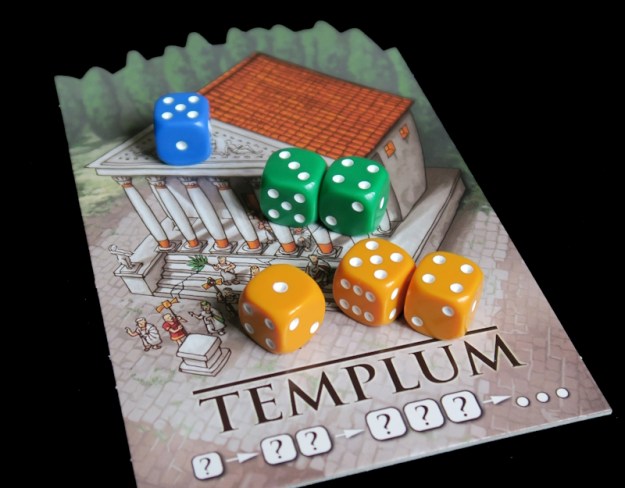
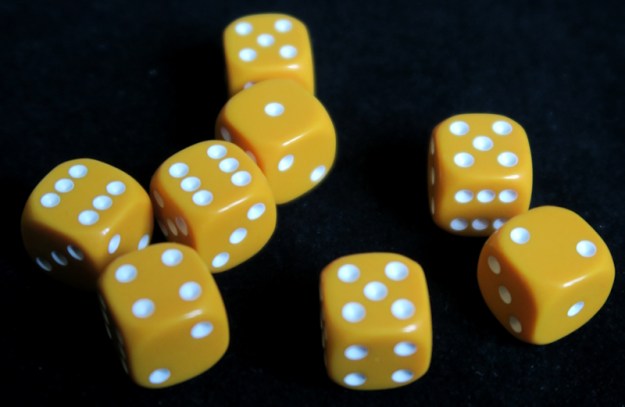
Like Las Vegas, players have a handful of dice, which they roll on their turn and then place a some or all in one of the locations. In Las Vegas, the locations are different gambling joints and the dice placed are all the same number. However, in Alea Iacta Est, the dice placed depend on the location, there are five, and the all behave differently. For example, in the Templum, the first player adds one die and takes a face down Fortunum token. The next player to place dice in the Templum adds one more die than the first player making sure the total number of pips is larger, and also takes a token. If a player is returning to the Templum, they can reuse the dice they placed previously, making sure their number of dice is one more than the previous person to play there.
 |
| – Image by boardGOATS |
The Fortunum tokens are points, ranging at random from one to three. At the end of the round (triggered by one player running out of dice), the player with the most Fortunum tokens keeps two of their tokens, while everyone else keeps one of their choice. In the Senatus, players have to place “runs”, that is sequences of dice with consecutive values. Players who place dice later must add one more die than the previous player and the run must be different to any that already exist. Players can only have one run in the Senatus, but as for the Templum, players can ad dice to their previous entry.
 |
| – Image by boardGOATS |
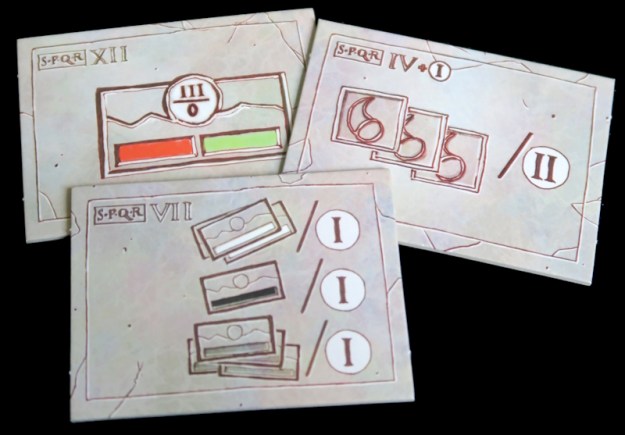
At the end of the round, the player with the longest sequence of dice takes three Senate cards, keeps one and passes the rest on to the player with the second longest sequence of dice. The Senate cards provide players with end game scoring opportunities. The Castrum is similar to the Slot Machine from the Las Vegas Boulevard expansion, in that players add sets of dice of the same value. Like the Slot Machine, players can have more than one group, but unlike Las Vegas, there may be any number of groups in the Castrum, but never two groups with the same pips and same number of dice.
 |
| – Image by boardGOATS |
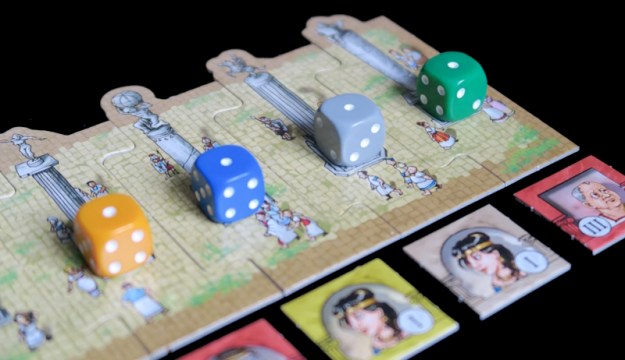
The player with the largest group in the Castrum at the end of the round takes their choice from the face up selection of Province tiles. These score points at the end of the game, as long as they have at least one assigned Patrician. Players get Patricians from the Forum Romanum. The Forum Romanum is perhaps the most complex to control. Player can place either a single die with any number of pips or exactly two dice, which show together the total five pips (i.e. a one and a four, or a two and a three). The dice are placed at the base of pillars in value order with the lowest value added to the left displacing everything to the right by one space.
 |
| – Image by boardGOATS |
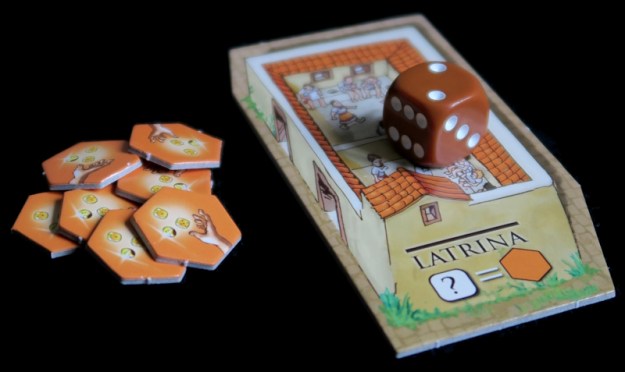
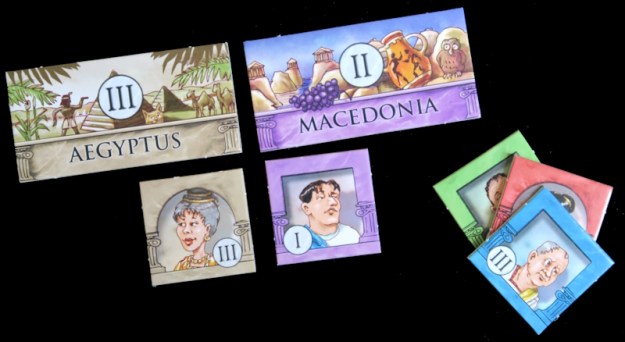
The clever part is the order the dice are placed when there is the inevitable tie: the most newly added, also goes in the space to the left the group with the same number (again shifting everything to the right by one space). At the base of each pillar there is also Patrician tile and these go to the owner of the die next to the pillar at the end of the round. The fifth and final space is the Latrina, which is where players place dice if they can’t place them anywhere else, getting a re-roll token in return. These can be cashed in during the game, or are worth a point for each pair at the end of the game. The Patrician tiles and the Provinces are coloured. Patricians are worth their face value, but only if allocated to a Province with a matching colour.
 |
| – Image by boardGOATS |
Each Province can support two Patricians, one male and one female. Each Province also scores its face value, though there is a point deduction if it has no Patricians. These are the main source of points, though Senate tiles can provide a lot as well, with additional points from the re-roll chips and Fortuna tiles (taken from the Templum). The game is played over five rounds with players taking it in turns to allocate dice until one player runs out (play continues until everyone has had the same number of turns). As expected, it took a couple of rounds for everyone to get the hang of the locations, and in particular how the Forum Romanum worked and the implications for the scoring.
 |
| – Image by boardGOATS |
Initially, everyone, but Pine in particular collected some Senate cards, to try to give them a steer on what to aim for. They were a bit more complicated than people realised, so while they helped to an extent, in some cases, things became more opaque rather than less. Pink, Pine and Blue made a real effort to get what they wanted from the Forum Romanum, which became increasingly difficult as the game progress—in the final round, the only dice left there had the value of one. Teal focused on the getting lots of Provinces, realising that they still scored most of the points even when they were unoccupied.
 |
| – Image by boardGOATS |
Given how people struggled to get to grips with the scoring, it was a really close game. Pink just pipped Blue by a single point and Teal was only a couple of points behind in third. Ultimately, despite the similarities with Las Vegas, it was very definitely a “learning game”. Indeed, the similarities are quite superficial as the guts of the game are in the way the different locations interact. This takes the game from being a light betting game to a much more complex game, though one that is still a lot of fun, with special moments when someone shifts someone else’s carefully positioned dice right out of the Forum.
 |
| – Image by boardGOATS |
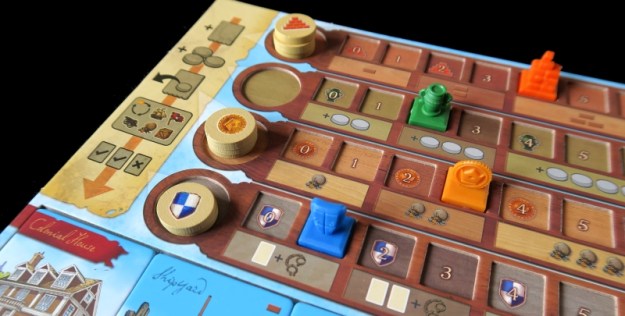
Meanwhile, on the next table, Green led Black, Purple and Cobalt in a game of Endeavor: Age of Sail. This is a game that is very popular with the group, and although it seems quite complex, really comprises of point-by-point decisions, so although strategy is very important, tactics are critical too. The game is played over eight rounds, each consisting of four basic phases: Build, Populate, Payment and Action. There are four technology tracks roughly corresponding to each phase, which dictate what a player can do during that phase. For example, how far along the building track a player is dictates what they can build: the further along they are, the more buildings they have to choose from.
 |
| – Image by boardGOATS |
Thus it is one of those games where small decisions made early can have a big impact later in the game. The first phase consists of passing round the tray of buildings rather like a box of chocolates, but after that, the second and third phases are more or less carried out simultaneously. The guts of the game, however, is the Action phase. In this round, players can place population markers on their buildings to activate them and carry out one of the five actions: Colonise, Ship, Attack, Plunder Assets, and Pay Workers, actions that are generally focused on the central map.
 |
| – Image by boardGOATS |
Cobalt had not played Endeavor before so the group opted for the standard buildings and played using the standard, four/five player side of the board. They did add three exploits from the Age of Expansion, however, the last three that had not yet been played with this copy of the game. They would not come into play until later and by then everyone should have a good idea of how to play. While Cobalt and Black went with the Occupy action for their first building followed by the Workshop for extra bricks for their second building, Green and Purple both chose Shipping as their first building. Green then took a Shipyard for a second shipping action and Purple went for a Market (gaining cards), “just to to be different”.
 |
| – Image by boardGOATS |
In that first round, Black and Cobalt only took a single occupy action with a plan to get better actions for their third building. Purple could only manage a single shipping, while Green also only managed one ship, but combined it with gaining a Culture to push him into the next category to get more citizens in the second round. In that next round, Purple and Cobalt continued their similar strategy, gaining slaves for their bricks, while Green was forced into a workshop to stop himself getting hamstrung on buildings later and Purple was struggling to get enough citizens to use all the actions she had available to her.
 |
| – Image by boardGOATS |
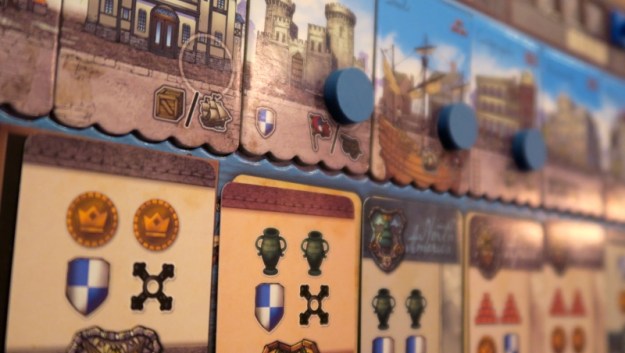
That was pretty much how the game continued. Black and Cobalt placing people into Europe and building up their cards; Green was shipping around the world (although mostly in the Caribbean and South America) and Purple was taking the shipping routes in Europe, but always without enough citizens. As the game progressed, regions started to open. Green inevitably gained the first Governor card. Cobalt and Puple fought for who had the most cards in total.
 |
| – Image by boardGOATS |
Once three and then four regions became open, only Green and Cobalt had people in both regions of the two opened exploits, so only they were able to make use of them. They did use the South Sea Company exploit and Green took the extra brick as a ongoing benefit. This was not a normal brick, but a whole extra brick level, which allowed him to gain a level five building in the final round (the only one to do so). Cobald had tried to get a level five building, but then realised he had failed to reduce his brick level after he’d lost a couple of cards, and so was restricted to another level four building. Although the Letters of Marque was the other opened exploit, no one actually made use of it.
 |
| – Image by boardGOATS |
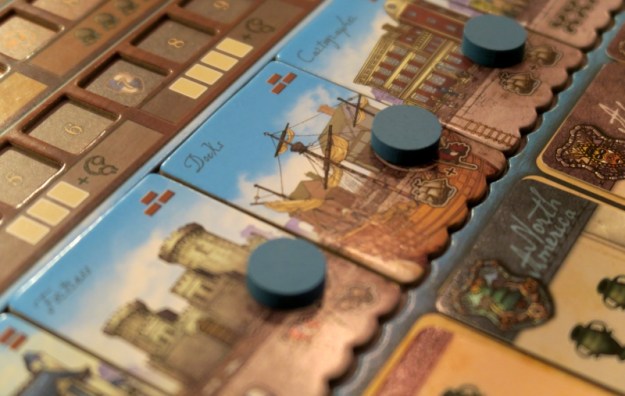
About three rounds in, Green suddenly realised he had forgotten to explain the “Abolition of Slavery” rule to Cobalt. It didn’t look likely to happen as no-one had yet taken any European cards, however, Cobalt made his mind up then that this was what he was going to aim for—even though he had his own slaves, it felt morally right to him to make it happen! Which he duly did, however, the only players to lose out as a result were himself and Black. Both of them needed to reduce their card count anyhow, and the slaves were the ones likely to be for the chop, so it didn’t cause too much damage. The minus points they both received were only a small price to pay for their freedom.
 |
| – Image by boardGOATS |
Balancing everything is critical in this game and unfortunately Purple had always been on the back foot without enough citizens to do the actions she had available. In the end Green ran out the winner as he had managed to get most of his attribute tracks up and gained a fair presence on the board. The Letters of Marque, although unused, did provide for extra scoring on the shipping tracks, where Green had rather a lot of due to his early double shipping strategy. He and Cobalt also gained some points for using the South Sea Company Exploit. This pushed Cobalt into second, marginally ahead of Black (who had managed a fair few points on cards and buildings).
 |
| – Image by boardGOATS |
It was still early and Endeavor was on-going, so when Teal left, the group looked for something little and light to play, and quickly settled on No Thanks!. This is a favourite with the group because it is super-quick to set up and play: players start with eleven red chips, and on their turn either take the card shown or pay a chip to pass the problem on to the next player. At the end of the game, when the deck has been depleted, players score for the lowest value card in each continuous “run”, offset by any remaining chips and the winner is the player with the lowest total. This is made more difficult by the fact that around thirty percent of the cards have been removed.
 |
| – Image by boardGOATS |
This time, the group played a total of three games. In the first one, Pink took all the chips leaving everyone else with nowhere to go but pick up cards, which Blue did in spectacular fashion, finishing with one hundred and forty points. The other three were very close together, with Pink just edging it by a single point from Lime. The second game was much better balanced. Although Pine won, there were clues as to Lime’s strategy for the next game as he picked up lots of cards and would have won by a large margin if two of the cards he wanted hadn’t been removed from the deck, but that’s the point of the game of course.
 |
| – Image by boardGOATS |
The third and final game was very unusual. Lime rode his luck like a bucking bronco and kept taking cards. Blue picked up a couple, but that was all he let her have, and Pine and Pink who just kept passing, eventually ran out of chips. As they were playing open handed, Lime saw this and just collected the rest of the cards leaving him with forty chips and fifty-two points from his cards—a very good final score of twelve. Unfortunately for him, as both Pine and Pink had no cards or chips, they both finished with a round, fat zero, and therefore shared victory in one of the strangest No Thanks! games anyone had ever played.
 |
| – Image by boardGOATS |
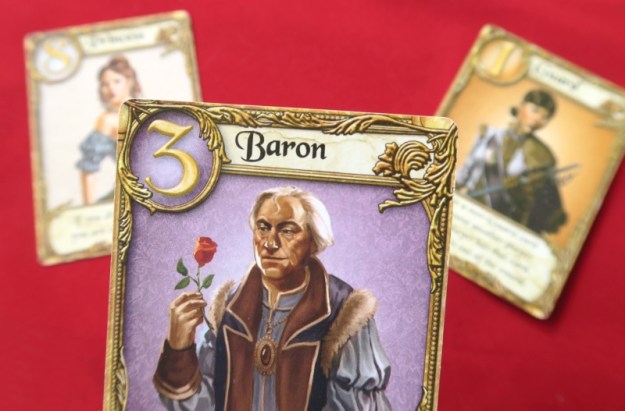
With Endeavor coming to a close, there was just time to squeeze in something quick. The fancied a change though and, as it had been a while since it’s last outing, Love letter was picked. Everyone knew the game well , so the rules didn’t really need to be explained: start with a hand of one card, draw a second and choose one to play, effectively dueling to have the highest value card once the deck was exhausted. Blue and Pine won the first two rounds, and as the others were finishing packing up, rather than play more, the group decided Blue and Pink should have a play-off. Blue quickly acquired the Princess, which can be risky, but it was soon over when Pine played the Baron and compared hands, do his detriment. With that, it was time to go home.
 |
| – Image by boardGOATS |
Learning Outcome: Although two games may seem similar, they may not suit people equally well.

 boardGOATS