People were still eating when Ivory rolled up nice and early to start setting up Ark Nova. Although it was not the “Feature Game“, we are planning to feature the Marine Worlds expansion in the next few weeks and wanted to play the base game before we did. So, Ivory was soon joined by Cobalt, Plum and Green on the other side of the table, leaving the rest to decide who would play the “Feature Game”, CuBirds, and what everyone else would play while they did. Before long, Pine, Pink, Lime and Blue were dealing out the bird cards while Purple, Black and Teal moved to the next table and rummaged through the game bags to decide what to get out.
 |
| – Image by boardGOATS |
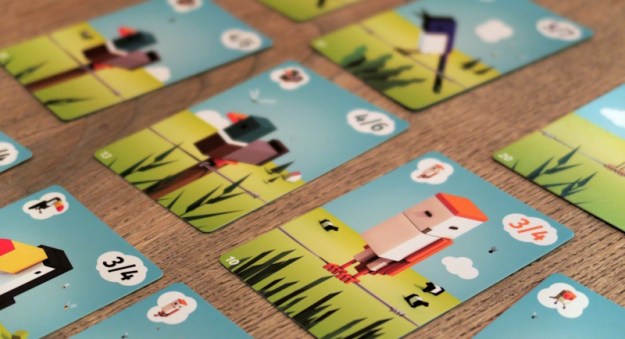
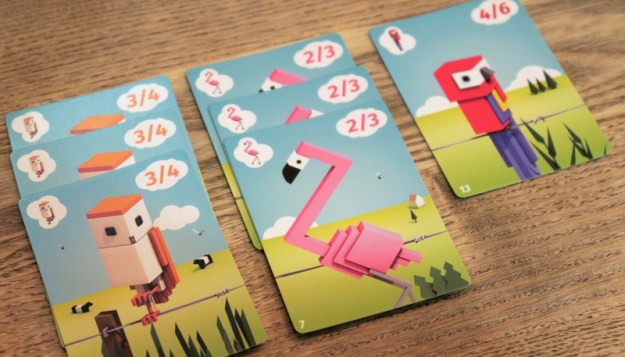
CuBirds is a fairly simple set-collecting game built round a central market. Players start with a hand of seven cards and, on their turn must place cards from their hand. They have to place all the cards they have of one type, adding them to one of the four rows on the table, at either end. If there is already a card of this type in that row, then they take all the cards between that card and the newly added cards into their hand. Optionally, if they have enough cards of a given type in their hand, they can complete a flock of them, that is play the cards, keeping one or two in their display (a bit like harvesting a been field in Bohnanza, where harvesting a field of five beans might leave a player with two Bean Thalers).
 |
| – Image by boardGOATS |
The game ends immediately when one player’s collection has either three cards of each of two bird types, or seven different bird types (of the eight available) in front of them. It should play out in about half an hour, though inevitably, the first play through took longer as everyone felt their way through. When any player places the last card in their hand, everyone has to ditch their whole hand which can be quite brutal with players losing partial sets and having to start collecting again. Pink was the first to upset everyone’s plans, quickly followed by Pine.
 |
| – Image by boardGOATS |
A lot of fun was had identifying the bird types, and nobody got close to guessing what the tall, thin, “little brown job” was, which turned out to be a reed warbler, but was soon universally known as “WeirdBird”. When the end of the game was triggered, both Blue and Lime had a magpie apiece with Lime’s paired with four toucans and Blue’s with three robins, while Pink just had two little ducks. Fittingly, as by far the most dedicated birder in the group, the winner was Pine with three flamingos and three “wols” with a spare parrot. It had been fun, but rather than play again, as he’d missed out on both the previous plays, Pink had been keen to give the new full-sized, Scandinavian Northern Lights version of Ticket to Ride a go.
 |
| – Image by boardGOATS |
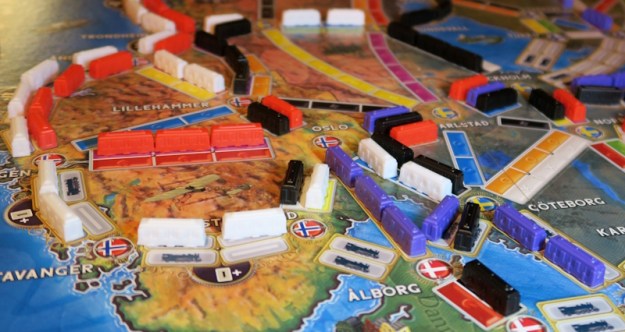
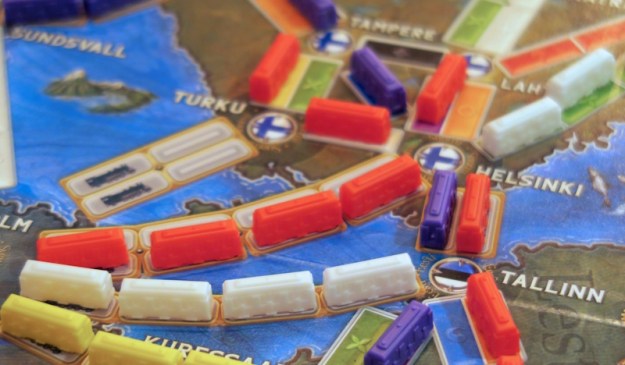
Like the other variants, Ticket to Ride: Northern Lights has slight changes to the rules and a new map, which in this case, similar to the older, festive themed Nordic Countries, though it plays up to five instead of just three. The base rules are quite simple: on their turn, players either take train cards from the face-up market (or the blind draw deck), or spend cards to place trains on the map for points. Once or twice during the game, players may instead choose to draw Tickets, which give players points at the end of the game if they are completed (i.e. the owner has connected the two locations with their trains) and score negative points if they are not.
 |
| – Image by boardGOATS |
Northern Lights additionally has some triple routes (which only take effect with five players) and some routes have a “+X” next to them and when trains are laid on these the player takes X train cards from the face down pile. In general, Locomotive (wild) cards can replace any other card but for ferry routes they can be replaced with a pair of the same colour (that doesn’t have to be the same as the rest of the cards used). Unlike most of the other versions, however, if there are three or more face-up Locomotive cards in the market, the market is not refreshed. The biggest differences are the addition of Bonus cards, however, which extra points at the end.
 |
| – Image by boardGOATS |
This time the Bonus cards used were Capital Investment (B), Local Area Network (F), International Tycoon (G) & Ferry Master (J). These gave Bonus points for completing Tickets to the capital cities (Stockholm, Copenhagen, Oslo and Helsinki); completing the most short Tickets; connecting to the most countries; and completing the most Ferry routes. The map is very tight with a lot of short routes, spread over a fairly long thin map and a wide variety of Ticket lengths. Everyone complained that their starting Tickets weren’t compatible, though Blue and Lime both kept all three of theirs, even so Pink surprised everyone when he took his first set of Tickets very early.
 |
| – Image by boardGOATS |
Pine soon followed and his sniggering as he kept all the new Tickets was ominous, signalling that he’d already completed all three—a fact confirmed when he drew more on his next turn too. Blue and Lime covered similar spaces,connecting the north-west to the south-east, while Pine’s network dominated the east and Pinks sprawled over the south. Everyone was getting on with doing their thing when suddenly, Lime brought the game to a rather abrupt end, catching everyone else out. As a result, Pink and Pine both had an incomplete ticket that costing them fourteen and twelve points respectively, while Blue had two giving her a combined loss of sixteen points (though part of that was her own fault as she’d overstretched her self and would have run out of trains anyhow).
 |
| – Image by boardGOATS |
In spite of that, it was a very, very tight finish with just six points between first and third place, meaning the Bonus cards became much more critical than might have been expected earlier in the game. Lime set the target with a nice round hundred points, but he did not take any of the Bonus points and was just pipped by Pine who took several of them with Blue making up the podium. It had been an imperious game from Lime, and he was unlucky to have lost to Pine who was the first to admit that he’d got very lucky with his Tickets, especially the draw where he’d already completed the Tickets, quite remarkable given how spread out the network is on this map.
 |
| – Image by boardGOATS |
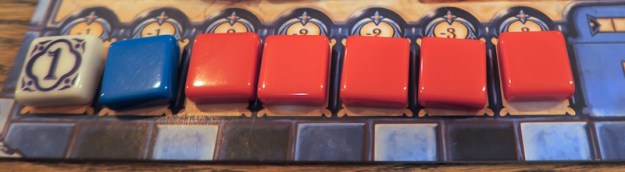
Meanwhile Purple, Black and Teal had been playing Azul. This is a favourite game within the group, which is unusual as we tend to eschew abstract games. Players are mosaic building, taking tiles from a shared array of factories, adding them to their Storage on their personal player boards. At the end of the round, any full rows are scrapped with one tile progressing into the player’s mosaic. Players score when the tiles added form rows or columns, and the longer they are, the more points players get. The catch is that each Storage space can only hold one tiles of one colour. If there is nowhere to put tiles taken from the Factories, left over tiles go into the Scraps bin costing players points which can be very costly as Black found out when he lost fourteen in the final round.
 |
| – Image by boardGOATS |
For a little variation, the trio added the Joker tiles and the five double score markers from the Special Factories Promo tiles. The Joker tiles are a set of ten beautiful promotional tiles that can serve as a proxy for any of the other tiles, though their aesthetic comes at a price as players can’t use them for end of game color Bonuses. The five double score markers allow players to double the points scored for a row or column, by taking the marker of the matching colour. Everyone took one of these during what was a hard-faught game where Purple and Black tied for with seventy points. The clear victor was Teal, however, with eighty-eight points.
 |
| – Image by boardGOATS |
Teal and Pine took their leave, so after some chatter, Purple and Black joined Lime, Pink and Blue in another game of CuBirds. This time, Black collected magpies but twice had enough for sets but kept losing them. Pueple got three WeirdBirds and was busy collecting parrots when the game came to an end. Both Lime and Blue tried to collect a set of seven different birds, but while Blue got close with five (and a duplicat “wol”), Pink was imperious. Before his final turn he had a set of three toucans and two sets of two (flamingos, ducks and robins), pretty-much guaranteeing him victory, regardless what he was left with, though he chose to check-out with another flock of flamingos.
 |
| – Image by boardGOATS |
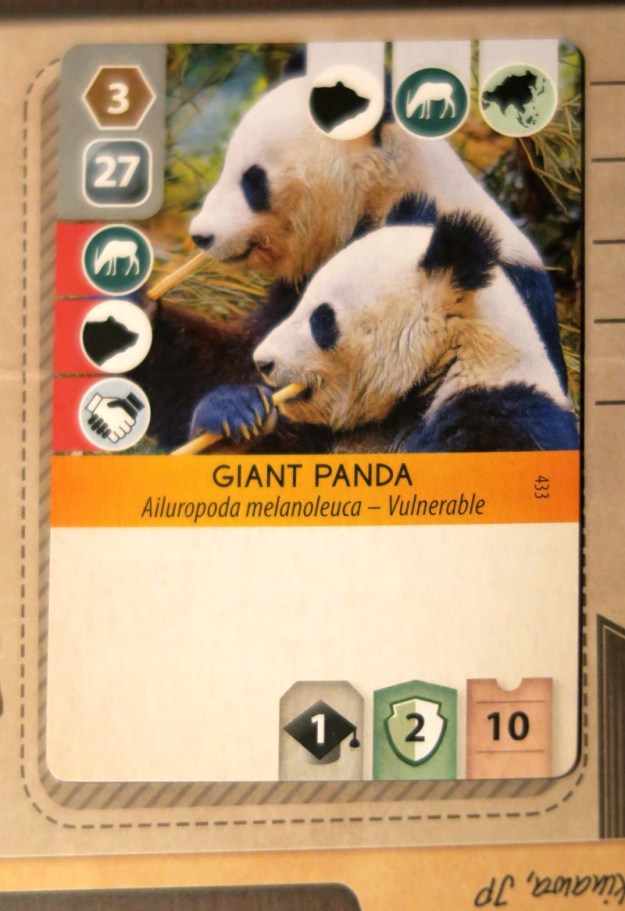
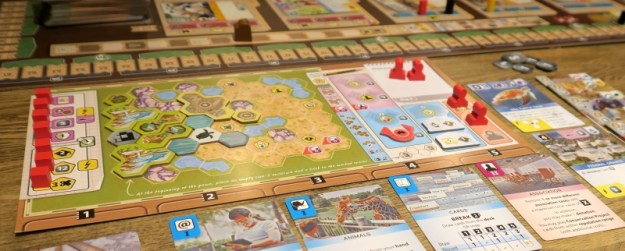
While all this was going on, on the other side of the room an epic game of Ark Nova was underway between Ivory, Cobalt, Green and Plum. This is a much longer game than we usually play with an advertised playing time of upwards of two hours and reputedly considerably more with inexperienced players and setup time included. It is all about planning and designing a modern, scientifically managed zoo, but the game-play is more like Terraforming Mars with animals, than Zoo Break or Zooloretto. That said, although it is quite complex, functionally it is not difficult to play on a turn by turn basis, though there is quite a lot to manage and keep a track of.
 |
| – Image by boardGOATS |
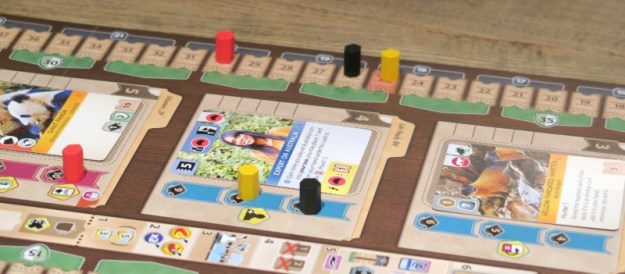
On their turn, players take one of six possible actions: activating one of the five action cards (Cards, Build, Animals, Association and Sponsor) with a strength equal to the number above the card, or move a card back to the first space and take a cross token instead. When activating a card players perform the action based on its power level which is dictated by its position in the row. Once a card has been played, it is moved the first space in the player’s five card row (i.e.to the lowest power position on the left) moving the other cards to the right to replace the card removed, effectively incrementing their power by one. During the game, players can upgrade and turn over the action cards to a more powerful second side using various Bonuses.
 |
| – Image by boardGOATS |
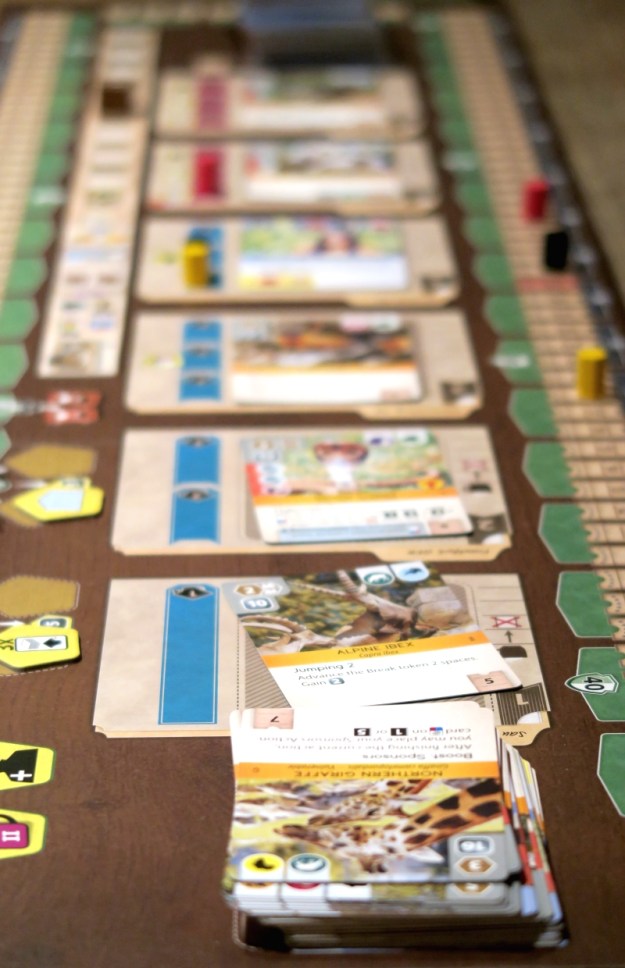
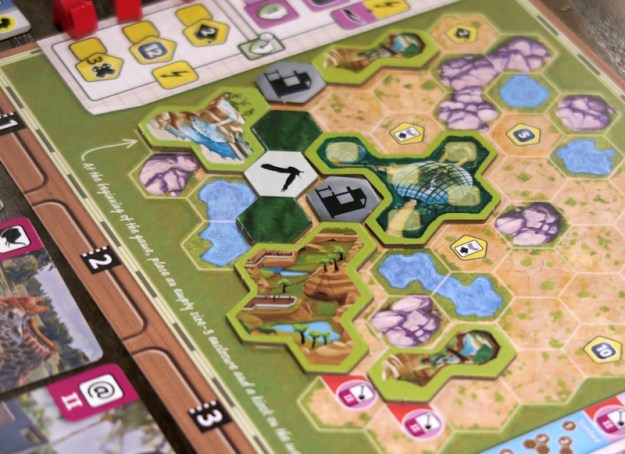
The Cards action is the simplest action, which lets players draw cards from the deck (the number depending on strength) then advance the marker two spaces along the break track which defines when the round ends. The Build action allows players to pay to construct one building on their zoo map. Players can build basic enclosures with a size of one to five, but they can also build a petting zoo for animal storage or pavilions and kiosks (which give players Appeal and money respectively based on adjacent filled enclosures). With the upgraded build action, players can build multiple different buildings and have access to the large bird aviary and reptile house which allow the storage of multiple animals.
 |
| – Image by boardGOATS |
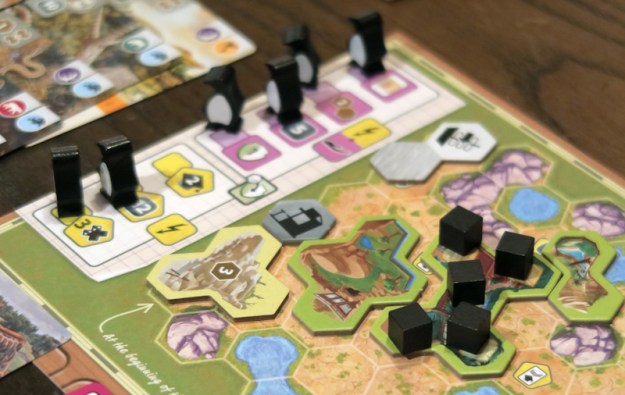
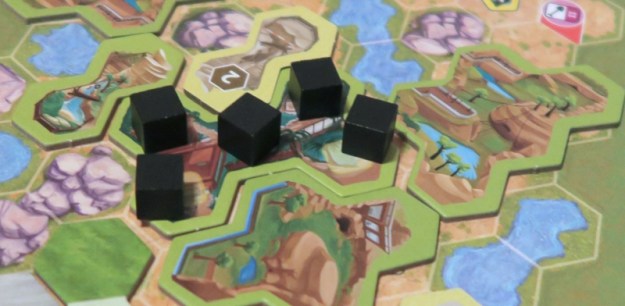
The Animals action allows players to add animals into enclosures in their zoo. Some animals have a special requirement and need a symbol in their tableau and/or the upgraded animal card. Adding an animal to an enclosure has a cost, and then the player turns over the empty enclosure of at least the size needed or places the listed cubes into a special enclosure (an aviary or a reptile house). The player then adds the animal card to their tableau and resolves the abilities on it and receives ticket sales along with possibly Conservation points and Reputation.
 |
| – Image by boardGOATS |
The Association action allows players to take one task on the Association board with different tasks available based on their power level. This allows people to gain Reputation points, acquire a partner zoo they don’t already own, gain a partner university, or support a Conservation. Finally the Sponsor action allows players to play exactly one Sponsor from their hand which offer ongoing abilities. They can allow players to place unique tiles in their zoo and offer end game Conservation point opportunities. Some Sponsor cards have conditions on their play similar to the animal cards.
 |
| – Image by boardGOATS |
Players take it in turns to take actions, resetting every time a break occurs, until the end game has been triggered. There are two tracks, Appeal (Tickets) and Conservation that follow the same course, but in opposite directions. The game end is triggered when one player’s pair of scoring markers cross, after which, everyone gets one more turn and then the end-game cards are scored. The player with the largest overlap between their Conservation and Appeal values is the winner. Everyone was familiar with the game and had watched the rules refresher video, so the group could make a fast start, however, Cobalt and Green had played a lot online and Plum had only played once, so there was a difference in experience levels.
 |
| – Image by boardGOATS |
Green and Plum took early Association actions taking the two Reputation universities, scuppering Cobalt’s first turn who couldn’t make use of the double science university. Cobalt therefore took a partner zoo and snapped a Conservation project from the display in the first few turns. Early game sponsors included: “Veterinarian” by Green (grabbing him an additional university and allowing Conservation projects to be performed at Association level four instead of five, although he didn’t make use of this throughout the game); “Quarantine Lab” by Plum (providing her immunity to venom, constriction, hypnosis and pilfering); “Expert in small animals” by Cobalt (reducing the cost of two-sized animals by three); and “Expert in Herbivores” by Ivory (providing three money each time a herbivore is placed into any zoo).
 |
| – Image by boardGOATS |
Plum was very pleased with her “Quarantine Lab” as it meant she didn’t really have to bother with the effects of red tokens that say you have been bitten or poisoned because it meant there was one less thing to get in here way and complicate her game. Cobalt used his expertise in small animals to good effect, especially when combined with partner zoos, with a petting zoo and several small animals, allowing his money to stockpile. Ivory concentrated on reptiles while Green played several negative effect cards early (e.g. boa constrictor), which hit Ivory and Cobalt (the latter multiple times, and grabbing some of that stockpiled cash). Plum appeared to take an early lead possibly due to her Quarantine Lab which kept her out of all the early pilfering and poisoning.
 |
| – Image by boardGOATS |
Cobalt was first to complete a Conservation project, using the snapped card to release a herbivore into the wild and gaining the two-enclosure Bonus, immediately followed by Ivory. In the middle-game, the African Bush elephant and Serengeti National Park appeared side-by-side in the display, so Cobalt took the risky decision to nab these over two consecutive rounds, but was forced to discard five or six cards from an unexpected break. Having kept the elephant and Conservation project, Cobalt played these to grab an extra scoring card and race up the Conservation track and triggered the scoring card discard. Ivory and Plum took to the Appeal track. Green remained languishing on both tracks, particularly the Conservation track where he barely moved all game.
 |
| – Image by boardGOATS |
Cobalt was first to upgrade his cards, leaving only the Association action not upgraded, whereas Green concentrated on Sponsors and Association actions. Plum was working through some difficult choices, ultimately deciding to having to flip the Animals card so that she could play the Elephant she had been nursing. She left the Reputation as the non-upgraded card, which unfortunately removed some of the better options that the Elephant gave. Plum was just a Europe icon away from being able to take the multi-regional goal, but ultimately forgot that having high Appeal is the negative element to the score and didn’t do the things to convert her Appeal to give her points.
 |
| – Image by boardGOATS |
Green was slow to get going, but eventually, managed a master move with his first Conservation project and flew up the scoring to overtake Plum, and began chasing down Ivory and Cobalt. It was very close between Ivory and Cobalt on who would trigger the end game: Cobalt managed to keep his counters from crossing, causing Ivory to trigger the end game and allowing Cobalt one last turn. Although Ivory scored well on the final turn, Cobalt covered his zoo (giving him seven more Appeal) and scored more than twenty points in the final turn. In end game scoring, it became apparent that Plum had misunderstood her end game scoring card. She had thought it gave points for empty enclosures in her zoo (rather than empty spaces) and had set about building lots of them towards the end. Without this, her game would have ended very differently.
 |
| – Image by boardGOATS |
Ivory took the third place on the podium having realised Green was closing and decided to end the game perhaps a turn or two earlier than he really wanted which may have inadvertently caused himself more damage as Green needed some three turns to score anymore. Green did exceptionally well taking a full four Conservation points from his Bonus card and three extra points from Sponsors, and with it, almost taking victory with a total of eighteen points. However, Cobalt’s final turn plus two scoring cards (one of which was for small animals) meant he won with a convincing score of thirty.
 |
| – Image by boardGOATS |
It had been quite stressful getting the game completed in time, especially with some long turns where actions were chained together, for example Plum played one card which enabled another full turn, but with two new cards it was tough to decide which gave the better option. All that said, it had been very enjoyable and everyone had got on with their game and helped each-other where necessary. The group clearly demonstrated that the game can be played in around four hours even with four, so long as everyone knows what they are doing and keeps moving. It will be a few weeks before the Marine Worlds expansion gets an outing, but it will be exciting when it does.
 |
| – Image by boardGOATS |
Learning Outcome: Reed warblers are weird warblers.
 boardGOATS