Being the first meeting after SPIEL, there was a lot of chatter about Essen and how things had changed since the last time anyone from the group went, some four or five years ago. Lots of people from the group have been over the years, and others have been to other conventions like UKGE or HandyCon, so have something to compare it to. Eventually, the group settled down to play games and five very quickly volunteered to play the “Feature Game“, which was Forest Shuffle, a new Essen release. This is a card game where players are trying to build combinations of animals around trees to score points.
 |
| – Image by boardGOATS |
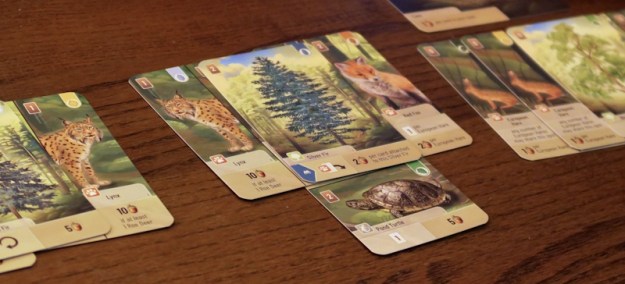
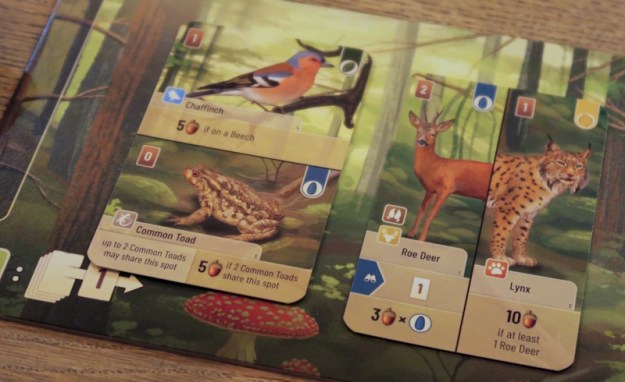
Game play is quite simple: players start with a hand of cards and, on their turn draw two cards from the market (or “Clearing”) or play one to their tableau. There are two sorts of card, Trees and “Critters”. Before playing a Critter, players must have played a Tree, which then has spaces on all four sides. Birds and Butterflies are played to the canopy, Fungi and Amphibians are played at the bottom of the tree and Mammals are played either side. The clever part is that Critter cards are split so they show two critters (either left and right or top and bottom), so players choose which they would like to play, and therefore where, tucking the other side under the tree, making the unplayed half invisible.
 |
| – Image by boardGOATS |
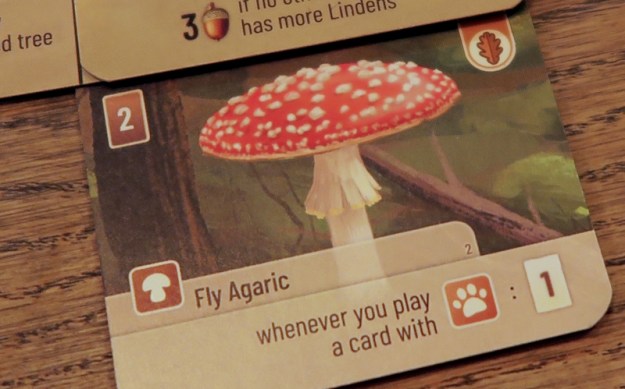
Players have to pay the cost of playing a card into the fact up Clearing, making those cards available to other players (and even sometimes themselves). Most cards have an effect associated with them, usually this is a one-off special action, but in the case of Fungi, they are special powers that last for the rest of the game. If the card played matches the colour of the cards used to pay for it, sometimes there is an additional bonus (e.g. take an extra turn, or extra cards, play a card for free etc.). These can be extremely powerful as they allow players to, for example, pay with cards they can then pick back up, or play a sequence of cards together.
 |
| – Image by boardGOATS |
The game ends abruptly when the third “Winter is Coming” card is drawn from the deck and the player with the most points is the winner. Players score points for Trees and for Critters, but it is how players get their cards combining together that really makes the difference. Thus it is a game of strategy and tactics, but also of timing, which relies on very simple rules. Blue outlined the rules and explained how some of the cards work together, then ??? started by choosing a card from the market. There was a little confusion when the Dürer-Fledermaus/Feldhase card came out with the text all in German, but otherwise, everyone got the hang of the basics quite quickly, though playing well can take a little longer.
 |
| – Image by boardGOATS |
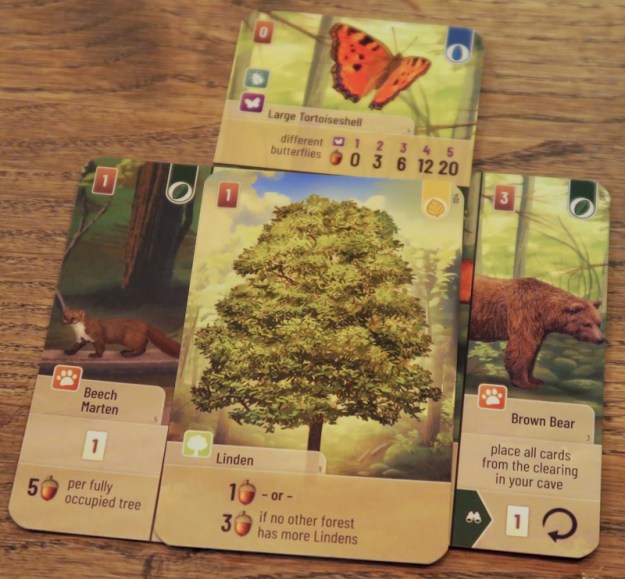
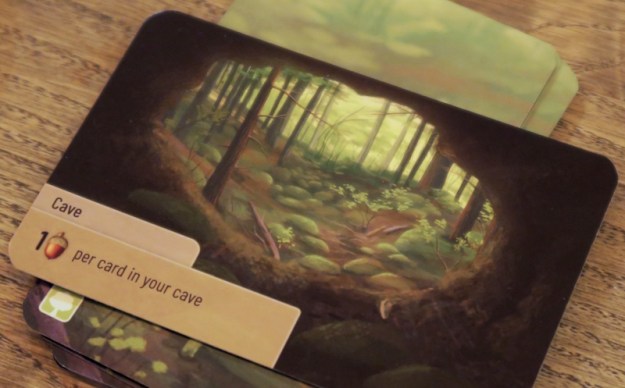
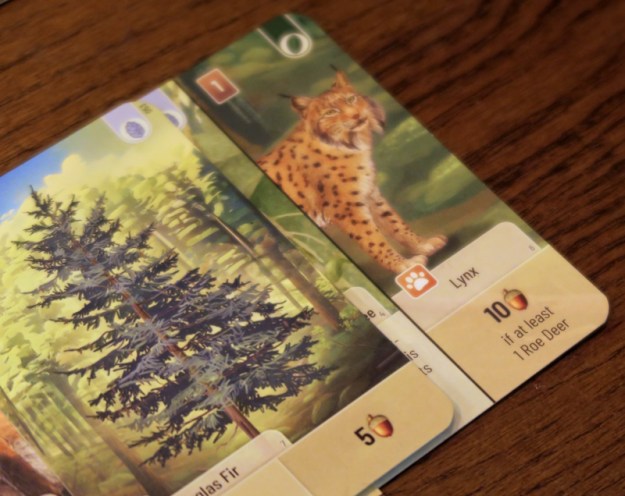
Pine got into a bit of a tussle with Blue and Black for Linden Trees, while Blue spent a long time setting up a “super-move” to play a Brown Bear and place lots of cards from the Clearing into her cave. Ivory started collecting bats, more bats and even more bats, which coupled with a few gnats gave him lots of points. His Fungi also gave him a extra cards as he built his forest, making him look like the player to beat. Meanwhile, Teal was collecting hares (including the Dürer-Feldhase) and before long had down of them. Then he switched his tactics somewhat after picking up a Roe deer. This was a critical moment, because from there her started adding lynxes, which give ten points each if there is a Roe deer in the forest.
 |
| – Image by boardGOATS |
With five, Forest Shuffle drags a little, particularly when everyone is new to the game as they have to read all the cards and try to work out which combinations work well together. It was an enjoyable game in spite of that, though most people played it in a very multi-player solitaire way, concentrating on their own game rather then keeping an eye on what others want and avoiding gifting people points. That said, everyone became more aware of what was going on in their neighbour’s forest as the game progressed. Nobody really had a feel for how well everyone was doing though because of the way the cards combined. So it was a little bit of a surprise how disparate the scores were.
 |
| – Image by boardGOATS |
In the end, it was “The Lynx Effect” that made the difference, with Teal taking victory with a hundred and nine points, nearly twenty ahead of Ivory and his bats, with Pine a distant third. Teal had an early start the next day, so flushed with success, he headed off leaving Ivory to consider leaving as well. However, when presented with the possibility of playing Draftosaurus, he was tempted into staying—despite it being one of the most popular games in the group, Ivory had only played once before. He felt he hadn’t really got to grips with it that time, so was keen to give it a quick try now.
 |
| – Image by boardGOATS |
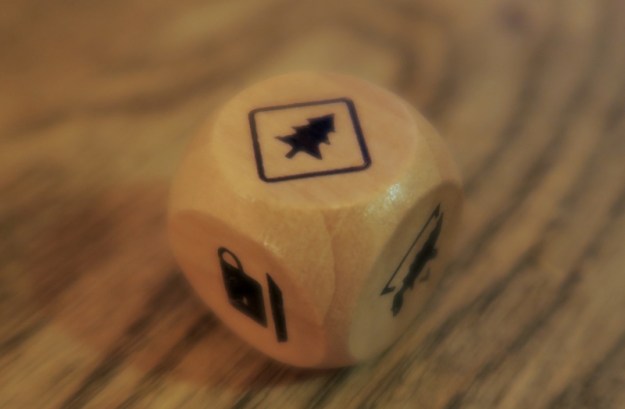
Pine was interested in playing with the Marina Expansion again, but given Ivory had only played it once before, the group decided to save that for anther time. Without that, Draftosaurus is a simple enough game of drafting wooden dino-meeples with players starting with a hand of six, choosing one and passing the rest on. Players also take it in turns to roll a die and that dictates where players can place their chosen dino-meeple in their Dinosaur Park. The parks have pens that score points under certain conditions (e.g. the “Woody Trio” scores seven point if if contains exactly three dino-meeples) and the player with the most points after two rounds of drafting is the winner.
 |
| – Image by boardGOATS |
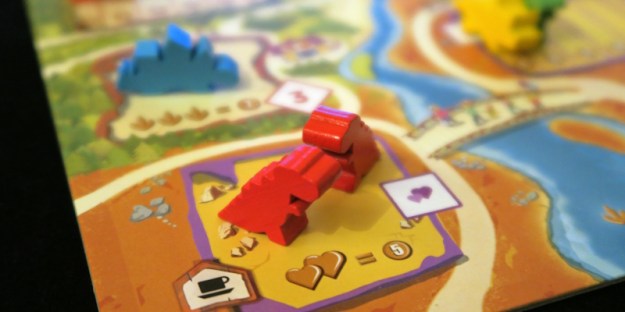
In contrast to Forest Shuffle, Draftosaurus was an extremely close game—everyone picked up seven points for the “King of the Jungle” and fifteen points for their “Meadow of Differences”. Everywhere else, where one player had an advantage, others picked up points elsewhere. Purple and Blue picked up points for their “Woody Trio”, Pine for his “Solitary Island” and Ivory had an extra loved up couple. In the end, Purple and Pine tied for third with thirty-five points, and Blue just pipped them to second place by a single point. It was Ivory who was the victor, just two points ahead, perhaps thanks to his extra tyrannosaurs giving him an extra point each; it is safe to say, that he’s definitely got to grips with the game now…
 |
| – Image by boardGOATS |
Meanwhile, on the next table, Green’s suggestion of Terraforming Mars (with the Prelude Expansion) was turned down since the group didn’t want to play a complex and potentially longer game. For the same reason, the group eschewed Village although it has been a long time since the group played it (Green commented on how the original artwork is very pretty, but the new version is horrible!). In the end, since last time Green had agreed to play one of Cobalt’s games, the group ended up playing Barcelona, a game that is both complex and quite long. With hindsight, perhaps looking for something else entirely might have been sensible as everyone except Cobalt needed to learn it, and even with experienced players it can take a while.
 |
| – Image by boardGOATS |
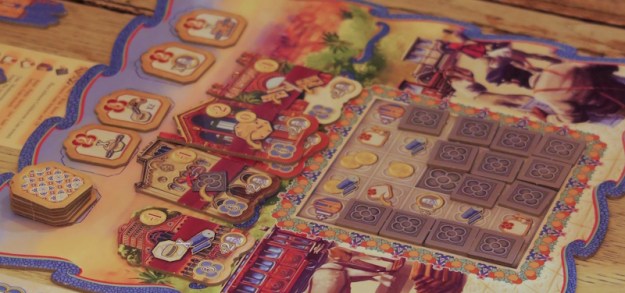
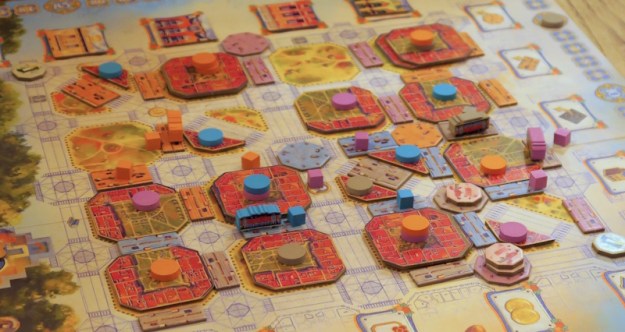
Barcelona is a game where players take on the role of builders in nineteenth century Barcelona who are working on the new expansion to the city following the destruction of old city walls. Each round, each player takes a single turn consisting of two or more actions, a building phase, and then preparation for their next turn. Players start with two random Citizen tokens which are placed in a stack onto a chosen unoccupied intersection. Unusually, players can place anywhere they want (no adjacency restrictions as seen in other games).
 |
| – Image by boardGOATS |
Choosing an intersection is the guts of the game that has significant consequences, initially the type of actions the player can carry out in that round, which are indicated by the streets selected. At the end of their turn, players must construct a single building if they can which depends on the Citizens adjacent to the building spot selected. There are four types of buildings: corners and normal shaped Level One buildings require any two adjacent citizens while Level Two building require at least one of them to belong to the middle class and Level Three buildings require three adjacent citizens, one of which must be a member of the upper class.
 |
| – Image by boardGOATS |
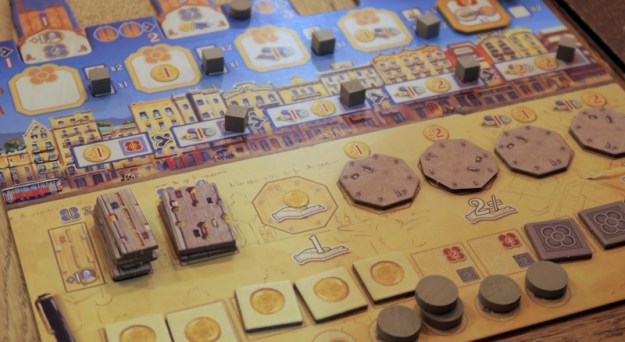
As well as moving players along the Cerdà track, Level Two buildings also allow them to progress on their own Sagrada track giving Sagrada bonus tiles with rewards increasing the more they progress. Level Three buildings move players two steps on their Sagrada track and give them seven pooints, but will also move players down two steps on the Cerdà track. All the citizens required for buildings have to come from intersections adjacent to the building spots and are removed from the board and placed on their respective progress tracks according to their colour. Once the first citizen is placed on the end segment of a track, that segment’s Cerdà scoring is triggered and players gain points based on the criteria shown on the tile.
 |
| – Image by boardGOATS |
This value is then multiplied by players’ positions on the Cerdà track, which represents whether or not players build according to the original intentions of Ildefons Cerdà (now considered the inventor of urbanism). The game is then played over a variable number of rounds interrupted by three scoring phases before a final scoring phase, after which, the player with the most points wins. Cobalt started first and went straight in, knowing exactly what the best thing to do was, but being first he couldn’t buy a building with only one stack of citizens. Everyone else was much more uncertain of what to do.
 |
| – Image by boardGOATS |
At the outset Black chose to follow a policy of not buying buildings if he could get away with it (the rules are you must buy after your turn if you can), while Green had decided to work to getting the best result for each stage scoring, and Lime for a while was really confused and did not really know what he was doing at all. Lime managed to trigger the first stage scoring, meaning that while he, Cobalt and Black had two turns before scoring, Green had only one turn—so much for his game plan and he soon found himself falling behind the others. Going last seemed to be a significant disadvantage, something Cobalt said has been mentioned before in forums, especially for four player game.
 |
| – Image by boardGOATS |
And so the game continued. Cobalt knew what he was doing, while Black was trying not to buy buildings, but to get as many points along the way from other means as he could—as he put it, the game was a bit of a “points salad”. Green fared a little better at the second round scoring, but he was still a turn behind the rest (as was Lime for the second stage). By this time he had decided to get his tram moving as much as possible as well, which was helping him to catch up on the score board. Lime was still struggling, and gaining a lot of help and advice from Cobalt. It seemed to be working though as he was scoring nearly as well as Cobalt himself.
 |
| – Image by boardGOATS |
The final stage of the game took a bit longer to complete, but was mostly just more of the same. By the final scoring, Lime took the lead to win the game while Cobalt’s experience had helped him compete and take second place, just three points behind. Green had caught up a bit and took third, while Black’s strategy of not buying really hampered him as he dropped further and further behind. He admitted that it probably wasn’t a good strategy as the later building buys really brought home a lot of points due to the points that also came with each purchase. It had been an interesting game though, not so much about building a points engine, but looking for a good haul of points on each turn. Having played once though, next time it might feel more like players are scoring from the game rather than the game scoring for them.
 |
| – Image by boardGOATS |
Learning Outcome: Nobody can resist the Lynx Effect.
 boardGOATS