Blue and Pink were unusually early and had already finished their pizzas when Pine rolled in. He was soon followed by Black and Purple and then Lime and Teal giving a total of seven for one of the quietest nights for a long time. With seven, the question was how to split the group and what would everyone play. For seven players, the go-to game is generally Bohnanza, which Blue inevitably suggested. Pink suggested playing it later, but when Teal commented that he’d never actually played it, that was the decision made. There was no way that state of affairs could continue, so the “Feature Game” (which was to be Canvas) was put on the back burner until later, and the Beans came out.
 |
| – Image by boardGOATS |
Bohnanza is best part of thirty years old and is, despite him designing a huge number of excellent and popular games since, including Agricola, Caverna, Le Havre, A Feast for Odin and Patchwork, is arguably, still one of Uwe Rosenberg‘s best games. It is a really simple game of set collecting and trading, that when explained sounds strange, but when played is great fun. While everyone else chatted, Blue explained the rules and how to play to Teal. The important thing is players cannot rearrange the cards in their hand (similar to recent Spiel des Jahres nominee, SCOUT).
 |
| – Image by boardGOATS |
So, players start with a hand of cards, and, on their turn, must plant the first Bean card in the front of their hand into one of the two “Bean Fields” in front of them. Then they may, if they wish plant the next Bean into one of their Fields, but each Field can only contain one type of Bean. Once they have finished planting from their hand, the active player turns over the top two Bean cards, which must be planted, but may be traded and planted in another player’s Field if agreements can be reached. Once these Beans have been dealt with, the active player can trade any cards from their hand, but all cards involved in any trades must be planted straight away.
 |
| – Image by boardGOATS |
Finally, the active player tops up their hand taking Bean cards into their hand (three in the case of the seven player game). At any point, players can harvest one or both their Bean Fields converting some of the cards into Bean Thaler (according to the “Beanometer”), placing them face-down in their scoring pile, returning the other cards to the discard pile. However, players cannot harvest a Field with a single single bean in it unless all their Fields have only the one Bean in them (a rule that can sometimes make things unbelievably difficult). The game ends after three passes through the deck and the player with the most Thaler at the end is the winner.
 |
| – Image by boardGOATS |
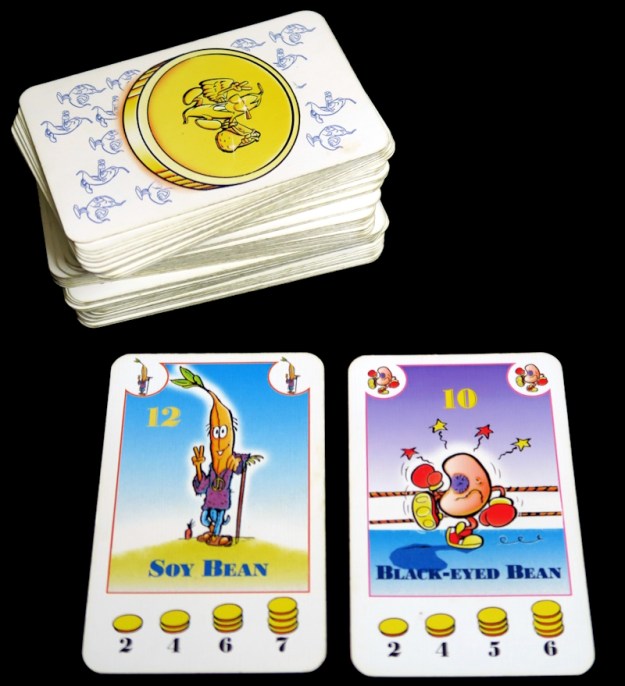
There are a few, very clever things that really make the game work. Firstly, there are different numbers of the different types of Beans in the deck—some beans are very common and give a small return, others are quite rare and give a better return. The number of each card present in the deck at the start of the game is printed on them. This is key, because it helps players to work out the rarity and therefore the value of different Beans when arranging trades. However, the value also changes according to the situation in the game and how many players want each Bean type at the time.
 |
| – Image by boardGOATS |
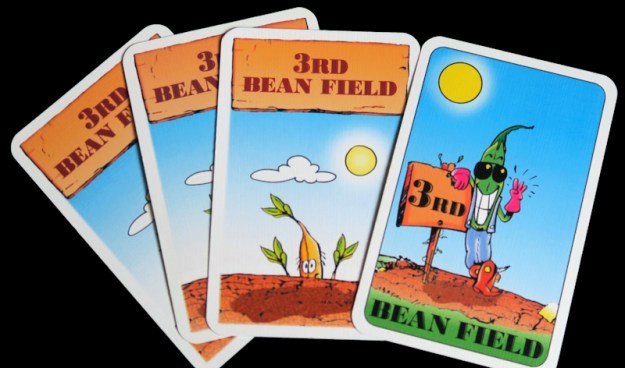
Further, because the rare Beans give a larger yield, more of these are removed from the deck, which makes them increasingly rare as the game progresses. This is because there are disproportionately fewer in the discard pile when it is shuffled to give the new deck. Players can also buy a third Bean Field, but choosing to do this is a real gamble and only worthwhile if it can be done early in the game. Choosing when to harvest is also critical, because harvesting a big Field just before the discard pile is shuffled will increase the length of the game. Finally, players can be generous in their trades in the hope that the generosity will be returned, however, giving away trades too cheaply can cost a player the game.
 |
| – Image by boardGOATS |
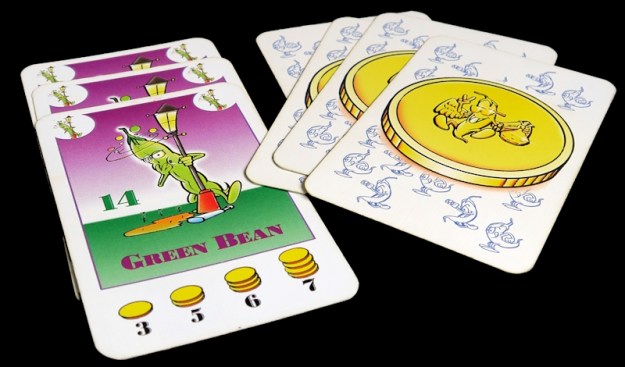
Once Blue had finished explaining the game, Black started and explained his way through his turn. Teal quickly caught on and got engaged in trading and planting Beans with everyone else. There was a lot of debate about players buying their third Bean Fields with about half the players buying one and Teal leaving it to the second round (much against Black’s advice). Several people, including Purple, Teal and Pine got into Black-eyed Beans—quite an achievement given how few of them there are in the pack—and Blue had a couple of goes with the similarly rare Red Beans. Pink tried for Soy with mixed success and almost everyone planted some combination of Wax, Coffee and Blue Beans at some point during the game.
 |
| – Image by boardGOATS |
Teal quickly realised how quick you have to be declaring an interest in a trade in a game where if you snooze, you lose. And with seven you have to be keep an eye on what’s going on, which can be difficult given how far away some players are. In the corner, Black quietly got on with his game eschewing the third Bean Field option as he felt there wasn’t time in the seven player game to recoup the cost, and perhaps he was proved right as he ran out the eventual winner with twelve Bean Thaler, closely followed by Pine with eleven and Blue with ten. It had been a lot of fun, but as usual, had lasted longer than it really should, leaving little time before the first people needed to head home.
 |
| – Image by boardGOATS |
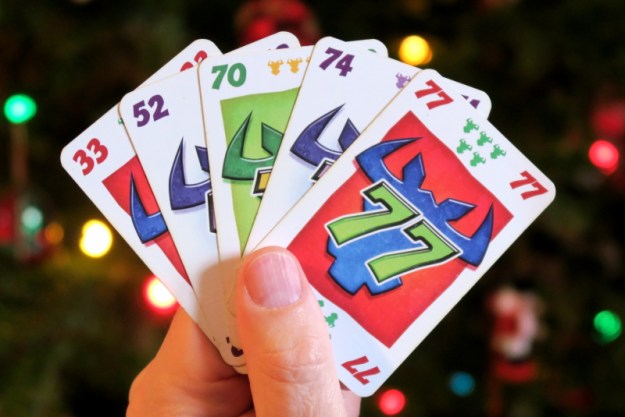
So after some discussion (where pink suggested Ticket to Ride: Northern Lights again), everyone settled down to play 6 Nimmt!. This had recently had an outing with the new Jumping Cow mini-expansion, but this time the group chose to play it without the additional madness. 6 Nimmt! is also a simple game that is a lot of fun: Players start with a hand of cards and simultaneously choose one to play, then, starting with the lowest value, these are added one at a time to the four rows on the table. If a player’s card is the sixth in the row, instead, they take the first five into their scoring pile and their card becomes the first in the row.
 |
| – Image by boardGOATS |
This is another very clever game that does a lot with very little (which is probably why it is still so popular despite the fact it is thirty years old). Different cards give a different number of points (or Nimmts), and players can also introduce a little bit of their own randomness by playing a card lower than the final card in all the available rows and thus, taking a row of their choice, upsetting everyone else’s plans. The Jumping Cow mini-expansion adds more of this, but the group felt it didn’t really improve the game, so stuck with the chaos and fun of the original game, also eschewing the mathematical complexity of the Professional Variant.
 |
| – Image by boardGOATS |
This time, both Pink and Pine managed to avoid picking up any cards in the first round. However, Blue only picked up two Nimmts and Teal collected seven leaving it all to play for, at least for most people—Black’s twenty Nimmts had already put him out of the game. In the second half, Lime picked up twenty-four giving him the top score of thirty-eight (some way ahead of Purple with total twenty-nine). Black managed a clear round, but there was nothing he could do about his pile of Nimmts from the first round. It was tight between the top three, but Pink just took victory with ten, three fewer than Blue and Pine who tied for second place. From there, the evening deteriorated into chatter and we decided to leave the “Feature Game“, Canvas, for another day.
 |
| – Image by boardGOATS |
Learning Outcome: You can have a lot of fun with nothing but an old deck of cards.
 boardGOATS