Blue and Pink were just finishing their supper when Pine arrived, soon followed by Cobalt. There was a lot of discussion about the road closure to the A420 (due to an accident) and whether this would delay those coming from the west, but Jade, Plum, Sapphire and Byzantium soon arrived with their tales of countryside detours in the dark. Inevitably, that led to more stories of road closures due to accidents and flooding, and the horror-show that driving anywhere has been over the last week or so. With almost everyone present, with more proactivity than usual, the group split into three, with two tables playing the “Feature Game“, the Landmarks expansion to the 2022 Spiel de Jahres winner, Cascadia.
 |
| – Image by boardGOATS |
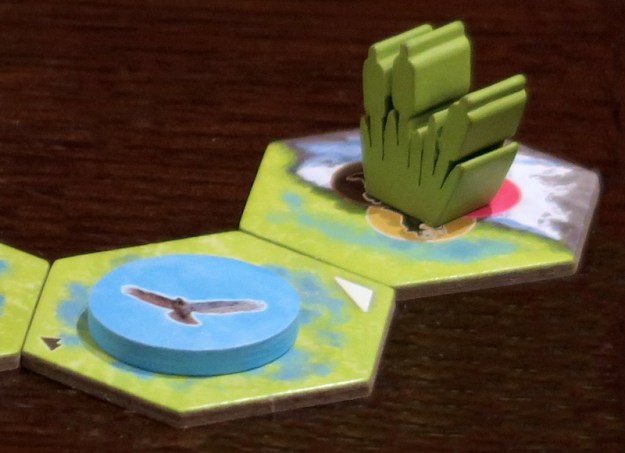
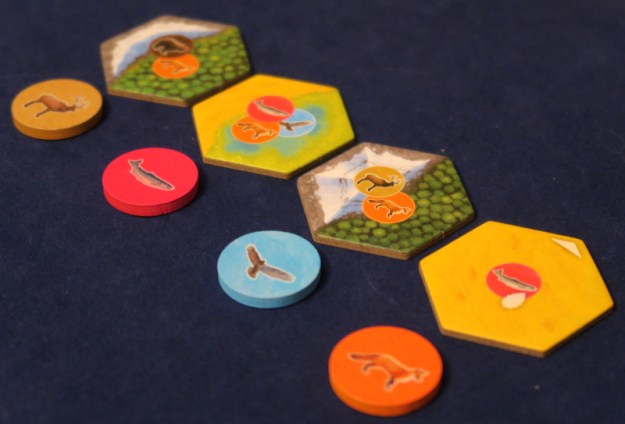
Cascadia is one of the group’s most popular tile laying games. The mechanisms of the base game are simple enough: on their turn, players take a Habitat Tile/Animal pair from the market and add them to their territory. The Habitat Tile can be placed anywhere, but the Animal Token must be placed on a Habitat Tile which depicts that Animal. The market is then replenished back to four pairs until the Tile pile is depleted and the game ends. The Tiles and Animals are drawn and paired at random, and players have to take the prearranged pair, they cannot freely mix and match unless they have a Nature Token, which they can spend to either change all the Animals, or to take an Animal from a different pair.
 |
| – Image by boardGOATS |
Nature tokens are rewards for adding animals to Keystone Habitat Tiles, which, in general, are more difficult to fill because they can only hold one animal type (other tiles can take two or three). While the mechanism is quite simple, the guts of the game is in the scoring. Players score for each of the five Animals, Bears, Elk, Foxes, Salmon and Eagles, but the clever part is that the way each of these scores depends on which card is drawn at random from each of the five Animal decks. Thus, the game plays very differently depending on the combination of Animal scoring cards drawn.
 |
| – Image by boardGOATS |
In addition to animal scoring, players also score one point for each tile in their largest corridor of each of the five Terrain types, as well as earning bonuses if their largest area is the largest overall. The Landmarks expansion consists of three new modules, one which increases the the potential player count, one which adds more variety to the scoring (more Animal scoring cards) and finally, the titular Landmarks. The first of these adds a Personal Market of five Habitat Tile/Animal pairs for each player to give them something to think about (and potentially play) between turns. This can be played at lower player counts, but is essential in larger numbers as it reduces perceived downtime.
 |
| – Image by boardGOATS |
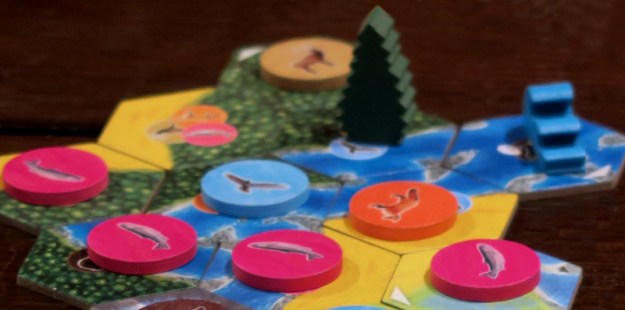
The second module is simply some more scoring cards, which adds more variety, but also a little more complexity as some of these are slightly more challenging to work with. The final module, the Landmarks, changes things a little more. These can be added to a Habitat Tile when the once the area of Terrain is large enough (spreads over five tiles or more). These Landmarks also come with a choice of the available cards (drawn at random) which give bonus points at the end of the game, for example, for every Bear in the player’s Forests. Each player can only build one Landmark on each Terrain type, and because the Landmarks occupy space, players start the game with one additional Keystone Tile.
 |
| – Image by boardGOATS |
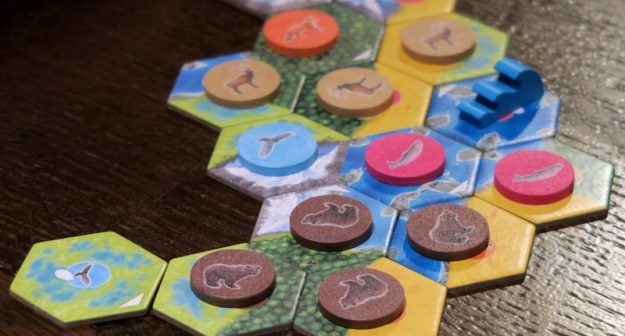
Blue, Pink, Plum, Black and Lime played with all three modules, making a point of choosing scoring cards from the expansion. In contrast, although the Personal Market can be used for any player count, the four on the other table, Jade, Byzantium, Sapphire and Pine, only added the Landmarks module, choosing scoring cards solely from the base game. Jade et al. got going first and were four or five rounds in before Blue’s Crew had even started, as the latter had more rules to cover and were a little later to start as they were too busy gossiping. On the other hand, despite the fact that there were a lot of rules queries, at least they mostly got them right, in contrast, to the little rules malfunction on the other table.
 |
| – Image by boardGOATS |
The rules for the Landmarks state that players may take a Landmark when they add their fifth or tile to a Terrain, or any subsequent addition, whereas Jade, Byzantium, Sapphire and Pine played that the Landmark had to be taken when the fifth Terrain Tile is added. It was just a very little thing, but actually had quite a large knock-on effect. The problem was, if a Landmark is added to a Keystone Tile, then players don’t get the Nature token. Worse, in some cases, players were taking Landmarks when the cards weren’t in-line with their strategy, just because they had to.
 |
| – Image by boardGOATS |
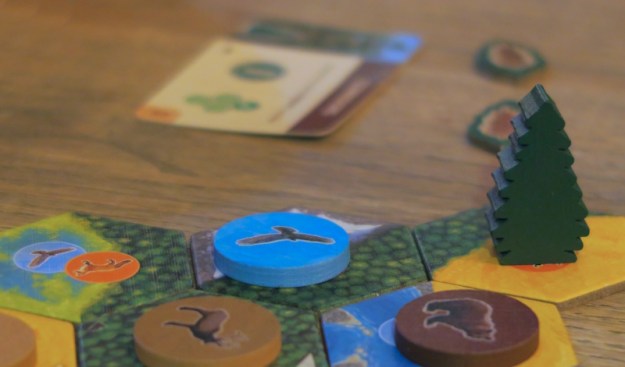
As the games progressed, both groups realised that taking Landmarks can really restrict a player’s options, especially towards the end of the game when things can get very tight. And forcing players to take unhelpful Landmarks just exacerbated this effect and meant some Terrains were stuck at four just to avoid some of the issues. The games both progressed quite merrily, however. Blue concentrated on a mixture of Animals and Terrain, going for Landmarks early in the proceedings. Plum, misunderstood and didn’t realise that players scored a point for each tile in their largest Terrain, so she concentrated on Animals, but did very well with her Terrain anyhow, by virtue of trying to get bonus points for having the largest areas.
 |
| – Image by boardGOATS |
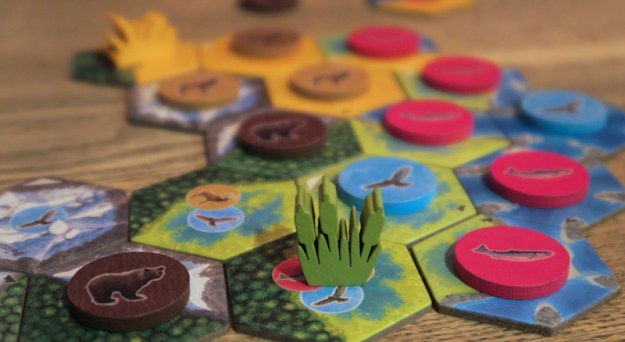
Pink asked a lot of questions and got a bit confused between when he could add Landmarks and when he could take tiles from his Personal Market. So, he ended up concentrating on Foxes instead, “as he was a foxy sort of fellow” (and there aren’t any Pandas in the game). Black meanwhile collected Elk, but all-round concentrated on animals rather than Terrain. Lime commented, “Birds are difficult to understand, so I’m not going to bother with them; if I score at the end of the evening, so be it…” though he probably didn’t mean it to come out quite like that! On the other table, Sapphire was collecting Elk, and Byzantium was focussing on Eagles while Pine concentrated on building his Terrain and Jade capitalised on the Landmarks.
 |
| – Image by boardGOATS |
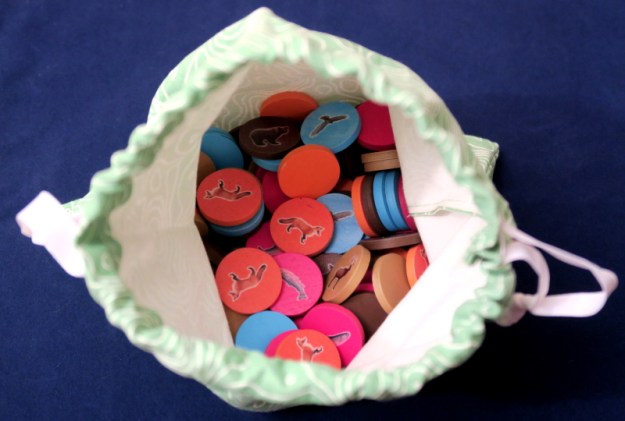
With or without the Landmarks expansion, Cascadia is a little bit of a “multi-player solitaire” game, that is to say, players can mostly quietly get on with their own thing without upsetting each others’ plans. However, with Blue, Black and Plum all having a full set of five salmon, Pink and Lime struggled to get the last few they needed. In the four-player base game, all the tiles and therefore all the animals are used and Lime hadn’t realised the expansion added more tiles, some of which had been removed and therefore, there was no guarantee that any of the lovely juicy salmon left in the bag were going to come out. And much to Lime’s chagrin, so it proved, as he was left one short of the full set at the end of the game.
 |
| – Image by boardGOATS |
The five-player game, despite starting later and having the extra player, finished at much the same time as the four-player game, demonstrating how the new mechanism in the Landmarks expansion really does speed the game up. Despite the perceived, increased challenge associated with the new Landmark scoring cards, the five-player game was generally more highly scoring, with the Blue and Plum sharing victory, tied on a hundred and seven points (some fifteen more than Black in third) and tied on the tie-breaker too. The other game was much closer, with a spread of just eleven points and with Pine finishing in first place with ninety-nine, only two points ahead of Byzantium who was the runner up.
 |
| – Image by boardGOATS |
All in all, both groups liked the base game and enjoyed the game with the Landmarks expansion. The group playing with all three Landmarks modules felt it was much more of a struggle, though both groups felt the Landmarks didn’t give all that many points unless you knew what you were going for and were able to really make them count. Certainly, adding lots of Landmarks made things very difficult at the end of the game causing players to reject Animal Tokens, so although the rules say add an extra Terrain Tile, there was some discussion regarding the merits of “house ruling” the addition of a second in future, to encourage people to build Landmarks.
 |
| – Image by boardGOATS |
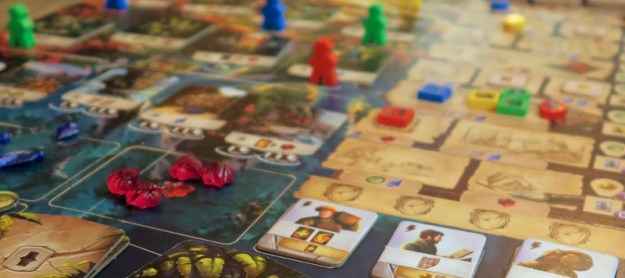
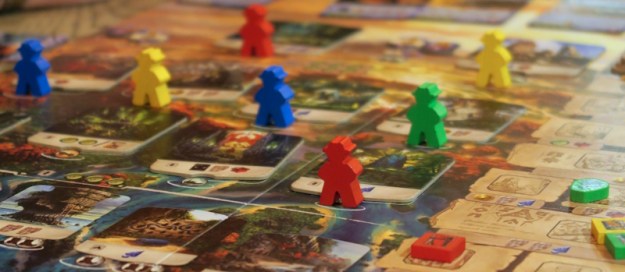
Meanwhile, on the next table, Ivory had enticed Cobalt, Purple and Teal to play his new Christmas acquisition, Lost Ruins of Arnak. It turns out that he wasn’t the only person in the group to receive this game over the holidays—Green had also been given a copy and would no doubt have been keen to play had he been able to come. The game is set on an uninhabited island where explorers have found traces of a great civilization. Players lead an expedition to explore the island, find lost artifacts, and face fearsome guardians in a quest to learn the island’s secrets.
 |
| – Image by boardGOATS |
The game combines deck-building and worker placement with resource management. Players start with six cards in their deck, two Money, two Compasses and two Fear cards, and draw five to play. As in the original deck-builder, Dominion, or in the racing games, Flamme Rouge and Snow Tails, Fear cards clog up players’ decks and more are acquired as the game progresses. But also as in Dominion, there are ways to “exile” cards during the game. So, players can try to keep a tight deck with minimal cards, or try to buy lots of cards that work well together. Players then have two meeples each that can be sent to locations on the map, to either discover or use an action Location. These generally give Resources plus some additions like draw a card, or gain a Fear card etc.. Each new site also has a Creature guarding it, which, if beaten, will give points and a small one-time bonus.
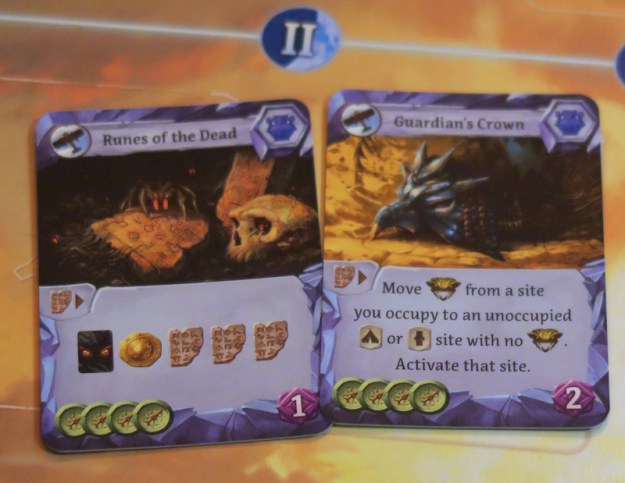 |
| – Image by boardGOATS |
The Research Track is where players spend three of the resources, Tablets, Arrows and Jewels. Each player has two tokens which move up the same track giving different rewards as it ascends. Thematically, you can’t write stuff in the notebook until you find it with your magnifying glass, so the former can never overtake the latter on the track. And of course, the notebook gives cooler rewards. Players get one action each per turn, until everyone has passed and the game finishes after five rounds. At the end of the game, Points are awarded for Cards, for progress on the Research Track, for discovering Locations and for beating Creatures; the player with the most points at the end is the winner.
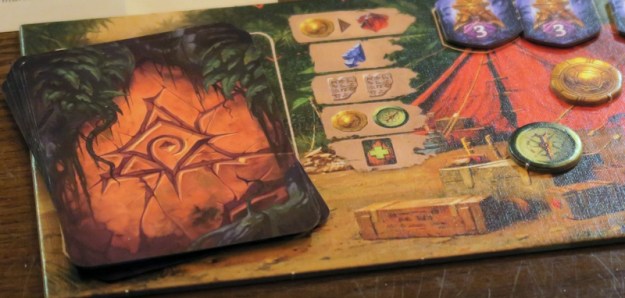 |
| – Image by boardGOATS |
The first round was very slow as there was only limited spaces to go and everyone had weak cards in hand. Purple, Cobalt and Teal all focused on building up resources and buying tool cards for future rounds where Ivory did something a little different and started progressing along the Research Track as well as opening up new Dig sites. The issue with this was that he picked up a Fear card, though fortunately he had already got rid of one of his initial Fear cards through the site he opened so there was no net negative effect. In the second round, things picked up and strategies started to become apparent.
 |
| – Image by boardGOATS |
Cobalt continued to focus on getting Tools, especially ones that allowed him to draw extra cards (and hence allowed additional actions) and he started making headway on the Research Track and was first to unlock an Assistant. He also did a little exploring, but did not overcome the Guardian. Ivory wasn’t far behind on the Research Track and also continued to explore new areas (and this time overcome the Guardian) and make up for lost ground in getting tool cards. Teal went for a very different strategy and started to focus purely on exploring and overcoming Guardians, netting him three points for exploring and gaining the idol and five points for overcoming the Guardian. Purple, on the other hand, continued to focus mainly on building her supply of resources.
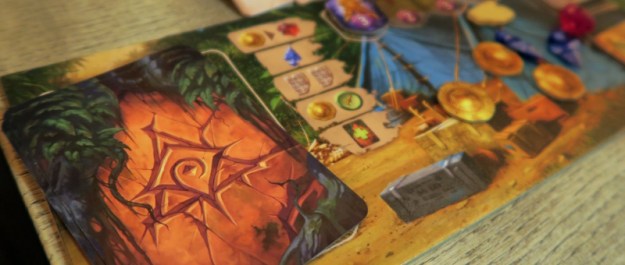 |
| – Image by boardGOATS |
The third round continued in much the same vein with everyone continuing to pick up Tools and starting to gain Artifacts. Ivory focused almost exclusively on the Research Track and was able to catch Cobalt and had picked up all the bonuses, while both unlocked their second assistant. Teal was continuing his exploring strategy to great effect, whilst Purple continued to bide her time building up resources, including a significant amount of Rubies (the most valuable resource). And so it continued into the next round too, except Cobalt began spending his Compasses on Artifacts while Ivory continued to hoard them for the last round.
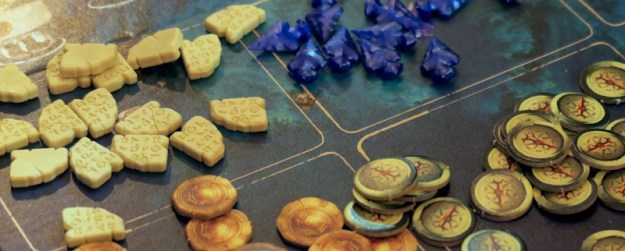 |
| – Image by boardGOATS |
And it was in the final round that Ivory’s plan became apparent as, in true Ivory style, he used all his Compasses to explore a level two Dig Site. Hitherto, exploration had been limited to level one sites and Ivory was the first to explore a higher level, thinking this would be a fun thing to do. In the end, this ironically might have been the critical move that influenced the outcome of the game. The level two site gave Ivory valuable resources, helping him complete the Research Track just after Cobalt and also overcome the newly uncovered Guardian. With two idols on a level two site, this gave Ivory eleven points.
 |
| – Image by boardGOATS |
Teal continued with his strategy and also explored a level two site and began moving along the Research Track too. Purple used all her carefully collected resources and make a late dash to the top of the Research Track, gaining valuable points. It should be said the whole work placement element of the game felt very tight with limited spaces at the start and then difficulty knowing whether to take the optimal route planning cards first, but potentially missing out on a valuable space to other players, or taking the sub-optimal route and placing your workers first guaranteeing the activity, but at a cost of efficiency.
 |
| – Image by boardGOATS |
Everyone got blocked at some point (except perhaps Teal who was opening up new sites), and certainly towards the end of the game everyone wished they had more than two workers! Teal with his explore/overcome Guardian strategy led to him defeating a very impressive impressive six Guardians and gave him a total of sixty-eight points. In the end, however, the fact Ivory completed the Research Track and was also able to explore and overcome Guardians gave him the victory by just three points with a winning total of seventy-one. It was a very good game though, one greatly enjoyed by all involved.
 |
| – Image by boardGOATS |
Learning Outcome: Now we know what Bears do in the Woods!


 boardGOATS