Following on from Little Lime’s visit last time, this week we had special visits from Mister Mint (aka Vermillion), Little Mint (aka Sable), and Little Ivory (aka Tangerine). While everyone else got their collective acts together, Family Mint ordered their supper and got down to a quick couple of rounds of Panda Panda, a set collecting game with cute panda artwork. In this game, players take it in turns to discard a card onto their personal discard pile or take a card from the draw pile from someone elses discard pile; when a player discards an “A” card, everyone passes a card to the left. The winner is the first player to start their turn with a set. Sable tried to win without discarding cards, but the victor of both rounds was Mint.
 |
| – Image by boardGOATS |
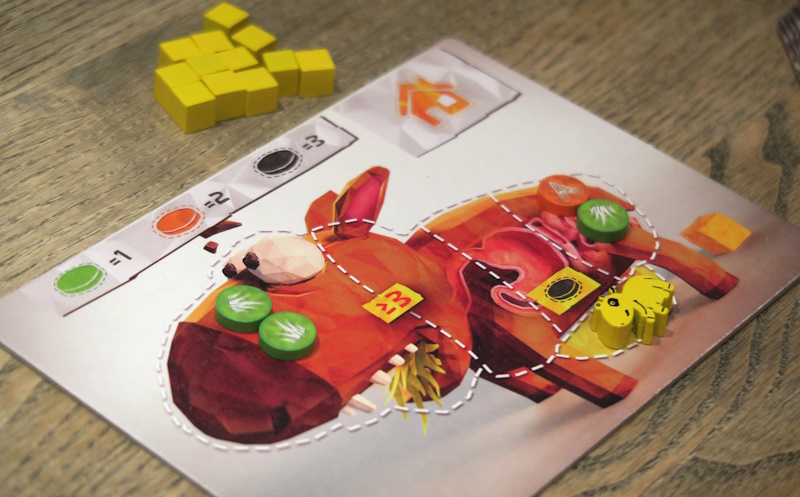
One of Family Mint’s current favourites is Wombat Rescue, where players are taking the role of mummy wombat trying to find their lost babies. Enticed by the animals in the game, Pine joined Vermillion, Sable, Ivory and Tangerine, to play a game that seemed to be based almost entirely on the fact that the most fundamental Euro-game piece is the wooden cube and wombats are the only known animals who’s poo is cube-shaped (due to a slow digestive tract and intestines that contract in a specific way to shape their feces over time). The theory is that because wombats have extremely poor vision but an excellent sense of smell, they use their poop cubes as “smell markers” and cube-shaped poop it is less likely to roll away or be moved.
 |
| – Image by boardGOATS |
The premise of the game is that a dingo has stormed the burrow and chased away four of each player’s baby wombats or joeys. As mummy wombat, players have to eat and digest food in order to produce poop cubes, that they can use to build smell areas to navigate the board. With a network of poop cubes, they can then find their baby wombats, and bring them home. Thus, the player who best plans their smell areas and moves most efficiently will be the first to find all their joeys, and win the game. Unfortunately, with five, the game took rather longer than the suggested sixty minutes, but they had a great time, so that didn’t really matter.
 |
| – Image by boardGOATS |
There was much amusement as cries of, “Stop sniffing my poo!”, “Are you going to use your smell corridor now?” and “There’s poo EVERYWHERE!” carried to the neighbouring tables along with odd words and phrases like “smell radius”, and the slightly odd request, “Can I sniff your baby please?”. The eventual winner was Vermillion and there was quite a bit of chat as players packed up. Although it had out-stayed its welcome a little, it wasn’t in the same league as that other Austrlian game, Echidna Shuffle, which on one notable occasion took hours because nobdy wanted to be the person who gifted someone the game, even though, everyone desperately wanted it to end!
 |
| – Image by boardGOATS |
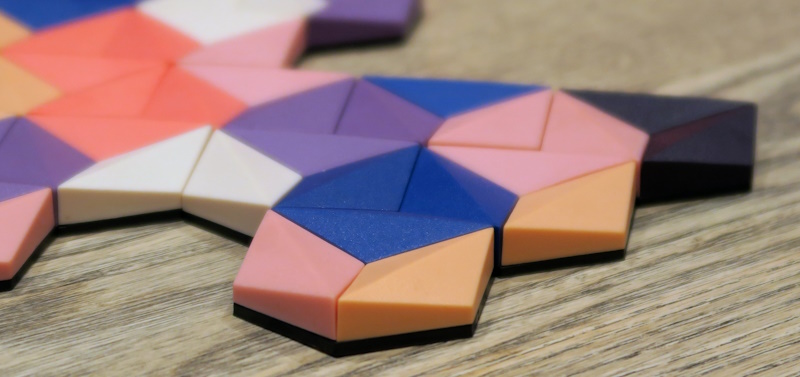
The main beneficiaries of the poop-laden comments were Mint, Blue and Lime on the next table. They were playing the “Feature Game“, which was Cubed. This is a very simple, sort of 3D, hexagonal/trioominoes domino game. Players started with a hand of twenty of the delightfully tactile hexagonal pieces and then take it in turns to play a piece, adding it to the central grouping. Pieces must join two edges, matching colour and slope direction: each piece has a dip in the middle and the vertices alternate high and low. Although this is simple, it is more difficult than it looks at first glance. Additionally, some of the pieces have black edges, which are blocking pieces and nothing can be added to these sides.
 |
| – Image by boardGOATS |
If a player can’t place a piece, instead they draw a random tile from the face-down pool. The winner is the first player to get rid of all their pieces and they score zero. Everyone else scores for the pieces they have left, with one point for those with three different colours, two for any with two colours, three for monochrome pieces and five for any blocking pieces. Blue started, which turned out not to be the advantage initially thought as later players have more options. That wasn’t the reason Blue did horrifically badly though, that was partly due to inneptitude and partly due to luck of the tile draw. It was quickly clear that she was trying to limit losses and the battle was between Lime and Mint.
 |
| – Image by boardGOATS |
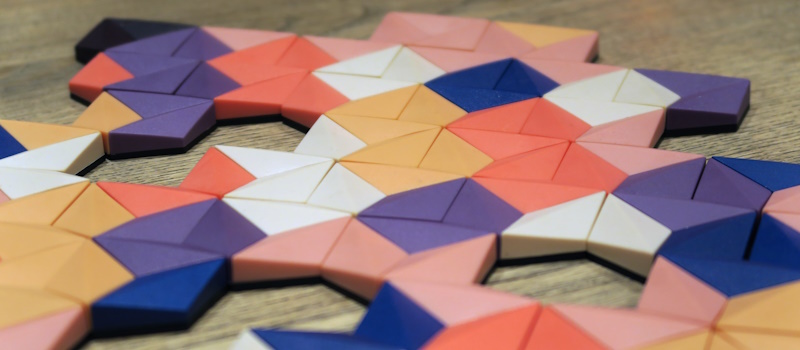
Lime finished first, but Mint only had one piece left and if everyone got the same number of turns she could have placed it thus ending in a tie. The rules weren’t entirely clear on the point although arguably, the advantage of potentially getting an extra turn offsets the advantage of more play space (especially early in the game). Either way, the group decided to call it a tie and settle the matter over another game, this time adding the variant rules. These introduce the concept of “gaps”, single space “holes” in the array. Players who “bridge the gap” and create one get to place an extra piece, and players who “fill the gap” get to “gift” one tile to another player. Inevitably, however, this meant everyone saw making gaps as a challenge.
 |
| – Image by boardGOATS |
Mint did, eventually manage to make a gap, but it really wasn’t easy and probably partially led to her conceding victory to Blue, who made a much better fist of the second try. That left how to score—consider it to be two separate games, or combine the scores as a campaign? Well, Lime won the first “game”, Blue won the second, but Mint had the lowest overall score (with or without the extra turn), so it was decided that it was a three way tie and everyone was a winner! That wasn’t the nly tie of the evening though. There were two more tables of games, the first playing Vivarium.
 |
| – Image by boardGOATS |
This is a card collection game with fantastic art, based round a market similar to that in Meadow. In Vivarum, however, players use dominoes to create the coordinates that dictate the card they take. After seven rounds, the player that has successfully completed their objectives and collected the greatest creatures wins the game. Jade led the game with Cobalt and Sapphire joining him. Players start with two dominoes and, on their turn swap one with central pile and then either use the new pair to take a card or take two gems—these are worth a point each at the end of the game, but can also be used to alter the values of dominoes during the game.
 |
| – Image by boardGOATS |
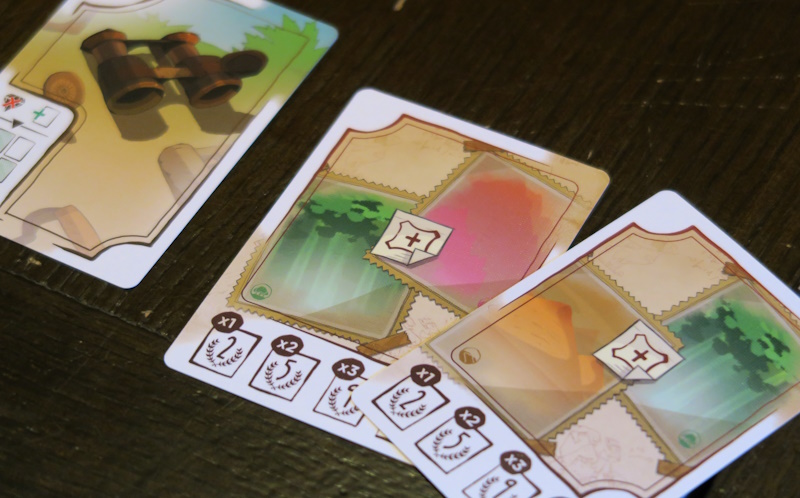
Once everyone has taken two turns, the market is restocked and a new (two turn) round starts. There are three different types of cards: Creatures, Equipment and Contracts. Each Creature is one of four types, one of four colours and is worth points; Equipment are in four different types, earns Gems and give a special power; Conracts provide objectives that reward for different types of Equipment or Creatures. At the end of the game, players score for Creatures, unused Gems, Priority Tokens (earnt for taking certain cards each round) and Contracts. This time, it was close, though not actually a tie (that came later).
 |
| – Image by boardGOATS |
Creature scores and Gems were all smilar, but the most significant differnce was in Priority Tokens. Cobalt took ten more points from these than anyone else, which more than offset his slight deficit in other departments and gaving him seventy-seven points with Jade taking second place a few points behind. After a short break, the group moved on to place Diced Veggies, a really clever little resource management game. Players take it in turns with the Cleaver, using it to slice up the central array of dice. Each die represents an ingredient and these are then assigned to the recipes players are working on.
 |
| – Image by boardGOATS |
Players can’t just grab loads of veg though—they can only take a limited number of pips with each chop, and the right dice values can unlock bonus cards to boost a recipe’s score. Once a player has carefully sliced their veg from the main block (with a total value of ten or fewer) the can assign dice to Cook one of their recipes before drawing one more card (either a Hype/bonus card or a recipe). Players can carry eight veggies, two Hype cards and two Recipe cards on to their next turn, but when one player has completed six recipes, everyone gets one more turn before the scores are added up. And this was the game that ended in a tie—despite lots of variation in recipes and bonuses, Jade and Cobalt both finished with fifty points, with Sapphire just behind.
 |
| – Image by boardGOATS |
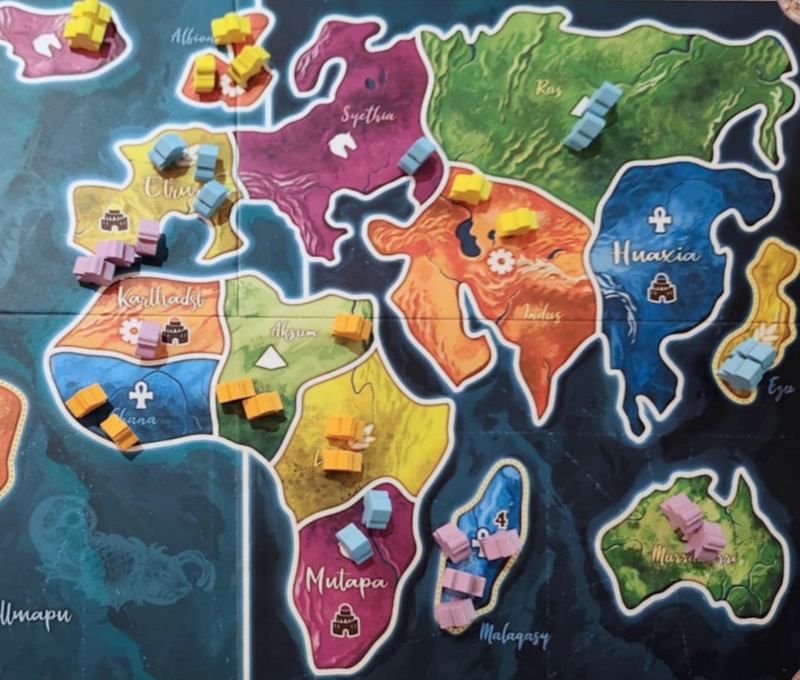
The final table, led by Plum, were playing First Empires, a game where each player takes control of an ancient nation and determines its fate. On their turn, players roll dice according to how they’ve developed their empire board. The six sides of the dice correspond to the five abilities on their board. To expand to new territories or invade opponents, players unlock movement ability; to annex a territory, they have to outnumber the current occupant or have a “sword” result on the dice and chase the inhabitants elsewhere. Dice also allow players to develop their player board, using the die face that corresponds to improvement and controlling an associated territory.
 |
| – Image by boardGOATS |
As the game progresses, players can also gain more dice and additional re-rolls, while also unlocking achievement cards. The game ends after a set number of rounds (dependent on player number) when players earn points based on played achievement cards, points unlocked on their personal board, and for cities under their control. After Plum had explained the rules, everyone began. With only four players, the far East wasn’t available, so Plum started in Morocco (K), Ruby in the the Far East (H), Flint began in Europe (E) and Pink in South Africa (M). Flint quickly achieved one of his early goal cards and occupied two islands
 |
| – Image by boardGOATS |
Pink pressed north early on, which meant it was more difficult for Plum to invade new lands. Pink, Ruby and Plum all drew the “occupy another player’s home region” card in the first half of the game, so there was a lot of shifting about as people targeted each other’s regions picking up Cities in the process. There was a little bit of a rules interpretation error as most people restricted themselves to only re-rolling one die rather than picking a number of dice, but that was soon rectified. Flint got to the top of the dice track, but it was towards the end of the game so he wasn’t able to capitalise on it by rolling five dice.
 |
| – Image by boardGOATS |
Flint picked up lots of points for his dice track, but failed to score on his re-roll track, whereas everyone else was the other way round. In fact, Plum and Pink both got their highest score from the re-roll track. Ruby top scored on explorers, but the winner was Pink who also did well on his explorers track, but picked up a lot of points for his cards and cities too. He finished with sixty-five points, nine points clear of Ruby with Plum completing the podium.
 |
| – Image by boardGOATS |
Learning outcome: The shape of your poo is important.
 boardGOATS