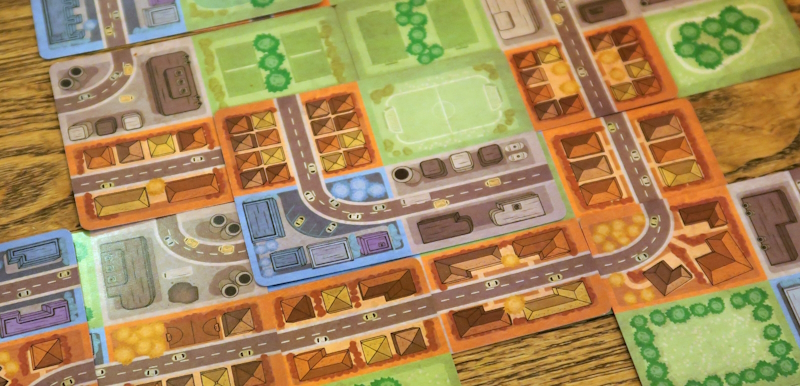
With a generally Japanesey theme planned for the evening to mark the official start of the Japanese Cherry Blossom Season, Blue and Pink, the early arrivals considered 5×5 Zoo, Songbirds and Honshū which were all abandoned variously because the rules were in Japanese, the game was too complex, or it didn’t natively play two. In the end, they settled on Sprawlopolis, which although very definitely not Japanese, did at least have a bit of a Japanese feel to it. The game is a simple quick cooperative micro-game where players take it in turns to at to their city by placing cards.
 |
| – Image by boardGOATS |
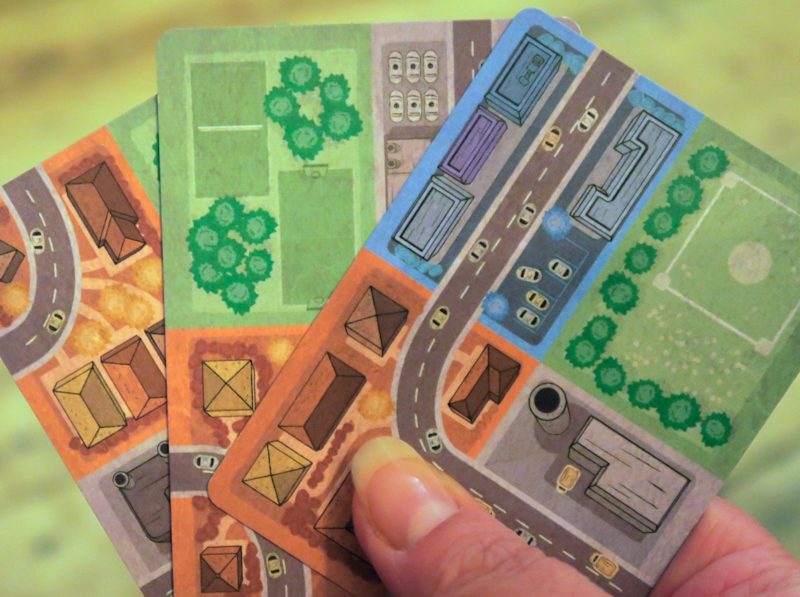
Each card is quartered with each section showing one of the four different zones, green Parks, brown Residential, grey Industry and blue Offices. The players score a point for each piece in the largest region of each city zone minus the number of roads, plus scores for each objective. This time the objectives were “Master Planned”, “The Outskirts” and “Sprawlopolis” giving a points target of twenty-five. It was close and, as Blue and Pink weren’t quite on the same wavelength with their planning (communication is allowed without describing the cards in hand) it was didn’t look like they were going to make it, but in the end, they topped the target by two points.
 |
| – Image by boardGOATS |
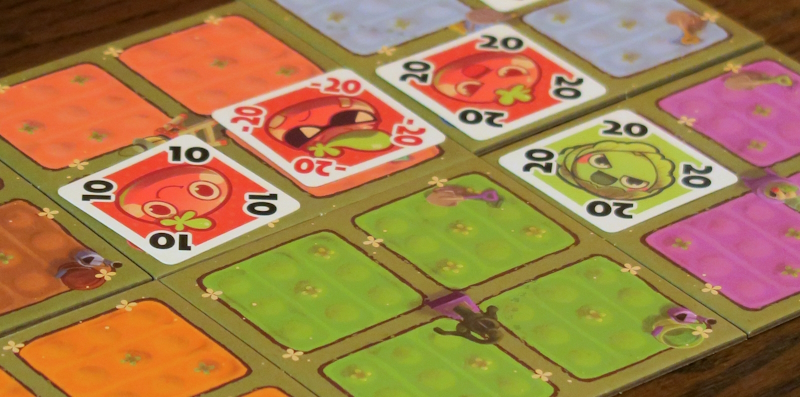
By this time, everyone else had arrived so the group split into three with the first group, a large group of six playing the “Feature Game” which was Habesuto (aka ハーベスト) which translates as “Harvest”. This is a quick game from Japan about building a farm, growing vegetables and distributing produce. On their turn players play a card onto the central board and then replenish their hand. Each player owns a field in the central play area; if that field is empty then players must play a card into their own field, thereafter, they can play anywhere. When a row of three or more cards is created, the cards are scored, with the cards, and therefore points, going to the owner of the field, but points can be positive or negative.
 |
| – Image by boardGOATS |
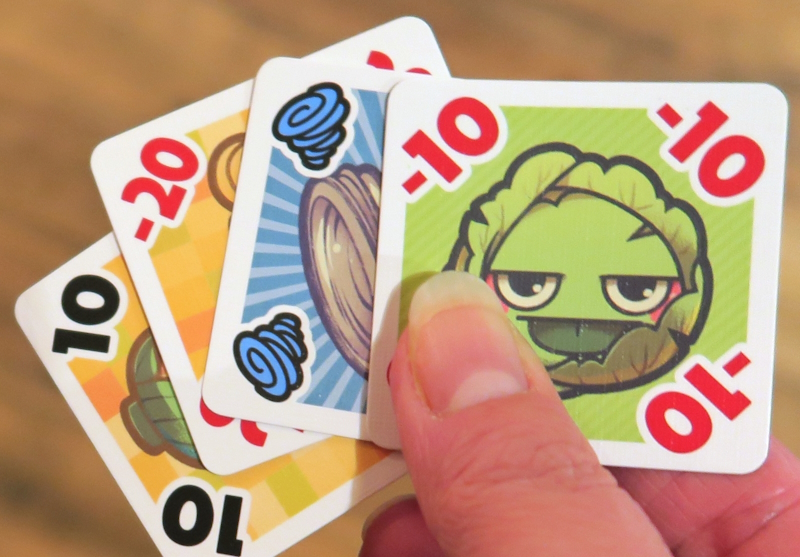
There are special cards like the Tornado which removes cards and the wild Harvest card. There are three vegetable suits of cards (red, yellow and green) each with five denominations, ten, twenty, forty, and minus ten and minus twenty. At the end of the game, when everyone has run out of cards or is unable to play, players score the value of each card in their score pile. To this they add fifty points if their field is empty, but subtract fifty points for each special card left in their hand.The game is really quick and nasty. Initially everyone felt their way through and began playing nicely. The niceness was reflected in the scores which were very even—Teal was the winner with a hundred points, but it was a three-way tie for second between Sapphire, Ruby and Lime.
 |
| – Image by boardGOATS |
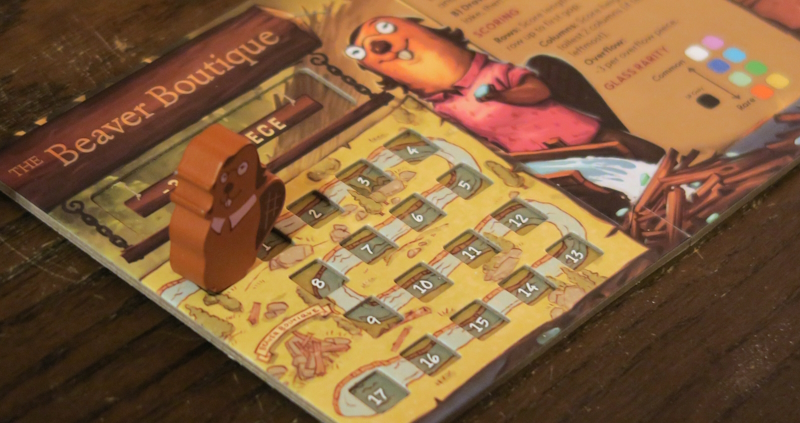
Everyone had got the feel of the game and wanted to play again, but this time, the gloves were off. Second time round, Ruby was the victor with Teal increasing his score, but dropping down the rankings into second with a hundred and sixty. Jade came in third, twenty points behind. The third round was a bit more evenly balanced, with Lime taking first place with a hundred and thirty and Flint the only other player to make it into three figures. Teal went from hero to zero and finished the final game with minus ten. From there, the group decided to move away from Japan and into a world inhabited by cute animals with River Valley Glassworks, which got its first outing just a week ago.
 |
| – Image by boardGOATS |
As River Valley Glassworks plays a maximum of five, Jade taught and acted as umpire. In this game, players take it in turns to play a piece from their inventory into the river. Each river tile can take only a specific shape, and players have to play into a space adjacent to where they want to draft from. After claiming their glass, the river shifts forward revealing new pieces. Glass is stored in players’ shops, and the scores depend on where the glass is placed with completed rows and columns giving bonus points. However, too many of one type gives negative points.
 |
| – Image by boardGOATS |
The game process is simple enough: either place a piece of glass onto a river tile or draw exactly four pieces from the lake with the aim of collecting a rainbow of glass pieces but the challenge is getting the balance right. In the end, the group did a “Lime”, that is, played it once and then decided to give it another go. First time round, the battle was between Ruby, Sapphire and Teal with Ruby holding off Sapphire by four points who in turn, just pipped Teal by one. By the second time, Teal had got the hang of things and won by a bit of a land-slide, finishing with sixty-six, eighteen more than Lime in second.
 |
| – Image by boardGOATS |
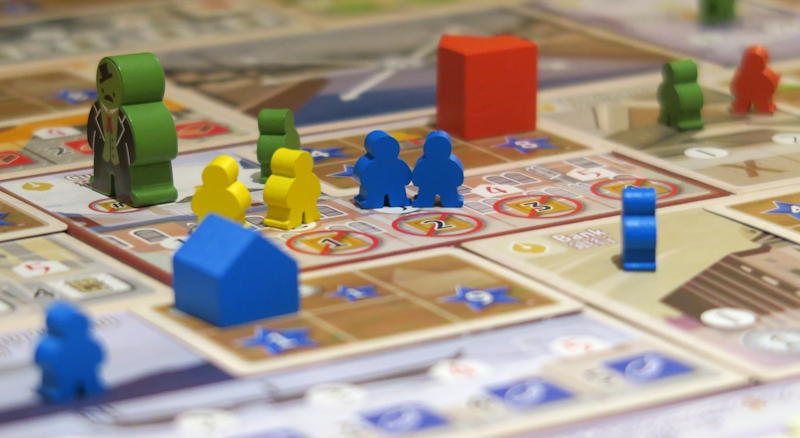
Meanwhile, on the other side of the room, Plum, Ivory, Byzantium and Blue settled down to play another Japanese game, which turned out to be something of a secret favourite amongst them: Yokohama. This is a sort of path building game, almost like a heavier version of the popular game, Istanbul. Players operate a Merchant who travels around building their business. They also have Assistants, Shops and Trading Houses. On their turn, players deploy one Assistant in three different areas or two Assistants in one area, then they move their Merchant. Merchants can move as far as they like, but can only travel through locations occupied by their Assistants and cannot finish in an area already occupied by another Merchant.
 |
| – Image by boardGOATS |
Players then perform the action associated with their destination, with the level depending on the Power of that player at that location. The Power is the player’s presence in that location, i.e. the sum of the President (equal to one), any Assistants and any Buildings. The more Power, the better the resultant benefit. A Power of four or more enables the player to build a Shop or Trading house at the location which will earn additional points or other rewards as well as providing more Power on future visits. Any Assistants at the location are “used” and returned to the player to be placed on a later turn.
 |
| – Image by boardGOATS |
As in Istanbul, the different locations provide different benefits. There are locations that provide resources (Tea, Copper, Silk and Fish), some that provide Order cards (Dock or Port) or Technology cards (Laboratory or Research centre) and others that enable players to get more Assistants, Shops or Trading Houses (Employment Agency), Money (Bank) or points (Church and Customs). Ivory started quickly, grabbing early points for the game focuses (lots of Tea) and getting some buildings placed, while Blue ended up with a pile of initially unwanted Fish and Plum spent some time tripping over everyone else. Byzantium, didn’t seem to be doing much but Plum rather ominously said that was the way he played the game, just before winning by a huge margin.
 |
| – Image by boardGOATS |
Ivory made great headway getting the goods to give him twenty-two points from the Customs House, but just as the game came to a conclusion he ran out of steam having spent lots of turns playing only two Assistants as opposed to three. It was a close run thing in the end with barely ten points between first and last, indeed, Ivory finished a single coin away from getting the ten point Technology that would have given him the game. As it was, Plum’s prediction proved right and victory was taken by Byzantium who had quietly got on with his game, mostly unnoticed by everyone else. It wasn’t the landslide foretold though, as his hundred and six points was only three points ahead of Plum in second.
 |
| – Image by boardGOATS |
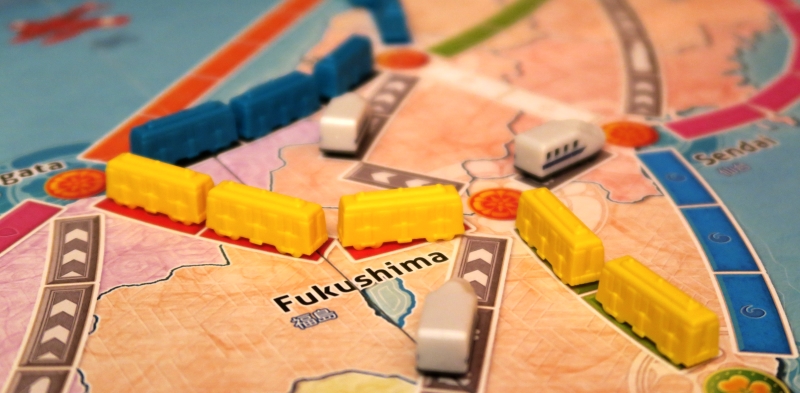
The last group were Blue, Pine, Purple and Black who started off with a game of Ticket to Ride with the Japan expansion. This is played much like the original base game i.e. players take cards from the market or play cards to place trains; score points for placing trains and completing Tickets. Like all the expansion maps, the Japan map has its own set of additional features, in this case, these a mostly focused on the Bullet Train which runs through the centre of the long thin board. Once these routes have been claimed, they can be used by all players to complete destination tickets. Instead of scoring points for such routes, players progress along the Bullet Train track. Whoever has contributed most to this shared project at the end of the game receives the largest bonus, with the player who contributes least being penalised.
 |
| – Image by boardGOATS |
Last time we played this game there was a rules malfunction associated with the Bullet Train, but this time, that wasn’t a problem. Much hilarity ensued when Purple place a single train route from Hiroshima to Okayama and entirely unintentionally prevented Pink from completing his four long Tickets costing him a total of fifty-two points leaving him with a final score of minus twenty-four. Pine found this so amusing that he went round the room telling everyone else. Besides this the minor aspect of the winner seemed immaterial, but that was Pine thanks mostly to his completed Tickets, double Black’s total which gave him second place.
 |
| – Image by boardGOATS |
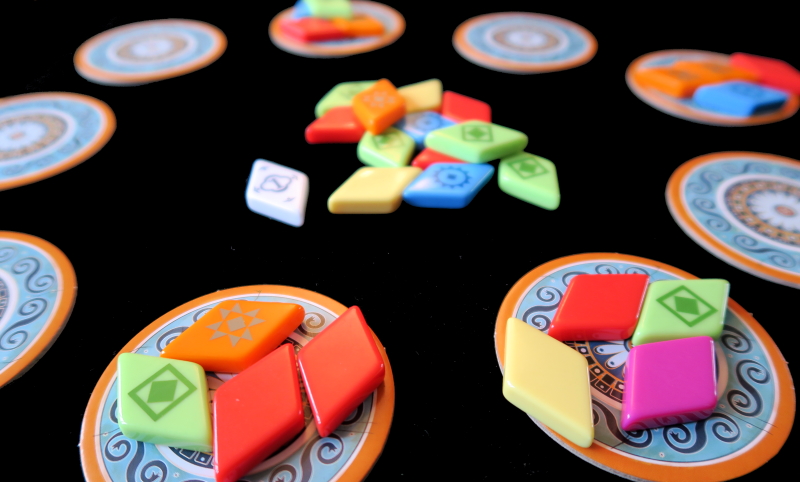
Once the dust had settled, Pine, Pink, Purple and Black rounded off the evening with a game of the Summer Pavilion version of our old favourite, Azul. This uses the same market mechanism as in the base game, but instead of taking square tiles and placing them straight away, players take lozenge shaped tiles and and put them to one side for the second phase when players place them on their player board. The pieces a positioned according to colour to form seven coloured “stars”. Each location is numbered according to the cost to play it—thus a space numbered five needs five pieces one of which is placed on the board while the others are discarded.
 |
| – Image by boardGOATS |
Placing one gives a single point while placing a second next to the first scores two and so on until the placing the sixth scores six points. So a priority is placing tiles to expand groups, however, surrounding statues give bonus tiles. Additionally, played over six rounds, each colour takes its turn as wild, though at least one tile of the required colour has to be played. At the end of the game, players score a bonus for each of the seven stars that they’ve filled completely and bonuses for completing all seven spaces of value one, two, three or four.
 |
| – Image by boardGOATS |
Pink couldn’t remember the rules, so summoned Blue to explain, but her brain wasn’t on the right page so Jade, who, by this time was just adjudicating, explained instead. The in-game scoring was quite close with just two points between Pine and Pink, and Purple and Black not far behind. So it all came down to the bonus points. Pine picked up points for completing his green star and all the seven spaces with the value one giving him twenty-two additional points. Pink’s fourteen points for completing his red star together with his twenty-four number bonus points more than off-set Pine’s small advantage, giving a modicum of revenge for the delight everyone got from his earlier misfortune in Ticket to Ride.
 |
| – Image by boardGOATS |
Learning outcome: Bad things that happen can make good memories, for some people at least.
 boardGOATS