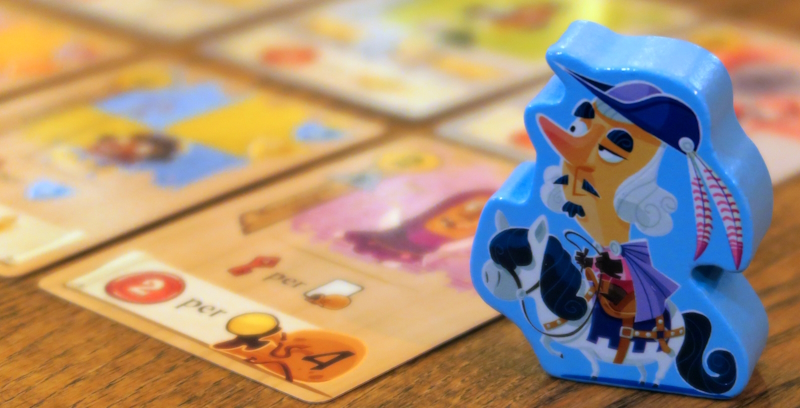
There were quite a few people eating this week, but the earliest arrivals were finished when Green turned up for the first time in months toting his copy of Lost Ruins of Arnak. Jade was already preparing to lead the “Feature Game” which was to be Castle Combo, and he was joined by Sapphire, Pine and Lime. This is a game that was released to coincide with Essen, but like many of the most popular games was sold out within a couple of hours. The essence of the game is tableau-building where players draft cards from two markets creating a three-by-three square of people interacting with each other triggering instant effects and end-of-game bonuses.
 |
| – Image by boardGOATS |
The two markets consist of Castle Cards and Village Cards. At the start of their turn, players can pay a Key to to carry out a special action, before they buy a Card from whichever market the Messenger token is currently located in and place it in their Tableau. Some card abilities grant a permanent discount when purchasing cards of a specific location (Castle, Village, or both). If a player can’t afford any of the cards (or choose not to pay for them), they can always take a card without paying its cost, and place it face down in their tableau. In doing so, they ignore its ability, its end game points and any other information printed on it, but immediately gain six Gold and two Keys in compensation.
 |
| – Image by boardGOATS |
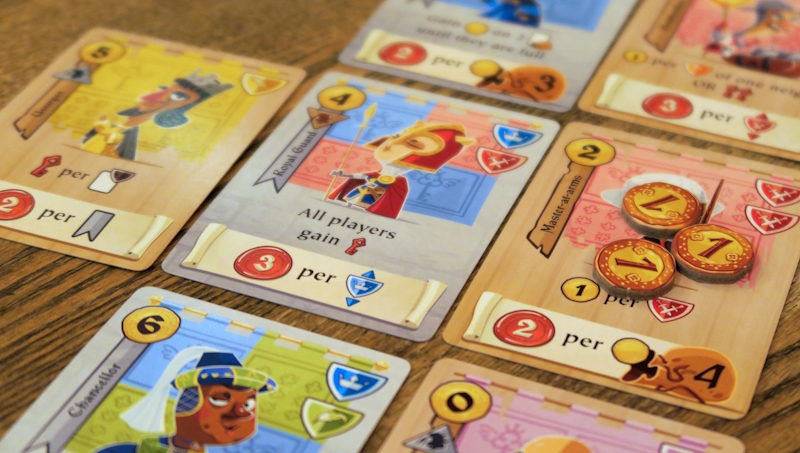
Each card after the first must be placed orthogonally adjacent to at least one other card in a player’s Tableau and at the end of the game, their Tableau must be a three-by-three grid of Cards. In this way, the final position of the cards in the array is fixed as the game progresses. Once it has been placed, the ability of the Card is applied. Some abilities affect opponents (all other players), while others affect a player’s neighbour (they choose which one). Finally, if the Messenger icon is depicted on the card played, the active player moves the Messenger Token, either to the Castle or to the Village, as appropriate, before refilling the market and ending their turn.
 |
| – Image by boardGOATS |
The game ends when everyone has nine Cards in their Tableau and everyone adds up their scores. This time, Sapphire went first as he’d played before. The game plays very quickly and smoothly as everyone began building up their displays. It turned out that playing before wasn’t a great deal of help, however,, as Pine gave everyone else a bit of a trouncing as his final Tableau was worth ninety-six points, seventeen more than Jade who took second place a handful of points ahead of Sapphire in third. Meanwhile, on the next table, Blue and Byzantium were leading a game of Stamp Swap at the request of Pink who had missed out last time.
 |
| – Image by boardGOATS |
This is another fairly straight forward game, albeit one that takes a bit longer than Castle Combo, though it plays just as smoothly. There is a lot of simultaneous play, which is nice because it minimises down time. First, players take it in turns to choose items from the central Pool, then simultaneously divide them into two piles of offerings. The player with the first player token, chooses and takes one of the piles offered by their opponents. The opponent keeps their other pile and then chooses a pile from one of their opponents and so on. Once everyone has two piles, players arrange the Stamps in their Album and then choose which of the four available end of round cards to score this time.
 |
| – Image by boardGOATS |
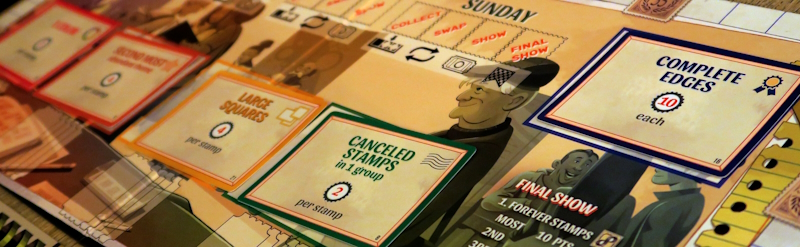
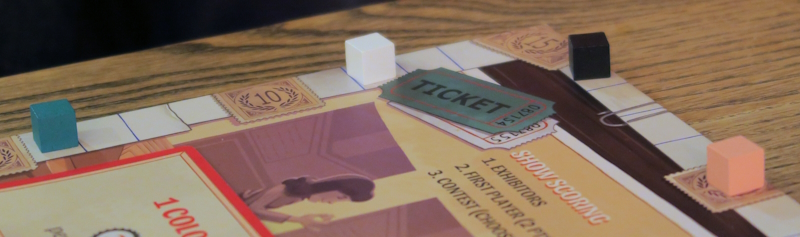
After three rounds, players score the end of game objective card and the player with the most points is the winner. One of the clever parts about this game is how much difference the objective cards make to the way players arrange their Stamps. This was very obvious last time when there were two parallel games and one scored Finale Contest gave for points for Stamps completely surrounded by other Stamps, while the other gave points for each empty region. The former gave lots of Albums where the Stamps were clumped together, while the latter gave spread out Stamps in a lattice-type pattern. This time, the Finale Contest gave ten points for each completed edge, so players began the game working along the borders of their Album page leaving a hole in the middle that they only filed in later in the game.
 |
| – Image by boardGOATS |
The end of round scores allowed players to score points for the number of stamps they had in one colour, the number of large square Stamps they had, the number of cancelled Stamps and the number of Stamps in their second most abundant theme. This artificially increased the value of large square Stamps, which was something that Pink failed to take into account early on. It led to Blue taking what Pink felt was his obviously less valuable pile and giving her a surprise Special Stamp with a sad face from him. Still, that was replaced with a big grin when he stole one of Blue’s hidden Stamps later in the game and it turned out to be the one with the Giant Panda on it.
 |
| – Image by boardGOATS |
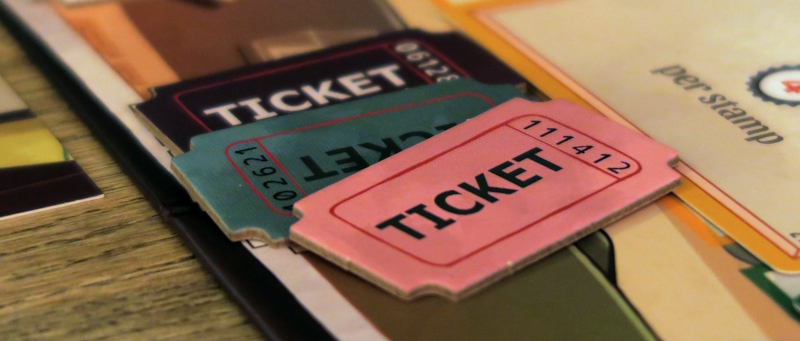
The first event card was Generous Gifts where players choose one of their Stamps to score and then pass on—always a difficult decision, but more-so at the start of the game. Slim Pickings was the second event giving players fewer items from the Pool at the start of the round, while Hands to Shake was the final event which made more Attendee Cards available, although by this time, it was too late to really take advantage of them. That said, Byzantium had made collected quite a few Attendee Cards, using them to great effect to gain extra points and Stamps and took one in the final round as well.
 |
| – Image by boardGOATS |
Aside from the Panda, Purple seemed to collect nearly all the Animal Stamps, while Pink did a good job of collecting Flowers. The game is a bit of a “Point Salad” though, with points coming in little aliquots from lots of different places, and it perhaps pays not concentrate too much on one aspect. Byzantium got a fast start and took an early lead, which he just managed to maintain to the end, beating Blue into second place by ten points, for the second time, which Pink taking third. While packing up, everyone agreed that they really enjoyed the game for its smoothness, and the only part that “jarred” was setting out the starting Pool which was a little laborious. Discussion online later, however, suggested a away to improve this, so that’s something to try next time.
 |
| – Image by boardGOATS |
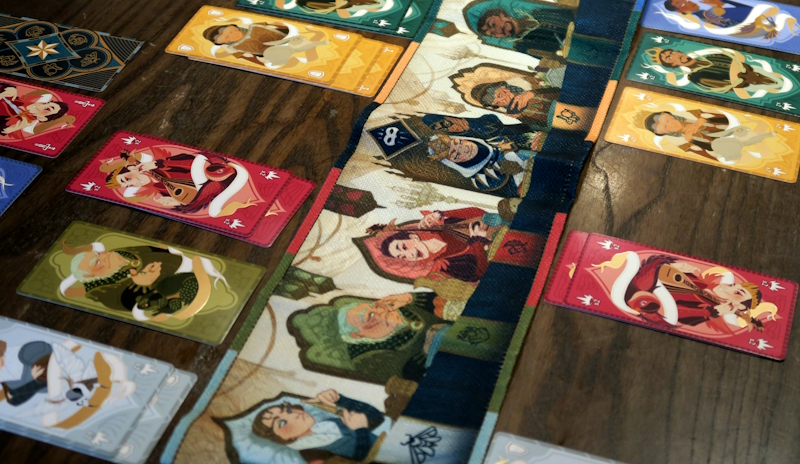
By the time Stamp Swap finished, Castle Combo had already come to an end and Jade, Sapphire, Pine and Lime had moved on to play Courtisans. We first played this a few weeks ago, shortly after UK Games Expo. This is a clever little card game from the same stable as Castle Combo and Faraway, where players are manipulating card values by where they play them. On their turn, each player receives and plays three coloured Family cards. One card is played at the Queen’s table to sway a Family’s influence in a positive or negative way depending on whether it is placed above the table or below. At the end of the game, those Families with more cards below than above will have “Fallen from Grace”.
 |
| – Image by boardGOATS |
One of the other two cards is played in the player’s own Domain and the other in an opponent’s Domain. At the end of the game, each card a player has from an “Esteemed” Family is worth a point, while each card from an Family that has “Fallen from Grace” loses them a point. Thus, players are trying to increase the value of the cards they have, while decreasing the value of the cards their opponents have. The first game was a game of two parts, Jade and Pine tied for victory with nine points, while Sapphire and Lime also tied with four points.
 |
| – Image by boardGOATS |
As is often the case with this sort of game, after the first play, once he’d seen how the game works, Lime requested a second game. This second game was higher scoring with players getting more “Esteem” and fewer Families that had Fallen from Grace. Both Jade and Lime completed both their objectives as well. Lime’s massive Esteem scoring of twelve, gave him clear victory with a total of sixteen points, while Jade, who finished with eleven points, just pipped Pine to second by a single point. There was a bit of chatter with everyone discussing the games, but nobody really had the inclination to play anything else before going home.
 |
| – Image by boardGOATS |
On the next table, while Blue took a little time out, Pink, Purple and Byzantium played a quick game of the sixteen card filler, Love Letter. This is a sort of multiplayer dueling game where players have a hand of one card, draw a second from the face down deck and then choose one to play, with the aim of being the last player standing, or the player with the highest value card if in the event that the deck runs out first. The trio only played two rounds, but Byzantium managed to get knocked out first turn both times. It was a tie between the other two though, with Purple taking the first round and Pink the second when he knocked out Princess Purple.
 |
| – Image by boardGOATS |
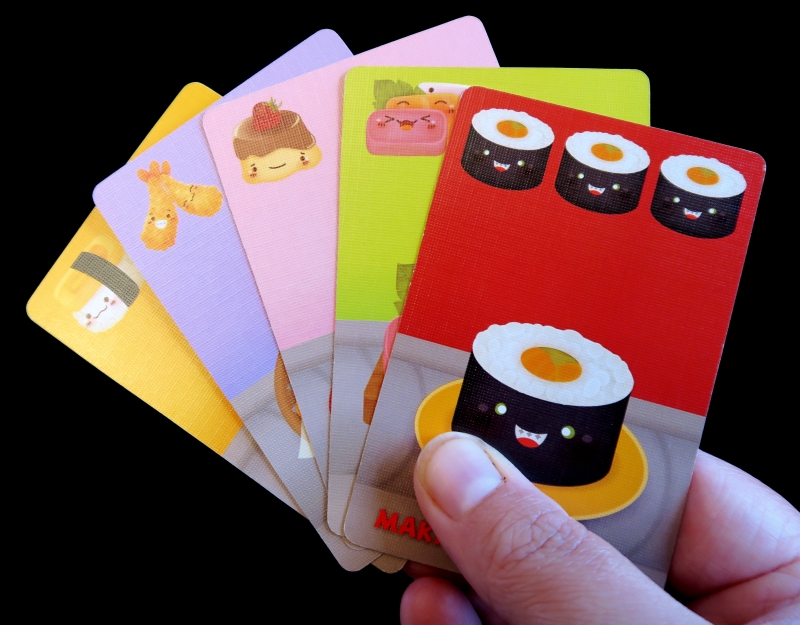
After two rounds, the trio got bored and moved on to playing Sushi Go!. Sushi Go Party! had had a mention earlier in the evening, but as none of them were familiar with the rules changes, they stuck with the smaller, original version. This is a simple, and one of the purest card drafting games where players start with a hand of cards, keep one and pass the rest on. The cards are Sushi and players are trying to get sets, or pairs, or as many as possible depending on the Sushi on the card. The group played the full three rounds, with very mixed outcomes. At the end of the game, the player with the most Pudding cards gets extra points, but as all three tied so nobody got any. The winner was Byzantium, with a massive fifty-eight points, seven more than Pink in second in what was a high scoring game.
 |
| – Image by boardGOATS |
Byzantium was waiting for Plum to finish on the other side of the room, so Blue rejoined the group for a quick game of something silly—an old game that Blue and Pink acquired at Essen, called Why First?. The premise of this game is, what’s so important about being first, maybe the winner should be the person who is second. So in this game, players start with a hand of five number cards and simultaneously, chooses a card to play before, on the count of three giving it to someone. This player’s piece is then moved that number along the race track. The round ends after five cards, the last of which must be used to move the payers’ own piece.
 |
| – Image by boardGOATS |
At the end of the round, only the player who is second scores, and that depends on their location on the track. In the first round, Blue came second (and therefore won the points) and Pink won the second. Byzantium won the third, but as he finished on the start line, he scored no points, much to his chagrin. Blue and Purple tied for second in the fourth round so both took a single point, before Purple took the final round. The winner of the game is, obviously, the player who comes second overall. Despite a lot of effort by Blue who ultimately finished first and therefore lost, this was Pink who was therefore the winner.
 |
| – Image by boardGOATS |
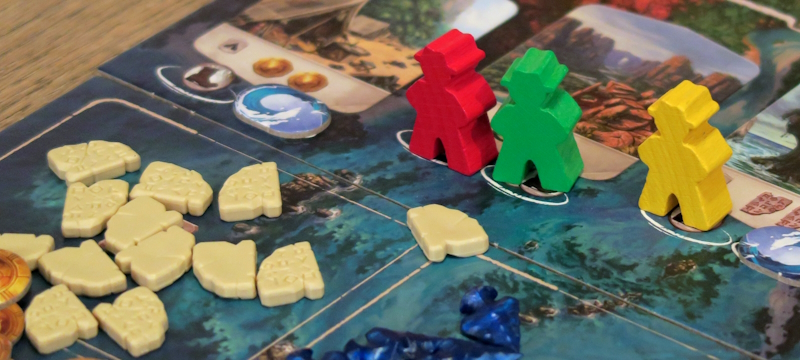
By this time, the table on the other side of the room had finally finished and were packing up. Green had clearly arrived wanting to Lost Ruins of Arnak, and Ivory and Plum had kindly joined him. This had an outing about six months ago, when Green and Plum were also involved. By this time, however, Green had acquired The Missing Expedition expansion and, having played the game quite a lot solo, wanted to include it to add interest. The basic game combines deck-building and worker placement with resource management. Players start with six cards in their deck, two Money, two Compasses and two Fear cards (which just clog up players’ hands), and draw five of these to play.
 |
| – Image by boardGOATS |
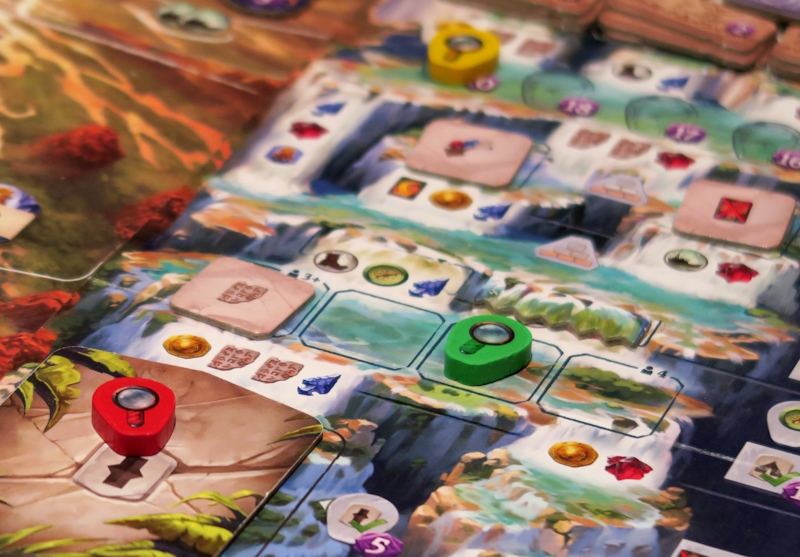
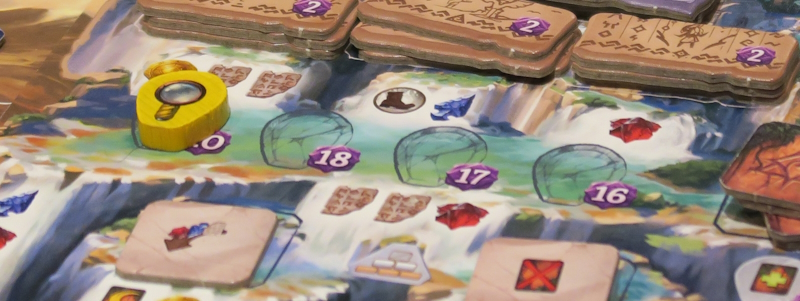
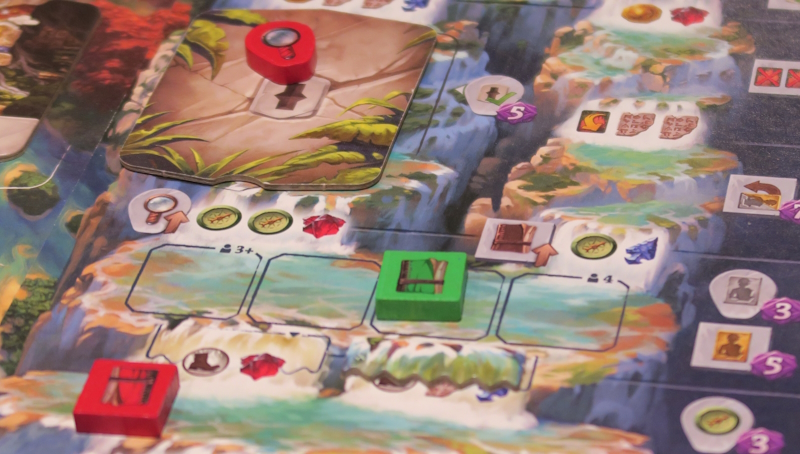
Players then have two meeples each that can be sent to locations on the map, to either discover or use an action Location which generally give Resources plus some extras. Each new site has a Creature guarding it, which, if beaten, will give points and a small one-time bonus. Players can use resources to move up the Research Track giving different rewards. Players get one action each per turn, until everyone has passed signalling the end of the round, and the game finishes after five rounds. The Missing Expedition expansion is modular, but this time the group added the Waterfall Temple and the extra encounter cards. The Waterfall Temple has a couple of steps whose cost changes each time someone Researches past them which can make it a bit unpredictable, though there is a sneaky shortcut to the top of the temple for players prepared to pay the steep cost.
 |
| – Image by boardGOATS |
The first round went very quickly with everyone having limited options. Green and Plum began moving up the Research track, looking to gain an Assistant as soon as possible, where Ivory focused on gaining coins and an additional card. Ivory grabbed the Recovered Plane card (from the expansion) that allowed him to recall his explorers and using them again, which felt quite powerful. In the second round, Plum and Green both got their Assistants. They also started getting additional cards with Plum getting the Unreliable Compass card that gave her the benefits from the bottom tile of the exploration track and Green got the Army Knife which gave him flexibility when gaining Resources. Ivory began Exploring, uncovering the first new worked spot, slowly followed by Plum. Ivory managed to use his Plane card to avoid the Guardian, whereas Plum didn’t have that option and gained a Fear card at the end of the round.
 |
| – Image by boardGOATS |
In the following rounds, Ivory begin focusing on the research track, catching up with Green and Plum and eventually overtaking them. He reached the part of the track where he could gain the Resources on a set aside exploration tile and got one that gave me an Explore card from the expansion which gave him the choice of something now or something latter. As the third and fourth rounds progressed, the Research track became a core focus Ivory managed to reach the top the first. Everyone continued exploring, and Ivory was also the first to explore a level two tile, gaining additional idols and resources and then subsequently able to recall his explorer to avoid the Guardian and Fear card.
 |
| – Image by boardGOATS |
Plum was also Exploring, though at the lower level, but unfortunately the Guardians that she was drawing meant they were very difficult to defeat and she picked up more Fear cards. Green was Exploring less, but was using the engine that he assembled with his Assistants and cards to explore and defeat quite a few Guardians, adding to his engine whilst also gaining points. Towards the end of the game, the question for everyone was how to be most efficient and make the most moves up the Research track. Green joined Ivory at the top, and additionally gained enough Resources to grab an eleven point temple tile. Ivory was looking for an additional Resource to move my notebook up one more step and then remembered he hadn’t gained the bonus tile for reach the top of the Research track, gaining him that valuable Resource.
 |
| – Image by boardGOATS |
Plum was also pushing up the Research track, looking to squeeze as much value as possible. Ivory also had accumulated quite a few coins, which allowed him to buy lots of cards during the final round just for their points. With everyone passing in the final round there was just the small matter of the scores. Points for Exploring, Research and Idols were pretty much level. Green’s engine which allowed him to gain the eleven point temple tile and defeat four Guardians (as opposed to Ivory’s and Plum’s one) ultimately gave him victory with seventy-seven points. Ivory’s Artifacts and Item cards gave him second ahead of Plum who had struggled with her Fear (bordering on Terror!) throughout the game.
 |
| – Image by boardGOATS |
Learning Outcome: Princesses don’t want to live in Ruined Castles.

 boardGOATS