This week, Jade was proactive and quickly got a group together to play the “Feature Game“, which was to be Flip 7. This is a quick, push-your-luck card game along the lines of Blackjack and recently won a Golden Geek award and received a nomination for the Spiel des Jahres. The group have already played it a couple of times on a Tuesday, but we wanted to raise its profile and share it more widely amongst our people by making it the Feature Game. The idea is really simple: players turn over cards and gamble on not revealing the same number twice. Unlike Blackjack, the game is played turn-wise, so the the dealer starts by dealing one card to each player. Then players take it in turns to decide whether they want to “flip” or ” stick”.
 |
| – Image by boardGOATS |
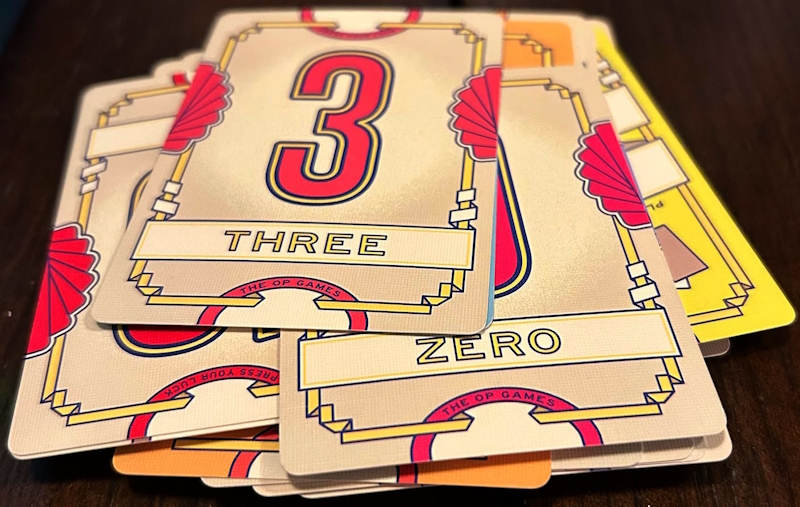
This mode of play is critical to the game’s popularity because it keeps everyone involved and the turns short. If players stick, they score the total of the face value of their cards. There are a couple of other things that make the game tick, in particular the fact that each numbered card appears in the deck that number of times (i.e there is one one, two twos and so on). Thus, the highest scoring cards are also the most risky. Further driving push to gample, flipping over seven cards in a row gives fifteen bonus points. There are also some action cards in the deck, “Flip Three”, “Freeze”, “Second Chance” and modifier cards which give extra points, all of which break the rhythm and add interest without adding significantly to the downtime.
 |
| – Image by boardGOATS |
The game ends when players have reached the pre-agreed total (two hundred, according to the rules, though games can easily be made longer or shorter as desired). This time, the group played the game as written, to a total of two hundred, which took seven rounds. Sapphire and Flint managed to go bust five and six and seven rounds respectively, though Flint did manage to push his luck to get seventy—the most in a single round. Jade achieved a new low, however, failing to score at all. The front runner was Teal, but going bust in the sixth round left the door open to Ruby who had been matching him step for step, scoring in every round and triggering the end of the game with her unsurpassed two-hundred and thirteen.
 |
| – Image by boardGOATS |
Everyone else was playing a longer game, so with six, that left the choice of another six player game or splitting into two groups of three. The party feel of Flip 7 had got everyone in the mood for playing in a larger group, leaving a fairly limited choice, though there are a couple of really good options. Bohnanza is one, but instead, the group chose Faraway—another game that received a Spiel des Jahres nomination this year, that we first played in the group over a year ago and has proved very popular since. This is another relatively simple game, this time with a market and a trick-taking type element, but with a really clever twist, and one that really messes with the head.
 |
| – Image by boardGOATS |
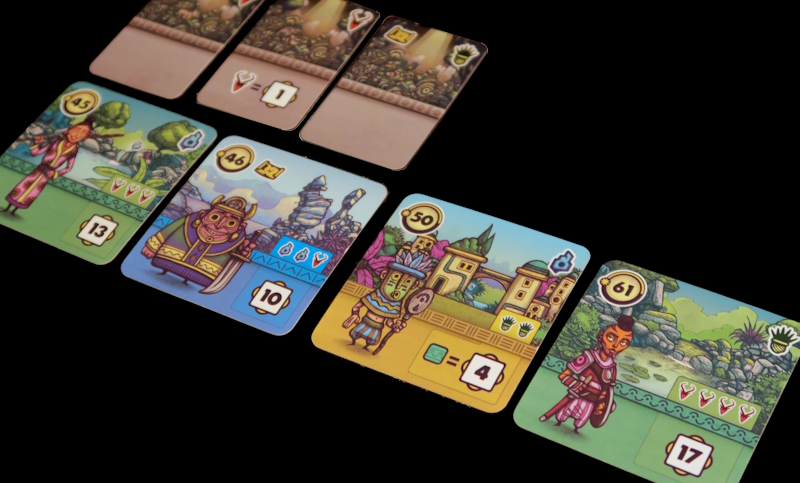
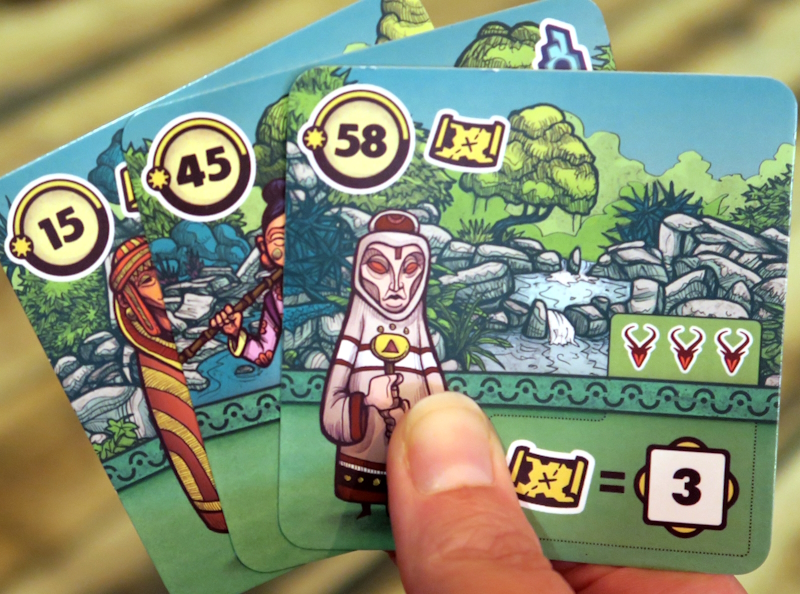
The story is that players are exploring the mysterious land of Alula in search of its secrets, meeting its inhabitants and listing its wonders in order to gain more fame than everyone else. Players simultaneously chose one of the numbered cards from their hand to add to their tableau then, starting with the the player that played the lowest card (similar to 6 Nimmt! or Kingdomino), everyone takes it in turns to choose one from the market to add to their hand. Players then simultaneously choose another card to play, and again, choose one to add to their hand. The game ends after everyone has played a total of eight cards, and then everyone scores.
 |
| – Image by boardGOATS |
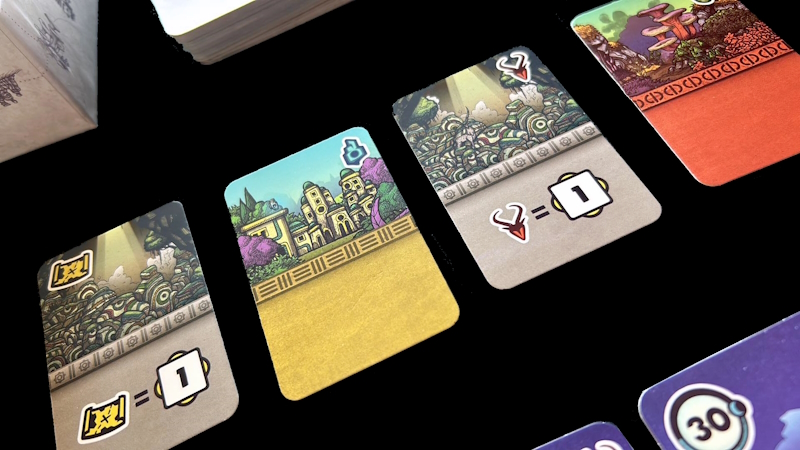
The scoring is the really clever part, because although the cards are played into tableaux from left to right, the scoring is from right to left. At first glance, this looks like it makes things easy, because early in the game players find out what they need to get points and can then focus on getting the resources they need as the game progresses. However, the desire to play scoring cards early is tensioned against card choice (the player who placed the lowest numbered card goes first) and the ability to get Sanctuary bonus cards. Scoring cards are generally higher number and Sanctuary cards are gained when the card played has a higher value than the previous one in their tableau.
 |
| – Image by boardGOATS |
It is always hard to see how players are doing with this game, because if a player has played a high value scoring card early it can be worth a lot, but if the player fails to gain the necessary resources it can be worthless. In the event, it was quite close with four of the six players scoring over sixty. The winner, however, was Pink who got lucky early when he played card number fifty-nine first to start a map strategy and finished with five of them. Sapphire was only two points behind in second though, and Teal two points behind that.
 |
| – Image by boardGOATS |
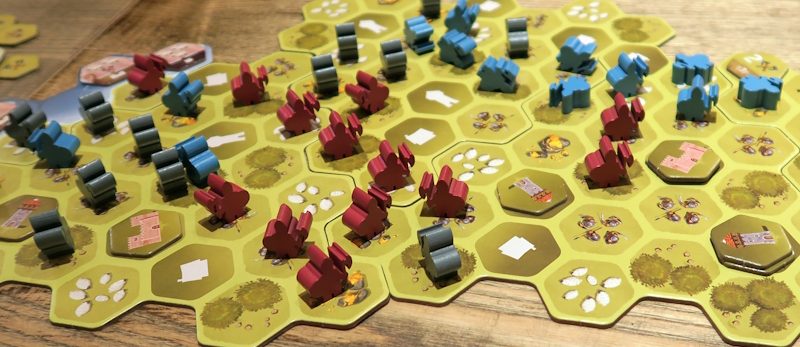
Meanwhile, on the other side of the room, Black and Purple were introducing Pine to Looot, another game that received a nomination, this time for Kennerspiel des Jahres, the “Expert” or “Connoisseur’s” game. This is a game where players gather resources and capture buildings to develop their fjord, fill their Long Ships and complete buildings to rack up victory points. The player with the most riches is crowned Jarl of the Vikings. The game is played over several rounds until each player has played all their Vikings, giving a maximum of thirteen turns. In each, a player first places their Viking on a Resource tile on the central board adjacent to another Viking of any colour and takes the Resource and place it on their personal board.
 |
| – Image by boardGOATS |
If possible, they then capture a Building and place that on their board, take a Long Ship and also place it on their board, use a Shield, complete a Construction Site and finally grab a Trophy. At the end of the game, scoring is a bit of a point salad with points awarded for Castles, Watchtowers, Houses, Gold, Sheep, Trees, Construction Sites, any Trophies the player may have claimed and a five-point penalty for any unfilled Long Ships. Purple raked in points for her Houses, Construction Sites and Trophies, while Black did better for his Watchtowers and Gold, and Pine top-scored for Trees. The winner, however, was Purple whose total of ninety-one was five ahead of Black in second.
 |
| – Image by boardGOATS |
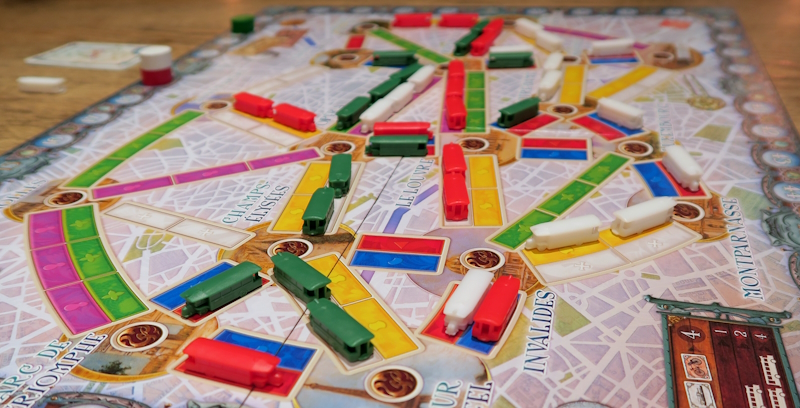
The trio followed this with a shorter game, the Paris version of the 2004 Spiel des Jahres winner, Ticket to Ride (aka Zug um Zug). Like the original, game-play is very quick and simple: players take it in turns to take Cards from the market, or spend them to place Trains on the map with the aim of completing Tickets. Players score points for placing Trains and completing Tickets with penalties for any incomplete Tickets. Each game variant has its own special rules. In the case of Paris, when players score bonus points each time they complete a Tricolor: a set of blue, white, and red routes. This time it was a very close game. Pine had the most points collected during play (including Tricolors), but Black picked up more for his Tickets and edged it by a single point.
 |
| – Image by boardGOATS |
The final game of the night took all evening and was the only one that that has not had a nomination for the Spiel des Jahres, Century: A New World. This is the final game in the Century Trilogy (preceded by Spice Road, Eastern Wonders), but as they all use some of the same components, Plum and Byzantium had managed to squeeze all three games into one box (with an extra set of cubes so two could be played at once). In A New World, players are exploring the Americas at the dawn of the 16th century trading with local inhabitants, recording their findings, and hunting and gathering to survive.
 |
| – Image by boardGOATS |
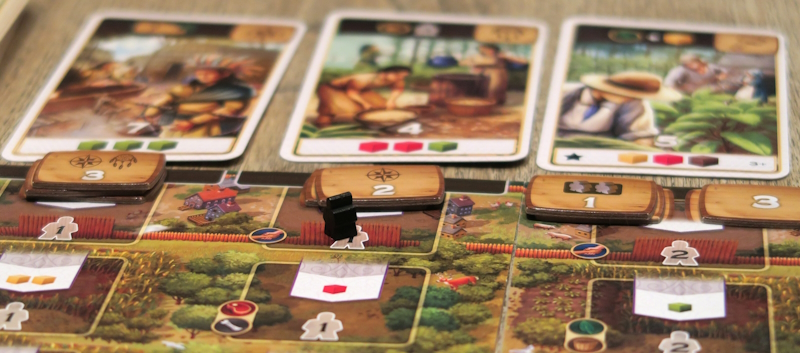
The game uses the resource trading mechanisms (Collect, Upgrade and Exchange) found in the rest of the Century series, but instead of using cards as in Spice Road, this is combined with with a worker placement mechanism. On their turn, players can either Work (place Workers) or Rest (retrieve Workers). Workers can work at Locations that have neither an Exploration tile nor Workers of their own colour. If a Location is vacant, they can activate it by placing the number or workers depicted on the space; if it is occupied, the current occupants must be evicted and returned home by placing one extra Worker.
 |
| – Image by boardGOATS |
There are four locations types, thee allow players to Collect, Upgrade and Exchange Resource cubes, while the fourth (Forts) allows them to use Resources to claim Points Cards and Bonus Tiles. Players can only have a limited total number of Bonus Tiles, and can only claim the Points Card associated with the particular Fort. These Cards are supposed to slide along a conveyor belt so that they move from one Location to another, but thanks to a rules malfunction, this time the didn’t until more than halfway through the game. The game finishes when one player has their eighth Points Card, so it can end quite suddenly, as players can pick up cards quit quickly due to special powers.
 |
| – Image by boardGOATS |
These games are basically race games, and it felt like Byzantium had a good start with points from his Exploration tiles, the only one to have any. However, as Plum built her engine, she galloped up on the rail, ultimately taking the most points from her Cards. She also took the most points from Bonus Tiles. In such a tight game, left over resources were critical and they enabled Cobalt to leap-frog Byzantium into second. Plum was the winner, though by just two points. It had been fun, though Plum’s comment that she actually preferred the second of the trilogy meant Blue who had not played it would take the opportunity to grab a copy at the UK Games Expo Bring and Buy a couple of days later.
 |
| – Image by boardGOATS |
Learning Outcome: The Spiel des Jahres Jury can spot a good game.
 boardGOATS