The evening started with a lot of chat about the new and used games people had picked up at UK Games Expo a few days ago, with everyone very keen to play their new acquisitions. The “Feature Game” was to be one of these, a a shiny new pre-release copy of Sierra, flown in specially for the fair by a chap from Hachette Boardgames UK called Flavien Loisier who was recognisable by his memorable, playable, MicroMacro suit. Sierra is card game about traveling the Andes that received a UK preview at UK Games Expo, and is a very unusual game. There are several different ways to play the game including cooperatively and competitively, but this time the group went with working in pairs, playing with the person opposite.
 |
| – Image by boardGOATS |
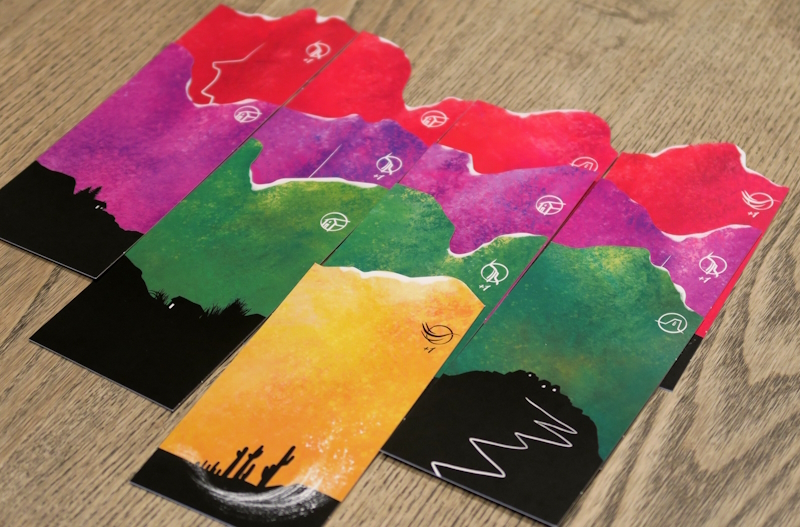
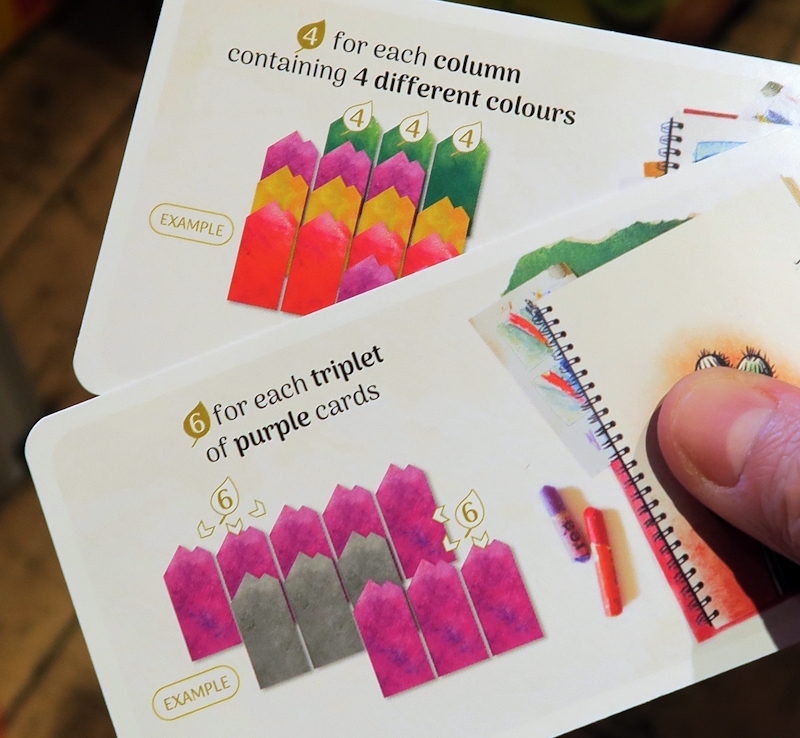
The pairs were Jade & Sapphire, Blue & Ivory, Black & Byzantium, and Purple & Plum. The idea is that in their pairs players place cards from their shared hand to create a landscape and earn points for satisfying their objectives. The catch is that while the Landscape cards are shared, all but one of the objectives are not. In each round, the player with the Landscape cards draws two and plays two, while the other player draws two Objective cards and keeps one for themselves. At the end of the round, the player with the Landscape cards passes them onto the next couple and the player who drew the Objective cards receives two Landscape cards—thus, the roles are swapped over for the next round.
 |
| – Image by boardGOATS |
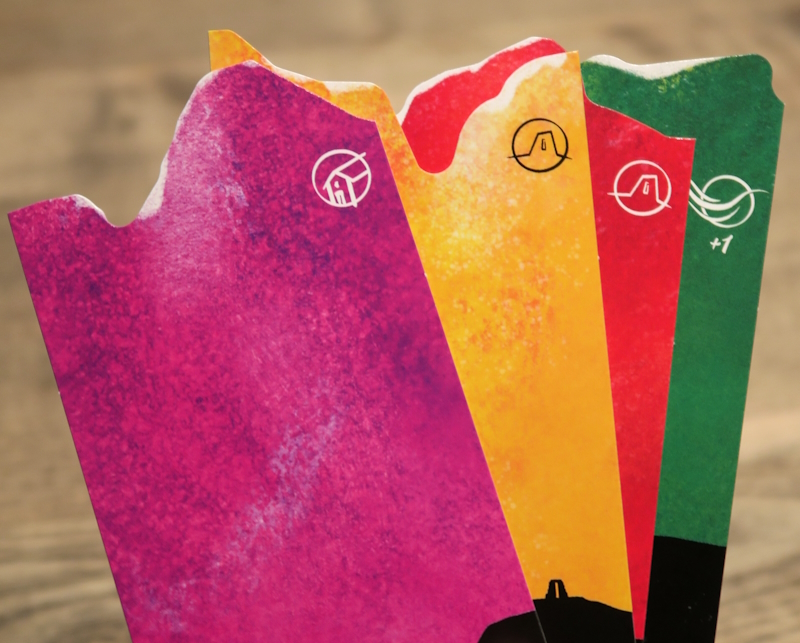
The Landscape cards come in four different colours and can be placed at either end so that the colours match, or they can start a new row. The tops of the cards makes them look like mountain ranges, the cards form an interesting tableau. As well as the colour, each card also has one of six symbols: Mammals, Birds, Houses, Ruins, Rivers and Wind—these are used for scoring. After eight rounds each player will have four Objective cards and each pair’s shared Landscape will contain sixteen Landscape cards. The game play was very different with so many players and playing in pairs. The cards and the Landscapes the formed were beautiful. Everyone who was new to the game started feeling their way somewhat, but eight rounds doesn’t last long and it was all over really very quickly.
 |
| – Image by boardGOATS |
The scoring turned out to be a little quirky and in the end took almost as long as the game. Each player then scores one point for each River and Wind cards in their shared Landscape and scores for their shared Objective. Players then count the number of points they have earned for their individual objectives. The player with the highest total wins, however, the partner of the player with the largest total receives a bonus of five points If, with this bonus, the partner has more points than anyone else, then the pair win as a team. This time, Blue and Ivory scored the most for their shared Landscape. Individually though, it was a tie between Plum and Ivory as Plum scored much more for her personal Objectives (as indeed did Purple).
 |
| – Image by boardGOATS |
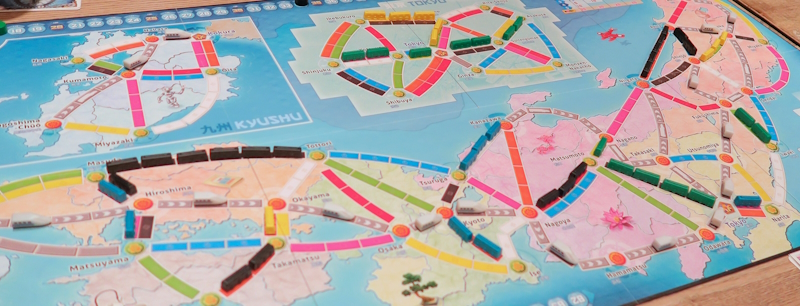
Because the individual winner was tied, there were no “team bonuses” awarded, which left the scoring feeling a little unsatisfying somehow and nobody fancied playing again straight away. Instead, the group split into two groups with Ivory, Sapphire, Jade and Blue deciding to squeeze in a quick game of Ticket to Ride with the Japan map. This had an outing fairly recently (when Pink hilariously took a fifty point hit when Purple played a single train claiming the route from Hiroshima to Okayama and blocked all his Tickets), but all the people involved in that game were elsewhere.
 |
| – Image by boardGOATS |
The Japan map is played exactly the same way as all the other versions of Ticket to Ride (i.e. take cards from the market or spend them to place trains in order to fulfill Tickets), but on a map of Japan and with the addition of the Shinkansen or “Bullet Train”. Once a player has completed a section of Bullet Train, any player can use it to complete Tickets, but the player who completed that section moves along the Bullet Train Track. At the end of the game, the player who progressed the furthest, who contributed the most to this shared project receives the largest bonus, with the player who contributed least being penalised.
 |
| – Image by boardGOATS |
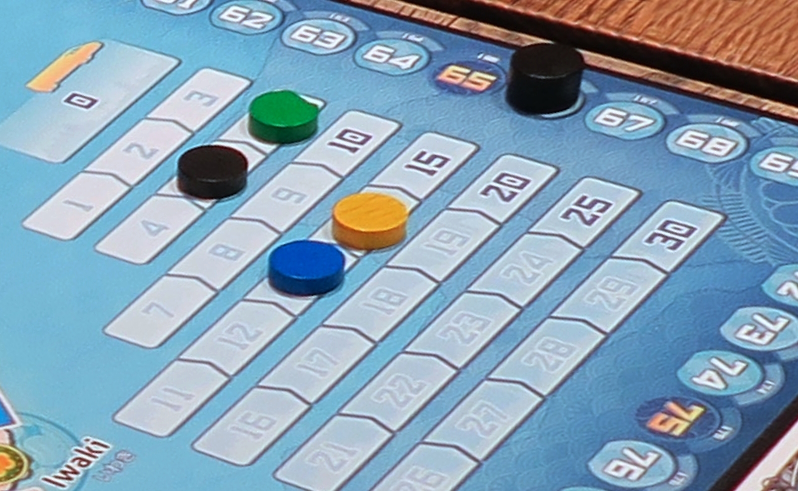
This time, everyone went for the Bullet Train early, so much so that there was quite a battle and by the time Sapphire realised what was going on, it was too late and he was left with the penalty. That forced him to switch tack however, which might actually have done him a favour as he left Blue and Ivory to fight for the biggest, twenty-point bonus. It was all really tight, but Sapphire was some way out in front as the Shinkansen points were evaluated. And despite picking up a five point penalty, there he stayed to claim victory—Ivory who finished in third, pipped Blue on the Bullet Track, leaving her runner up with an eight point deficit (instead of a two point lead).
 |
| – Image by boardGOATS |
The other half of the Sierra group had moved on to play another game picked up at UK Games Expo, Tegula. This is a very beautiful game played with beech wood hexagonal tiles with artwork based on Roman mosaics. The idea is that players have to match the edges in order to place them. Players can use actions to swap tiles, give tiles or play extra tiles and the first player to run out is the winner. This time that was Black, with Purple the best of the rest (i.e. the player with the fewest tiles left, and Plum and Byzantium tied for third.
 |
| – Image by boardGOATS |
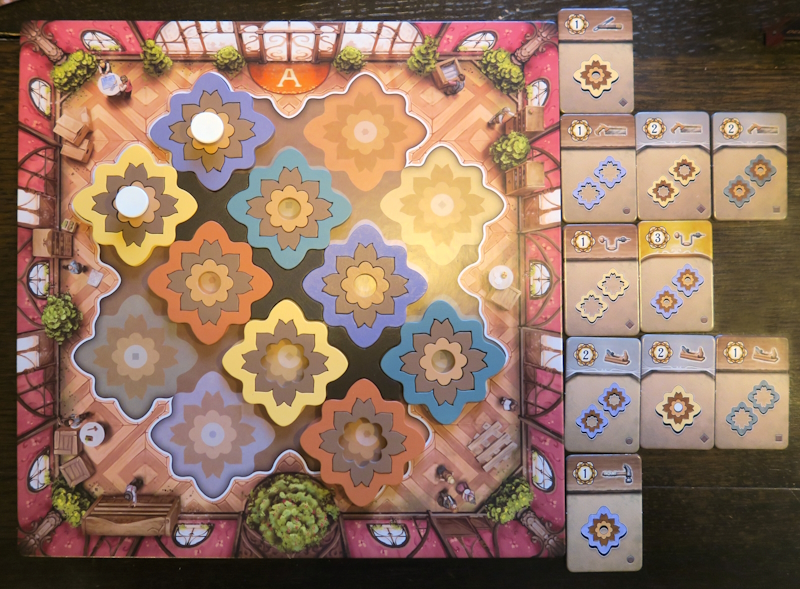
Meanwhile, Mint had also brought her new acquisition from the UK Games Expo, Intarsia, and taught it to Pink and Pine. Although this had a most uninspiring box cover and the uninteresting theme of polishing wooden floors, the game itself is really pretty and fun to play. Like Tegula, it is also made out of wood, the game is played over three rounds with eacvh round comprising three phases. First, each player takes the ten Material Cards depicted on their Starting Hand Card from the general supply. Players then take it in turns placing wooden elements onto their Flood Boards by paying the necessary Material Cards and taking new ones where possible and claiming and scoring Tool Tiles when their requirements are complete.
 |
| – Image by boardGOATS |
Finally, players score points based on the number of connectors they’ve placed and choose a new Starting Hand Card to begin the next round. At the end of the game, players calculate their scores for the number of intarsias they’ve built and add them to their running total and the winner is the player with the most points. The game was very tight… for second place! In the end Pine pipped Pink’s ninety by a single point, but Mint took victory by a bit of a landslide with a hundred and eight, as she had four intarsias, compared with three and two for the others. It had been a very enjoyable, lovely tactile game though and that hadn’t out-stayed its welcome.
 |
| – Image by boardGOATS |
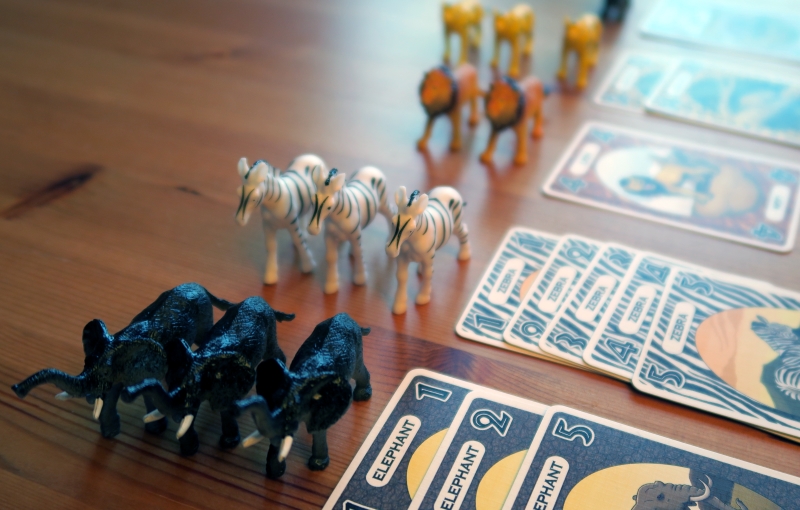
With the floor duly polished, the trio moved on to introduce Mint to the weird and wonderful game that is Botswana. This is a sort of stocks and shares game played with cards and plastic animals. Players start with a hand of cards and, on their turn, choose one to play taking a plastic animal of their choice from the central supply to add to their holding. At the end of the game, each player scores for each animal with points equal to the total number of animals of the type they hold, multiplied by the face value of the last card of that type that was played. Thus a player with five elephants might be scoring twenty-five points until another player replaces the “Five of Elephants” with a zero and crashes their value.
 |
| – Image by boardGOATS |
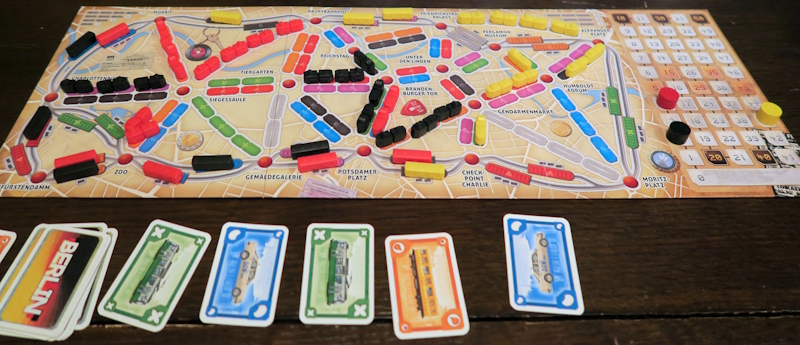
This game went down to the wire, but Pine just got his nose in front, with twenty points for his lions and fifteen for his rhinos giving him a total of thirty-five, on point more than Mint, while Pink finished a few points behind that. There was just time for another very quick game and the game they chose was Ticket to Ride: Berlin—one of the city versions of Ticket to Ride. These are much quicker to play, but still follow the same collect cards and spend them to place pieces in order to complete Tickets pattern. However, in Berlin, players have two different kinds of train car to place—trams and U-bahn trains. On the board, there are specific single-space routes that can only be filled using an U-bahn train.
 |
| – Image by boardGOATS |
The number of coloured cards required to complete the U-bahn is indicated on the game board (up to three), but similar to the Bullet Train in Japan, players only ever place one piece on than U-bahn route. Players only have a total of five U-bahn carriages to work with and their placement is critical, which makes Berlin one of the more interesting of the city games. Once again, this was a close game with everyone using all their pieces. Pink was the victor however, beating Pine into second by two points, but that meant that all three of them had won a game, so everyone went home basking in the warm glow of success.
 |
| – Image from facebook.com adapted by boardGOATS |
Learning Outcome: You can get some great games from UK Games Expo.
 boardGOATS