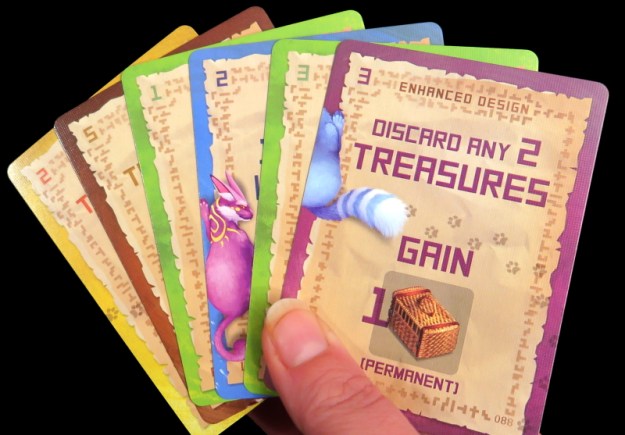
Despite missing a few people, we were still well into double figures, and more than enough for two groups to play the “Feature Game“, the Kittens module from the Kittens + Beasts expansion to The Isle of Cats. The Isle of Cats is a tile laying game where players are trying to rescue Cats and place them on their Ship while scoring points for completing Lessons (aka end of game goals). The game is played over five rounds, with each round starting with players getting twenty Fish and a hand of seven Cards. These Cards are drafted two at a time, that is to say, players keep two Cards and pass the rest to their neighbour and repeat until they have none left. Players then choose which Cards they want to use, paying their cost in Fish and discarding the rest.
 |
| – Image by boardGOATS |
There are five different types of Card: blue bordered Lessons; green bordered Rescue Cards; yellow bordered Treasure Cards, brown bordered Oshax Cards and purple edged “Anytime” Cards (which can be played at anytime). Lesson Cards are objective cards and come in two types, Private and Public, with Private Lessons being secret, personal objectives and Public Lessons being revealed and available for everyone. These are revealed before anything else happens. Next players decide which Rescue Cards they are going to play—unlike the Lesson Cards, these can be held over for later rounds. Rescue Cards feature either “Boots”, or “Baskets” or a combination of both.
 |
| – Image by boardGOATS |
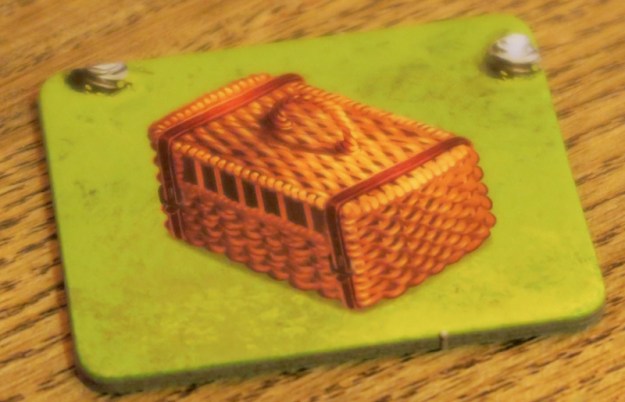
Boots dictate player order, whereas Baskets allow players to rescue more Cats; players start the game with one permanent Basket which can be used once per round to rescue one Cat, but these can be augmented by temporary Baskets from the Rescue Cards. Once the Rescue Cards have been played, then, starting with the player at the top of the mountain (the one who played the most Boots), players start to rescue Cats. The Cat Tiles are drawn at random from a bag before the start of the round, placing Cats on both the left and right sides of the island. Players then take it in turns to use Fish to lure Cats into their Baskets and relocate them on their Ship.
 |
| – Image by boardGOATS |
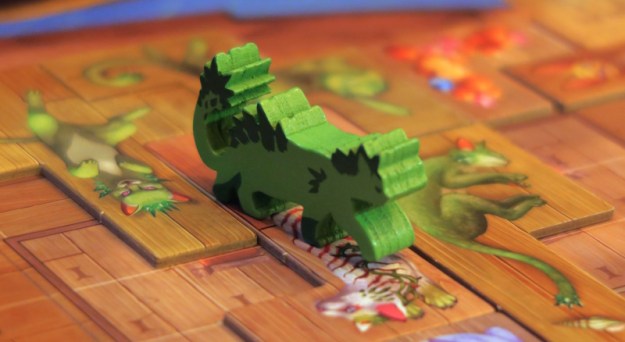
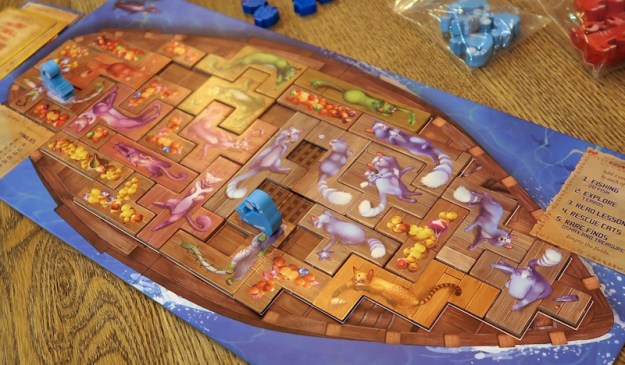
The first Cat can be placed anywhere on the player’s Ship, but thereafter, new Cats must be placed next to another Cat. At the end of the game, players score points for groups of adjacent Cats of the same breed (colour), with negative points for each room on their Ship which hasn’t been filled and any Rats on the deck which haven’t been covered. Finally, once everyone has rescued all the cats they can, players then take it in turns to play any Rare Finds Cards they choose from their hand—these are brown edged Oshax Cards and yellow bordered Treasure Cards. Oshax are friendly Cat-like creatures that are added to the player’s Ship and adopt the colour of a breed of the player’s choice.
 |
| – Image by boardGOATS |
The Kittens module from the Kittens + Beasts expansion adds cute little Kitties that the fastest player (the one who played the most Boots), can rescue instead of fully grown cats. Being smaller they are are more flexible when it comes to placing them on the player’s boat and two can be rescued at a time, using only one basket. At the end of the game, they behave just like full-sized Cats for scoring and therefore can be highly lucrative, while adding little complexity to the game. Players also score for their completed Lessons and the player with the most points after the five rounds of the game is the winner.
 |
| – Image by boardGOATS |
The first thing everyone had to do was decide who was going to play what and where. In an effort to separate couples who usually play together, Blue led one game with Sapphire, Ivory, Pine and Yellow (on his first visit), while Pink was persuaded to join Jade on the other side of the room along with Purple, Plum and Lime. That left Black, Byzantium, Cobalt and Teal who took themselves off to a third table. The first game (led by Blue) got going quite quickly, while the second (led by Jade) quickly realised that discretion is sometimes the better part of valour, and decided to skip the Kittens expansion and stick to playing the base game.
 |
| – Image by boardGOATS |
Blue began by eschewing Boots and sitting repeatedly at the bottom of the hill, hoping to save them all for one large push later in the game. This was a plan reinforced by one of her Lessons which would give her extra points if she finished the game as the first player. Pine, Yellow and Ivory all had a shot at collecting Kittens, while Yellow and Ivory got lucky getting several Oshax cards in the deal which they prioritised buying and playing. It is always difficult to get a feel for who is winning in this game, but going into the final stages, it all felt quite tight. Blue played all her Boots and a load of baskets in the final round, but was trampled by Sapphire who played a massive fourteen Boots to take the lead and much to his delight, costing Blue a massive Cat Carrier full of points.
 |
| – Image by boardGOATS |
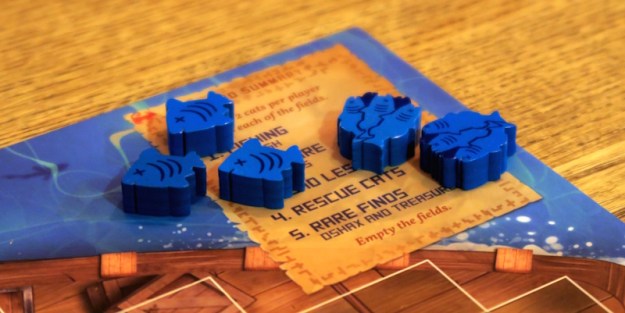
Her problems were made worse by the fact she didn’t realise her Lesson giving her a two points for each visible rat at the end of the game was in addition to rather than instead of the negative point they usually accrue. In a close game, such loses are costly, and this was quite close with only twenty points between between first and last place and only three points separating third and fifth. There was more of a gap to Pine with seventy-five points in second, but the winner on his first game with the group was Yellow, thanks to a large clowder of blue Cats and only one room on his boat unfilled. The game on the next table was considerably less close, however.
 |
| – Image by boardGOATS |
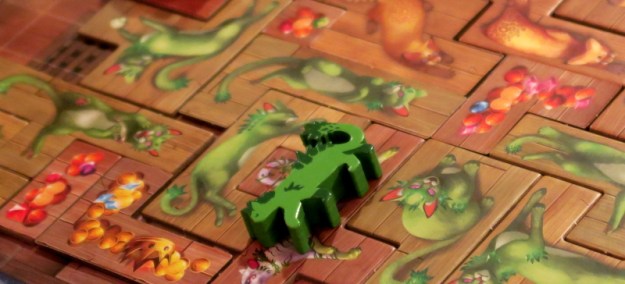
Teaching had taken quite a bit longer and the group also played more slowly, so as a result, as round three came to a close with no end in sight, the group chose to finish the game after four rounds instead of five. For some, this was not a huge problem as they were able to modify their game plan so they could complete their Lessons. For example, Plum wouldn’t have fulfilled more of her Lessons with more time, but successfully completed her five-by-five grid of purely green Cats (though she had one too many touching the central one for her “five Cats touching one” Lesson to score. In the final scoring, the difference between first and last was a massive sixty-five points, probably not helped by shortening the game, though that wasn’t the only cause.
 |
| – Image by boardGOATS |
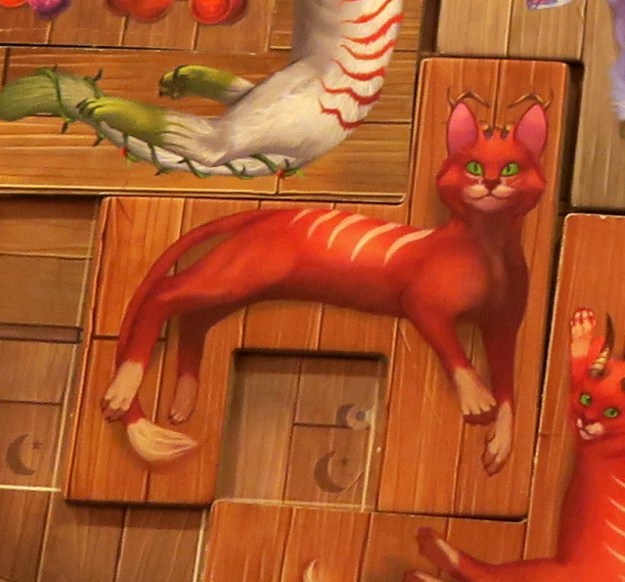
Jade had concentrated on teaching and trying to keep the game on track while Purple had struggled reading the cards without her glasses. Plum who singularly failed in her duty of of providing residents for the box lids took third some way behind Pink in second. The runniest of runaway winners, despite never having played before, was Lime thanks to a huge number of successfully completed Private Lessons. These considerably more than offset his negative points from Rats and unfilled rooms on his Ship. It was a slow game that led to some to comment that there was a lot to be said for the lighter, more streamlined, roll and write version of the game, Isle of Cats: Explore & Draw.
 |
| – Image by boardGOATS |
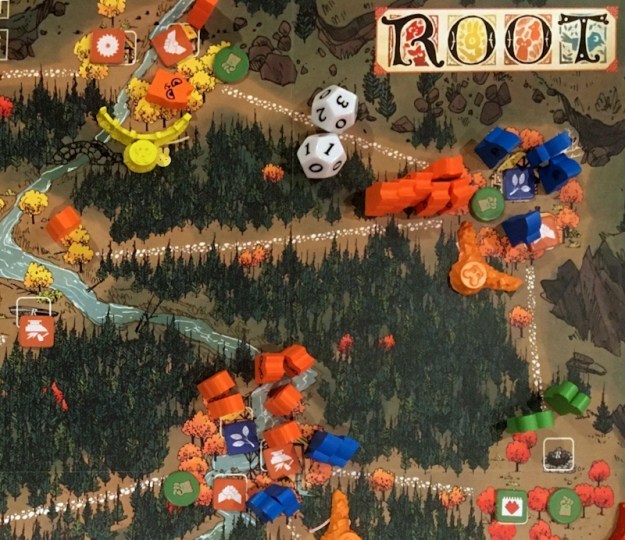
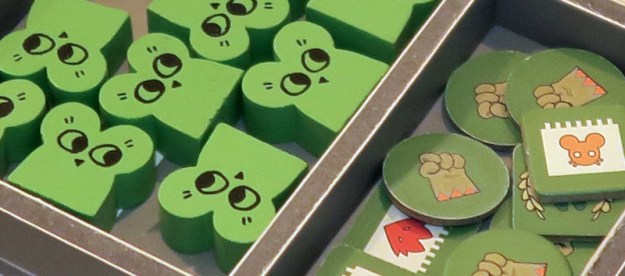
Meanwhile, Teal had found three people who were prepared to give the epic game, Root, a go—something he’d been keen to play with the group for a long time, but had not happened due to its reputation as a long game. With Cobalt being familiar with the game too and Byzantium and Black keep to play as well, the group decided to give it a try. Root is a board game of competitive area control in a fictional woodland setting. Players adopt the role of one of four asymmetric factions (increased to ten in expansions) – roughly split between area control and insurgency play-styles. In our game we used the four factions from the base set.
 |
| – Image by boardGOATS |
The Eyrie Dynasties are aristocratic Birds of the old regime (think Greece in decline following Roman expansion), the faction of the Marquise de Cat control the whole board with an empire of Cats at the start but are thinly spread (like the height of the Roman Empire on the brink of collapse). The Woodland Alliance are like a Peasant’s revolt faction, reacting to mistreatment by their rulers with outrage and sometimes acts of extreme violence. The Vagabond is a solo actor represented by a single piece, out for themselves—a mix of Robin Hood, folk hero, mercenary for hire and outlaw just doing their own thing.
 |
| – Image by boardGOATS |
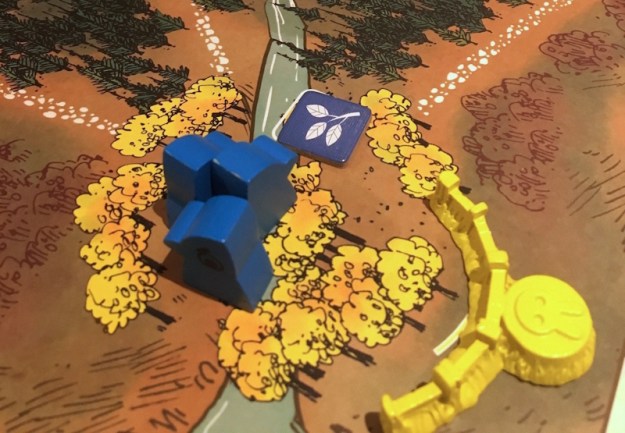
The basic rules of movement, combat (and gaining points for destroying opponent tokens and buildings), use of cards for crafting items for points and bonuses and ruling the twelve settlements connected by paths are common to all. The game immediately ends when one player achieves thirty victory points. Each faction has a unique play-style, breaks the standard rules in their own way and has their unique process of gaining victory points. One of the challenges of playing asymmetric games is that players need to not only learn their own unique rules, but also have to understand their opponents’ strategies and abilities to effectively counter them. Cobalt and Teal jointly taught the game to Black and Byzantium, which was helped by the clear player boards which take a step-by-step approach to what a player can do on their turn.
 |
| – Image by boardGOATS |
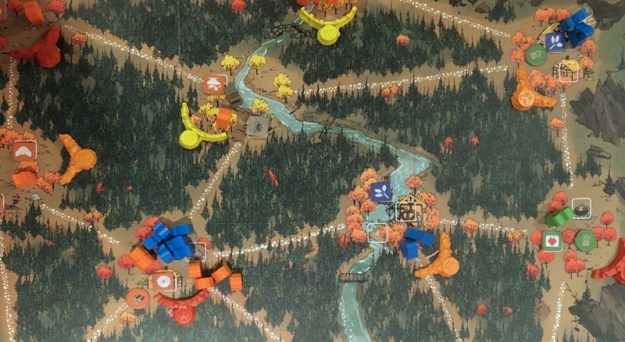
The Marquise de Cat gains points each time they construct a building even if these are re-builds after they have been destroyed. In the early stages of the game, Byzantium with the Cats shored up his defenses by retreating to a front-line which he could hold against bird incursion. The Cats then focused on a steady building programme, starting with Sawmills to generate timber tokens to enable even more building. Each time a Workshop, Recruiting Post and Sawmill is built on the map board and removed from the player board it reveals a point value of increasing value. With the production engine in place Byzantium steadily increased the Cats’ building construction rate and the points flowed in.
 |
| – Image by boardGOATS |
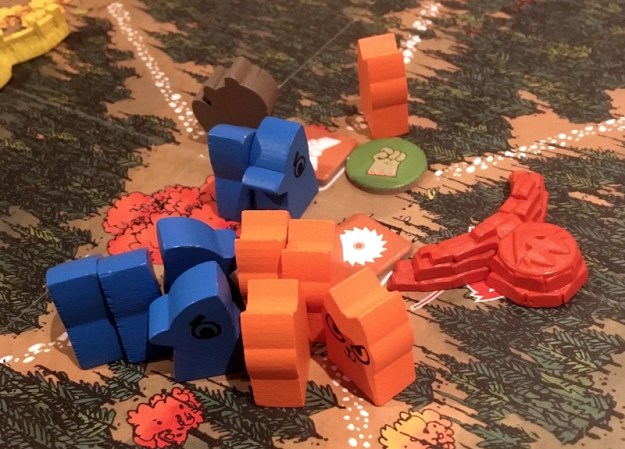
The Eyrie gain their points by the number or Nests which they have on the board at the end of each round. The Birds of the Eyrie, under guidance of Black steamrollered around the board with a massed horde, dominating clearings and building Nests. At one point this ended up in a massive ongoing siege with the Cats into which both players poured Warriors. The Eyrie have to add cards to it’s decree each turn locking it into committing to a certain number of moves, battles, recruitments and builds in the allocated clearings. Failure to complete any of these orders each turn immediately results in the Eyrie government going into Turmoil and concomitant loss of points and a new flavour of Leader (with unique abilities) being selected.
 |
| – Image by boardGOATS |
The Eyrie eventually suffered one great Turmoil, like a playing card pyramid toppling after becoming too unstable. But Black quickly managed to use the refresh of the decree cards to their advantage by choosing cards which provided greater flexibility of actions and was nearly able to catch the Cat’s tail. The Woodland Alliance gain points by uprisings of popular support across the board expressed by placing of Sympathy tokens. The Alliance under the control of Cobalt steadily built up support in a corner of the board gradually establishing rebel bases for more control—these grant wipe-out of all other pieces in a clearing when established and unlock new abilities for the faction including recruiting Warriors, battling and converting Warriors into Sympathy tokens.
 |
| – Image by boardGOATS |
The more Sympathy tokens placed in clearings, the more points they generate. The Woodland Alliance eventually managed to build all three bases and also to place eight Sympathy tokens (the eighth now generating four victory points). To move into areas with Sympathy tokens the Cats and Eyrie had to pay a card tax (Outrage) to Cobalt, who could then use these cards as “Followers” to produce more Sympathy for points. This snowballing engine of points was just getting into gear promising to pay dividends when the Cats building rate pushed into the lead.
 |
| – Image by boardGOATS |
The Vagabond earns points by exploring ruins for items, fulfilling mini-missions (by exhausting items tokens in their Satchel) and trading with other players. Teal as The Vagabond, spent the early game exploring ruins to locate useful items and trading cards for crafted items from other players—being a friend to all and posing no threat. Vagabond trading gradually upped their status with the Eyrie so that they had become an ally meaning that each time a card trade resulted in two points. All was set to for a strategy of fulfilling missions to generate cards, to gift to the Eyre and gain points, when the Cats won!
 |
| – Image by boardGOATS |
Byzantium, The Marquis de Cat achieved the thirty points he needed to win with Black as the Eryie taking second with twenty-seven and Cobalt and the Woodland Alliance pipping The Vagabond, Teal to third by one point. In spite of the game being new to two people, the turns passed fairly quickly and momentum gathered with point-scoring as the game progressed. When the game concluded all were happy to have completed the game with time to spare before the pub closing bell. It had been a successful teach and timely play of a game which has a reputation for being difficult to introduce to new players for a one-off session without prior preparation. Hats off to the quick learners and to the group as a whole for resisting analysis paralysis in the interests of game-play.
 |
| – Image by boardGOATS |
Learning Outcome: Every game should come with “Cat Setup” instructions.

 boardGOATS