Tag Archives: The Spirits of Niagara

27th December 2022

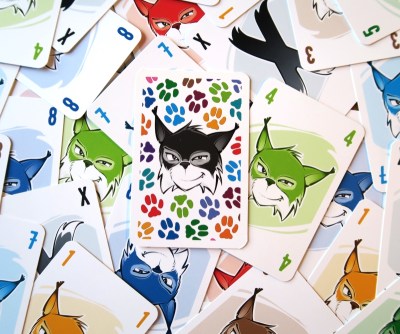
It was a quiet night with everyone still recovering from Christmas.  Black and Purple arrived at the advertised 7pm, soon followed by Lime and then Pink, Blue and Pine.  After a bit of chatter about Christmas and the “To Let” sign outside the pub, the group eventually settled down to play the “Feature Game“, Zuuli.  This is a light, family friendly, card drafting game that is a bit like Sushi Go! or 7 Wonders, but with animals.  Similar to Sushi Go! or 7 Wonders, players choose a card from their hand before passing it on to the next player.
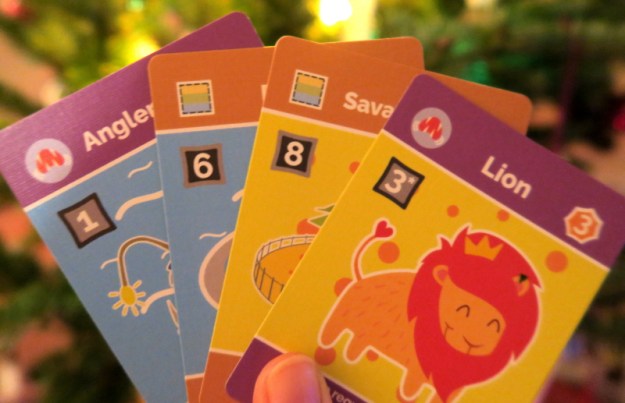
Zuuli
– Image by boardGOATS

In contrast to Sushi Go!, however, instead of using cards at the end of each turn, players save them until the end of the round and then try to make sure they have all the animals housed.  The game is played over three years (“Really?” commented Lime, “I thought you said it was a short game—I had no idea we were going to be here until 2025!”).  In the rules as written, there is scoring at the end of each of the three rounds (or years), but it was clear that everyone was struggling with the rules a little at the start, so we “House Ruled” it so for the first game, we only scored at the end of the final year.

Zuuli
– Image by boardGOATS

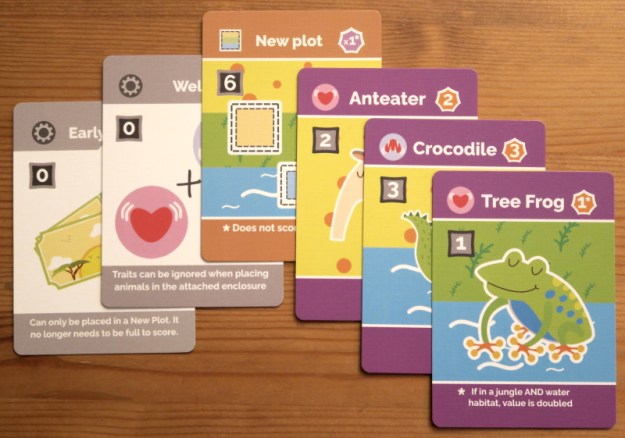
The idea is that each enclosure has a size, habitat type and a satisfaction multiplier while each animal has a space requirement, habitat and satisfaction.  To score, for each enclosure, players simply add together the satisfaction value of the animals and multiply the total by the value for the pen.  There is a catch, however.  As well as ensuring the animals have enough space in the right habitat, players also have to make sure that animals don’t eat each other: animals are either fierce or friendly, friendly animals can share an enclosure, but fierce animals can only live in an enclosure with their own kind.

Zuuli
– Image by boardGOATS

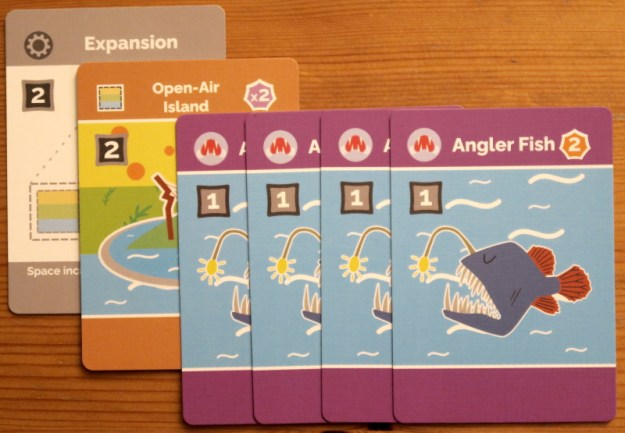
Additionally, some animals and some enclosures have special conditions, for example, tree frogs score double if they are in both water and jungle habitat, and the starting enclosure (the “New Plot”), only scores if it is fully occupied.  There were lots of rule clarifications:  the first concerned why you would want more land expansions which add no additional space (answer, because they add terrain type).  Then some of the animal conditions needed clarifying, and finally whether an expanded New Plot needs to be full (including the expansion). This was not helped by the fact we were including the extra cards from the mini expansion (now included in the second edition, namely hippos and red pandas).
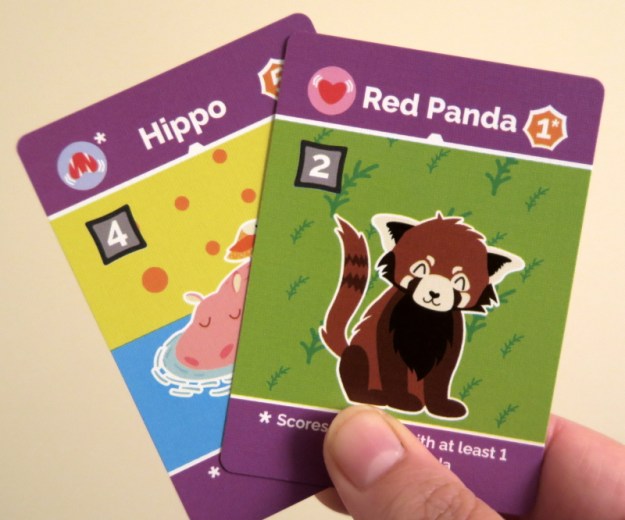
Zuuli
– Image by boardGOATS

As a result, it was a bit of a messy first game, made worse by the fact that the Christmas spirit meant people were struggling to concentrate.  The end result was quite tight though with a single point between first and second as Pink just pipped Blue with Black not far behind.  It was no surprise, when Lime suggested giving Zuuli a second try now we all knew what we were doing.  As it turned out, this was more a case of, “now Lime knew what he was doing.”  This time, we played with the rules as written, including the scoring at the end of each year.
Zuuli
– Image by boardGOATS

By the end of the second year, it was very clear that Lime was going to be the winner, the only question was by how much.  In the end he beat Pink into second by a massive twenty points as he finished with seventy-one, though Pink felt he deserved a bonus points for failing to kill his red pandas with hypothermia (unlike Longleat who managed to kill their two cubs born to much fanfare over the summer).  Blue and Pine were not far behind Pink fighting it out for third, but this time it was all about Lime whose scores in the second and final year were well ahead of everyone else’s.
Zuuli
– Image by boardGOATS

With six, the question was then whether to play as two groups of three, or stick with a larger group of six.  As a sociable group, especially at Christmas and other festivals, we tend to go for the latter, and this time was no exception.  Whenever there are six players, Keyflower always gets a mention and Pink had put it in the bag, but it was too late to start it really.  That left either a couple of much shorter, filler-type games, or Niagara.  Mostly people have refused to play Niagara with Pink since, in a “Moment of the Year” he infamously won a game by daring to play by the rules, stealing gems from several others including Burgundy and Blue who never forgave him.
Niagara
– Image by boardGOATS

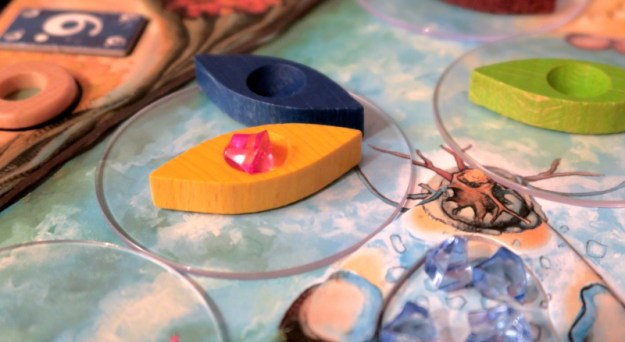
Lime felt that with five against one it was a good opportunity for the group to get their collective revenge and Niagara duly made it to the table.  This is an older game which won the Spiel des Jahres Award nearly twenty years ago, but is still a lot of fun.  It is a sort of programming game where players simultaneously choose which Paddle tile they are going to play and then take it in turns to activate that action (mostly move their canoe).  Players begin with two canoes which they use to collect gems and attempt to return them to the starting jetty; the winner is the first player to get home four identical gems, one of each of the five varieties or any seven gems.

Niagara
– Image by boardGOATS

The game is really made, however, by the really cool moving river, which is essential to the game play.  After each round, the river moves, with the movement equal to the movement of the slowest canoe.  In addition to moving canoes somewhere between one and six spaces (depending on the Paddle tile played), players can also adjust the speed of the river by playing a Cloud Paddle Tile.  This adds a little extra jeopardy, especially as players cannot reuse Paddles until they have used them all and when they play their cloud, their canoes don’t move and therefore risk their craft plummeting over the cataract.

Niagara
– Image by boardGOATS

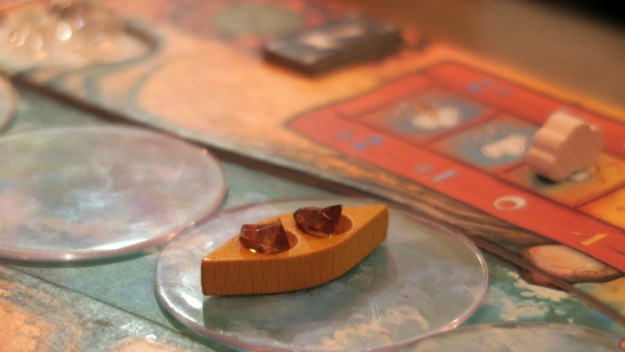
It costs two movement points to pick up a gem (or drop one off).  However, if traveling up stream and the boat finishes its movement on the same space as another loaded boat, the player can steal from other players on the same space, as long as they have space in their boat.  Native, Niagara only plays five, however, with the Spirits of Niagara expansion, it plays six, though with a few rules tweaks.  These include replacing one single canoe with a double canoe that can hold two gems which makes stealing easier and more likely.  There are also new Paddle cards, the introduction of a Whirlpool, the Bathing Beaver and the Hurried Elk.
The Spirits of Niagara
– Image by boardGOATS

Most of these just make things more complex.  So Blue made the executive decision to only include an extra Paddle Tile (value seven) and replace the slowest Paddle Tile (value one) with the 1/2/3 (which allows the player to decided how many they can move, but they can only move one boat).  This seemed to maintain the simplicity of the original game while ensuring there wasn’t too much carnage.  That said, almost everyone ended up with at least one boat going over the falls, Lime lost several.  All that proved was that crime doesn’t pay, however, as he repeatedly nicked gems from poor Pine.

Niagara
– Image by boardGOATS

Following the ill-feeling last time, Pink announced his strategy up front—to win, by whatever means was necessary within the rules, including stealing gems.  However, when fate chose him to go first, he garnered opprobrium (and a rules check) when he began by playing his seven and picked up two purple gems on his first turn.  Pine also tried stealing gems from others, but as they were immediately pinched by Lime who followed him in turn order, he commented that it felt just like pay day—there one moment and gone the next!  Blue was the first to get a gem home, though it was a colourless one, one of the easiest to claim and it wasn’t long before others followed.
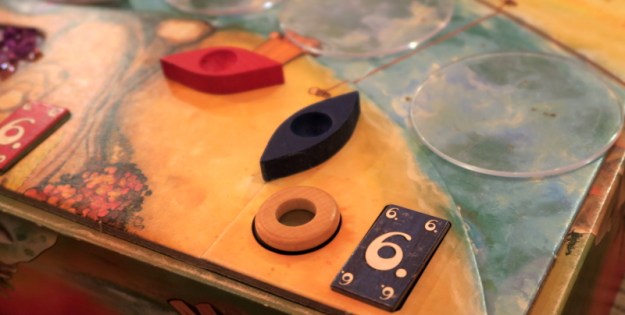
Niagara
– Image by boardGOATS

There was a bit of group-think going on, with players generally playing their higher value Paddle Tiles at the start, making the river run fast before it slowed down later when everyone played slower Paddle Tiles.  Black and Blue increased the flow of the river to its maximum, but Lime slowed it down again at the first opportunity.  We had just got through the Paddle Tiles the first time when Lime commented on his plans.  Black responded that he wasn’t going to get another as he was going to end it, and if he didn’t Pink would.  In the event, Black, Pink and Blue all achieved the winning condition with four gems of the same kind but Blue and Pink had collected a fifth so rejoiced in their shared victory.

The Spirits of Niagara
– Image by boardGOATS

There was just time for one last game, of an old favourite, 6 Nimmt!.  This is one of our most played games and slightly controversially won the Golden GOAT Award in 2020 largely for keeping us sane while playing games online.  Online we played a lot of the “Professional Variant”, but this time we chose to keep it simple.  Players simultaneously choose a card from their hand and then, in ascending numerical order, the cards are added to one of the four rows.  Each card is added to the row ending with the highest number that is lower than the face value of the card played; if it is the sixth in a row, it becomes the first card instead and the player adds the other five cards to their scoring pile.  The lowest score is the winner.
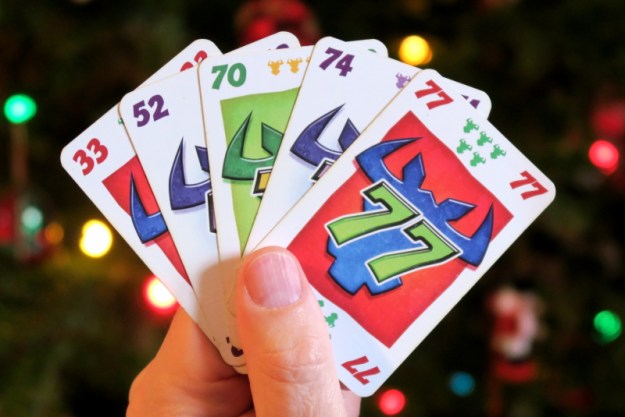
6 Nimmt!
– Image by boardGOATS

We play a variant that has two rounds and sees all (or almost all, depending on player count) of the hundred and four cards in the deck.  This time, the first round was quite attritional as everyone picked up cards.  Aside from Pink who picked up twice as many points as anyone else, it was all quite close though.  The second round was more variable however.  It was Black who top-scored this time, giving him a total of thirty-two, one more than Pink’s final score.  Most of the other scores averaged out giving totals in the high teens, however, Purple’s second round clean sheet gave her a winning score of nine.
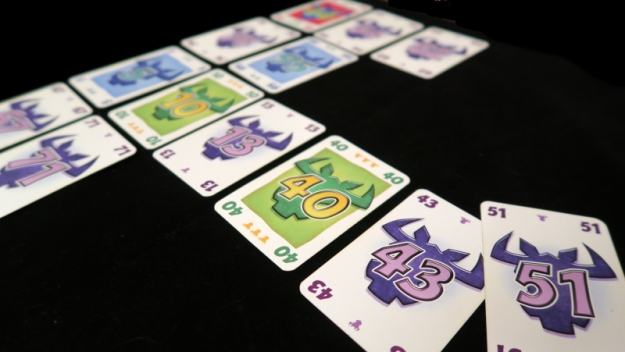
6 Nimmt!
– Image by boardGOATS

And with last orders called, that was it.  There was a little bit of chat about the New Year Party, but otherwise it was a sad farewell.  With more uncertainty surrounding the pub, it is a little unclear whether it will still be open for the group’s next scheduled meeting (10th January), so we will see.  With that very much in mind, we waived good night to the staff, wished them a Happy New Year and hoped to see them in January.
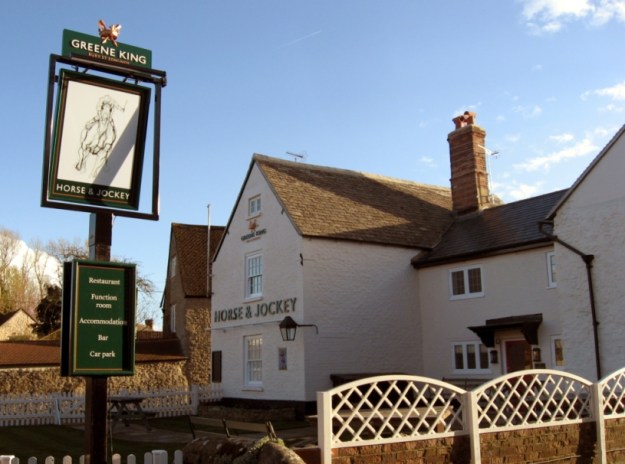
The Horse and Jockey
– Image by boardGOATS

Learning Outcome:  Don’t leave red panda cubs out in the cold.
23rd August 2016

A little unsure as to who was coming, we decided to start with the “Feature Game”, which was the filler, Abluxxen (also known as Linko!).  This is a “get rid of all your cards” type of game, and although it is initially a little confusing to understand, it mostly became clear as we played.  On their turn, players play any number of cards as long as they are all the same. The cards are then sequentially compared with the last cards played by all the other players:  if the number of cards played is the same, and the face value of the cards played is higher, then the other player’s cards are “snatched”.  They can either be “snatched” by the active player (the “snatcher”) who takes them into their hand, or alternatively the “snatchee” has to do something with them.  The “snatchee” can either choose to take them back into their hand or discard them.  If they decide to discard, then they must replace the cards with the same number from the face up display in the centre or drawn blind from the draw deck.

Abluxxen
– Image by boardGOATS

Thus, the idea is that players are trying to get rid of cards and force other players to pick cards up, however, picking up cards an also be a good thing as it can be an opportunity to improve the cards in hand.  Better, having a lot of identical cards in hand means that when they are played they go on top of any cards previously played making it more difficult for anyone to “snatch” them or force them to be picked up.  The game ends when either one player runs out of cards or the draw deck and central pool has been depleted.  Just to add to the the confusion, however, the winner is then the player who has played the most cards, but any cards left in hand give a penalty of minus one.

Abluxxen
– Image used with permission of BGG contributor punkin312

Although it was a simple game and everyone knew what they had to do, at first nobody really understood what they had to do to win.  Gradually people began to work it out though, starting with Burgundy who had watched a video of the game online, then Ivory who was new to the group, but had played plenty of games before.  Pine and Blue eventually joined the “in the know” club, but Red continued to struggle.  Every time it was her turn, Red said, “Sorry, I know I keep asking, but if I play two sevens what will happen?”  Despite this apparent lack of understanding, Red was the first to check-out and with a huge pile of cards too.  This was particularly amusing as Red had just been explaining to Ivory that he shouldn’t believe Burgundy and Blue when they claim to be doing badly or have no idea what they are doing as they usually go on to win.  Inevitably then, although most people were only one or two turns away from finishing, Red was miles ahead much to Burgundy’s chagrin as he needed just one more turn and was left with six cards in hand compared with the seven in his pile.  Blue who had just played seven “fives” and had only a couple of cards in-hand was second, just ahead of Ivory and Pine.

Abluxxen
– Image used with permission of BGG contributor punkin312

Black and Purple had walked in just as Abluxxen started, so amused themselves reading game rules and trying to work out what everyone else was doing.  Abluxxen had taken a little longer than expected so with everyone present and a group of seven, we decided to split into two.  Red was keen to play Niagara, a really unusual game with a moving river.  It won the Spiel des Jahres in 2005 and still holds up as a good family game more than ten years on.  The group has played it before, but in summary, players have two boats that they move up and down the river, trying to collect gems and return them home, to the top of the river.  There are a couple of catches.  The first is that each player has a set of Paddle Cards and must play each one once before they can play any of them again.  These Paddle Cards dictate how far they can move on the river, but can also affect how much the river will move.  Paddle Cards are selected simultaneously at the start of the round, so there is an element of programming involved, though not as much as in games like Colt Express or Walk the Plank!, but it does mean there is an element of anticipation.

Niagara
– Image used with permission of BGG contributor Marsh

The second “catch” is the river.  The river flows after everyone has moved their boats and the rate is dependent on the lowest Paddle Card played in the round and the weather.  Each player has a weather Paddle Card, which they use to speed up or slow the river down, however, as this has to be played instead of moving boats, this can be a trap for the unwary.  In the worst case this can lead to the loss of a boat and its contents with a penalty to get the boat back.  The game ends when one player fulfills one of three criteria:  four gems of the same colour, one gem of each of the five colours or any seven gems.  Gems are limited, and this leads to the third “catch”, which is that once a player has picked up a gem and has it safely in their boat, another player can steal it so long as they are paddling up stream and land on the same river segment.  So a nice little game with a nasty edge.

Niagara
– Image used with permission of BGG contributor erfalucho

Red was joined by Pine, Ivory and Burgundy in what was to be a very close game.  With four players, each boat should only hold one gem at a time, but a minor rules malfunction meant that everyone played with the double boats from the Spirits of Niagara expansion.  Red and Burgundy took full advantage of this collecting the difficult blue and pink gems first and in one trip.  It quickly became clear that five unique gems was going to be difficult so everyone went for the slightly easier seven random gems.  Pine was the only “proper adventurer” exploring the limits of the river.  Misinformed by Burgundy with respect to the effects of the weather, Pine become intimately acquainted with the waterfall, turning one of his boats to matchwood, but he was the only one to experience the long soggy drop.  Otherwise, the weather was fairly muted and everyone was fairly close to getting a full set of gems when Red, kicking on from her successful start got her nose over the line first, finishing with a total of eight gems.

Niagara
– Image used with permission of BGG contributor William Hunt

With Niagara done, the group moved onto Splendor.  In this game, players have just three options on their turn:  collect gem tokens, buy a gem card using gem tokens (and/or cards), or reserve a gem card and receive a gold (wild) token at the same time.  Players can have a maximum of ten tokens, though unlimited cards and the cards act as permanent tokens.  Thus, at its heart Splendor is an engine building game built on a set-collection mechanism.  Players score points when they buy some gem cards and for attracting Nobles which are awarded to the first player collect certain combinations of gem cards; the game end is triggered when one player reaches fifteen points and the player with the most at the end wins.

Splendor
– Image by boardGOATS

Despite being a very simple game, it is one we still enjoy as a relaxing little filler.  Indeed, it got an outing last time when Blue succeeded in snatching defeat from the jaws of victory when Burgundy came steaming through from nowhere to win.  It could have been this, or perhaps it was previous alleged trouncings that inspired Blue and Purple to let out an emphatic war cry from the neighbouring table exhorting everyone to stop Burgundy at all costs.  So, Burgundy did lots of sighing as everyone rallied to the clarion call and went out of their way to bring him down.  Pine had been one of the victims last time and, understanding his likely fate commented that he wished he could record all of Burgundy’s deep sighs and general moaning and then play it back to him when he won.

Splendor
– Image used with permission of BGG contributor henk.rolleman

The tactics appeared to be working, however, as about half way through, Pine had eight points as Burgundy took his first.  It wasn’t long before Burgundy took the first Noble too, but he was still some way behind and nobody was terribly concerned.  Meanwhile, Ivory was quietly building his engine taking lots of freebees, looking like the new threat.  Red was enjoying herself hoarding rubies just to annoy Burgundy even though she was well aware that it wasn’t actually doing her any favours.  Then suddenly, Burgundy took his second Noble and the writing was on the wall:  everyone knew they were doomed.  It wasn’t long before Burgundy took his third Noble and nobody had an answer as he repeated the trick he’d pulled off so successfully last time winning from the back of the pack.

Splendor
– Image used with permission of BGG contributor henk.rolleman

Meanwhile, on the next table Black, Blue and Purple were engaged in a slightly protracted game of Castles of Burgundy.  This is a game we’ve not played before with the group, though Blue had played it a few times as a two player game and Black had played it quite a bit online.  It is one of those games with fairly simple mechanics, but a lot of complexity in the game play.  The idea is that each player has two dice which they roll at the start of the round.  On their turn they then spend the two dice, trading them for two separate actions.  Players can take a building from the pool on the central player board that matches the number on their die, for example, if a player rolled a six, they can take any of the buildings in the “six” poll and place it in their own supply.  Their supply is limited in size and there must be space for them to be able to do this.

Castles of Burgundy
– Image by BGG contributor thatmadgirl

Alternatively, the player could take a building form their supply and place it on their personal player board on a space that matches both the number of the die and the colour of the building.  Both of these actions are quite restrictive, so players can instead choose to collect two worker tiles and add them to their store.  These worker tiles are the oil that greases the wheels a little, since they allow players to alter one of their dice by one for each tile used (e.g. spending two worker tiles will allow a player to change a five to a three or a one).  The last action is selling goods.  Players can acquire goods tiles during the game, but can only store three different types.  each of the six types correspond to a different number and, on their turn, as an action players can sell all their goods that correspond to the die (modified by workers if they choose).  In return they get a silverling and some points.  Silverlings are a form of currency and can be used to buy one extra building per round.  These are taken from a special pool, though there is nothing particularly special about the buildings themselves except that they are harder to obtain and therefore are generally only taken by players that really want them.

Castles of Burgundy
– Image by BGG contributor verminose

Points is what the game is all about, and being a game designed by Stephan Feld, there are lots of different ways to get them.  Although the actions within the game are simple, how points are achieved is where the complexity of the game really lies.  Each building placed on their board gives the active player a bonus.  Sometimes it is a bonus action, sometimes it is bonus points and sometimes it is a strategic advantage; it is the player that makes the most of these bonuses that will win the game.  Players then also score points for placing buildings to complete regions on their own board.  The larger the region, the more points they get, however, there are also bonus points for completing regions early.  Extra points are also available to the first players place the maximum number of each type of building in their province.

Castles of Burgundy
– Image by BGG contributor 3EBC

Black, by far the most experienced, began by investing in the special buildings that give one off strategic bonuses (e.g. an the opportunity to place an extra tile or take another from the central board).  Blue began without a strategy and, as is her wont played very tactically, without a real strategy and see what unfolded.  Purple, on the other hand, went for animals early.  These give points, but in an unusual way:  every time an animal tile is added to an area, all the other animals of the same type score again.  Blue picked up four pigs in the first couple of rounds, then added two, then three then another four more, and before long she was following Purple down the animal route.  Their strategies were very different, however, with Purple taking anything she could get while Blue was much more targeted.  So, as Blue went heavily into pigs, she was able to keep re-triggering their scoring building a tidy number of points.  Purple could have made up for with the yellow knowledge tile that rewards players with four points at the end of the game for each different sort of animal they have, but Blue had her eye on it too and got there first.

Castles of Burgundy
– Image used with permission of BGG contributor kilroy_locke

While Blue and Purple were engaged in a agricultural battle Black was able to continue with his plan pretty much unchallenged.  So he moved into shipping and completed lots of areas picking up the corresponding bonuses.  Purple took the bonus for finishing the farming tiles first and picked up points for finishing several others too including mining – quite an achievement since she was the last to get a mine at all.  It was the compound scoring for the animals that clinched it though coupled with the knowledge tile that enabled Blue to place her green farming tiles more flexibly and she ran out the winner with one hundred and eighty-five points, nearly twenty ahead of Black in second place.

Castles of Burgundy
– Image by BGG contributor Korosu_Itai

Ivory headed off, and Castles of Burgundy was still well under way, which gave Red an opportunity to suggest one of her favourite games, Bohnanza.  The original bean-trading game, this is a staple family game and is still very popular with the group as it keeps everyone involved throughout and is usually very popular as a “gateway” game.  Last time he’d played it, Pine had really struggled, which both surprised the rest of the group and caused us a certain amount of consternation as it should have been a game Pine would have enjoyed.  It seemed he couldn’t remember the disaster last time though and he was happy to try again.

Bohnanza
– Image used with permission of BGG contributor spearjr

The game is very simple, but players have to keep their eye on what is going on around them.  Players start with a hand of cards and are not allowed to change the order – a simple mechanic that is the critical part of the game.  In front of each player are two “Bean Fields” and on their turn, players must plant the first card in their hand and may plant the second.  Thus, the key to the game is managing the order of cards in their hand, as they cannot be rearranged and must be “planted” in the order they arrive.  However, it is possible to remove unwanted cards by trading them away.  Once the active player has planted the card(s) from their hand, then they turn over the top two cards from the draw deck:  these must be planted by the end of the turn, though not necessarily in one of the active player’s fields if they can be traded.  Once all these cards have been planted, the active player can then offer to trade any unwanted cards in their hand before their turn ends with them replenishing their hand from the draw deck.

Bohnanza
– Image by boardGOATS

There are lots of different strategies players use:  the cards have different values which reflect their rarity so some go for high value rare cards and others for more common cards that are easy to get.  The best players are usually the most flexible and those that fit in best with what other players around are trying to do.  Another aspect players need to keep an eye on is harvesting.  Each field can only contain one type of bean and when they are harvested some of the cards are kept as profit.  In this way, the rare cards (which are also the most profitable) are gradually depleted from the deck.  So towards the end of the game, they become increasingly difficult to find.  Worse, sometimes there might only be one card left and woe-betide the player that gets stuck with it in a field as there is a nasty little rule that says players can only harvest a field with one bean card if all their fields have only one bean card.

Bohnanza
– Image used with permission of BGG contributor spearjr

This time, Pine began well offering lots of generous donations which earned him lots of good will as well as getting him off to a flying start.  In contrast, Burgundy was repeatedly forced to plough up fields before promptly picking up the beans he had just disposed of.  The first trip through the deck always seems to take ages, but as usual, the second time through was much quicker.  With three players, everyone got a couple of turns in the final, third pass and everyone was looking nervously at each others’ piles of “coins”; it looked very close.  In fact, there was only one point in it as Red finished just ahead of Pine who finished with a very creditable twenty-seven.

Bohnanza
– Image by boardGOATS

With Castles of Burgundy finally over, Blue was keen to play something quick and light to finish the evening and, knowing how much Purple likes it, suggested Om Nom Nom.  This is a really sweet little game with elements of double-think.  The idea is that there are three food chains each with three tiers, a primary predator, a secondary predator and pray.  Each player has a hand of cards representing the top two predator tiers and dice are rolled to represent the bottom two tiers.  Once the dice have been rolled and assigned to their spaces on the board, everyone simultaneously chooses a card and the food chains are resolved starting from the top.  Any predator with no prey (or where there is insufficient for all the animals played) goes hungry and is discarded.  Otherwise, prey is divided equally amongst its predators leaving any left-overs for later.

Om Nom Nom
– Image by BGG contributor jancis

A bit like 6 Nimmt!, it is all about synchronising with everyone else, or rather in this case, getting out of synch with everyone else.  This is because everyone has the same set of cards, so if every player except one plays the same cards, all the players who played the same cards will likely cancel each other out and get no reward.  On the other hand, irrespective of whether they get any reward for playing something different, the very fact they did not play the same card means they have it to play later when there is no competition.  This worked particularly well for Blue in the first round, when she managed to pick up lots of carrots and cheese uncontested.  Since prey at the bottom of the food chain are worth two point, this netted her a massive seventeen points.  In contrast, the second round was very low scoring with lots of animals going hungry.  Blue was less effective this time, but still won the round so going into the final round the game was hers to lose, and she tried her best.

Om Nom Nom
– Image by boardGOATS

Pine struggled throughout and Red couldn’t get to grips with the double think aspect so was curious as to whether random draw would work better  Since she won the final round it is possible that it did.  Meanwhile Blue was doing her best to throw the game, demonstrating that while it was important to be out of synch with everyone else, it was important to be out of synch in the right way.  First her rabbit got eaten, then her cat went hungry, but somehow she managed to scrape together enough points to ensure she ran out the winner.

Om Nom Nom
– Image by boardGOATS

Learning Outcome:  You don’t have to know what you are doing to win.