Tag Archives: Ticket to Ride: Northern Lights

30th April 2024

Blue and Pink were unusually early and had already finished their pizzas when Pine rolled in.  He was soon followed by Black and Purple and then Lime and Teal giving a total of seven for one of the quietest nights for a long time.  With seven, the question was how to split the group and what would everyone play.   For seven players, the go-to game is generally Bohnanza, which Blue inevitably suggested.  Pink suggested playing it later, but when Teal commented that he’d never actually played it, that was the decision made.  There was no way that state of affairs could continue, so the “Feature Game” (which was to be Canvas) was put on the back burner until later, and the Beans came out.

Bohnanza
– Image by boardGOATS

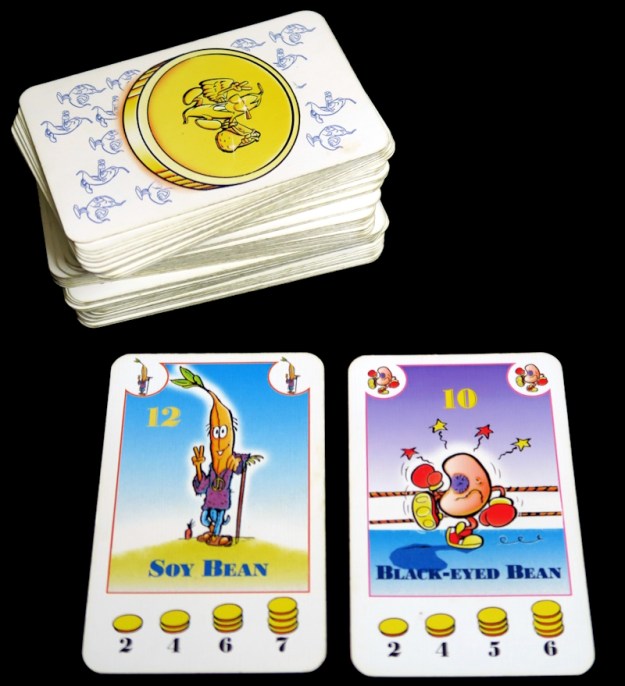
Bohnanza is best part of thirty years old and is, despite him designing a huge number of excellent and popular games since, including Agricola, Caverna, Le Havre, A Feast for Odin and Patchwork, is arguably, still one of Uwe Rosenberg‘s best games.  It is a really simple game of set collecting and trading, that when explained sounds strange, but when played is great fun.  While everyone else chatted, Blue explained the rules and how to play to Teal.  The important thing is players cannot rearrange the cards in their hand (similar to recent Spiel des Jahres nominee, SCOUT).

Bohnanza
– Image by boardGOATS

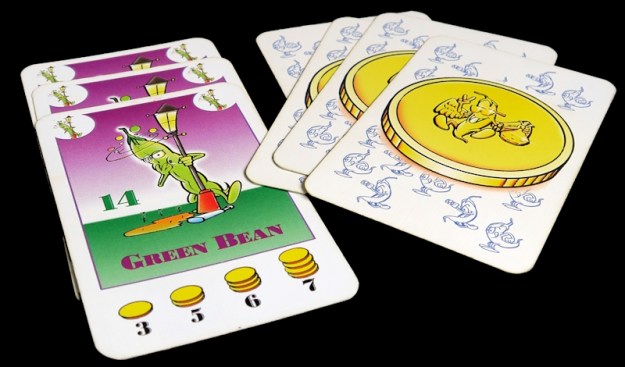
So, players start with a hand of cards, and, on their turn, must plant the first Bean card in the front of their hand into one of the two “Bean Fields” in front of them.  Then they may, if they wish plant the next Bean into one of their Fields, but each Field can only contain one type of Bean.  Once they have finished planting from their hand, the active player turns over the top two Bean cards, which must be planted, but may be traded and planted in another player’s Field if agreements can be reached.  Once these Beans have been dealt with, the active player can trade any cards from their hand, but all cards involved in any trades must be planted straight away.

Bohnanza
– Image by boardGOATS

Finally, the active player tops up their hand taking Bean cards into their hand (three in the case of the seven player game).  At any point, players can harvest one or both their Bean Fields converting some of the cards into Bean Thaler (according to the “Beanometer”), placing them face-down in their scoring pile, returning the other cards to the discard pile.  However, players cannot harvest a Field with a single single bean in it unless all their Fields have only the one Bean in them (a rule that can sometimes make things unbelievably difficult).  The game ends after three passes through the deck and the player with the most Thaler at the end is the winner.

Bohnanza
– Image by boardGOATS

There are a few, very clever things that really make the game work.  Firstly, there are different numbers of the different types of Beans in the deck—some beans are very common and give a small return, others are quite rare and give a better return.  The number of each card present in the deck at the start of the game is printed on them.  This is key, because it helps players to work out the rarity and therefore the value of different Beans when arranging trades.  However, the value also changes according to the situation in the game and how many players want each Bean type at the time.

Bohnanza
– Image by boardGOATS

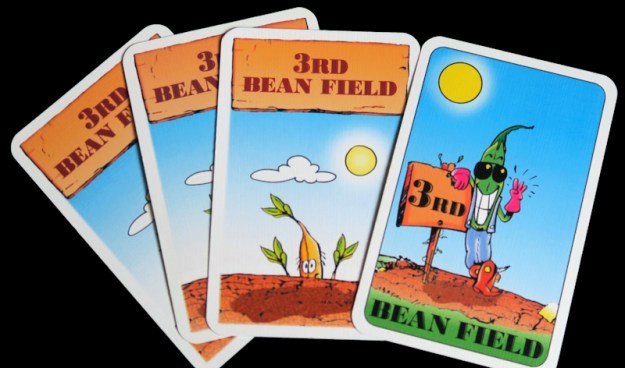
Further, because the rare Beans give a larger yield, more of these are removed from the deck, which makes them increasingly rare as the game progresses.  This is because there are disproportionately fewer in the discard pile when it is shuffled to give the new deck.  Players can also buy a third Bean Field, but choosing to do this is a real gamble and only worthwhile if it can be done early in the game.  Choosing when to harvest is also critical, because harvesting a big Field just before the discard pile is shuffled will increase the length of the game.  Finally, players can be generous in their trades in the hope that the generosity will be returned, however, giving away trades too cheaply can cost a player the game.

Bohnanza
– Image by boardGOATS

Once Blue had finished explaining the game, Black started and explained his way through his turn.  Teal quickly caught on and got engaged in trading and planting Beans with everyone else.  There was a lot of debate about players buying their third Bean Fields with about half the players buying one and Teal leaving it to the second round (much against Black’s advice). Several people, including Purple, Teal and Pine got into Black-eyed Beans—quite an achievement given how few of them there are in the pack—and Blue had a couple of goes with the similarly rare Red Beans.  Pink tried for Soy with mixed success and almost everyone planted some combination of Wax, Coffee and Blue Beans at some point during the game.

Bohnanza
– Image by boardGOATS

Teal quickly realised how quick you have to be declaring an interest in a trade in a game where if you snooze, you lose.  And with seven you have to be keep an eye on what’s going on, which can be difficult given how far away some players are.  In the corner, Black quietly got on with his game eschewing the third Bean Field option as he felt there wasn’t time in the seven player game to recoup the cost, and perhaps he was proved right as he ran out the eventual winner with twelve Bean Thaler, closely followed by Pine with eleven and Blue with ten.  It had been a lot of fun, but as usual, had lasted longer than it really should, leaving little time before the first people needed to head home.

Bohnanza
– Image by boardGOATS

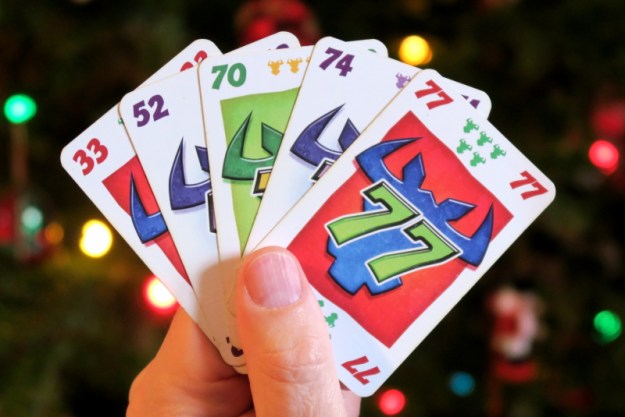
So after some discussion (where pink suggested Ticket to Ride: Northern Lights again), everyone settled down to play 6 Nimmt!.  This had recently had an outing with the new Jumping Cow mini-expansion, but this time the group chose to play it without the additional madness.  6 Nimmt! is also a simple game that is a lot of fun:  Players start with a hand of cards and simultaneously choose one to play, then, starting with the lowest value, these are added one at a time to the four rows on the table.  If a player’s card is the sixth in the row, instead, they take the first five into their scoring pile and their card becomes the first in the row.

6 Nimmt!
– Image by boardGOATS

This is another very clever game that does a lot with very little (which is probably why it is still so popular despite the fact it is thirty years old).  Different cards give a different number of points (or Nimmts), and players can also introduce a little bit of their own randomness by playing a card lower than the final card in all the available rows and thus, taking a row of their choice, upsetting everyone else’s plans.  The Jumping Cow mini-expansion adds more of this, but the group felt it didn’t really improve the game, so stuck with the chaos and fun of the original game, also eschewing the mathematical complexity of the Professional Variant.

6 Nimmt!
– Image by boardGOATS

This time, both Pink and Pine managed to avoid picking up any cards in the first round.  However, Blue only picked up two Nimmts and Teal collected seven leaving it all to play for, at least for most people—Black’s twenty Nimmts had already put him out of the game.  In the second half, Lime picked up twenty-four giving him the top score of thirty-eight (some way ahead of Purple with total twenty-nine).  Black managed a clear round, but there was nothing he could do about his pile of Nimmts from the first round.  It was tight between the top three, but Pink just took victory with ten, three fewer than Blue and Pine who tied for second place.  From there, the evening deteriorated into chatter and we decided to leave the “Feature Game“, Canvas, for another day.

6 Nimmt!
– Image by boardGOATS

Learning Outcome:  You can have a lot of fun with nothing but an old deck of cards.

5th March 2024

The evening started with everyone unsure who was coming, so the nine players present split into three groups of three, with Blue, Pine and Lime starting with the “Feature Game“. This was the very short, light, Make the Difference, a game that is basically “spot-the-difference” in board game form.  The idea is that each player gets a pre-printed picture and simultaneously add five extra “features” to their pictures.  Once everyone has added their “extras”, players take it in turns to place their pictures in the centre of the table (covered with a sheet of acetate to make it a little more difficult to spot the difference between printing and drawing), together with an unadulterated copy.
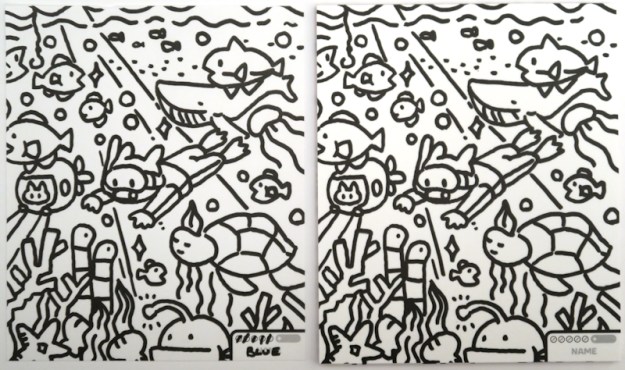
Make the Difference
– Image by boardGOATS

Players have one minute (timed with a slightly grumpy egg-timer), during which a player spotting an addition gets a point, then a second minute, during which both the spotter and the modifier get a point.  After the two minutes, any un-spotted additions are assessed for size, and if they are large enough, the modifier gets two or three points.  The additions have to be a single line, may extend an existing feature, and can’t just increase the width of an existing line.  This time, Pine went first with his picture, and the slightly mardy timer gave Lime and Blue a few extra seconds to spot his additions as Pine encouraged it to behave.  Most of his additions were spotted, partly as a result.

Make the Difference
– Image by boardGOATS

Lime went next, and players were slower to spot his additions giving him extra points.  Blue was the last, but this time Pine and Lime really struggled.  For some reason, Blue seemed to be better hiding hiding her additions, taking six points for lines that weren’t spotted during the two minutes of play.  In contrast, her poor spotting let her down, giving her a total of eight points, and just enough for second place.  The winner was Lime, however, with ten points.  There was a little chatter while they packed away, but as there were no new arrivals, the trio moved on to play something else, and quickly chose to give the recent Northern Lights edition of Ticket to Ride another outing.
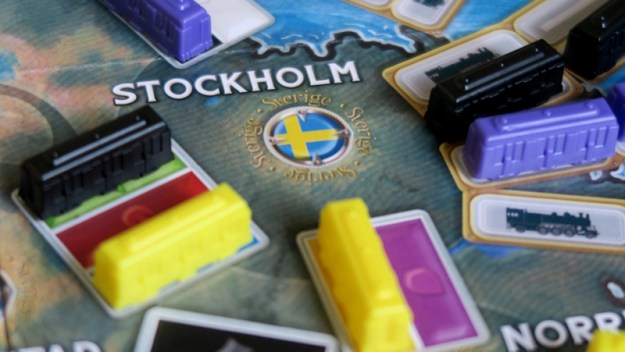
Ticket to Ride: Northern Lights
– Image by boardGOATS

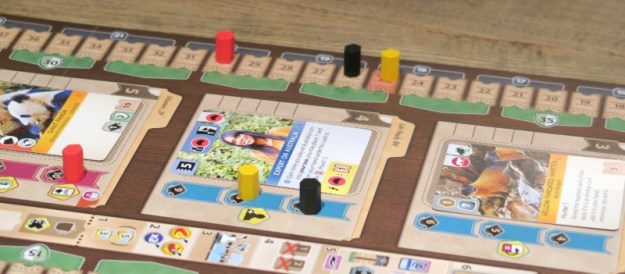
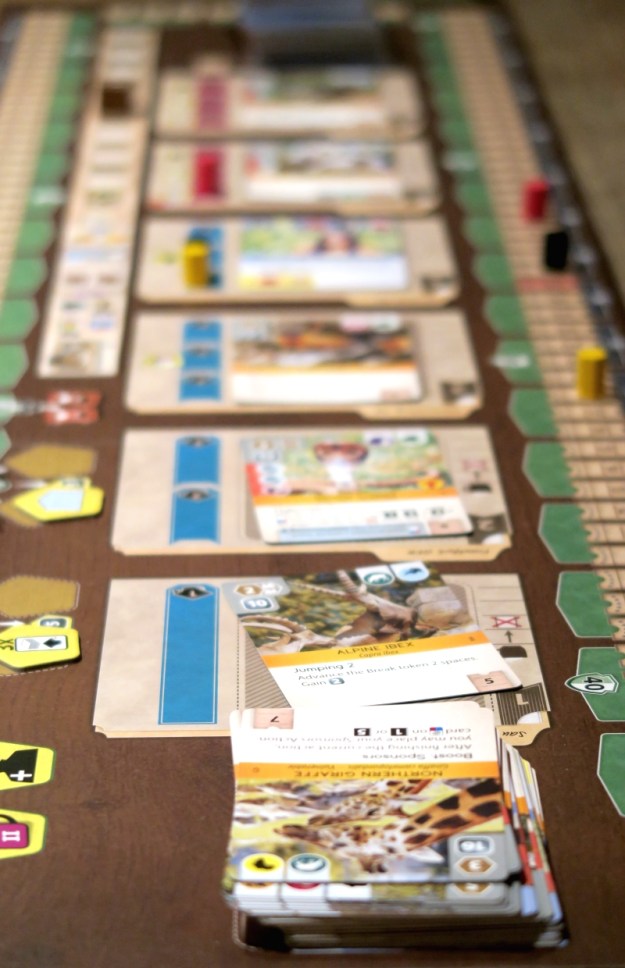
Ticket to Ride: Northern Lights has had a couple of outings since it’s group debut last summer, and has been quite popular in the group.  The game is a fairly standard edition of Ticket to Ride (take cards from the market, or play cards to place trains), but the map is set around the Scandinavian countries of Denmark, Norway, Sweden and Finland.  Like all the variant games, this one has a couple of minor rules tweaks, principally, the addition of bonus cards which give points at the end of the game and bonuses for completing some of the longer Ferry routes.  Locomotives are also handled slightly differently as the market is not refreshed when saturated by them, and for Ferry routes only, they can be replaced by any two cards of the same colour.

Ticket to Ride: Northern Lights
– Image by boardGOATS

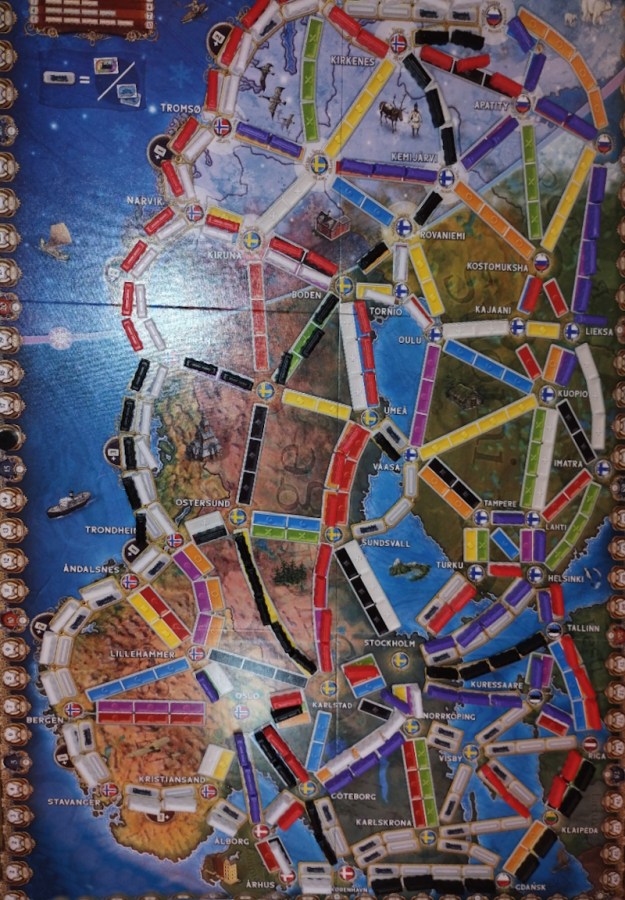
This time, the bonus cards drawn at random were the Locomotive Collector (A), International Tycoon (G), Polar Express (H) and the Ferry Master (J).  Pine went first and started placing trains much to Lime and Blue’s horror.  A few turns later, Lime headed up the Norwegian cost, while Blue started building an extended route from Bergen in the west through Stockholm to Tallin in the east.  It was then that Pine, with his north-south route got in her way and began costing her points thanks to the fact that with only three players the double routes weren’t in play.
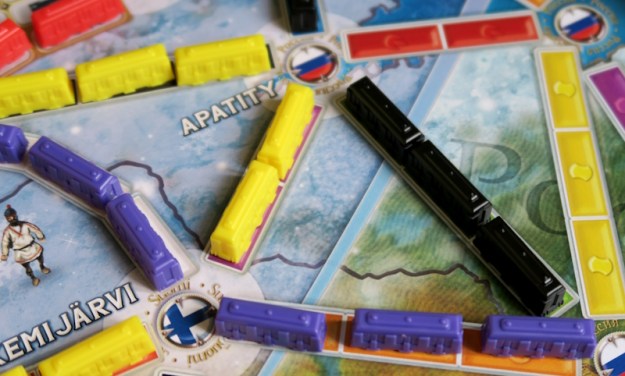
Ticket to Ride: Northern Lights
– Image by boardGOATS

As he had done last time the group played, Lime churned through his trains remarkably quickly catching Pine and Blue on the hop slightly. After the last few turns had been played, the bonus points were allocated with each player winning one (Lime for the most Ferry routes; Pine for the most tickets ending in the Arctic Circle and Blue connecting the most countries while nobody had any Locomotive cards at the end of the game).  Pine claimed a completed Ticket for eighteen points which he had almost completed when he drew it (AGAIN!).  Also like time, Lime finished with a nice round hundred points, and once again was pipped pipped to victory by Pine, albeit by a larger margin (ten points rather than three).
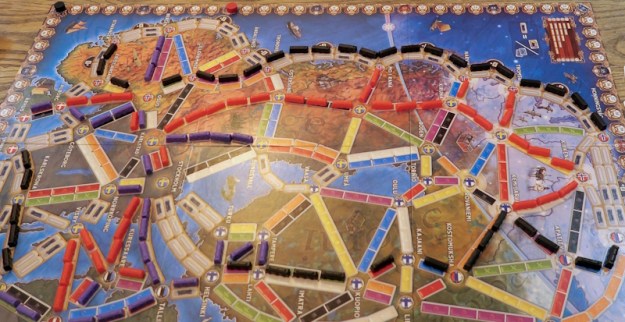
Ticket to Ride: Northern Lights
– Image by boardGOATS

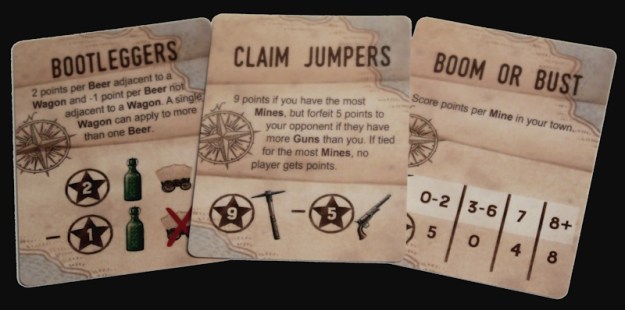
With that over, Lime headed home, leaving Blue and Pine to kill time while waiting for one of the other games to finish.  In this, they played a little “wallet game” called Circle the Wagons.  This is a simple, quick game where players take cards from a market and add them to their player area, building a map, scoring points according to the largest areas of each terrain type and three addition scoring criteria selected at random.  These scoring criteria are printed on the reverse of the cards and are drawn at random at the start of the game.  The first bonus card drawn was “Boom or Bust which gives points for two or fewer Mines/Pickaxes, none for three to six and four or five points for seven or eight (or more).
Circle the Wagons
– Image by boardGOATS

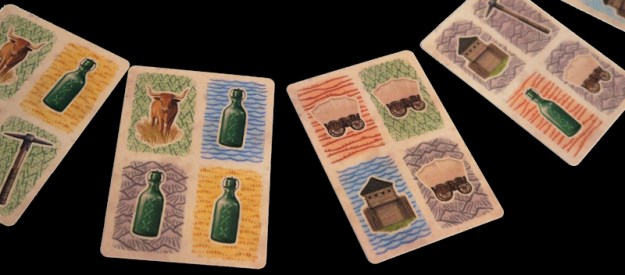
The other bonus cards were Claim Jumpers which gives the player with the most Mines/Pickaxes nine points (though they lose five if their opponent as more Guns), and Bootleggers which give two points for each Beer Bottles next to a Wagon (and minus one for any not next to a Wagon).  Once the bonus cards had been picked, the remaining fifteen cards were shuffled and arranged in a circle.  The first player, in this case Pine, could then choose to either take the first card, or take another, later card, leaving any that had been skipped for his opponent, Blue, who then had the same choice.  Play continues until all the cards had been taken.
Circle the Wagons
– Image by boardGOATS

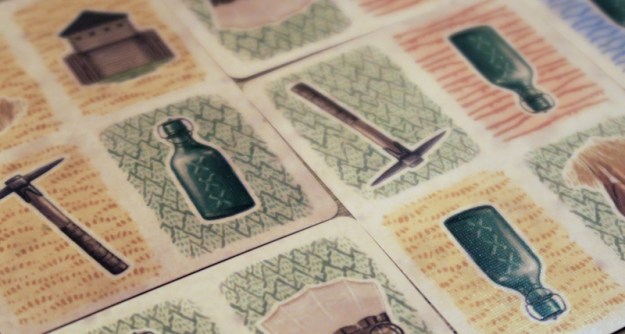
This time, Pine started prioritising Pickaxes, given the fact that two of the bonus points scored for them.  Blue was slow to get started with these and ultimately scored nothing for Boom and Bust and for Claim Jumpers.  She collected Beer Bottles instead and prioritised scoring for her terrain.  Blue’s thirteen points for Beer Bottles exactly matched Pine’s for his Pickaxes, though he picked up half a dozen points for his Beer as well.  Blue took six points for her Forest and four for her Plains, while Pine got five points for each of his Desert and Water terrain.  It was closer than it seemed during the game, however, with Pine finishing with thirty-five points, just three more than Blue.
Circle the Wagons
– Image by boardGOATS

By this time, Pink, Teal and Ivory were bringing Viticulture to a close.  This is one of the group’s most popular worker-placement games and a particular favourite amongst Pink and Teal who have been promising each other a game for months.  The game is quite simple and doesn’t really do anything fancy, it just does what it does very well.  The idea is that players are making wine, which they do by placing their workers on spaces on the central board.  Each space has a limit to how many workers can occupy it, with each player having a “Grande” worker who can muscle in anywhere.  This time, the group played with the Tuscany expansion, which adds a few little extras.

Tuscany
– Image by boardGOATS

Firstly, whereas the base game has essentially two seasons spring and autumn (with visitors in summer and winter), the Tuscany expansion has actions for all four seasons.  Players can also build special buildings (which give additional powers and special options for those that make the effort to build them), and claim regions to gain influence (and bonuses) which scores points at the end of the game.  The player order works slightly differently to the base game and the end of the game is triggered when someone passes twenty-five points (rather than twenty in the original game).  This time, however, nobody took advantage of the opportunity that Tuscany provides to build buildings, instead focusing on the basics of planting grapes and harvesting them.
Viticulture
– Image by boardGOATS

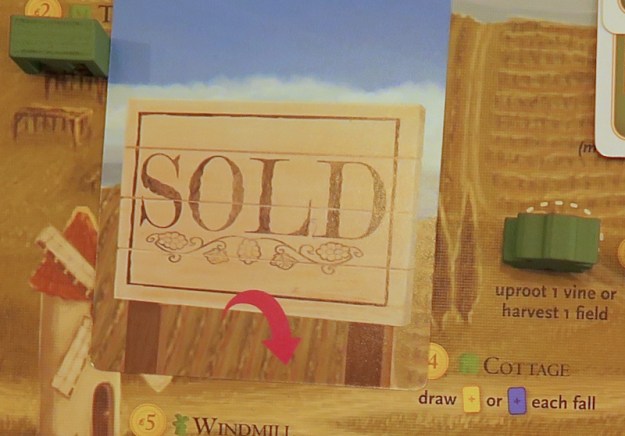
There is a now a well-known and frequently used tactic of selling a field at the start of the game to provide equity in the early part of the game.  Teal and Ivory both went down this route while Pink decided to try something else, but that didn’t go well for him.  His problems were exacerbated by his inability to get access to fulfilling orders later in the game.  Ivory started acquiring points early taking an early lead.  Teal wasn’t far behind, but never quite managed to overhaul Ivory who triggered the end of the game and finished with thirty-one points, seven more than Teal in second place.
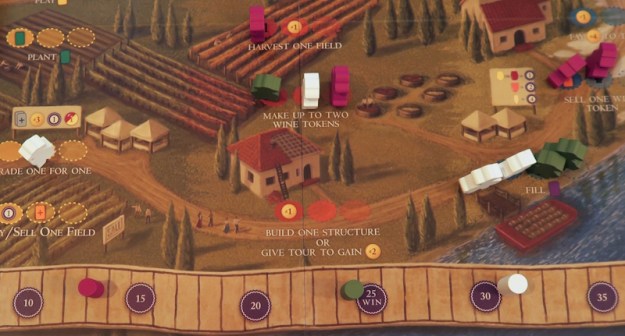
Tuscany
– Image by boardGOATS

When Viticulture finished, Ivory and Teal headed home, leaving Pink to join Blue and and Pine in a couple of quick games of Botswana.  This is a sort of simple stock-holding game where players are collecting animals.  The idea is that there are five suits of animal cards, each numbered from zero to five—these are shuffled and dealt out to the players with a small number left out for ambiguity.  Matching the suits, there are five sets of five plastic animals.  Players take it in turns to play a card (any card) and then take an animal (any animal) until someone plays the sixth card in any suit.

Botswana
– Image by boardGOATS

When the last card is played in any suit, the game ends immediately and players score points for their animals with each animal being worth the face value of the last card played in that suit.  Thus, Zebras might have been worth five points each, right up until the last card was played which could be a zero, rendering them totally, point-less.  Somehow, it is a hard game to understand—far from random, a bit like 6 Nimmt!, it is very hard to control and manipulate the scoring in a particular direction.  This was quite evident in the two rounds played this time.
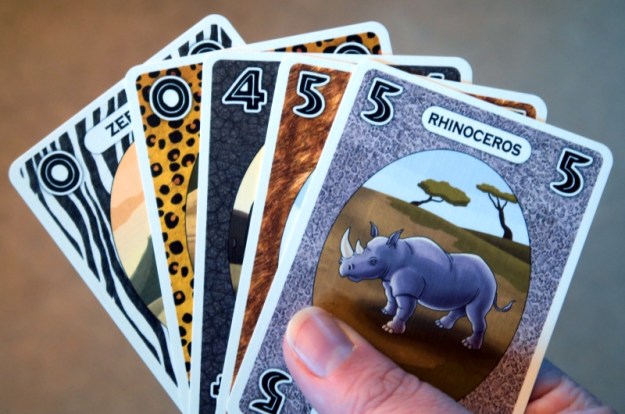
Botswana
– Image by boardGOATS

In the first round, Blue held a few key Elephant cards and was able to manipulate the game end to ensure they scored well.  With a couple of high scoring Lions added to her menagerie, she ended the game, ensuring she finished with thirty-five points.  It was very tight between Pink and Pine, but Pink just edged second place with twenty-two.  The second round was also close with just two points between Pink and Pine, but this time they were vying for victory.  In the end it was Pink again, this time triggering the end of the game allowing him to ensure his Leopards scored well.

Botswana
– Image by boardGOATS

Botswana is a lot of fun and as they packed up, there was quite a bit of chatter.  Pine pointed out that the backs of the cards said “Wildlife Safari” and wondered why.  Blue commented that there were lots of different versions, but couldn’t remember the differences.  A little bit of research shows that the game was originally released as “Flinke Pinke” and then “Quandary” and eventually “Loco!”, all with simple colour suits.  Then, in 2010, the boring colour suits were changed for animals by Eagle-Gryphon Games, who initially republished the game as “Botswana”, before increasing the size of the box and calling it “Wildlife Safari”.  Presumably this particular copy was released when small boxes were still available, but the company had run out of matching cards…
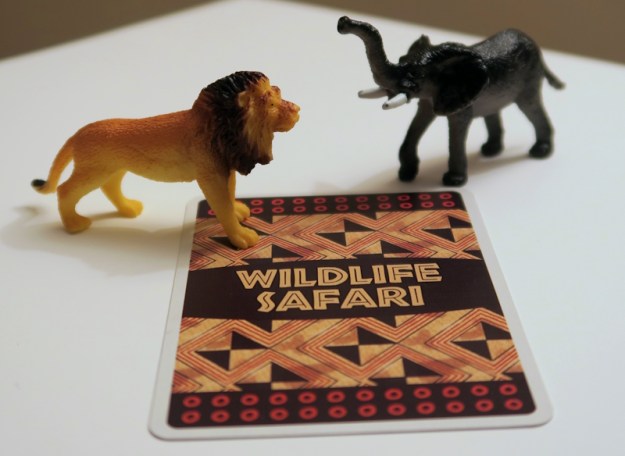
Botswana
– Image by boardGOATS

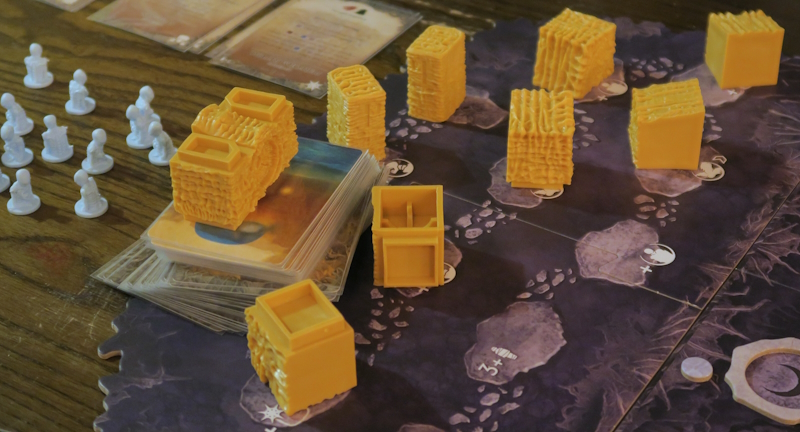
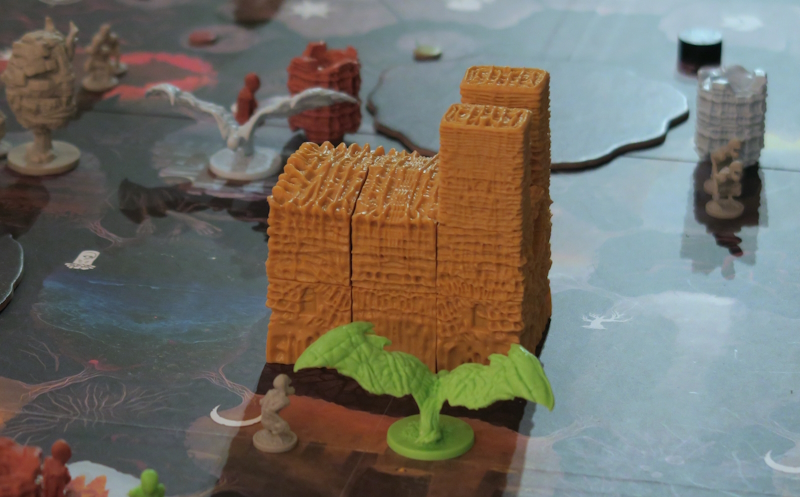
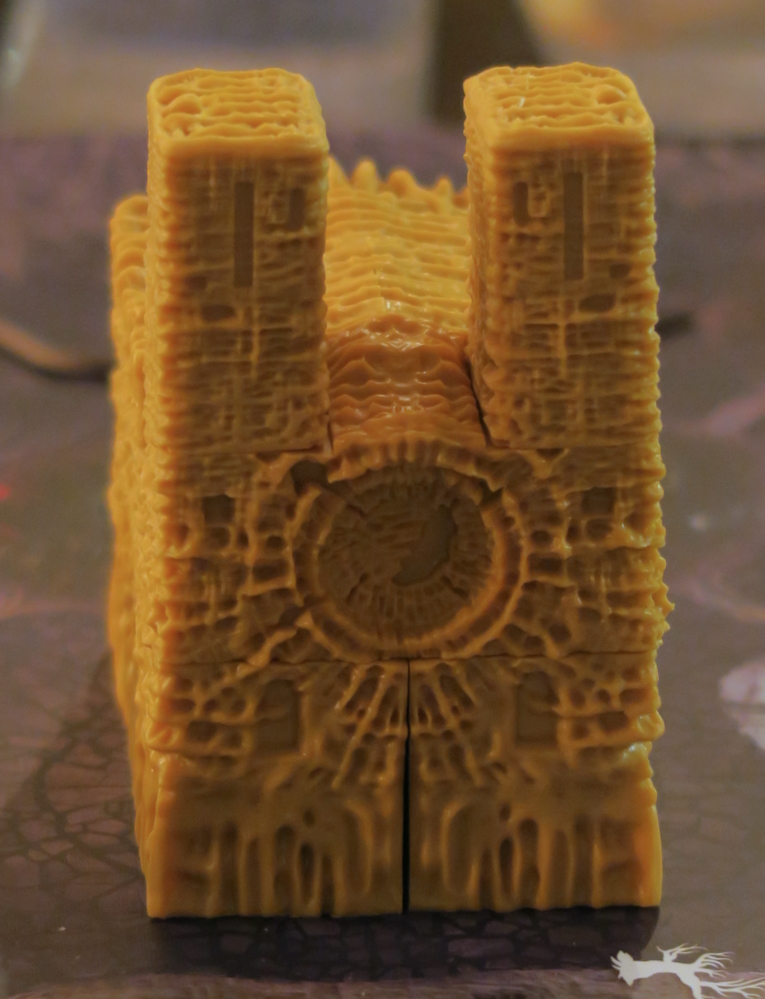
Meanwhile, on the next table, Cobalt had persuaded Plum and Byzantium to join him playing the rather epic-looking Nightmare Cathedral. This is a card-driven action-selection area-control game set in the fantasy world of late Polish surrealist painter and sculptor Zdzisław Beksiński. The game is adorned with his artwork and beautifully sculpted miniatures. Players control Units, which act as a resource, whilst an imposing Cathedral is built in the centre of the board. Once the Cathedral is completed, two Nightmares (out of a selection of eight) appear next to the Cathedral and can be controlled by a player on their turn if a certain condition is met. Each Nightmare, represented by a unique sculpt, has varying abilities such as converting or devouring units as they move around the map.

Nightmare Cathedral
– Image by boardGOATS

The game ends when a certain number of Units have been devoured, or, less likely, after completing three rounds. The winner is determined by points, which can be obtained from climbing the Ritual track, building Forts, Devouring the most Units, or completing objectives on Dream cards (the latter being the largest source of points). On a their turn, the active player selects an action with their Dreamer from one of five on the day/night action track, although they cannot select an action adjacent to their dreamer’s current space. After performing the action, other players get to follow, either Conforming or Dissenting depending on whether their dreamer is adjacent to the current action space.
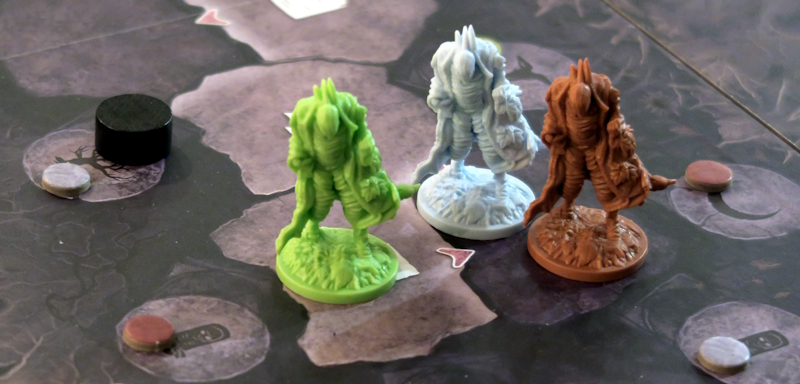
Nightmare Cathedral
– Image by boardGOATS

The active player then moves their Dreamer to the adjacent Night space, a section of the Cathedral is built, the turn marker moves to the subsequent space and the next player takes their turn.  Each player starts with a tableau of five cards, one for each action type, that details how each action can be performed, as well as the Conform/Dissent actions. The players also have a hand of cards, which come in two forms: action Upgrades or one-time Effects; each card also contains combat symbols.  The five basic actions are: Ritual (spending/removing followers to move up the Ritual track); Summon (producing Followers); Fortify (spending Followers to Build/Upgrade Forts); Manoeuvre (moving Units and/or Shaper, performing a conversion and then initial Conflicts); Develop (playing Development cards from hand, either to Upgrade actions or gain one-time benefits).

Nightmare Cathedral
– Image by boardGOATS

A player controls an area if they have a Fort present, or if there is no Fort and they have the most Units in the area. The board is also populated with a “neutral” player, called The Shadows, that can participate in conflicts and be Devoured for benefits. Each area is associated with one of four symbols, with the active symbol being determined by the turn marker (which changes every turn, cycling through each symbol). Certain actions refer to these symbols, for example when moving up the Ritual track, players must spend Units from areas matching the symbol on the next level of the track, or areas marked active by the turn marker produce if that action is selected. When producing Units by marked areas, the unit is produced by the player who controls the area, not by the active player.
Nightmare Cathedral
– Image by boardGOATS

A player may forgo the action on the card to draw two Development cards to hand. Each player may have up to two Dream (objective) cards at any time, and may complete them on their or another player’s turn provided they match the criteria at the appropriate time as specified on the objective card.  However, they may only draw new cards at a specific point in their turn from a display. Once the Cathedral is nearly complete, the Level II Development and Dream cards are mixed in with the initial Level I cards to provide enhanced benefits and more points. When a player initiates Conflicts, they get to choose which of the valid areas the Conflict(s) occur, and they do not need to participate in the conflict themselves.

Nightmare Cathedral
– Image by boardGOATS

To resolve a Conflict, the two players involved reveal a number of Development cards from hand—the number determined by the number of units present in the Conflict area (plus one if they also have a Fort). Each card depicts claws and shields: a Unit is removed for each claw that was not deflected by a shield. The winner of the Conflict is the player who has a Fort remaining, or, failing that, the most Units in the area; the looser must retreat all remaining Units to adjacent areas.  Each player starts with one action upgraded, drawn at random—each player drew an upgraded summons card.

Nightmare Cathedral
– Image by boardGOATS

Cobalt played first, and was able to complete one of his Dream cards immediately. In the first few turns, Byzantium managed to pin Cobalt in one corner of the board, which severely limited his ability to expand and produce Units, whereas Plum was able to grow relatively peacefully on the opposite side of the board. Byzantium, and to some extent Plum, were able to make use of their expansion to move up the Ritual track. Plum was also able to expand her Forts to several areas. Cobalt was able to upgrade his forts in the limited areas he controlled, as well as draw up to the hand limit of eight development cards over the first half of the game.
Nightmare Cathedral
– Image by boardGOATS

During the second half of the game, after the Cathedral was built and the Nightmares came out, Cobalt was able to make use of his Development cards (especially due to a very well timed fortunate draw) to control both Nightmares in a single turn to Convert and then Devour a sufficient number of his own Units to claim a high-scoring Dream card as well as ensure he had the most Devoured units for end-game scoring.  Unfortunately, this time, the group ran out of time so had to end the game early, stopping after everyone had completed an equal number of turns (time which Byzantium used to move up the Ritual track and Plum used to built a few more Forts).

Nightmare Cathedral
– Image by boardGOATS

Long before the game finished, it was clear that Cobalt was miles ahead and nobody was going to catch him.  Plum held on to he Dreams for too long, while Cobalt and Byzantium were better at completing theirs.  She did manage to get a Fort in the fourth corner of the map fairly early on which gave her somewhere to spawn her Units from, though.  Ending the game early meant players didn’t get to make as much of their Upgraded Action Cards as they might have done and there were cards left in hand which could have come into play with another few more rounds. As a taster game, it proved quite different, however, and deserving of another try sometime, as long as there is time to complete it.
Nightmare Cathedral
– Image by boardGOATS

Learning Outcome:  You are never too old to play “Spot-the-Difference”, but that doesn’t make you good at it.

6th February 2024

People were still eating when Ivory rolled up nice and early to start setting up Ark Nova.  Although it was not the “Feature Game“, we are planning to feature the Marine Worlds expansion in the next few weeks and wanted to play the base game before we did.  So, Ivory was soon joined by Cobalt, Plum and Green on the other side of the table, leaving the rest to decide who would play the “Feature Game”, CuBirds, and what everyone else would play while they did.  Before long, Pine, Pink, Lime and Blue were dealing out the bird cards while Purple, Black and Teal moved to the next table and rummaged through the game bags to decide what to get out.

CuBirds
– Image by boardGOATS

CuBirds is a fairly simple set-collecting game built round a central market.  Players start with a hand of seven cards and, on their turn must place cards from their hand.  They have to place all the cards they have of one type, adding them to one of the four rows on the table, at either end.  If there is already a card of this type in that row, then they take all the cards between that card and the newly added cards into their hand.  Optionally, if they have enough cards of a given type in their hand, they can complete a flock of them, that is play the cards, keeping one or two in their display (a bit like harvesting a been field in Bohnanza, where harvesting a field of five beans might leave a player with two Bean Thalers).

CuBirds
– Image by boardGOATS

The game ends immediately when one player’s collection has either three cards of each of two bird types, or seven different bird types (of the eight available) in front of them.  It should play out in about half an hour, though inevitably, the first play through took longer as everyone felt their way through.  When any player places the last card in their hand, everyone has to ditch their whole hand which can be quite brutal with players losing partial sets and having to start collecting again. Pink was the first to upset everyone’s plans, quickly followed by Pine.

CuBirds
– Image by boardGOATS

A lot of fun was had identifying the bird types, and nobody got close to guessing what the tall, thin, “little brown job” was, which turned out to be a reed warbler, but was soon universally known as “WeirdBird”.  When the end of the game was triggered, both Blue and Lime had a magpie apiece with Lime’s paired with four toucans and Blue’s with three robins, while Pink just had two little ducks.  Fittingly, as by far the most dedicated birder in the group, the winner was Pine with three flamingos and three “wols” with a spare parrot.  It had been fun, but rather than play again, as he’d missed out on both the previous plays, Pink had been keen to give the new full-sized, Scandinavian Northern Lights version of Ticket to Ride a go.

Ticket to Ride: Northern Lights
– Image by boardGOATS

Like the other variants, Ticket to Ride: Northern Lights has slight changes to the rules and a new map, which in this case, similar to the older, festive themed Nordic Countries, though it plays up to five instead of just three.  The base rules are quite simple: on their turn, players either take train cards from the face-up market (or the blind draw deck), or spend cards to place trains on the map for points. Once or twice during the game, players may instead choose to draw Tickets, which give players points at the end of the game if they are completed (i.e. the owner has connected the two locations with their trains) and score negative points if they are not.

Ticket to Ride: Northern Lights
– Image by boardGOATS

Northern Lights additionally has some triple routes (which only take effect with five players) and some routes have a “+X” next to them and when trains are laid on these the player takes X train cards from the face down pile.  In general, Locomotive (wild) cards can replace any other card but for ferry routes they can be replaced with a pair of the same colour (that doesn’t have to be the same as the rest of the cards used).  Unlike most of the other versions, however, if there are three or more face-up Locomotive cards in the market, the market is not refreshed.  The biggest differences are the addition of Bonus cards, however, which extra points at the end.

Ticket to Ride: Northern Lights
– Image by boardGOATS

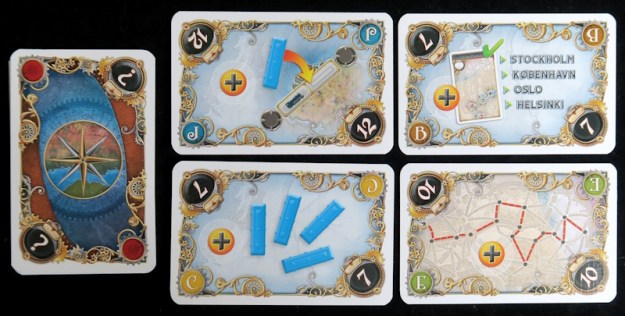
This time the Bonus cards used were Capital Investment (B), Local Area Network (F), International Tycoon (G) & Ferry Master (J).  These gave Bonus points for completing Tickets to the capital cities (Stockholm, Copenhagen, Oslo and Helsinki); completing the most short Tickets; connecting to the most countries; and completing the most Ferry routes.  The map is very tight with a lot of short routes, spread over a fairly long thin map and a wide variety of Ticket lengths.  Everyone complained that their starting Tickets weren’t compatible, though Blue and Lime both kept all three of theirs, even so Pink surprised everyone when he took his first set of Tickets very early.

Ticket to Ride: Northern Lights
– Image by boardGOATS

Pine soon followed and his sniggering as he kept all the new Tickets was ominous, signalling that he’d already completed all three—a fact confirmed when he drew more on his next turn too.  Blue and Lime covered similar spaces,connecting the north-west to the south-east, while Pine’s network dominated the east and Pinks sprawled over the south.  Everyone was getting on with doing their thing when suddenly, Lime brought the game to a rather abrupt end, catching everyone else out.  As a result, Pink and Pine both had an incomplete ticket that costing them fourteen and twelve points respectively, while Blue had two giving her a combined loss of sixteen points (though part of that was her own fault as she’d overstretched her self and would have run out of trains anyhow).

Ticket to Ride: Northern Lights
– Image by boardGOATS

In spite of that, it was a very, very tight finish with just six points between first and third place, meaning the Bonus cards became much more critical than might have been expected earlier in the game.  Lime set the target with a nice round hundred points, but he did not take any of the Bonus points and was just pipped by Pine who took several of them with Blue making up the podium.  It had been an imperious game from Lime, and he was unlucky to have lost to Pine who was the first to admit that he’d got very lucky with his Tickets, especially the draw where he’d already completed the Tickets, quite remarkable given how spread out the network is on this map.

Ticket to Ride: Northern Lights
– Image by boardGOATS

Meanwhile Purple, Black and Teal had been playing Azul.  This is a favourite game within the group, which is unusual as we tend to eschew abstract games. Players are mosaic building, taking tiles from a shared array of factories, adding them to their Storage on their personal player boards.  At the end of the round, any full rows are scrapped with one tile progressing into the player’s mosaic.  Players score when the tiles added form rows or columns, and the longer they are, the more points players get.  The catch is that each Storage space can only hold one tiles of one colour.  If there is nowhere to put tiles taken from the Factories, left over tiles go into the Scraps bin costing players points which can be very costly as Black found out when he lost fourteen in the final round.

Azul
– Image by boardGOATS

For a little variation, the trio added the Joker tiles and the five double score markers from the Special Factories Promo tiles.  The Joker tiles are a set of ten beautiful promotional tiles that can serve as a proxy for any of the other tiles, though their aesthetic comes at a price as players can’t use them for end of game color Bonuses.  The five double score markers allow players to double the points scored for a row or column, by taking the marker of the matching colour.  Everyone took one of these during what was a hard-faught game where Purple and Black tied for with seventy points.  The clear victor was Teal, however, with eighty-eight points.

Azul
– Image by boardGOATS

Teal and Pine took their leave, so after some chatter, Purple and Black joined Lime, Pink and Blue in another game of CuBirds.  This time, Black collected magpies but twice had enough for sets but kept losing them.  Pueple got three WeirdBirds and was busy collecting parrots when the game came to an end.  Both Lime and Blue tried to collect a set of seven different birds, but while Blue got close with five (and a duplicat “wol”), Pink was imperious.  Before his final turn he had a set of three toucans and two sets of two (flamingos, ducks and robins), pretty-much guaranteeing him victory, regardless what he was left with, though he chose to check-out with another flock of flamingos.

CuBirds
– Image by boardGOATS

While all this was going on, on the other side of the room an epic game of Ark Nova was underway between Ivory, Cobalt, Green and Plum.  This is a much longer game than we usually play with an advertised playing time of upwards of two hours and reputedly considerably more with inexperienced players and setup time included.  It is all about planning and designing a modern, scientifically managed zoo, but the game-play is more like Terraforming Mars with animals, than Zoo Break or Zooloretto.  That said, although it is quite complex, functionally it is not difficult to play on a turn by turn basis, though there is quite a lot to manage and keep a track of.

Ark Nova
– Image by boardGOATS

On their turn, players take one of six possible actions:  activating one of the five action cards (Cards, Build, Animals, Association and Sponsor) with a strength equal to the number above the card, or move a card back to the first space and take a cross token instead.  When activating a card players perform the action based on its power level which is dictated by its position in the row.  Once a card has been played, it is moved the first space in the player’s five card row (i.e.to the lowest power position on the left) moving the other cards to the right to replace the card removed, effectively incrementing their power by one.  During the game, players can upgrade and turn over the action cards to a more powerful second side using various Bonuses.

Ark Nova
– Image by boardGOATS

The Cards action is the simplest action, which lets players draw cards from the deck (the number depending on strength) then advance the marker two spaces along the break track which defines when the round ends.  The Build action allows players to pay to construct one building on their zoo map.  Players can build basic enclosures with a size of one to five, but they can also build a petting zoo for animal storage or pavilions and kiosks (which give players Appeal and money respectively based on adjacent filled enclosures).  With the upgraded build action, players can build multiple different buildings and have access to the large bird aviary and reptile house which allow the storage of multiple animals.

Ark Nova
– Image by boardGOATS

The Animals action allows players to add animals into enclosures in their zoo. Some animals have a special requirement and need a symbol in their tableau and/or the upgraded animal card. Adding an animal to an enclosure has a cost, and then the player turns over the empty enclosure of at least the size needed or places the listed cubes into a special enclosure (an aviary or a reptile house).  The player then adds the animal card to their tableau and resolves the abilities on it and receives ticket sales along with possibly Conservation points and Reputation.

Ark Nova
– Image by boardGOATS

The Association action allows players to take one task on the Association board with different tasks available based on their power level.  This allows people to gain Reputation points, acquire a partner zoo they don’t already own, gain a partner university, or support a Conservation.  Finally the Sponsor action allows players to play exactly one Sponsor from their hand which offer ongoing abilities.  They can allow players to place unique tiles in their zoo and offer end game Conservation point opportunities. Some Sponsor cards have conditions on their play similar to the animal cards.

Ark Nova
– Image by boardGOATS

Players take it in turns to take actions, resetting every time a break occurs, until the end game has been triggered.  There are two tracks, Appeal (Tickets) and Conservation that follow the same course, but in opposite directions.  The game end is triggered when one player’s pair of scoring markers cross, after which, everyone gets one more turn and then the end-game cards are scored.  The player with the largest overlap between their Conservation and Appeal values is the winner.  Everyone was familiar with the game and had watched the rules refresher video, so the group could make a fast start, however, Cobalt and Green had played a lot online and Plum had only played once, so there was a difference in experience levels.

Ark Nova
– Image by boardGOATS

Green and Plum took early Association actions taking the two Reputation universities, scuppering Cobalt’s first turn who couldn’t make use of the double science university.  Cobalt therefore took a partner zoo and snapped a Conservation project from the display in the first few turns. Early game sponsors included: “Veterinarian” by Green (grabbing him an additional university and allowing Conservation projects to be performed at Association level four instead of five, although he didn’t make use of this throughout the game); “Quarantine Lab” by Plum (providing her immunity to venom, constriction, hypnosis and pilfering); “Expert in small animals” by Cobalt (reducing the cost of two-sized animals by three); and “Expert in Herbivores” by Ivory (providing three money each time a herbivore is placed into any zoo).

Ark Nova
– Image by boardGOATS

Plum was very pleased with her “Quarantine Lab” as it meant she didn’t really have to bother with the effects of red tokens that say you have been bitten or poisoned because it meant there was one less thing to get in here way and complicate her game.  Cobalt used his expertise in small animals to good effect, especially when combined with partner zoos, with a petting zoo and several small animals, allowing his money to stockpile. Ivory concentrated on reptiles while Green played several negative effect cards early (e.g. boa constrictor), which hit Ivory and Cobalt (the latter multiple times, and grabbing some of that stockpiled cash). Plum appeared to take an early lead possibly due to her Quarantine Lab which kept her out of all the early pilfering and poisoning.

Ark Nova
– Image by boardGOATS

Cobalt was first to complete a Conservation project, using the snapped card to release a herbivore into the wild and gaining the two-enclosure Bonus, immediately followed by Ivory.  In the middle-game, the African Bush elephant and Serengeti National Park appeared side-by-side in the display, so Cobalt took the risky decision to nab these over two consecutive rounds, but was forced to discard five or six cards from an unexpected break. Having kept the elephant and Conservation project, Cobalt played these to grab an extra scoring card and race up the Conservation track and triggered the scoring card discard. Ivory and Plum took to the Appeal track. Green remained languishing on both tracks, particularly the Conservation track where he barely moved all game.

Ark Nova
– Image by boardGOATS

Cobalt was first to upgrade his cards, leaving only the Association action not upgraded, whereas Green concentrated on Sponsors and Association actions. Plum was working through some difficult choices, ultimately deciding to having to flip the Animals card so that she could play the Elephant she had been nursing. She left the Reputation as the non-upgraded card, which unfortunately removed some of the better options that the Elephant gave.  Plum was just a Europe icon away from being able to take the multi-regional goal, but ultimately forgot that having high Appeal is the negative element to the score and didn’t do the things to convert her Appeal to give her points.

Ark Nova
– Image by boardGOATS

Green was slow to get going, but eventually, managed a master move with his first Conservation project and flew up the scoring to overtake Plum, and began chasing down Ivory and Cobalt.  It was very close between Ivory and Cobalt on who would trigger the end game: Cobalt managed to keep his counters from crossing, causing Ivory to trigger the end game and allowing Cobalt one last turn. Although Ivory scored well on the final turn, Cobalt covered his zoo (giving him seven more Appeal) and scored more than twenty points in the final turn.  In end game scoring, it became apparent that Plum had misunderstood her end game scoring card.  She had thought it gave points for empty enclosures in her zoo (rather than empty spaces) and had set about building lots of them towards the end.  Without this, her game would have ended very differently.

Ark Nova
– Image by boardGOATS

Ivory took the third place on the podium having realised Green was closing and decided to end the game perhaps a turn or two earlier than he really wanted which may have inadvertently caused himself more damage as Green needed some three turns to score anymore.  Green did exceptionally well taking a full four Conservation points from his Bonus card and three extra points from Sponsors, and with it, almost taking victory with a total of eighteen points.  However, Cobalt’s final turn plus two scoring cards (one of which was for small animals) meant he won with a convincing score of thirty.

Ark Nova
– Image by boardGOATS

It had been quite stressful getting the game completed in time, especially with some long turns where actions were chained together, for example Plum played one card which enabled another full turn, but with two new cards it was tough to decide which gave the better option.  All that said, it had been very enjoyable and everyone had got on with their game and helped each-other where necessary.  The group clearly demonstrated that the game can be played in around four hours even with four, so long as everyone knows what they are doing and keeps moving.  It will be a few weeks before the Marine Worlds expansion gets an outing, but it will be exciting when it does.

Ark Nova
– Image by boardGOATS

Learning Outcome:  Reed warblers are weird warblers.

14th Movember 2023

With Black, Teal, Pink, Green and Lime all away, it was looking like it was going to be a very quiet night.  In the event, however, the numbers remained good with the slightly unexpected arrival of Plum, Byzantium, Jade and Sapphire.  When Green dropped off Purple and stayed for a while, it became clear that we’d need something short to play alongside Kites, the “Feature Game“.  Kites is a real-time, cooperative game where players are playing cards and flipping egg-timers to keep the air display going.  A single play-through doesn’t take very long, but it is the sort of game that tends to get played through a couple of times in succession.

Kites
– Image by boardGOATS

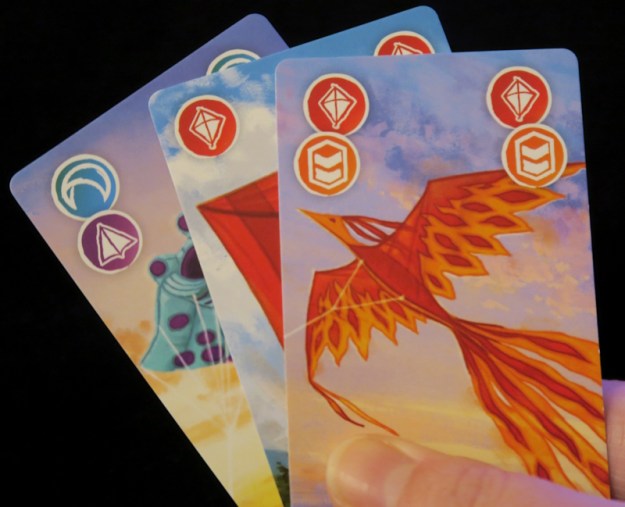
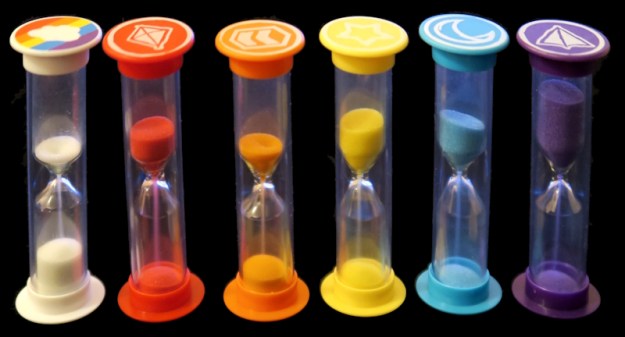
The idea is that that the Team have to launch six Kites, each represented by sand timers, and keep them flying by preventing the timers from running out.  Game play is very simple:  Players start with a hand of cards and must play one on their turn before replenishing their hand from the draw deck.  The cards all show either one or two coloured symbols on the corner, which correspond to the six coloured egg-timers in red, orange, yellow, blue, purple and white/rainbow colours that represent the different Kites.  When a card with two symbols on it is played, both egg-timers in those colours must be turned, however, a card with one just one symbol allows the active player to choose whether to turn the timer in that colour or to flip the white/rainbow coloured timer instead.

Kites
– Image by boardGOATS

The game ends when either all the cards are played out (the Team win), or when one of the timers runs out of sand (the Team loses).  There are a couple of additional “features”.  Firstly, the different coloured timers each have different amounts of sand in them—the purple lasts the longest at ninety seconds with red running fastest lasting just thirty seconds.  This catches out the unwary, and indeed it caught out the group composed of Jade, Plum, Blue, Purple, Pine and Byzantium on their first try when they succeeded in playing just four out of the fifty-three cards in the deck.  The second attempt wasn’t much better, ending with just six cards played.

Kites
– Image by boardGOATS

The game has an “easy start” mode where players start with just three coloured Kites (plus the white/rainbow one), but nobody was keen to take cards out of the deck.  So, to make things a little easier, instead of starting with three cards in hand as per the rules, the group started with a hand of four cards, giving them a little more in the way of choice on their turn.  With this “House Rule” they were a little more successful, but it was at the fourth attempt, that things clicked, and the group finished with only twelve unplayed cards.  And it was then that the second “feature” caught out the group—when the draw deck has been exhausted, players can no-longer turn the white/rainbow timer.

Kites
– Image by boardGOATS

Having done well with four cards in hand, it was then that the group decided to revert to the rules “as written” and play with three cards in hand.  This made things more difficult during the early part of the game, but had the advantage of leaving players with fewer cards to play once the draw deck had been exhausted.  At that fifth attempt, the players were left with just six cards unplayed, and on the sixth try, they had eight left.  They were so close, they could feel it, and everyone in the group was determined not to stop before they’d won, which turned out to be on the seventh play.

Kites
– Image by boardGOATS

Kites is not the usual sort of fare for many in the group, being both cooperative and featureing real-time play.  It had been interesting and fun, however, with players learning how to work together and what information they needed to share.  Two people took responsibility for turning the timers and everyone else made sure they let people know when they spotted a timer running low.  Perhaps the biggest impact was the realisation that waiting was sometimes more powerful than playing quickly, and certainly more haste often brought less speed.  With the successful game, everyone felt they’d had enough, and while the other table finished their game, the group moved on to another party-style game, the simple little memory game, That’s Not a Hat.

That's Not a Hat
– Image by boardGOATS

Each player starts with a single card and shows it to all the other players before turning it face down.  One player then draws an extra card shows it to all the other players and passes their original card to the left or right (as per the arrow on the back of the card), announcing what they think it is.  The receiving player can either accept the card as it is, or challenge the declaration.  If a challenge is incorrect, the recipient keeps the card as a penalty point, whereas a correct challenge leaves the card/penalty point with the gifter.  It seems very simple, and doesn’t sound promising when described, however, after a couple of turns, when someone realises they can’t remember the card they’ve got in front of them and is forced to guess, the tension mounts and everyone suddenly appreciates the game.

That's Not a Hat
– Image by boardGOATS

Byzantium, Plum and Jade had played the game before and knew what to expect, but it was new to everyone else.  Most people thought they knew what card everyone had, only to discover that wasn’t the case after a couple of swaps.  Blue and Purple picked up just the one penalty, while Plum and Jade picked up a couple each.  After the game, there was some discussion about challenges needed to be accompanied with the correct card identity (which is how Plum had played it it HandyCon).  With this, it actually paid to try to bluff/confuse people who couldn’t identify the correct gift.  Inspired by this, there was some discussion about a possible “House Rule” to introduce a bit more jeopardy:  the challenger could optionally attempt to name the gift with the carrot of forcing another point on their gifter, and an incorrect guess reversing the effect of the challenge.

That's Not a Hat
– Image by boardGOATS

That was for another day.  This time, the winners, were Pine and Byzantium who avoided any penalties, though whether that was by luck or judgement wasn’t entirely clear and indeed, was unimportant.  That was especially true as the game was brought to an abrupt end by the game ending on the next table.  That was 7 Wonders—Green only wanted to play something short that he was familiar with and this fitted the bill.  7 Wonders is a card-drafting game, but has a bit of a “Marmite Factor” and is very unpopular with a significant number in the group, so rarely gets played.  This time though, Cobalt, Ivory and Sapphire were all happy to join Green and give 7 Wonders an outing.

7 Wonders
– Image by boardGOATS

In 7 Wonders, players take the role of leader of one of the seven great cities of the Ancient World (Alexandria, Babylon, Ephesus, Giza, Halicarnassus, Olympia and Rhodes), gathering Resources, developing commercial routes, and developing their Military, build their City and erecting an architectural Wonder.  In each round or age, players receive seven cards and draft them, that is choose one card, then pass the remainder to their neighbour (much like Sushi Go! or Draftosaurus).  Players then reveal their cards simultaneously, paying Resources if required, collecting Resources or interacting with other players according to the cards played ant their player board (which gives special powers).

7 Wonders
– Image by boardGOATS

7 Wonders is essentially a card development game:  Some cards have immediate effects, while others provide bonuses or upgrades later in the game.  Some cards provide discounts on future purchases while others provide Military strength to overpower neighbors and some cards give nothing but victory points. Each card is played immediately after being drafted, so everyone knows which cards their neighbor is receiving and how their choices might affect what they’ve already built.  Players continue to draft cards until everyone has six cards (discarding the seventh).  The game ends after three rounds or ages.

7 Wonders
– Image by boardGOATS

7 Wonders is quite a famous game that Cobalt had heard about it and wanted to try, though he was the only one from the group who was unfamiliar with it.  It is one of those games where it seems like there is a lot to take in, but actually it is really quite simple and easy to pick up (though players do tend to require a round to see how it all plays, and there are only three in the whole game).  Everyone chose their respective Sides of Wonder.  Ivory who had Giza, elected to go for Side B, which has a four-piece Wonder and would give lots of points if he could complete it; Cobalt (Halicarnassus) chose to go for the simpler Side A, which would give him points and a chance to rifle through the discard deck for a card if he managed the second stage.

7 Wonders
– Image by boardGOATS

Sapphire (Ephesus) felt both sides were the same, money & points, just in different ways, while Green (Olympia) went for his Side B where he could have the option of copying a neighbour’s end game purple scoring card and the ability to buy Resources for only one coin each instead of two.  As expected the first round was a little slow as Cobalt felt his way around the cards and options, with help from the rest of the group, particularly from Ivory who was sat next to him and was initially passing his cards to Sapphire (so he could show Ivory the deck for some explanations without giving anything away).

7 Wonders
– Image by boardGOATS

The first round was gentle. Ivory and Sapphire lost out in the fight to Cobalt and Green.  In the second round Cobalt had to use his “Muppet Allowance” and swap a card he had kept when others pointed out he should have taken the other one.  Green was building up his army and building his Wonder with a lot of his own Resource (even though he had the Wonder benefit). Cobalt and Sapphire were beginning to specialise in the green Science cards.  Ivory was not really sure where he was going as he was beginning to lose out by not having access to the vast amount of Resources he needed to build his epic Wonder.

7 Wonders
– Image by boardGOATS

By the third and final round we everyone had the problems associated with trying to choose the best of a good bunch of cards.  Green and Cobalt ended up in an army fight, with six points at stake and already a reasonable army, it wasn’t a battle either of them wanted to give up on. The result was that they both let other good cards pass by.  By the end there were not many purple cards left, as it seemed a few had been used to build the Wonders, so Green’s “Copy” did not score heavily, although he did win the battle with Ivory (and subsequently with Sapphire too). Sapphire managed to get a full set of Science and a couple of single type multipliers, thus learning the power of Science in 7 Wonders (which is often hard to achieve).

7 Wonders
– Image by boardGOATS

By the end scoring, it seemed that Ivory, unusually for him, had indeed been boxed into a corner and ended up some way adrift of the rest of the group.  That aside, it was a very close contest between Cobalt, Green and Sapphire, with only a couple of points between each of them, but it was new player Cobalt who took the Laurels of victory.  Everyone enjoyed the game, so it might get another outing soon for which Green would be particularly grateful as it had always been a firm favourite of his.  With all the early games over at the same time, it was possible to swap the groups about as Green took an early night.  Jade was keen to introduce people to After Us, a game he had picked up at the UK Games Expo and hadn’t yet had the opportunity to introduce the group.

After Us
– Image by boardGOATS

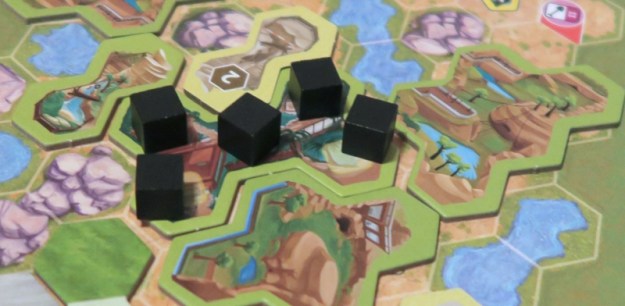
After Us is a deck-building, Resource management, engine building game featuring an original card-combo mechanism.  The story is set in 2083 and mankind has died out leaving only apes which have kept evolving. As the leader of a tribe, players try to guide it towards collective intelligence, by adding new Primate Cards to their starting deck of tamarins. Primate Cards have three rows of “Effects”—the top row will award resources, the middle row will give points (often at the cost of resources) and the the bottom row will have abilities related to the primate type. At the start of a round, players draw four Primate Cards from their deck to be laid out in a row making “Connections”.

After Us
– Image by BGG contributor The Innocent

The aim is to get the most out of the Connections by closing the open ended “Frames” along the sides of the cards by butting them up against adjacent cards that also have open ended Frames. Players then resolve the now closed Frames following the order of top left to bottom right, trying to gain as many bonuses as they can.  Once everyone has simultaneously collected their Resources they can then use them to buy Primate Cards which are added to the top of the draw deck (and thus they come into use on the very next turn). In this way, they are improving the quality of their deck.  The Frames have been resolved, the players simultaneously chose one of their Action Discs denoting which primate type they want to recruit.

After Us
– Image by boardGOATS

The Action Disc chosen will also gives the player a bonus. When recruiting, players have an option to pay three or six Resource (fruit, flowers or grain) to gain a Card. Players can additionally spend two Resource during this phase to copy one of their neighbours’ Action Disc bonus.  Once everyone has resolved their Action Disks and bonuses, players discard their cards and draw four new ones and start again.  The game starts slowly with players building their tribe, but it can end in a sudden rush when one player breaks into a gallop and charges past eighty points triggering the end of the round.  In the shuffle, Cobalt joined Byzantium, Jade, Blue and Purple playing After Us.  Jade and Byzantium led the way (both being familiar with the game), while the others felt their way.

After Us
– Image by boardGOATS

Arranging the cards to make the Connections proved the biggest challenge initially, especially when frustratingly, it wasn’t possible to make use of a really good half Frame.  Blue, Purple and Cobalt just started collecting cards as well as they could, but Jade showed everyone an alternative, shedding all his starting cards until he had no tamarins at all.  It was then that  Byzantium suddenly started surging forward on the points track—having picked up a small number of good quality primate cards and shed a few tamarins he just turned the handle on his engine and it was too late for anyone else to do anything about it.  And he was the first to cross the eighty point finish line, with Blue (who had put on a bit of a spurt) in second.
After Us
– Image by boardGOATS

Meanwhile, Ivory, Plum, Pine and Sapphire settled down to to play the new Scandinavian edition of Ticket to Ride, Northern Lights.  Like all the other editions, players take it in turns to either take two coloured cards from the market, pay cards to place trains or take more ticket cards.  Like all the different versions, Norther Lights has a small number of special rules, but unfortunately, the rules in the box are in Danish, Swedish, Finish and Norwegian, and nobody in the group is a speaker, worse, although we played it about three months ago, nobody could remember the rules, so it was out with the phones to get translations.  The biggest difference boiled down to the addition of bonus cards, four of which are drawn at random at the start of the game and give extra points at the end.

Ticket to Ride: Northern Lights
– Image by boardGOATS

Additionally, there are some triple routes (which only take effect with five players) and some routes have a “+X” next to them which give players who build them X train cards from the face down pile.  Finally, for all routes Locomotive cards can replace any other card and for ferry routes Locomotive cards can be replaced with a pair of the same colour (and as a result, unlike most of the other versions, if there are three or more face-up Locomotive cards in the market, the market is not refreshed).  This time, the bonus cards drawn at random gave points for the most stations in Norway, the most stations in the arctic circle, the most successfully completed small Tickets, and the longest continuous connected train route.

Ticket to Ride: Northern Lights
– Image by boardGOATS

While everyone else seemed to be taking more and more tickets, Plum focused on completing her three starting Tickets, two fairly long ones running north-south, and a short one across the top.  It was a tight game for the podium places, though with Ivory, Pine and Plum vying for the lead.  Ticket to ride is often a high-risk, big-reward game though and if Plum had taken Tickets on her final turn instead of placing a single train for one point, she would have gained two more tickets and an additional twenty point which would likely have given her victory.  As it was, she finished in third, behind Ivory in second and Pine the worthy winner with a hundred and twenty-five points.

Ticket to Ride: Northern Lights
– Image by boardGOATS

Learning Outcome: Keeping kites flying takes teamwork.

22nd August 2023

It was an unusually quiet night—indeed we haven’t been this low on numbers since the dark days of 2020.  On a bleak night in mid March of that year, there were also just four, and that presaged eighteen months of playing games online.  On that occasion, everyone knew something bad was coming and it was a very sombre evening as a result.  This time was much more positive though, as almost all the absentees were away because they were having a good time.  That left just Black, Purple and Plum to meet Cobalt on his first meeting.
Ticket to Ride: Northern Lights
– Image by boardGOATS

The group started with the “Feature Game” which was Ticket to Ride: Northern Lights.  This is the latest version of one of the group’s most popular games, Ticket to Ride, and one that is currently only available in Scandinavia.  Like all the other versions, the rules are quite simple:  on their turn, players either take train cards from the face-up market (or the blind draw deck), or spend cards to place trains on the map for points.  Once or twice during the game, players may instead choose to draw Tickets, which give players points at the end of the game if they are completed, that is to say, the owner has connected the two locations with their trains.  Woe betide any player with incomplete tickets however, as they score negatively.

Ticket to Ride: Northern Lights
– Image by boardGOATS

Northern Lights is similar to the Nordic Countries stand-alone game that we often play at Christmas, except that more people can play and the artwork is a little less festive (though still very, very beautiful).  There are the usual “rule tweaks” that come with a new version of the game and which are in Finish, Danish, Swedish and Norwegian only.  In this case, a translation says that the biggest differences are the addition of bonus cards, four of which are drawn at random at the start of the game and give extra points at the end, (for example to the person with the most left over trains, longest continuous route, most completed ferries etc.).  Additionally, there are some triple routes (which only take effect with five players) and some routes have a “+X” next to them and when trains are laid on these the player takes X train cards from the face down pile.

Ticket to Ride: Northern Lights
– Image by boardGOATS

The rules surrounding Locomotive (wild) cards are slightly different too:  for all routes they can replace any other card and for ferry routes Locomotive cards can be replaced with a pair of the same colour (that doesn’t have to be the same as the rest of the cards used).  As a result, unlike most of the other versions, if there are three or more face-up Locomotive cards in the market, the market is not refreshed (a point of discussion some weeks back).  With just four players, the triple routes were not used and the bonus cards drawn were the Small Step Strategist (D), the Nordic Express (E), the International Tycoon (G) and the Snowplough Reward (I).

Ticket to Ride: Northern Lights
– Image by boardGOATS

These rewarded players for the most single space tracks claimed, the longest continuous route, connecting the most countries and the most routes connecting pairs of cities in the arctic.  The group also forgot to remove the spare trains, making the game slightly longer than it would have been with the rules as written.  Black built a long route all the way down the west coast of Norway, which he shared with Plum in the north and Cobalt further south.  Purple kept to the East side of the map, with a significant amount of her tracks above the arctic circle.

Ticket to Ride: Northern Lights
– Image by Black

When it came to the bonuses, Plum took the Snowplough award and Black was the International Tycoon.  Plum and Black tied for the Longest Route (Nordic express) and Cobalt missed out on joining them by just two two trains.  Instead, he just pipped Purple to the reward for having the most single track sections.  Aside from this, it was a hard-fought game as usual.  Black and Cobalt both completed three Tickets, while Plum finished four and Purple managed a massive seven.  Size matters though, and Purple’s Tickets were all short routes, so didn’t score as highly as the others’.  The bonuses were critical though in such a close fought game, and there were just three points in it, with Black just taking victory ahead of Plum with Cobalt in third.

– Image by Black

It had been quite a long game and time was marching on, so the group opted for another old favourite, Splendor.  This had been a favourite game of Burgundy‘s who’s birthday it would have been at the end of the month.  This year it has not been possible to plan something to mark the occasion (as we did last year), but we will try to do something in September.  In the meantime, as always, everyone will continue to remember him in the games we play.  And Splendor was definitely one of those games—at one point Burgundy had a fourteen game winning streak.  Although Burgundy liked complex games, he also really appreciated simple elegance, and this is definitely one of those games.

Splendor
– Image by boardGOATS

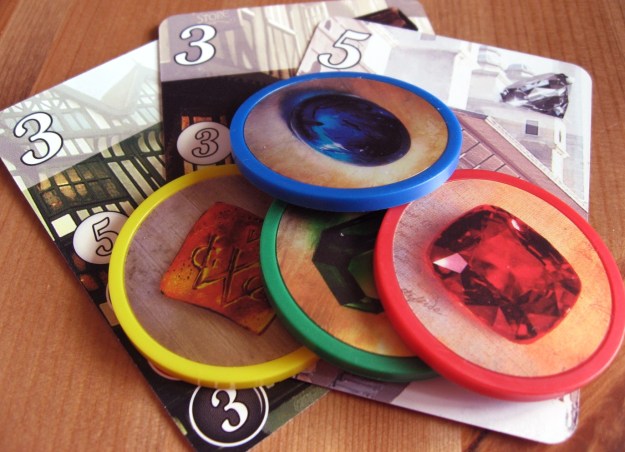
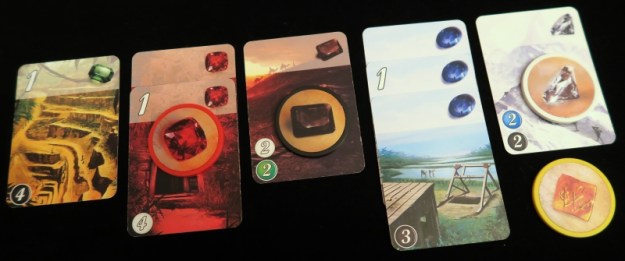
The game is a simple engine builder:  players take chips from the market (three different ones or two the same if there are four or more available), or spend chips to buy cards.  The cards are permanent gems and those that cost more additionally give points.  At the end of the game, the player with the most points is the winner.  Cards aren’t the only way of scoring points though, players can also get points for enticing a Noble to support their cause by collecting the correct gems.  The rules say the game end is triggered when one player reaches fifteen points, however, this time, due the group played to just ten.

Splendor
– Image by boardGOATS

There are several consequences of playing a shorter version of the game, including changing the effect of the more expensive cards, but it also changes the importance of the Nobles.  It also makes reserved cards more difficult to fulfill.  This time, Cobalt had one card that he reserved, but failed to complete.  Everyone had lots of cards and the game was just getting going when Black swooped to secure the support of Elisabeth of Austria with his three Onyx, Sapphires and Diamonds and triggered the end of the game.  Plum had looked like she might just take her revenge for Black pipping her in Ticket to Ride, but it was to be a second runner up place for her behind Black’s unsurpassed twelve points.

Splendor
– Image by Black

Learning Outcome: Board games are in my mind, they guide me back to you…