What started out threatening to be a quiet night with the absence of Green, Lilac, Purple and Black, turned out to be quite lively in the end. As Blue and Pink finished their supper, Pine, then Jade, Sapphire, Plum and Byzantium arrived, soon followed by Teal, Ivory and Lime. Ivory was armed with his new, shiny copy of Apiary, which was to be the “Feature Game“. This is a worker-placement, hive-building game where players explore planets, gather resources, develop technologies, and create carvings to demonstrate their faction’s strengths before the end of the year when it is time to hibernate.
 |
| – Image by boardGOATS |
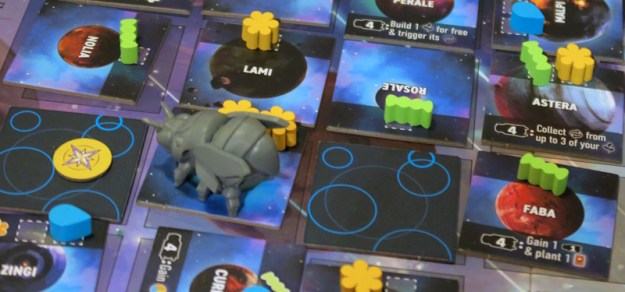
At first glance, Apiary seems to be a fairly simple Worker Placement game, where players have the Tzolk’in choice: place a Worker or retrieve Workers. Unlike in Tzolk’in where Workers carry out their action when they are retrieved, in Apiary, players take the action and gain the associated benefits when placing a Worker, while retrieving Workers enables players to run any engine they have that relies on those recalled workers. Unlike many other worker placement games, there is no blocking and players can add workers to any space as long as they have the power and required resources. If a space is already occupied the existing occupant is “bumped” either to the next space (for certain areas) or sent back to the owner (with a choice to increase strength and make available straight away, or hold on to make use of income abilities).
 |
| – Image by boardGOATS |
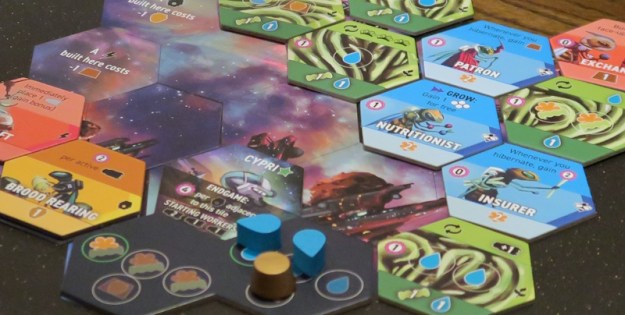
Players start with asymmetric factions and basic resources (Pollen, Water, and Fiber) according to their faction. The Action spaces are mostly about getting or trading Resources and Cards, or adding Tiles to improve their base. There are five available to players at the start of the game: Explore, Advance, Grow, Research and Convert. Explore allows players to visit planets, gaining bonuses for being the first to visit a planet, and also resources from the planets they discover while Advance allows players access tiles they can build if they have the resources to do so. Grow enables players to gain their fourth worker (or gain a worker back from the pool once it hibernates) and allows players to build ship frames while Research gives players access to the Seed Card deck, some of which are incredibly powerful.
 |
| – Image by boardGOATS |
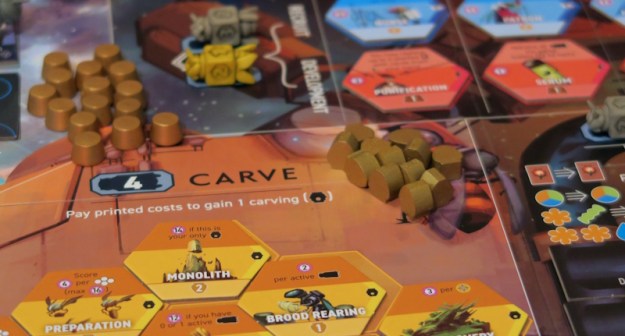
Wax and Honey are more advanced resources that can be created during the game using the Convert Action. Honey, in particular, is required for the final Action, Carve (which also needs a Level Four worker). When Workers return to the Active Pool (either by being bumped or because they have been recalled), their value increases by one. Level Four Workers trigger special bonuses when played, but instead of returning to the Active Pool when bumped or retrieved, they hibernate. In this way, the player loses that worker, but gains a bonus. The game ends when all the hibernate spots are taken or when a player uses all seven of their hibernate tokens.
 |
| – Image by boardGOATS |
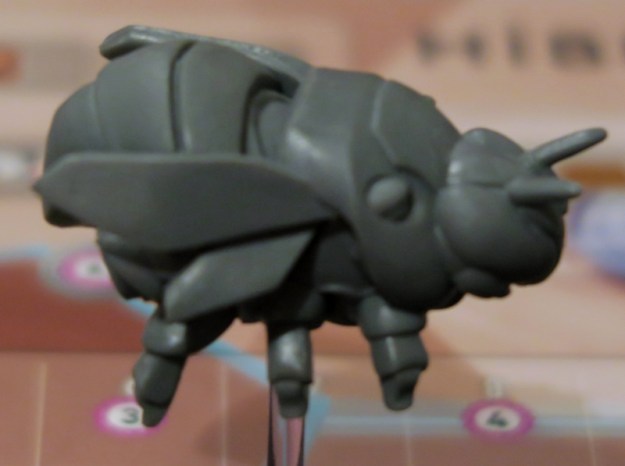
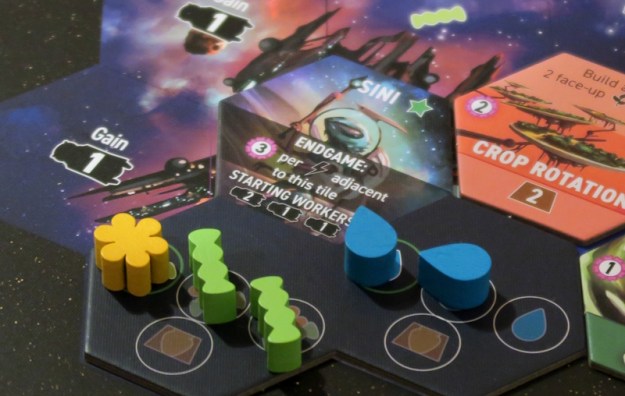
The game is beautifully produced with great art and lovely wooden resource pieces. The QueenShip is arguably the best, looking a bit like Starbug from Red Dwarf. With that and the theme (which had those traveling from Swindon crying, “Bees… In… Space!” à la The Muppets “Pigs in Space!” at intervals), the game was off to a good start. The not-blocked worker space mechanism is similar to that in Euphoria: Build a Better Dystopia, which Plum, Byzantium and Jade had played at HandyCon. Everyone starts off with a unique player “Hive Mat” and starting Faction Tile. Ivory began with “The Log” and “The Sini” which gave points for filing the Hive Mat and for each Development Tiles surrounding the Faction Tile (respectively), so he prioritised getting Development Tiles.
 |
| – Image by boardGOATS |
Cobalt’s Faction, “The Cypri”, gave him four points for each Carving adjacent to his Faction Tile, but found that hard to achieve needing a lot of Honey, so concentrated elsewhere instead. Plum’s focus was on her Hive Mat, “The Warre”, which had spaces that progressed her along the Queen’s Favour track when she covered them, so she decided early to try and focus on that. She had some Farm Tiles that also would have helped her gain more Favour when she triggered the income for taking workers back, but she didn’t use that until later as, although her workers were bumped a lot, she kept choosing to increase their strength and have them available straight away instead.
 |
| – Image by boardGOATS |
Byzantium started with “The Lama” for his faction that gave him a point for each tile he added to his Hive which grew quite rapidly. He also nabbed a Farm Tile from under Plum’s nose which gave him the Edge on the Queen’s Favour Track. As the game came to a close, everyone scrabbled to try to finish things off—like filling their Hive Mat (Plum’s last space was filled for free when she covered the adjacent hex). The lead at the end of the game was held by Plum, but that isn’t really where the points are in Apiary. In contrast to everyone else, Ivory almost completely eschewed the Queen’s Favour, focusing on Planted Cards and Honey Pots, which gave him over thirty points alone, and as a result he charged from the back of the pack to take victory.
 |
| – Image by boardGOATS |
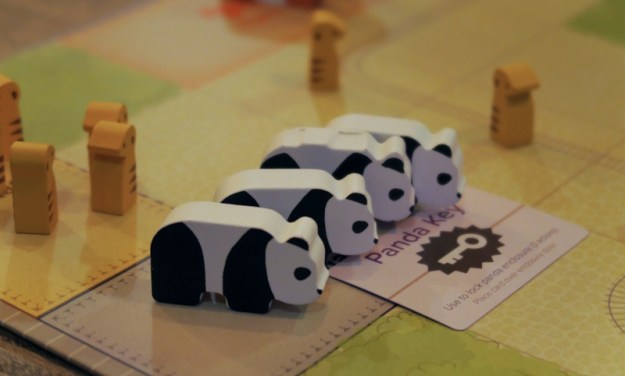
Meanwhile on the other side of the room, Pink, who had been fondly remembering his visit to the see the pandas “Down Under”, sucked Pine and Blue into a game of Zoo Break. This is a cooperative game where players are zoo keepers trying to prevent the marauding animals escaping the zoo. This has had a couple of outings this year the first was a disaster ended when a cobra got out, but the second was a hard-fought victory. This time, with just three keepers, turns would come round more frequently, so to make things a little more interesting, Pink (Lucky Duck), Pine (Gardener) and Blue (Angler) decided to play with the Faulty Lock Variant, personally recommended by the designer.
 |
| – Image by boardGOATS |
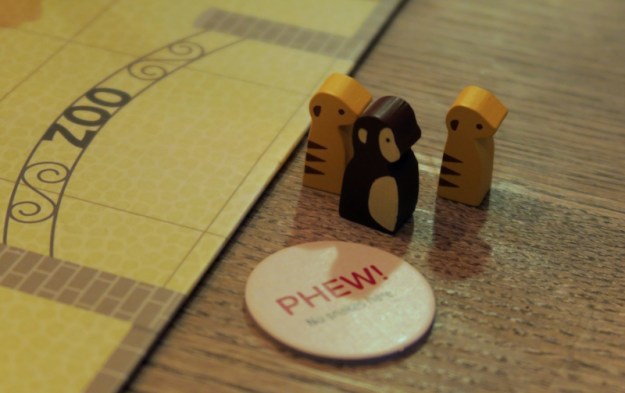
The idea of the game is that players take it in turns to roll the Action Die to found out how many actions they get, then after carrying out the actions, players first draw an Escape card and then a Move card, to see what animals escape and move. In the original game, once animals are locked up, however, they can’t escape, which means the game gets progressively easier. Further, some players potentially end up lurking about with nothing much to do waiting for someone else to deal with the last couple of mischievous meerkats. In the Faulty Lock Variant, however, when an Escape card is drawn for an enclosure that has already been locked, a die is rolled to see if the lock is faulty and whether the animal escapes or not.
 |
| – Image by boardGOATS |
The problem with the Faulty Lock Variant is that it can extend the game quite a bit. That said, it didn’t look like that was going to be a problem as Pink chucked first Pine and then Blue under the Charging Rhinoceros. Then Pink got trampled too, before Pine paid a couple more visits thanks to a mad Elephant and a venomous snake. Eventually, the team got their act together and locked up the Rhino, and then the Capuchins, Pandas, and Elephants. Every now and then, a lock failed and an Elephant got out, but gradually, the animals were being locked up, and eventually the last of the Meerkats was evicted from the part in the fountain locked up (aside from the two that escaped).
 |
| – Image by boardGOATS |
It had been a lot of fun, even though Pink was sad that he’d not been hugged by a lonely Panda, and jealous of Pine who had. It had taken all evening though, and on the next table, Jade, Sapphire, Lime and Teal had managed two leisurely games and a bit of chit-chat. The first game was Isle of Cats: Explore & Draw, a role and write version of the much more substantial card-drafting, polyomino cat-tile-placing game, Isle of Cats. In Explore & Draw, instead of drafting cards before choosing tiles, players choose a set of cards each turn and then draw their “discoveries” on their boats.
 |
| – Image by boardGOATS |
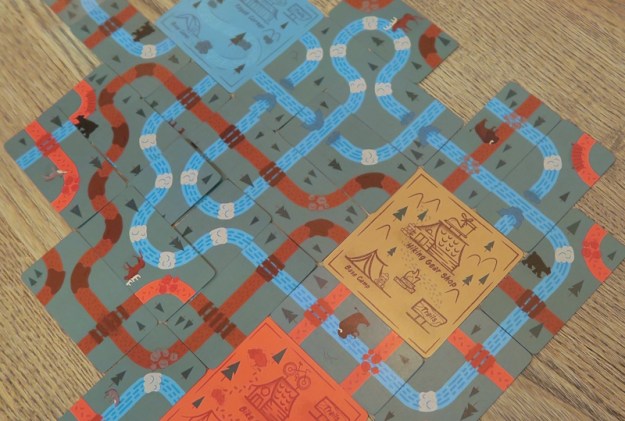
This time it was relatively close for second place, but Sapphire won by something of a landslide, his seventy-nine points was some twenty-five points ahead of Lime who took second with his neatly coloured in boat. Once the wipe-clean boards had all been cleaned, Teal took an early night before the remaining trio played moved on to the card drafting and path building game, Trailblazers. In this game, players start with eight Trail cards and draft two cards three times, adding them to their tableau. The cards must either be placed adjacent to or overlapping other cards as players try to construct long and elaborate trails in three different colours.
 |
| – Image by boardGOATS |
Only closed loops in a single colour, that start and end at a matching campsite will score points and players also compete to fulfill “First To” and “End Game” goals. The game ends after four rounds, when the player with the most points from closed loops and goals achieved is the winner. This was much closer than the previous game, though the outcome was, ultimately, much the same. The goal cards in play were “Hikers’ Quartet”, “Trail Hugs”, “Forever Float” and ” Wanderlust”, though the players only scored for the last two (giving points for the longest single blue “Kayak” route and the longest total brown “Hiking” routes.
 |
| – Image by boardGOATS |
Lime and Jade tried to build trails of all three types, Hiking, Kayaking and Biking evenly, making the best of the cards they had. However, Sapphire focused exclusively on the two that featured in the “Forever Float” and ” Wanderlust” goals, finishing with twenty-eight points for his Kayaking routes alone. While it was very close when the trail lengths were taken into account, Sapphire took first place for both end game bonuses and Lime came second in both, which also reflected the final placing. There was some chatter, while “Bees… In… Space!” finished and then it was time for everyone to go home to hibernate until next time.
 |
| – Image by boardGOATS |
Learning Outcome: Golden Honey is valuable.
 boardGOATS