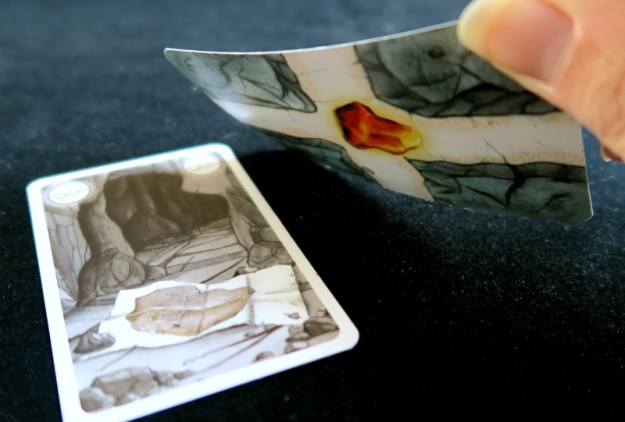
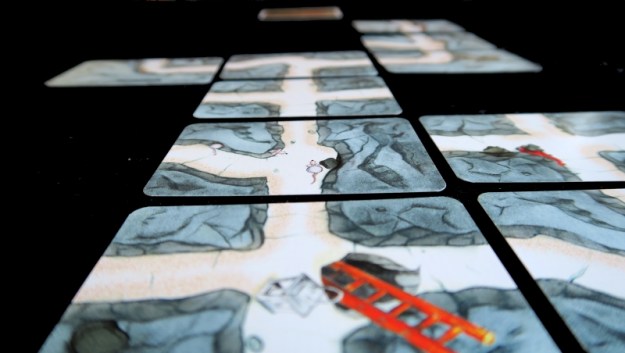
Things were late starting, largely due to the delayed arrival of Blue and Pink with their copy of the “Feature Game“, the the shiny new Emberleaf. It was Plum’s Special Birthday—there have already been two in the last few weeks (Jade and Pine, with Black a few months ago) and more to come in the not too distant future—so there was a bit of chat, card signing and some amazing chocolate cakes provided by Sapphire. Eventually, as time was marching on, games were assigned and Blue and Jade started to explain the rules of Emberleaf to Ivory. This is a “card dancing” and tile placement game from the same stable as The Isle of Cats, where players are trying to re-home their kin in clearings on the central Forest board.
 |
| – Image by boardGOATS |
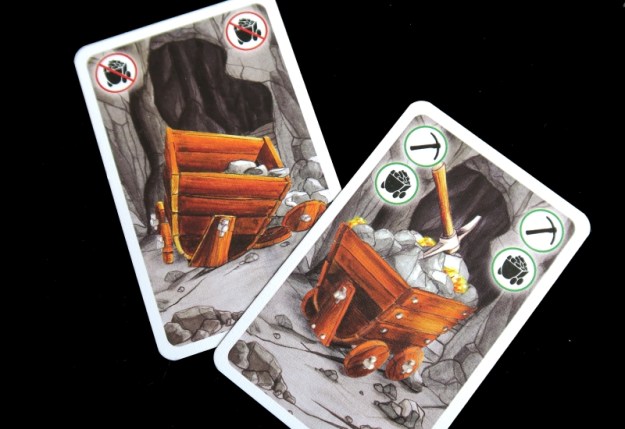
The core mechanic of the game is card placement and movement on the players’ individual Fellowship player boards. The idea is that on their turn, players carry out one of two possible mandatory actions and as many optional actions as they like. The two possible mandatory actions are Card Placement and Card Movement (or “Dancing”). There are five different types of power on the Cards and one of these is the “On Play” action. This takes effect when they are placed—players start with a two by six space to place cards and can place each card in any empty space. The other possible mandatory, Card Movement involves starting with the card in the top left corner and progressing down each column, each card is moved left one space and any “Slide” actions are carried out.
 |
| – Image by boardGOATS |
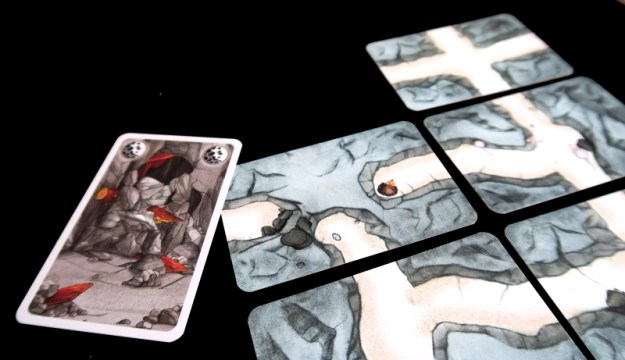
When cards reach the left-most column, Sliding moves them off the player’s board (activating any “Drop Off” actions) and back into their hand (not via a discard pile like deck-building games, so there is no probability element; Cards as always available in hand or on the player’s Fellowship board). The remaining two powers include “Ongoing” and “Charge”. Ongoing powers are always active as long as the card is on the board, while Charge powers are optional actions that can only be taken a set number of times before they must be refreshed by the Card Sliding off the board. All these actions broadly come under the categories of Gathering Resources (Wood, Stone, Turnips or Honey), Walking between clearings, Attacking monsters to make dangerous areas in the forest safe, and Building in clearings.
 |
| – Image by boardGOATS |
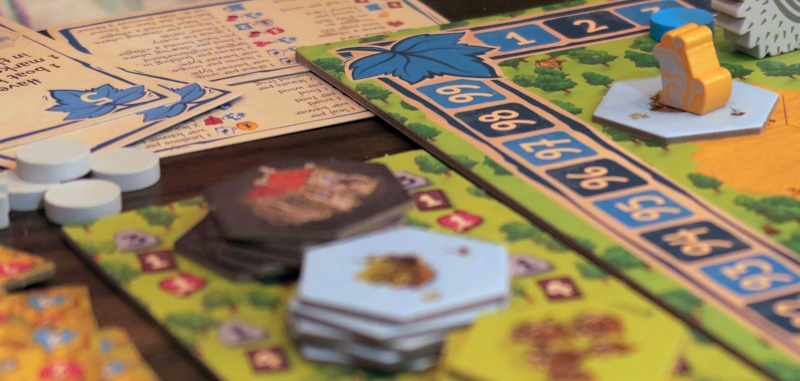
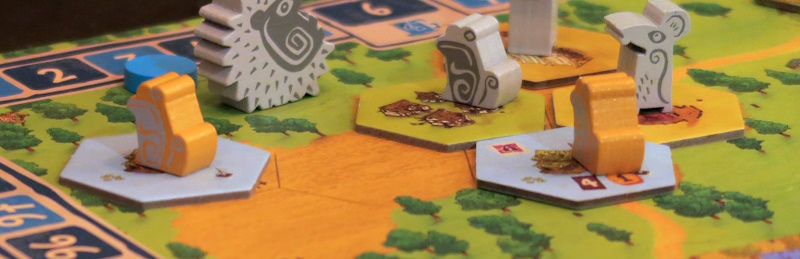
Each player has a space on their Fellowship board to place Resources, which means players have a limited number they can store. So, for example, Building requires a card to give the action (either placed or moved) and the necessary Resources to be spent, as well their Hero figure at the clearing they are building in. Each player starts with a super-cute Hero Figure representing their clan chief, located in Hawker’s Crossing—the most westerly clearing, on the edge of the Forest. From there, players can move their Hero around the board by Walking along paths which go through dangerous areas. If a player wants to travel through a dangerous area, they need to walk further or, alternatively, they can spend a turn Attacking the monsters in the Dangerous area and make it Safe (which also requires an action either by placing a Card or as part of a Card Movement).
 |
| – Image by boardGOATS |
As always, Ivory was on the case, and asked the key question: Where do the points come from? In truth, Emberleaf is a bit of a “point salad” with points coming from all sorts of places. For example, players get points for Building with the number of points equal to the number of different types of building in a neighbourhood. Players also get points for making Dangerous areas Safe, as well as for collecting Trophies. There are six Trophies available during the game, and getting these is all about timing with the player who reaches the bottom of the cooperative War Banner Track taking one. Everyone gets some benefit from this, but the player who takes the Trophy gets an extra bonus. The game ends at the end of the round when the sixth is taken.
 |
| – Image by boardGOATS |
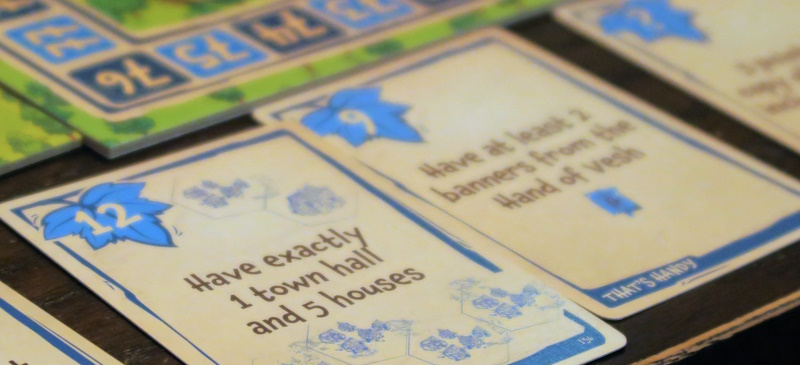
Additionally, in a similar way to the tiny buildings in Tapestry, when players take one of their twenty Emberlings from their Fellowship board and re-home them, they reveal a little bonus and some of these are points (others include Resources etc.). There is another, more significant way of gaining points, however, and that is through Favour Cards. These are personal objective cards which can be very lucrative and are scored at the end of the game. Favour Cards can be acquired as part of rehoming Emberlings, but also by Promising a Favour, one of the optional actions that can be carried out as part of a player’s turn. Each clearing starts with a Favour token in each player’s colour and if their Hero is currently located in a clearing containing one the player may spend it to take a Favour card.
 |
| – Image by boardGOATS |
On the surface, the game is not that complex, though building an engine requires an understanding of what the cards do and how to get the best of them. Additional Hero cards can be taken from a Card market when a Campfire icon is revealed (likely on re-homing an Emberling). There are a few little rules niggles as well. For example, the Card markets (there are two: Favour and Heros) are refreshed at the end of a player’s turn, but as well as replacing the used cards, the oldest card is also discarded meaning the order cards are drawn in has to be observed. Similarly, whenever a the bottom of the War Banner Track is reached, the Dangerous Area tiles are refreshed.
 |
| – Image by boardGOATS |
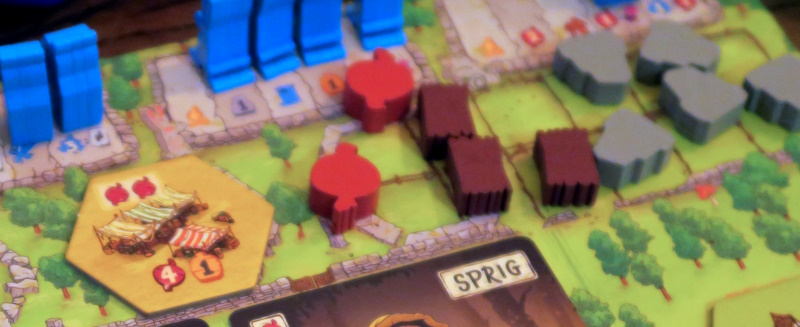
Ivory, got a handle on the rules really quickly and was out of the blocks on the “B” of bang. Jade wasn’t far behind, while Blue was much, much slower as she spent much of her time with her nose in the rules checking queries rather than focusing on her game. When she finally got round to looking up, the others were distant figures on the horizon and she had a lot of catching up to do. Ivory had moved quicklywith an initial strategy of building buildings on the areas that gave honey (particularly markets occupied by a mouse for his end game scoring). This gave him additional spaces on his board and he then picked up a couple of additional Hero Cards and several Favour Cards to further drive his strategy.
 |
| – Image by boardGOATS |
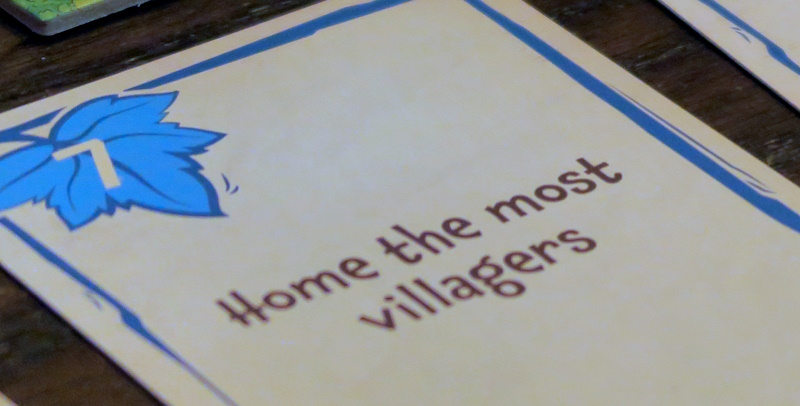
The Koala allowed Ivory to battle anywhere whenever he “Danced”, and that gave him a steady stream of points and resources. Jade and Blue were slow to clear the additional board actions, but Ivory found that opening up the Build Action meant he always had that available and could place a card with only “Dance Actions” at the end, giving me max benefit for that card. Everyone tried to get end game objective cards early as they give something to aim for. Ivory was by far the most effective at this however getting cards that gave points for having his mice on markets, mice in at least three different areas and building in exactly four areas, whereas Blue who was slower, found she was trying to take objectives that matched her achievements.
 |
| – Image by boardGOATS |
Inevitably, Ivory was the victory by a veritable country mile finshing with one-hundred and thirty-eight, though Blue who had been practically stationary for most of the game, came through strongly in the late stages to take second. It had been a tough learning game, but everyone had liked it and it definitely deserves anothe outing. Meanwhile, Plum, the Birthday Girl, was playing one of her favourite games, Viticulture. This is also one of Pink’s favourites and is also very popular with both Byzantium and Mint who completed the foursome. There is nothing really innovative about the game—it is “just a standard worker placement game”, but it does the job really, really well, which elvates it above so many other worker placement games, and as a result, it rates highly on ranks very highly on so many lists.
 |
| – Image by boardGOATS |
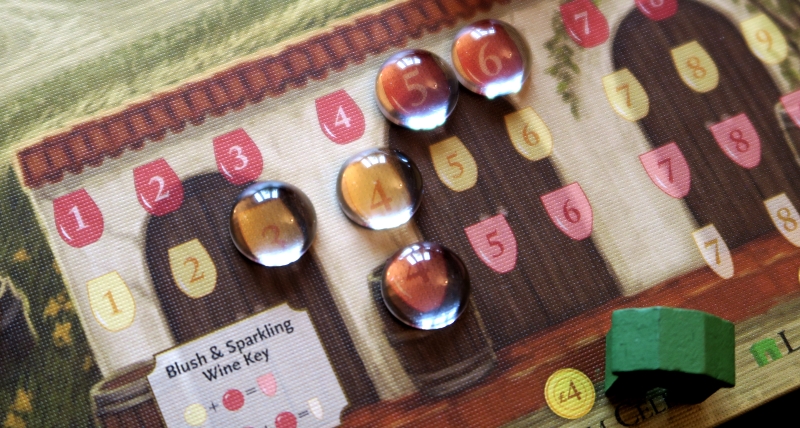
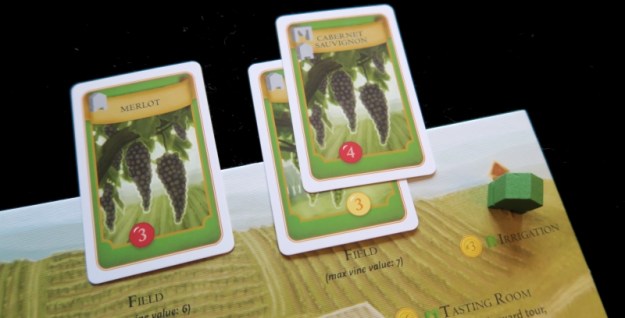
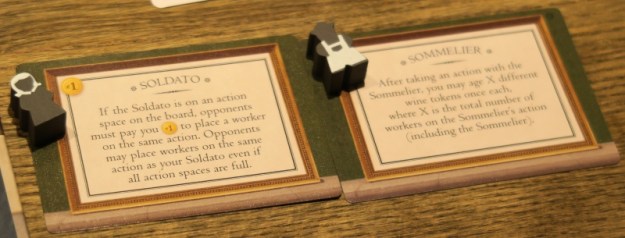
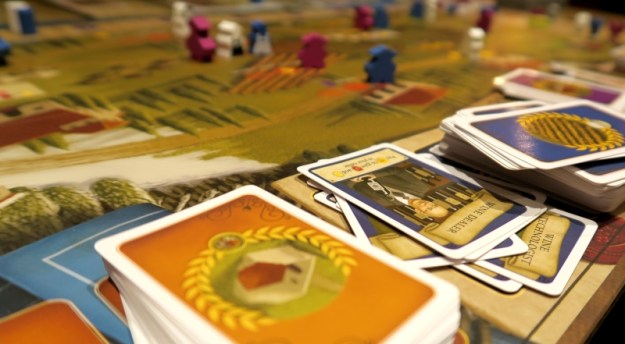
The game played over several rounds, which are split into seasons—Players take it in turns to place workers on the Summer part of the board in the first half allowing them to plant grapes and prepare for Winter when players can harvest their grapes, make wine and fulfill contracts for points. In general, each action has a small number of active spaces, but players also have a Grande worker who can always be used to carry out an action, even when all the usual spaces have been filled. Winter and Summer are setup phases when turn-order is addressed and Visitors arrive. Visitors are cards which allow players to bend the rules slightly and/or gain points.
 |
| – Image by boardGOATS |
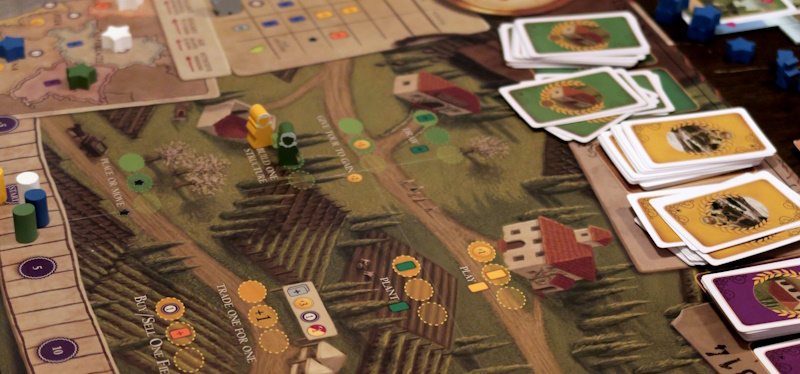
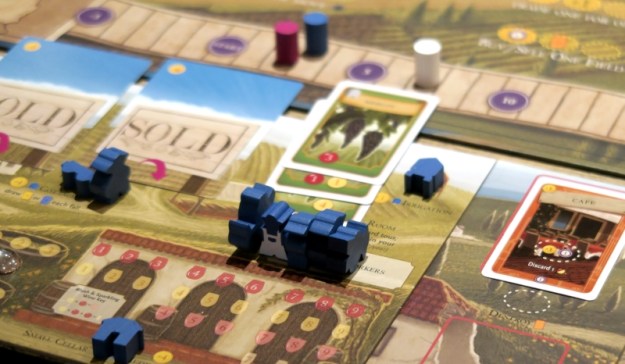
This time, however, the group decided play with the Tuscany expansion and the Moor Visitors card deck. Tuscany replaces the main board with a larger board, but also re-structures the phases so that there are now four seasons to place workers. It additionally adds a small map where players can place star-eeples to gain a bonus and points at the end of the game for the player with the most influence in this area. Tuscany also brings in structures, which players can build to enhance their vinyard and use to gain more points. It also lenghtens the game slightly, ending when a player passes twenty-five points rather than twenty in the base-game.
 |
| – Image by boardGOATS |
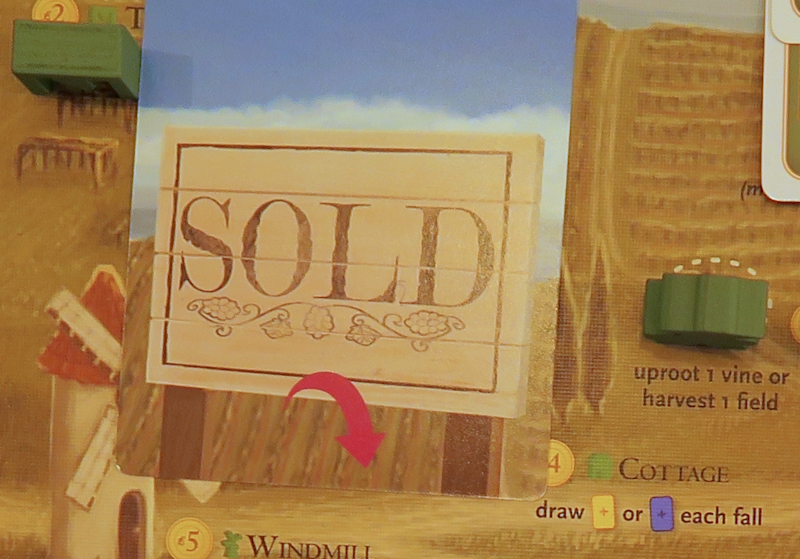
Everyone knew the game well, so after just a few rules clarifications the game was underway with everyone opting for the the now standard trategy of selling a field for an early influx of cash. Mint started with some really nice building cards including one which enabled her to harvest multiple fields at the same time. Plum was less enthused by hers and recycled them—as she had begun the game with the Cottage she was picking up extra Visitor cards every Autumn. She made a concious decision not to choose to “wake up” first, which meant she never went first or last in the turn order and when she chose the start bonus of “age grapes” she forgot to take advantage of it. This was clearly catching as Byzantium did something similar when he chose the same starting position.
 |
| – Image by boardGOATS |
The Tuscany expansion also adds Special Workers which have their own special abilities and players can train one of their workers to have each of these. This time they were the Farmer and the Builder, with the latter from the Special Workers promo. Respecively, workers with these powers, allow the player to choose a bonus (even if they are not on a bonus space) and save two lira when building. A priority is always to get more workers early in the game, but whether to upgrade them is a difficult decision as it costs an extra lira and cash is always so tight in this game. These proved quite popular though as going second in a location with a Farmer still gave a bonus.
 |
| – Image by boardGOATS |
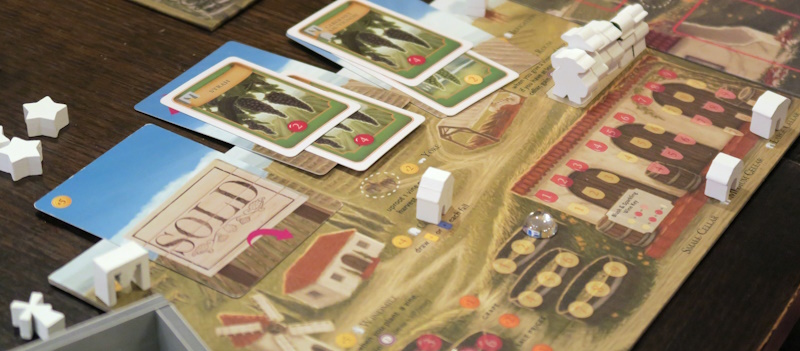
Pink got his head down making wine early as he picked up two really nice, achievable and valuable contracts early in the game, which gave him a solid start. However, it was a very long time before anyone actually really started scoring points as everyone concentrated on building their vinyards before putting them into action. For example, Plum, needed a Trellis for her first grapes, although having a Builder reduced its cost. Eventually she also built a Penthouse which gave an extra point when making high quality wine over a value of seven and with those in place was in a position to start growing, harvesting and turning grapes into wine.
 |
| – Image by boardGOATS |
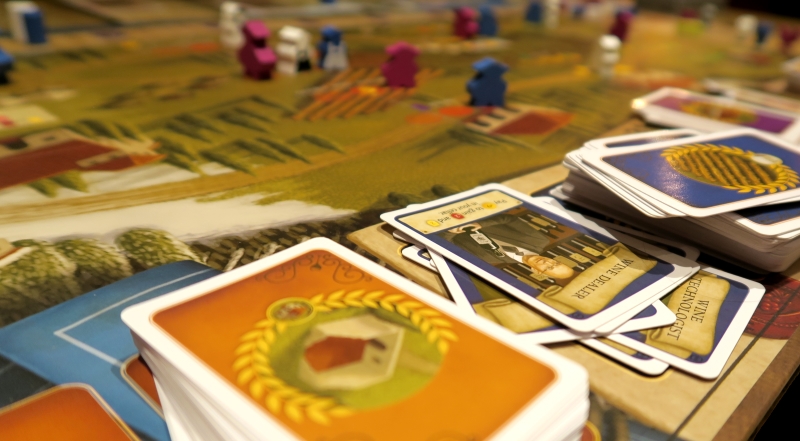
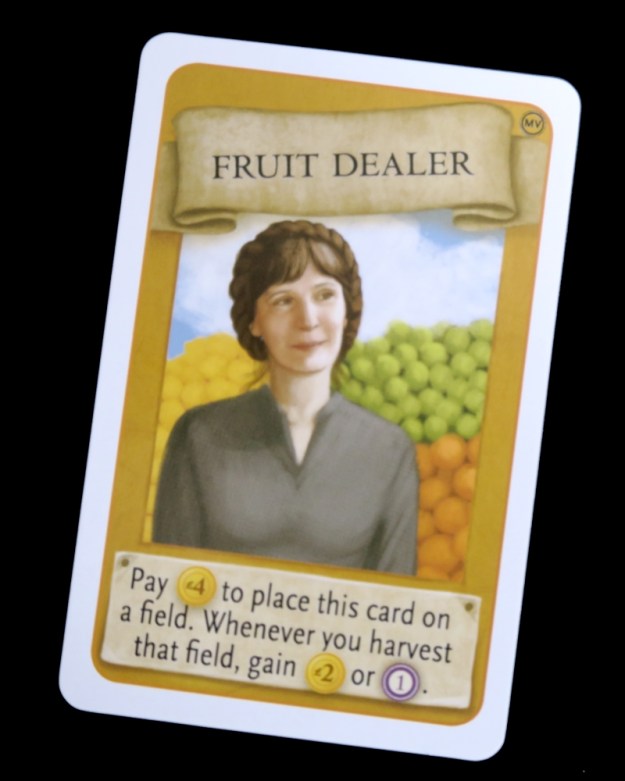
At one point, Plum played a two Visitor card combo that gaver her a grape which she was immediately able to sell at tripple the normal price. Otherwise, everyone mostly focussed on turning grapes into wine and completing contracts for points, although Pink did turn cash into points as well. As is always the way with Viticulture, there was a sudden cascade of points, and with four experienced players it was a tight game with all four finishing over the twenty-five point finishing line. The winner was Pink, however, who finished with thirty one points, three more than Plum who took second (no, Pink wasn’t going to let her win, even on her birthday!), and Byzantium and Mint tied and shared the last spot on the podium.
 |
| – Image by boardGOATS |
The third table, comprising Black, Purple, Pine, Sapphire and Lime, started with a game of Sagrada (with the 5-6 player expansion). This is a fairly simple game of dice-drafting, where players are placing dice to create stained glass windows. Dealt at random, each player begins with a private objective card and two double-sided Window pattern cards, choosing one side to play with and taking the number of Favor tokens marked on the chosen pattern. Three Tool cards and three public objective cards are placed in the communal central area and the first player rolls all the dice.
 |
| – Image by boardGOATS |
In “serpentine order” (i.e everyone taking a turn in order then taking a turn in reverse player order), players can use any Tool card (paying one Favour token for the first use, two thereafter) and then choose one die from the pool and place it on an open space in their Window. The first die must be placed on an edge or corner space and every other must touch another die diagonally or orthogonally. Dies must match the colour or value depicted on the space if there is one and may never be orthogonally adjacent to a die of same color or value. Players may choose not to take a die on their turn, but that will leave an empty space and each one costs a point at the end of the game.
 |
| – Image by boardGOATS |
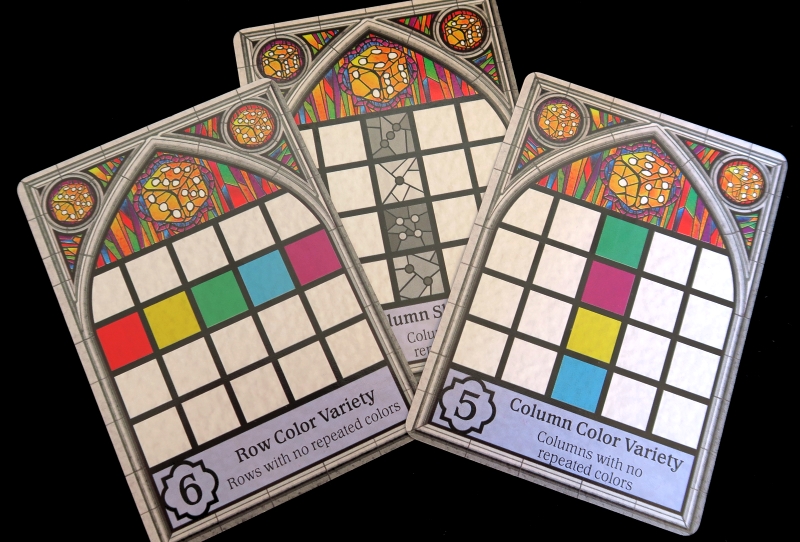
The game ends after each player has had twenty turns after which players score points for each public and private objective achieved adding one point for each remaining Favour token and and deducting a penalty point for each empty space. Even though there were five, the group played by these standard rules rather than adding the optional private dice pools from the expansion. The communal goal cards gave points for placing pairs of dice with a value of three and four; sets of dice with a value of one to six and rows with no repeated numbers. As is always the case with dice games, this game is all about riding the luck of the roll, but it can play havoc with people’s plans.
 |
| – Image by boardGOATS |
For example, on Pine’s first turn a roller six of the dice had a value of two, but nobody wanted them. Later in the game he rolled again, this time rolling no twos when at least two people desperately wanted them! When the game came to an end, there was just the scoring. Honours were pretty much even for the first two communal objectives. Purple managed to score once for the lucrative, one row without repeated numbers objective, while Sapphire and Black scored it twice and Pine three times. Scores for the private objectives were almost identical for Sapphire, Lime and Pine. In total that gave Pine victory, nine points ahead of Sapphire in second and sixteen ahead of Black in third.
 |
| – Image by boardGOATS |
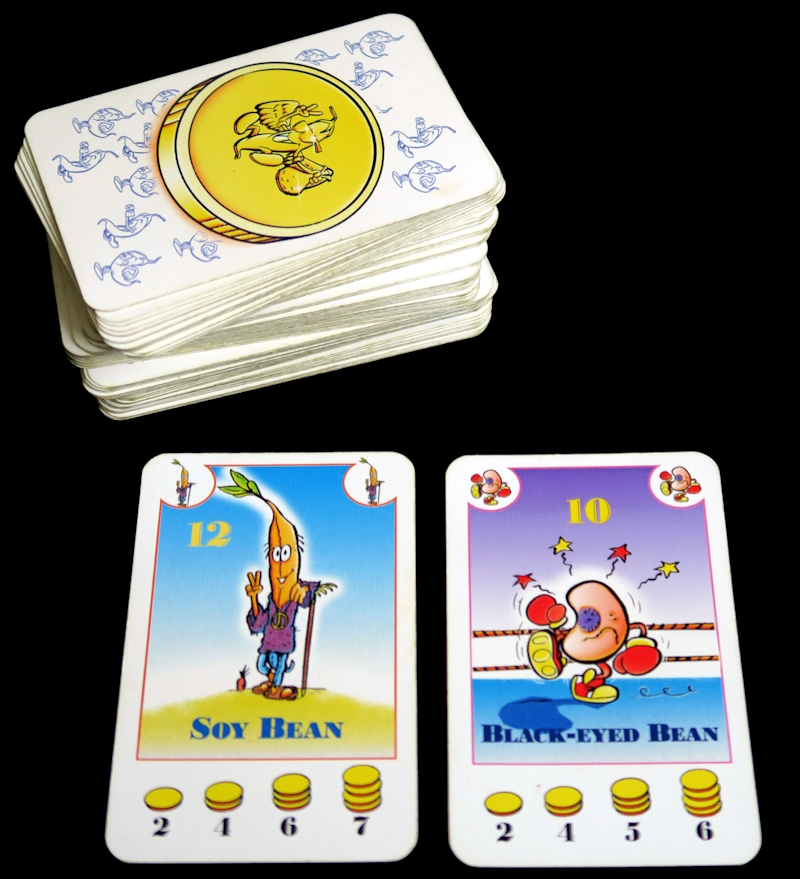
The other games were still going and looking like they were giong to take the rest of the evening, so the group looked around for another game that played five. From the other side of the room Blue suggested Bohnanza, and as Sapphire thought he’d never played it, the group decided that wasn’t a state of affairs that could continue. This is a popular game within the group as it is a lot of fun, even though a game about bean farming and trading sounds very unpromising. Played with cards, the key mechanism is that the order of players’ hands cannot be changed—they can only be manipulated by in-game play. So, on their turn, players must play the first card in their hand into one of their two “Bean Fields”, and may play a second if they can.
 |
| – Image by boardGOATS |
Beans can only be added to empty fields or to fields of the same type. A field can be harvested at any point, but the aim it to maximise the yield. Once the active player has played from their hand, there is the flop: two cards are played from the deck onto the table. These must be planted before the next phase, but can be planted in the active player or by any player with their agreement. Sometimes these are gifted, sometimes they are traded, and this is how players can manipulate the cards in their hand, by trading away undesirable cards. Once the cards on the table have been disposed of, then the active player can trade any card in hand before replenishing from the deck to end their turn.
 |
| – Image by boardGOATS |
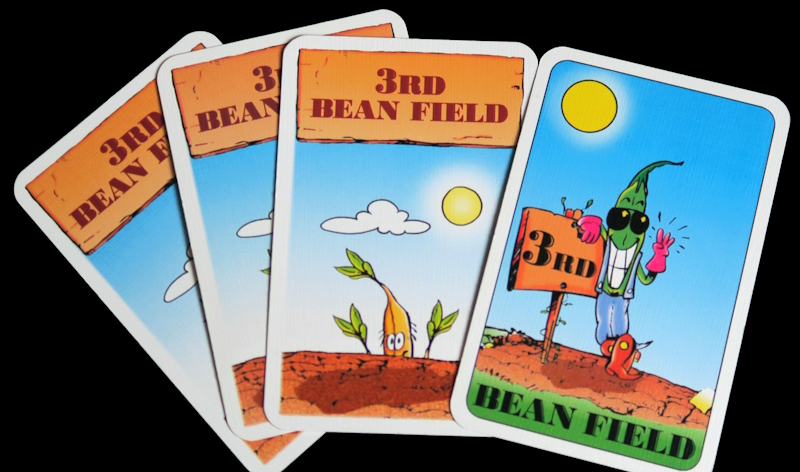
The game ends after three passes threough the deck, but while the first pass seems to take forever, the last always goes like lightening because many of the cards are now in players’ score piles. Further the balance of the cards changes as the game progresses, with rare cards disappearing as they are turned into “Thaler” and get stuck in players’ stash. Players can spend some of their riches on a Third Bean Field, but this is only really productive if carried out early in the game. This was a strategy adopted by Pine this time—unusually for him.
 |
| – Image by boardGOATS |
It paid off almost imediately as Pine collected two of the super-rare cocoa beans, and soon added a third. Black commented that he’d get the fourth, and Pine couldn’t hide his delighted laugh when he immediatly picked it up! The winner was Lime though who finished three points clear with twenty, leaving Pine to take second and Black to make up the podium. The question was, however, had Sapphire enjoyed it? Sadly, the answer was a resounding “no”. Worse, it turned out that he had played it before, and had disliked it so much that he’d blocked out the experience. Such a shame, but some games are not for everyone…
 |
| – Image by boardGOATS |
Learning outcome: You don’t have to know how you win, you just have to score more points.







 boardGOATS