Lime was the first to arrive, soon followed by Blue, Pink with Purple, then Pine, Jade, Plum, Ivory, and Teal. Jade and Teal were armed with some of their toys from UK Games Expo, so the first two games were the “Feature Game“, the Aerial expansion to Draftosaurus and the 2022 Spiel des Jahres nominated SCOUT. There was the usual chatter at the start while Blue and Plum tried to work out some of the details of the Draftosaurus expansion where the rules were unclear. Then there was the usual hiatus to sort out who was playing what, but eventually Plum led Purple, Jade, Pine and Pink passing Pterodactyls round the table.
 |
| – Image by boardGOATS |
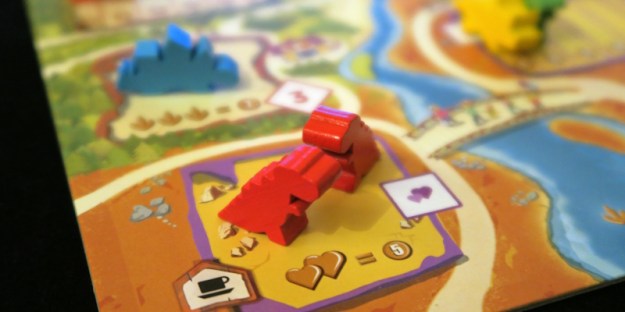
Draftosaurus is a lot like Sushi Go!, but with wooden dinosaurs. It’s one of our most popular games that we first played online in 2021 and have since played lots of times in person, drafting real, cute, miniature, wooden dinosaurs. Instead of sushi cards, players start each round with a handful of wooden dino-meeples, choose one to keep and add to their dino-park, and pass the rest on to the next player. The active player rolls a location die, which applies a restriction to where dinosaurs can be placed that everyone except the active player has to observe. There are various pens, each of which score players points in different ways. For example, the Meadow of Differences can only hold one of each type/colour and scores for each different type.
 |
| – Image by boardGOATS |
In contrast, the Forest of Sameness can only hold one type/colour of dinosaur, but also scores more the higher the occupancy. The Prairie of Love needs pairs of dinosaurs of the same type, each of which score five points, while the Woody Trio will score seven points if it contains precisely three dinosaurs at the end of the game (otherwise it scores nothing). The King of the Jungle and the Solitary Island only hold one dinosaur each, but the King of the Jungle scores if nobody else has more of that type of dinosaur, while the Solitary Island only scores if it contains the only dinosaur of that type in the Park.
 |
| – Image by boardGOATS |
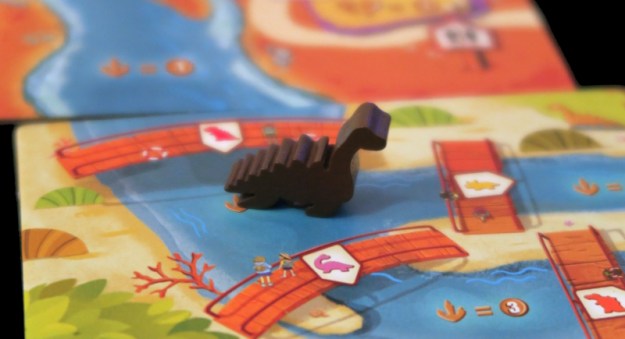
At any time, players can place dinosaurs in the River that runs through the middle of their Park instead of placing them in an enclosure. There, they will only score a single point, except for any that are the red tyranosaurus Rex which increase the score of any pen they are in by one. Played over two rounds (passing clockwise and then anti-clockwise, scores are calculated at the end of the game and the player with the most points is the winner. There is a bit of variety in the base game with double-sided Park boards, though we’ve rarely if ever played the winter side. There are also two expansions; a month ago, we played the Marina expansion which adds an extension to the river and plesiosaurs, but this time we wanted to try the Aerial expansion which adds nests on Mountain extension boards and pterodactyls.
 |
| – Image by boardGOATS |
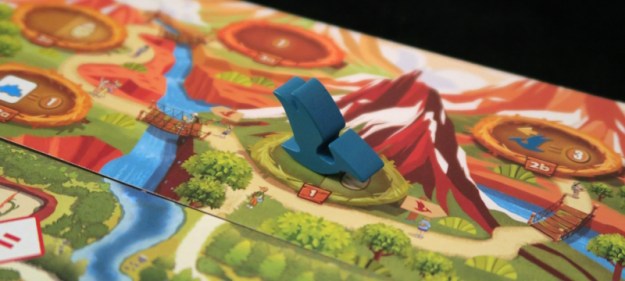
Pterodactyls can only be placed in the nests on the Mountain expansion board, but when they are placed the player gets some sort of bonus. The nests are all numbered, one, two or three. The rules say that before a pterodactyl can be placed in a nest numbered two, one must be placed in nest numbered one. It was not clear, however, whether players could place dinosaurs in multiple nests numbered one, or whether a second pterodactyl had to be placed into nest numbered two (and by extension, a third should be placed in a nest numbered three). After much searching online, Plum concluded players had to start with a nest numbered one, before they had the option to use a nest numbered two—an interpretation that was later found to be correct.
 |
| – Image by boardGOATS |
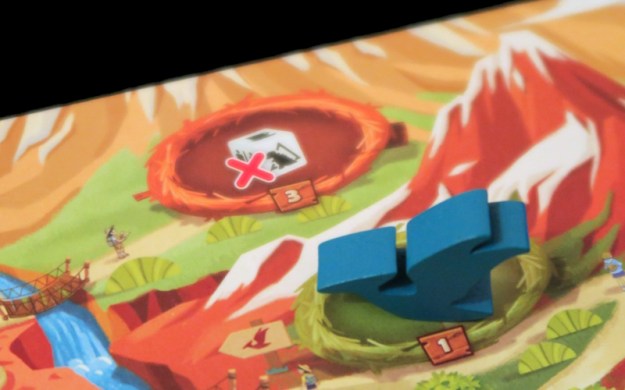
The Aerial extension boards are double-sided, so things were further complicated by the fact that the board chosen had two nests marked 2a and one marked 2b. It was suggested that perhaps players had to do both the 2a nests before progressing on to the third nest, but Plum thought that was not the case and that was the choice. After the event, it was found that the third nest could only be used once one of the 2a nests had been filled (but was not accessible via nest 2b). Plum did best finishing with a massive thirty-eight, but as everyone was still getting to grips with the new rules and the game is not a long one, the group decided to give it another go with the reverse side of the Mountain board.
 |
| – Image by boardGOATS |
This time it went better for everyone except Plum and Pink (who had come second in the first game, with thirty-four). Plum had prioritised placing three pterodactyls so she would be able to ignore the restriction imposed by the placement die, perhaps at the expense of all else. Lime (who always likes to play games twice in quick succession) and Pine had got the hang of the game and took first and second respectively with thirty-six and thirty-two points. Although everyone had played Draftosaurus quite a bit during 2020/2021, nobody had been familiar with the expansions. While they certainly add something new, the Marina expansion is probably the better of the two, though it would be interesting to see how the game would play with both expansions in use too.
 |
| – Image by boardGOATS |
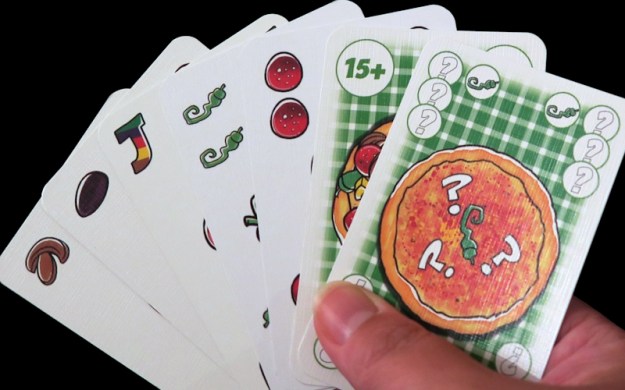
From there, the group went on to play Mamma Mia!, which is a hand-management card game from Uwe Rosenberg, the designer of the king of all hand-management games, Bohnanza. Mamma Mia! is quite an old game and we played it quite a bit some years back, but the last time was nearly six years ago and those that knew how to play it had forgotten, and others hadn’t played it then or since. Purple did her best to explain the rules from memory, but was somewhat hampered by Plum and Lime who kept interjecting, trying to guess how the game might play. Meanwhile, Pink spent the time trying to read the rules and make sense of them, that said, the game is not all that complex, though really very clever, like all of Uwe Rosenberg’s games.
 |
| – Image by boardGOATS |
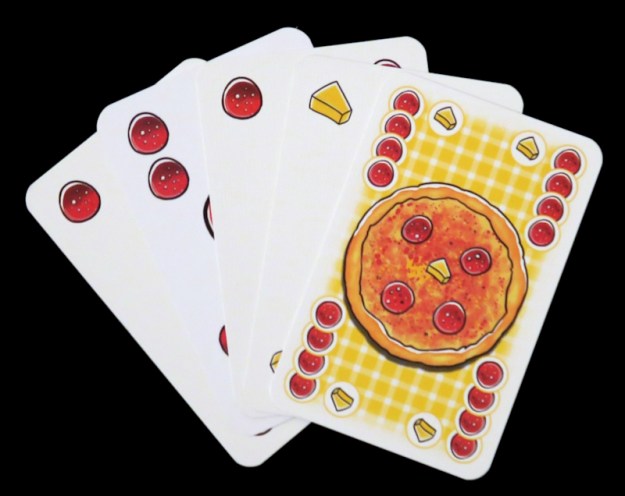
The idea is that each player starts with a hand of pizza topping cards and a deck of order cards. On their turn, the active player puts pizzas in the oven by placing ingredients cards on top of the central pizza deck and then, optionally, follows it with an order card (which are colour coded for each player) before replenishing their hand from the supply deck. Unfortunately, in the rushed rules reading, there were a couple of, er, malfunctions: the group omitted to include the restriction that only one type of ingredient could be played per turn and only one order could be placed, and after placing the toppings cards. Further, when drawing cards, a player may take them from either the central ingredient deck or from their personal order stack, but not both in the same turn—another rule that, er, malfunctioned.
 |
| – Image by boardGOATS |
Once the ingredients supply deck is empty, the pizzas are thematically taken out of the oven, by flipping the pile of cards over and placing the cards face up in separate piles for each ingredient i.e. in the order they were played. When an order is reached the ingredients piles are examined to see if there are sufficient to fill the order. If so, the cards are removed from the piles, if not, the owner of the order card may add any missing ingredients from their hand to ensure the order is fulfilled. If they choose not to do so, the incomplete order card is discarded. After three rounds, the player with the most fulfilled orders is the winner.
 |
| – Image by boardGOATS |
It was all a bit mad, and with players (incorrectly as it turned out) placing assortments of ingredients cards in the oven, they called out what cards they were adding to the deck. The cry of “Four chilies and an olive,” was met with the comment from the next table, “That sounds like a mariachi band—who’s the olive?” It was clear that a lot of fun was had. Plum succeeded in completing an order of requiring fifteen ingredients that everyone else thought was very risky, but that was pretty much all she managed in the whole game. Pink, who finished with six clearly thought he should have won, as he commented that Lime was “apparently” the winner with seven and Pine responded, that Pink was “apparently” second, “apparently” followed by Purple in third…
 |
| – Image by boardGOATS |
Pine commented that before the game started they’d had three different variations and he wasn’t sure which they were going to play, and as it turned out, the one they chose wasn’t quite right! Despite all the rules issues, however, it had been a lot of fun. The card-counting memory play worked well, though without a bit of luck in the ingredients department, players could keep playing cards hoping to replenish the hand with better once, without success. Still, it is clearly fun little card game that we should play again and see if the game is better with the rules played as written.
 |
| – Image by boardGOATS |
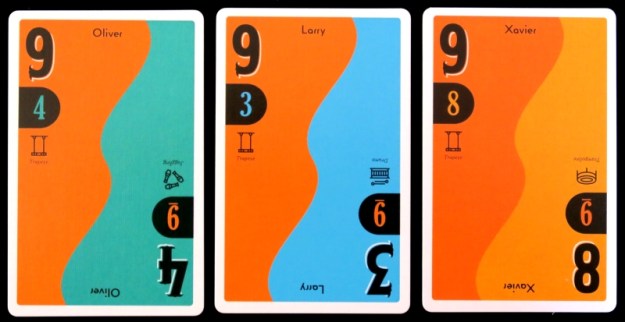
On the next table, Ivory, Teal, Jade and Blue started with SCOUT. This is a ladder-climbing game with a very nominal theme of circus owners collecting acts for their show. This theme isn’t really reflected in the art or the game leading Blue to comment that it was the most theme-less game she had ever seen and she wondered why they had bothered. Not that this made it a bad game, by any means—indeed, when the group played it last year both she and Teal had really enjoyed it. The game is quite simple, the first player leads with either a run of consecutively numbered cards or a meld of cards of the same number. The next player can play either a larger set of cards or has cards, or one of the same size but of a higher value (melds always beat runs of the same size).
 |
| – Image by boardGOATS |
If they beat the cards on the table, the active player takes the beaten cards into their score pile and leads with a new set. Alternatively, the next player can “Scout” i.e. take a card from either end of the set on the table and add it to their hand. And this is where the game gets really clever—like Bohnanza, players can only play consecutive cards from their hand, but when they add a card to their hand, they can add it anywhere. Further, the cards are double-headed, that is to say, they have different values depending on which way up they are. At the start of the game, players are dealt a hand and, as in Bohnanza must not rearrange their cards, though they can choose which way up the whole hand is, and thus the quality of the hand as a whole.
 |
| – Image by boardGOATS |
When Scouting, the player can choose which way up it goes into their hand as well as where, and it retains that value in their hand and when played. Once per round, players can “Scout and Play”, taking a card from the display and immediately playing a set of cards for the cost of a single point. Playing this at the right time can be critical to winning the game. The round ends when either a player plays their last card or when play gets back to the player who last played a set and everyone else in between Scouted. Players score for each card they have taken, but any remaining cards in their hand give negative points, often the decisive factor.
 |
| – Image by boardGOATS |
This time, the first round was quite close. Ivory finished the round and also took the most points. This was the case for much of the rest of the game, and it was soon clear that everyone else was playing for second place. In that, it was actually quite close. Blue did particularly badly in the penultimate round, and looked to be cruising for a bruising. However, she ended the final round very quickly with a very long run leaving both Jade and Teal with negative points (though Ivory still top-scored). These negative point proved critical, and Blue took second with twenty-seven points, two more than both Teal and Jade. They were all miles behind Ivory though, who finished with nearly twice that with forty-nine.
 |
| – Image by boardGOATS |
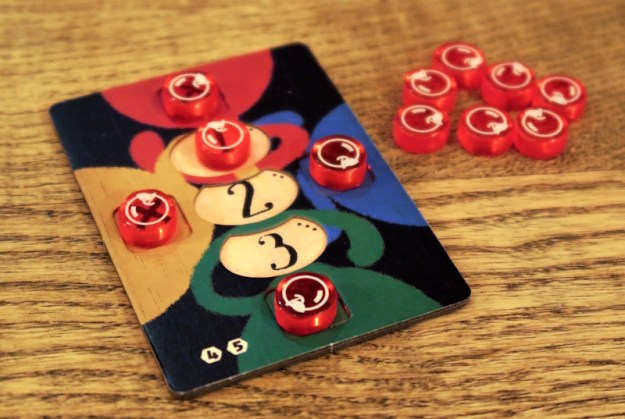
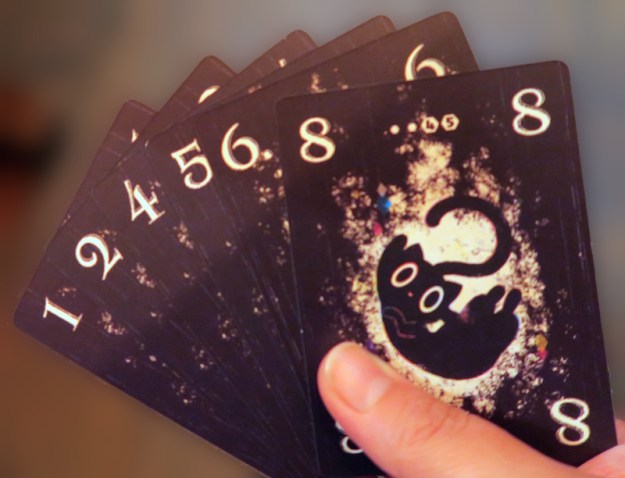
From there, the foursome moved onto an equally theme-less card game that Jade had come back from UK Games Expo, but one that is also very good, Cat in the Box. The game that was preceded by a quick game of Snap when Ivory pulled the same game out of his bag. The game is essentially Hearts, but with the twist that the cards exist in all suits until they are played (analogous with Schrodinger’s cat where the it is both alive and dead until the box it is in is opened—hence the name of the game). The cards are all black and there are five cards of each value. As in Hearts, the first player leads with a card of there choice declaring its suit. The players have a pile of tokens and, when they play a card they mark that card on a tally board so nobody else can play the same card.
 |
| – Image by boardGOATS |
At a time of their choosing, players can declare they no-longer have cards of a suit by marking that on their cat card, but although that enables them to play a red trump card, it also limits what cards they are left with in their hand. The round ends either when a player creates a Paradox because they cannot play any of the remaining cards in their hand, or when the last player plays their final card. At the end of the game, players score one point for each trick they took during the round. However, in a sort of solo-Bridge fashion, players make a contract at the start of each round, declaring how many tricks they think they will take. If they successfully take exactly this number, they get bonus points equal to the largest contiguous group on the tally board, introducing an area control element.
 |
| – Image by boardGOATS |
The catch is that if the round ends with a Paradox (and it usually does), then the player that caused the Paradox does not score any bonus points and additionally scores minus one for each trick they won. This is particularly savage as a player can go from doing very well to doing very badly in a heartbeat, as Blue discovered in the first round. Not appreciating the risk, she made a contract for three tricks, which she achieved and with the bonus points would have taken seven or eight in the round until she went bust and ended up with minus three! So, the risk of Paradoxes introduces a lot of tension, but there is also an element of tactics in forcing players to take tricks they don’t want to
 |
| – Image by boardGOATS |
Teal was more circumspect and played very cautiously, so although he caused two paradoxes, they only cost him a total of two points. Unfortunately for him, he only picked up one point in each of the other two rounds leaving him with a round fat zero. Jade started cautiously, but then went for bonus points, successfully taking seven points twice, but unfortunately, for him his paradox in the third round was costly, losing him three points, he still finished with ten points, one more than Blue. Ivory just managed to avoid triggering a Paradox, which is a key part of the game of course. So with his moderately high, consistent scoring in the second, third and final rounds he finished with fifteen points and his second victory of the night in what was a fun, if quite nasty game.
 |
| – Image by boardGOATS |
Learning Outcome: Little card games can be an awful lot of fun.
 boardGOATS