Blue and Pink were just finishing their supper when Plum and Byzantium arrived, soon followed by Pine, Black and Purple, Teal, Ivory, and finally Lime. With ten then, the first question was whether to play two games with five each, or three games with fewer. And then it was who would play the “Feature Game“, Namiji, and who would play something else. The decision was pretty much made when Ivory said he’d brought Roll for the Galaxy and lots of people looked interested. Roll for the Galaxy is somehow a game a lot of people struggle with, so who played what almost sorted itself out, with the outstanding question being whether there would be a third game.
 |
| – Image by boardGOATS |
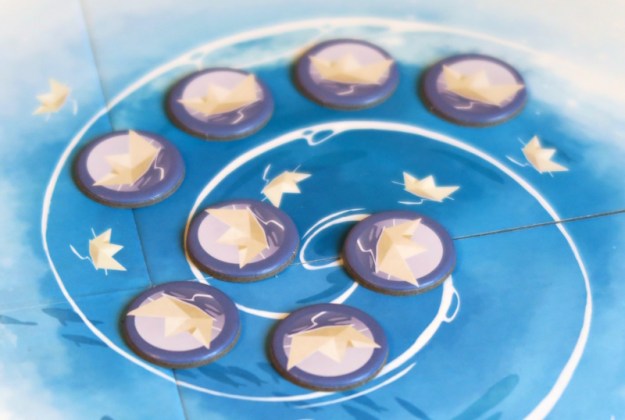
In the end, it was easier to play two games than try to come up with a third, so Ivory took Plum, Teal, and Byzantium to the other side of the room to recap the rules for Roll for the Galaxy, while Blue taught the others Namiji. Although this was new to everyone, it is extremely to the group favourite, Tokaido. Both games are based on a time-track, that is to say, players are traveling along a path playing a kind of “leap-frog” where the player at the back jumps forward into an empty space and then carries out the action associated with it. The player can move forward as far as they like, but the desire to jump into a chosen space is tensioned against the fact that the further forward a player moves, the longer it will likely be until their next turn.
 |
| – Image by boardGOATS |
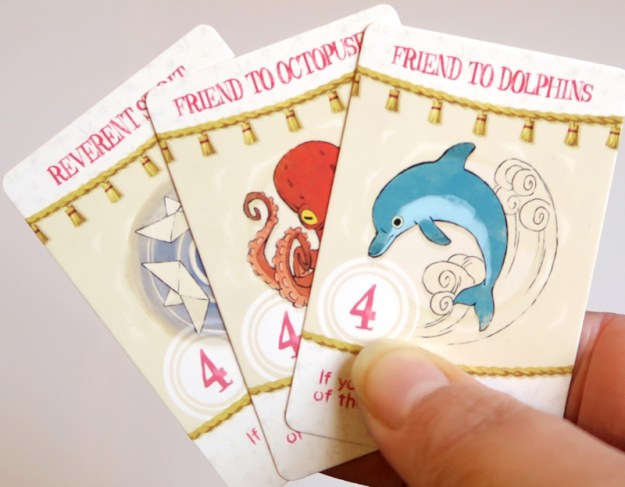
Both Namiji and Tokaido have with elements of set collecting, indeed the different actions are very, very similar between the two games, and although players are Japanese fishermen, sailing south of the Japanese archipelago in Namiji, the rubric says they are just “a few miles away from the famous Tokaido road” and that games are barely that far apart. The “Stations” in Namiji are: Angling, Net Casting, the Crustacean Trap, the Whirlpool, the Sacred Rock, the three Panoramas and the Dock. The last four are roughly analogous to the Temple, the Hot Springs, the Panoramas and the Inn in Tokaido. The Angling, Net Casting and Crustacean Trap stations are a little bit different.
 |
| – Image by boardGOATS |
Like the Village and the Encounters, these have set-collecting elements, but fish caught when Angling or Casting are laid out in the player’s boat with points scored for rows where the colours or types are the same. The Crustacean Trap is a push-your-luck draw from a bag where players score a point for each Crustacean drawn (up to a maximum of five), but if two crabs are drawn in the same haul, the whole lot are lost. The biggest difference between the two games is that there is no money, which has the effect of knocking some of the slightly rougher corners off. For example, the Inn is much harsher in Tokaido than the Dock in Namiji.
 |
| – Image by boardGOATS |
Because Food cards have to bought at the Inn and these have different costs and duplicates cannot be bought, sometimes players have to go without which costs them six points. This is enough to effectively put a player out of the running. In contrast, in Namiji, they are a bit of a non-event. There are two types of card drawn at the Dock: Food and Upgrades. As in Tokaido, Food gives points—fewer than in Tokaido, and variable without the cost or the limit of one type per player. Upgrades grant players permanent abilities for the rest of the game (triggered when landing on their corresponding Station. The game ends when everyone returns to port—as in Tokaido, there are bonus points for lots of things, and that includes being early back at port (with decreasing numbers of points as players arrive later).
 |
| – Image by boardGOATS |
Although the rules were simple and the game was mostly known, the debate started when Blue had barely left the table. The discussion centred on whether the player chosen to be first should go at the front of the track (and thus actually “go” last) or whether they should take the first turn (and therefore actually start at the back). Black opined that the that the turn order (randomly picked) was the order players should be placed on the track, while Pine felt the person picked should be the one start. In the end, after studying the rules (which failed to answer the question), the group went with Pine’s view, and finally started sailing.
 |
| – Image by boardGOATS |
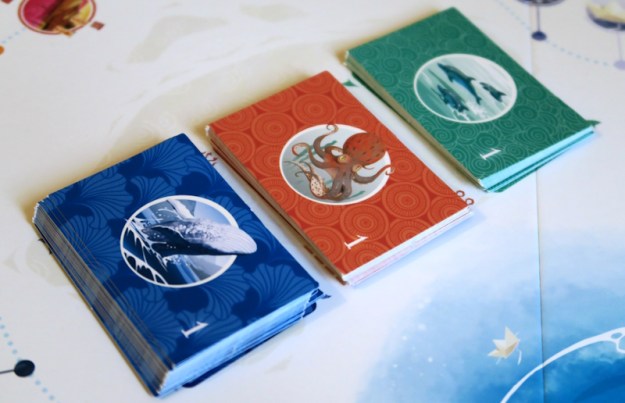
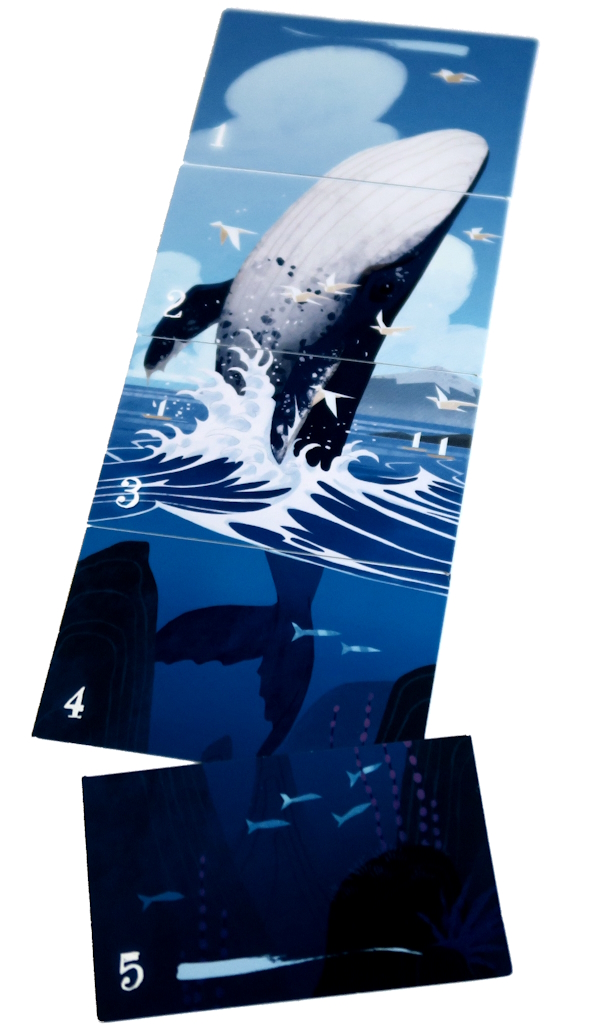
Pink was the first to complete the first Panorama (the Squid), soon followed by Lime who out-competed Purple and Pine to complete the lucrative Whale Panorama taking the bonus points for it too. Black concentrated on setting his paper hats sailing into the Whirlpool to jettison negative points and top-scored for his catch (though there aren’t any bonus points for that). Pine concentrated on collecting Cards and then was the first to get back to port. Ultimately, Namiji is a game that rewards players for concentrating on one thing, and in this case that was Lime, who’s twenty-five points for his Panoramas made all the difference giving him clear victory ahead of Pine in second and Black and Pink jointly in third.
 |
| – Image by boardGOATS |
Meanwhile, on the other side of the room, Ivory had just about finished explaining the rules for Roll for the Galaxy when Blue arrived. In principle, the rules are quite simple, but playing the game well is much more difficult. The game is based on the card game, Race for the Galaxy. In both games, there are five phases, and players choose one each to activate. This is important, because with more players more phases are likely to happen. That is to say, while it is possible that everyone chooses the same phase which is the only one to happen, it is much more likely that two, three or four will be picked giving people more things to do in each round.
 |
| – Image by boardGOATS |
In Roll for the Galaxy, at the start of the round, players simultaneously “shaky-shaky” their dice in their Cup and roll in secret. Then, behind their screen they secretly assign them to the different phases. Most are assigned according to the face that was rolled, but any one can be used to decide which phase the player wants to happen. Additionally, any one die can be used to “Dictate” the behaviour of one other die. Once everyone has assigned their dice, everyone reveals their choices and the phases for the round are finalised. Each player then gets to carry-out the actions indicated by their dice, returning unused dice to their Cup.
 |
| – Image by boardGOATS |
There are five phases in each round: Explore, Develop, Settle, Produce and Consume. Explore allows players to choose tiles that they build in either the Develop or Settle phases, while Produce places goods on Production Worlds that can be turned into points or Credits in the Consume phase. Used dice (those consumed or used to build) are then placed in a player’s Citizenry and only return to their Cup on payment of one Credit per die. Thus, the game is very smooth with dice being assigned simultaneously, then moving to either of the player’s stacks of tiles to be used to pay for building, or onto one of their Production Worlds where it stay until it is Consumed.
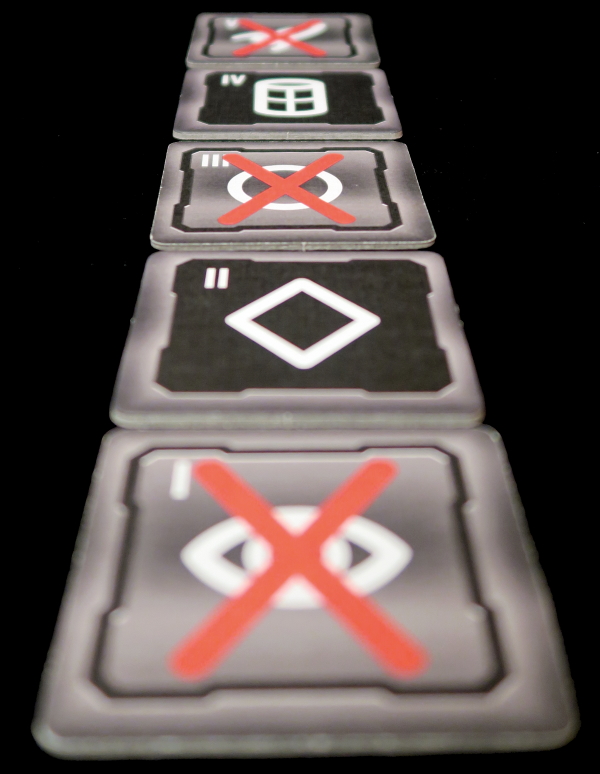 |
| – Image by boardGOATS |
Since what players can do depends on the roll of the dice, at first glance, it seems like the decisions are made by chance. However, that just makes the decisions more key, if nuanced. Which Worlds to build, which phase to choose, whether to Dictate to reassign a die, whether to consume to give points or cash, and overall, which strategy to choose. And although the roll of the dice plays a big part, there are lots of dice and plenty of rolls, so the luck averages out, though players have to surf their luck. The game ends at the end of the round when a player builds their twelfth World, or when the pile of Victory points runs dry, and in this sense, although the game is about rolling dice, it is still a race, a race to build an engine, score points and finish the game.
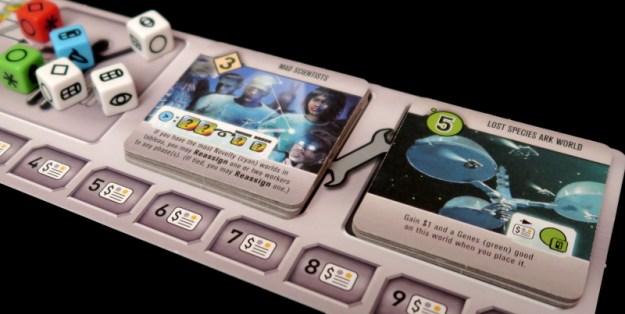 |
| – Image by boardGOATS |
The game began with the rattle of the simultaneous “shaky-shaky” as dice rattled in everyone’s Cups. At the start of the game everyone wanted to Explore and build, but what depended on strategy. Blue started with a military strategy dictated by her first Development which gave points for red dice at the end. Ivory also planned his game around his Developments and their bonus points, but built his engine based on reduced costs to build and to Dictate. Teal and Sapphire chose to follow a conventional “Produce-Consume” victory point strategy, while Plum tried a bit of everything.
 |
| – Image by boardGOATS |
Roll for the Galaxy is a little bit “multi-player solitaire”, with everyone concentrating on their own engine and deciding what they want to do. However, the winner has to take advantage of the fine margins and that means watching what other players are doing and anticipating and then taking advantage of their choice of phase when they can. This time, the end was triggered by Ivory, who accelerated quickly out of the traps thanks to his early choice of Development Worlds, and ultimately finished with thirty-six points for his buildings and ten bonus points giving him a runaway victory. A very creditable second place went to Byzantium, the only player who had never played either Roll or Race for the Galaxy before, with Blue completing the podium.
 |
| – Image by boardGOATS |
Learning Outcome: Sometimes when you win you have a Whale of a time!
 boardGOATS