There were a few absentees again, but the group still made it into double-figures. So, after the usual chit-chat, the group split into two—the first group playing the “Feature Game“, Meadow, while the other, larger group, played a couple of lighter games. Meadow is a very smooth, engine building, set-collection card game with charming artwork. Players take on the roles of explorers competing for the title of the most skilled nature observer. Reviews refer to it as a “Splendor Killer”, that is to say, these people feel it has a similar feel to Splendor, but is a better game. It is also considerably more complex, though not especially difficult in its own right.
 |
| – Image by boardGOATS |
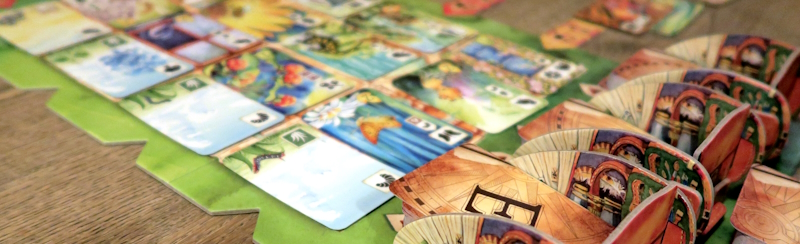
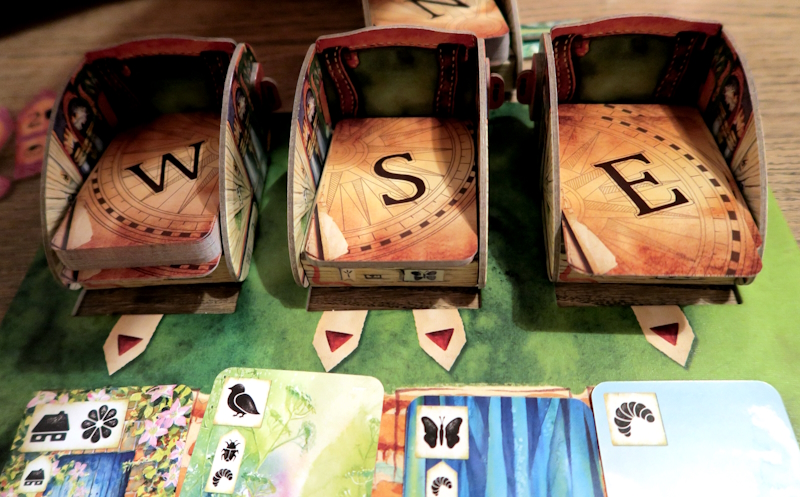
Players start with four or five Action tokens (depending on player count), a Road token and a double-sided Ground card. There are four decks of cards, North, South, East and West, and players also begin with a card from each of the North, East and West decks and two from the South deck. Players then take it in turns to play one of their Action tokens either in the Market or round the Campfire, and complete the associated Actions. The Market is the simplest: this consists of a four by four grid of face up cards. Players choose a notch along the edge of the board to play their token in and this defines a row or column and the number on the token dictates which card they will take from that row.
 |
| – Image by boardGOATS |
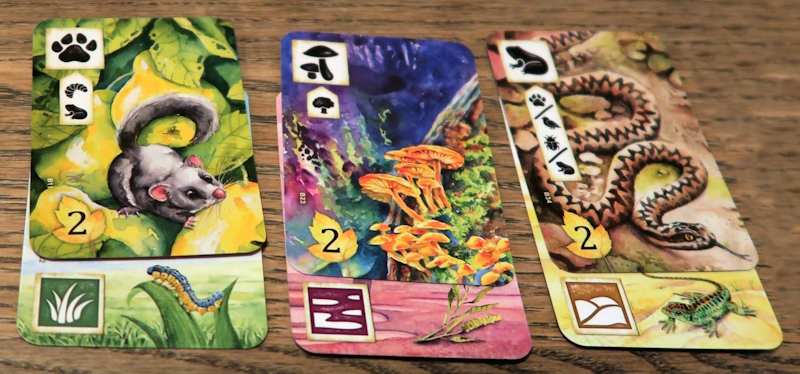
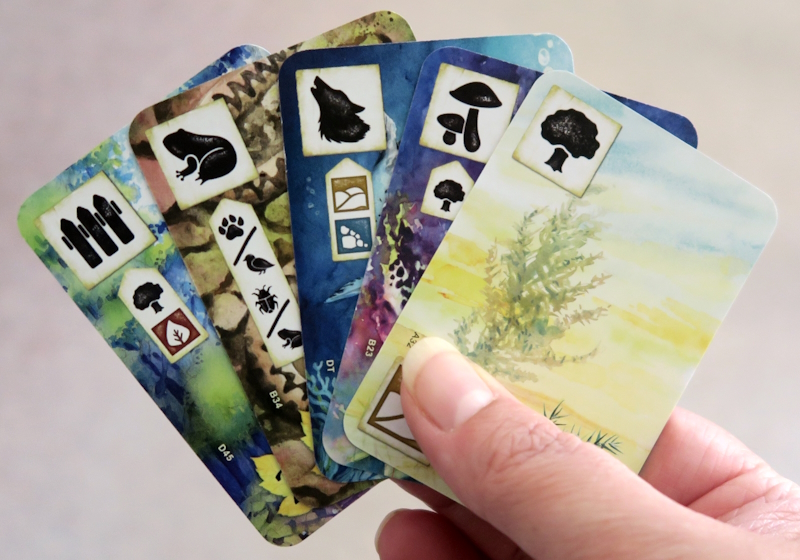
There are four types of cards: Ground, Observations, Landscapes and Discoveries. After taking a card from the Market, the active player then plays a card from their hand or the card drawn into the play area in front of them. In general, each card has a large symbol in the top left corner usually with smaller symbols below—these smaller symbols are prerequisites for playing a card and the player must already have them in their area before they can play the new card. Ground cards are just played in the players’ Meadows and are the lowest cards in the Meadow stacks.
 |
| – Image by boardGOATS |
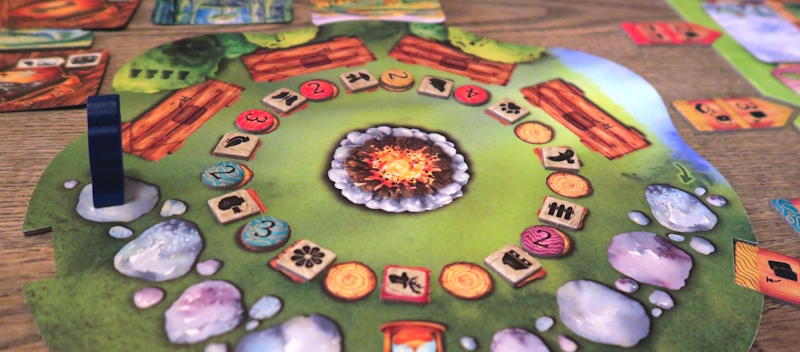
Landscape cards are similar, but require a Road tile, and are played in the Surroundings area, above the player’s Meadow. Observation and Discovery cards are played on top of existing cards (in the Meadow and Surroundings respectively), such that the new symbol replaces one of the old ones. Instead of collecting a card from the Market and playing a card, players can play their Action token in one of the notches around the Campfire. This activates the special Action shown on the token (take one card from the Market; take two Road tokens; take three cards blind from any deck and keep one; play two cards).
 |
| – Image by boardGOATS |
Players taking the Campfire option can additionally place a bonus point token on a tree-stump between any pair of symbols as long as they are displayed in their play area. Players have three tokens (valued two, three and four points) giving a total of nine extra points at the end of the game if they manage to place them all. Finally, in the absence of anything else they can do, players can place their Action token on a bench on the Campfire board and play one card. This is really very much a last resort as this is a much weaker action, giving half or less than the other options give.
 |
| – Image by boardGOATS |
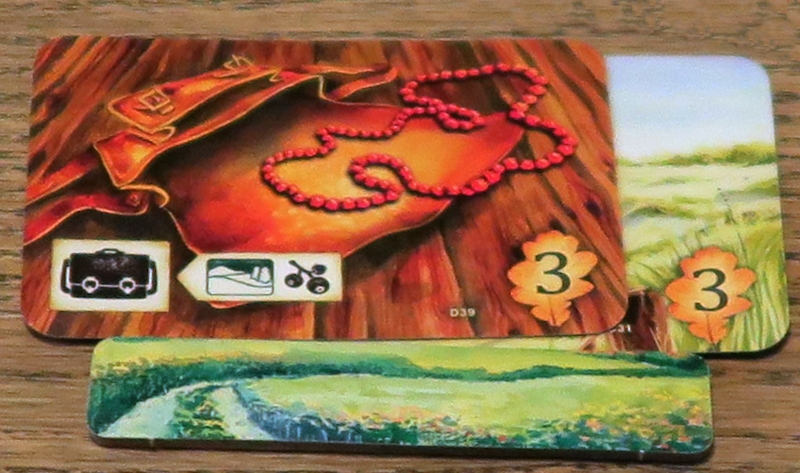
Pink led explaining the rules to Plum, Lime and Teal, and was roundly chastised by Pine from the next table for not knowing what a Meadow was, and confusing it with “normal grassland”. The first round was a little slow as the group found their feet, but then it was all go. Plum started with a Badger card which is quite high value and features a Wolf icon, so she planned her strategy round that. As the game progressed, everyone was collecting Satchel icons and expected them to be needed for something in the second half of the game. However, after the South cards were swapped for the North deck at the half-way stage, there was a slow realisation that they were just the final step on the path (though that could change with the inclusion of expansions of course).
 |
| – Image by boardGOATS |
Plum’s Badger card turned out to be quite difficult to place, so as players can have a hand of ten cards, she filled her hand to give her the most options. Someone else took the space around the campfire on one side of the wolf before she got to it, but as the the icons on either side weren’t as rare she was able to take the other easily enough and followed it with two more to get the full nine Bonus points, the only one to do so. There was a problem with an odd token around the fireplace that featured a Stag with a red border, that turned out to be from Envelop U: Big Encounters. This is a mini-expansion that comes with the base game, and had been confused with the core game as one token had been accidentally left at home.
 |
| – Image by boardGOATS |
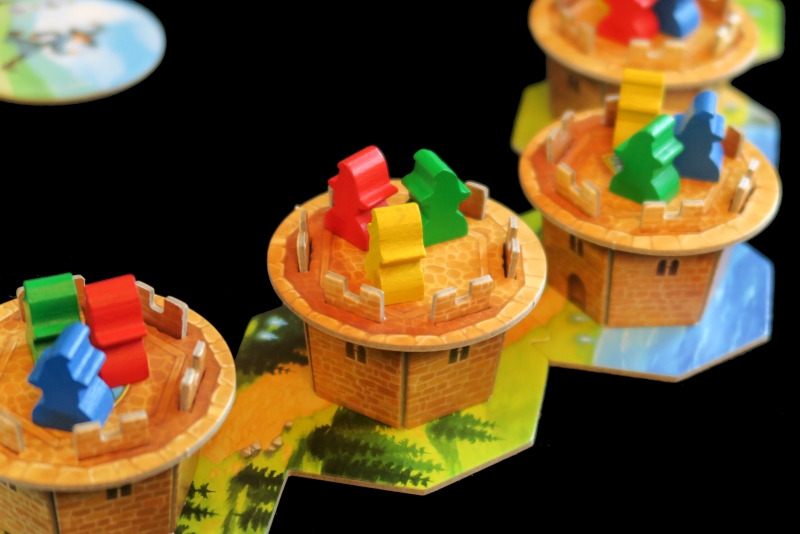
The game was enjoyed by all, though with four it perhaps slightly over-stayed its welcome a little. The eventual winner was Plum with sixty-one points nearly ten points ahead of Pink in second. Meanwhile, on the next table, the rest of the group were having a light evening, playing as a group of six. First up was Die Wandelnden Türme (aka Wandering Towers)—a game that has been very popular in the group since it first came out a eighteen months ago. The idea behind this game is that on their turn, players play two cards from their hand of three cards, one after another, performing all the moves if at all possible. There are three types of cards, those that move a Wizard, those that move a Tower and those that move either a Wizard or a Tower; in each case, the number of movement spaces is given.
 |
| – Image by boardGOATS |
Players can only move their own Wizard and each Tower and empty space can hold up to
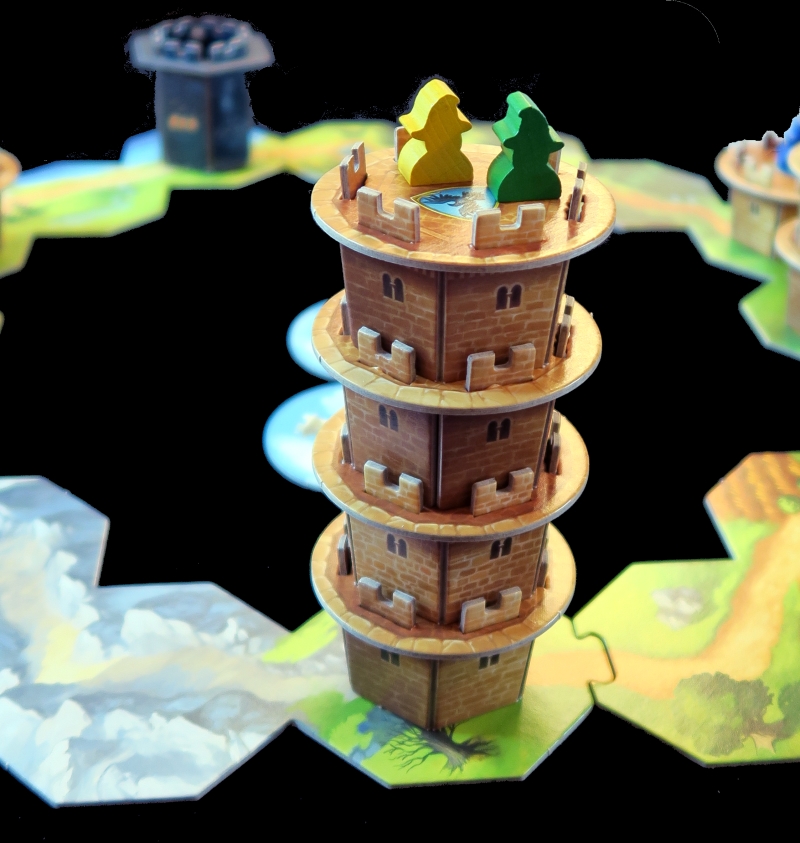
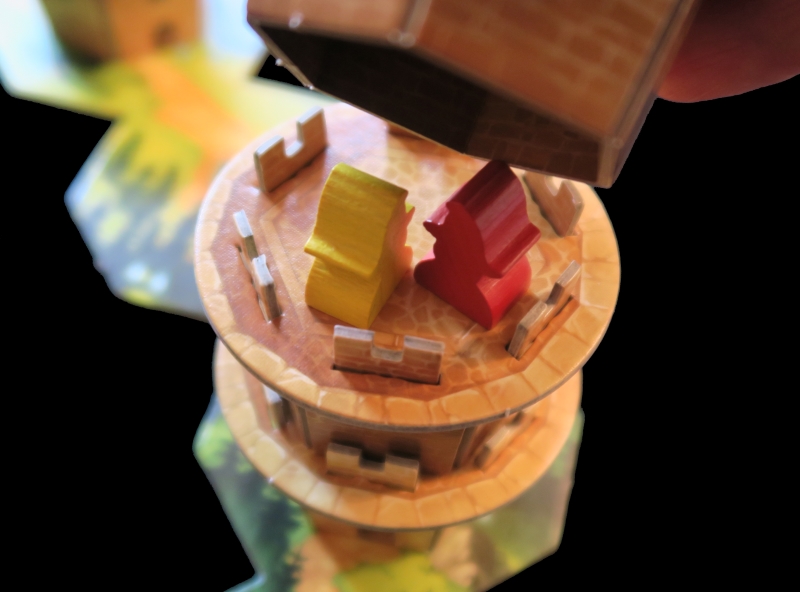
six wizards (if a move would exceed that limit, it cannot be made). Whenever a Wizard’s move ends in the space with the Ravenskeep, the player drops the Wizard into the keep—this is one of the key targets during the game as the winner must have all their Wizards trapped in the Ravenskeep. In contrast to Wizards, players can move any Tower segment along with everything on top of it (Tower segments and Wizards). Whenever a Tower’s move ends in a space with Tower segments already in it, the new Tower goes on top, imprisoning all the Wizards it covers—all nine towers and the Ravenskeep could end up in the same space!
 |
| – Image by boardGOATS |
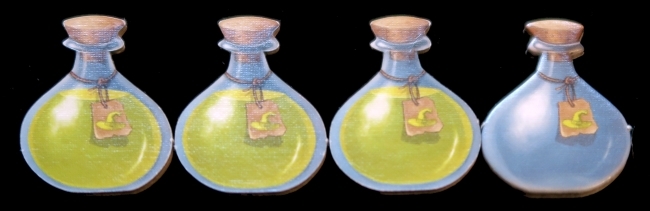
Whenever a Tower covers Wizards, imprisoning them players get to fill one of their Potion Vials, turning it over—this is the other key target during the game as the winner must have all filled all their Potion Vials. The player with both, all their Wizards in the Ravenskeep and all their Vials full of Potion, triggers the end of the game, with play continuing until everyone has had the same number of turns and all players that fulfill the criteria share victory. Jade led the group, reminding everyone of the rules and explaining them to those who had not played before.
 |
| – Image by boardGOATS |
Cobalt managed to tease a few extra rules out of the rule book , in particular that no more than six Wizards can sit on any one Tower segment, and a player’s turn finishes immediately if they place a Wizard in the Ravenskeep. Aside from this, much amusement was had, especially as the stacks of Towers got really tall, they didn’t quite make it to the maximum of nine plus the Ravenskeep, but they did reach a good six or seven segments in one stack. Black was the first to fulfill both the end-game criteria and Cobalt trapped dropped the last of his Wizards into the keep before the round finished.
 |
| – Image by boardGOATS |
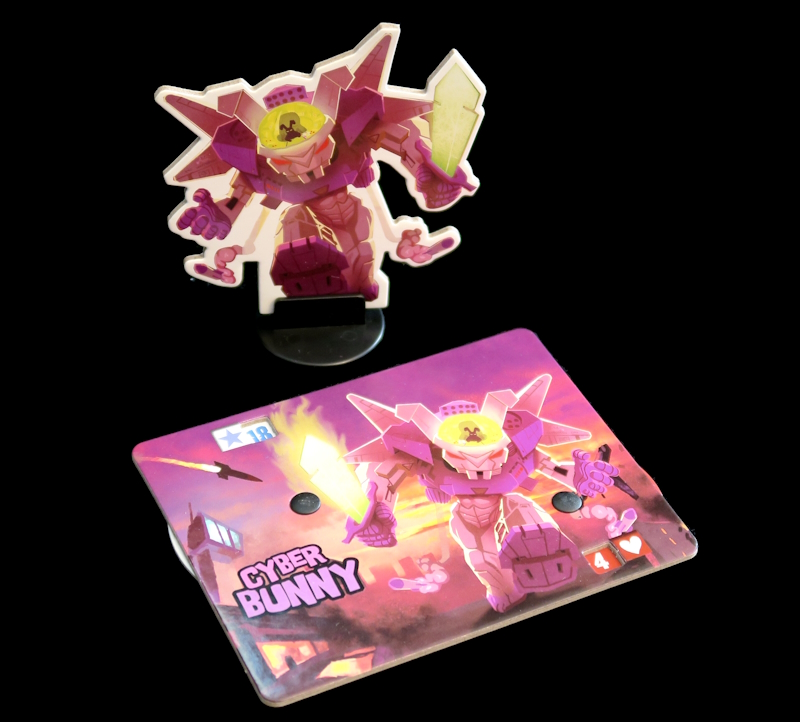
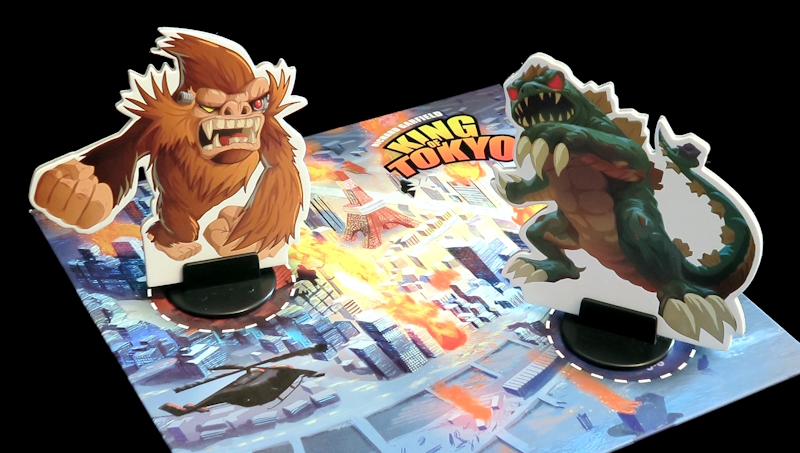
As Cobalt still had two empty Vials, he took second place with Sapphire and Jade taking joint third. Staying together as a group of six, they then went on to play King of Tokyo, a fast dice roller along the lines of Yahtzee where players control a monster try to destroy more of the city than their opponents while also attacking the other monsters to either take them out or keep them down long enough to enable the attacker to take victory. Players each have a Monster and two dials which are used to track their Monster’s health (starting at ten) and the number of Victory Points they have gained. The winner is either the first player to earn twenty Victory Points or by being the last Monster standing.
 |
| – Image by boardGOATS |
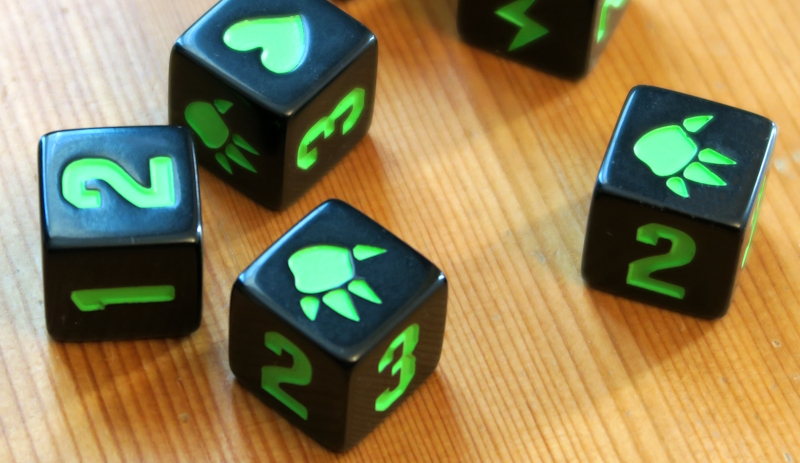
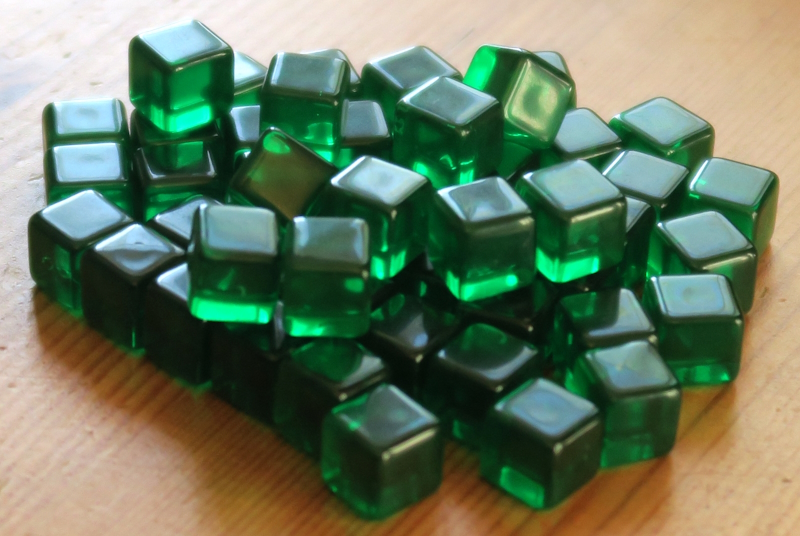
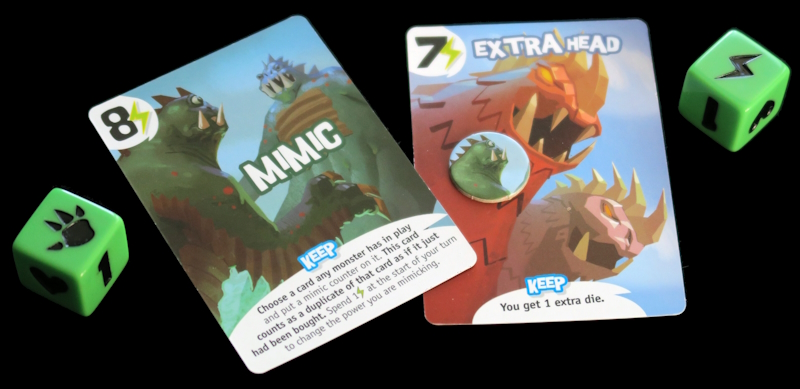
Players take turns before passing the Dice on, clockwise. They get a maximum of three rolls, but can stop early and any number of Dice can be put aside after each roll. The Dice are not locked, so Dice set aside after the first round can be rolled in the third if desired. The dice feature numbers one, two and three, a Claw, a Lightening Bolt, and a Heart. The numbers give the player Victory Points and the Claw indicates damage inflicted on a chosen opponent. The Lightening Bolt gives the player an energy cube which can be spent on Power Cards, and the Heart increases the Monster’s Health (though the Monster must be outside the City to be able to take advantage of this).
 |
| – Image by boardGOATS |
Once the dice have been rolled and resolved, players can buy Power Cards from the face-up display—these typically cost between two and eight Energy, and can be very useful at helping to control the game. The other key part of the game is the Monsters’ locations: they can be “In Tokyo” or “Outside Tokyo”. To enter Tokyo a player must roll one or more Claws; when a monster in Tokyo is attacked they will take damage and the player has to decide whether to stay in Tokyo or not. If they Yield Tokyo, they allow/force the attacking monster to enter Tokyo in their place. This is critical because Monsters deal damage based on their location and any Monsters in Tokyo deal damage to all monsters outside Tokyo and vice versa.
 |
| – Image by boardGOATS |
One of the handicaps of being in Tokyo is the fact that a player cannot heal whilst in Tokyo. However, when a Monster enters Tokyo it earns a Victory Point for doing so and if it starts its turn in Tokyo, then it earns two Victory Points. These points help a player inch towards that winning total of twenty. With six players the Tokyo Bay location on the game board is also used, effectively meaning that two Monsters can be in Tokyo at the same time, improving the balance and preventing five monsters ganging up on one, while also discouraging everyone outside Tokyo to try and displace them rather than just focus on collecting Energy, Healing or Victory Points.
 |
| – Image by boardGOATS |
Unusually for the games the group plays, King of Tokyo has player elimination—when a player’s health falls to zero, they are out, a fate suffered by half the players in the game this time. Jade was first to be knocked out, but Sapphire and Cobalt weren’t far behind. With six players, Black’s stay in Tokyo which lasted three full rounds was quite remarkable. It was perhaps no surprise therefore that he was the eventual victor, collecting the full twenty Victory Points, some way ahead of Pine in second with eight and Purple just behind him in third.
 |
| – Image by boardGOATS |
Learning Outcome: A meadow is grassland which is not regularly grazed instead being left to grow to produce hay.
 boardGOATS