While Blue, Pink and Cobalt were finishing their supper, Plum led a quick game of Draftosaurus with Black, Purple and Cobalt (who had already finished his pizza). Cobalt was new to the game, so after a quick rules explanation the group were passing dino-meeples left and right and building themselves exciting dino-parks. The game is really quick and simple: players start with a handful of wooden dino-meeples, and on each turn, they draft one, that is to say, they choose one and pass the rest on. The chosen dino-meeples are then placed in the players’ parks, obeying the rules on the Die (the active player who rolled the Die excepted).
 |
| – Image by boardGOATS |
The Die roll forces players to choose from locations in one half of the board, or restricts them to playing in an empty pen or one without a T-rex, making things considerably harder. Players draft a hand clockwise, and then a second hand anti-clockwise, after which, points are scored for each pen and totalled up to find the winner. This was Plum’s fiftieth game—it was one of their group’s go-to warm-up and filler games played remotely during the global pandemic on BoardGameArena. Although her 24% success rate seems really good at first, at four players, one out of four could be seen as about par.
 |
| – Image by boardGOATS |
Plum marked her milestone with a change of strategy, forced by the Dice to go for the most T-rexes, but it worked giving her victory with forty-one points. Purple took a very respectable second with thirty-five points—one of her best scores in this game. From there, Cobalt headed off to play Meadow with Blue, Jade and Sapphire, while everyone else joined Plum, Black and Purple to play the “Feature Game“, which to mark the thirtieth anniversary of 6 Nimmt!, was the new Jumping Cow mini-expansion. 6 Nimmt! is one of the group’s favourite games and was arguably responsible for keeping us sane when we were stuck at home in 2020 and as a result, won the Golden GOAT Award.
 |
| – Image by boardGOATS |
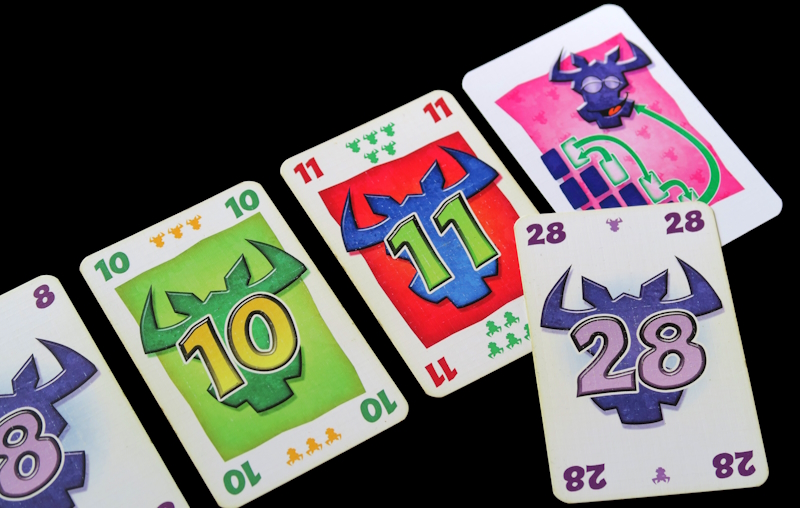
The game is super-simple: players simultaneously choose a card from their hand and then, starting with the card with the lowest face value, they are added to one of four row. Each card is added to the row that ends with the highest value card that is lower than the card to be placed. If that means the row now has six cards, the active player takes the first five cards in the row into their scoring pile, with their card becoming the new first card. The new Jumping Cow expansion is a single additional card that lurks at the end of the row. Cards are added as normal, however, when one is added to the Jumping Cow row, the Cow jumps to another row, the one with the lowest face value at the end.
 |
| – Image by boardGOATS |
The Jumping Cow Card does not have a value itself, but it does add to the number of cards in the row. So if the card added is the sixth, the player takes the other four cards and then the Cow jumps. If the row the Cow jumps to has five cards in it, the active player takes four of those too before the Cow jumps again… Thus, as Plum discovered this time, multiple jumps can lead to collecting a lot of points! The game was the usual entertaining fun, but although the Jumping Cow expansion adds more madness, 6 Nimmt! is a near perfect game that needs little to no improvement (although we have found the Professional Variant an occasional worthwhile addition).
 |
| – Image by boardGOATS |
This time, the top scorer (aided by the Jumping Cow) was Plum with sixty-one, closely followed by Ivory with fifty-seven. Purple did very well to limit her takings to nineteen, but she was beaten into third place by Pink who just kept his to single figures with nine. The winner was Teal, however, with just four from the first hand and a clear round from the second. From there, with six, the options were limited, but the group decided to stick together and, after eschewing Bohnanza, opted for another golden oldie: For Sale. Remarkably, Ivory had somehow not played this before, and was really taken with it, so much so that he immediately looked to see if he could get a copy and everyone was shocked to find it was out of print and the only copy available was for forty pounds on ebay!
 |
| – Image by boardGOATS |
For Sale is really simple: Players start with a hand of cash and use this to bid for buildings, with a face value from one to thirty. In the second half of the game, cheques are revealed and players have to choose one of their properties—the player with the highest value building then takes the highest value cheque, thus the idea is not to waste high value buildings when the takings available are low. Pink, Plum and Teal were all really close and ended in a three-way tie for third place. Ivory and Purple were some way in front, but separated by a single point with Purple just taking victory, with a final taking of fifty-six thousand dollars.
 |
| – Image by boardGOATS |
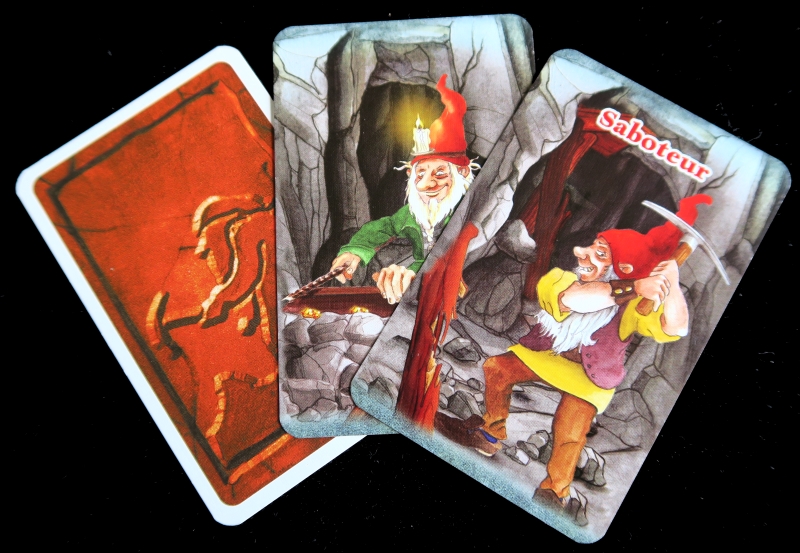
Casting about for another game that plays well with six, Bohnanza was passed over once again, this time in favour of Saboteur. Saboteur is a hidden traitor game where players are Dwarves tunneling to find gold. With six players, the rules have either one or two Saboteurs, however, as the game is always difficult for the Saboteurs and impossible alone, the group chose to forgo the ambiguity and go for a guaranteed two Saboteurs. Once the Saboteurs knew who they were, everyone got a hand of cards: a mixture of tunnel cards and special cards. On their turn, players play a card and draw a new one. Tunnel cards extend the network, while special cards allow players to break or mend tools stopping other players from building tunnels (or reinstating that ability).
 |
| – Image by boardGOATS |
Additionally, there are Treasure Map cards which allow players to look at one of the three potential gold cards to see if it is gold or coal, and Rockfall cards which allow players to collapse the tunnel by removing one card. Usually, the Saboteurs hide for as long as possible in an effort to acquire some good “Saboteury cards” and play them with a lot of impact. Choosing the right time for that reveal is really critical though, leaving it too late means there isn’t time to do enough damage. This time then, Black announced his position very early by playing an obviously obstructing tunnel card and was swiftly followed by Pink who compounded the poor Dwarves’ problems by playing a Rockfall card.
 |
| – Image by boardGOATS |
The Evil Criminal Masterminds were aided by the fact that when the Dwarves played their Treasure Map cards they struggled to find the gold. The game turned out to be quite epic, but success just fell to the Saboteurs, giving them a rare victory. As Teal and Ivory waved farewell, the others looked for something else to play. Saboteur is a great game, and although it is not as old as 6 Nimmt!, this year is also Saboteur’s anniversary year. It is celebrating twenty years, as is another old favourite, No Thanks!. In choosing this, those that had played all five games had played over a hundred years of popular games in one evening.
 |
| – Image by boardGOATS |
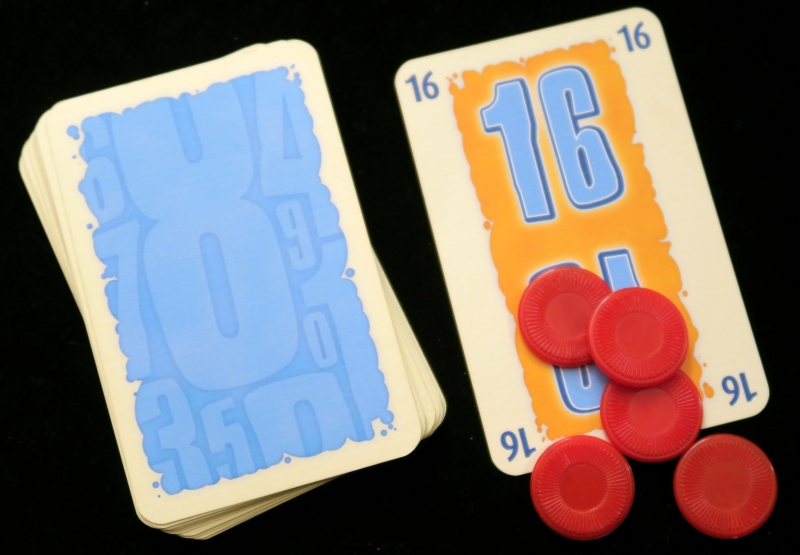
No Thanks! is a super simple, push-your-luck game, where players are trying to finish with the lowest score from the total face value of their cards minus any chips they have. On their turn, players either take the top card and any chips on it, or pay a chip to pass the problem on to the next player. There are thirty-three cards in the deck (numbered three to thirty-five), but nine are removed at random, which is what makes the game really tick—when scoring, players only count the lowest card of a run. This time. Pink top-scored with forty-nine points. Plum and Purple both took forty-eight points for their cards, but in Plum’s case this was off-set by her enormous pile of chips, leaving her with just twenty.
 |
| – Image by boardGOATS |
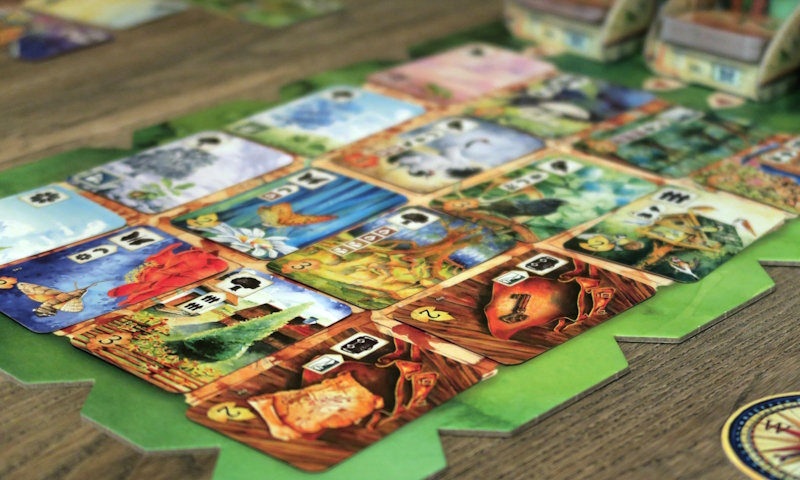
It wasn’t enough though. Black managed to just scrape through with only a single chip left at the end, giving him a total of thirteen points, and with it, victory. While everyone else had been sampling a smorgasbord of golden oldie games, Jade, Blue, Cobalt and Sapphire were revisiting the relatively new Meadow, which they’d missed out on playing last time. This is a fairly simple game, where the complexity is in choosing and placing tokens to get cards that combine well together. Players take it in turns to play an Action Tokens either in the Market or round the Campfire, and complete the associated Actions. The Market consists of a four by four grid of face up cards.
 |
| – Image by boardGOATS |
Players play an Action token in the market to define a row or column with the number on the token dictating which card they will take from that row or column. They then place a card in their play area. This can be the card just collected or one from the player’s hand, but the prerequisites must be satisfied. Playing around the Campfire gives a special action and the option to additionally place a bonus point token on a tree-stump between any pair of symbols currently displayed in the player’s area. At the end of the game, the total score for the cards played is added up together with any bonuses and the winner has the most points.
 |
| – Image by boardGOATS |
Last time, the general feeling was that the game dragged a little with four, so Blue suggested that instead of playing with the full eight rounds, maybe playing with six (as for the three player game) would make things easier. Jade interpreted that as the suggestion to play with the three player board, but as quickly became apparent, the campfire circle is smaller with three, leaving fewer bonus spaces available making that element of the game very competitive. Blue and Sapphire were already committed to their strategy as placing later bonus tokens give more points, so they went for the bonuses doubly hard.
 |
| – Image by boardGOATS |
Jade kept getting Cobalt’s name wrong in a way reminiscent of Blue with Ivory’s name some ten years ago—that lasted the best part of a year, but hopefully Jade will sort it out before then. It didn’t seem to put Cobalt/Chromium/Cadmium off his game though. From early on, he focused on building some Landscape cards adding some valuable Observation and Discovery cards. Sapphire’s starting hand included a Wolf icon for his card from the North deck, and he played that nice and early giving him the opportunity to use it to claim a couple of the bonus spots giving him all three and a total of nine points. Blue also claimed her third quite early leaving only two for Jade and Cobalt/Chromium/Cadmium to share between them.
 |
| – Image by boardGOATS |
Although she couldn’t see it, going into the final couple of rounds it was tight between Blue and Cobalt/Chromium/Cadmium. The game is very tight though, with only four turns per round, so it is important to make sure they all count. In the final round, Blue was fortunate in going first and was able to grab and play a couple of high value cards. Jade and Sapphire also added a couple more cards to their tableau all of which made it really hard to call. In the end, Jade (who had the most valuable tableau) pipped Sapphire by a single point (after a couple of recounts) and Cobalt/Chromium/Cadmium was two points clear, finishing with forty points. The winner, however, perhaps thanks to those final couple of cards, was Blue with a total of forty-three.
 |
| – Image by boardGOATS |
Learning Outcome: Golden Oldies are golden for a reason.
 boardGOATS