After the usual chatter and some food, the interested parties staked their claim to play the “Feature Game“, Stamp Swap. This is a game where players take on the role of stamp collectors at a convention collecting, trading and then scoring their stamp album. All the reviews claim it is a light game, but while it is not hugely complex, there is more to the game than appears at first glance. At its core is the “I cut, You Choose” mechanism that is used in games like Isle of Skye and …aber bitte mit Sahne, but Stamp Swap is nothing like either of these.
 |
| – Image by boardGOATS |
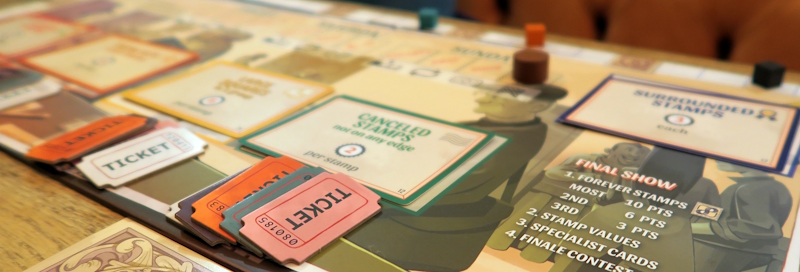
The game takes place over three rounds each with three phases: Collect, Swap and Show. In the collect phase, an Event card is revealed and then players take turns to take an item from the central pool. Once everyone has six items, everyone puts one item aside to Reserve and then splits the rest into two piles for the Swap phase. Some “I cut, You Choose” games struggle work across a range of player counts, for example, San Marco, really only plays well with three players where one splits the cards into three sets and the others choose. While the game might work with two, the decisions would be too trivial (though there are variants with a dummy player).
 |
| – Image by boardGOATS |
In contrast, dividing a pile into four would require too many cards and make the decision complex as well as make the game potentially quite “swingy”. Thus, although the game officially plays three to four players, the mechanism really only works with three. Stamp Swap avoids this problem with a snake-like mechanism that also negates the need for valuing the hands or the use of money as an intermediate (as in Isle of Skye). The first player chooses one set and the owner of that set keeps their other set and chooses one from another player. That player keeps their second set and chooses a set from another player and so on.
 |
| – Image by boardGOATS |
Players then place the stamps in their album and score in the Show Phase. There are four Goals in each game and each player can score one of these per round, but can only score each only once. These Goals are different in each game giving a lot of variability, especially as thy combine together in different ways. At the end of the game, players additionally earn points for the face value of each Stamp, for any Specialist cards they may have, for Stamps that match their personal Theme, and for their achievement in the Finale Contest, while receiving bonus points their place in the Forever Stamp competition.
 |
| – Image by boardGOATS |
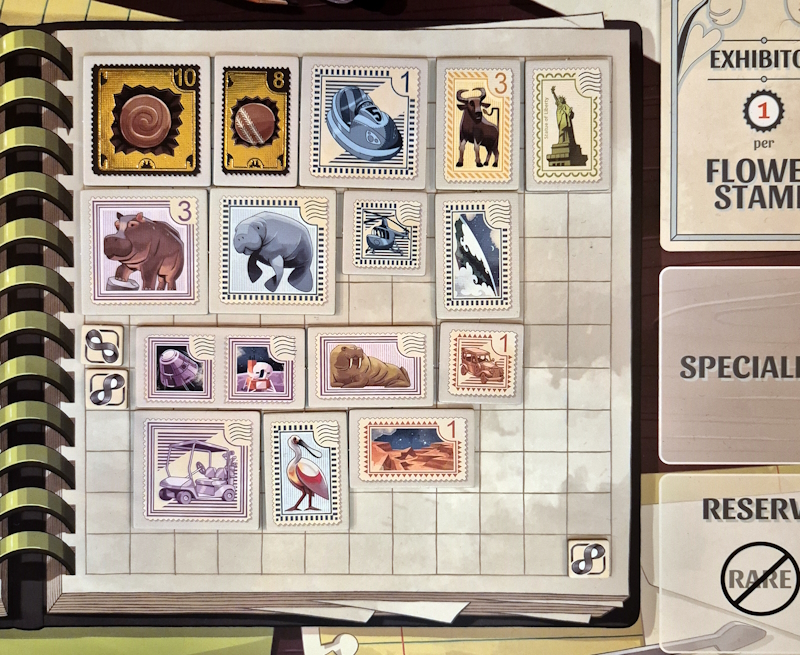
The unexpected complexity arises from the stamps themselves. They come in five different colours, themes and size/shapes. Some of these stamps are “Cancelled” (and have no face value) and some are “Faded” (and have a negative face value, but may be useful for claiming the Goals). There is are special gilded Stamps with their own Chocolate theme and a high face value, but cannot be reserved at the end of the Collect phase. Finally, there are the “Forever” Stamps. These are Square and are the only Stamps available in the smallest size and have no face value, but are useful for filling tiny holes (should that be required for the Goals) and give bonus points at the end of the game (in much the same way as Pudding do in Sushi Go!).
 |
| – Image by boardGOATS |
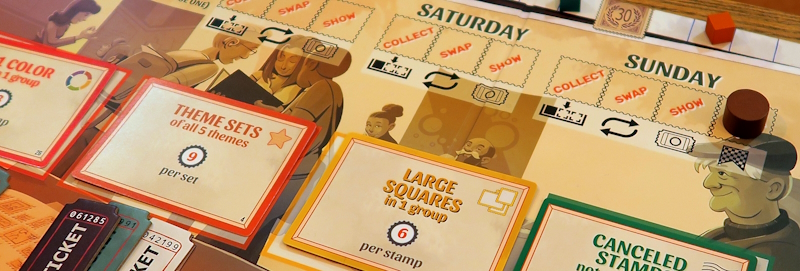
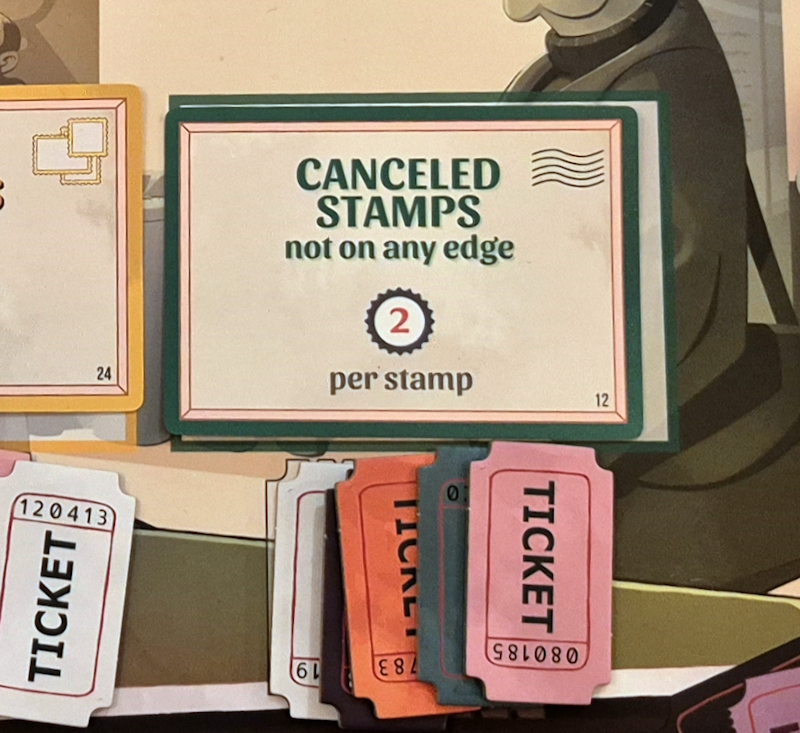
It turns out that the game takes quite a lot longer with more players, which was a bit of a surprise given that much of the game is played simultaneously. This time Ivory led a group of five with Plum, Sapphire, Jade and Teal, while Blue led a group of four comprising Byzantium, Purple and Black. Ivory’s group were quick off the mark and first to get going after the rules explanation. Their Goals gave points for: Stamps of one Colour in one Group; sets of all five Theme Stamps; Large square Stamps, and Cancelled Stamps not on the edge, while their Finale Contest gave points for the number of Stamps completely surrounded by other Stamps. Ivory’s personal scoring objective was Space Themed Stamps, Plum’s were Animals, Sapphire’s were Vehicles, Jade’s were Monuments and Teal’s were Flowers.
 |
| – Image by boardGOATS |
Everyone began by feeling their way a bit, especially as the first round added additional Specialists—cards that give extra powers for the rest of the game. Plum made a “bee line” for these, while Jade and Teal focused on the Large Square Stamps, scoring the related bonus, and giving them an early lead. Jade also managed to “hide a gold stamp (face down)” and ended up with it in his collect as no one took it. Plum scored for the Cancelled Stamps first, as she had picked up a lot of them. As nobody chose his set, Ivory ended up with all his own Stamps, which he thought was great at first, but then had second thoughts as he ended the first round at the back of the pack.
 |
| – Image by boardGOATS |
In the second round, the event was “Rewarding finds” giving two points immediately for taking a face down Stamp, which everyone was keen to do, especially Plum, who quickly caught up with Jade and Teal as a result. Plum made good use of her “Swap one for three face down Stamps before splitting your collection” to grab extra Stamps. Teal managed to hang on to the First Player token for most of the game and also took a lead on the Forever Stamps. Sapphire grabbed an exhibitor for Yellow Stamps and proceeded to take Stamps to match wherever possible (both from the pool and from other peoples piles). Ivory made a point of collecting a full set of five different Theme Stamps, scoring nine points, as well as managing to keep a valuable face-down Gold stamp.
 |
| – Image by boardGOATS |
Going into the final round, Ivory was still trailing significantly behind everyone else who were bunched tightly together. This time the Event gave bonus points for taking Stamps that matched the Theme of their neighbours, which made the game slightly meaner as everyone was taking Stamps others wanted. Plum was again using the additional Stamps she was getting from her Specialist to shape what she was going to end up with, managing to get three complete sets for twenty-seven points. Jade also managed to score well for this in the final round, as well as for the coloured Stamp cards he collected. Sapphire was similar with his vehicles and Yellow stamps, as well as scoring scoring for Large Square Stamps.
 |
| – Image by boardGOATS |
Teal fell a little behind, taking fewer points for the Cancelled Stamps on the edge and he also failed to collect any of the Flower Stamps he needed as everyone kept taking them during the swap phase (in order to get complete sets). Ivory meanwhile focused on getting as many Large Square Stamps adding to the three he already had, giving him a massive fourty-two points taking him from behind and giving him a significantly lead. In the final scoring, Teal took the bonus for the most Forever Stamps giving him ten points while and everyone but Plum tied for second with a single Forever Stamp, giving six points.
 |
| – Image by boardGOATS |
Everyone managed to get at least one gold stamp, but Ivory had the most valuable total face value. Plum scored most for specialists, although most people had at least one, so this made little difference to the scores. Everyone scored well for the Finale Contest, especially Jade, and Plum, but it was not enough to overhaul Ivory’s lead. He finished with a total of a hundred and forty-eight, ten more than Plum who took second place, who was a handful of points ahead of Sapphire in third. On the next table, Blue took longer to explain the rules, but once they got going, they soon caught up with the first group and ended up finishing just before.
|
| – Image by boardGOATS |
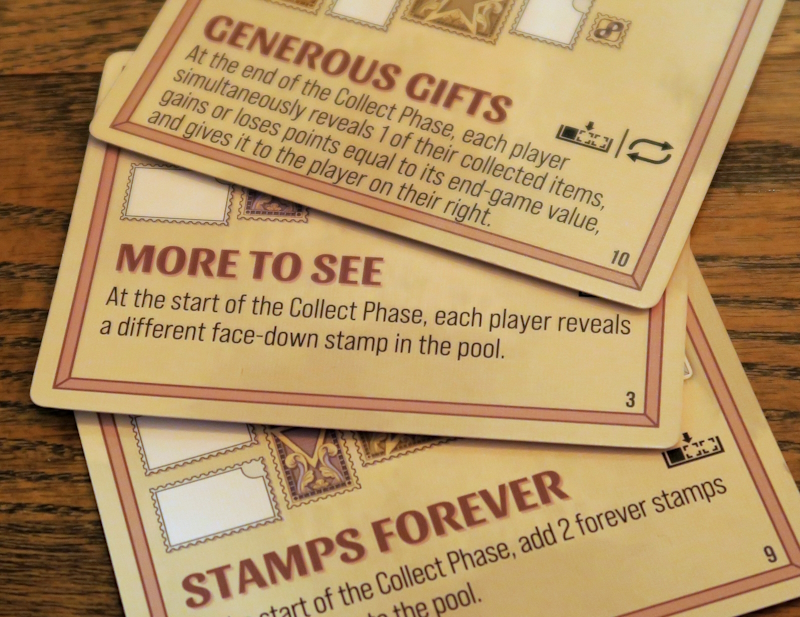
Their first Event card was “Generous Gifts” so after the Collect phase, players choose one collected items to score and then pass on to their neighbour. Everyone quickly chose their highest scoring Stamp, then realised that meant they would lose it, so had a bit of a re-think. It was then that the group began to really appreciate the quandary at the centre of the game: it was all very well taking nice tiles, but they were no use if someone else took them. This tension was particularly obvious in the final round of the first game where the “Mine not Yours” Event gave points for taking Stamps that matched a neighbour’s theme—while players lost the opportunity to pick up Stamps they wanted in the Collect Phase, they had the chance to take them in the Swap phase.
 |
| – Image by boardGOATS |
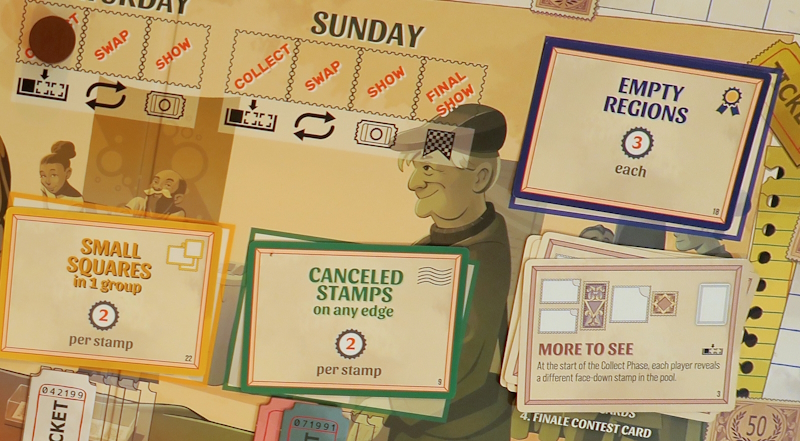
The Events in the second and third rounds were “More to See” and “Stamps Forever”. These had a much smaller impact on the game play, or at least it felt like that, though the Forever Stamps were all collected in the final round. The Finale Contest was “Empty Regions” which gave three points for each empty region. Black showed everyone how to to maximise this and from the end of the first round, everyone’s collections began to look like every-expanding checker boards. Comparing the final album boards between the two games, the layouts were completely different with compact groups for the first game and gappy sprawling displays for the second game.
 |
| – Image by boardGOATS |
Black picked up the bonus for having the most the Forever Stamps, and Byzantium, who by his own admission had been “pants during the game” picked up loads of points in the dying stages. Purple had done the best with her personal Goal—Flowers, while Blue had a plethora of rare, valuable Stamps. During the game it had been unclear who was really in the lead as the scores seesawed a bit, but Byzantium’s lunge for the line gave him the lead when it mattered and he finished with a hundred and forty-six points, seven more than the runner up, Blue. All in all, everyone had enjoyed the game, though the overwhelming feel was that there was much more to the game than the reviews claimed, but that’s a good thing.
 |
| – Image by boardGOATS |
Cobalt was the only person with a strong aversion to playing Stamp Swap, but Pine, Lime and Pink were all keep to play one of their favourite games, Zoo Break, another game that wasn’t really his type. In he end, Cobalt graciously joined in the keepers of Bedlam Zoo, trying to keep the animals under control. The game is a cooperative game, where players take it in turns to roll a die to determine how many actions they get, take the actions like acquiring
supplies, capturing animals, locking enclosures etc., before cards are drawn to see what animals escape and then move towards the exit. The aim is to get all the animals back into their cages and lock them before five animals or anything dangerous gets out.
 |
| – Image by boardGOATS |
The group chose to use the standard difficulty (two “Phew” cards), but with the “Faulty Lock” variant. This is where players roll to see if the lock holds when one of the locked up animals tries to escape; it adds a but of interest to the end of the game, however, unfortunately this time, the group didn’t get that far. They managed to lock up the Elephants, Tigers and the Rhino, but the mischievous Pandas remained rogue until the end of the game. They weren’t the problem, however, that was the Snakes. Three harmless Garter Snakes got out, but they were followed by a Viper, and as it left, so did the group’s zoo license…
 |
| – Image by boardGOATS |
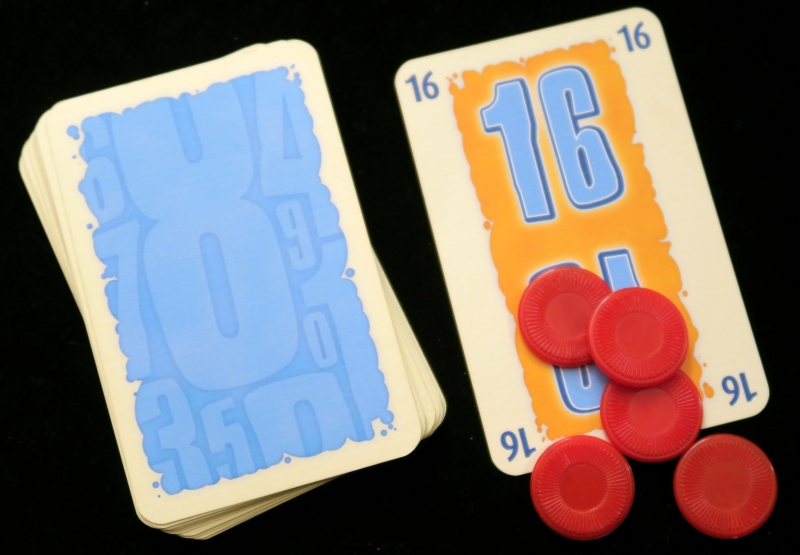
With Bedlam Zoo sadly closed prematurely, the group moved on to a couple of quick fillers. The first of these was No Thanks!, a really clever little “cards with numbers” game. The idea is that players either take the face up card or pay a chip to pass the problem on to the next player with the aim being to be the player with the lowest total at the end. The clever part is that if a player has a run, only the lowest value card counts, but the deck also has some cards removed at random. This makes it a proper gambling and “push your luck” game. This time, Cobalt was the top scorer, but the winner with eighteen was Pink.
 |
| – Image by boardGOATS |
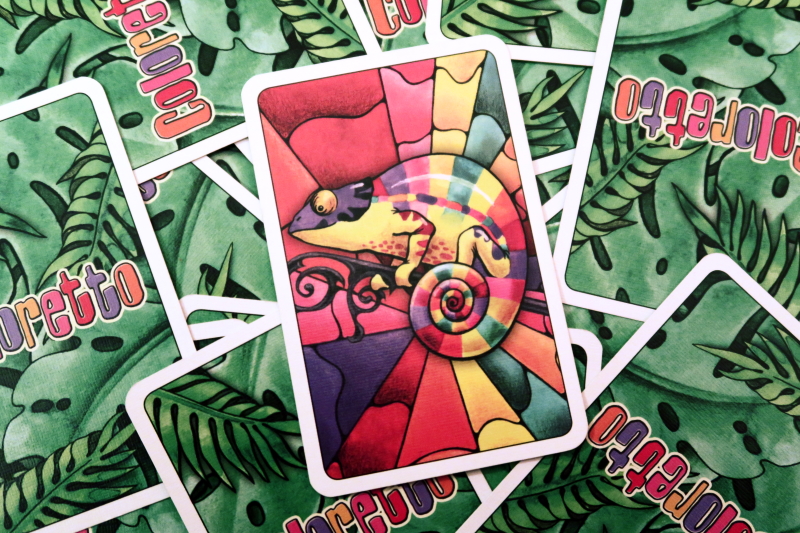
There was just time for one more game, Coloretto. This is another simple and clever card game, this time the essence of the core mechanism in the bigger game, Zooloretto. The idea is that players either draw a card and add it to a truck, or take a truck and add its contents to their collection. At the end of the game players score their three largest sets positively, with negative points for any other sets. The clever part is the use of the Triangular number sequence which means the first card in a set is worth one point, while the sixth is worth six. There were the usual questions about Joker cards which resulted in questions being called across the room, but in spite of taking all three Jokers in the deck, Pink was just second by three points behind Lime’s total of forty.
 |
| – Image by boardGOATS |
Learning Outcome: A game about Philately can be more than just Stamp Collecting.
 boardGOATS