Blue and Pink were just finishing their supper when not one, but three copies of Ark Nova walked in, escorted by Ivory, Cobalt and Green. This was because the “Feature Game” was to be its Marine Worlds expansion and, as Ark Nova is a substantial game that doesn’t get as many outings as it deserves, everyone was keen to give their copy a bit of an airing. The game is much longer than those we usually play on a Tuesday so everyone who was keen to play was early and started setting up promptly. Given the length, we also erred on the lower end of the player count, with just Ivory, Cobalt and Green playing. The game is all about planning and designing a modern, scientifically managed zoo, but the game-play is more like Terraforming Mars with animals, than Zoo Break or Zooloretto.
 |
| – Image by boardGOATS |
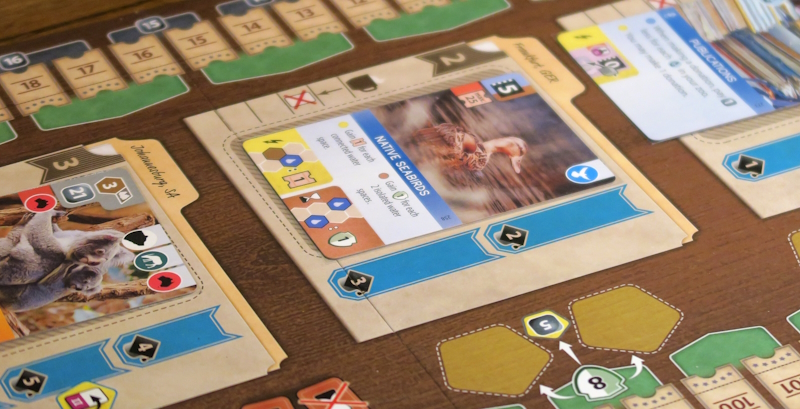
Although it is quite a complex game, functionally it is not difficult to play on a turn by turn basis, though there is quite a lot to manage and keep a track of. On their turn, players take one of six possible actions: activating one of the five action cards (Cards, Build, Animals, Association and Sponsor) with a strength equal to the number above the card. When activating a card players perform the action based on its power level which is dictated by its position in the row. During the game, players can upgrade and turn over the action cards to a more powerful second side using various Bonuses. The Marine Worlds expansion introduces several new elements to the game.
 |
| – Image by boardGOATS |
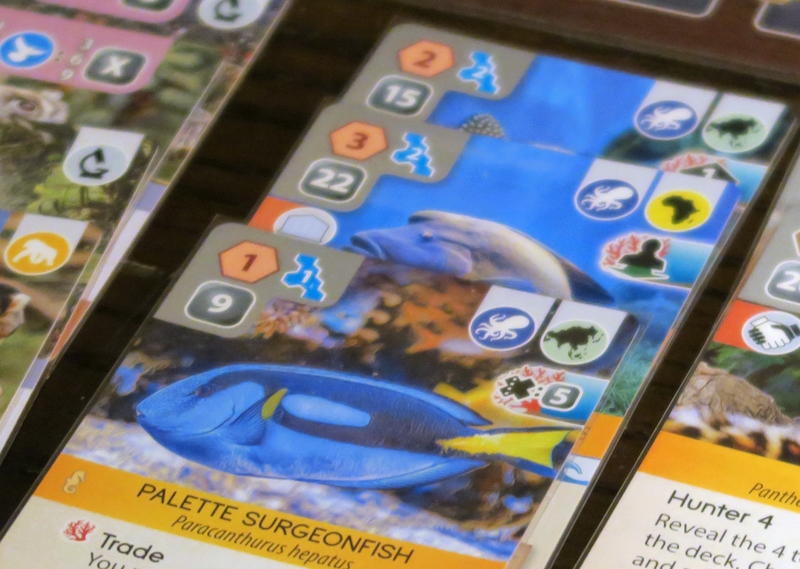
Firstly, there are sea animals that have to be played in new special enclosures that must be built adjacent to water. Roughly half the sea animals are reef dwellers, and whenever a player adds a reef dweller to their zoo, they trigger the ability of all reef dwellers in that zoo. To deal with the dilution of the deck (caused by adding more cards), all sea cards feature a wave icon, and whenever it is revealed in the display, you discard the first card in the row, then replace it. For each of the five Action cards there are four alternate versions with a little twist. Players draft these action cards at the start of play, replacing two of their standard action cards with these new ones, increasing the asymmetry in the game.
 |
| – Image by boardGOATS |
A new fourth University option is also available on the Association board. If a player takes it, they claim one of six special Universities from the Reserve that feature one Research icon and one of six animal icons. When a player takes this, they reveal Cards from the top of the deck and keep the first revealed card with an animal icon that matches their chosen University. There are also new bonus tiles and other little bits and pieces to smooth out the game play. Although the Marine Worlds expansion comes is modular, the group chose to play with all the components (Marine animals, asymmetric maps and drafted action cards).
 |
| – Image by boardGOATS |
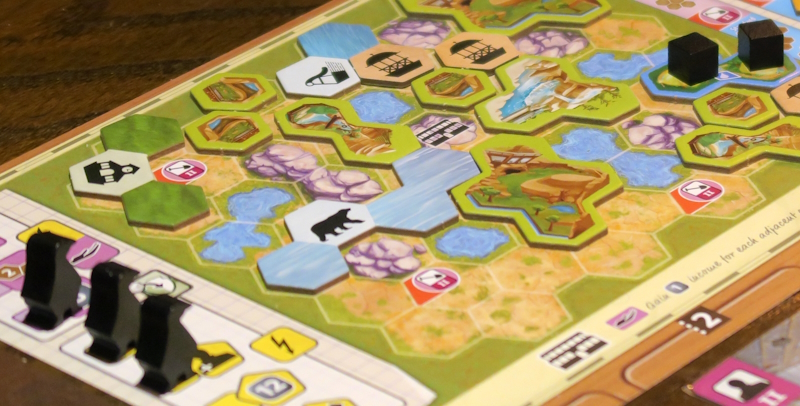
Ivory took a Sponsor Card that gave him extra money for breaks and an Association Card that gave him the ability to hire workers. This coupled with the lake map which gave extra money for building around the lake meant Ivory had access to lots of cash as the game developed. Both Cobalt and Green took a Sponsor and an Animal Card, with Cobalt taking a map that allowed him to discard cards for money while Green had the map with the park restaurant. While Cobalt was also able to build up a lot of cash, Green spent most of the game playing the poor relation, just scraping by. The game started slowly, with initial conservation projects devoted to Australian animals, Birds, and African Animals.
 |
| – Image by boardGOATS |
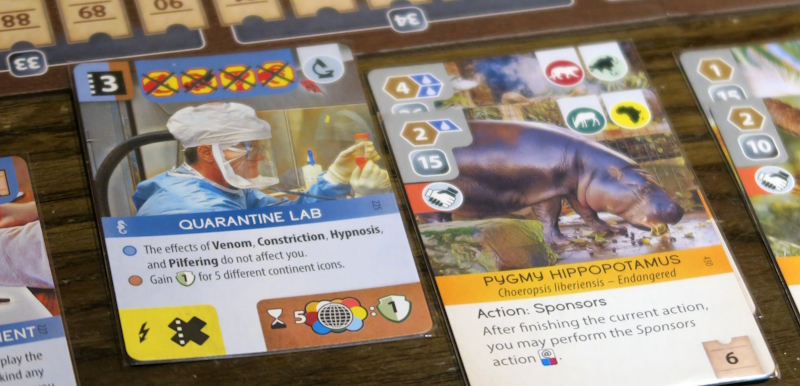
Both Green and Ivory wound up spending all their early money, trying to get Animals out, whereas Cobalt focused on the Association board and playing Sponsor cards. After struggling with money for the first couple of rounds, Ivory managed to get two Australian animals, allowing him to put a token on the conservation card, giving an additional Zoo Dollars at each break/income step and from then on, money wasn’t too much of an issue for him. Green however, struggled for money for most of the game, where Cobalt continued to focus on Sponsor Cards and Association Actions, and as a result, he took an early lead on the Research track which gave him a much greater card choice. Cobalt did build an early aquarium, however, and started filling it up with fish.
 |
| – Image by boardGOATS |
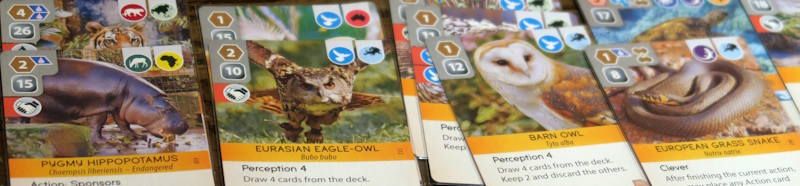
After a quick start, both on the conservation track and appeal track, Ivory’s game slowed down significantly—he was too focused on animals, compared to Green and Cobalt. They had both spent time taking Association actions, leading them to Upgrade cards and progress up the Reputation track. Cobalt was able to significantly move up the Conservation track in the middle game using his Sponsor Cards, whereas Green focused on one big move by having lots of birds in his zoo. Much to Pink’s disgust, although the panda was an option at one point in the game, the “wave” added by expansion pushed it on, so nobody got the Panda. Instead, by the end of the game, Ivory had quite a collection of monkeys, Green had a few some birds and Cobalt had a lot of fish.
 |
| – Image by boardGOATS |
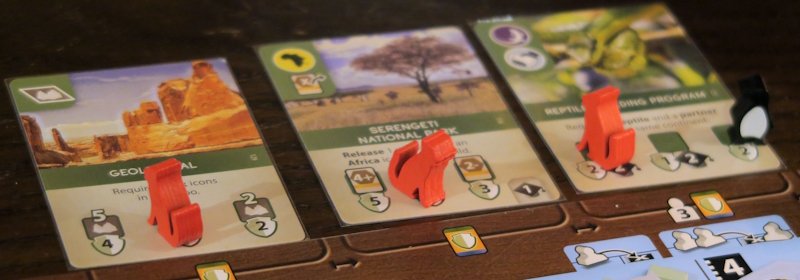
Going into the end game, Cobalt some way ahead on the Conservation track, followed by Green, while Green and Ivory were fairly similar in Appeal. Cobalt then started playing lots of animals in his zoo and managed to completely fill it moving rapidly along the Appeal track. It was clear he was soon going to bring the game to a close, due in part to both his (and Green’s) ability to make donations by upgrading the Association card. Green was also moving forwards on both tracks while Ivory was lagging behind albeit with three conservation cards in hand. Fortunately, Ivory had lots of “x tokens”, allowing him to play all his conservation cards (and gain the additional worker he needed, shooting up the conservation track, though sadly, it was too little too late. From there, It wasn’t long before Cobalt’s Tokens to crossed, ending the game.
 |
| – Image by boardGOATS |
Everyone had made some mistakes reading their cards and/or abilities which cost a little bit, but was probably fairly balanced out. Everyone managed to get the full four Conservation points on their personal scoring cards, but Green picked up quite a few extra points from the Sponsorship cards leaving him level with Cobalt. Inevitably, this led to a hunt for tie-breakers—the rules state that the tied player who supported the most Conservation Projects wins the game. As Green and Cobalt had also supported the same number of Conservation projects the rules dictated they should share the victory. That said, Green magnanimously said he felt Cobalt had the edge by virtue of having way more coin at the end of the game.
 |
| – Image by boardGOATS |
On the next table, Blue, Pink and Mint had finally got underway playing Kavango. This is a conservation, card-drafting game. A bit like games like Sushi Go! and 7 Wonders, players draft cards to build their Reserve. Like games like Terraforming Mars, however, cards can only be added to a player’s Reserve if they have its requirements. These might be the food supply, or enough protection (environmental, poaching or climate). Climate protection is unique because, as in real life, players have to work on that together. At the end of the game, after three rounds, players add up the value of their animals, and any bonuses together with any points scored during the game for Research, and the player with the most points is the winner.
 |
| – Image by boardGOATS |
Pine joined them briefly and expressed an interest in playing another time, but decided this week he would take himself home to better acquaint himself with his C-vitamins and avoid unnecessarily sharing his bugs. Mint was the nominal first player, though mostly the game is played simultaneously. Blue started hard and fast building up lots of income, however, she was forced to invest heavily in Climate protection—honourable, but not necessarily lucrative. Pink and Mint were a little slower to start, but made good progress. Both got caught out by a very minor rules malfunction that had a significant impact: Cards not used at the end of the round are supposed to go into a discard pile, but instead were returned to their decks.
 |
| – Image by boardGOATS |
Towards the end of the game, this suddenly became significant as some types of card are not available in the final rounds. So, those that needed, for example, termites (like Mint), were unable to get them. Pink and Mint were most obviously affected, though everyone got caught in some way or another. The card draw hindered Blue as she struggled to find any migratory animals at all and had to abandon her personal objective as unachievable. In contrast, Mint and Pink both did really well with theirs (birds and toxic creatures respectively), making the result much closer than it would otherwise have been with Blue the victor with a hundred and seventy-one, a single point more than Mint.
 |
| – Image by boardGOATS |
Meanwhile, Plum and Byzantium had kindly agreed to take Lime to the other side of the room to play the Golden GOAT Award 2024 Winner, Stamp Swap. Somehow, despite the flurry of outings it received towards the end of last year, Lime had missed out on playing it. This is also a drafting-type game, but this time with stamps (mostly). The game takes place over three rounds, each split into two parts: Firstly players take it in turns to choose from a central pool, then players divide their pile into two and the first player chooses one pile from another player to take, who keeps their other pile and chooses one from another play—and thus the piles of stamps are swapped.
 |
| – Image by boardGOATS |
On previous outings, Byzantium had managed to annoy Blue by just beating her. It had been his birthday at the weekend, so the question was whether he would get another, albeit slightly belated, birthday gift in the form of another victory. Sadly for Byzantium, it was not to be though. Plum took ten more points than him during the game and another ten more in the end game scoring between them, giving poor Lime quite a trampling on his first game. Stamp Swap wasn’t the only popular new game to get an outing this evening. On the next table, Jade and Sapphire were introducing Purple and Black to Fromage, a sort of cheesy worker placement game with simultaneous play and a time component, not completely unlike Tzolk’in.
 |
| – Image by boardGOATS |
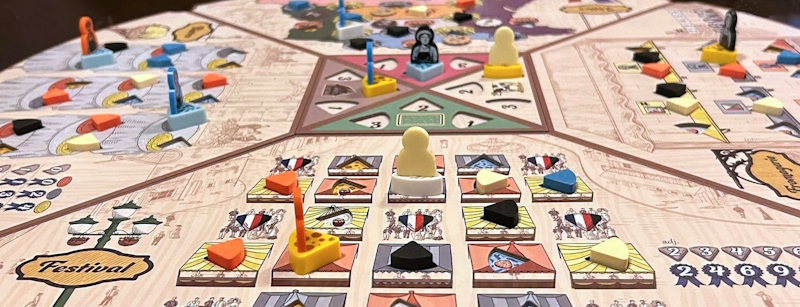
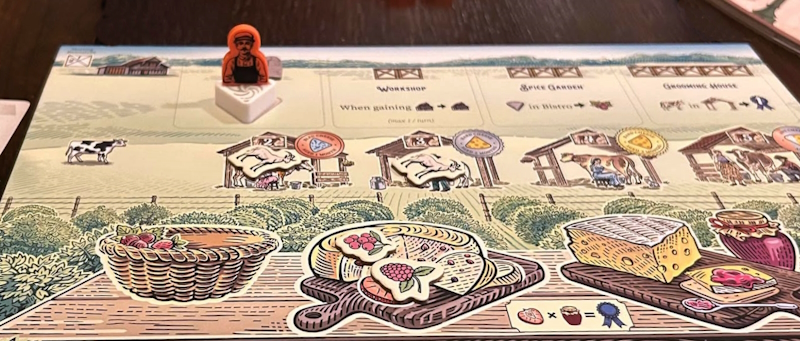
The actions are tied up in four “mini-games” which players take it in turns to participate in. It has proven quite a popular little game because once everyone knows how to play, there is relatively little down time and despite playing different areas at different times, quite a lot of interaction. Players simultaneously choose where to place their workers, in their quadrant of the board, and once everyone is done, the board is turned and then players retrieve any workers they can and then place workers on their next quadrant. Players score points for occupying tables in the Bistro quadrant, holding the majority in regions in the Villes quadrant, filling different tables in the Fromagerie quadrant, occupying contiguous areas in the Festival quadrant, and for fulfilling Orders.
 |
| – Image by boardGOATS |
This time, Purple and Jade made a bit of a killing in the bistro taking nearly thirty points each, while Sapphire took twenty-two points in the Villes. Black’s strategy was somewhat different, picking up points more evenly across the board and focusing particularly on fruit. In the end, despite the differences in approaches, the scores were very similar, with only three points covering second to fourth. The winner was Jade, however, some twenty points clear of Sapphire, who just nicked second, but a single point. The game had been well received, and the group ended up “Doing a Lime” and playing it a second time.
 |
| – Image by boardGOATS |
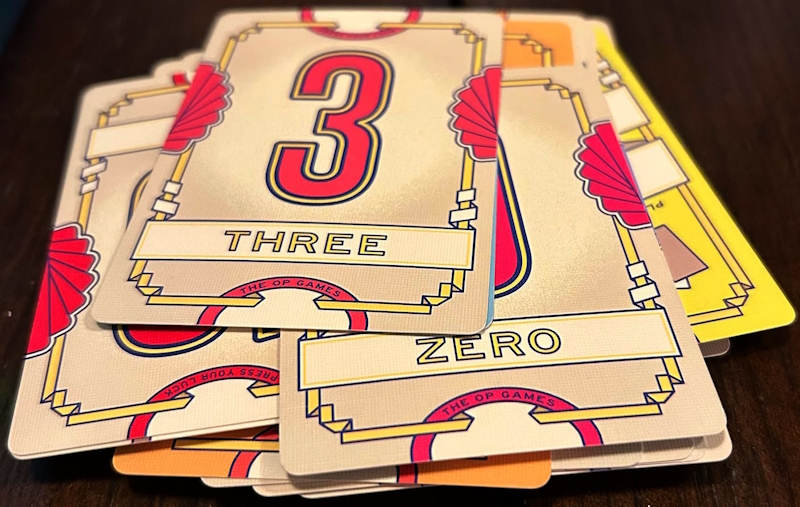
The second game was also tight, although everyone was much more even in where they scored their points. Sapphire just edged it though, again by a single point, again from Black, pushing Jade into third. There was still time after the second game for something else, something new, something quick—Flip 7. This is a really simple “Push your Luck” game reminiscent of Port Royal, where players simply turn over cards and gamble on not revealing the same number twice. The catch is that each numbered card appears in the deck that number of times (i.e there is one one, two twos and so on). Flipping over seven in a row gives fifteen bonus points.
 |
| – Image by boardGOATS |
There are also some action cards in the deck, “Flip Three”, “Freeze”, “Second Chance” and modifier cards which give extra points. Players take it in turns to decide whether they want to “flip” or ” stick”. The game ends when players have reached the pre-agreed total (two hundred, according to the rules, though games can easily be made longer or shorter as desired). In the first round, three players scored well, but the rest of the game did not go so well. In fact, the only player who managed to score in every round was Black with a fairly consistent total around thirty. It was no surprise that he was the first to pass two hundred and was therefore the winner, ahead of Sapphire and Purple, who were joint second with a hundred and seventy-six.
 |
| – Image by boardGOATS |
Learning Outcome: Zoos are even more fun with sea creatures.
 boardGOATS