Author Archives: nannyGOAT

26th August 2014

We started the evening with a big bowl of chips, some ice-cream and a game of Hanabi.  This is a a co-operative game where everyone works together to try to achieve a common aim.  The idea is very simple:  everyone has a hand of tiles which are turned to face away, so that players can see everyone else’s tiles, but not their own.  On their turn, players then either play a tile, give a clue about the colour or number of the tiles in front of a player, or discard a tile (and recover a clue).  The aim is to lay twenty-five tiles in order within their suits.

Hanabi

Everyone had played the game before, but never together as a group, so we had a quick discussion of conventions.  The game can be played very strictly in complete silence with “poker faces”, but given how hard the game is, we’ve always played it in a fairly relaxed way.  Some groups have a lot of extra ways of giving clues, for example, if a player has three green tiles, they point to them in a prearranged order, say, from lowest to highest, however, within the group we’ve always felt this is a step too far.  We typically play with a conveyor-belt, where new tiles are generally placed at one end and, in the absence of other information,  should it be necessary, the oldest tiles are discarded.  This not only helps the players giving clues ensuring that tiles stick about for as long as possible and makes sure people know which tile is “in the hot seat”, but also helps the owner remember which tile is which.  In the past, we’ve also used some element of the active player talking through their thought process so that other players can learn how people think.  This is nice when learning, but does have the tendency to give away a little too much information, so this time, with more experienced players, we tried to keep that to a minimum.

Hanabi

We started off well with one player beginning with three ‘ones’ all of different colours, but then the trouble set in.  The absence of “twos” meant that nobody could really find any really good clues to give and before long we were forced to discard tiles which led to the inevitable consequence of throwing away both white “threes”.  Although it limited our highest possible score, it had the advantage that people could freely discard white tiles and recover clues.  Doors opened a little and we managed to play complete blue, green and red fireworks.  The total of nineteen gave us an excellent crowd pleasing display, though it would be interesting to see if the same group could do as well, or even better next time, playing a little more strictly.

Hanabi

Meanwhile a couple of other players arrived and, seeing that the game had some way to go, decided to start a quick game of The Little Prince:  Make Me a Planet.  This is a pretty little game based on the book, The Little Prince, by the French writer, Antoine de Saint-Exupéry.  We’ve not played it before on a Tuesday, though many of us have played it on other occasions.  The idea is that each player is trying to build a planet from a total of sixteen square tiles.  The tiles have one of four different motifs: characters, up edges, down edges and middles and when four of each are combined, they make a picture of a planet with the four corner spaces occupied by the characters.

The Little Prince:  Make Me a Planet

On their turn, the active player chooses a motif, draws one tile per player and keeps one.  They then choose another player and pass on the remaining tiles for them to select one, then pass remaining tiles on etc.   The final player gets no choice and gets to keep the last tile, but to make up for that, this player becomes the start player for the next round.  Each tile features a number of items:  lamp posts, sheep stars, strange-looking foxes, elephants, baobob trees, cobras etc. which are used for scoring.  The score for each item depends on the characters, however, and items will score highly for one planet and poorly, or even negatively for another.  The game was tight all the way through, but Purple finished ahead with a lead of seven points.

The Little Prince:  Make Me a Planet

The games came to an end and we decided to start two simultaneous games of The Speicherstadt, our “Feature Game” for the week.  This is an unusual auction card game where players compete for victory points, which come mainly from contracts (sets of resources) and special cards.  The game is set in Hamburg around 1900 where there was a unique complex of storehouses (Speicherstadt) and a network of canals and bridges forming a terminus for spices, coffee, tea and carpets from all over the world.  Players act as wholesaler at the heyday of the Speicherstadt acquiring shiploads for the storehouses and making profits selling selling them.  We played this game quite a bit a few months back, but somehow seemed to have forgotten how to play it.  After a period of staring blankly at the rules, we remembered that each player starts with three meeples which they use for bidding, and bid by placing them above their chosen card (and any meeples already there).  Once everyone has declared their interest, the first card is auctioned:  the person at the front of the queue has the first chance to buy and the price is set by the total number of meeples in the queue.  If they choose to buy at that price, they pay up and the auction is over.  If they choose not to buy (or are unable to), then they forfeit their opportunity, remove their meeple and the next person has a chance (and the cost is reduced accordingly).  The deck is stacked so that contracts mostly come out first, then “schiffs” which carry the goods used to fulfil the contracts.  There are also firemen (or feuerwehrmenn) and a smattering of other interesting and valuable cards.

The Speicherstadt

In the first game, Blue failed to acquire any firemen and was duly punished by losing a total of ten points during the game.  Because Orange and Red had not played before, they had neglected contracts in the early stages, which meant goods were plentiful and were mostly sold.  Blue picked up the most contracts, but it was nowhere near enough.   On the other hand, Orange took all ten points, so the question was whether the contracts and Counting Houses held by Red were enough.  It came right down to the wire and the game finished with just one point in it, in Red’s favour, by just two points.  Meanwhile, the second game was playing in a completely different way.  In contrast to the first where contracts had gone unclaimed and all the “schiffs” were bought and goods sold, in the second game, most of the contracts had been snapped up, but with a shortage of money, some of the ships had not been bought.  In the second game, Green had picked up most of the firemen points and finished thirteen points clear of Black, his nearest challenger.

The Speicherstatd

A couple of people left early and those remaining played decided to play Montego Bay.  This is a game we’ve played a few times before, that features simultaneous card selection, which are then played in a predefined order.  Cards are numbered one to five and each player chooses two to move their big docker and their little docker round a circular track.  If they land on a space that is already occupied, then the piece that was there, moves to the other side of the track if that space is available.  If that space is also occupied, then the active piece moves as far as it can and then stops.  Each space corresponds to a cellar that contains some number of barrels which players then take it in turns to load into boats.   When a boat is full (or if it is the first boat in line at the end of the round), it sails and players score points for having the most barrels in boats when they go.  Beware the broken barrels though, if a player lands on a cellar with some of these they must remove the corresponding number of barrels from the boats rendering the best laid plan in tatters.

Montego Bay

Black started off really well with excellent timing on a couple of boats and catching lots of points as a result.  Then Purple joined in before Green took a commanding lead.   Blue made some in-roads, but proved her own worst enemy when she landed her big man on a cellar with broken barrels and then, to add insult to injury, landed her little man on the same space, moving the big man to the other side where there were even more broken barrels waiting for her.  Green ran out the winner with forty-four points to Blue’s thirty-eight in second place.

Montego Bay

Learning Outcome:  If fire is inevitable, ignore it at your peril.

Next Meeting – 26th August 2014

Our next meeting will be on Tuesday 26th August, at the Horse and Jockey pub in Stanford-in-the-Vale.  As usual, we will be playing shorter games from 7.30pm as people arrive, until 8pm when we will start something a little longer.

This week the “Feature Game” will be The Speicherstadt.  This is an unusual auction card game where players compete for victory points, which come mainly from contracts (sets of resources) and special cards.  The game is set in Hamburg around 1900 where there was a unique complex of storehouses (Speicherstadt) and a network of canals and bridges forming a terminus for spices, coffee, tea and carpets from all over the world.  Players act as wholesaler at the heyday of the Speicherstadt acquiring shiploads for the storehouses and making profits selling selling them.  We played this game quite a bit a few months back and felt it was due for another outing.

The Speicherstadt

And talking of Hamburgers…

Jeff was taking his new girlfriend out for lunch.  She ordered a smoked salmon and cream cheese bagel and Jeff went for a hamburger.  There was a flurry of activity behind the counter, the chef spat into his hands, rubbed them against each other, grabbed a handful of ground beef and started rolling it into a ball.  He then spat on the grill, put the ball of minced beef under his armpit to make a patty and then started cooking it.

Jeff’s girlfriend looked at Jeff in horror and whispered, “That’s gross!”

Without thinking, Jeff replied, “That’s nothing, you should come in early in the morning and see how he makes bagels…”

12th August 2014

It was a quiet night tonight with just the two games and not many more people.  We started out with the Feature Game, 7 Wonders, which is a card drafting game.  Basically, each player starts with a hand of cards and, simultaneously, each player chooses a card to play, a card to keep and then a passes the rest to the next player.  The cards are played with various different aims, you might try to build up a set of city and erect an architectural wonder, or attempt to have a superior military presence to neighbouring players.  The game consists of three rounds, the first and third passing cards to the left, with the middle round passing cards to the right.  We’ve played this a couple of times before – the first time, there were seven of us and it was just completely disorganised chaos.  Nobody had any idea of what was going on and changing direction in the second round just caused even more confusion;  it seemed to last for ever.  We played it again a few weeks later, this time with fewer and got through two games in the time it took the other half of the group to get through one.  This time, with just three players, it went OK, but the conclusion was that it works best with four or five, three is too few, and seven is definitely too many!  Green won, but Yellow’s comment, “I want to like it, but find it difficult to work out all the scoring combinations,” pretty much summed up everyone else’s view.

7 Wonders

The second game was a new game that two players had played several years ago, Kaigan.  It seemed that four years was “beyond living memory” as nobody could remember how to play and it took ages to work out the rules.  The game is set in 1800 when, at fifty-five years of age, Tadataka Ino started his journey to make the first scale map of Japan’s coast (Kaigan) using modern surveying techniques. After twenty-one years, Ino had a beautiful 1:36000 scale map that remained the definitive map of Japan for over a century.  In the game, the players oversee teams of surveyors and compete against each other to map the coast of Japan. Players generate income which they use to dispatch their surveyors around the island of Japan in an effort to map its different regions.  Then they improve their artistic skills and develop relationships with local governments in an effort to contribute the most to mapping Japan, gaining the most honour thus winning the game.

Kaigan

The game consists of five rounds that represent the twenty-one years Ino took to map Japan.  It didn’t take too long to play (certainly didn’t feel like twenty-one years!), but when we finished, we still felt as though we had played it wrong some-how. Purple bluntly said,”I didn’t like it then, and I don’t like it now,” while Yellow (who won) commented that he still didn’t really get it.  Green who had not played it before opined that it was not one he’d particularly wanted to play again as he didn’t like the fact that he kept losing his action choices, however he thought it might play a bit differently a second time.

Kaigan

Learning Outcome:  Sometimes, your first impression, really is the right one!

Next Meeting – 12th August 2014

Our next meeting will be on Tuesday 12th August, at the Horse and Jockey pub in Stanford-in-the-Vale.  As usual, we will be playing shorter games from 7.30pm as people arrive, until 8pm when we will start something a little longer.

This week the “Feature Game” will be 7 Wonders.  This is a card-drafting game that we’ve played before a couple of times – firstly at Christmas when there were loads of us and it was complete chaos, then again a few weeks later with very few people which meant most people didn’t get the chance to play it.  So it’s time for another go.  In this game, players travel back in time to become leaders of one of the seven great cities of the Ancient World, gather resources, develop commercial routes, and affirm their military supremacy, ultimately making their city and its Wonder the most impressive.

7 Wonders

And talking of travelling back in time…

Jeff and his American cousin, John-boy are shown a time machine which can see 50 years into the future.  They both decide to test it by asking a question each.

John-boy goes first, “What will the USA be like in fifty years time?”

The machine whirls and beeps and goes into action and gives him a printout.  He reads it out, “The country is in good hands under the new president, Jose Fernandez…. crime is non-existent, there is no conflict, and the economy is healthy. Vice President Jin Tao has declared Chinese language mandatory in all USA schools.  There are no worries.”

Jeff thinks, “It’s not bad, this time machine, I’ll have a bit of that.”  So he asks, “What will the UK be like in fifty years time?”

The machine whirls and beeps and goes into action again and once again, he gets a printout.  But Jeff just stupidly just stares at it.

“Come on, Jeff,” says John-boy, “It can’t be that bad – tell us what it says!”

“I can’t…” replied Jeff, “It’s all in Punjabi!”

29th July 2014

After a bite to eat, we started late with our first game, Indigo and immediately in walked a two more gamers.  It is a quick game though, and Yellow in particular was quite fascinated watching.  It is a really beautiful and simple yet clever game, based on tile laying and path building.  The idea is players have to direct glass pebbles and catch them in their “gates”; different coloured stones are worth different numbers of points.  Each player has a single tile and on their turn, they place that tile anywhere on the board in almost any orientation.  If the tile extends the path of one of the stones or connects it to another bit of path, the stone is moved along the path to the new end.  If a stone arrives in a gate, the owners of the gate get to keep the stone; each stone have a value and the player with this highest total at the end wins.

Indigo

In the four player game, players have three gates each, sharing one with each player, so there is a certain degree of team-work.  This was White’s first visit, and it became clear early on that this was not the best game for her as, without her glasses, working out where the blue ribbons go was challenging!  Nevertheless, she did remarkably well, especially in helping us make sure Green didn’t win!   Red and Blue led the charge and, when Red brought home the blue stone (which is worth a valuable three points), the writing was on the wall – a draw!

Indigo

With a few more arrivals, we decided to play our “Feature Game” next, which was 6 Nimmt! (aka Category 5 amongst other things).  This is a much older game (celebrating its 20th anniversary this year), though is also quite simple to play.  There are four cards on the table forming the start of four rows and players start with ten cards in their hands.  Each card has a face value between one and one hundred and four and features a number of “Bulls Heads” (mostly just one, but some have as many as seven).  Basically, players secretly choose a card to play, and then simultaneously show them.  The lowest card is then placed after the highest card on the table that has a face value lower than the card they are playing.  In this way, four rows are formed.  The rows are full when they contain five cards and when the sixth card should be added, the active player instead takes all the cards in the row and places their card down to start a new row.  A player scores the number of Bulls Heads on the cards and winner is the one with the fewest at the end.  Since the number of cards in the rows increase (making it harder to play safely) and the number of cards in hand decrease on each turn (players don’t pick up after each turn), the decisions get increasingly agonising, especially when the number of Bulls Heads in the rows starts to increase.

6 Nimmt

We checked that Red understood that she wasn’t supposed to be collecting cards and she assured us that she understood this aspect of the rules, however, it wasn’t a surprise when she finished with nearly twice as many Bulls Heads as anyone else!  So we decided to play a second round and work our way through the second half of the deck to give her a chance to improve things.  Green decided that it was time to “nobble” Blue as she had finished the first round with one Bulls Head, however, he had no idea how to go about doing it, nevertheless, everyone was delighted when Blue was the first to pick up.  Red seemed to have got the hang of it this time and managed to get through the whole round without picking up a single card which meant she finished in joint second with Green.

6 Nimmt

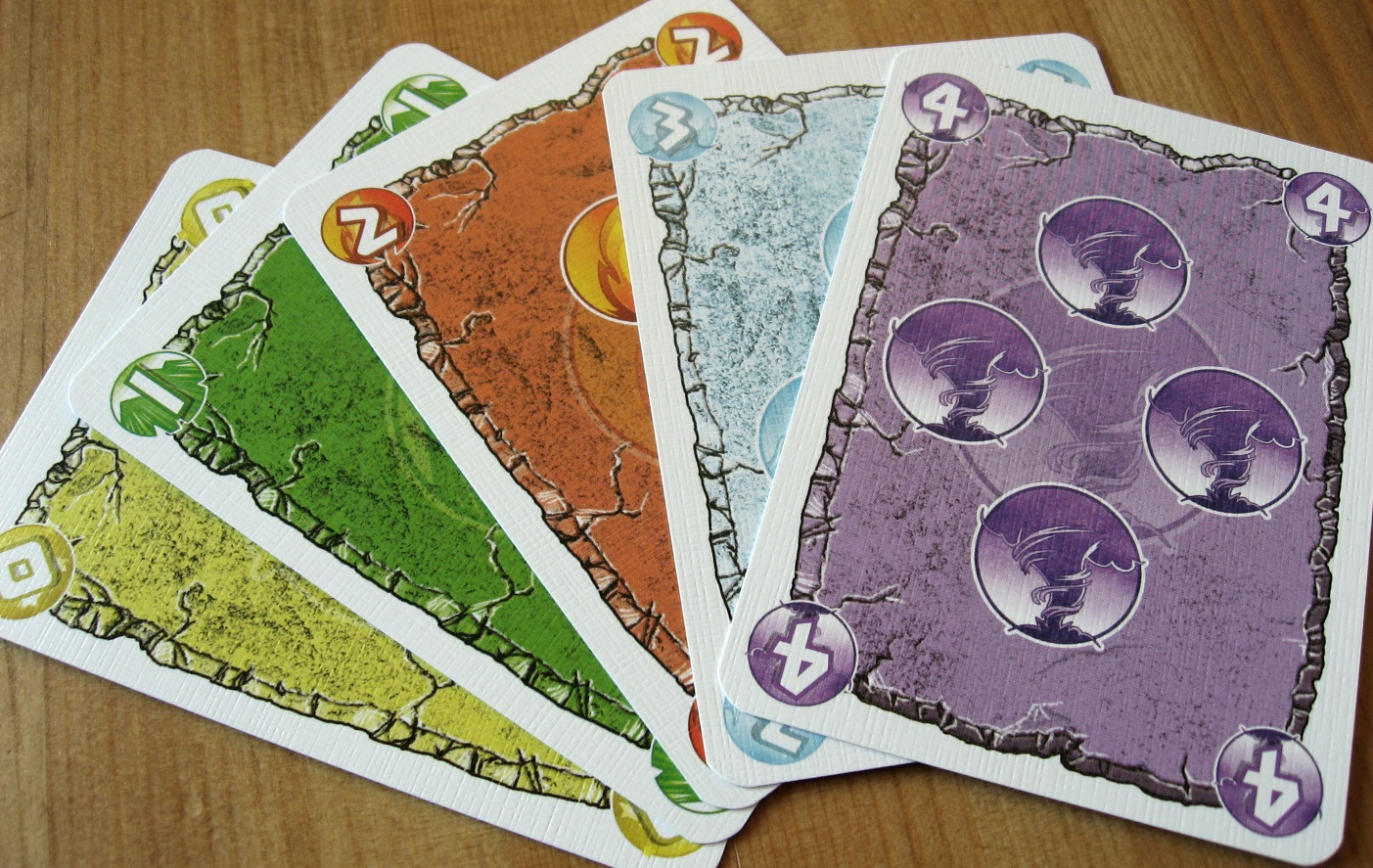
We didn’t have long before people had to leave,  so we played a game of one of our new favourite fillers, Dodekka, which has a lot in common with another game we like, Parade.  This is a simple little push-your-luck card game, with five different suits, Fire, Earth, Air, Water or Ether each with cards numbered 0-4. The game starts with three random cards placed in a line from the draw deck.  On a player’s turn they can either take a card from the deck and add it to the end of the row of cards, or take the card nearest the deck.  If the total of the face values of the cards in the row exceeds twelve, then the player has to take the whole row.  At the end of the game, players choose a scoring suit and add up the face value for that colour, then they subtract the penalty points – one for every card not in their scoring suit.

Dodekka

Yellow was the first to pick up a handful of cards, but it quickly became clear that he had a strategy and, as a substantial number of the cards were blue he was hoping to collect enough to offset any penalties.  Red, Green and Blue, meanwhile tried to delay picking up cards and then minimise the number they got so they could leave the decision until they were forced to choose.  Purple was forced to choose quite early on, but ran out the winner with a grand total of five, just one ahead of Green and three ahead of Yellow.  Remarkably, nearly everyone finished with a positive score, which we felt was much better than last time!

Dodekka

Next up was another recent favourite in Ivor the Engine.  We played this only a few weeks ago, but Yellow has won every game he’s played, so we all felt we couldn’t let this record stand…  Yellow started out well early on, with a lucrative job in Llangubbin, but it stayed close.  Purple carried out a lot of jobs at Mrs. Porty’s House and then picked up the matching event card to add more points.  Green collected a lot of sheep in the Grumbly Town area and then played a handful of cards to do several jobs one after another.  When an event card came up that moved everyone to Tewyn, we all payed a sheep except Yellow who followed the move with an ominous number of jobs in Tewyn Beach.  Meanwhile, Blue had picked up a lot of cards for Dinwiddy’s Gold mine, but without help was unable to clear the sheep efficiently.  So when the matching event card came and went, she changed her strategy and collected a couple of tasty looking jobs in Grumbly Town.  When it looked like Yellow was about to finish the game, Blue gave him a lost sheep card, immediately followed by Purple who forced him to lose a couple more sheep.  Blue turned her Goldmine cards into gold, then into coal enabling her to move and carryout a couple of jobs bringing her sheep flock to twenty-five, and as the last player in the round, brought the game to an abrupt end.  With her extra sheep event card, she finished with thirty, just ahead of Green who pushed Yellow into third, for the first time.

Ivor the Engine

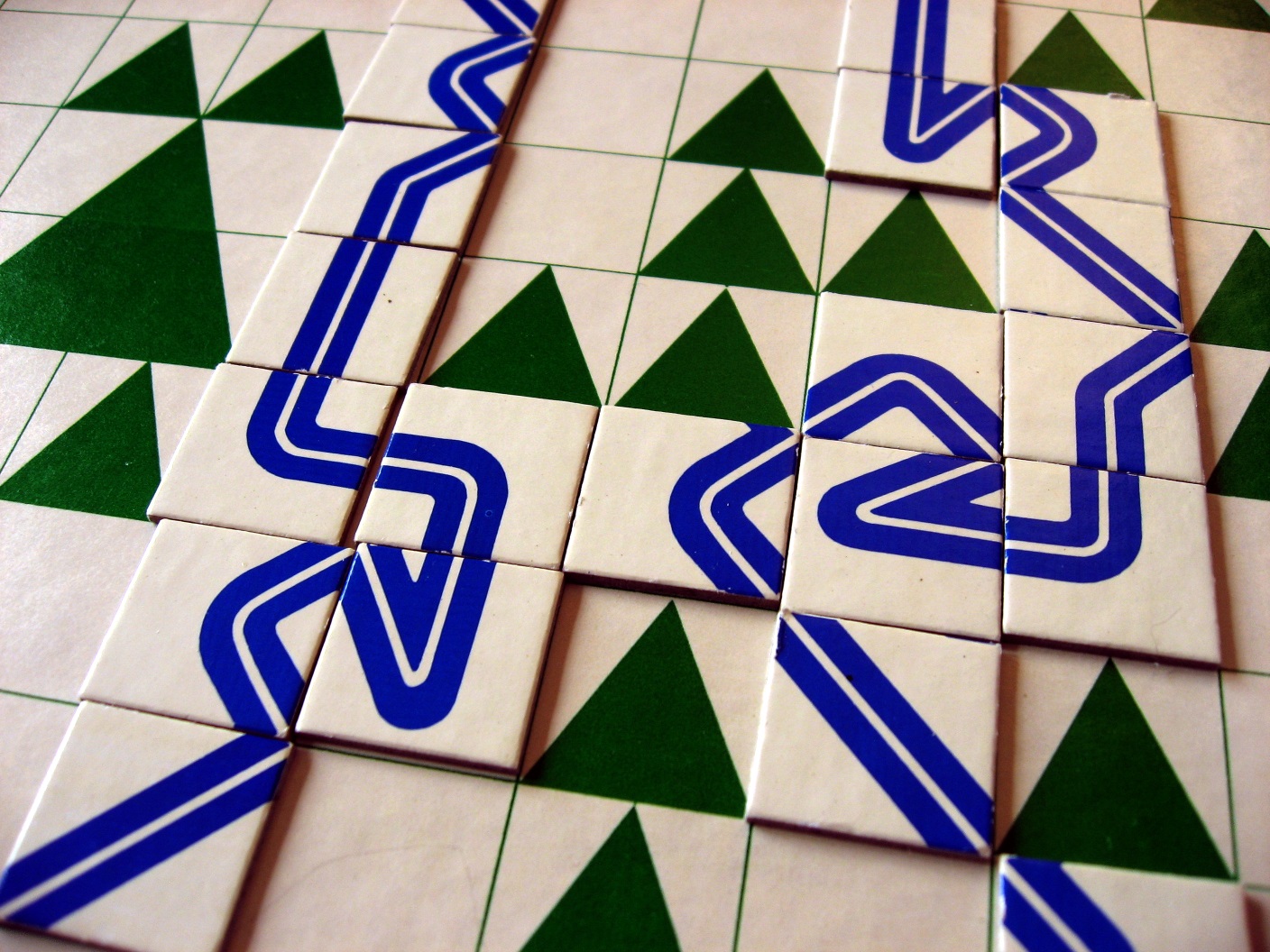
With only half an hour left, we decided to play what looked like a quick game in The Great Downhill Ski Game.  This is is an old game dating back to over forty years, but was ahead of its time.  Basically, players have a hand of ten tiles and on their turn they lay as many of them as they can to create a continuous path avoiding all the trees.  At the end of their turn they draw tiles from a face down pool to bring their hand back up to ten.  The game ends when one player makes it to the bottom of the run and players get points for finishing the course, but also for the tiles they lay, with points for corners and more points for sharper corners or crossing a track.

The Great Downhill Ski Game

Yellow started followed by Blue and Purple, so by Green’s turn he was squeezed into a corner and had to wriggle between the edge and Yellow’s track, as well as avoid the trees.  Purple was lucky with the space she had as Blue had left her with a lot, but didn’t get the tiles she needed.  Meanwhile, Blue started well and made a run for the line, but trying to weave in as many of her higher scoring tiles as she could.  It looked like Blue was miles ahead, but Yellow crossed the line first, leaving everyone one turn to finish.  Purple was the only one who couldn’t quite make it, though she managed to use nearly all her tiles.  Blue was hampered by drawing a high scoring, but high penalty tile in the penultimate round that she couldn’t get rid of, and came joint second with Green who did remarkably well considering his difficult start.  The gold medal went to Yellow though, who was not only first down the course, but was also left with the fewest penalties at the end.

The Great Downhill Ski Game

Learning Outcome:  Old games are sometimes still good games.

Next Meeting – 29th July 2014

Our next meeting will be on Tuesday 29th July, at the Horse and Jockey pub in Stanford-in-the-Vale.  As usual, we will be playing shorter games from 7.30pm as people arrive, until 8pm when we will start something a little longer.

This week the “Feature Game” will be 6 Nimmt (aka Category 5 amongst other things).  We have chosen this game to celebrate its 29th anniversary which is this year.  It is also a fairly quick, fun game of “bulls head collecting” that should be good to play as a warm up before we move on to something a little “meatier”.

6 Nimmt

And talking of bulls…

Three bulls heard the rancher was bringing another bull onto the ranch.

“I’ve been here five years. I’m not giving this new bull any of my hundred cows,” said the first bull.

The second bull responded, “I’ve been here three years and have earned my right to my fifty cows – I’m keeping them all.”

The third bull added, “I’ve only been here a year, and so far, you guys have only let me have 10 cows. I may not be as big as you fellows, but I worked hard for my cows and I’m keeping all ten of them.”

Just then an enormous cattle truck pulled up in the yard carrying the biggest bull they’ve ever seen.  At 4,700 pounds, each step he takes strains the steel ramp – the bulls can almost feel the ground shaking as he approached.

The first bull was first to react, “I think I can spare a few cows for our new friend,” he says trying to look nonchalant.

The second bull added, “Yes, well, I actually have too many cows to take care of – I definitely can spare a few.  I’m certainly not looking for an argument.”

They looked over at the third bull and find him pawing the dirt, shaking his horns and snorting.

“Don’t be foolish son,” whispered the first bull,  “Let him have some of your cows and live to tell everyone about it.  It’s not worth fighting him for, really, it’s not!”

The third bull replied, voice shaking, “Hell, he can have all my cows. I’m just making sure he knows I’m a bull!”

15th July 2014

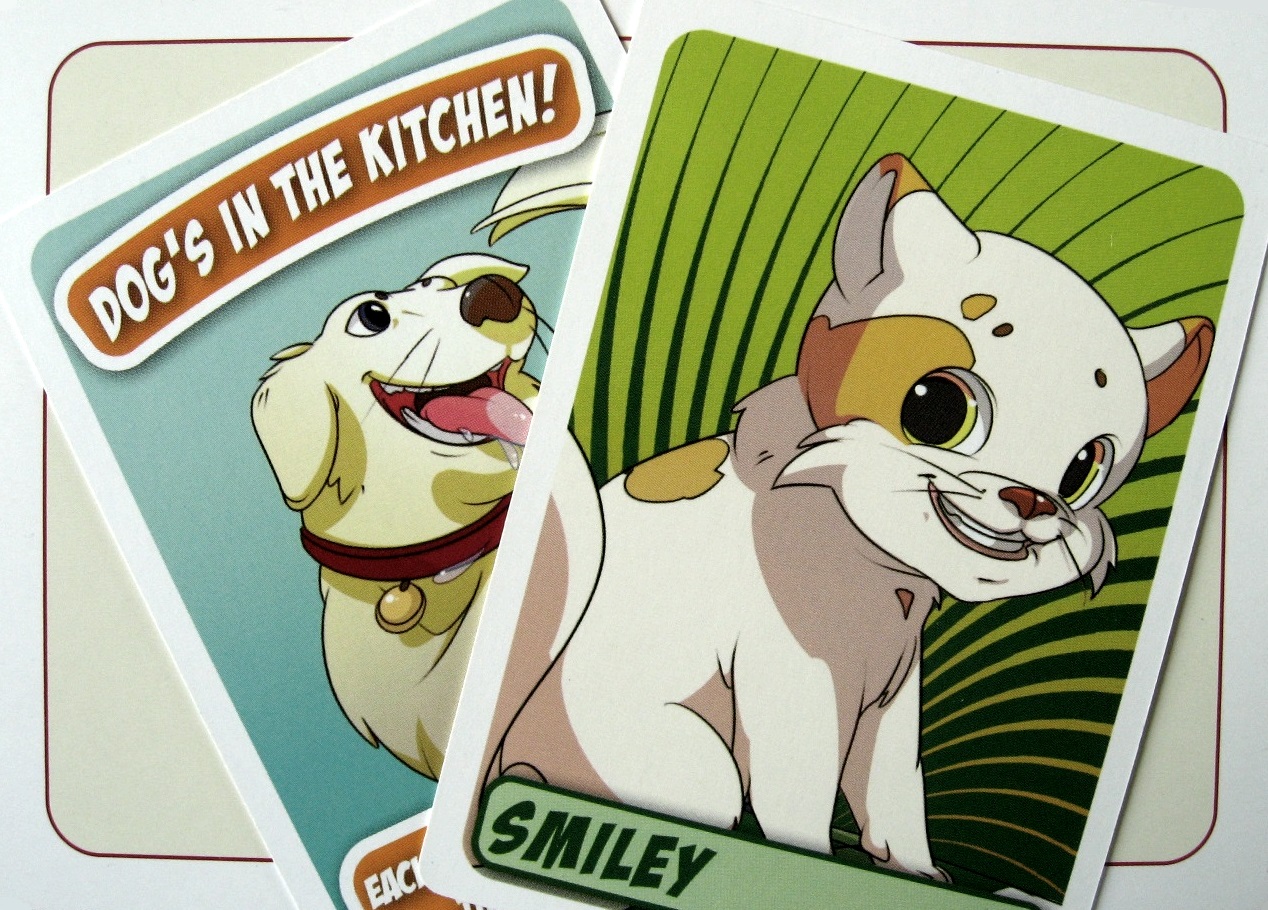
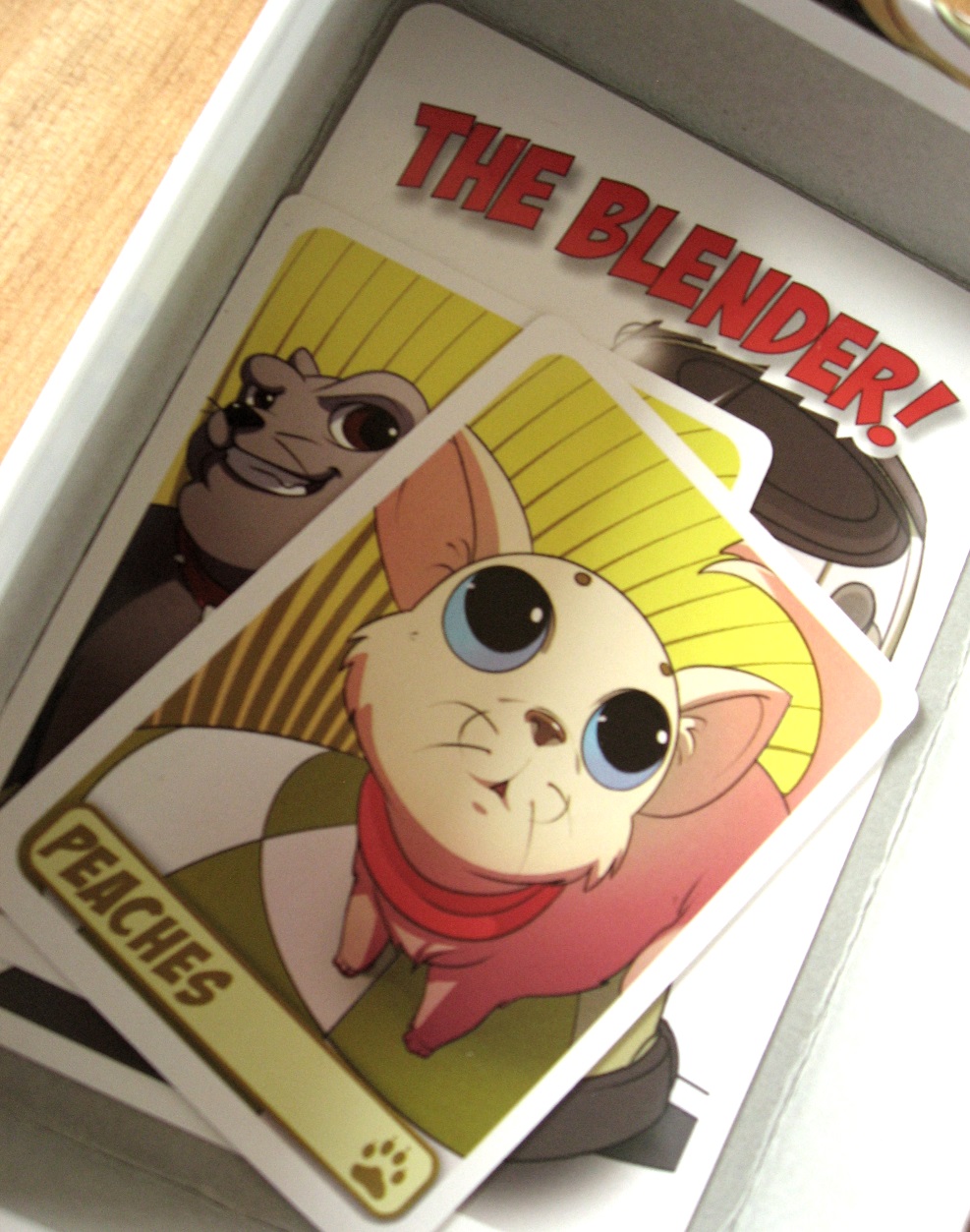
This week we started with a quick game of Kittens in a Blender.  This is a light card game, if one with a slightly ghoulish theme.  The idea is that on their turn, players must play two cards from their hand of six cards.  If they choose to play a kitten card it can go onto the counter in the middle of the table; into the relative safety of the box, or straight into the blender to await its fate.  Other cards allow Kittens to be moved one space from the box to the counter or the counter to the blender vice versa.  And then there are the blend cards, which cause any kittens in the blender to be blitzed, the kittens in the box to be permanently rescued and the kittens on the counter to move to the blender to become the next in line for “kitten smoothy” (if they aren’t rescued in time).  Players score points for every kitten of their own colour that they rescue, and lose points for those that meet a less pleasant end.

Kittens in a Blender

Yellow started out picking on Blue and Orange kittens and, well, Red ones too.  So before long, everyone retaliated and the fur began to fly as it all got ugly quite quickly.  Orange managed to do the least to offend everyone else and finished miles ahead of everyone else with fourteen points while everyone else struggled (or failed) to finish in paw-sitive figures.

Kittens in a Blender

Everyone else was here by now, so next up was our “Feature Game”, the new Spiel des Jahres winner, Camel (C)Up.  There has been much debate about the correct name as the box is ambiguous.  It was originally released as “Camel Cup”, presumably to reflect the Australian camel race, however, the Spiel des Jahres citation clearly calls it “Camel Up”, which at first sight seemed strange, however, once we started playing it became clear why this name was appropriate.  The game consists of a race of five camels and players effectively bet on the leader and eventual outcome of the race.  Thus, on their turn players can do one of four things:  use the cool pyramid dice shaker to move a camel; bet on which camel will be in the lead at the end of the round; bet on the final outcome of the race (i.e. which camel will cross the line first triggering the game end, or which will be in last place when that happens), or place their oasis tile which can earn the owner money as well as help or hinder a winning/losing camel.

Camel Up

There are a couple of clever things about the game.  Firstly, the dice shaker:  this is a pyramid-shaped device, made out of card and held together with an elastic band.  The idea is that players shake it, turn it upside down and push the slider to let out just one die.  Although it malfunctioned a couple of times, in general, it works well.  As there are five dice (one per camel) and when a die is “rolled” it is removed from the shaker for the rest of the round,  this is used to determine the length of the round (or “leg”).  Next, when a camel moves onto another camel’s space it is stacked on top of it, then if the bottom camel moves, the top camel takes a ride.  This means that a riding camel can get an extra move, and stacks can contain any number of camels, so if a camel is lucky it can pick up a lot of extra moves.  Finally, the way the betting is handled means that players don’t have to worry about stakes and odds.  To bet on the outcome of a leg, players simply take a tile of the appropriate colour.  Since these are stacked with the highest value first, if that camel comes home first, that player gets more at the end of the round.  Similarly, the betting on the end of the race is done by players choosing a card from their hand of five (one per camel) and placing them in the “to win” stack or the “to lose” stack.  The earlier they are placed, the more the player wins (if they get it right of course!).

Camel Up

The game began with the the Blue and White camels getting a slight head start.  White made a surge forward and everyone made a dash for the White betting tiles, until one player put a mirage in front of it…  For some reason, although all the other camels had no difficulty jumping the mirage, the White one really struggled and quickly went from the front to the back, a problem exasperated as every other space now had a mirage tile on it.  The Yellow Camel managed to catch a couple of rides, and before anyone could do much about it, it was across the line, with it handing the win to the only two players who had played it before.

Camel Up

Time was getting on and we only had time for a short game before some of us had to leave, so we played Incan Gold.  This is a game we played quite a bit a year or so ago, but hasn’t  made it to the table in a while.  Basically it is a push your luck game, where players are mining for gold and gems.  Each player enters the mine and a card is drawn and placed to make a path; the value of the gems on the card is split equally amongst the players in the mine with any left overs placed on the card.  Players then get the option to leave the mine (sharing all the left-overs as they go), or stay in the hope of getting more treasure.  The snag is that in addition to gem cards of varying values, there are also “nasty cards”.  You can draw lots of different nasty cards, but if s second of the same time type is drawn, the mine collapses and anyone left in loses whatever they had collected in that round.  In this game, it was a tale of “nasty cards” as the first three rounds had at least two nasty cards in the first five every time.  So it was all a bit scrappy with everyone nervously leaving early.  Then, somehow, Orange managed to pull off a bit of a coup and got out of the mine with lots of booty, just before it collapsed.    It turned out the lead was unassailable and Orange pulled off her second victory of the night.

Incan Gold

Now much depleted in numbers, we decided to continue with the Spiel de Jahres theme and finished with a game of Splendor (one of the runners up).  We played this a few weeks ago and like  Camel Up, it is quite a simple game, but is much more strategic.  The idea is that players are gemstone dealers and can use gem-chips they have collected to purchase cards.  In turn, these cards allow players to buy more cards of a higher value, some of which come with extra prestige points.  The end of the game is triggered when the first player reaches fifteen points.  Black ran off with an early lead, however, while Purple struggled a little, Blue managed to catch up with a couple of high scoring cards.  By this time Green had got his engine working properly and started to catch Black.  It finished a very close game, but Black just managed to hold on, beating Green and Blue by one and two points respectively.  Inevitably we finished with a discussion as to whether we Camel Up or Splendor was the better game.  We concluded that while Camel Up was fun, with seven it was too chaotic so that the “sweet-spot” was probably four or five and it would probably be great fun with a family under those conditions.  For us, however, we enjoyed Splendor much more and it will no-doubt make a return.

Splendor

Learning Outcome:  Camel racing is fun, but trading gems is Splendid!

Next Meeting – 15th July 2014

Our next meeting will be on Tuesday 15th July, at the Horse and Jockey pub in Stanford-in-the-Vale.  As usual, we will be playing shorter games from 7.30pm as people arrive, until 8pm when we will start something a little longer.

This week the “Feature Game” will be Camel Up (also known as Camel Cup).  We have chosen this game to celebrate the Spiel de Jahres (German Game of the Year) which was awarded yesterday to Camel Up.  It is a fairly quick, fun game of camel racing that should be good to play as a warm up before we move on to something a little “meatier”.

Camel Up

And talking of camels…

Two camels, a father and son are grazing peacfully.  The younger camel looks up to his father and says, “Dad!  Why do we have these giant humps on our backs?”  The father camel looks down at his young son and says, “Why, they are so we can travel for miles in the desert without stopping for water.”  The young camel looks astonished and says “Wow, I didn’t know that!”

A minute or so later, the younger camel pips up again, “Dad! Why do we have really thick eyelids?”  His father, slightly irritated at being disturbed from his grazing by his son’s curiosity, answers quickly, “So that our eyes are not scratched by sand storms.

“Wow!” the young camel replies and then a moment later, daddy camel hears his son again, “Dad!”

“What now!” his father asks clearly biting his tongue. His son asks, “Why do we have such huge feet, Dad?”

“Well son,” his father says in strained patience, “We need to tread through the sand and out feet are big so we can travel much easier.”

This time a few minutes pass before the father hears his son again.  Daddy camel, clearly agitated snaps, “What!?!?”

“Dad… What are we doing in a zoo then?”

Spiel des Jahres Winners – 2014

Camel Up (confusingly also known as Camel Cup) has just been announced as the winner of the German Game of the Year, or Spiel des Jahres.  This is a game of betting on camel racing, trying to suss out one which will place first and second in a quick race around a pyramid. The earlier you place your bet, the more you can win — should you guess correctly, of course…!

Camel Up

At the same time the Kennerspiel des Jahres, was awarded.  This honours more challenging games and was introduced in 2011 to replace the jury’s habit of intermittent special awards for games too complex for the Spiel des Jahres, but were still deserving of recognition.  This award went to Istanbul, in which players have navigate a merchant and his assistants through the bazaar collecting jewels.  The challenge is planning ahead to avoid being left with no assistants and thus unable to do anything.

Istanbul

We’ve not played either game in the group yet, but I’m sure we’ll give them a try as soon as we get the chance.

Games Sommeliers – in Oxford!

Boardgames have made it onto the radio again, this time with an eight-minute article on the BBC Radio 4 magazine programme, You & Yours.  The recording was done at Thirsty Meeples, the Boardgames Café in Oxford and broadcast on 4th July.  They interview a few customers as well as Simon one of the “Game Gurus”, or a “Games Sommelier” as they describe them, and John Morgan, the Manager.  Amongst other things, they play King of Tokyo, which is a dice rolling game that uses a Yahtzee mechanic and discuss what they do with lost pieces.

You & Yours