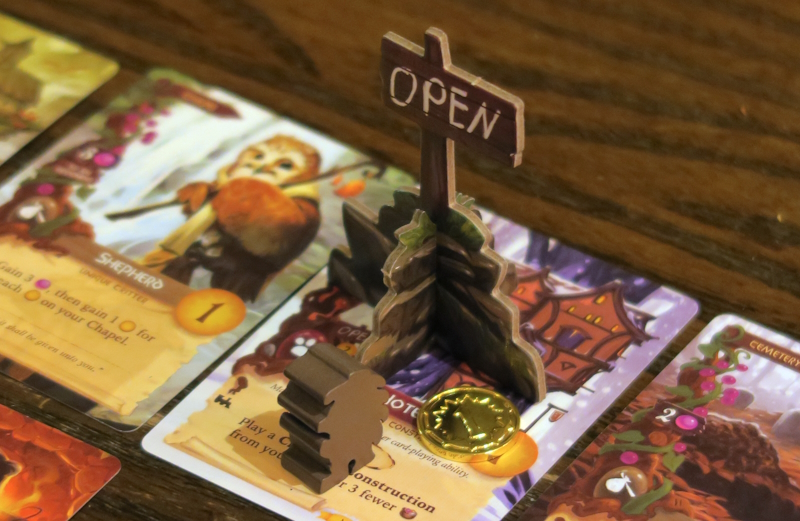
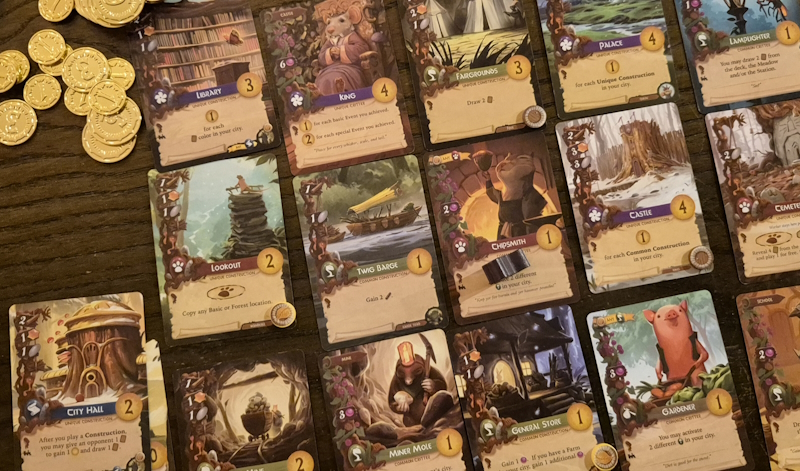
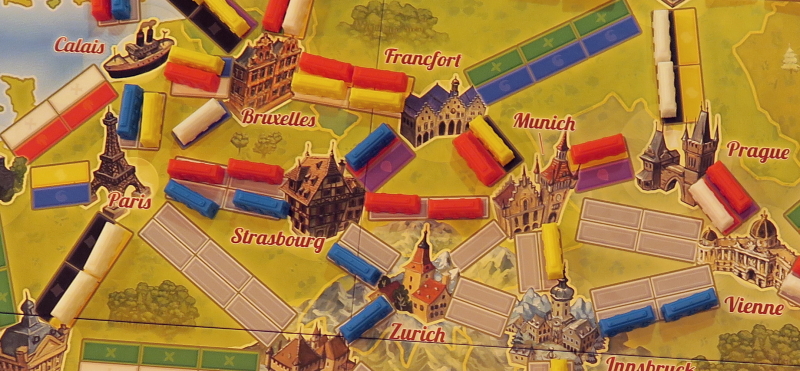
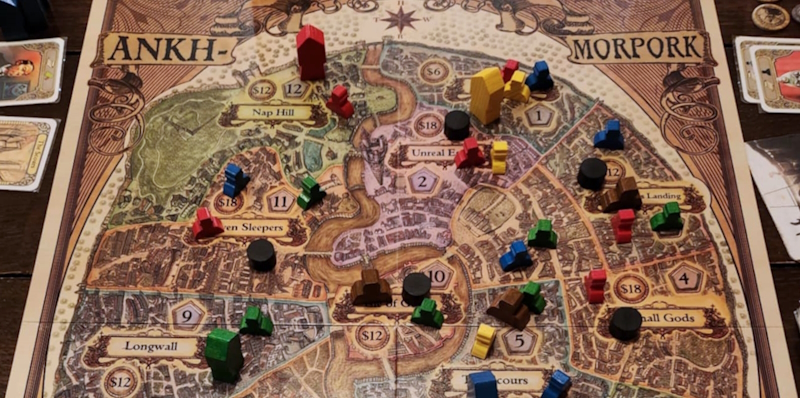
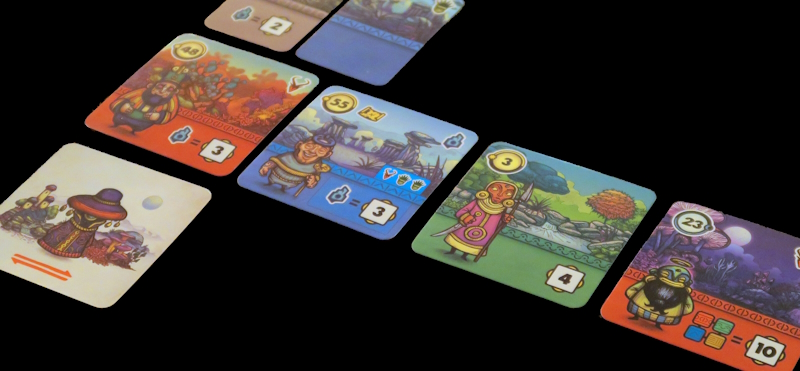
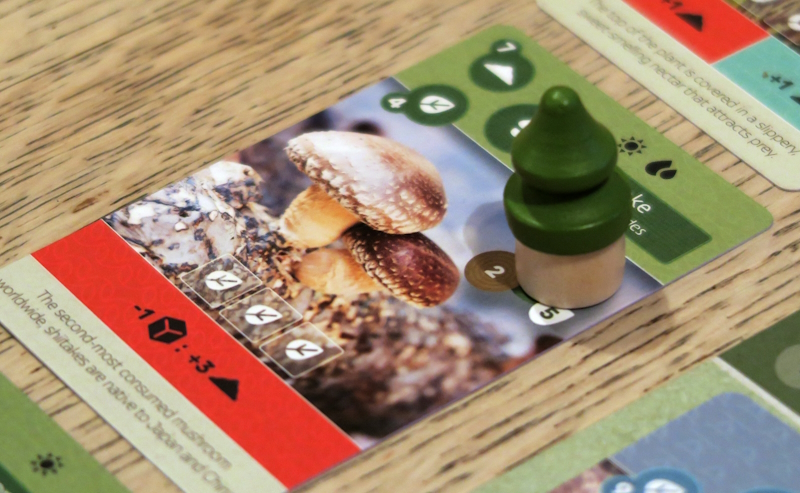
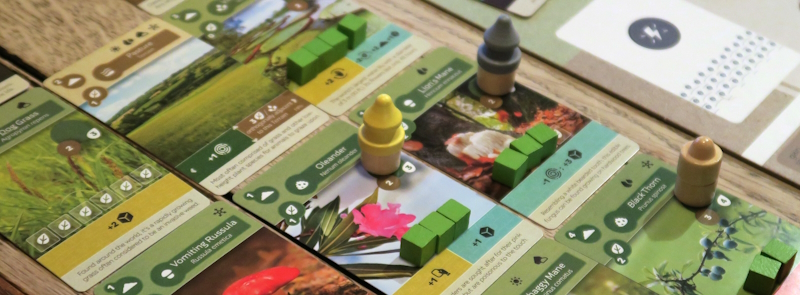
Category Archives: Games Night

5th August 2025 (Report)

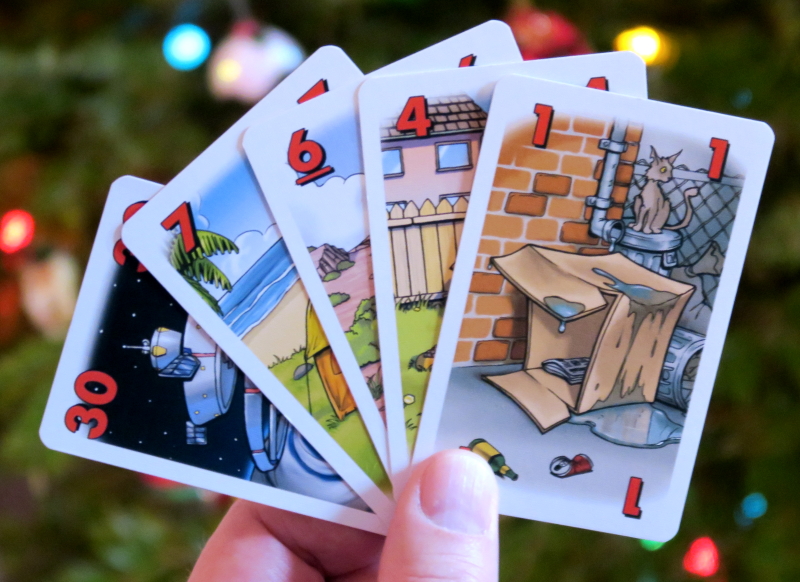
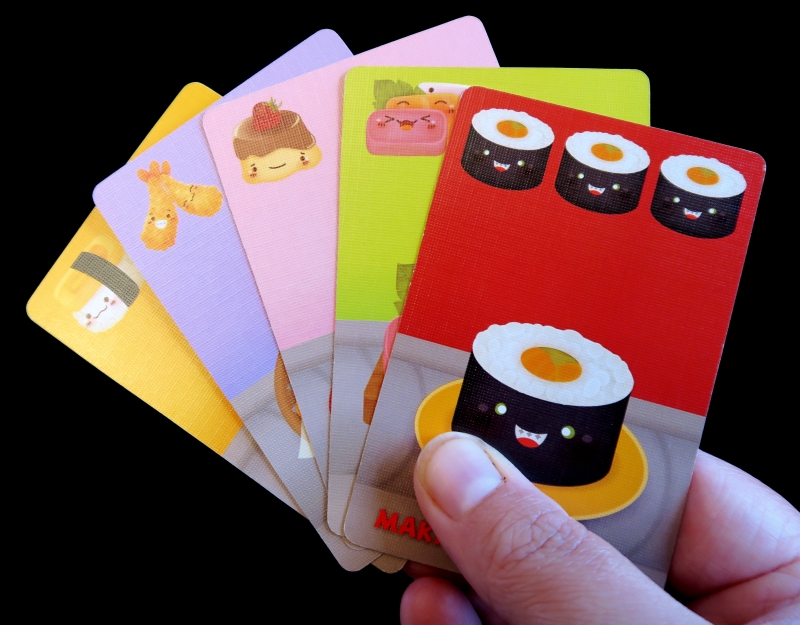
Following on from Little Lime’s visit last time, this week we had special visits from Mister Mint (aka Vermillion), Little Mint (aka Sable), and Little Ivory (aka Tangerine).  While everyone else got their collective acts together, Family Mint ordered their supper and got down to a quick couple of rounds of Panda Panda, a set collecting game with cute panda artwork.  In this game, players take it in turns to discard a card onto their personal discard pile or take a card from the draw pile from someone elses discard pile; when a player discards an “A” card, everyone passes a card to the left.  The winner is the first player to start their turn with a set.  Sable tried to win without discarding cards, but the victor of both rounds was Mint.

Panda Panda
– Image by boardGOATS

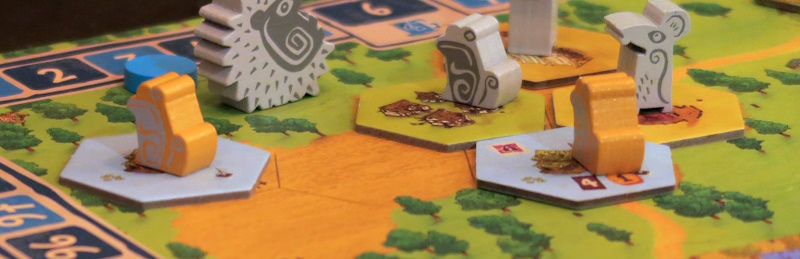
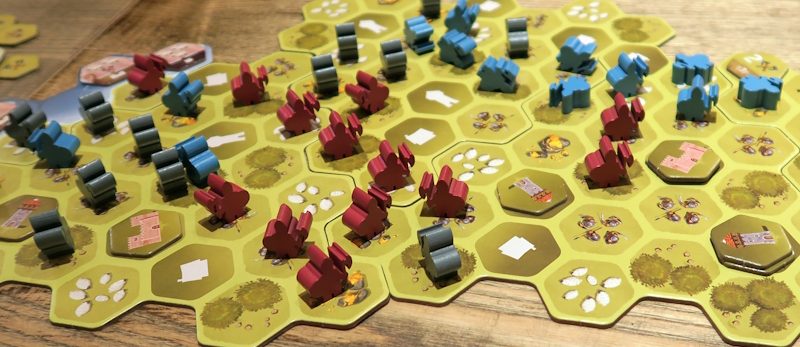
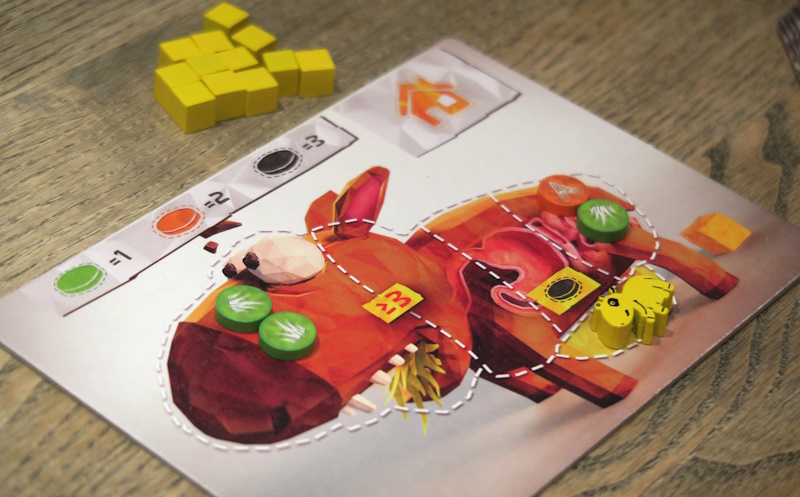
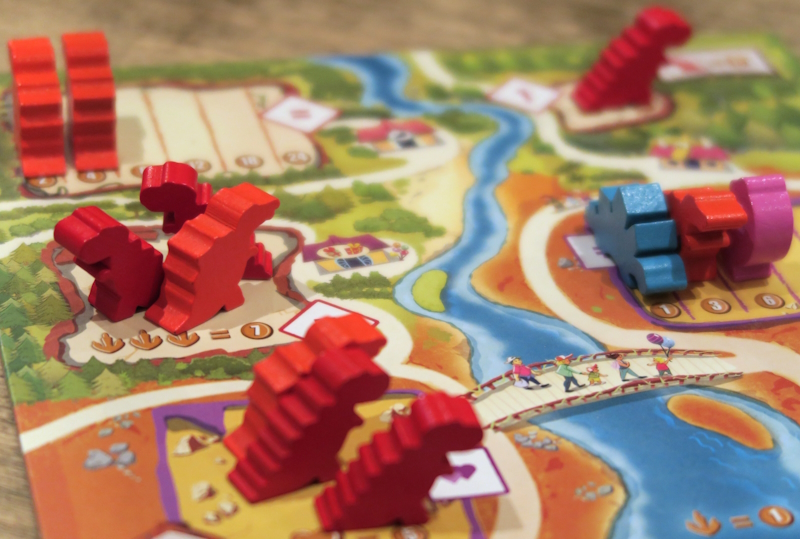
One of Family Mint’s current favourites is Wombat Rescue, where players are taking the role of mummy wombat trying to find their lost babies.  Enticed by the animals in the game, Pine joined Vermillion, Sable, Ivory and Tangerine, to play a game that seemed to be based almost entirely on the fact that the most fundamental Euro-game piece is the wooden cube and wombats are the only known animals who’s poo is cube-shaped (due to a slow digestive tract and intestines that contract in a specific way to shape their feces over time).  The theory is that because wombats have extremely poor vision but an excellent sense of smell, they use their poop cubes as “smell markers” and cube-shaped poop it is less likely to roll away or be moved.

Wombat Rescue
– Image by boardGOATS

The premise of the game is that a dingo has stormed the burrow and chased away four of each player’s baby wombats or joeys.  As mummy wombat, players have to eat and digest food in order to produce poop cubes, that they can use to build smell areas to navigate the board.  With a network of poop cubes, they can then find their baby wombats, and bring them home.  Thus, the player who best plans their smell areas and moves most efficiently will be the first to find all their joeys, and win the game.  Unfortunately, with five, the game took rather longer than the suggested sixty minutes, but they had a great time, so that didn’t really matter.

Wombat Rescue
– Image by boardGOATS

There was much amusement as cries of, “Stop sniffing my poo!”, “Are you going to use your smell corridor now?” and “There’s poo EVERYWHERE!” carried to the neighbouring tables along with odd words and phrases like “smell radius”, and the slightly odd request, “Can I sniff your baby please?”.  The eventual winner was Vermillion and there was quite a bit of chat as players packed up.  Although it had out-stayed its welcome a little, it wasn’t in the same league as that other Austrlian game, Echidna Shuffle, which on one notable occasion took hours because nobdy wanted to be the person who gifted someone the game, even though, everyone desperately wanted it to end!
Wombat Rescue
– Image by boardGOATS

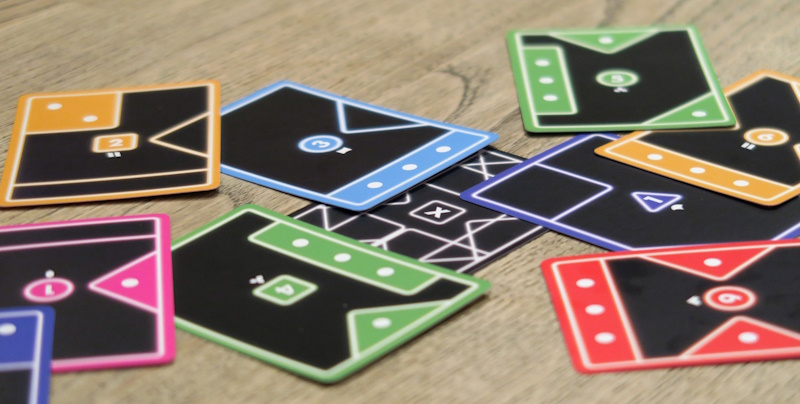
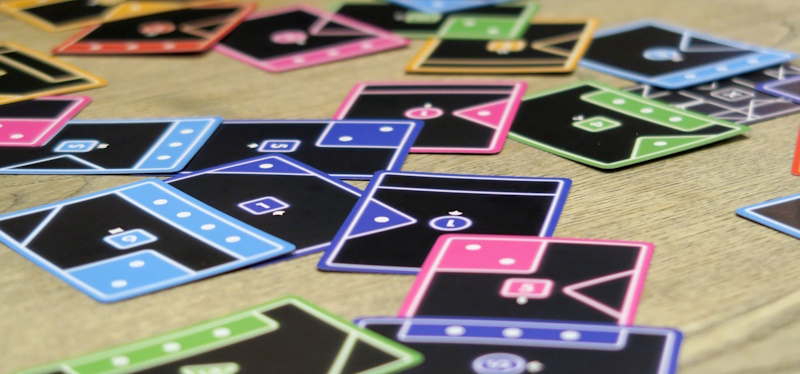
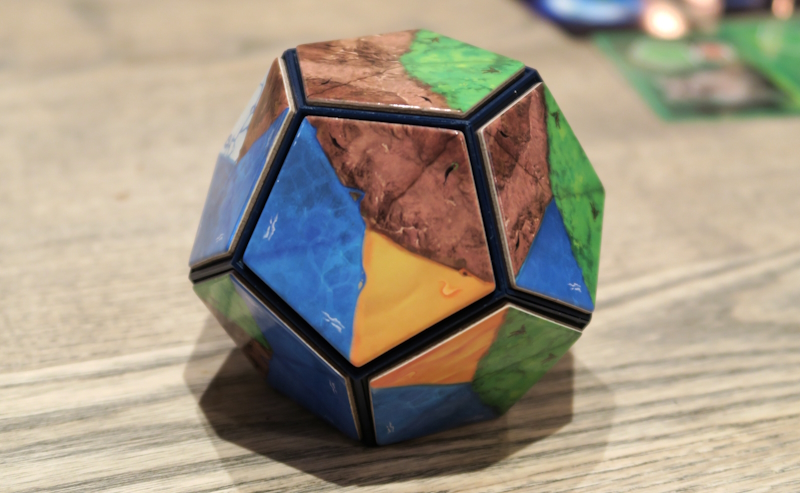
The main beneficiaries of the poop-laden comments were Mint, Blue and Lime on the next table.  They were playing the “Feature Game“, which was Cubed.  This is a very simple, sort of 3D, hexagonal/trioominoes domino game.  Players started with a hand of twenty of the delightfully tactile hexagonal pieces and then take it in turns to play a piece, adding it to the central grouping.  Pieces must join two edges, matching colour and slope direction:  each piece has a dip in the middle and the vertices alternate high and low.  Although this is simple, it is more difficult than it looks at first glance.  Additionally, some of the pieces have black edges, which are blocking pieces and nothing can be added to these sides.
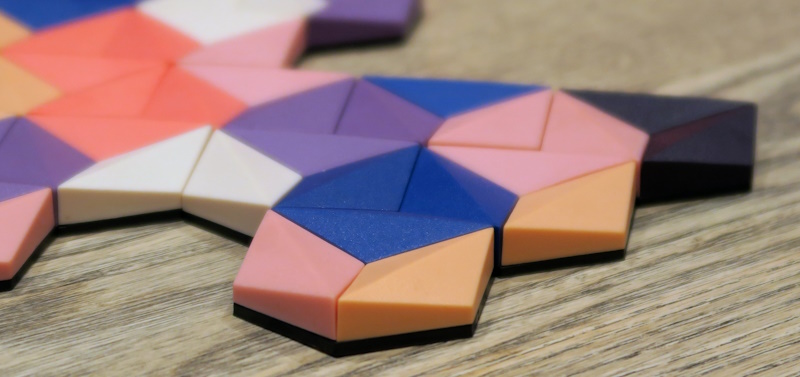
Cubed
– Image by boardGOATS

If a player can’t place a piece, instead they draw a random tile from the face-down pool.  The winner is the first player to get rid of all their pieces and they score zero.  Everyone else scores for the pieces they have left, with one point for those with three different colours, two for any with two colours, three for monochrome pieces and five for any blocking pieces.  Blue started, which turned out not to be the advantage initially thought as later players have more options.  That wasn’t the reason Blue did horrifically badly though, that was partly due to inneptitude and partly due to luck of the tile draw.  It was quickly clear that she was trying to limit losses and the battle was between Lime and Mint.

Cubed
– Image by boardGOATS

Lime finished first, but Mint only had one piece left and if everyone got the same number of turns she could have placed it thus ending in a tie.  The rules weren’t entirely clear on the point although arguably, the advantage of potentially getting an extra turn offsets the advantage of more play space (especially early in the game).  Either way, the group decided to call it a tie and settle the matter over another game, this time adding the variant rules.  These introduce the concept of “gaps”, single space “holes” in the array.  Players who “bridge the gap” and create one get to place an extra piece, and players who “fill the gap” get to “gift” one tile to another player.  Inevitably, however, this meant everyone saw making gaps as a challenge.
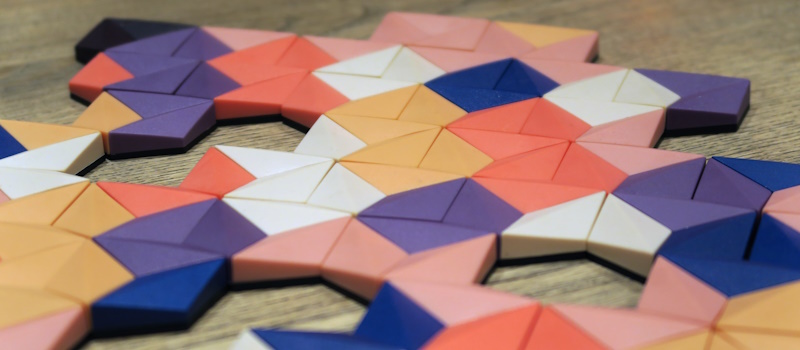
Cubed
– Image by boardGOATS

Mint did, eventually manage to make a gap, but it really wasn’t easy and probably partially led to her conceding victory to Blue, who made a much better fist of the second try.  That left how to score—consider it to be two separate games, or combine the scores as a campaign?  Well, Lime won the first “game”, Blue won the second, but Mint had the lowest overall score (with or without the extra turn), so it was decided that it was a three way tie and everyone was a winner!  That wasn’t the nly tie of the evening though.  There were two more tables of games, the first playing Vivarium.

Vivarium
– Image by boardGOATS

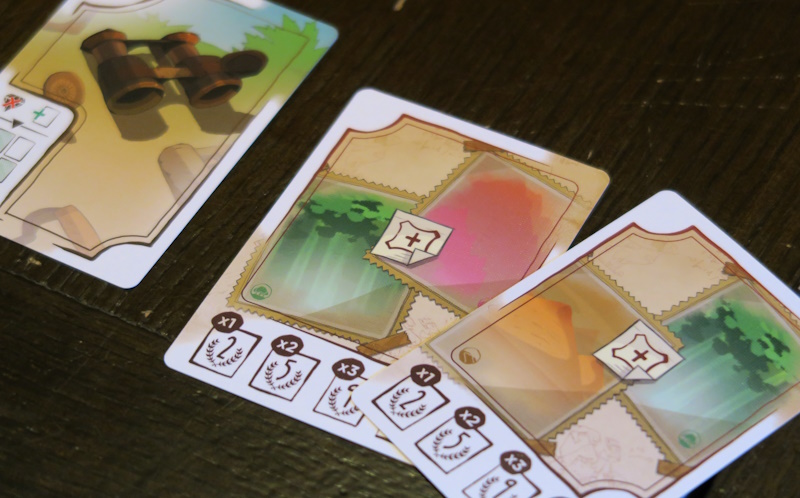
This is a card collection game with fantastic art, based round a market similar to that in Meadow.  In Vivarum, however, players use dominoes to create the coordinates that dictate the card they take.  After seven rounds, the player that has successfully completed their objectives and collected the greatest creatures wins the game.  Jade led the game with Cobalt and Sapphire joining him.  Players start with two dominoes and, on their turn swap one with central pile and then either use the new pair to take a card or take two gems—these are worth a point each at the end of the game, but can also be used to alter the values of dominoes during the game.

Vivarium
– Image by boardGOATS

Once everyone has taken two turns, the market is restocked and a new (two turn) round starts.  There are three different types of cards: Creatures, Equipment and Contracts.  Each Creature is one of four types, one of four colours and is worth points; Equipment are in four different types, earns Gems and give a special power; Conracts provide objectives that reward for different types of Equipment or Creatures.  At the end of the game, players score for Creatures, unused Gems, Priority Tokens (earnt for taking certain cards each round) and Contracts.  This time, it was close, though not actually a tie (that came later).
Vivarium
– Image by boardGOATS

Creature scores and Gems were all smilar, but the most significant differnce was in Priority Tokens.  Cobalt took ten more points from these than anyone else, which more than offset his slight deficit in other departments and gaving him seventy-seven points with Jade taking second place a few points behind.  After a short break, the group moved on to place Diced Veggies, a really clever little resource management game.  Players take it in turns with the Cleaver, using it to slice up the central array of dice.  Each die represents an ingredient and these are then assigned to  the recipes players are working on.

Diced Veggies
– Image by boardGOATS

Players can’t just grab loads of veg though—they can only take a limited number of pips with each chop, and the right dice values can unlock bonus cards to boost a recipe’s score.  Once a player has carefully sliced their veg from the main block (with a total value of ten or fewer) the can assign dice to Cook one of their recipes before drawing one more card (either a Hype/bonus card or a recipe).  Players can carry eight veggies, two Hype cards and two Recipe cards on to their next turn, but when one player has completed six recipes, everyone gets one more turn before the scores are added up.  And this was the game that ended in a tie—despite lots of variation in recipes and bonuses, Jade and Cobalt both finished with fifty points, with Sapphire just behind.

Diced Veggies
– Image by boardGOATS

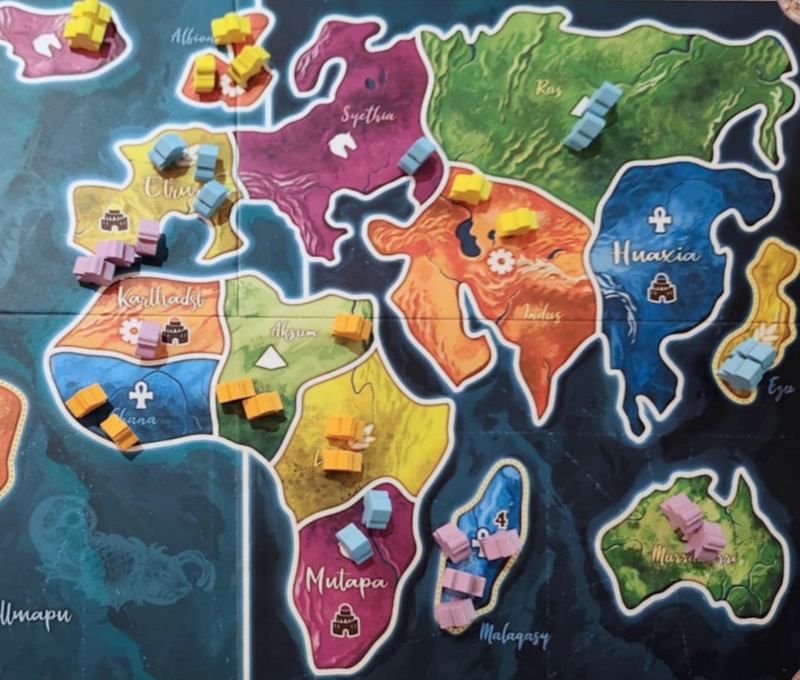
The final table, led by Plum, were playing First Empires, a game where each player takes control of an ancient nation and determines its fate.  On their turn, players roll dice according to how they’ve developed their empire board. The six sides of the dice correspond to the five abilities on their board. To expand to new territories or invade opponents, players unlock movement ability; to annex a territory, they have to outnumber the current occupant or have a “sword” result on the dice and chase the inhabitants elsewhere. Dice also allow players to develop their player board, using the die face that corresponds to improvement and controlling an associated territory.

First Empires
– Image by boardGOATS

As the game progresses, players can also gain more dice and additional re-rolls, while also unlocking achievement cards.  The game ends after a set number of rounds (dependent on player number) when players earn points based on played achievement cards, points unlocked on their personal board, and for cities under their control.  After Plum had explained the rules, everyone began.  With only four players, the far East wasn’t available, so Plum started in Morocco (K), Ruby in the the Far East (H), Flint began in Europe (E) and Pink in South Africa (M).  Flint quickly achieved one of his early goal cards and occupied two islands

First Empires
– Image by boardGOATS

Pink pressed north early on, which meant it was more difficult for Plum to invade new lands. Pink, Ruby and Plum all drew the “occupy another player’s home region” card in the first half of the game, so there was a lot of shifting about as people targeted each other’s regions picking up Cities in the process.  There was a little bit of a rules interpretation error as most people restricted themselves to only re-rolling one die rather than picking a number of dice, but that was soon rectified.  Flint got to the top of the dice track, but it was towards the end of the game so he wasn’t able to capitalise on it by rolling five dice.

First Empires
– Image by boardGOATS

Flint picked up lots of points for his dice track, but failed to score on his re-roll track, whereas everyone else was the other way round.  In fact, Plum and Pink both got their highest score from the re-roll track. Ruby top scored on explorers, but the winner was Pink who also did well on his explorers track, but picked up a lot of points for his cards and cities too.  He finished with sixty-five points, nine points clear of Ruby with Plum completing the podium.
First Empires
– Image by boardGOATS

Learning outcome:  The shape of your poo is important.
22nd July 2025 (Report)

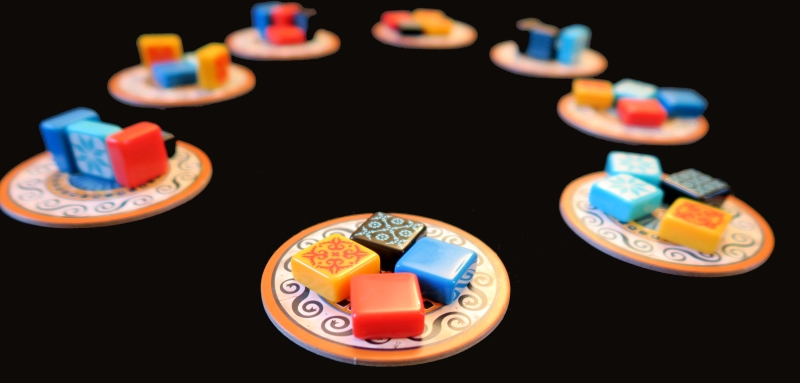
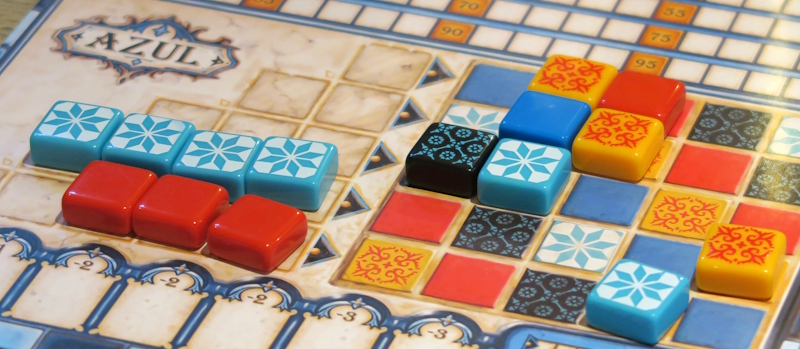
This being the summer, Lime brought LIttle Lime to join in the evening, but as there is a curfew for under-eighteens (due to licencing restrictions), the first game had to get off the mark quickly.  Together with Pink and Plum, they quickly got going with the well known favourite and Spiel des Jahres winning game, Azul.  This is known to everyone, so needed little clarification, though they group decided to use one of the alternate boards from the Crystal Mosaic expansion (the one with the cross pattern).  The game is very simple with players taking tiles of one colour from a factory and putting the remains in the centre, or taking all the tiles of one colour from the central pool.

Azul
– Image by boardGOATS

In either case, players have to add them to their conveyor and if, at the end of the round the conveyor is full, one tile is slid across to be added to the mosaic and the rest disposed of. If the added tile is isolated it scores a single point, but if placed next to other tiles, then more points are scored with larger groups scoring more points.  In this way, tiles grouped together keep scoring points.  Thus, a player who starts well can build a lot of points, which both Little Lime and Plum managed to do.  In the end, Big Lime ended the game, leaving Plum with a single point advantage—The moral of the story:  Don’t end the game too early (as Big Lime commented regretfully).

Azul
– Image by boardGOATS

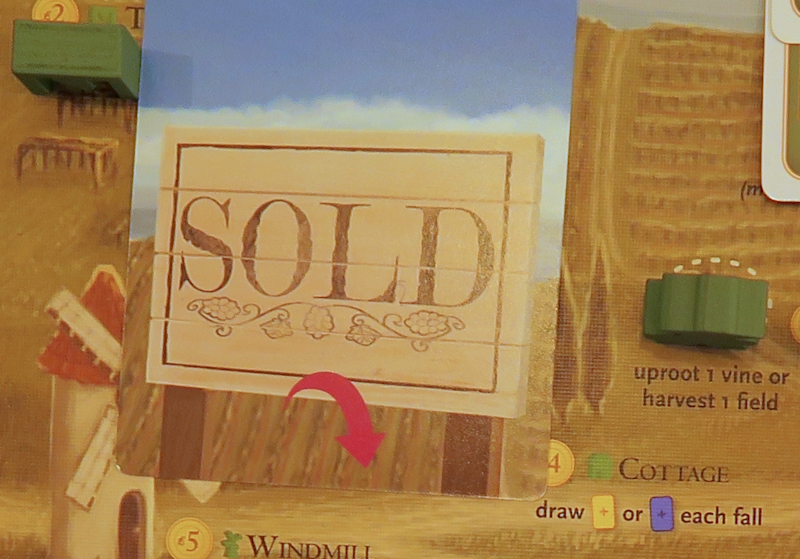
On something of a roll, the group moved on to one of Pink’s favourite quick fillers, For Sale.  Dating from the end of the last century, this game is now nearly thirty years old, but isn’t really showing its age, despite that.  The game comes in two halves:  Buying Properties at Auction, then Selling Properties by Blind Bid.  This game was really really close with a single point between Plum and Little Lime, but they were a a few points behind Big LIme who, as an accountant might be expected to perform well in a financial game.  The winner, however, was Pink, who, despite it being one of his favourite games had never won, until now.  And with that, it was time for Family Lime to head off.

For Sale
– Image by boardGOATS

Meanwhile, the rest of the group were engaged in the two tables of the “Feature Game“.  To mark the recent announcement of the Spiel des Jahres winners, this was  Looot.  Although Loot was not actually one of the winners, it, along with Faraway, had recieved a nomination for the Kennerspiel des Jahres and, as it had proved popular within the group (also like Faraway) we decided to make it the Feature.  Although its nomination was in the Expert or Connoisseur category, the game is not overly complex.  The game is played over a series of rounds where each player places one of their Viking workers—the game ends when everyone has run out of Vikings.

Looot
– Image by boardGOATS

On their turn each player places one of their Vikings on the central playerboard.  This is is made up of hexagons: the Viking must be placed on an empty space next to another Viking (of any colour).  Each hexagon gives a resource which can be used to purchase Longships, and if the Viking fulfills certain conditions, it’s owner can capture a house, Watchtower or Castle.  The player with the most points at the end of the game is the winner.  This time there were two tables playing the same game, with Black leading the first table comprising Purple, Byzantium, and Cobalt.

Looot
– Image by boardGOATS

This game turned into a a bit of a battle for Castles between Byzantium and Cobalt.  Cobalt did rather better in the end though thanks to his Long-ship bonuses.  This was because Byzantium kept revealing them and everyone else eschewed them until it came to Cobalt who snapped them up.  Byzantium’s frustration was increased somewhat because Cobalt was just before him in turn order so it looked like they miight make it round to him until they didn’t…  quite…  In the end, Cobalt’s were worth forty-two while Byzantium’s gave him just twenty-eight, despite the fact he actually had more.

Looot
– Image by boardGOATS

It was still close between them, but fairly inevitably, Cobalt had the edge finishing with one-hundred and twenty-eight, ten more than Byzantium in second place.  This was a much higher scoring game than the second table, although that was much closer.  Jade led this game with Mint, Sapphire, and Blue making up the group.  The strategies were very varied, with Jade going for Castles, Mint for Watchtowers, Sapphire for Gold, and Blue who was new to the game, going for a balanced strategy so she could change her tactics as required.

Looot
– Image by boardGOATS

In the end, Blue’s “points from everything” approach just had the edge giving her victory with eighty-eight points, two more than Mint who had one more than Jade with Sapphire close behind. With the games of Looot coming to an end at the same time as For Sale and with Family Lime heading off, the rest of the group split into two.  The first, larger group, consisted of Jade, Sapphire, Blue, Pink, Mint, Plum and Byzantium who decided to give a simple and supposedly quick little game called Tacta an outing.  This is a sort of “card placing” game where players have a hand of cards and place them on the table to cover up spots on other players’ cards.  At the end of the game, the player with the most spots visibleis the winner.

Tacta
– Image by boardGOATS

Unfortunately, game time is proportional to the number of players, so with the six players (Plum and Byzantium shared a hand and worked together), the game was always going to take twice as long as it would with three.  Worse, this was one of those games where gamers take even longer as they want to make sure the find the best placement option and push the rules boundaries.  It is a very clever little game though and a lot of fun, though perhaps playing with fewer cards or fewer players would avoid it outstaying its welcome.

Tacta
– Image by boardGOATS

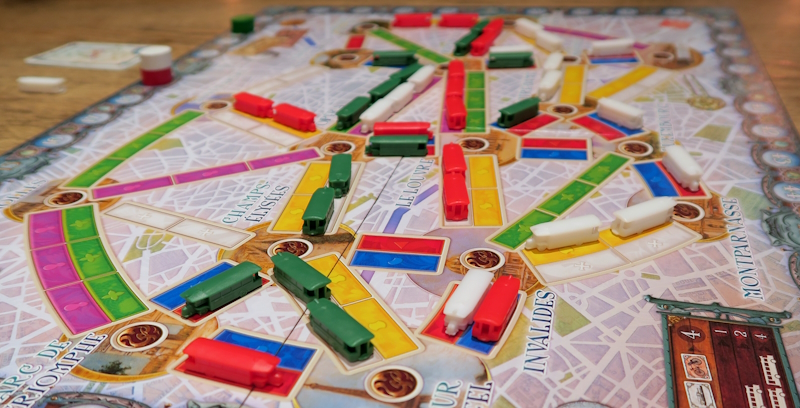
It was made worse by the fact that everyone helped everyone else and therefore, the victor was quite obvious from fairly early in the game  Although Blue made a dash to come from zero to finish in a more respectable last place, nobody looked like they were seriously going to challenge the Byzantium-Plum team.  Mint took second one point ahead of Pink who was one point ahead of Jade who was one point ahead of Sapphire.  Definitely one to try again, but with fewer people next time.  The supposed quick card game ended up finishing some time after the supposed longer game, Ticket to Ride: Paris that Black, Purple and Cobalt chose.

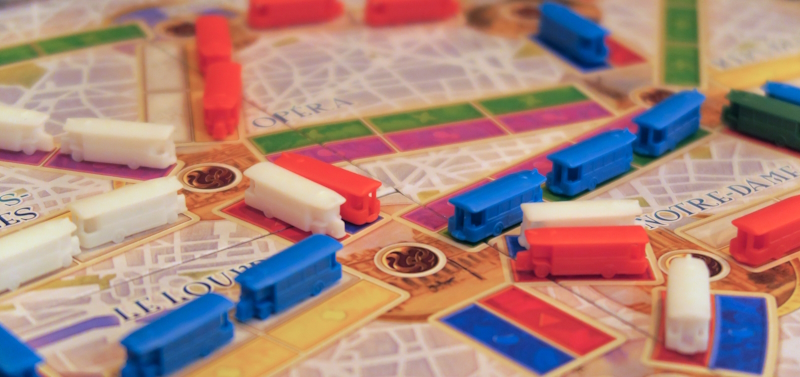
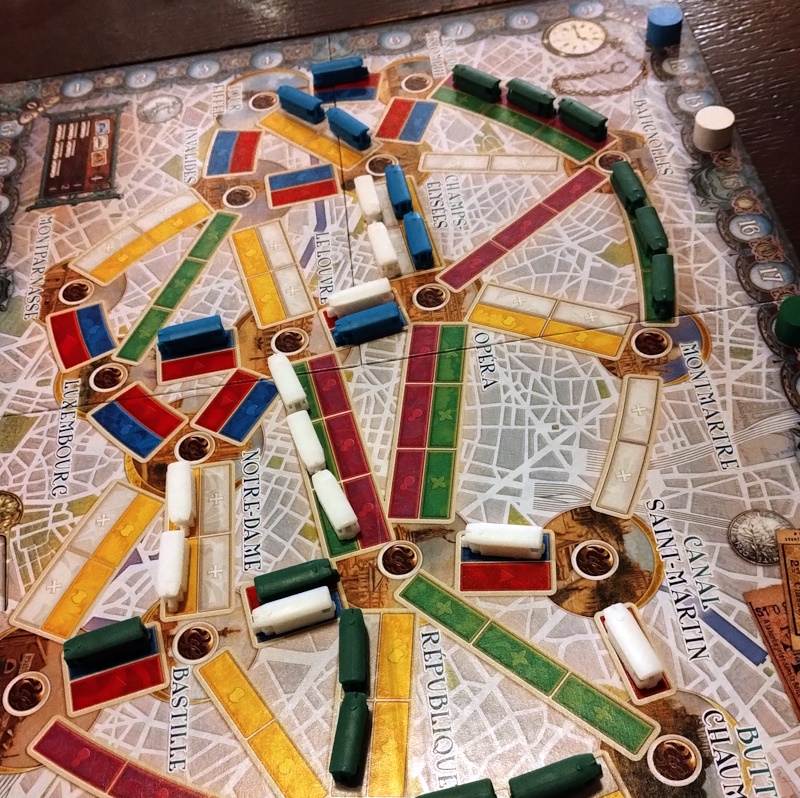
Ticket To Ride: Paris
– Image by boardGOATS

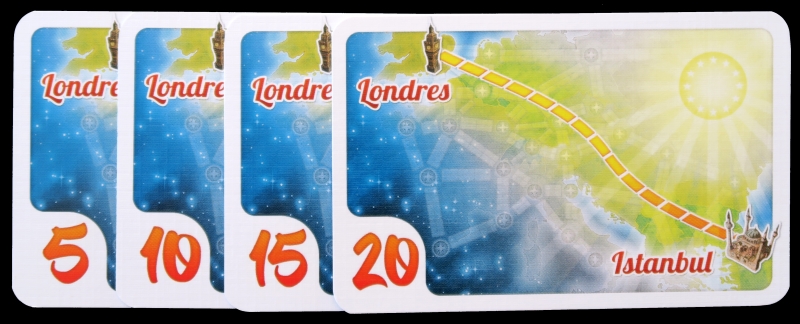
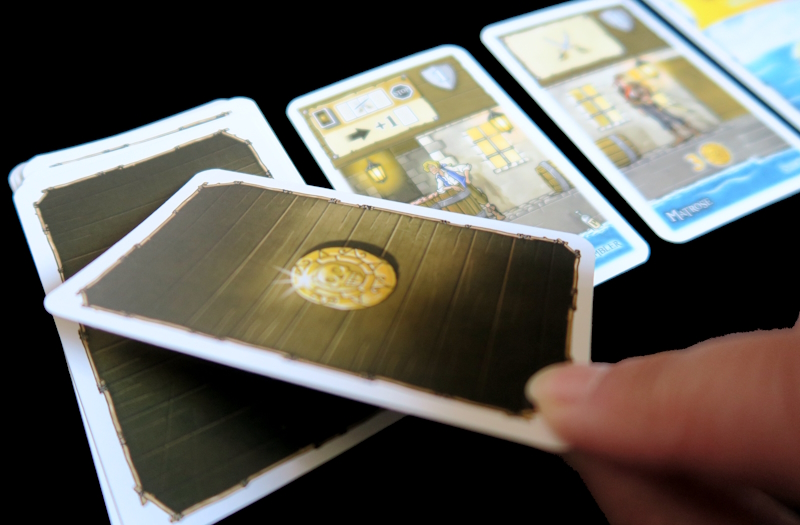
One of the small, “City Editions” of the popular, Spiel des Jahres winning Ticket to Ride games, we’ve played Paris quite a bit since it was released last year.  Following the same pattern as all its brethren, the game involves collecting coloured carriage cards and spending them to place metro carriage pieces on the board to connect regions of the city, while trying to also complete tickets.  Each edition has its own extra little rule, and in the Paris edition, this is centred on the colours of the tricolor.  When players build a red, white or blue route, they keep one of the cards, when they complete a set of three they discard the cards and claim bonus points.

Ticket To Ride: Paris
– Image by boardGOATS

Purple started and game play was rapid.  Before long, players were running out of pieces, with Blake miles ahead of the other two.  But that was without the addition of scores for Tickets. Purple took got nine points for her three completed Tickets thanks to her misplaced bravery in picking up tickets at the end and not being able to complete her last one.  Cobalt took sixteen points for completing all four of his Tickets, though that was with a bit of jiggery pokery (i.e. retaking his last turn) in order to complete one ticket when he realised he had actually failed to complete it. It was therefore perhaps fair that Black who only scored ten points for completing his pair of tickets just managed to keep his nose in front, taking victory by a single point.
Ticket To Ride: Paris
– Image by boardGOATS

Learning Outcome:  There is something for almost everyone in the Spiel des Jahres lists.

8th July 2025 (Report)

Things were late starting, largely due to the delayed arrival of Blue and Pink with their copy of the “Feature Game“, the the shiny new Emberleaf.  It was Plum’s Special Birthday—there have already been two in the last few weeks (Jade and Pine, with Black a few months ago) and more to come in the not too distant future—so there was a bit of chat, card signing and some amazing chocolate cakes provided by Sapphire.  Eventually, as time was marching on, games were assigned and Blue and Jade started to explain the rules of Emberleaf to Ivory.  This is a “card dancing” and tile placement game from the same stable as The Isle of Cats, where players are trying to re-home their kin in clearings on the central Forest board.

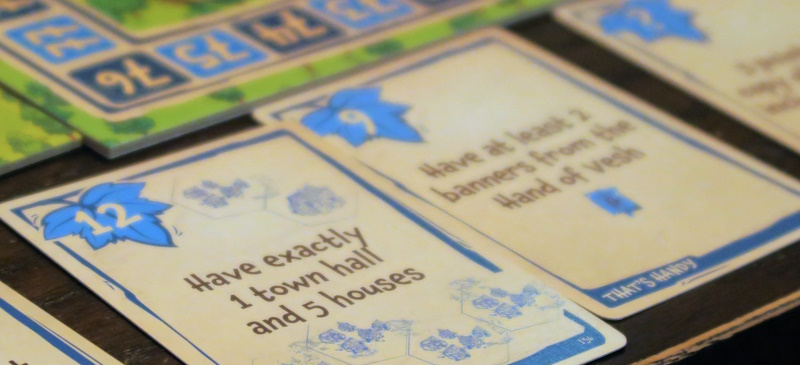
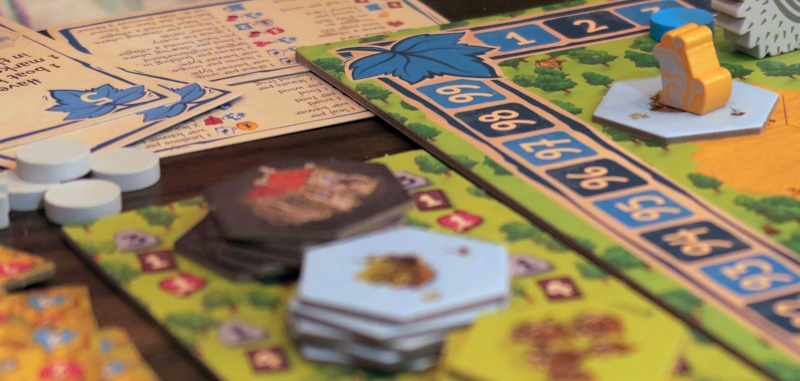
Emberleaf
– Image by boardGOATS

The core mechanic of the game is card placement and movement on the players’ individual Fellowship player boards.  The idea is that on their turn, players carry out one of two possible mandatory actions and as many optional actions as they like.  The two possible mandatory actions are Card Placement and Card Movement (or “Dancing”).  There are five different types of power on the Cards and one of these is the “On Play” action.  This takes effect when they are placed—players start with a two by six space to place cards and can place each card in any empty space.  The other possible mandatory, Card Movement involves starting with the card in the top left corner and progressing down each column, each card is moved left one space and any “Slide” actions are carried out.
Emberleaf
– Image by boardGOATS

When cards reach the left-most column, Sliding moves them off the player’s board (activating any “Drop Off” actions) and back into their hand (not via a discard pile like deck-building games, so there is no probability element; Cards as always available in hand or on the player’s Fellowship board).  The remaining two powers include “Ongoing” and “Charge”.  Ongoing powers are always active as long as the card is on the board, while Charge powers are optional actions that can only be taken a set number of times before they must be refreshed by the Card Sliding off the board.  All these actions broadly come under the categories of Gathering Resources (Wood, Stone, Turnips or Honey), Walking between clearings, Attacking monsters to make dangerous areas in the forest safe, and Building in clearings.
Emberleaf
– Image by boardGOATS

Each player has a space on their Fellowship board to place Resources, which means players have a limited number they can store.  So, for example, Building requires a card to give the action (either placed or moved) and the necessary Resources to be spent, as well their Hero figure at the clearing they are building in.  Each player starts with a super-cute Hero Figure representing their clan chief, located in Hawker’s Crossing—the most westerly clearing, on the edge of the Forest.  From there, players can move their Hero around the board by Walking along paths which go through dangerous areas.  If a player wants to travel through a dangerous area, they need to walk further or, alternatively, they can spend a turn Attacking the monsters in the Dangerous area and make it Safe (which also requires an action either by placing a Card or as part of a Card Movement).

Emberleaf
– Image by boardGOATS

As always, Ivory was on the case, and asked the key question:  Where do the points come from?  In truth, Emberleaf is a bit of a “point salad” with points coming from all sorts of places.  For example, players get points for Building with the number of points equal to the number of different types of building in a neighbourhood.  Players also get points for making Dangerous areas Safe, as well as for collecting Trophies.  There are six Trophies available during the game, and getting these is all about timing with the player who reaches the bottom of the cooperative War Banner Track taking one.  Everyone gets some benefit from this, but the player who takes the Trophy gets an extra bonus.  The game ends at the end of the round when the sixth is taken.

Emberleaf
– Image by boardGOATS

Additionally, in a similar way to the tiny buildings in Tapestry, when players take one of their twenty Emberlings from their Fellowship board and re-home them, they reveal a little bonus and some of these are points (others include Resources etc.).  There is another, more significant way of gaining points, however, and that is through Favour Cards.  These are personal objective cards which can be very lucrative and are scored at the end of the game.  Favour Cards can be acquired as part of rehoming Emberlings, but also by Promising a Favour, one of the optional actions that can be carried out as part of a player’s turn.  Each clearing starts with a Favour token in each player’s colour and if their Hero is currently located in a clearing containing one the player may spend it to take a Favour card.

Emberleaf
– Image by boardGOATS

On the surface, the game is not that complex, though building an engine requires an understanding of what the cards do and how to get the best of them.  Additional Hero cards can be taken from a Card market when a Campfire icon is revealed (likely on re-homing an Emberling).  There are a few little rules niggles as well.  For example, the Card markets (there are two:  Favour and Heros) are refreshed at the end of a player’s turn, but as well as replacing the used cards, the oldest card is also discarded meaning the order cards are drawn in has to be observed.  Similarly, whenever a the bottom of the War Banner Track is reached, the Dangerous Area tiles are refreshed.

Emberleaf
– Image by boardGOATS

Ivory, got a handle on the rules really quickly and was out of the blocks on the “B” of bang.  Jade wasn’t far behind, while Blue was much, much slower as she spent much of her time with her nose in the rules checking queries rather than focusing on her game.  When she finally got round to looking up, the others were distant figures on the horizon and she had a lot of catching up to do.  Ivory had moved quicklywith an initial strategy of building buildings on the areas that gave honey (particularly markets occupied by a mouse for his end game scoring).  This gave him additional spaces on his board and he then picked up a couple of additional Hero Cards and several Favour Cards to further drive his strategy.

Emberleaf
– Image by boardGOATS

The Koala allowed Ivory to battle anywhere whenever he “Danced”, and that gave him a steady stream of points and resources.  Jade and Blue were slow to clear the additional board actions, but Ivory found that opening up the Build Action meant he always had that available and could place a card with only “Dance Actions” at the end, giving me max benefit for that card.  Everyone tried to get end game objective cards early as they give something to aim for.  Ivory was by far the most effective at this however getting cards that gave points for having his mice on markets, mice in at least three different areas and building in exactly four areas, whereas Blue who was slower, found she was trying to take objectives that matched her achievements.

Emberleaf
– Image by boardGOATS

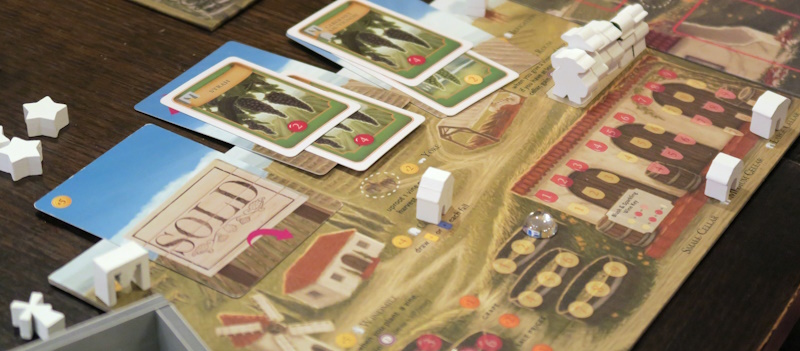
Inevitably, Ivory was the victory by a veritable country mile finshing with one-hundred and thirty-eight, though Blue who had been practically stationary for most of the game, came through strongly in the late stages to take second.  It had been a tough learning game, but everyone had liked it and it definitely deserves anothe outing.  Meanwhile, Plum, the Birthday Girl, was playing one of her favourite games, Viticulture.  This is also one of Pink’s favourites and is also very popular with both Byzantium and Mint who completed the foursome.  There is nothing really innovative about the game—it is “just a standard worker placement game”, but it does the job really, really well, which elvates it above so many other worker placement games, and as a result, it rates highly on ranks very highly on so many lists.

Viticulture
– Image by boardGOATS

The game played over several rounds, which are split into seasons—Players take it in turns to place workers on the Summer part of the board in the first half allowing them to plant grapes and prepare for Winter when players can harvest their grapes, make wine and fulfill contracts for points.  In general, each action has a small number of active spaces, but players also have a Grande worker who can always be used to carry out an action, even when all the usual spaces have been filled.  Winter and Summer are setup phases when turn-order is addressed and Visitors arrive.  Visitors are cards which allow players to bend the rules slightly and/or gain points.

Viticulture
– Image by boardGOATS

This time, however, the group decided play with the Tuscany expansion and the Moor Visitors card deck.  Tuscany replaces the main board with a larger board, but also re-structures the phases so that there are now four seasons to place workers.  It additionally adds a small map where players can place star-eeples to gain a bonus and points at the end of the game for the player with the most influence in this area.  Tuscany also brings in structures, which players can build to enhance their vinyard and use to gain more points.  It also lenghtens the game slightly, ending when a player passes twenty-five points rather than twenty in the base-game.

Tuscany
– Image by boardGOATS

Everyone knew the game well, so after just a few rules clarifications the game was underway with everyone opting for the the now standard trategy of selling a field for an early influx of cash.  Mint started with some really nice building cards including one which enabled her to harvest multiple fields at the same time.  Plum was less enthused by hers and recycled them—as she had begun the game with the Cottage she was picking up extra Visitor cards every Autumn.  She made a concious decision not to choose to “wake up” first, which meant she never went first or last in the turn order and when she chose the start bonus of “age grapes” she forgot to take advantage of it.  This was clearly catching as Byzantium did something similar when he chose the same starting position.

Viticulture
– Image by boardGOATS

The Tuscany expansion also adds Special Workers which have their own special abilities and players can train one of their workers to have each of these.  This time they were the Farmer and the Builder, with the latter from the Special Workers promo.  Respecively, workers with these powers, allow the player to choose a bonus (even if they are not on a bonus space) and save two lira when building.  A priority is always to get more workers early in the game, but whether to upgrade them is a difficult decision as it costs an extra lira and cash is always so tight in this game.  These proved quite popular though as going second in a location with a Farmer still gave a bonus.

Tuscany
– Image by boardGOATS

Pink got his head down making wine early as he picked up two really nice, achievable and valuable contracts early in the game, which gave him a solid start.  However, it was a very long time before anyone actually really started scoring points as everyone concentrated on building their vinyards before putting them into action.  For example, Plum, needed a Trellis for her first grapes, although having a Builder reduced its cost.  Eventually she also built a Penthouse which gave an extra point when making high quality wine over a value of seven and with those in place was in a position to start growing, harvesting and turning grapes into wine.

Tuscany
– Image by boardGOATS

At one point, Plum played a two Visitor card combo that gaver her a grape which she was immediately able to sell at tripple the normal price.  Otherwise, everyone mostly focussed on turning grapes into wine and completing contracts for points, although Pink did turn cash into points as well.  As is always the way with Viticulture, there was a sudden cascade of points, and with four experienced players it was a tight game with all four finishing over the twenty-five point finishing line.  The winner was Pink, however, who finished with thirty one points, three more than Plum who took second (no, Pink wasn’t going to let her win, even on her birthday!), and Byzantium and Mint tied and shared the last spot on the podium.

Tuscany
– Image by boardGOATS

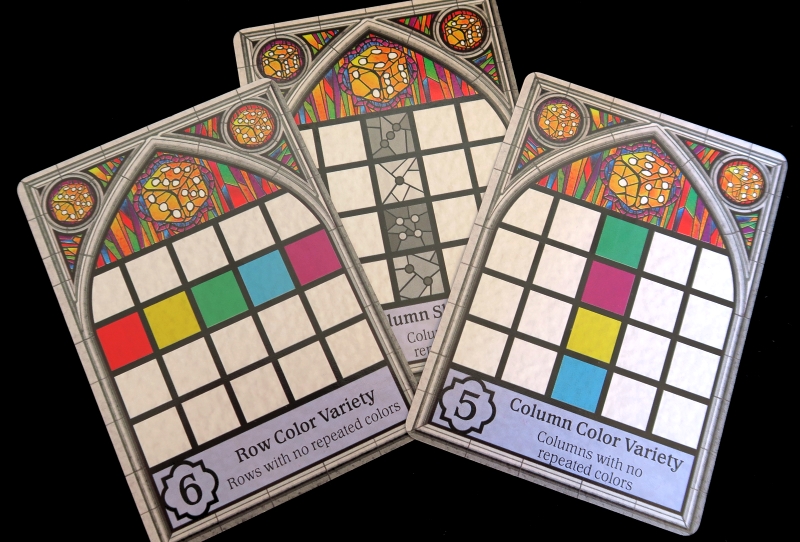
The third table, comprising Black, Purple, Pine, Sapphire and Lime, started with a game of Sagrada (with the 5-6 player expansion).  This is a fairly simple game of dice-drafting, where players are placing dice to create stained glass windows.  Dealt at random, each player begins with a private objective card and two double-sided Window pattern cards, choosing one side to play with and taking the number of Favor tokens marked on the chosen pattern.  Three Tool cards and three public objective cards are placed in the communal central area and the first player rolls all the dice.

Sagrada
– Image by boardGOATS

In “serpentine order” (i.e everyone taking a turn in order then taking a turn in reverse player order), players can use any Tool card (paying one Favour token for the first use, two thereafter) and then choose one die from the pool and place it on an open space in their Window.  The first die must be placed on an edge or corner space and every other must touch another die diagonally or orthogonally.  Dies must match the colour or value depicted on the space if there is one and may never be orthogonally adjacent to a die of same color or value.  Players may choose not to take a die on their turn, but that will leave an empty space and each one costs a point at the end of the game.

Sagrada
– Image by boardGOATS

The game ends after each player has had twenty turns after which players score points for each public and private objective achieved adding one point for each remaining Favour token and and deducting a penalty point for each empty space.  Even though there were five, the group played by these standard rules rather than adding the optional private dice pools from the expansion.  The communal goal cards gave points for placing pairs of dice with a value of three and four; sets of dice with a value of one to six and rows with no repeated numbers.  As is always the case with dice games, this game is all about riding the luck of the roll, but it can play havoc with people’s plans.

Sagrada
– Image by boardGOATS

For example, on Pine’s first turn a roller six of the dice had a value of two, but nobody wanted them.  Later in the game he rolled again, this time rolling no twos when at least two people desperately wanted them!  When the game came to an end, there was just the scoring.  Honours were pretty much even for the first two communal objectives.  Purple managed to score once for the lucrative, one row without repeated numbers objective, while Sapphire and Black scored it twice and Pine three times.  Scores for the private objectives were almost identical for Sapphire, Lime and Pine.  In total that gave Pine victory, nine points ahead of Sapphire in second and sixteen ahead of Black in third.

Sagrada
– Image by boardGOATS

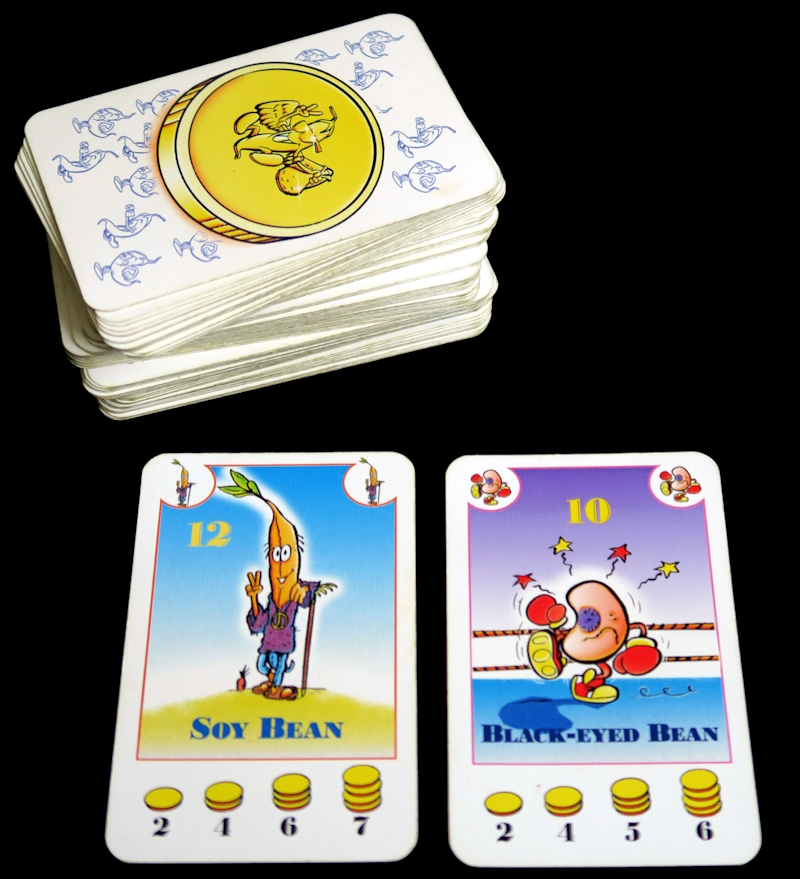
The other games were still going and looking like they were giong to take the rest of the evening, so the group looked around for another game that played five.  From the other side of the room Blue suggested Bohnanza, and as Sapphire thought he’d never played it, the group decided that wasn’t a state of affairs that could continue.  This is a popular game within the group as it is a lot of fun, even though a game about bean farming and trading sounds very unpromising.  Played with cards, the key mechanism is that the order of players’ hands cannot be changed—they can only be manipulated by in-game play.  So, on their turn, players must play the first card in their hand into one of their two “Bean Fields”, and may play a second if they can.

Bohnanza
– Image by boardGOATS

Beans can only be added to empty fields or to fields of the same type.  A field can be harvested at any point, but the aim it to maximise the yield.  Once the active player has played from their hand, there is the flop: two cards are played from the deck onto the table.  These must be planted before the next phase, but can be planted in the active player or by any player with their agreement.  Sometimes these are gifted, sometimes they are traded, and this is how players can manipulate the cards in their hand, by trading away undesirable cards.  Once the cards on the table have been disposed of, then the active player can trade any card in hand before replenishing from the deck to end their turn.
Bohnanza
– Image by boardGOATS

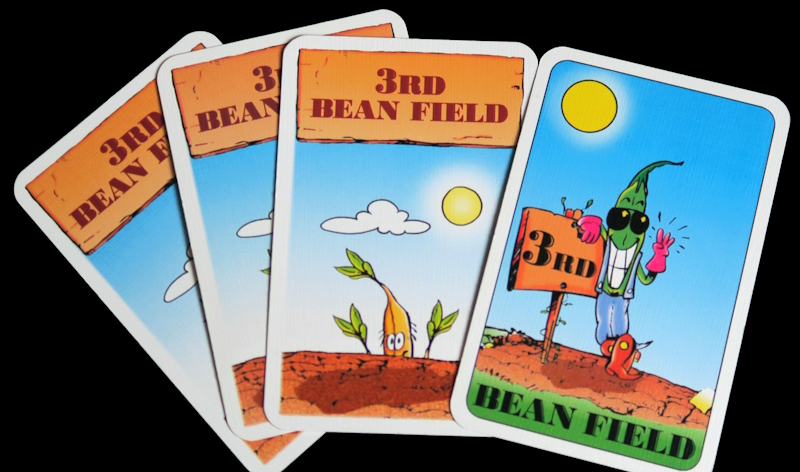
The game ends after three passes threough the deck, but while the first pass seems to take forever, the last always goes like lightening because many of the cards are now in players’ score piles.  Further the balance of the cards changes as the game progresses, with rare cards disappearing as they are turned into “Thaler” and get stuck in players’ stash.  Players can spend some of their riches on a Third Bean Field, but this is only really productive if carried out early in the game.  This was a strategy adopted by Pine this time—unusually for him.

Bohnanza
– Image by boardGOATS

It paid off almost imediately as Pine collected two of the super-rare cocoa beans, and soon added a third.  Black commented that he’d get the fourth, and Pine couldn’t hide his delighted laugh when he immediatly picked it up!  The winner was Lime though who finished three points clear with twenty, leaving Pine to take second and Black to make up the podium.  The question was, however, had Sapphire enjoyed it?  Sadly, the answer was a resounding “no”.  Worse, it turned out that he had played it before, and had disliked it so much that he’d blocked out the experience.  Such a shame, but some games are not for everyone…

Bohnanza
– Image by boardGOATS

Learning outcome:  You don’t have to know how you win, you just have to score more points.

24th June 2025 (Report)

The evening began quietly and for a while Blue, Purple and Black wondered whether they were going to be the only ones and had got the wrong week, but before long, people trickled in.  The hot weather seemed to have sapped a lot of the enthusiasm from everyone, but eventually, two groups began playing Port Royal. This is a fairly simple “Push-your-Luck” game where players are merchants in the Caribbean.  It has an interesting history as it was originally released by the Österreichisches Spiele Museum, the Austrian Games Museum as Händler der Karibik (Traders of the Caribbean).

Port Royal
– Image by boardGOATS

When it won the Austrian Game Designers Competition, the game was taken up by the publisher Pegasus Spiel in 2014, who added a few cards and tweaked the rules including adding a few cards so it works with five players.  The artwork didn’t change significantly though, that happened much more recently, in 2022, when Pegasus brought out a Big Box edition which included both the Contracts and Campaign expansions, the Gambler promo and the lighter “expandalone” Unterwegs game.  This time both the 2014 version and the Big Box edition got an outing, with Jade leading Lime, Ivory and Mint with the new edition, while Plum set up the older game in a much smaller box with Sapphire, Black and Flint.
Port Royal
– Image by boardGOATS

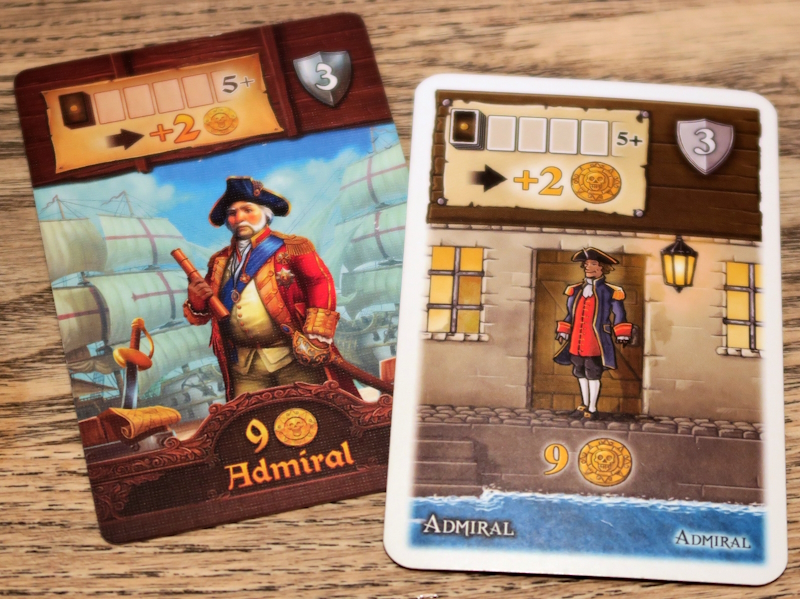
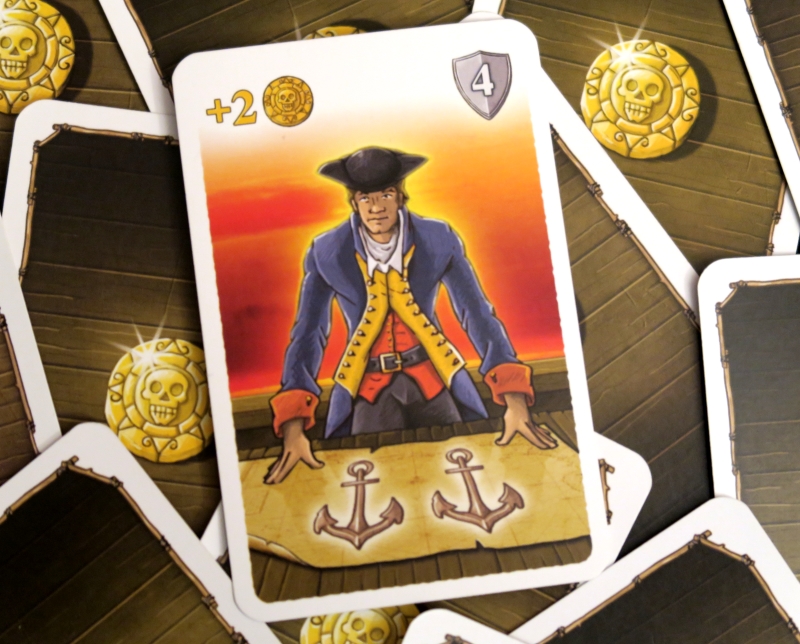
The basic game is quite simple:  players draw cards, as many cards as they like until they choose to stop and take cards, or go bust by drawing a second Ship card of one colour.   There are four different types of cards, but most are Ships or Characters.  Ships come in different five colours and are worth Doubloons (like San Juan and Bohnanza, these are just cards that are stored face down to show the Coin on the reverse), whereas Characters generally give some sort of on-going power, are worth Points, and are paid for with Doubloons.  Some of the Character cards (Pirates and Sailors) provide Cutlasses, which enable players to repel Ship cards that they don’t like, thus extending the number of opportunities to draw cards without going bust.
Port Royal
– Image by boardGOATS

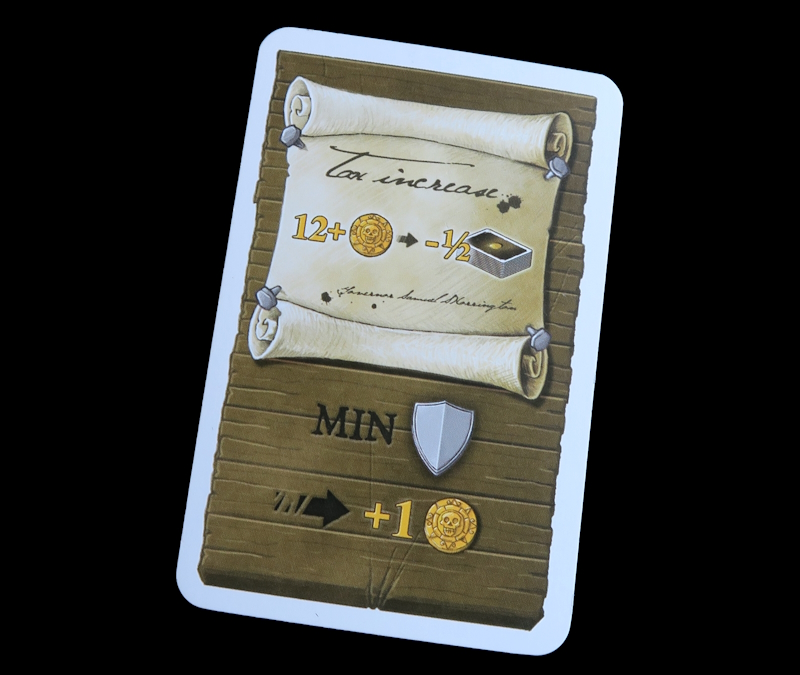
In addition to Ships and Characters, there are also two other types of cards in the deck:  Expedition and Tax cards.  Expedition cards, once drawn are placed in the centre to become communal objectives that give points, but once achieved by one player they are gone.  In general, these involve collecting symbols shown on some of the cheaper Character cards.  There are two Tax cards in the deck, and when one is drawn anybody with twelve or more Doubloons has to discard half their cash.  Additionally, depending on which card, either the player with the fewest Points gains or the player with the most Cutlasses gains one Doubloon.

Port Royal
– Image by boardGOATS

So, players draw and reveal cards until they go bust or decide to stop and take cards.  The player can stop whenever they like, then take one card if there are three or fewer Ships in the Harbor display, take two cards if four ships are present, and three cards if five ships (one of each of the five colours) are present.  Thematically, players either rob Ships (collecting the number of Doubloons depicted, then discarding the card) or hire Characters, paying from their stash.  The game ends when one player has at least twelve Points, and the round is completed before scoring—the player with the most points is the winner.

Port Royal
– Image by boardGOATS

The Ein Auftrag geht noch expansion (aka Just One More Contract…) adds solo and cooperative modes, but aside from these it doesn’t change the game significantly, just adding a handful of cards and an alternative mechanism to gain Doubloons and score points.  The new game element is “Contracts”, which provide additional ways to score victory points and get coins by meeting the listed conditions.  At the start of the game, each player gets three tokens and four Contracts are revealed.  If a player meets the requirements of a Contract at any time (including not on someone else’s turn) they can place one of their cubes on the leftmost spot on the contract taking the financial benefit.

Port Royal: Ein Auftrag geht noch...
– Image by boardGOATS

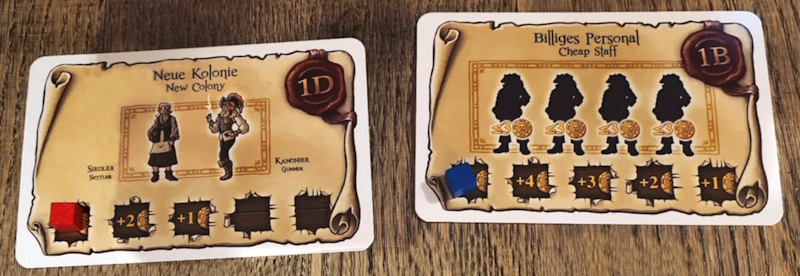
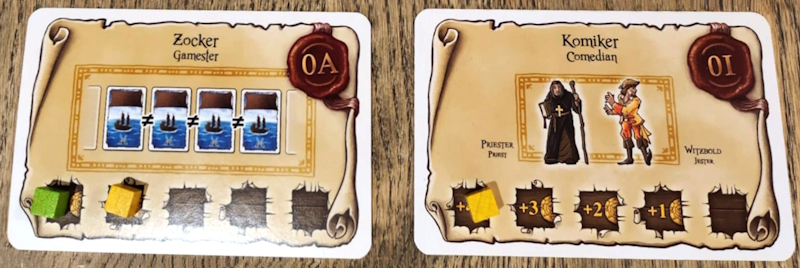
This reward decreases each time the Contract is subsequently completed.  When the player completes their second contract they additionally receive one point taking a Contract card from the unused stack and keeping it face down to display the Point shown on the reverse.  On completing their third Contract, players receive the financial reward and two additional Points.  Plum led one group, comprising Sapphire, Black and Flint.  The contracts they draw out were New Colony, Comedian, Cheap Staff, and Gamester.  New Colony and Comedian required a a specific pair of Character cards (Settler/Gunner and Priest/Jester respectively), while Cheap Staff needed four Characters with a cost of three or less.

Port Royal: Ein Auftrag geht noch...
– Image by boardGOATS

The Gamester Contract was a bit different as it was based on Ships, and could be claimed by the active player as soon as there were four of different coloured Ships in the Harbour at the same time.  Early in the game, Plum and Flint claimed a Gunner, while Flint added and a Clerk from the expansion and Black took an Admiral.  The Gunner and the Admiral provide benefits if conditions are met just before they take a card, respectively giving money if there are multiple ships available or two extra coins if there are more than five cards in the Harbour display.  The Clerk gives the owner the option to take a second card if they take a ship of the right colour from the Harbour.

Port Royal
– Image by boardGOATS

Sapphire took a slightly different approach.  He collected Traders, getting one of each colour which meant that whenever he took a ship, whatever the colour, he always got an extra coin and together with his Vice Admiral (who gave an extra coin coin if there were three or four cards in the Harbour on his turn) meant he always had plenty of cash.  Plum was the first to complete an expedition, the Gamester, but everyone completed one, although Black managed a second.  Black, Plum, and Flint also completed an expedition giving more points, but the winner was Flint who finished with thirteen points while Plum and Black tied for second.

Port Royal
– Image by boardGOATS

Elsewhere, there was a second game of Port Royal underway with Lime, Ivory and Mint, led by Jade.  This group were playing with the 2022 Big Box editionwith the new artwork that includes both expansions. However, as they were playing with people who were new to the game, they chose to stick to the base game and spent a lot of time at the star sorting out cards.  Once they got going a lot of hilarity ensued, particularly when Lime, who desperately needed some cash turned over twenty cards in succession without a single ship!  The victor was Mint, however, with Jade and Ivory tying for second.

Port Royal
– Image by boardGOATS

They had enjoyed it so much and with time left, the decided to “do a Lime” and give it another go.  This time, the winners were tied with Ivory and Mint both finishing with twelve just ahead of Lime in third.  With the winners tied, there was more interest in what the tie-breaker was.  Both also had the same amount of money and the rules state that in such cases victory is shared.  However, according to the rules there is a end of game variant which requires the winner to have an Expedition card.  As Ivory had completed an Expedition and Mint had not that was assumed to be the tie breaker leaving Ivory the victor.

Port Royal
– Image by boardGOATS

Meanwhile, Blue and Purple introduced Ruby to Little Town, another popular game within the group, but this time, one with much less luck.  It is a fairly simple little worker placement and tile laying game based on a central board.  The idea is that players have five workers and on their turn players can place them on the terrain area and activate the space, or in the build area and place a building on the board paying the costs and placing an ownership marker on it.  When activating a space, players also activate the eight surrounding spaces.  Some of these will be spaces printed on the board which allow players to collect resources (Wood, Stone or Fish), while others might be buildings tiles placed, by themselves or one of the other players.

Little Town
– Image by boardGOATS

Players musty pay to use other players’ buildings, only one coin, but coins can be difficult to acquire.  Players get points during the game by activating some buildings, lose points if they are unable to feed their workers.  They also start with three personal objective cards which are scored as and when they are achieved.  At the end of the game, after four rounds (just twenty actions per player), the player with the most points is the winner.  The first draw of tiles included three from the Goodie Building promo set, but as the rules for these had gone walk-about, two were thrown back and re-drawn.  Blue explained the rules, and then Purple started unfortunately, this meant that Ruby going last had fewer good placement options, and worse, was the only player to go last twice during the game.

Little Town
– Image by boardGOATS

Both Blue and Purple offered what help and advice they could they could and all three players were pretty much dead level for the first couple of rounds. Cash is often hard to come by in this game, but this time with the Gold Mine present, which was built early by Purple, there was enough to grease the wheels and keep the game moving.  In addition to the Goldmine, other buildings included the Fishmonger which Ruby built and enabled players to sell fish, getting money.  Blue began by building a little fish engine with a Pier and a Sushi Bar (from the Goodie Buildings) placed near a Lake, then Purple widdled on her bonfire a little, by turning one of the neighbouring spaces into a Wheat Field.  Even so, with just two turns she could gain Fish and turn them into a total of six points, picking up a bit of Wood and some Wheat (at a cost of one coin) on the way.

Little Town
– Image by boardGOATS

It had been back and forth between Blue and Ruby until Blue nabbed the Statue from under Ruby’s nose giving her a straight ten points.  That forced Ruby to switch tack and build the Church which allows players to convert Cash into points.  Although there wasn’t really time to activate it more than once, it was also worth eight points in its own right.  All three players managed to complete their Objectives, even Purple who had some tough ones.  Before the game, Purple had made a comment, that nobody would need the Sixty Point Token, but as the end of the final round approached it looked like both Blue and Ruby might actually manage it.  In the end, it was close, but Blue just managed it finishing with sixty-four, while Ruby didn’t quite make it in second place.

Little Town
– Image by boardGOATS

Learning outcome:  Popular games are popular for a reason.

10th June 2025 (Report)

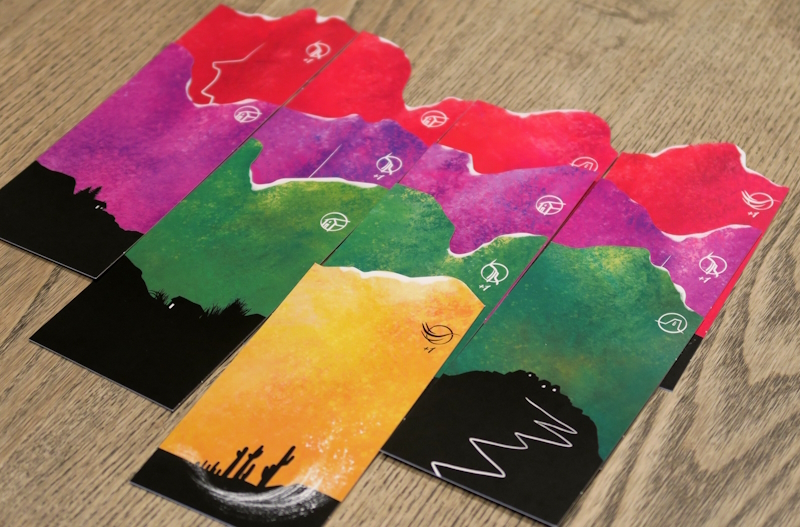
The evening started with a lot of chat about the new and used games people had picked up at UK Games Expo a few days ago, with everyone very keen to play their new acquisitions.  The “Feature Game” was to be one of these, a a shiny new pre-release copy of Sierra, flown in specially for the fair by a chap from Hachette Boardgames UK called Flavien Loisier who was recognisable by his memorable, playable, MicroMacro suit.  Sierra is card game about traveling the Andes that received a UK preview at UK Games Expo, and is a very unusual game.  There are several different ways to play the game including cooperatively and competitively, but this time the group went with working in pairs, playing with the person opposite.

Sierra
– Image by boardGOATS

The pairs were Jade & Sapphire, Blue & Ivory, Black & Byzantium, and Purple & Plum.  The idea is that in their pairs players place cards from their shared hand to create a landscape and earn points for satisfying their objectives.  The catch is that while the Landscape cards are shared, all but one of the objectives are not.  In each round, the player with the Landscape cards draws two and plays two, while the other player draws two Objective cards and keeps one for themselves.  At the end of the round, the player with the Landscape cards passes them onto the next couple and the player who drew the Objective cards receives two Landscape cards—thus, the roles are swapped over for the next round.

Sierra
– Image by boardGOATS

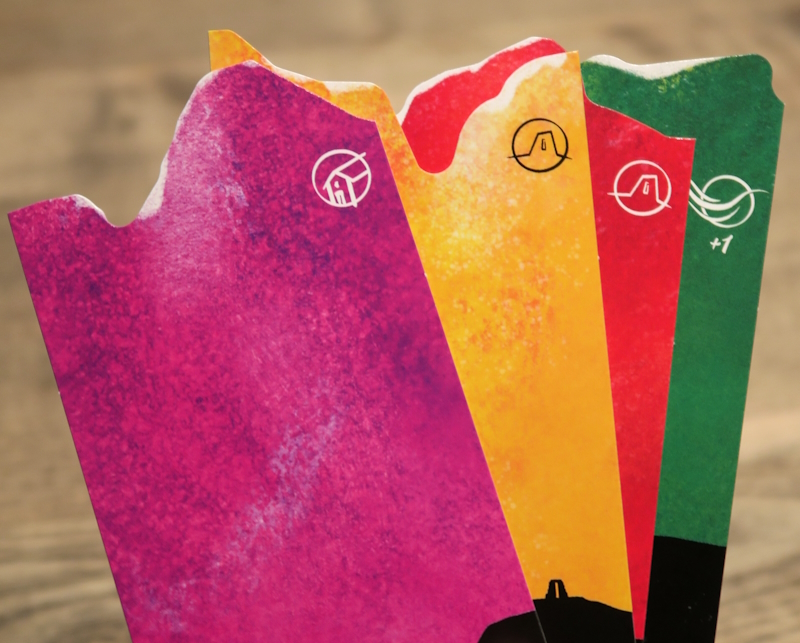
The Landscape cards come in four different colours and can be placed at either end so that the colours match, or they can start a new row.  The tops of the cards makes them look like mountain ranges, the cards form an interesting tableau.  As well as the colour, each card also has one of six symbols: Mammals, Birds, Houses, Ruins, Rivers and Wind—these are used for scoring.  After eight rounds each player will have four Objective cards and each pair’s shared Landscape will contain sixteen Landscape cards.  The game play was very different with so many players and playing in pairs.  The cards and the Landscapes the formed were beautiful.  Everyone who was new to the game started feeling their way somewhat, but eight rounds doesn’t last long and it was all over really very quickly.

Sierra
– Image by boardGOATS

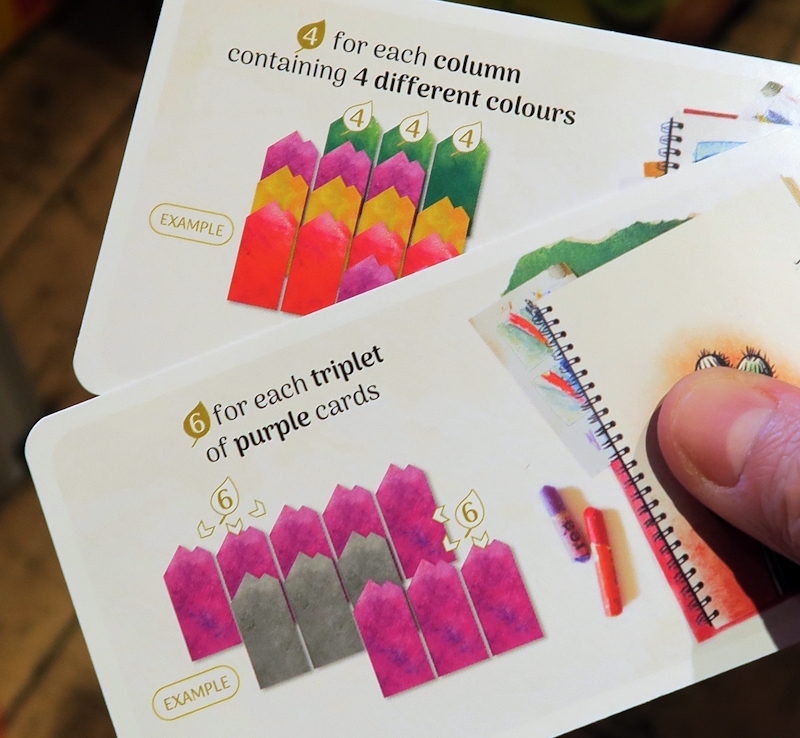
The scoring turned out to be a little quirky and in the end took almost as long as the game.  Each player then scores one point for each River and Wind cards in their shared Landscape and scores for their shared Objective.  Players then count the number of points they have earned  for their individual objectives.  The player with the highest total wins, however, the partner of the player with the largest total receives a bonus of five points If, with this bonus, the partner has more points than anyone else, then the pair win as a team.  This time, Blue and Ivory scored the most for their shared Landscape.  Individually though, it was a tie between Plum and Ivory  as Plum scored much more for her personal Objectives (as indeed did Purple).

Sierra
– Image by boardGOATS

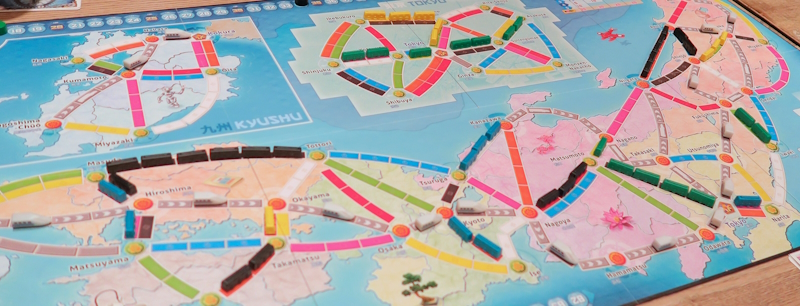
Because the individual winner was tied, there were no “team bonuses” awarded, which left the scoring feeling a little unsatisfying somehow and nobody fancied playing again straight away.  Instead, the group split into two groups with Ivory, Sapphire, Jade and Blue deciding to squeeze in a quick game of Ticket to Ride with the Japan map.  This had an outing fairly recently (when Pink hilariously took a fifty point hit when Purple played a single train claiming the route from Hiroshima to Okayama and blocked all his Tickets), but all the people involved in that game were elsewhere.

Ticket to Ride Map Collection: Volume 7 – Japan & Italy
– Image by boardGOATS

The Japan map is played exactly the same way as all the other versions of Ticket to Ride (i.e. take cards from the market or spend them to place trains in order to fulfill Tickets), but on a map of Japan and with the addition of the Shinkansen or “Bullet Train”.  Once a player has completed a section of Bullet Train, any player can use it to complete Tickets, but the player who completed that section moves along the Bullet Train Track. At the end of the game, the player who progressed the furthest, who contributed the most to this shared project receives the largest bonus, with the player who contributed least being penalised.

Ticket to Ride Map Collection: Volume 7 – Japan & Italy
– Image by boardGOATS

This time, everyone went for the Bullet Train early, so much so that there was quite a battle and by the time Sapphire realised what was going on, it was too late and he was left with the penalty.  That forced him to switch tack however, which might actually have done him a favour as he left Blue and Ivory to fight for the biggest, twenty-point bonus.  It was all really tight, but Sapphire was some way out in front as the Shinkansen points were evaluated.  And despite picking up a five point penalty, there he stayed to claim victory—Ivory who finished in third, pipped Blue on the Bullet Track, leaving her runner up with an eight point deficit (instead of a two point lead).

Ticket to Ride Map Collection: Volume 7 – Japan & Italy
– Image by boardGOATS

The other half of the Sierra group had moved on to play another game picked up at UK Games Expo, Tegula.  This is a very beautiful game played with beech wood hexagonal tiles with artwork based on Roman mosaics.  The idea is that players have to match the edges in order to place them.  Players can use actions to swap tiles, give tiles or play extra tiles and the first player to run out is the winner.  This time that was Black, with Purple the best of the rest (i.e. the player with the fewest tiles left, and Plum and Byzantium tied for third.

Tegula
– Image by boardGOATS

Meanwhile, Mint had also brought her new acquisition from the UK Games Expo, Intarsia, and taught it to Pink and Pine.  Although this had a most uninspiring box cover and the uninteresting theme of polishing wooden floors, the game itself is really pretty and fun to play.  Like Tegula, it is also made out of wood, the game is played over three rounds with eacvh round comprising three phases. First, each player takes the ten Material Cards depicted on their Starting Hand Card from the general supply. Players then take it in turns placing wooden elements onto their Flood Boards by paying the necessary Material Cards and taking new ones where possible and claiming and scoring Tool Tiles when their requirements are complete.

Intarsia
– Image by boardGOATS

Finally, players score points based on the number of connectors they’ve placed and choose a new Starting Hand Card to begin the next round. At the end of the game, players calculate their scores for the number of intarsias they’ve built and add them to their running total and the winner is the player with the most points.  The game was very tight… for second place!  In the end Pine pipped Pink’s ninety by a single point, but Mint took victory by a bit of a landslide with a hundred and eight, as she had four intarsias, compared with three and two for the others.  It had been a very enjoyable, lovely tactile game though and that hadn’t out-stayed its welcome.

Intarsia
– Image by boardGOATS

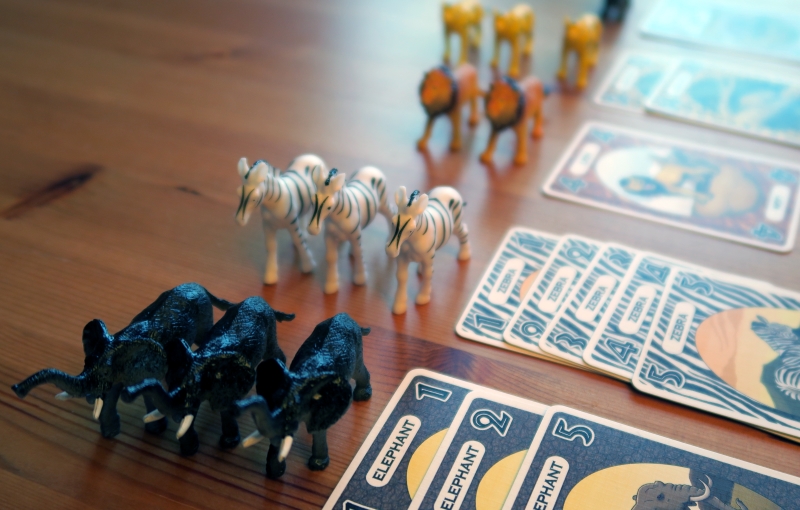
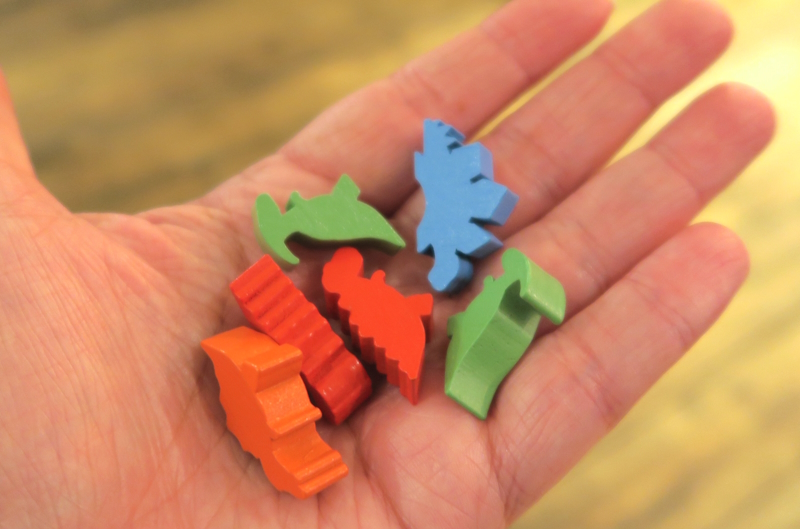
With the floor duly polished, the trio moved on to introduce Mint to the weird and wonderful game that is Botswana.  This is a sort of stocks and shares game played with cards and plastic animals.  Players start with a hand of cards and, on their turn, choose one to play taking a plastic animal of their choice from the central supply to add to their holding.  At the end of the game, each player scores for each animal with points equal to the total number of animals of the type they hold, multiplied by the face value of the last card of that type that was played.  Thus a player with five elephants might be scoring twenty-five points until another player replaces the “Five of Elephants” with a zero and crashes their value.

Botswana
– Image by boardGOATS

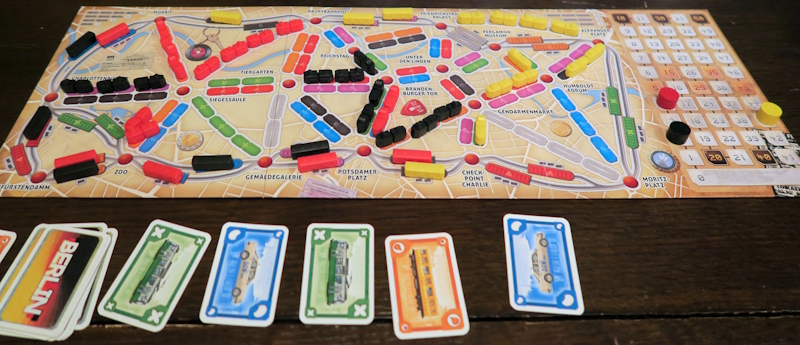
This game went down to the wire, but Pine just got his nose in front, with twenty points for his lions and fifteen for his rhinos giving him a total of thirty-five, on point more than Mint, while Pink finished a few points behind that.  There was just time for another very quick game and the game they chose was Ticket to Ride: Berlin—one of the city versions of Ticket to Ride.  These are much quicker to play, but still follow the same collect cards and spend them to place pieces in order to complete Tickets pattern. However, in Berlin, players have two different kinds of train car to place—trams and U-bahn trains.  On the board, there are specific single-space routes that can only be filled using an U-bahn train.

Ticket to Ride: Berlin
– Image by boardGOATS

The number of coloured cards required to complete the U-bahn is indicated on the game board (up to three), but similar to the Bullet Train in Japan, players only ever place one piece on than U-bahn route. Players only have a total of five U-bahn carriages to work with and their placement is critical, which makes Berlin one of the more interesting of the city games.  Once again, this was a close game with everyone using all their pieces.  Pink was the victor however, beating Pine into second by two points, but that meant that all three of them had won a game, so everyone went home basking in the warm glow of success.

Flavien Loisier
– Image from facebook.com
adapted by boardGOATS

Learning Outcome:  You can get some great games from UK Games Expo.

27th May 2025 (Report)

This week, Jade was proactive and quickly got a group together to play the “Feature Game“, which was to be Flip 7.  This is a quick, push-your-luck card game along the lines of Blackjack and recently won a Golden Geek award and received a nomination for the Spiel des Jahres.  The group have already played it a couple of times on a Tuesday, but we wanted to raise its profile and share it more widely amongst our people by making it the Feature Game.  The idea is really simple:  players turn over cards and gamble on not revealing the same number twice.  Unlike Blackjack, the game is played turn-wise, so the the dealer starts by dealing one card to each player.  Then players take it in turns to decide whether they want to “flip” or ” stick”.

Flip 7
– Image by boardGOATS

This mode of play is critical to the game’s popularity because it keeps everyone involved and the turns short. If players stick, they score the total of the face value of their cards.  There are a couple of other things that make the game tick, in particular the fact that each numbered card appears in the deck that number of times (i.e there is one one, two twos and so on).  Thus, the highest scoring cards are also the most risky.  Further driving push to gample, flipping over seven cards in a row gives fifteen bonus points.  There are also some action cards in the deck, “Flip Three”, “Freeze”, “Second Chance” and modifier cards which give extra points, all of which break the rhythm and add interest without adding significantly to the downtime.

Flip 7
– Image by boardGOATS

The game ends when players have reached the pre-agreed total (two hundred, according to the rules, though games can easily be made longer or shorter as desired).  This time, the group played the game as written, to a total of two hundred, which took seven rounds.  Sapphire  and Flint managed to go bust five and six and seven rounds respectively, though Flint did manage to push his luck to get seventy—the most in a single round.   Jade achieved a new low, however, failing to score at all.  The front runner was Teal, but going bust in the sixth round left the door open to Ruby who had been matching him step for step, scoring in every round and triggering the end of the game with her unsurpassed two-hundred and thirteen.

Flip 7
– Image by boardGOATS

Everyone else was playing a longer game, so with six, that left the choice of another six player game or splitting into two groups of three.  The party feel of Flip 7 had got everyone in the mood for playing in a larger group, leaving a fairly limited choice, though there are a couple of really good options.  Bohnanza is one, but instead, the group chose Faraway—another game that received a Spiel des Jahres nomination this year, that we first played in the group over a year ago and has proved very popular since.  This is another relatively simple game, this time  with a market and a trick-taking type element, but with a really clever twist, and one that really messes with the head.

Faraway
– Image by boardGOATS

The story is that players are exploring the mysterious land of Alula in search of its secrets, meeting its inhabitants and listing its wonders in order to gain more fame than everyone else.  Players simultaneously chose one of the numbered cards from their hand to add to their tableau then, starting with the the player that played the lowest card (similar to 6 Nimmt! or Kingdomino), everyone takes it in turns to choose one from the market to add to their hand.  Players then simultaneously choose another card to play, and again, choose one to add to their hand.  The game ends after everyone has played a total of eight cards, and then everyone scores.

Faraway
– Image by boardGOATS

The scoring is the really clever part, because although the cards are played into tableaux from left to right, the scoring is from right to left.  At first glance, this looks like it makes things easy, because early in the game players find out what they need to get points and can then focus on getting the resources they need as the game progresses.  However, the desire to play scoring cards early is tensioned against card choice (the player who placed the lowest numbered card goes first) and the ability to get Sanctuary bonus cards.  Scoring cards are generally higher number and Sanctuary cards are gained when the card played has a higher value than the previous one in their tableau.

Faraway
– Image by boardGOATS

It is always hard to see how players are doing with this game, because if a player has played a high value scoring card early it can be worth a lot, but if the player fails to gain the necessary resources it can be worthless.  In the event, it was quite close with four of the six players scoring over sixty.  The winner, however, was Pink who got lucky early when he played card number fifty-nine first to start a map strategy and finished with five of them.  Sapphire was only two points behind in second though, and Teal two points behind that.

Faraway
– Image by boardGOATS

Meanwhile, on the other side of the room, Black and Purple were introducing Pine to Looot, another game that received a nomination, this time for Kennerspiel des Jahres, the “Expert” or “Connoisseur’s” game.  This is a game where players gather resources and capture buildings to develop their fjord, fill their Long Ships and complete buildings to rack up victory points. The player with the most riches is crowned Jarl of the Vikings.  The game is played over several rounds until each player has played all their Vikings, giving a maximum of thirteen turns.  In each, a player first places their Viking on a Resource tile on the central board adjacent to another Viking of any colour and takes the Resource and place it on their personal board.

Looot
– Image by boardGOATS

If possible, they then capture a Building and place that on their board, take a Long Ship and also place it on their board, use a Shield, complete a Construction Site and finally grab a Trophy.  At the end of the game, scoring is a bit of a point salad with points awarded for Castles, Watchtowers, Houses, Gold, Sheep, Trees, Construction Sites, any Trophies the player may have claimed and a five-point penalty for any unfilled Long Ships.  Purple raked in points for her Houses, Construction Sites and Trophies, while Black did better for his Watchtowers and Gold, and Pine top-scored for Trees.  The winner, however, was Purple whose total of ninety-one was five ahead of Black in second.

Looot
– Image by boardGOATS

The trio followed this with a shorter game, the Paris version of the 2004 Spiel des Jahres winner, Ticket to Ride (aka Zug um Zug).  Like the original, game-play is very quick and simple:  players take it in turns to take Cards from the market, or spend them to place Trains on the map with the aim of completing Tickets.  Players score points for placing Trains and completing Tickets with penalties for any incomplete Tickets.  Each game variant has its own special rules.  In the case of Paris, when players score bonus points each time they complete a Tricolor: a set of blue, white, and red routes.  This time it was a very close game.  Pine had the most points collected during play (including Tricolors), but Black picked up more for his Tickets and edged it by a single point.

Ticket To Ride: Paris
– Image by boardGOATS

The final game of the night took all evening and was the only one that that has not had a nomination for the Spiel des Jahres, Century: A New World.  This is the final game in the Century Trilogy (preceded by Spice Road, Eastern Wonders), but as they all use some of the same components, Plum and Byzantium had managed to squeeze all three games into one box (with an extra set of cubes so two could be played at once).  In A New World, players are exploring the Americas at the dawn of the 16th century trading with local inhabitants, recording their findings, and hunting and gathering to survive.

Century: A New World
– Image by boardGOATS

The game uses the resource trading mechanisms (Collect, Upgrade and Exchange) found in the rest of the Century series, but instead of using cards as in Spice Road, this is combined with with a worker placement mechanism.  On their turn, players can either Work (place Workers) or Rest (retrieve Workers).  Workers can work at Locations that have neither an Exploration tile nor Workers of their own colour.  If a Location is vacant, they can activate it by placing the number or workers depicted on the space; if it is occupied, the current occupants must be evicted and returned home by placing one extra Worker.

Century: A New World
– Image by boardGOATS

There are four locations types, thee allow players to Collect, Upgrade and Exchange Resource cubes, while the fourth (Forts) allows them to use Resources to claim Points Cards and Bonus Tiles.  Players can only have a limited total number of Bonus Tiles, and can only claim the Points Card associated with the particular Fort.  These Cards are supposed to slide along a conveyor belt so that they move from one Location to another, but thanks to a rules malfunction, this time the didn’t until more than halfway through the game.  The game finishes when one player has their eighth Points Card, so it can end quite suddenly, as players can pick up cards quit quickly due to special powers.

Century: A New World
– Image by boardGOATS

These games are basically race games, and it felt like Byzantium had a good start with points from his Exploration tiles, the only one to have any.  However, as Plum built her engine, she galloped up on the rail, ultimately taking the most points from her Cards. She also took the most points from Bonus Tiles.  In such a tight game, left over resources were critical and they enabled Cobalt to leap-frog Byzantium into second.  Plum was the winner, though by just two points.  It had been fun, though Plum’s comment that she actually preferred the second of the trilogy meant Blue who had not played it would take the opportunity to grab a copy at the UK Games Expo Bring and Buy a couple of days later.

Century: A New World
– Image by boardGOATS

Learning Outcome:  The Spiel des Jahres Jury can spot a good game.

13th May 2025 (Report)

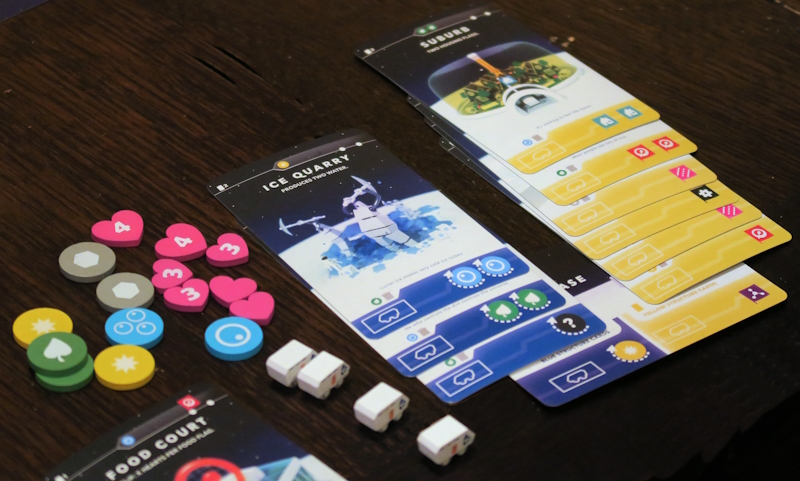
For some, the evening began early with fish and chips in the garden to mark a special visit from Plum’s Aunt Damson.  The evening took an even more special turn as it was the day before Pine’s Big Birthday, so there was cake.  Green also put in one of his special appearances, bringing his mum, Saffron, with him.  Salmon came for the second time, and lastly, Orange, who had acquired a motorbike and was therefore now able to travel, also came for the first time in about eighteen months.  So with all these extras as well as the usual suspects, the room was packed and the group split into four with Jade leading the “Feature Game” which was to be Moon, a card drafting game where players construct bases, vying to build the new lunar capital.

Moon
– Image by boardGOATS

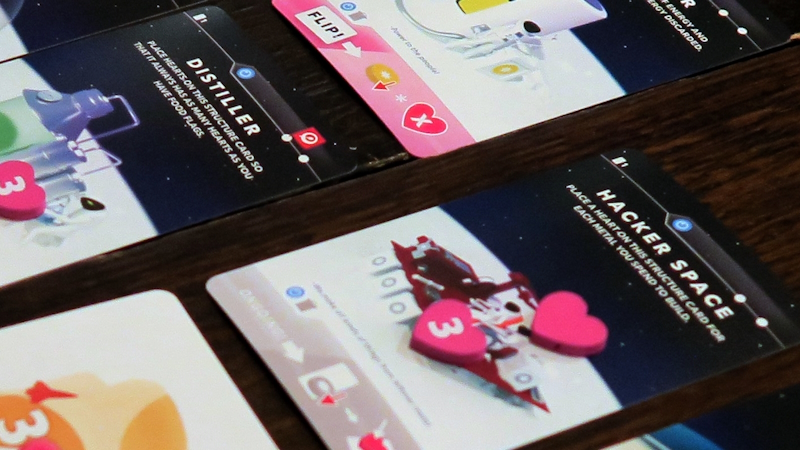
Moon is played over three rounds or Eras, collectively representing the first hundred years of populating the Moon.  Each Era is divided into three parts:  first players produce Resources, Rovers and Hearts from their Settlements.  Then comes the drafting where players choose a card from their hand to Build or discard, then pass their hand to the next player, repeating until there are no cards left.  Finally, players claim the Hearts on the central Flag Reward Board, and score any Hearts placed on their Structures and Reputation Cards.  At the start of the drafting phase, each player has one Expedition cards while the rest of the cards are Structure cards—this hand of cards represents an expedition from Earth that travels between settlements on the Moon.

Moon
– Image by boardGOATS

Unlike most card-drafting games, turns are taken sequentially with, players a Structure card from their hand and placing it in their Settlement paying any Resources and making sure any Flag Requirements are fulfilled.  Alternatively, instead of playing a card, they can discard (or “Assimilate”) a card, taking the Resources, Rovers or Hearts depicted in the discard line.  There are also four optional actions that players can carry out once each in any order before or after their mandatory action (Building or Assimilating)—use the Bonus Action on their Expedition Card; park a Rover; claim a Reputation card, or turn over a pink Action card.

Moon
– Image by boardGOATS

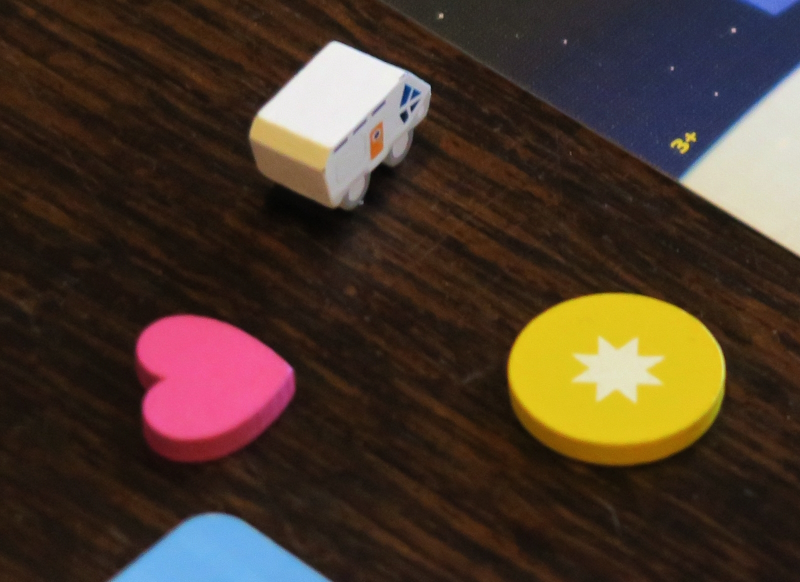
Once all players have taken their turn, all players pass their hands (including the Expedition card) to the player seated to their left and the player who now has the First Expedition Card starts the next round.  There are some similarities with Terraforming Mars, with cards having “Flags” (akin to the “Tags”), with some cards needing some Flags as a prerequisite while others display and therefore provide them.  There are five different Flags, Industry, Science, Food, Housing, and Transportation.  There are also four different types of Resource, Energy, Water, Biomass and Metal which are represented by wooden tokens, or Resource-eeples.

Moon
– Image by boardGOATS

The guts of the game are the cards—there are five different types:  blue Production cards, yellow Flag cards, pink Ability cards, grey Excitement cards and red Special cards.  Blue and yellow Structure cards also display a Rover parking space.  Players begin the game with two Rover-eeples, but can acquire more during the game.  Players can park Rovers on other players’ Structures to either use the card to immediately gain its Resources (blue) or use the Flags on it to fulfill a Flag Requirement when Building (yellow). Pink Ability cards provide an ability players can use once per Era by flipping the card while grey Excitement cards provide Hearts, which are victory points—some of these just give points at the end of the game while others give Hearts during the game.

Moon
– Image by boardGOATS

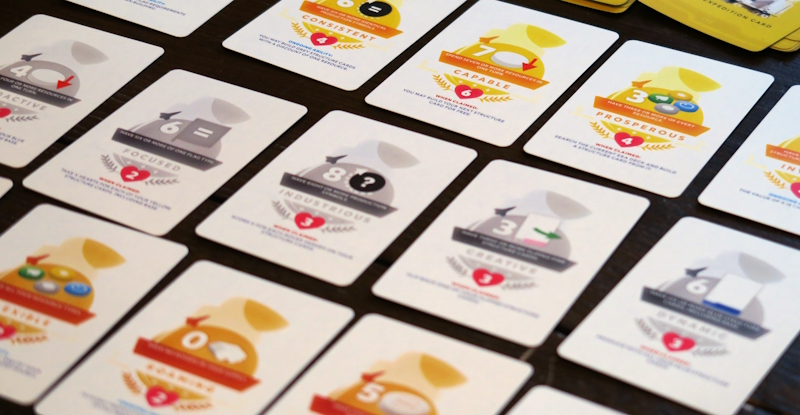
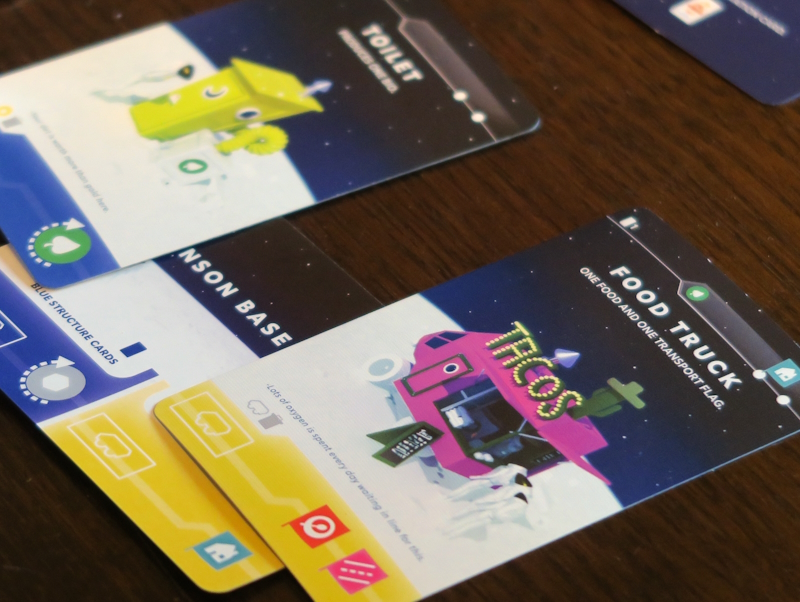
There was some hilarity over the card names, especially when Orange built a Toilet right next to his food van, Just in case!  Jade who was the most familiar with the game, took an early lead in the Hearts and finished with what appeared at first glance to be an unassailable lead with fifty-six of them, fifteen more than anyone else.  There are other scoring opportunities however, with points available for Grey Structures and Reputation Cards, and Jade came off worst for both of these.  Black picked up the most points for his Grey Structures with thirty followed by Pine with twenty-seven.  Scores were much lower for Reputation with Black, Sapphire and Pine with a similar tally.  In the end, it was very close, but the victory was Sapphire with a combined total of seventy-nine, just two more than Black in second, with Jade completing the podium.

Moon
– Image by boardGOATS

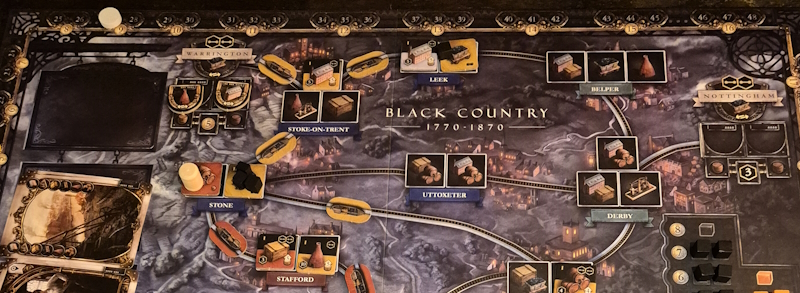
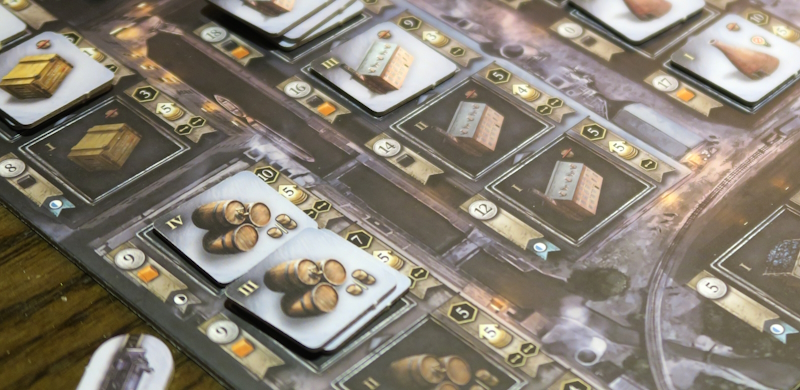
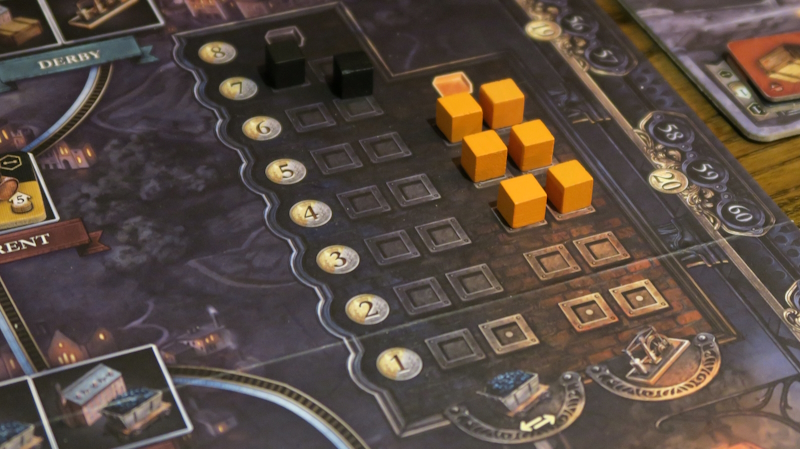
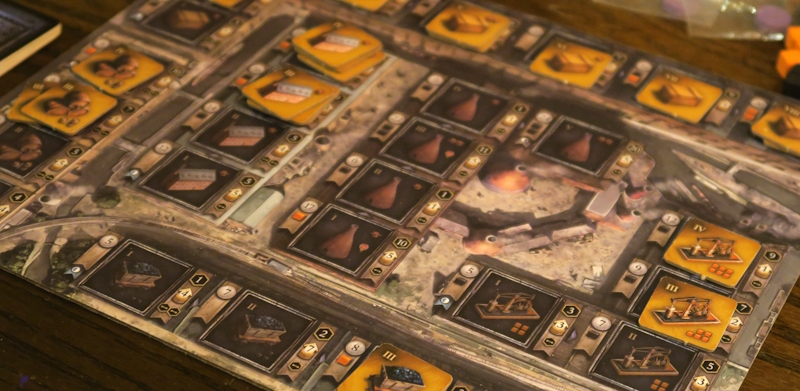
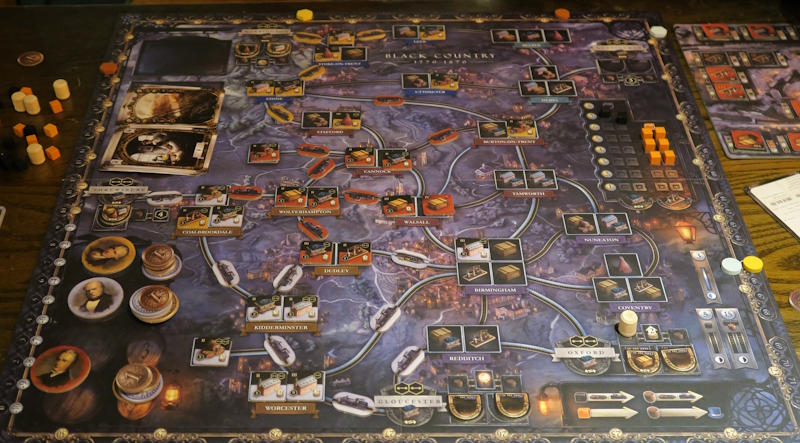
On the next table, Ivory and Byzantium were introducing Salmon to Brass: Birmingham.  There was a concern after last time that they might be a bit pushed to finish it in time (especially after last time), but with only three and with Birmingham being quicker to play than the original Lancashire version, they felt it was worth a go.  Ivory explained the rules while Byzantium set up the board.  In both games, players develop, build and establish their industries and network in an effort to exploit low or high market demands.  Players take turns according to the turn order track, paying two cards (from their hand of eight) to take any two actions from a possible six: Build, Network, Develop, Sell (cotton, manufactured goods or pottery), Borrow, and Scout.

Brass: Birmingham
– Image by boardGOATS

Building involves paying the required resources to place an industry tile while Networking is placing a Rail or Canal Link.  When Developing, players increase the point value of an industry, while Borrowing involves taking a £30 loan and a reduction in income.  The Scout action is new to the Birmingham game and replaces the Double Action Build in original, instead discarding three cards and taking a wild location and wild industry card.  Played in two halves, when the deck runs out players score, remove all the Canal Links then play on but this time building Rails.  The game ends when the deck runs out for the second time.

Brass: Birmingham
– Image by boardGOATS

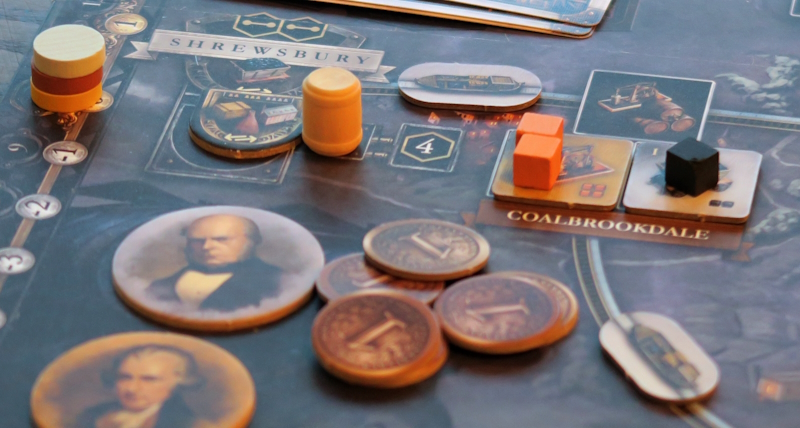
Ivory went first.  Due to Shrewsbury accepting all goods (this was randomly determined as part of set up) and selling goods being critical to scoring points, initially everyone focused on building near there and building industries that gave resources (i.e. coal and iron) that were going to be need to build further industries.  So Ivory, who went first began by building a Coal Mine in Coalbrookdale, while Byzantium added an Iron Works at the same location and Salmon placed a Coal Mine next door in Wolverhampton. At the start it looked like all three would all be competing in the same area, but once they continued building their networks (via Canals) and more industries, everyone started to spread out.  Ivory headed south, building Cotton Mills in Kidderminster and Worcester and was the first player to Sell, Selling to Shrewsbury and gaining four points for consuming Beer there (Beer being a prerequisite to Selling) and filling the tile to increase his income.

Brass: Birmingham
– Image by boardGOATS

Byzantium went north and sold Cotton to Warrington, gaining £5 as his “Beer Bonus”, and increased his income. Seeing the opportunity Byzantium was building, Ivory took the opportunity using a Leek card he had which allowed him to build outside his network, to build a Cotton Mill in Leek and immediately Selling, using the remaining Beer there to also gain £5. Salmon went more central (Cannok and Walsall), focusing on Coal Mines and Iron Works, but as no one was consuming the resources (both Byzantium and Ivory were slightly self-sufficient), he was unable to flip his industries and increase his income. This became a major issue for him as the game progressed. Everyone ran out of money quite quickly and were forced to take out Loans, decreasing their income making it negative so that they had to pay money to the bank at the end of each round.

Brass: Birmingham
– Image by boardGOATS

Whereas Byzantium and Ivory promptly Sold some Goods, flipped tiles and increased their  income so it was positive again, Salmon got caught in a debt trap, having to take further Loans to take actions and service his debt. When required to take a third Loan (and then pay £9 each in upkeep), it was agreed that he should take the Loan without the drop in income, allowing him to take actions and sell goods and ultimately get back to a positive income. After a late era focus on breweries to get the Beer to Sell further goods, cotton and in Byzantium’s case, Pottery, the Canal Era came to an end. After scoring flipped tiles and Canal Links, Ivory had a slight lead.

Brass: Birmingham
– Image by boardGOATS

At the end of the Canal Era and going into the Rail Era, as well as all the Canals, all Level 1 tiles are removed from the board, representing obsolete technologies.  This wiped out everything Ivory had and most of Byzantium and Salmon’s tiles, so the start of the Rail Era was similar to the beginning of the game.  That said, Byzantium and Salmon were tied to their positions because, without a named card, players always have extend their Network from an existing position if they can.  That meant, Byzantium and Salmon always had something that was going to score twice though, where as Ivory had to build from scratch, but was free to start anywhere.

Brass: Birmingham
– Image by boardGOATS

With Rail connections requiring Coal to build, and because the cards in Ivory’s hand were all close to Shrewsbury (which that accepted all goods), he began the second Era almost exactly the same action way as he started the first, building a Coal Mine in Coalbrookdale. Although he had nothing on the board, Ivory was able to rebuild very quickly, partly because he had a good income, but also because he had taken a Loan as his very last action in the Canal Era.  Salmon and Byzantium also built their Networks in similar areas to the first Era. Byzantium’s core strategy was building and selling pottery to Warrington.

Brass: Birmingham
– Image by boardGOATS

Pottery is a unique resource in Brass: Birmingham, with the first pottery title being worth a large amount of points when flipped, the next being worth very little, the next giving big points etc.. Players are also restricted in developing Pottery, which mean they can’t skip the low point value titles. However, the big scoring tiles are worth a lot and Byzantium was able to get the highest level title out and flipped for a total of twenty points. Ivory again focused on the more standard cotton Mills, and each title being worth more points than the last, he was able to get multiple titles placed and Cotton sold, flipping the tiles to Shrewsbury. He also spent actions building lots of rail links next to his flipped tiles.

Brass: Birmingham
– Image by boardGOATS

Salmon again took a different approach, focusing on goods, the easiest to build and flip (especially as some don’t need beer), but these are not worth as many points. The game ended after all the cards had been played (for a second time), with Ivory’s focus on rail links and Cotton giving him victory over Byzantium by about twenty points.  Meanwhile, Teal beginning to explain the rules for Cottage Garden to Plum, Plum’s Aunt Damson and Blue, but then Ruby arrived.  Blue had cake to dispense and had a curiosity about Brass, so quickly offered her seat to Ruby and the Teal began again.  Cottage Garden is a fairly straight-forward Tetrissy, puzzle-type, polyomino game with a similar feel to Patchwork, but with more people.

Cottage Garden
– Image by boardGOATS

In Cottage Garden, players are competing in the art of gardening and are working two beds with a variety of flowers.  To do this, players select polyomino tiles of flower beds from a central market grid (restricted by the location of the “Gardener”), then place them on one of their two personal garden boards. Each board has several garden elements that are worth points when not planted over, and these are scored (on two different tracks) as soon as a garden has been completed. There are points “bars” on each track, and when these are passed players receive bonus tokens that can fill in empty spaces or give players a better selection of the flower bed tiles.

Cottage Garden
– Image by boardGOATS

Once a garden is finished, the player receives a new one to complete. After the Gardener completes her fifth lap around the market, the game enters its final round, after which, the player with the most points from their completed gardens is the winner.  The received wisdom is that the problem with the game is that it doesn’t change or intensify, which some people find boring.  However it also means that players have time to “get their eye in” and learn how to play without the game evolving beneath them and catching them out as they spend whole time playing chase.  As such, it was pretty much the perfect game for the occasion.

Cottage Garden
– Image by boardGOATS

Everyone did pretty well—Ruby picked up the scoring quickest, but Aunt Damson got the first beehive.  Teal wasn’t far behind though, getting the second.  In the final round, Plum just scored her current flower bed and discarded the second so that she didn’t get any negative points, something that turned out to be a critical decision in a very tight game.Plum and Teal had the edge in scoring for Pots, but that was off-set by Ruby’s scoring for her Cloches and and Aunt Damson’s Beehives.  Teal, Ruby and Aunt Damson were all within a couple of points, but the victor, was Plum with fifty-six, just three points clear of Ruby who edged second from Teal.

Cottage Garden
– Image by boardGOATS

In addition to Aunt Damson, Green had brought his mother, Saffron who was visiting. the area  Saffron was quite well known to some of the group so there was quite a bit of chatter before she joined Green, Lime and Purple in a game of Azul.  This is a game that is well known within the group and with everyone familiar, the rules explanation could be kept short:  the game uses a very simple, but very clever market mechanic where players take all the tiles of one colour from a market stall and put the rest into a the centre, or take all the tiles of one colour from the centre.

Azul
– Image by boardGOATS

As soon as they have taken the tiles, players add them to one of the rows on their player board.  At the end of the round, one tile in each full row is moved into their mosaic.  The game ends when one player completes one full row of their mosaic.  Players score points when they add tiles to their mosaic (one point for each tile in the row and column it forms), and receive bonuses for completed rows, columns and any completed sets in their mosaic.  The catch is that each feeder row can only contain one colour and and if there are left-overs when they add to it, these score negative points.  Further, each row in a player’s mosaic can only have one tile of each colour.

Azul
– Image by boardGOATS

This time, Lime nearly got caught out, however, after Blue was summoned for a rules adjudication.  The question was, was he able to have more than one feeder row in a colour?  If they all had to be different he would be forced to place a lot of tiles in his overflow space and pick up a pile of negative points.  As the rules are clear and players can have as many feeder rows of the same colour as they like at any point during the game (they can only put each colour in a row of the mosaic once), Lime dodged a bit of a bullet.  As a result, he just edged it taking victory by three points from Green with Saffron a few points behind him.

Azul
– Image by boardGOATS

With everything else still going, when Azul finished, Blue joined the table to introduce Saffron to another one of the groups favourite games, Draftosaurus.  This is a very simple drafting game (similar to games like Sushi Go! where players choose from a hand of cards and pass the hand on), but in this case players are drafting cool dino-meeples and adding them to their dinosaur park, with different locations scoring for different combinations of dinosaurs. The game is played over two rounds, each placing six dinosaurs.  The first game was a bit of a land-slide although it ended in a tie between Green and his mum, Saffron, both scoring thirty-seven points.

Draftosaurus
– Image by boardGOATS

It couldn’t be left there of course, so the group “did a Lime” and played again.  This time it wasn’t until the scoring that Green realised why he hadn’t seen a single T. rex—Blue sat to his right had nabbed them all before he got to see them!  T. rex is a special dinosaur in general, but especially in Draftosaurus, giving an extra point for each one, but also having some placement restrictions.  Blue is generally very bad at this game, but even a park full of dinosaur kings (and queens) didn’t help, although it was a very close game with four players within a couple of points.  The clear victory though was Purple with thirty-eight, three points ahead of Lime who led the rest of the pack.

Draftosaurus
– Image by boardGOATS

From there, there was a bit of chatter, but by the time Cottage Garden had finished, Teal, Lime, Green and Saffron all decided it was time to head home, leaving Purple to join Ruby, Plum and Aunt Damson.  There was some question about that they would play, but in the end they decided on one of Purple’s favourites, the hidden traitor game, Saboteur.  In truth, this is not at its best with four, but despite that, the group really enjoyed it.  The idea of the game is that players are Dwarves building a network of Tunnels in order to find treasure.  They do this simply by playing a card to extend the Tunnel and drawing a replacement.  The catch is that there is a traitor, an Evil Saboteur, in their midst.

Saboteur
– Image by boardGOATS

So, if the Dwarves have not found the treasure by the time the deck runs out, then they have lost and victory goes to the Evil Saboteur.  In addition to Tunnel cards, the deck also contains Special Map, Rock Fall, Broken Tool and Fixed Tool Cards which Dwarves and Saboteurs can use as they feel appropriate.  With four players, Ruby put two Saboteur cards in the pile used to assign the roles, but as it happened only one came out—Ruby.  Plum seemed to get the all map cards and checked the target nearest her first: Coal.  She then tried the the middle target card, but finally found gold in the one furthest from her.

Saboteur
– Image by boardGOATS

Ruby chose to strike out at Aunt Damson first, but that left Purple and Plum to continue digging for the gold.  Ruby then played a tunnel card with a dead-end which exposed her as a Saboteur, and as the only one, the writing was on the wall.  The game is formally played over three rounds, but we don’t like the way that plays and treat one round as a game in its own right.  Everyone enjoyed the game, but Aunt Damson in particular—she had watched and enjoyed The Traitors, so the overall concept particularly appealed.  It had been a lovely evening with a slightly different set of people and lots of games played.

Saboteur
– Image by boardGOATS

Learning Outcome:  It’s lovely to host family and old friends.

29th April 2025

The evening began with a quick game of the popular Blackjack based game, Flip 7.  This is a quick, push-your-luck card game along the lines of Port Royal where players turn over cards and gamble on not revealing the same number twice taking it in turns to decide whether they want to “flip” or ” stick”. The catch is that each numbered card appears in the deck that number of times (i.e there is one one, two twos and so on). Flipping over seven different cards in a succession gives fifteen bonus points.  There are also some action cards in the deck, “Flip Three”, “Freeze”, “Second Chance” and modifier cards which give extra points. The game ends when players have reached the pre-agreed total.

Flip 7
– Image by boardGOATS

Ivory was keen to get in a little practice as “Little-Ivory” was getting it for his birthday in the next few days.  Although the game plays up to eight (with one box), there were just the four as Ivory was joined by Jade, Sapphire and Mint.  Mint went bust early and Sapphire started fast, but the victor was Ivory who didn’t go bust at all during the game.  With that over quite quickly Jade and Sapphire were joined by Pine, Plum and Byzantium to play the “Feature Game“, Creature Comforts.  In this game, players spend Spring, Summer, and Autumn gathering different resources from the forest and spending them to collect items that will home a more inviting place while the world outside is covered in a layer of snow in the Winter.

Creature Comforts
– Image by boardGOATS

Creature Comforts is a worker placement game with a twist:  the workers can be placed at various locations, but dice of specific values (or sum-totals) are required to activate the locations. Thus, the players need access to dice of specific values when it comes to triggering those workers.  Jade explained the rules to Pine, Plum, Byzantium and Sapphire, some of whom were new to the game.  Played over twelve months, at the start of each month or round, a Traveler “event” card is revealed which either applies an instant effect or one that lasts the duration of the month.  Simultaneously, players then roll their two Family dice and place them on their Home Boards.

Creature Comforts
– Image by boardGOATS

Then, players simultaneously place their Workers at their choice of the twelve locations.  Although the locations can hold any number of Workers, players can only place a single worker at each one.  Each location will either require a dice of a specific value or multiple dice that add to a given sum (or have a particular requirement e.g. feature all odds or evens).  The catch is that at this point, players only know the values of the two dice that they have access to, their Family dice.  So, placing Workers requires some astute planning mixed with some luck when the four communal Village dice are rolled next, by the start player for the month.  Players then take it in turns to allocate the six dice at their disposal to activate as many of the locations their Workers are at as possible.

Creature Comforts
– Image by boardGOATS

Each Worker that a player cannot activate gets them a Lesson token, which can be used to modify dice values in later turns (for only that player).  Finally, players finish their turn by crafting any creature comfort cards they can, keeping in mind that only three can be carried over to the next round.  After eight months (six if playing a shorter version of the game), players can craft any left-over cards they might have in their hand if they can afford to and then score for their Comfort Cards, Improvement Cards, for empty Cottage spaces and left-over resources.  The first problem was that there were a lot of locations to get to grips with.  Pine, who was new to the game, struggled initially, but by the end was wanting to play again soon!

Creature Comforts
– Image by boardGOATS

Sadly, although the game was a lot of fun and enjoyed by all, it was marred by the fact that “Last Orders” was called sooner than expected.  This meant the last couple of rounds were played at something of a rush and points were missed and some of the scores might not have been correctly counted.  There are a lots of odd points to be counted, but the bulk come from the eponymous Creature Comfort cards.  Byzantium top-scored for these with forty-three points, some ten more than anyone else, so it was no surprise that he ran out the winner by a sizeable margin, with everyone else left fighting for second.  That battle was won by Sapphire with Pine taking third.

Creature Comforts
– Image by BGG contributor hipopotam

Meanwhile, Mint introduced Blue and Ivory to the really cool, three-dimensional game, Planet.  This is quite a simple game, but really clever:  each player receives a dodecahedral planet core with twelve pentagonal spaces and a magnet in the centre of each one.  On their turn, players choose a pentagonal tile with different terrains (Mountain, Ice, Forest and/or Desert) on them and stick it to their planet. The player who fulfills the most conditions for the appearance of certain animals gains its card.  There are public, animal objectives and each player has a private objective, their “Natural Habitat”.

Planet
– Image by boardGOATS

Players score points for the size of their Natural Habitat, and also for each animal card they claim.  Animals that live in an area that is not the player’s Natural Habitat score extra points which creates sort of opposing incentives to cover the planet with Natural Habitat tiles while also creating the right conditions to score animal cards.  And as the Planet fills up, this gets more and more complex.  Although everyone loved it, the game didn’t quite click for Blue, but it was close between Ivory and Mint.  There were only two points between them in the final totals, with Ivory taking his second victory of the night with twenty points.

Planet
– Image by boardGOATS

From there, the trio went on to play the Golden GOAT Award winning game, Stamp Swap.  In spite of the theme (which didn’t really set anybody’s imagination on fire), this has proved to be a really popular game within the group—it is just very smooth and doesn’t outstay its welcome.  Everyone had played it before, so there was only the barest minimum of a rules run-down.  The game takes place over three rounds, each split into two parts:  Firstly players take it in turns to choose from a central pool, then players divide their pile into two and the first player chooses one pile from another player to take, who keeps their other pile and chooses one from another play—and thus the piles of stamps are swapped.

Stamp Swap
– Image by boardGOATS

Players score points at the end of each round for their achievements and at the end of the game, for the face-value of the stamps and for end game objectives.  Despite everyone having played it before, there was a rules malfunction that might happened before and could have made a significant difference, to Mint and Blue especially.  Each player has an “Exhibitor” which gives players a point for each stamp they have of a given theme.  The group scored this at the end of the game, however, it is supposed to give points at the end of each round.  Everyone played by the same rules, so Ivory was the deserved winner with a hundred and eighteen points, but the scores would have been closer if the Exhibitors had been played correctly.

Stamp Swap
– Image by boardGOATS

On a night when there were four tables, the third consisted of Pink, Black, Pine and Purple, started with a game of Little Town.  This is a really cute little game of Worker placement, resource collection and management, and building tile placement.  The game lasts for four rounds, during which players collect resources (wood, stones, fish, and wheat) from the eight surrounding squares by placing Workers on central map.  Players can then build buildings using these resources, players can then gain the effect of the building by placing a Worker next to it.  Placing a Worker next to a building owned by another has a cost though, and the player must pay a coin before you can collect resources.

Little Town
– Image by boardGOATS

Players collect victory points using the powers of buildings, by constructing buildings, and by achieving objectives dealt at the beginning of the game. This time, Pink played a really pragmatic game essentially simply repeatedly activating the Well and the Bar (giving him two and three points each respectively).  As a result, the game was a bit of a land-slide with Pink taking victory with thirty-nine points, eleven ahead of Black in second with Pine a few points behind that.  With everyone else otherwise engaged, the group went on to play a quick game of Ticket to Ride: New York.  This is one of the first of the very small editions of Ticket to Ride, in fact, the first of the “Cities“, as it was preceded only by the Demo version.

Ticket to Ride: New York
– Image by boardGOATS

The game is played much the same as the full version of Ticket to Ride, with players taking coloured cards from the market and spending them to place pieces (in this case taxis) with the aim of completing tickets.  Black took the most points for the Tourist Attractions he made connections with, but had a bit of a ‘mare elsewhere, failing to complete a large pile of tickets which left him losing fifteen points.  This almost entirely wiped out the rest of his points, but it was relatively close between the others.  Pink was once again the victor though, taking the most points for placing taxis and for his tickets giving him a total of thirty-four points, with Pine taking second place just ahead of Purple.

Ticket to Ride: New York
– Image by boardGOATS

The fourth table consisting of Green, Teal, Salmon and Flint, only played the one game, but it was one of the most beautiful of recent times:  Earth.  This is a card-driven engine-builder where players are building themselves an ecosystem.  Often compared to Wingspan, although there is a lot to understand, the game itself is not actually all that complicated. Players are building a four by four grid of Flora and Terrain cards which represents their island; during the game they will plant flora, water it and allow it to grow.

Earth
– Image by boardGOATS

On their turn, players do one of four things: Planting (paying the cost in Soil tokens), Composting (gaining Soil and placing cards from the deck in their discard pile), Watering (place Sprouts and gain Soil) & Growing (draw new cards and place growth tokens).  A bit like Puerto Rico, once the active player has chosen which action they are taking, everyone else gets to do a subsidiary, slightly weaker version of the same action.  For example, when Planting, the active player plants two cards, draws four and keeps one, while the other players plant one and draw one.

Earth
– Image by boardGOATS

Once everyone has completed the action for the turn, everyone activates all the cards in their island that match the colour of the action chosen, starting with the card in the top left and working across each row in turn.  So, not only is it important which cards are played, but also where they are located in the player’s island.  At the end of the game (which is triggered when one player has completed their island), players score points for each Flora card, any Trunks and Canopies they have grown, their Sprouts and their pile of “Composted” or discarded cards.  Players also score points for achieving objectives on the Fauna cards revealed at the start of the game and for completing their island first.

Earth
– Image by boardGOATS

This was another game that turned out to be a bit of a land-slide.  The base scores for the islands was pretty consistent, but as with many games, it’s about what you do with the cards you get that makes the difference.  Green “Composted” fewer cards, but scored more for his Sprouts.  Players had ups and down, but otherwise it was fairly even.  The biggest difference, however, was the number of Leaf Tokens on the Fauna board—Green had more than twice as many as anyone else with sixty.  As a result, his total of two-hundred and forty-four was nearly fifty more than that of Teal who took second ahead of Flint in third.

Earth
– Image by boardGOATS

Learning outcome:  Rushing the end of a game can take the shine off it.

22nd April 2025

The evening began with the sad news that Kath and Ian and their daughters were leaving for a new pub in Shipton Abbot (or was that  Newton Abbot?).  They have been good to the group and worked hard to give us an environment that conducive to gaming, so it is sad to see them moving on, though Devon is quite a nice place.  Everdell is also reputed to be a nice place, and one that some of the group were to travel to perhaps using its new railway station, as the Newleaf expansion to Everdell was the to be the week’s “Feature Game“.  The game got going after about fifteen minutes of general faffing about and reminding everyone of the rules to the base game and explaining the additional features of the expansion.

Everdell: Newleaf
– Image by boardGOATS

The base game is a fairly simple one of worker placement to collect Resources and spend them to place Cards.  Players keep playing until they run out of workers when they get them all back (vacating the associated Action spaces), and then start again.  The game is played over four rounds (or Seasons), with players with the most points from Construction and Critter Cards as well as Event (end-game scoring) Cards.  The Newleaf expansion adds new Critter, Construction and Event Cards, but more obviously, it a new railway station.  This and associated Visitor Cards, Freight Trucks (which provide an alternative way to get Resources), Travel Tickets, and Reservation Tokens.

Everdell: Newleaf
– Image by boardGOATS

Plum (who obviously chose to play with Cat-eeple Workers) went first, grabbing some Resources, followed by Purple (Butterfly-eeples), Cobalt (Hedgehog-eeples) and then Ivory (Duck-bill Platypus-eeples).  Everyone started setting up their town, particularly focusing on green Constructions and Critters that could give income in spring. Plum built up a large pile of Resources and grabbed a Freight Truck with Resources loaded on it and her choice of discount when producing (paid in part using the Reserve Token to gave her a discount) . Purple didn’t go for green Cards, but red Cards with additional worker spots (in particular the Hotel and Chapel), whereas Cobalt and Ivory both got a Mine and Miner Mole, giving them access to valuable pebbles.

Everdell: Newleaf
– Image by boardGOATS

The length of Seasons in this game is variable, with some players doing more than others before they are forced to reclaim their Workers.  Purple passed on to Spring first, followed by Plum and then, sometime later, Cobalt and Ivory.  Cobalt gained a few blue Cards which had given him Resources (and in particular Cards) when playing Constructions and Critters, whereas Ivory had built quite a collect of green Cards, giving him a significant pile of Resources going into Spring. Spring was very similar to Winter, with everyone focusing on engine building, although Purple was beginning to struggle, due to a shortage of green Cards. Ivory made an early grab for Harvest Festival Event which gives a points bonus for having four green Cards in his city—he was already building quite a big tableau including a Castle.

Everdell: Newleaf
– Image by boardGOATS

Cobalt was taking things slightly more slowly, still focusing on blue Cards, which was enabling him to draw three cards every time he played a Card, so he was always at the hand limit.  Moving into Summer, Cobalt significantly stepped up his building, as did Plum.  She grabbed the Ever Wall Tower card which rewarded her for having nine Constructions. Having already taken Grand Tour event for having three red Constructions, Ivory was eyeing up the Royal Tea special event for having three green and two purple Cards in his town.  However, whilst focusing on collecting resources for buildings to complement his already built Castle and the Palace Card he had in his hand, he failed to notice Cobalt had already played three purple Critters/Constructions.

Everdell: Newleaf
– Image by boardGOATS

As a result, Cobalt beat Ivory to both the Royal Tea and the Scenic Flight awards. Much to Ivory’s disgust, Cobalt was then also able to claim the Sunflower Parade achievement award for having three Events too.  So, Ivory went into damage limitation mode, and began focusing on the passengers at Newleaf station as an alternative way to score points.  Purple was first to move into Autumn and as everyone else followed the focus was firmly on points.  Cobalt was able to collect the Juniper Jig Dance Contest Event card for having nine Critters (in part due to Ivory giving him the Fool!).  Ivory was collecting more passengers using his special ticket to enable him to take a worker back, something everyone had from the from the expansion while Plum was building as many building as possible.

Everdell: Newleaf
– Image by boardGOATS

It was all a bit of a rush at the end as it was nearly midnight when the game finally finished.  Largely due to the scores for his huge number of Events, the winner was Cobalt with ninety-three points.  Ivory took second some ten points behind, closely followed by Plum who got over half her points for Critters and Constructions.  The game had taken all evening, but during this time, Pink, Pine and Lime had managed to get through no less than five games.  The first was one of Pink’s favourites, Zoo Break.  In this game, players work cooperatively to try to prevent the escape of animals from their zoo.  It is one of Pink’s favourite games, but this time it was very, very short-lived.

Zoo Break
– Image by boardGOATS

Things started well as the group locked up the Capuchins, Snakes and the Rhino.  But then the Meerkats, who were partying in the fountain, decided to make a bid for freedom.  Three tigers and four elephants were already on the loose and rampaging round the zoo and while Pink put two Pandas back in their cage, five of the Meerkats made it to the exit and headed out.  And thus a handful of mischievous Meerkats led to the sad demise of Bedlam Zoo (which really had been Bedlam this time).  To help get over the disappointment of the epic failure, the group decided to go on a a train ride around France with Les Aventuriers du Rail Express, a light version of one of the group’s favourite games, Ticket to Ride.

Ticket to Ride: Europe
– Image by boardGOATS

There are lots of versions of Ticket to Ride, from the teeny-tiny city editions through to the rather epic Rails & Sails and Legacy versions.  Les Aventuriers du Rail Express is a French map that is a step up from the city editions and fits between the standard games (Like Europe) and First Journey, making it slightly quicker than the full games, as it is played on a slightly smaller map with slightly fewer trains.  Aside from that, it is essentially very similar in game play to all the others:  on their turn players either take cards from the market, or spend them to place plastic train pieces on the map.

Les Aventuriers du Rail Express
– Image by boardGOATS

As in the larger version players can also take tickets, but this has to be balanced with the bonus for completing a route from London to Istanbul, the most distant pair of cities.  The first player do so gets twenty points, the second gets fifteen and the third gets ten.  Additionally, the wild Locomotive cards also work slightly differently in this game in that, instead of being mixed in with the market, they are always available from a separate stack, but as usual, players can only take one per turn.  Being a quick game, and with everyone feeling they knew the game and was in with a chance of winning, the group ended up playing it twice.

Les Aventuriers du Rail Express
– Image by boardGOATS

The first time, Lime finished with the most points from placing Trains, but both he and Pine carried negative points from incomplete Tickets.  Incomplete tickets are a real drag as they effectively, carry a swing double their face-value.  As a result, Pine just pipped Lime to second place.  The winner was Pink, however, despite the fact that he had the lowest points for his tickets; he did finish the London to Istanbul connection first though.  In the second game, the roles were somewhat reversed with Pink taking the most points for placing trains, but failing to complete the London to Istanbul route at all.  The winner was Pine who, like Pink in the first game, also claimed the maximum of twenty bonus points, while Lime was the runner up.

Les Aventuriers du Rail Express
– Image by boardGOATS

Everyone else was still playing, so the trio managed a quick couple of games of the card-drafting game, Sushi Go!.  This is a very simple game, where players start with a hand of cards and choose one to add to their tableau before passing the rest on.  Played over three rounds, players collect points for collecting Maki Rolls, Sashimi and Nagiri (which is all the better when combined with Wasabi).  At the end of the game, players with the most Pudding cards score an extra six points, while those with the least lose six points.  The player with the highest total is the winner.  The points throughout both games were fairly even with nobody crashing out or having a golden round.

Sushi Go!
– Image by boardGOATS

Despite this, the winner of the first game took it by a bit of a land-slide.  It’s true that Lime top-scored in two of the three rounds, but they were all really close.  The real difference, therefore, was made by the Puddings which he had the most of and left him with a total of forty-five, a dozen more than Pink, the runner-up.  It was fairly inevitable then that in the second game, there was quite a battle for the Pudding cards.  The scores were close again, and again Lime won two out of the three rounds.  The overall winner was arguably Pink, who despite losing all three rounds had the most Puddings and therefore took victory from Lime on a tie-break.

Sushi Go!
– Image by boardGOATS

The final table for the evening, consisted of Jade, Sapphire, Black and Blue playing Meadow with the Adventure Book expansion.  Meadow is a clever little card game where players collect cards to add to their tableau from a central market.  On their turn players place one of their tokens next to the grid with the type of token and the location combining to dictate which card they take.  Players can then add a card from their hand (which may or may not be the one they picked up) to their tableau.  In the base game, there is an additional campfire board, but the Adventure Book replaces this.  Each “page” from the book changes the mechanics to a greater or lesser extent.

Meadow: Adventure Book
– Image by boardGOATS

The group played with the first scenario, which introduces Weather.  There are two token that indicate a row and a column in the market, and every time a card is taken from these, players can move along the appropriate Weather track.  Reaching the end of these gives players extra cards.  Additionally, placing a token in a space in the Book allows players to claim rewards if they have fulfilled the criteria and have the two symbols shown visible in their tableau.  These give extra points at the end of the game.  There was a lot of faffing about and getting to grips with the rules changes, especially as initially, the wording in the rules for the expansion was a little unclear.  Added to which, Black hadn’t played the base game at all before.

Meadow: Adventure Book
– Image by boardGOATS

Once the rules had been fathomed out and explained, the group got the game underway.  Different players targeted different card types with some going for the harder to place higher up the food-chain cards, while others tried to diversify.  Blue tried to get as many of the bonus points for collecting pairs of symbols as she could and as a result finished at the back of the pack.  The game is not a high scoring one though and those bonus points made a big difference.  It was not quite enough to give her the victory, however, and she finished one point behind Jade who topped the rankings with forty-six points, with Black in third.  It had been a very enjoyable evening all round though, regardless of the number or type of game played.

Meadow: Adventure Book
– Image by boardGOATS

Learning Outcome:  Cards are a critical part of most modern games.

8th April 2025

By the time everyone else started to arrive, Cobalt was already most of the way through losing his game of 20 Strong.  This is a solo-player deck-based game where the object is to progress through a shuffled deck of cards, each of which bears a unique challenge. This challenge could be in the form of an enemy, a unique scenario, or some other requirement which are completed by rolling a set of seventeen dice with different odds for a hit.  These dice, along with three adjustable stat dice, make up titular twenty dice.  Cobalt continued rolling his dice while others ordered food, chatted and ate.

20 Strong
– Image by boardGOATS

Before long players began splitting into groups, deciding what to play.  The first group was Blue, Pine, Mint and Pink playing the “Feature Game” which was to be Fire Tower.  This is a competitive game where players order air drops of water, and plan the building of firebreaks in order to combat a woodland blaze.  The rules are very simple:  players begin their turn by spreading the fire in the current wind direction then play one card from their hand (or discard all their cards) and replenish their hand.  There are four different types of cards, Wind, Fire, Water, and Firebreak cards.  Wind cards can be used to change the Direction of the Wind which affects which direction the fire spreads in.

Fire Tower
– Image by boardGOATS

This can either be by playing the card and changing the Wind Direction to that on the card, or by rolling the Wind die and leaving it up to fate.  Alternatively, the player may place a fire gem on one empty space orthogonally adjacent to an existing fire space (or the central Eternal Flame), in the wind direction indicated on the card.  Fire, Water and Firebreak cards give a pattern of spaces that the fire must either spread in, is removed from, or fire break tokens can be placed in.  Firebreaks prevent fire from landing on or jumping over the spaces they occupy and can only be removed using a card that includes the De/Reforest action and cannot be placed in orthogonally adjacent to another Firebreak token.

Fire Tower
– Image by boardGOATS

Each player took the Fire Tower on one corner of the board with Pine sitting opposite Blue and Mint opposite Pink.  Blue went first followed by Mint, then Pine and finally Pink.  The base game is an elimination game, with the winner the being the last player who’s Fire Tower has not be burnt down.  The group decided to play without the events and keep the game as simple as possible to see how things worked.  Pink was the first to get knocked out with Firestorms proving to be disastrous for his Tower.  Pine quickly followed with before there was a long, determined rear-guard action by Blue.

Fire Tower
– Image by boardGOATS

Unfortunately, Mint started in a better position and despite her best efforts, eventually Blue’s Tower was also a moldering ruin.  Since Pink and Pine had spent quite a lot of time as spectators, the group decided to give it a second go, but this time working in pairs.  This time, Blue’s Tower was first to be destroyed with Mint’s next.  Eventually, only Pink’s tower was still standing giving a second victory to Mint, which was shared with Pink.  The game had been quite enjoyable, if very different to the usual fare.  There was still plenty of time left for something else though, so the group had a rummage in the bags and came up with Draftosaurus.

Draftosaurus
– Image by boardGOATS

This is a very popular game where players start with a hand of dino-meeples, choose one and pass the rest on before placing them in their dinosaur park.  It frequently gets outings within the group, but on this occasion, for variety, the group decided to play with the winter setting which gives slightly different pens with slightly different placement conditions.  It was very tight, but as is often the case, Pine, who just seems to “get” this game emerged the victor with thirty-six points.  He was only one point ahead of Mint and Pink though, who tied for second place.

Draftosaurus
– Image by boardGOATS

Meanwhile, on the next table, Green putting in a rare, but welcome appearance, was leading Black, Purple and Plum in a game of Discworld: Ankh-Morpork.  In this game, Lord Vetinari has disappeared and players control different factions which are trying to take control of the city.  Game play is quite quick and simple with players playing a card and doing what it says.  Most cards have more than one action on them, and players can choose to do some or all of these actions. Some cards also allow people to play a second card, so they can chain actions together.

Discworld: Ankh-Morpork
– Image by boardGOATS

In this game, Black was the Dragon King of Arms, looking for trouble, Green was Chrysoprase, trying to amass lots of money, Plum was Commander Vimes who was trying to play through the deck and Purple was Lord Rust, with an area control remit.  The game was over quite quickly with Black running out the winner in a game that is much under-rated and sadly very out of print due to IP issues.  This copy was a much cherished one, as it had belonged to Burgundy so it was nice for it to get another outing within the group.  There was time for a second game and this ended up being Faraway, a very clever, much more recent, card-driven game that has had a few outings since its release last year.

Faraway
– Image by boardGOATS

The idea is that players simultaneously chose one of the numbered cards from their hand and starting with the the player that played the lowest card (similar to 6 Nimmt! or Kingdomino), everyone takes it in turns to choose one from the market to add to their hand.  Players then simultaneously choose another card, and again, choose one to add to their hand.  The game ends after everyone has played a total of eight cards, and then everyone scores.  The clever part is that the cards are played left to right, but the scoring is from right to left.

Faraway
– Image by boardGOATS

At first glance, this looks like it makes things easy, because early in the game players find out what they need to get points and can then focus on getting the resources they need as the game progresses, but of course that is not the case.   This time, Purple had a really bad run where she kept getting the highest number cards, which meant she picked last, and then picked up the higher number cards left by others.  Once again, the winner was Black making it two out of two for him, while Plum was second by seven points with Green a little way behind her.

Faraway
– Image by boardGOATS

Meanwhile, the third group comprising Jade (fresh from his birthday celebrations), Sapphire, Teal, Byzantium and Cobalt spent the evening playing a five-playergame of Earth.  This is a is a sumptuously illustrated card-driven engine-builder game that is often compared to Wingspan, where players are building themselves an ecosystem.  The game itself is not actually all that complicated. Players are building a four by four grid of Flora and Terrain cards which represents their island and during the game they will plant flora, water it and allow it to grow.  On their turn, players do one of four things: Planting (paying the cost in Soil tokens), Composting (gaining Soil and placing cards from the deck in their discard pile), Watering (place Sprouts and gain Soil) & Growing (draw new cards and place growth tokens).

Earth
– Image by boardGOATS

A bit like Puerto Rico, once the active player has chosen which action they are taking, everyone else gets to do a subsidiary, slightly weaker version of the same action.  Once everyone has completed the action for the turn, everyone activates all the cards in their island that match the colour of the action chosen, starting with the card in the top left and working across each row in turn.  At the end of the game (triggered when one player has completed their island), players score points for each flora card, any Trunks and Canopies they have grown, their Sprouts and their pile of “Composted” or discarded cards.  Players also score points for achieving objectives on the Fauna cards revealed at the start of the game and for completing their island first.

Earth
– Image by boardGOATS

During the game, Cobalt built up the most points; his forty-two were some five ahead of Byzantium.  By far the most points come in the end-game scoring however.  A bit of a point salad there are seven scoring sections:  Teal scored best for Compost; Jade scored most highly for completing his Canopies; Byzantium top-scored for Terrain, and Cobalt out-scored everyone else for his Fauna.  As well as getting the most points for his Sprouts and Ecosystem Objectives, Sapphire also scored well in many of the other categories giving him a clear victory with one hundred and sixty-eight points, thirteen more than Byzantium who pipped Cobalt for second by a single point.

Earth
– Image by boardGOATS

Learning outcome:  Playing with fire may be fun, but you risk getting burnt.