Tag Archives: 7 Wonders

12th August 2014

It was a quiet night tonight with just the two games and not many more people.  We started out with the Feature Game, 7 Wonders, which is a card drafting game.  Basically, each player starts with a hand of cards and, simultaneously, each player chooses a card to play, a card to keep and then a passes the rest to the next player.  The cards are played with various different aims, you might try to build up a set of city and erect an architectural wonder, or attempt to have a superior military presence to neighbouring players.  The game consists of three rounds, the first and third passing cards to the left, with the middle round passing cards to the right.  We’ve played this a couple of times before – the first time, there were seven of us and it was just completely disorganised chaos.  Nobody had any idea of what was going on and changing direction in the second round just caused even more confusion;  it seemed to last for ever.  We played it again a few weeks later, this time with fewer and got through two games in the time it took the other half of the group to get through one.  This time, with just three players, it went OK, but the conclusion was that it works best with four or five, three is too few, and seven is definitely too many!  Green won, but Yellow’s comment, “I want to like it, but find it difficult to work out all the scoring combinations,” pretty much summed up everyone else’s view.

7 Wonders

The second game was a new game that two players had played several years ago, Kaigan.  It seemed that four years was “beyond living memory” as nobody could remember how to play and it took ages to work out the rules.  The game is set in 1800 when, at fifty-five years of age, Tadataka Ino started his journey to make the first scale map of Japan’s coast (Kaigan) using modern surveying techniques. After twenty-one years, Ino had a beautiful 1:36000 scale map that remained the definitive map of Japan for over a century.  In the game, the players oversee teams of surveyors and compete against each other to map the coast of Japan. Players generate income which they use to dispatch their surveyors around the island of Japan in an effort to map its different regions.  Then they improve their artistic skills and develop relationships with local governments in an effort to contribute the most to mapping Japan, gaining the most honour thus winning the game.

Kaigan

The game consists of five rounds that represent the twenty-one years Ino took to map Japan.  It didn’t take too long to play (certainly didn’t feel like twenty-one years!), but when we finished, we still felt as though we had played it wrong some-how. Purple bluntly said,”I didn’t like it then, and I don’t like it now,” while Yellow (who won) commented that he still didn’t really get it.  Green who had not played it before opined that it was not one he’d particularly wanted to play again as he didn’t like the fact that he kept losing his action choices, however he thought it might play a bit differently a second time.

Kaigan

Learning Outcome:  Sometimes, your first impression, really is the right one!

25th March 2014

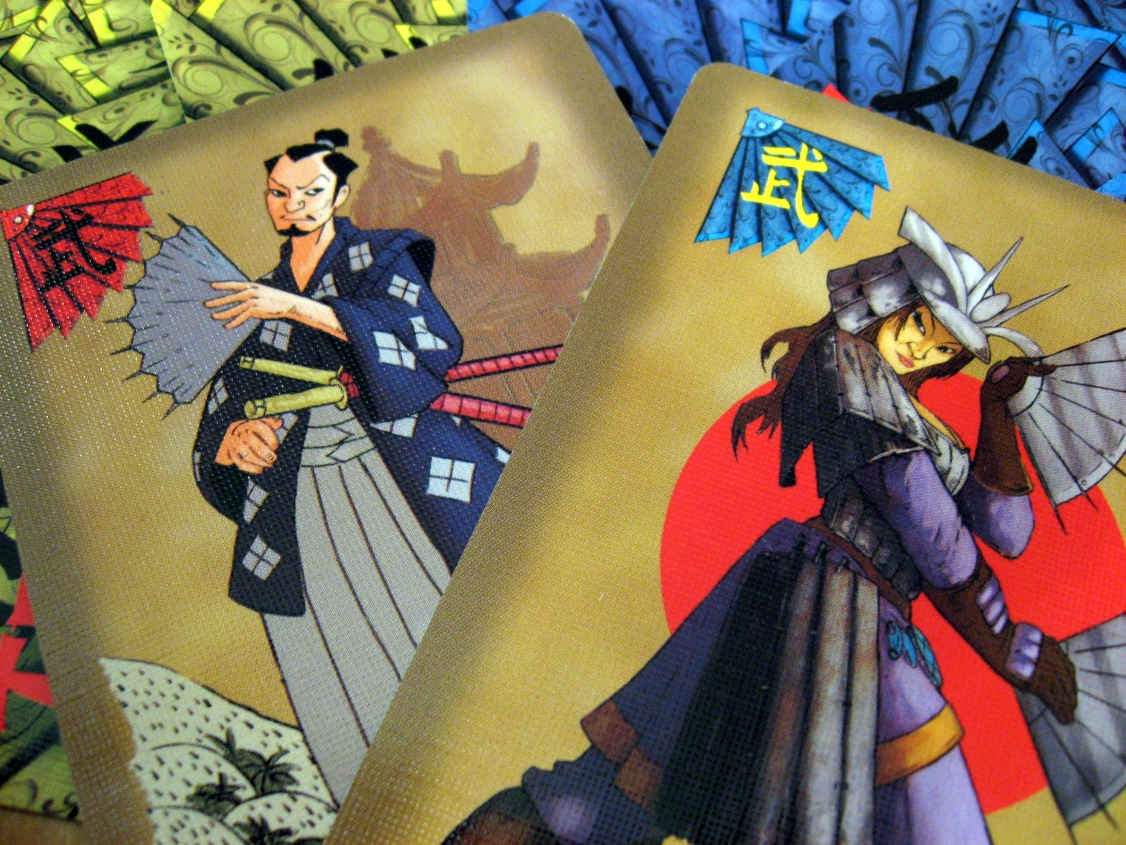
While we waited for people to arrive we started out with a quick duelling card game set in feudal Japan, called Tessen.  The tale goes like this:

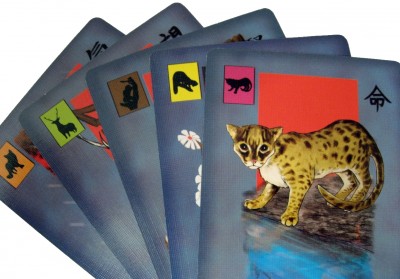
“Many years ago, in feudal Japan, disagreements and feuds were common among the clans. Fantastic battles were fought for control of resources, land, and supremacy.  Tiring of all the bloodshed, the Shogun declared a plan to minimize the violence…  All disputes would be decided by a Tessen challenge – a competitive hunt for eight types of elusive mystical animals that roamed the land. Whichever clan’s samurai were able to capture and bring back the most animals would be declared the victor, and the dispute would be ruled in that clan’s favour.  The samurai warriors from each clan would certainly attempt to sabotage the opposition’s efforts and capture their animals.  The only weapon the Shogun would allow was the Tessen, a war fan used for both attack and defence.  While the Tessen could still be deadly, there would be far less bloodshed than if the samurai were allowed to use swords.”
Tessen

So, players each have their own deck containing animal and samurai cards.  Players can draw cards, place them in one of five “cages” in their play area, or attack with a samurai card, but although actions are performed simultaneously, they must be discrete actions.  If attacked, the victim must stop immediately to either concede defeat so that the attacker can move the animals to one of their cages, or repel the attack countering with a samurai card of their own.  Each cage can only contain one type of animal and when it has three or more, the animals can be “banked” and moved into storage freeing up the cage for more animals.  The round ends when one player runs out of cards, so they are frenetic affairs which take only a couple of minutes each.  The first round was a bit of a landslide in favour of the Atika Clan, but the Nambu improved significantly on the second round to level the game.  The third round was close with the Nambu starting very aggressively, but the Atika caught up and ran out of cards first preventing the Nambu from banking her final four deer and winning the game. By this time the others had arrived, so exhausted, we left it as a best of three…
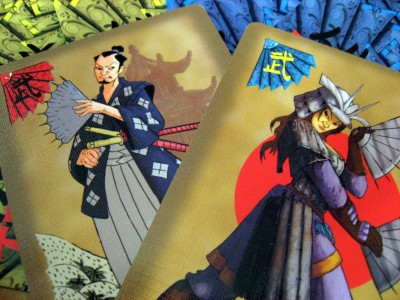
Tessen

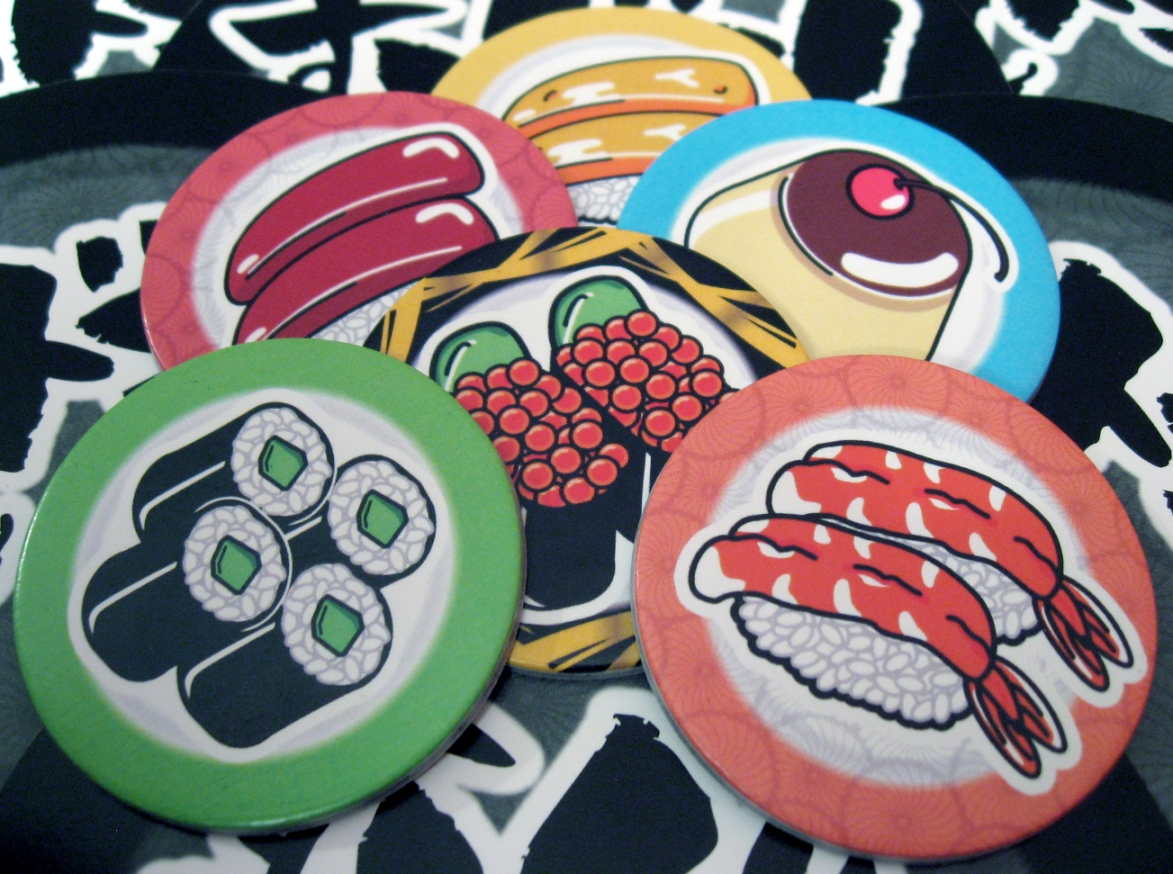
Next we played our “Feature Game” which was Sushi Draft!.  This game is similar to 7 Wonders in that it is based on “card drafting”, however, the aim is far less complex.  The story goes that the children are having a competition to see who can eat the most of one type of sushi at a Japanese family feast.  Mother, however, wants the children to eat a balanced diet, and will give pudding to the one who eats the most varied meal.  Therefore, the aim of the game is to try to do both.  Players start with a hand of six cards and then simultaneously play one before passing all but one of the remaining cards on to the next player.  Play continues until everyone has played five cards at which point the scores are evaluated and players with the most of each type get a corresponding token and the player with the most different types gets a token.  If there is a draw, then the next highest player gets the token.  About half-way through we realised that some sushi were more valuable than others which changed the game somewhat, but the damage was already done and the winner had already collected the highest value tokens.
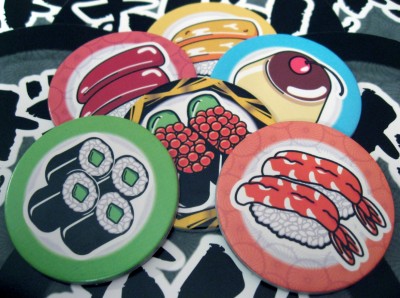
Sushi Draft

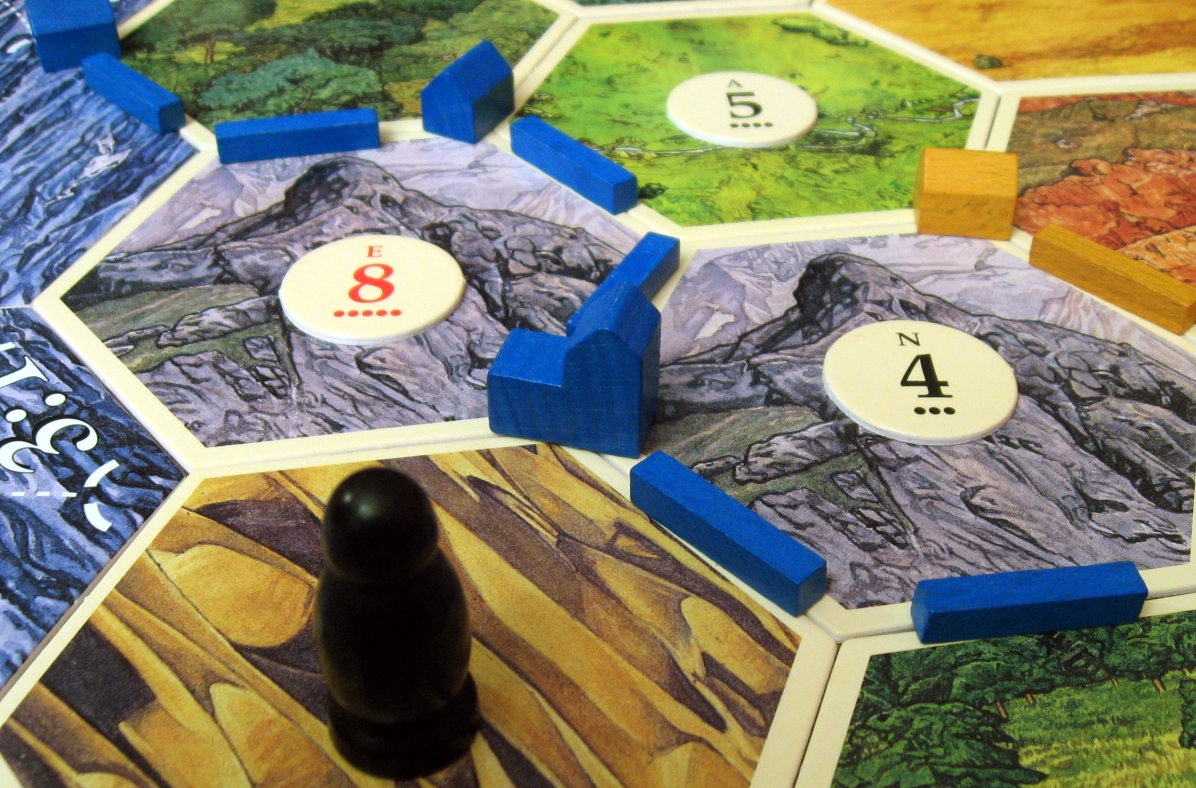
After some considerable debate, next we decided to play Settlers of Catan.  Nearly twenty years old, this is often credited with being one of the first modern boardgames.  As such, it has largely been usurped by more recent and fashionable games.  However, although we were all quite familiar with it, it was a while since most of us had played it, so we decided to blow off the dust.  The game is played on a modular board made up of hexagonal tiles corresponding to resources (wood, clay/brick, sheep, wheat/grain and ore), each of which gets a number.  Turns come in two parts.  First the player rolls two dice, adds the numbers together and anyone with a settlement on the edge of the corresponding hexagon, gets that resource.  However, if a seven is rolled, then the active player moves the robber onto one hexagon (preventing allocation resources from that hex) and then takes a card from an owner of one of the settlements surrounding it.
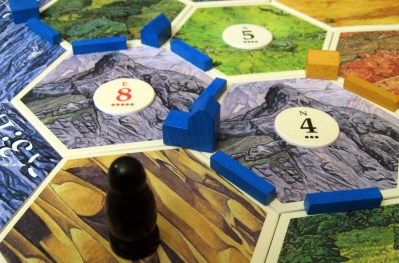
The Settlers of Catan

The second part of a turn is trading and building, where the active player can trade resources with other players at any rate they can negotiate, or with the Bank at a predefined rate.  Settlements (which score points at the end of the game) must be connected to at least one of the players other settlements by roads, and players start by placing two settlements on the board (in the player order 1, 2, 3, 4, 4, 3, 2 , 1).  Unquestionably the game has its faults, one of them being that the starting positions are really very critical.  While this is unquestionably true, it is not always obvious which positions are the best, and with the random nature of dice, sometimes double six will come up far more frequently than the statistically more likely combined totals of six or eight.

The Settlers of Catan

Since we started out with a random tile lay out we had a very, very distorted map with a lowland region containing all the sheep pasture and wheat fields in big regions with a more mountainous area of with forests and hills.  Even worse, all the clay (used to make bricks) was located on the low probability numbers (two, eleven and twelve), meaning that in theory, these would be difficult to come by.  Initial settlements were predominantly round the sixes and eights with players trying to maximise the variety of resources they had access to.  Blue settled in the highland area while Green, Orange and White tried to get a bit of everything, especially the rare clay.

The Settlers of Catan

It seemed Green had the best placement as he was the first to build a third settlement and followed it quickly with a fourth, meanwhile Blue was getting plenty of ore (which is useless at the start) but struggling to obtain bricks and ended up building a lot of road just to get something built, joined her two settlements and picked up the Longest Road in the process.  Two and eleven seemed to be rolled with peculiar regularity and Green was the main beneficiary as he had multiple settlements that qualified, while Orange and White also picked up the occasional hod-full.  Blue’s long road partitioned off an one corner of the board blocking both Orange and White in the process and when Green beat them to a couple of settlements, that left both Orange and White very tight for space to build and it was a race to the finish.

The Settlers of Catan

Orange judiciously used a monopoly card to steal sheep from everyone and then slaughtered the whole flock to build a city and a lot of road.  Meanwhile White used her impressive skills breading and exporting sheep to great effect to extend in the only direction available to her.  Blue’s productive ore and wood supplies in the mountains, together with the “ore harbour” and “wood harbour” finally started to pay dividends making up for her complete lack of any source of wheat or brick.  Green meanwhile, used his vast grain empire to build cities and collect development cards in an effort to build the Largest Army.  With Blue one point from winning with the cards she needed to build one last city in hand, Green needed just one more Soldier to get the Largest Army and bought a development card.  Although it turned out that three of the next four cards were Soldiers, Green was unlucky and Blue took the win.
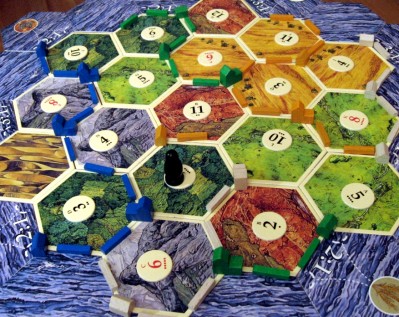
The Settlers of Catan

Learning Outcome:  Some of the old classic games are classics for a reason and should not be neglected.

28th January 2014

This week was memorable for a number of reasons.  Firstly, the non-playing member of the group, had been to the vet for the first time in about fifteen years and she didn’t like what they did to her (in fairness, she started it by taking a chunk out of the vet, but it is certain both she and the vet won’t forget the day quickly).  Secondly, nearly every current member turned up, the first time this had happened since the fire at the Jockey, and with the added bonus of a new member, we were just a bit pushed for space.  It is a very nice problem to have though, especially since this time last year we were really struggling.

Zooloretto: The Dice Game

People arrived gradually, so we started with our “Feature Game”, the filler Zooloretto:  The Dice Game.  This is closely related to the tile laying game, Zooloretto, which we’ve played before.  Both use the “Coloretto mechanism” which is a variant of the “I divide, you choose” mechanism that children sometimes use when sharing a cake.  Basically, the idea is that players take it in turns to roll dice (or draw tiles or cards depending on the game) and choose which “truck” to place them in.  When they see a truck they like, they can choose to take the contents instead of rolling (then they sit out of the rest of the round).  In the case of the dice version, players are collecting custom animal dice;  the idea is to have as many as possible up to a given limit and exceeding the maximum incurs a penalty.  The first two people to arrive were about half way through when two more turned up and joined in for a second game.

Zooloretto:  The Dice Game

After the second game we had a quick game of “extend the table, rearrange the furniture and hunt for extra chairs” and were just finishing as the last group arrived.  After some discussion, we decided to split the group into two and the first group played Montego Bay.  This is a game that we played last year and all felt that it was quite enjoyable, so we decided to give it another outing.  In summary, players control two figures, a large docker and a small docker who are travelling round the warehouses collecting barrels of rum to place on ships before they sail.  There are two aspects to the game, the first is the priority given to filling boats because, when a boat sails, the player with the largest number of barrels on board scores the most points.  Secondly, everyone chooses how far to move their dockers simultaneously at the start of the round, however, players take their turns in a prearranged order which leads to an interesting juxtaposition of chaos and “double-think”.  In this game, Orange came back from the dead with optimal use of “Lazy Jack” to win by four points.

Montego Bay

Meanwhile, the second group played 7 Wonders, which we played at New Year.  Played in three rounds, this is a card drafting game where players take one card from their hand and then pass the rest on, then repeatedly do the same with the cards they receive until there are none left.  The idea of the game is to build an civilisation and complete their “wonder”.  For the last game there were seven of us and it was over-long and completely disorganised chaos.  This time there was a much more manageable number and it worked much, much better.  One player had played it many times before and it showed in the score with him winning with fifty-two points, five ahead of second place.  The other group were only about halfway through their game though, so that gave an opportunity for a rematch.  Revenge was duly served as the game finished with the winner of the second game fifteen points clear of a tight pack which included the winner of the first game.

7 Wonders

For the last game we got back together as a large group and finished with a game of SaboteurWe played this nearly a year ago, but again didn’t have an optimal number of players.  This time, with more than twice as many, the game played much, much better.  The idea is that players are digging for gold by laying cards to form tunnels.  Everyone is either a “Dwarf” or a “Saboteur” and at the end of the game, points are given to the Dwarves if they extend the tunnel to find the gold, and Saboteurs if they succeed in stalling the Dwarves so much that they fail.  In addition to extending tunnel network, players can also play cards that inhibit the digging ability of others, or alternatively remove an impediment someone else has played.  The first game everyone was watching our “Habitual Saboteur” and waiting for him to do something suspicious, meanwhile, another player moaned about the nature of his hand, and kept discarding cards and everyone else seemed to get on with digging.  The Dwarves were about halfway there when one player declared she was a Saboteur and played a very obstructive card and immediately received a hail-storm of broken tool cards.  It was only after the Dwarves had run out of cards that the “discarder” showed his true colours as a Saboteur and the Habitual Saboteur wasn’t (this time).

Saboteur

In the second round, our Habitual Saboteur made up for his good behaviour in the first round and teamed up with the Saboteur Queen.  It looked like the dwarves might just make it when another Saboteur jumped out of the shadows throwing broken tools at all the Dwarves and putting the gold definitively beyond their reach.  Going into the final round, the Saboteur Queen (who ended up obstructing in all three rounds) had what was thought to be an unassailable lead with six points to a maximum of three elsewhere and a third failure for the Dwarves would have given her a landslide victory.  However, this time she only had the one team-mate which made it much more difficult for her to obstruct the tunnellers and, in due course, it was the Habitual Saboteur (who once again, surprisingly, wasn’t) who laid the final card and found the gold.  He managed to take a total of four points from the last round and just pipped the Saboteur Queen to the win.

Saboteur

Learning Outcome:  Don’t believe anyone when you know there is a Saboteur in your midst!

31st December 2013

The evening started with a quick two player game of “extend the table and try to find space for it”.  Just as we were finishing, one of our regulars arrived with his family, including his dinosaur-pyjama-clad four year old – unquestionably the youngest GOAT to date!

PitchCar

As planned, we started off with our “Feature Game”, the gorgeous, dexterity car-race, PitchCar.  The idea of this game is that, starting with the player at the front of the field in each round, players take it in turns to flick their small wooden car round the custom-made circuit.  Since the game was new to so many of the players, we started out with a simple track with just one jump (from the first expansion) and smooth corners (from the second expansion).  Despite their tender years, Black and Yellow demonstrated a remarkable aptitude, and Black ran in the easy winner.

PitchCar Track 1 - 31/12/13

The first game was such a hit that when three more people arrived, we built a second, slightly more complex track while pizzas were “prepped”.  In this game, Blue (played by one of the new arrivals), quickly got half a lap ahead and managed to maintain his lead until the end.  This was followed by a game of “hunt for enough chairs” by which time, the first of the pizzas were ready.  By this time, despite it being two hours past his bedtime, “dinoGOAT” was still keen to play on, however, we managed to persuade him (with the aid of a mince pie) that it was bedtime and we’d play Dinosaur Race another time.

PitchCar Track 2 - 31/12/13

That left us with just enough people to give the first of our “Christmas Games” an outing.  Waldschattenspiel is not, as you might think, a game about what bears do in the woods.  It is actually a really unusual game, played in the dark, where one player (the designated adult!) operates a candle and the others are little dwarf meeples with felt hats.  The idea is that that wooden trees cast shadows, and the dwarves, who start the game hiding in the woods, have to meet up together behind the same tree. The snag is that when they move, they must do so without being illuminated by the candle. Any photophobic dwarves caught in the light become “frozen” and are unable to move until they are rescued by other dwarves.  The dwarves started out badly when Green got trapped, and then frozen, very early on.  The rest of the dwarves managed to meet up, but in a failure of strategy, tried to rescue Green as a group.  When they all got trapped and only Red was able to escape, the writing was on the wall and the Candle scored a win on the next move.

Waldschattenspiel

Next up was the second of our Christmas Games, 7 Wonders.  This is a card drafting game, where each person picks one card from their hand to play, then passes their remaining cards on to the next player.  The aim of the game is to build your civilisation by developing your science and technology and building one of the seven wonders of the ancient world.  We played the ‘A’ side and with seven players, most of whom had never played it before, there was a lot of chaos, and the game was a bit of a mystery to a lot of us. However, the game was won by one of the new players, who, as well as successfully building the Hanging Gardens of Babylon, also had a strong army and had a well developed civilisation.

7 Wonders

A couple more players left and the rest of us played with the tower from Amerigo while we decided what the next game should be.  Enticing though it was, it only played four, so, after much deliberation, we decided to play Dixit.

Amerigo

This is a clever, light card game, where the “active player” secretly chooses a card and uses a sound, word, phrase or sentence to describe it.  The other players all choose the best card from their hand to match the sentence and secretly hand them to the active player who shuffles the cards and displays them to everyone. The players then try to guess which card was played by the active player with points being awarded for choosing correctly, having your card chosen by another player, and, as the active player, for being ambiguous enough to ensure that some players, but not all, chose their card.  The artwork by Marie Cardouat is wonderfully surreal and the game produced some equally peculiar clues in what ended up as a close game. Blue took an early lead, but it couldn’t last and, everyone else closed, pausing for just a brief interlude to sing Auld Lang Syne and watch fireworks (it was raining, so we “wimped out” of setting off our own and just admired everyone else’s from the warm; one group were especially obliging and set off some very nice ones just outside the window!). White snuck ahead of Blue with the last point of the game, and took the first win of 2014 adding it to her last win of 2013. This was in contrast to Red who lost both the last game of 2013 and the first game of 2014!

Dixit

Learning Outcome:  Cold pizza isn’t that bad after all!