Tag Archives: After Us

4th March 2025

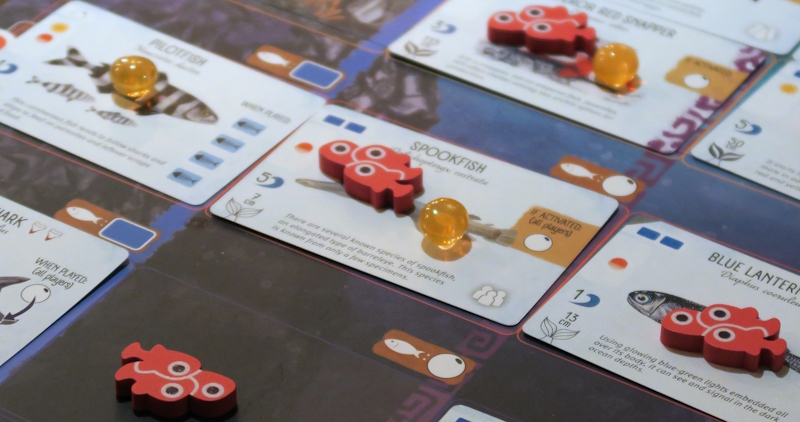
Once people had finished eating, the group settled down to play. There was quite lot interest in the “Feature Game” which was Finspan, a fish-themed version of one of the group’s favourite games, Wingspan.  It is advertised as shorter and lighter than the original, but in the event it was only slightly shorter and not much lighter though it was generally agreed to be a bit smoother and therefore perhaps easier to teach.  Like Wingspan. Finspan is card-based, though the cards are fish instead of birds, albeit just a beautifully illustrated.  As in Wingspan, players have a hand of cards (in this case open) and on their turn can choose to play one from their hand or activate one area or Dive-site of their player board (blue, purple or green), in this case representing the ocean.
Finspan
– Image by boardGOATS

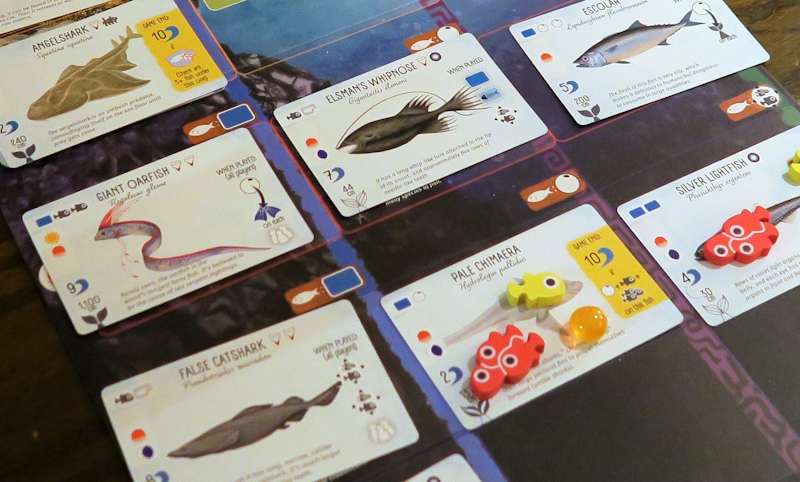
In the case of Finspan, the Dive-sites are arranged vertically (instead of horizontally), but rather than placing cards in order (from left to right in the original), the Fish cards have to be placed at the correct depth for the Fish—some live in the shallows, others in the deep sea, while a small number live in the “twilight” region, between the two.  As in the original, there is a cost for playing cards—fish eggs, Young,Schools and/or other cards. Unlike the original, however, cards spent in this way are placed into players’ own personal discard pile and there are mechanisms for getting them back later in the game.

Finspan
– Image by boardGOATS

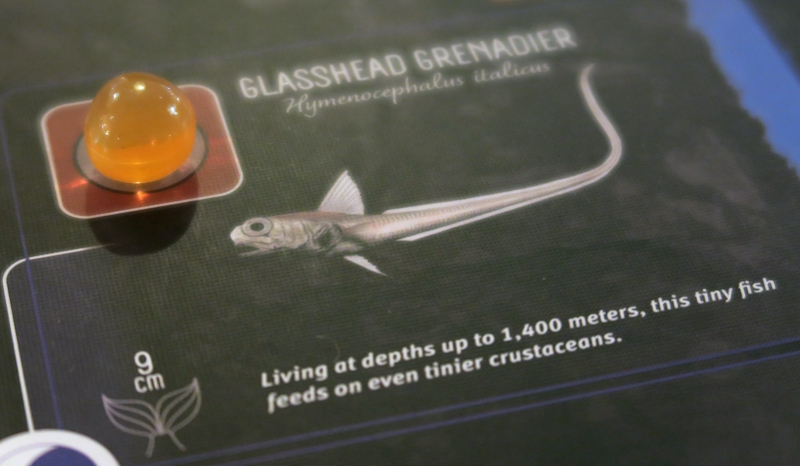
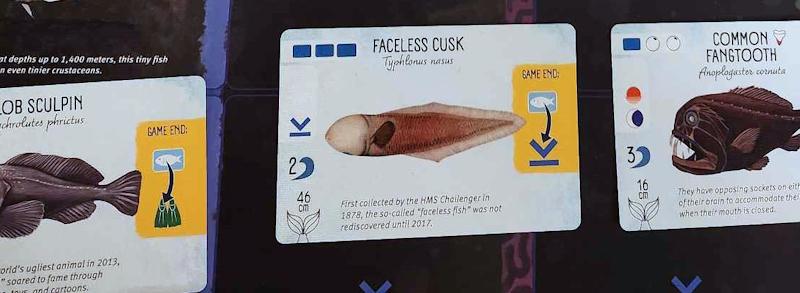
Another way that Finspan is different to the original, is the way the Dive-sites are activated. As in Wingspan, cards are activated in order, in this case, from the shallow “sunlit” zone to the “midnight” deeps. The Fish cards have “when played”, “when activated” and “end of the game” powers, but there are fewer cards that have a power on activation and many of these affect all players too. In addition to the difference in the balance of the cards, when a Dive-site is activated, the three zones each give a benefit as long as they have at least one Fish card in them.  These benefits are capped though, as multiple Fish doesn’t increase the income. The first time each player activates a Dive-site in a round, they also get a bonus benefit.
Finspan
– Image by boardGOATS

There are a small number of Fish pre-printed on players’ boards, which mean than some areas give benefits from the very start of the game.  The effect of all this is to give the game a more friendly feel than Wingspan, without reducing the challenge of the game.  There is another major change which significantly adds to the complexity. In Wingspan, a key part of the game is Egg production with Eggs worth a point each at the end of the game.  In Finspan, players also produce Eggs which are worth a point at the end of the game, but each Fish card can only be used to store one single Egg. Eggs can be hatched to give young (also worth a point) and three young on the same fish form a “School”.
Finspan
– Image by boardGOATS

Schools of fish are worth six points at the end of the game.  And this is where the game gets a little “head-hurty” as Young and Schools can be moved around, but while Young can share a Fish space, once they have formed a School, they can’t share a space with another School—one School can’t even pass through a space containing another School.  The game is played over four rounds (or Weeks) with points for achieving objectives at the end of each one.  These are added points gained for each Fish card, Eggs, Young, Schools and any end game actions to give a final total—the player with the most points is the winner.
Finspan
– Image by boardGOATS

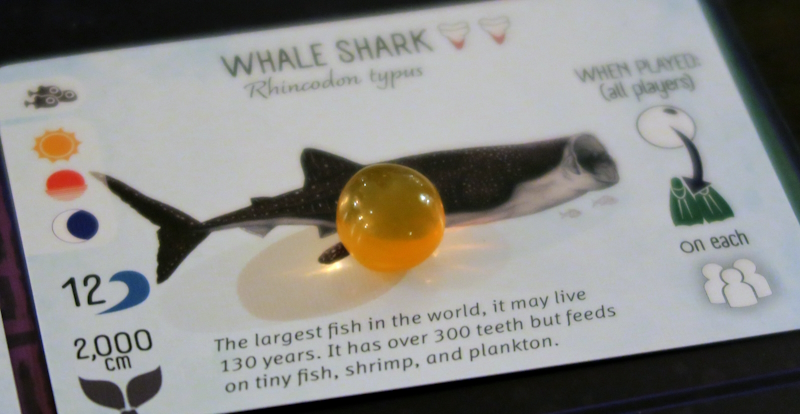
As there was a lot of interest in the game, the group set up two tables. Jade, Sapphire, Plum and Byzantium had played it at a convention over the weekend, so Jade led one game with Blue, Ivory and Sapphire, while Plum led the second with Byzantium, Black and Pine. Jade’s group was the first to complete the rules explanation and got going. Ivory was quite excited by the idea of collecting sharks, and while Blue found Nemo, Sapphire found Dorry.  The points from the end of the Week objectives were pretty even for the first three weeks, though only Ivory got much at the end of the final week taking twenty points for his end game bonuses, largely due to having a lot of sharks.
Finspan
– Image by boardGOATS

Blue top-scored for her fish while Jade scored the most for his Schools. In the end, Blue’s hundred and fifty-five took victory with Ivory in second eleven points behind, three points ahead of Jade. Over the other side of the room, Plum’s game was slower to start, but finished at much the same time.  This game was lower scoring and closer too; almost everyone picked up some end game bonuses, but not as many as Ivory, and there were fewer Schools.  The winner was Byzantium, with one hundred and thirty-one, just two points ahead of Plum who was just a nose in front of Black.  All in all, everyone had enjoyed the game as a nice variant on the well known original.
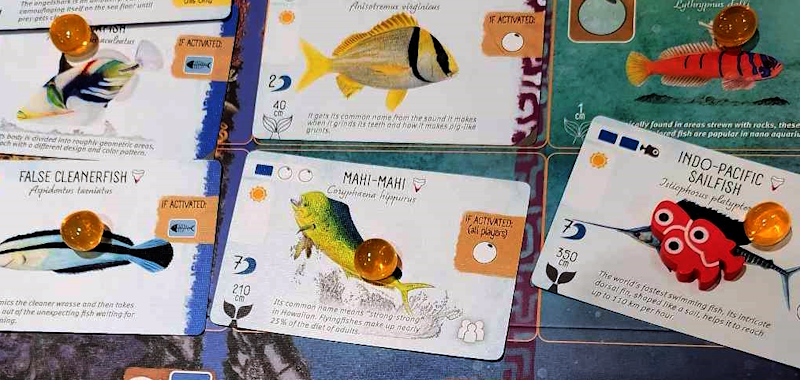
Finspan
– Image by boardGOATS

Meanwhile, on the next table, Pink, Cobalt, Lime and Purple had begun by playing Tokaido.  This is a sort of time-track game where the player at the back takes their turn moveing forward to an empty space of their choice taking turns until they are no-longer the one at the back at which point the new “Lantern Rouge” takes their turn.  Each space allows players to collect panoramas, chance it with a random draw for points, buy souvenirs, donate at a temple or work on a farm to gain cash.  At intervals, players have to stop for food which costs money, but the last player to arrive at the restaurant last gets the least choice which can be a catastrophe as these meals are usually more expensive with the risk that they are the same as those eaten on previous stops, which means they can’t eat and therefore don’t score.
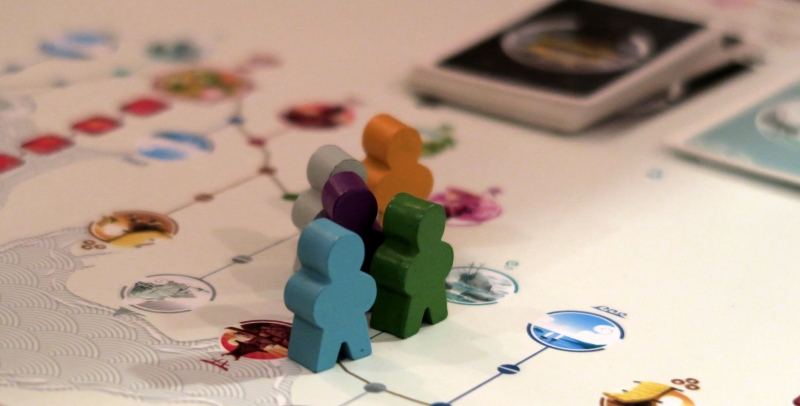
Tokaido
– Image by boardGOATS

Although it is quite popular within the group, Cobalt was new to the game and commented that it was quite mean when he realised that once a space had been taken it was gone.  The group played with the choice of two character cards at the start—Pink felt that his Traveler, Hiroshige, was a poor choice as, although he got a free panorama card at each food stop, it didn’t give him much money at the start.  On reflection, he felt Purple had made a better decision in choosing Yoshiyasu, who gave her nine Yen.  Lime was the runaway winner with ninety-one, some fifteen more than Purple who just sneaked into second ahead of Pink.

Tokaido
– Image by boardGOATS

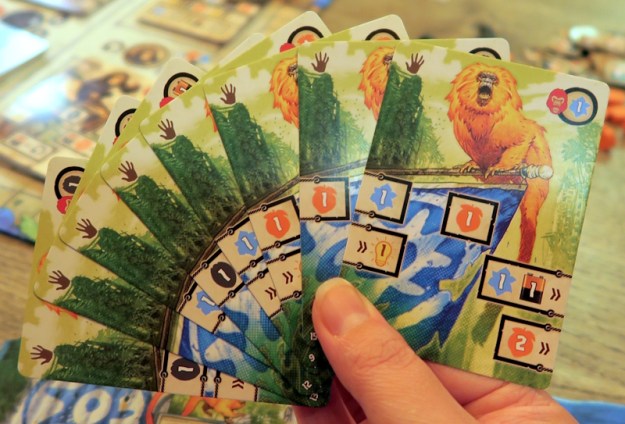
As the games of Finspan were still going, Cobalt introduced the group to After Us, aka “The Monkey Game”.  This had an outing within the group about eighteen months ago, but was new to Pink and Lime. It is a deck-building, resource management, engine building game featuring an original card-combo mechanism. The story is that mankind has died out leaving only apes which have kept evolving. As the leader of a tribe, players add new Primate Cards to their starting deck of tamarins. Primate Cards have three rows of “Effects”—the top row will award resources, the middle row will give points (often at the cost of resources) and the the bottom row will have abilities related to the primate type. At the start of a round, players draw four Primate Cards from their deck to be laid out in a row making “Connections”.
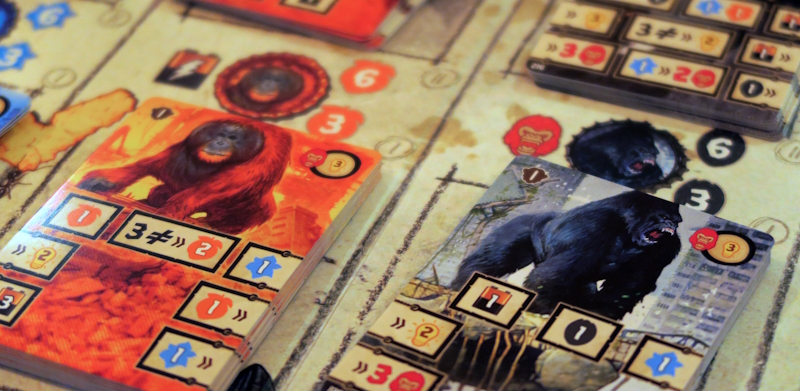
After Us
– Image by boardGOATS

The aim is to get the most out of the Connections by closing the open ended “Frames” along the sides of the cards by butting them up against adjacent cards that also have open ended Frames. Players then resolve the now closed Frames following the order of top left to bottom right, trying to gain as many bonuses as they can. Once everyone has simultaneously collected their Resources they can then use them to buy Primate Cards which are added to the top of the draw deck (and thus they come into use on the very next turn). In this way, they are improving the quality of their deck.
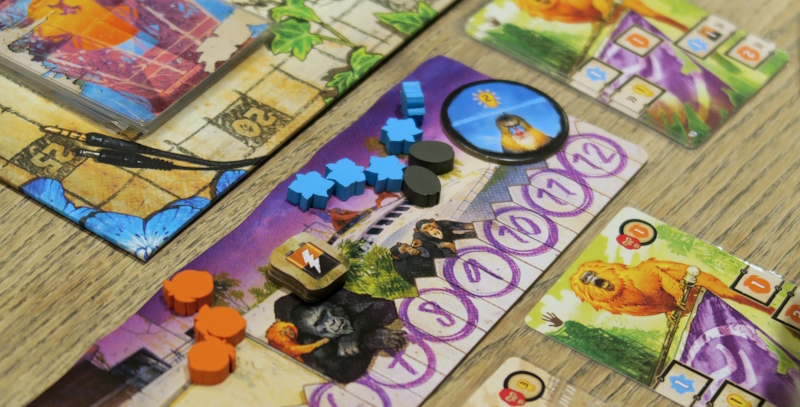
After Us
– Image by boardGOATS

One of the good things about the game is that if a player gets a bit “hosed” by the card draw, the frames mechanism allows them to make the best of a bad job.  The Frames have been resolved, the players simultaneously chose one of their Action Discs denoting which primate type they want to recruit.  The game starts slowly with players building their tribe, but it can end in a sudden rush when one player breaks into a gallop and charges past eighty points triggering the end of the round and this game was no exception.  Lime was again the victor, with sixty-nine points, with Pink second, some nine-points behind.

After Us
– Image by boardGOATS

Learning Outcome:  Jaws was not the only shark.
14th Movember 2023

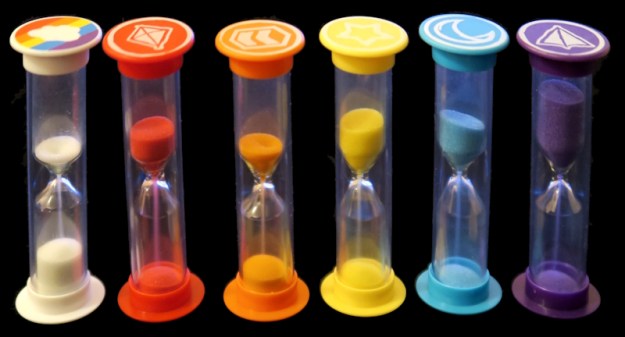
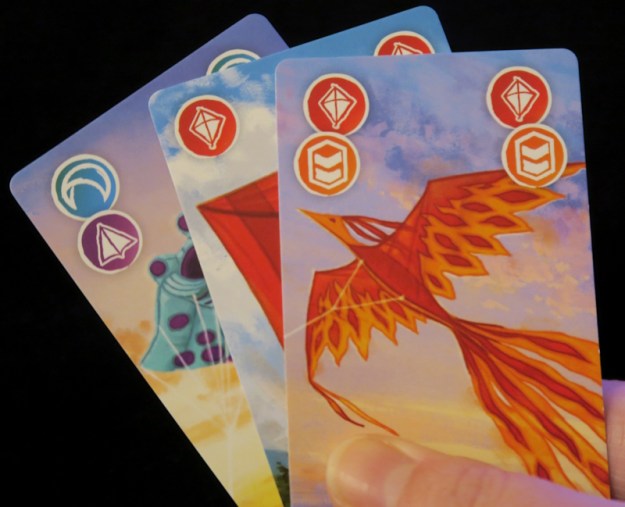
With Black, Teal, Pink, Green and Lime all away, it was looking like it was going to be a very quiet night.  In the event, however, the numbers remained good with the slightly unexpected arrival of Plum, Byzantium, Jade and Sapphire.  When Green dropped off Purple and stayed for a while, it became clear that we’d need something short to play alongside Kites, the “Feature Game“.  Kites is a real-time, cooperative game where players are playing cards and flipping egg-timers to keep the air display going.  A single play-through doesn’t take very long, but it is the sort of game that tends to get played through a couple of times in succession.

Kites
– Image by boardGOATS

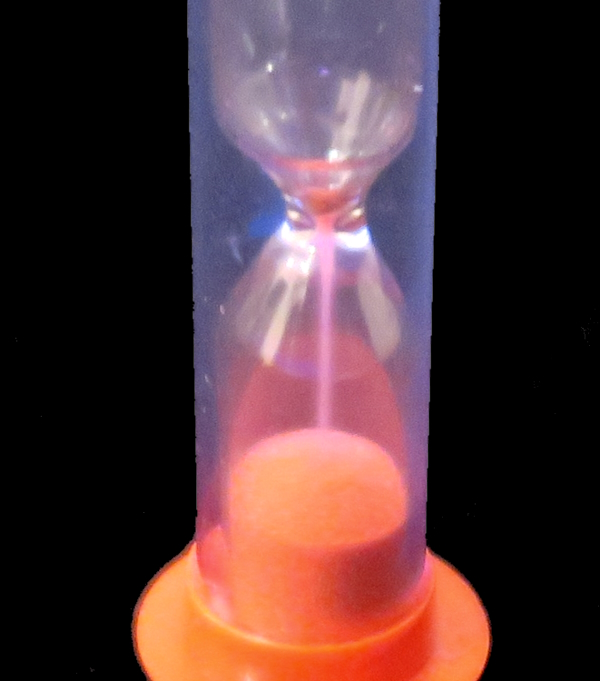
The idea is that that the Team have to launch six Kites, each represented by sand timers, and keep them flying by preventing the timers from running out.  Game play is very simple:  Players start with a hand of cards and must play one on their turn before replenishing their hand from the draw deck.  The cards all show either one or two coloured symbols on the corner, which correspond to the six coloured egg-timers in red, orange, yellow, blue, purple and white/rainbow colours that represent the different Kites.  When a card with two symbols on it is played, both egg-timers in those colours must be turned, however, a card with one just one symbol allows the active player to choose whether to turn the timer in that colour or to flip the white/rainbow coloured timer instead.

Kites
– Image by boardGOATS

The game ends when either all the cards are played out (the Team win), or when one of the timers runs out of sand (the Team loses).  There are a couple of additional “features”.  Firstly, the different coloured timers each have different amounts of sand in them—the purple lasts the longest at ninety seconds with red running fastest lasting just thirty seconds.  This catches out the unwary, and indeed it caught out the group composed of Jade, Plum, Blue, Purple, Pine and Byzantium on their first try when they succeeded in playing just four out of the fifty-three cards in the deck.  The second attempt wasn’t much better, ending with just six cards played.

Kites
– Image by boardGOATS

The game has an “easy start” mode where players start with just three coloured Kites (plus the white/rainbow one), but nobody was keen to take cards out of the deck.  So, to make things a little easier, instead of starting with three cards in hand as per the rules, the group started with a hand of four cards, giving them a little more in the way of choice on their turn.  With this “House Rule” they were a little more successful, but it was at the fourth attempt, that things clicked, and the group finished with only twelve unplayed cards.  And it was then that the second “feature” caught out the group—when the draw deck has been exhausted, players can no-longer turn the white/rainbow timer.

Kites
– Image by boardGOATS

Having done well with four cards in hand, it was then that the group decided to revert to the rules “as written” and play with three cards in hand.  This made things more difficult during the early part of the game, but had the advantage of leaving players with fewer cards to play once the draw deck had been exhausted.  At that fifth attempt, the players were left with just six cards unplayed, and on the sixth try, they had eight left.  They were so close, they could feel it, and everyone in the group was determined not to stop before they’d won, which turned out to be on the seventh play.

Kites
– Image by boardGOATS

Kites is not the usual sort of fare for many in the group, being both cooperative and featureing real-time play.  It had been interesting and fun, however, with players learning how to work together and what information they needed to share.  Two people took responsibility for turning the timers and everyone else made sure they let people know when they spotted a timer running low.  Perhaps the biggest impact was the realisation that waiting was sometimes more powerful than playing quickly, and certainly more haste often brought less speed.  With the successful game, everyone felt they’d had enough, and while the other table finished their game, the group moved on to another party-style game, the simple little memory game, That’s Not a Hat.

That's Not a Hat
– Image by boardGOATS

Each player starts with a single card and shows it to all the other players before turning it face down.  One player then draws an extra card shows it to all the other players and passes their original card to the left or right (as per the arrow on the back of the card), announcing what they think it is.  The receiving player can either accept the card as it is, or challenge the declaration.  If a challenge is incorrect, the recipient keeps the card as a penalty point, whereas a correct challenge leaves the card/penalty point with the gifter.  It seems very simple, and doesn’t sound promising when described, however, after a couple of turns, when someone realises they can’t remember the card they’ve got in front of them and is forced to guess, the tension mounts and everyone suddenly appreciates the game.

That's Not a Hat
– Image by boardGOATS

Byzantium, Plum and Jade had played the game before and knew what to expect, but it was new to everyone else.  Most people thought they knew what card everyone had, only to discover that wasn’t the case after a couple of swaps.  Blue and Purple picked up just the one penalty, while Plum and Jade picked up a couple each.  After the game, there was some discussion about challenges needed to be accompanied with the correct card identity (which is how Plum had played it it HandyCon).  With this, it actually paid to try to bluff/confuse people who couldn’t identify the correct gift.  Inspired by this, there was some discussion about a possible “House Rule” to introduce a bit more jeopardy:  the challenger could optionally attempt to name the gift with the carrot of forcing another point on their gifter, and an incorrect guess reversing the effect of the challenge.

That's Not a Hat
– Image by boardGOATS

That was for another day.  This time, the winners, were Pine and Byzantium who avoided any penalties, though whether that was by luck or judgement wasn’t entirely clear and indeed, was unimportant.  That was especially true as the game was brought to an abrupt end by the game ending on the next table.  That was 7 Wonders—Green only wanted to play something short that he was familiar with and this fitted the bill.  7 Wonders is a card-drafting game, but has a bit of a “Marmite Factor” and is very unpopular with a significant number in the group, so rarely gets played.  This time though, Cobalt, Ivory and Sapphire were all happy to join Green and give 7 Wonders an outing.

7 Wonders
– Image by boardGOATS

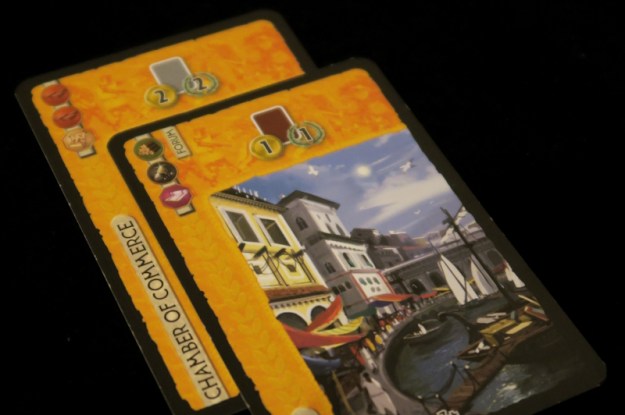
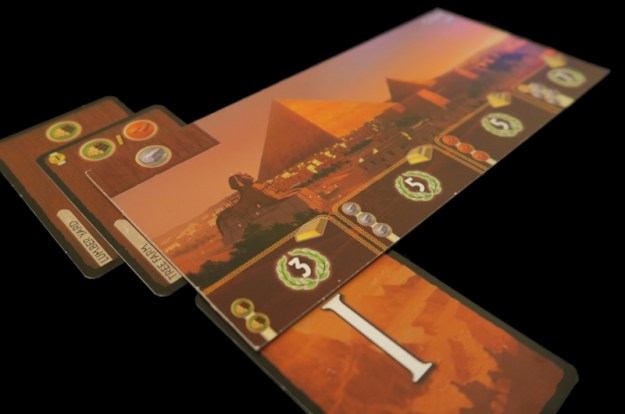
In 7 Wonders, players take the role of leader of one of the seven great cities of the Ancient World (Alexandria, Babylon, Ephesus, Giza, Halicarnassus, Olympia and Rhodes), gathering Resources, developing commercial routes, and developing their Military, build their City and erecting an architectural Wonder.  In each round or age, players receive seven cards and draft them, that is choose one card, then pass the remainder to their neighbour (much like Sushi Go! or Draftosaurus).  Players then reveal their cards simultaneously, paying Resources if required, collecting Resources or interacting with other players according to the cards played ant their player board (which gives special powers).

7 Wonders
– Image by boardGOATS

7 Wonders is essentially a card development game:  Some cards have immediate effects, while others provide bonuses or upgrades later in the game.  Some cards provide discounts on future purchases while others provide Military strength to overpower neighbors and some cards give nothing but victory points. Each card is played immediately after being drafted, so everyone knows which cards their neighbor is receiving and how their choices might affect what they’ve already built.  Players continue to draft cards until everyone has six cards (discarding the seventh).  The game ends after three rounds or ages.

7 Wonders
– Image by boardGOATS

7 Wonders is quite a famous game that Cobalt had heard about it and wanted to try, though he was the only one from the group who was unfamiliar with it.  It is one of those games where it seems like there is a lot to take in, but actually it is really quite simple and easy to pick up (though players do tend to require a round to see how it all plays, and there are only three in the whole game).  Everyone chose their respective Sides of Wonder.  Ivory who had Giza, elected to go for Side B, which has a four-piece Wonder and would give lots of points if he could complete it; Cobalt (Halicarnassus) chose to go for the simpler Side A, which would give him points and a chance to rifle through the discard deck for a card if he managed the second stage.

7 Wonders
– Image by boardGOATS

Sapphire (Ephesus) felt both sides were the same, money & points, just in different ways, while Green (Olympia) went for his Side B where he could have the option of copying a neighbour’s end game purple scoring card and the ability to buy Resources for only one coin each instead of two.  As expected the first round was a little slow as Cobalt felt his way around the cards and options, with help from the rest of the group, particularly from Ivory who was sat next to him and was initially passing his cards to Sapphire (so he could show Ivory the deck for some explanations without giving anything away).

7 Wonders
– Image by boardGOATS

The first round was gentle. Ivory and Sapphire lost out in the fight to Cobalt and Green.  In the second round Cobalt had to use his “Muppet Allowance” and swap a card he had kept when others pointed out he should have taken the other one.  Green was building up his army and building his Wonder with a lot of his own Resource (even though he had the Wonder benefit). Cobalt and Sapphire were beginning to specialise in the green Science cards.  Ivory was not really sure where he was going as he was beginning to lose out by not having access to the vast amount of Resources he needed to build his epic Wonder.

7 Wonders
– Image by boardGOATS

By the third and final round we everyone had the problems associated with trying to choose the best of a good bunch of cards.  Green and Cobalt ended up in an army fight, with six points at stake and already a reasonable army, it wasn’t a battle either of them wanted to give up on. The result was that they both let other good cards pass by.  By the end there were not many purple cards left, as it seemed a few had been used to build the Wonders, so Green’s “Copy” did not score heavily, although he did win the battle with Ivory (and subsequently with Sapphire too). Sapphire managed to get a full set of Science and a couple of single type multipliers, thus learning the power of Science in 7 Wonders (which is often hard to achieve).

7 Wonders
– Image by boardGOATS

By the end scoring, it seemed that Ivory, unusually for him, had indeed been boxed into a corner and ended up some way adrift of the rest of the group.  That aside, it was a very close contest between Cobalt, Green and Sapphire, with only a couple of points between each of them, but it was new player Cobalt who took the Laurels of victory.  Everyone enjoyed the game, so it might get another outing soon for which Green would be particularly grateful as it had always been a firm favourite of his.  With all the early games over at the same time, it was possible to swap the groups about as Green took an early night.  Jade was keen to introduce people to After Us, a game he had picked up at the UK Games Expo and hadn’t yet had the opportunity to introduce the group.

After Us
– Image by boardGOATS

After Us is a deck-building, Resource management, engine building game featuring an original card-combo mechanism.  The story is set in 2083 and mankind has died out leaving only apes which have kept evolving. As the leader of a tribe, players try to guide it towards collective intelligence, by adding new Primate Cards to their starting deck of tamarins. Primate Cards have three rows of “Effects”—the top row will award resources, the middle row will give points (often at the cost of resources) and the the bottom row will have abilities related to the primate type. At the start of a round, players draw four Primate Cards from their deck to be laid out in a row making “Connections”.

After Us
– Image by BGG contributor The Innocent

The aim is to get the most out of the Connections by closing the open ended “Frames” along the sides of the cards by butting them up against adjacent cards that also have open ended Frames. Players then resolve the now closed Frames following the order of top left to bottom right, trying to gain as many bonuses as they can.  Once everyone has simultaneously collected their Resources they can then use them to buy Primate Cards which are added to the top of the draw deck (and thus they come into use on the very next turn). In this way, they are improving the quality of their deck.  The Frames have been resolved, the players simultaneously chose one of their Action Discs denoting which primate type they want to recruit.

After Us
– Image by boardGOATS

The Action Disc chosen will also gives the player a bonus. When recruiting, players have an option to pay three or six Resource (fruit, flowers or grain) to gain a Card. Players can additionally spend two Resource during this phase to copy one of their neighbours’ Action Disc bonus.  Once everyone has resolved their Action Disks and bonuses, players discard their cards and draw four new ones and start again.  The game starts slowly with players building their tribe, but it can end in a sudden rush when one player breaks into a gallop and charges past eighty points triggering the end of the round.  In the shuffle, Cobalt joined Byzantium, Jade, Blue and Purple playing After Us.  Jade and Byzantium led the way (both being familiar with the game), while the others felt their way.

After Us
– Image by boardGOATS

Arranging the cards to make the Connections proved the biggest challenge initially, especially when frustratingly, it wasn’t possible to make use of a really good half Frame.  Blue, Purple and Cobalt just started collecting cards as well as they could, but Jade showed everyone an alternative, shedding all his starting cards until he had no tamarins at all.  It was then that  Byzantium suddenly started surging forward on the points track—having picked up a small number of good quality primate cards and shed a few tamarins he just turned the handle on his engine and it was too late for anyone else to do anything about it.  And he was the first to cross the eighty point finish line, with Blue (who had put on a bit of a spurt) in second.

After Us
– Image by boardGOATS

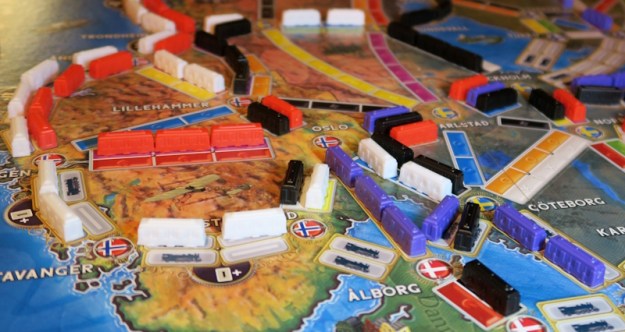
Meanwhile, Ivory, Plum, Pine and Sapphire settled down to to play the new Scandinavian edition of Ticket to Ride, Northern Lights.  Like all the other editions, players take it in turns to either take two coloured cards from the market, pay cards to place trains or take more ticket cards.  Like all the different versions, Norther Lights has a small number of special rules, but unfortunately, the rules in the box are in Danish, Swedish, Finish and Norwegian, and nobody in the group is a speaker, worse, although we played it about three months ago, nobody could remember the rules, so it was out with the phones to get translations.  The biggest difference boiled down to the addition of bonus cards, four of which are drawn at random at the start of the game and give extra points at the end.

Ticket to Ride: Northern Lights
– Image by boardGOATS

Additionally, there are some triple routes (which only take effect with five players) and some routes have a “+X” next to them which give players who build them X train cards from the face down pile.  Finally, for all routes Locomotive cards can replace any other card and for ferry routes Locomotive cards can be replaced with a pair of the same colour (and as a result, unlike most of the other versions, if there are three or more face-up Locomotive cards in the market, the market is not refreshed).  This time, the bonus cards drawn at random gave points for the most stations in Norway, the most stations in the arctic circle, the most successfully completed small Tickets, and the longest continuous connected train route.

Ticket to Ride: Northern Lights
– Image by boardGOATS

While everyone else seemed to be taking more and more tickets, Plum focused on completing her three starting Tickets, two fairly long ones running north-south, and a short one across the top.  It was a tight game for the podium places, though with Ivory, Pine and Plum vying for the lead.  Ticket to ride is often a high-risk, big-reward game though and if Plum had taken Tickets on her final turn instead of placing a single train for one point, she would have gained two more tickets and an additional twenty point which would likely have given her victory.  As it was, she finished in third, behind Ivory in second and Pine the worthy winner with a hundred and twenty-five points.

Ticket to Ride: Northern Lights
– Image by boardGOATS

Learning Outcome: Keeping kites flying takes teamwork.

UK Games Expo 2023

It is hard to believe that it is a whole week since the start of the sixteenth UK Games Expo.  With the Friday falling in half-term week for most schools, attendance reached an all-time high with reports of 32,000 unique visitors over the three days of the event—a remarkable bounce back from the 10,671 in 2021 (the first Expo after the cancellation in 2020).  As in previous years there was a viking encampment outside the NEC, and the queues to get in to the main halls were substantial.

UKGE 2023
– Image by Jade

Inside, though busy things were more manageable, gamers from boardGOATS managed to run into each other by accident, which was quite remarkable considering the massive crowds.  Queue conversations were quite a thing this year, especially in the queue for the Bring and Buy which was spacious and well laid out.  The Bring and Buy itself was especially good for Buyers this year as there were constantly new items being put out (though it was perhaps more frustrating for Bringers as their items weren’t put on display until there was space).

Hegemony: Lead Your Class to Victory
– Image by Teal

There were some great demonstrations of new games. One highlight was playing as the State in Hegemony: Lead Your Class to Victory, a great, new, heavy-weight, political board game.  There were also demonstrations of Undaunted: Stalingrad as well as for Vivarium and Vaalbara from the marvelous folks on the Hachette Boardgames UK stand (all of which came out last year).  There was a hilarious reading of Ian Livingstone’s City of Thieves and foiling a dastardly aristocrat’s demon-summoning plans in the new, one-shot RPG, Candela Obscura was memorable too.

UKGE 2023
– Image by Jade

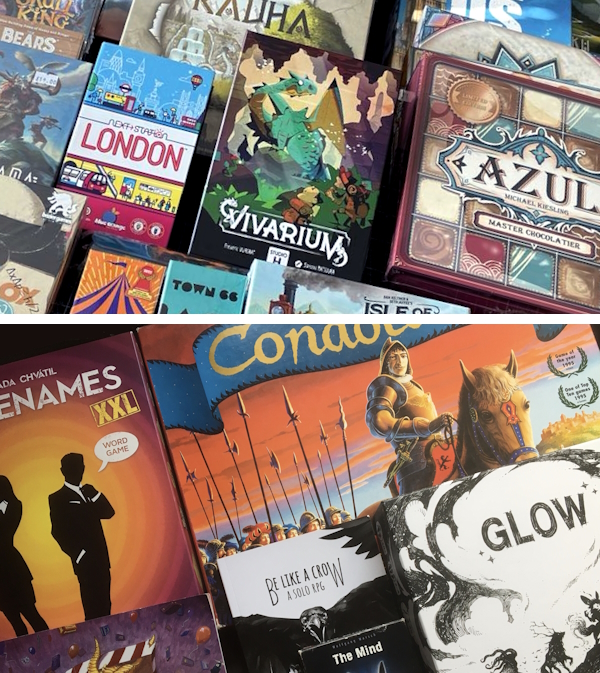
As usual, there were also a lot of designers about, including Tony Boydell, Alan Paul, Andy Hopwood, Bez Shahriari, Rob Harper, Gav Thorpe, Florian Sirieix and Morten Billcliff all sharing their games, chatting with gamers and signing boxes.  Copies of Condottiere, Azul: Master Chocolatier, Next Station London, Earth, Tiwanaku and After Us were also acquired amongst other things, and will likely be played over the coming weeks.

UKGE 2023
– Images by Teal and Jade