Tag Archives: Agricola

25th February 2014

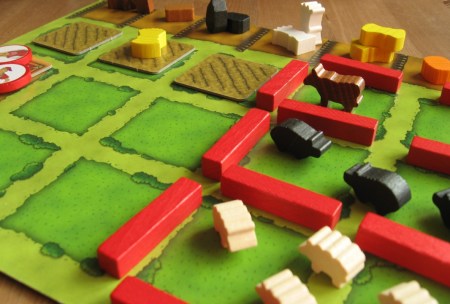
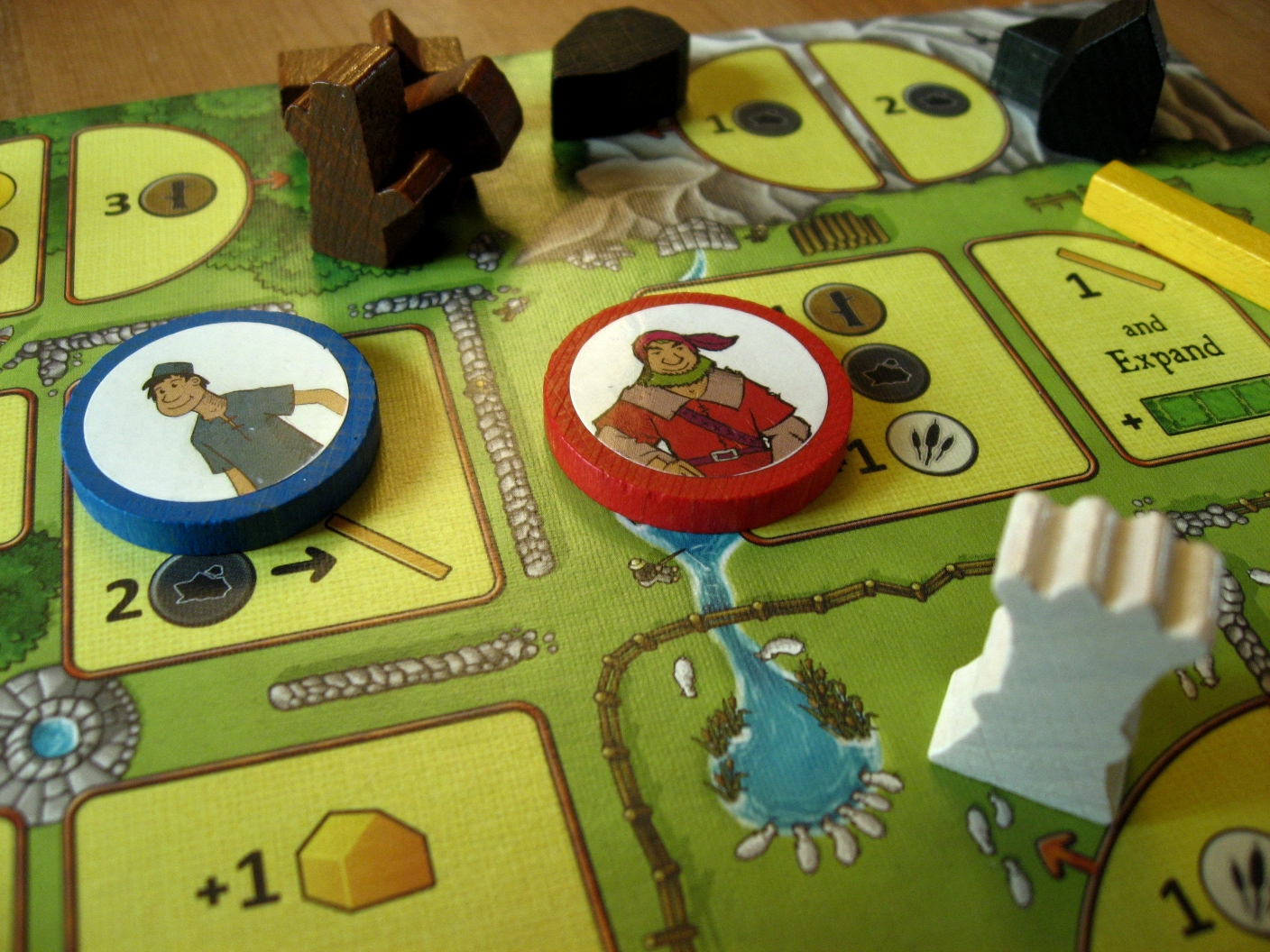
Thanks to people leaving, moving and catching lurgy we were really short of players – what a come down from a few weeks ago when we had two parallel games and were struggling to find chairs for everyone!  For this reason, we abandoned the “Feature Game” (Sushi Draft!), as it plays better with more people and started out with a quick game of Agricola:  All Creatures Big and Small.  This is a smaller version of one of our more popular “worker placement” games, Agricola.  In this game players are medieval farmers and the idea behind it is that players start with a small number of workers and carry out actions to build up their farm by fencing off pasture, buying animals, ploughing fields and growing corn and vegetables, all the time trying to make sure that workers have enough food.  At the end of the game, players score for a range of things including how large their house is, and how big their family is.
Agricola:  All Creatures Big and Small

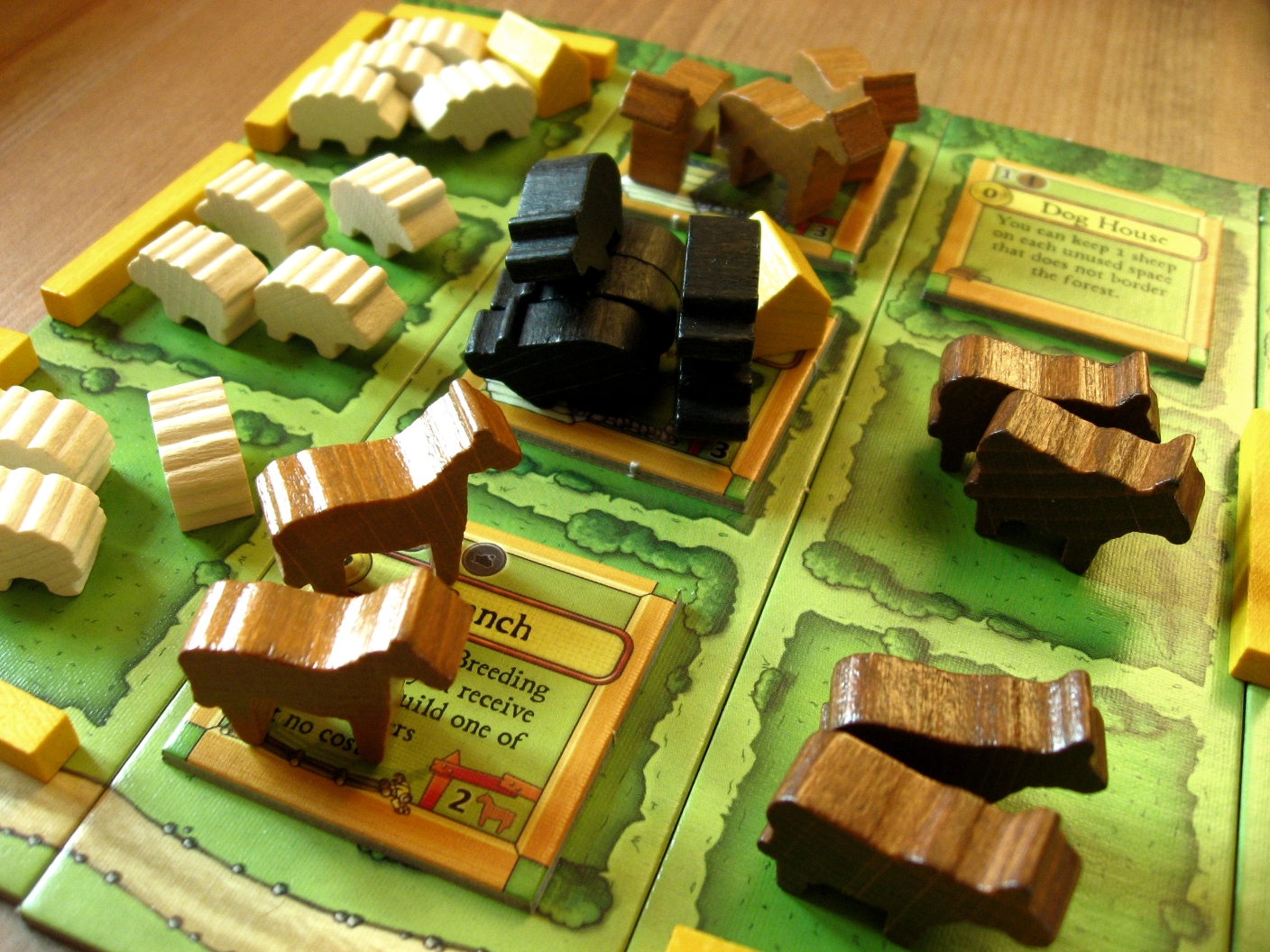
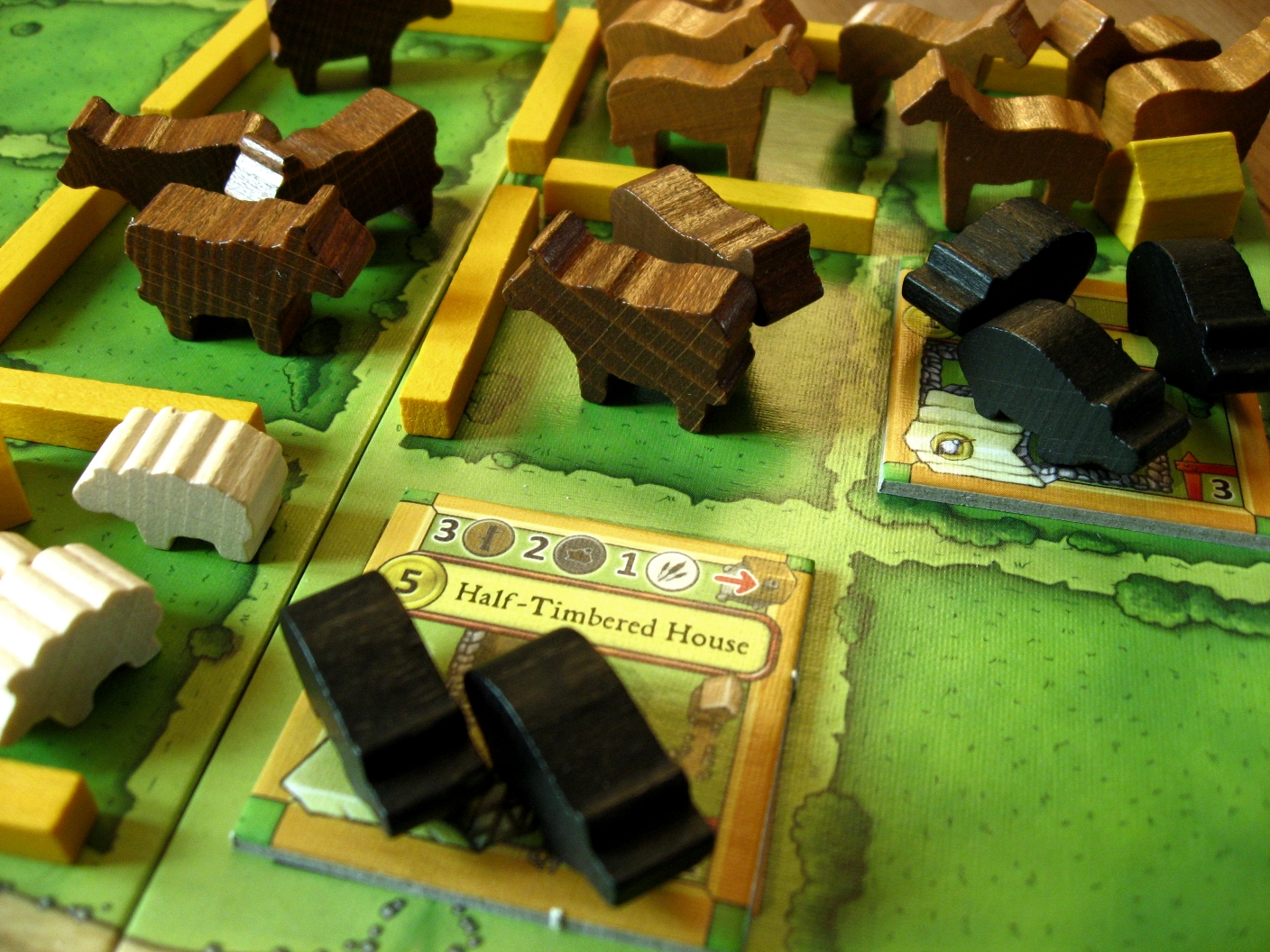
In the smaller version, the focus is concentrated on the animals and players primary aim is to develop their stock with a secondary aim of expanding their property and making good use of the new land.  In general, a lot of the basic rules are the same:  You collect resources to build anything and your animals must be kept in an enclosed space (either a building, tied to a drinking trough or in a fenced pasture); any animals that you have more than two of will breed at the end of the round to give another.  In contrast to its big brother, in this game there is no facility for increasing your family from the three you start with, there is very limited facility to upgrade your cottage, food is provided by some other means outside the game (clearly the workers are not going to starve), and minor/major improvements and occupations are provided by buildings.  We had played this before (though not on a Tuesday), so we included four random buildings from the expansion, More Buildings Big and Small, specifically, the Ranch, Dog House, Rearing Station and Barn Floor Manufacturer.
Agricola:  All Creatures Big and Small

Red started and began collecting horses, meanwhile, Blue built a Dog house that allowed her to keep one sheep in each unfenced pasture not adjacent to the forrest.  Red then built a stall and some feeding troughs and started breeding horses and pigs while Blue tried to expand her property and built a Ranch as the flock of sheep carried on growing.  In the dying stages of the game, Red managed to gather together enough sheep to avoid a penalty, but failed to completely cover his second expansion board;  Blue had to allow a couple of animals to escape as she couldn’t find space to house them despite completely covering all three of her expansion boards.  Blue ran out the winner with 51 points to Red’s 43, largely thanks to her large flock of sheep.
Agricola:  All Creatures Big and Small

Next, we played Tobago, which is a Christmas game that we’d played before (though again, not on a Tuesday).  This is a very beautiful game of treasure hunting on the island of Tobago.  The board is divided into segments of different terrain, forest, beach, mountain, river etc.   The idea is that players take it in turns to play cards that successively narrow down the location of the treasure.  Thus, if the first player plays an “in the forest”card, the next might play a not “next to the river” card reducing the number of available spaces that can hold the treasure to those wooded spaces out of earshot of the river.  Each player also has an All Terrain Vehicle (ATV) that they can move instead of playing a card, and use to collect treasures.  When an ATV arrives at the treasure space (or the treasure location is unambiguously revealed as a location where there is a vehicle), treasure cards are revealed to the players, with one per card per clue and an extra for the player who found the treasure.  The cards are then pooled, shuffled and the top one turned over.  The last player to place a clue card gets first choice of and can either choose to take the card, or pass (waiting for the next card), and let the next player choose.  Each treasure card has a different value and as players who placed a lot of clue cards will have seen a lot of them, they are in a better position to decide whether it is a good idea to take a treasure or to pass, the more so since there are two “cursed treasures” which prevent any further treasures being revealed as well as causing players to discard their most valuable treasure card.   Once the treasure has been distributed, amulets are distributed around the island; players who collect these can exchange them for an extra turn or use them to prevent treasure loss when the cursed treasure is revealed.

Tobago

Red placed his ATV in the middle of the island next to a lake, so Blue placed hers on the other side of the water and immediately realised that Red had the optimal position. Red started laying clues, so Blue carefully stalked him matching every clue he placed.  The first treasure was located in such a way that Blue could make it there first giving her the majority of treasure cards.  Placing second meant that Blue had first choice and was able to keep the most lucrative treasures.  This pattern was repeated for the first few treasures and Blue managed to get a nose in front.  Red made tried to collect amulets so he could regain control of the game, but the final damage was done when the cursed treasure cards appeared and in both cases Blue collected more treasures than Red.  As the game came to an end, Red had amassed a fine collection of amulets, but it was too late to make a real impact and Blue won, 73 points to 43.

Tobago

The last game we played was Morels, which we’ve played before, but was new to one of the players.  This is a fairly traditional set collecting game, but is a very nice rendition with lovely art-work and some hand made forage sticks provided by the designer.  The idea is that you can collect the readily available mushrooms “at your feet” for free, or you can choose a less accessible fungi and pay the difference in forage sticks, the game’s currency.  Once you have a set of three or more mushrooms you can cook them, and add cider or butter if appropriate to add extra points at the end of the game.  Red started again as he hadn’t played it before and made a point of collecting some forage sticks by trading a pair of “Hen of the Woods” for six forage sticks early on.  Meanwhile, Blue picked up a couple of basket cards and couple of night cards, but was unable to get a nice set worth cooking.  Red picked up a couple of Porcini cards and Blue collected a couple of Morels and both players waited for the third card to make up the set.  Red cooked a handful of Tree Ears flavoured with some cider and Honey Fungi, while blue cooked some Shitake with butter and some Lawyers’ Wigs.  As the supply of fungi started to dwindle, Blue finally managed to pick up the third Morel and cook it, but Red took the last pan card preventing her from playing the Chanterelles.  Despite this, Blue took the game by 38 Mushroom Varietal Points to 29, giving her a hat-trick of wins for the evening.

Morels

Learning Outcome:  It is nice to come back from a loosing streak with a bit of a bang.

14th January 2014

As we weren’t too sure about who was coming it took a while to get going, but first up, we decided to play our “Feature Game”, Parade.  This is a set collecting card game with an Alice in Wonderland theme.  Basically, there is a “parade” of characters in the form of a row of cards.  Players take it in turns to add a card from their hand to the parade and depending on the number and colour of the card they play, they then remove cards from the parade and place them in suits in front of them.  So, if a player places a red five, the five most recently played cards are “protected” and the player takes all the red cards and any cards numbered five or lower and places them in their area.  The aim of the game is to finish with the lowest accumulated total.  The clever part is the scoring:  if a player has the most cards of a given colour, all the cards score one regardless of the face value; all the remaining cards score their full value.  So, a set of high scoring cards can suddenly score a lot less because that player has the largest number of cards in that suit.  The other key part is that at the end of the game, each player adds two cards from their hand to their sets on the table.  Thus, the last two cards can have a dramatic effect on the game as they can change who has the majority in the colour suits and if you get it wrong  it can have a catastrophic effect on your end score.  Two players started off well, picking up only zeros and ones, while another was forced to pick up a few high cards straight away so decided to try to collect the most cards in these suits.  He was doing a good job when the everyone else was forced into taking a couple of high scoring cards each and started competing.  Despite initial appearances, the game was very tight, with the winner just one ahead of second with sixteen points, and slightly different card choices at the end could have completely changed the placings.

Parade

Next, we decided to play Agricola.  This is one of our more popular games and we had just finished setting up when one of the players was called away with boiler trouble.  We decided to leave it for another day and play Flash Point:  Fire Rescue instead.  This is a cooperative game where players take on the roles of fire-fighters trying to rescue people from a burning building.  Players take it in turns to carry out actions and then dice are rolled to spread the fire.  The addition of dice makes the game less predicatable than in some of the other cooperative games we’ve played where cards are used to simulate impending doom.  The use of dice also means that there isn’t the same “ticking clock” that there is with cards:  if you can stay on top of the fire, you can take as long as you like to get people out, on the other hand, if the fire gets out of control, it spreads faster and faster increasing the risk to the casualties and increasing the chance of explosions which cause damage to the building and suddenly the building collapses and everyone dies.

Flash Point:  Fire Rescue

Since we had a player who was new to the game, we played Veteran level (three explosions, three hotspots and four hazardous materials) and used the reverse side of the base game board.  We divided our labour so we had half the team fighting the fire and the other half rescuing people.  There was a lot of fire in the centre of the board down the corridor, so Red went in first as the CAFS fire-fighter.  Meanwhile, Blue entered via the side door as the Rescue Specialist and quickly saved the first casualty before riding the ambulance round to the other side and following Red in to rescue a couple more.  Red dealt with the recurrent smoke in the shower cubicle while Blue enlarged the hole in a damaged wall and rescued a couple more.  One of the new Points of Interest was placed rather unfortunately next to fire and we didn’thave time to deal with them before an explosion meant we had our first victim of the flames.  Despite the loss, however, we had soon rescued the required seven people.  Somehow, leaving casualties in a burning house seems wrong, so we continued to try to rescue everyone else.  All the Points of Interest were now on the far side of the board, so the Rescue Specialist rode round the building in the ambulance and made a new more convenient entrance.  Red helped reveal which of the Points of Interest were real people and then together Blue and Red carried the last two people out leaving only one Point of Interest behind, which was known to be a false alarm.

Flash Point:  Fire Rescue

Learning Outcome:  Where there’s smoke, fire will surely follow…

20th August 2013

It being the height of the summer holiday, there was a severe shortage of people about, so we started late with our Feature game, Agricola. This game is about farming in the middle ages and is a one we have played several times now.  However, one of our regulars has somehow missed out and, as it is a game we know she would enjoy we decided that while it was quiet it was a good opportunity to play the “family game” again.

Agricola

So we had a gentle run down of the rules before we started collecting wood and clay, fish and grain.  Before long, Red had renovated her two room hut to brick and started ploughing fields while her farming couple lived on fish.  Meanwhile, Blue was trying (and failing) to expand her wooden hut, plough fields and fence in some pasture so she could keep some sheep, all at the same time.  Blue was the first to engage in a little “family growth” and had no qualms about sending her unfortunate offspring out to work the land at an early age.  Red didn’t have enough clay to build an additional room, so had to wait until she had the option of sharing rooms.  Despite Red picking up vegetables, cattle and pigs, at the end of the day, Blue’s experience (and larger family) meant she had an unassailable lead.

Agricola

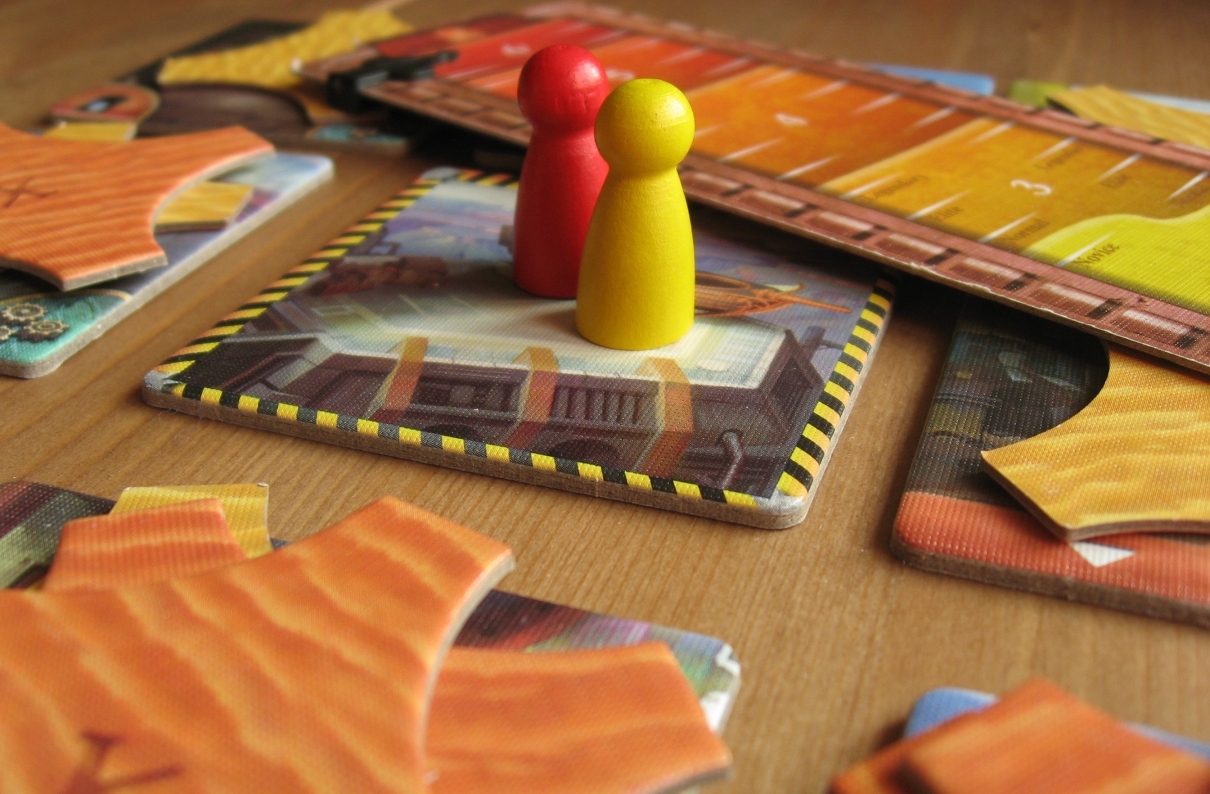
There was just time for a quick second game, so we decided to go with something we were familiar with, Forbidden Desert.  This is clever little cooperative game that we’ve played a couple of times before.  The idea is that players are members of a team of adventurers on a mission to excavate an ancient desert city and recover a legendary flying machine that’s rumoured to be powered by the sun.  Moments before arriving at the destination, the helicopter crash lands, stranding the team in the vast desert,exposed to an unrelenting storm and extreme sun.  The only hope for survival is to work together to excavate the city, find the parts of the flying machine and rebuild it to escape.

Forbidden Desert

Players have particular areas of expertise:  this time we had the “Archaeologist” and the “Meteorologist”, which meant we had one player who could clear sand more efficiently (twice as fast as normal) and another who could check what the storm was going to do next.  We started well, making good use of the special abilities and taking advantage of the tunnels to hide from the sun.  Without the “Water Carrier” we were really worried about dying of thirst, but we managed eke out our water supply and stayed on top of the problem by hiding as much as possible.  We also managed to prevent too much sand build-up with occasional judicious use of the Duneblaster, but what we failed to keep an eye on was the sand-storm level and we were at level six with clues still to find.  The storm was on its highest level when we finally managed to pick up the last clue, hop over the dunes with a jet pack, clear the launch pad and escape, but it was a very close-run thing!

Learning Outcome:  There is a reason farming families are usually large.

9th July 2013

This was our first meeting after the fire at the Jockey, so was the first meeting in someone’s home and therefore had a slightly different feel.

While we waited for people to arrive, we had a mess about with Hive.  This is a little two player game that some have compared to Chess.  This similarity comes from the fact that the pieces are Black and White and different pieces have different characteristics in the way they move.  Although much of the thinking is similar, the theme is insects and there is no board.  We had hardly started when everyone else arrived, so we left the teaching game for another occasion and decided to start something bigger.

Hive

In honour of the Jockey, we considered playing Flash Point:  Fire Rescue, however, we thought this could be considered bad taste so we decided to stick with our original plan to play our “Feature Game”, Agricola.  This is a game we played a few weeks ago, about farming in the middle ages.  Each player starts with a two room wooden hut and farmer and his wife.  In each round, players take it in turns to send the members of their family out to work.  The problem is that each action can only be taken once, by one player in each round.  In addition, there are only fourteen rounds and at intervals there are Harvests when all members of the family must be fed or the family has to go begging.  Last time we played the “basic game”, but as everyone had played it before (though some had only experience of the “basic game”), this time we decided to add a layer of complexity by playing with the “E-Deck” of “Minor Improvement” and “Occupation” cards.

We had a bit of a debate about whether we should just deal out the cards or whether we should “draft”.  Drafting is where everyone chooses to keep a card from their hand and passes the rest of their cards to the player on their left;  they then choose a second card from the hand they receive from the player to their right, before passing the rest on, and so on until all the cards have been shared out.  This has several purposes.  Firstly it means everyone knows what cards are in play, which allows for a deeper level of strategy where players can deliberately play to obstruct other people’s game.  Secondly, in theory, it means that nobody ends up with a really good hand while someone else ends up with all the rubbish cards.  Finally, it also means that players can choose cards that work well together, however, this can result in a bit of an “all or nothing” game depending on whether the plan works or not.  We decided against drafting as two players had never played with the cards and felt that they wouldn’t know what a good card or a good combination of cards was.  Although this was undoubtedly the right decision in the circumstances, unlike many games, the cards are not carefully balanced and there are definitely some cards that are better than others, so it would certainly be something to try another time.

Agricola

After carefully tiling the boards to make them fit on the table, we dealt out the cards and Red won the start player lottery.  Everyone made a dash for occupations before the players began to develop their different strategies.  Red had a occupation cards that made upgrading his wooden hovel into a stone palace cheaper, so decided to prioritise that, while Green decided to expand his family and went in for agriculture and fishing.  Meanwhile, Blue enclosed a massive pasture and Turquoise engaged in vegetable farming.  Each strategy appeared to have its good points and bad points, for example, Blue covered a lot of the space available, however, she spent the early part of the game flirting with starvation; in contrast, Green had plenty of food available, but struggled to make use of all the land.

In the last few rounds, everyone made the obligatory dash for points.  Red finally managed to upgrade his five bedroom mansion to stone, but at the expense of everything else except one solitary field; Blue added a stable to her pasture and invested in the next generation; Turquoise built three large pastures and crammed three children into his three bedroom brick house, and Green optimised his final harvests and enclosed a pasture for a couple of cows.  Turquoise ran out an easy winner with over forty points having managed to participate in a little bit of everything except sheep.  Blue and Green came in joint second with twenty-nine points apiece.

Agricola

Learning Outcome:  Living in a stone mansion does not make you a good farmer.

28th May 2013

The first game of the evening was Ice Flow, the cute strategy game where players have to cross the Bering Straight from Alasaka to Siberia by jumping from ice floe to ice floe.  We had played a quick game last time just before we finished, and this game started the same way as that one with Black making all the running and Red following on behind.  The first explorer home was Black  with a Yellow explorer was hot on her heels.  Black’s  remaining two explorers were very close to home though and ready to pounce.  This meant that Yellow was forced to try a bit of blocking to prevent Black and Red getting home, but unfortunately it needed a couple of moves too many and it was an easy win for the Black as the youngest player, with Red a close second.

Ice Flow

The other game we played was the “Feature Game”, Agricola, which is a highly regarded game about farming in the middle ages and since half the players hadn’t played it before, it was very much a learning game.  The idea is that players are medieval farmers living in a two room wooden hut with their spouse.  Life is hard, and success is measured by the quality and size of your home, the number of animals you keep, and your ability to put your land to good use.  However, your priority is simply to get enough food to survive and survival is difficult without resorting to begging.  Each round, the family go out to work to try to obtain materials to improve their homestead or to work on the land to avoid starvation, but there are always lots of things players want to do, and never enough turns.  To make matters worse, at intervals during the game, there is a harvest when the animals breed and the grain is brought in, but everyone has to be fed.

It was quite difficult for the players who had not played it before to grasp how to start, but Cyan and White started out collecting all the wood, while Green hoarded all the clay.  In the absence of anything better, Blue scraped together enough wood to extend her hut and decided engaged in a little procreation which meant she could send the children out to work on the land and an early age.  Meanwhile Cyan moved into animal husbandry building lots of fences and breeding sheep while Green got all house proud building a clay oven and extending and renovating his hut from a wooden shack to a brick cottage.    Unfortunately Green failed to use his shiny new oven before harvest so famine arrived and his burgeoning family had to beg to survive.  Although Cyan had a very impressive flock of sheep, without an oven, her family were forced to live on fish and it showed in the final score.  Green’s large family and building a huge paddock in the last round offset some of his five begging cards and he came home a close third, however, Blue ran out clear winner 11 points ahead of  White in second place.

Agricola

Learning Outcome:  You needed to do a little bit of everything to be a successful farmer in the middle ages.