Tag Archives: Between Two Cities

5th April 2016

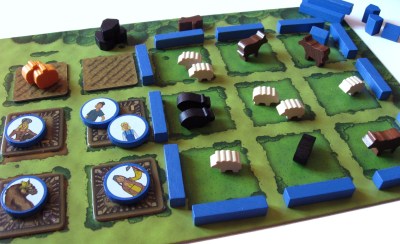
Despite a few regulars being away, there were still enough people for two games and the first group opted for the “Feature Game”, Agricola, a highly regarded game about medieval farming.  Agricola is a worker placement game where players take it in turns to deploy the members of their farming family in activities.  At the start of the game there are very few actions and each  player only has two members of their family, but as the game progresses the number of possible actions increases, but players also have the opportunity to expand their families. Each player has a farm which consists of a three by five grid of spaces and at the start of the game two of them are occupied by a two-room wooden hut.  During the game, players can expand their hut, upgrade their wooden shack to a brick or stone house, they can plough fields, enclose land to keep animals and grow vegetables and wheat.

Agricola
– Image by BGG contributor BeyondMonopoly

The game is played over fourteen rounds with harvests at intervals after which the family must be fed.  Failing to feed the family results in them going hungry and having to beg for vittles which costs points at the end of the game.  Points are awarded for almost everything, but the most successful players are usually those with a thriving farm that makes full use of all the available land and sustains a large family living in a big farmhouse.  The game can be played as a family game, or, for more experienced players, occupation and minor improvement cards can be added.  It had been quite some time since some of us had last played Agricola, and others had never played it, but those of us who were familiar with the game were keen to play with the cards.  When playing with cards it is common to “draft”, i.e. use the primary mechanism found in games like 7 Wonders, Sushi Go! and Between Two Cities where each player chooses a card from their hand before passing it on and choosing the next card from the hand they receive (passing that on until there are no cards left).  The advantage of this approach is that no single player gets all good (or bad) cards by chance, but the disadvantage is that it is very hard to choose cards when players are new to the game and unfamiliar with which cards might work well.  For this reason, drafting wasn’t really an option.  The copy of the game had been “pimped” with shaped wooden resources to replace the original cubes and discs from the base game.  This, combined with three different decks of minor improvements and tight space enhanced our initial confusion, but we did eventually get ourselves sorted and chose the basic “E” Deck.

Agricola
– Image used with permission of BGG contributor henk.rolleman

Green started off by learning a new occupation: Reed Collector; reeds are important for house building.  Having looked at his cards in hand, he had a plan:  he also had the Renovator which would reduce the cost to upgrade his farmhouse, so he thought he could expand his wooden house and then upgrade it on the cheap. He also had the Chiefs Daughter who would give him an additional three points if he successfully upgraded his house to stone. Meanwhile, the others set about collecting resources as a base from which to build their farms.  Indigo quickly learnt the second occupation of the game: the Hedge Keeper which would enable her to build three additional fences each time she built at least one – impressively powerful we thought at the time, especially at end game for filling unused spaces.

Agricola
– Image by BGG contributor lolcese

The first rounds were a lesson in frustration as resources and actions were limited and we all found ourselves unable to get what we needed and do what we wanted, a problem compounded by only having two farmers each.  Progress on the farms seemed slow; Green, Pine and burgundy seemed more interested in home improvements than actual farming and at one point it looked like we should have renamed the game, “Yuppy-ville”.  Green then invested in a canoe and went fishing a lot:  was the price of farming so high he was going into retirement before he got into a financial mess?  Despite her highly prized hedge making ability, it wasn’t Indigo who fenced in their first field but Pine, which he promptly filled with the four sheep that no-one had been able to find a home for previously.  This was especially funny since, as the vegetarian of the group, he had planned to make his and arable farm rather than a pastoral farm.  Still sheep are good for wool, so his moral stance was intact, for the moment, at least. Released from Market, Pine’s sheep quickly produced a nice spring lamb for our intrepid veggie farmer, to keep as a pet in his farmhouse.
Agricola
– Image by boardGOATS

Burgundy meanwhile had made use of his special ploughing skills to turn over two fields in one go, but that was about as far as they went for many rounds.  Although he was forced into a fallow strategy (not one that scores any points or subsidies in this game), he wasn’t complaining. That was reserved for anyone else who took the available wood before he could reach it.  This forced Burgundy into becoming a bit of a clay specialist which meant he was able to build an oven before anyone else, something he desperately needed to feed his family since there was so little actual production going on on his farm.  In keeping with his non-farming, farming strategy, Burgundy was also the first to renovate his home, twice in quick succession to a give him a grand two room stone cottage.  Pine and Green followed and extended their wooden shacks. This gave Green room to grow and he became the first player to gain an extra farmer.  Pine quickly followed suit, but his attempts to grow vegetables was being scuppered by everyone else taking the one available “Plough & Sow” space before him. So, with a tear in his eye, he was forced to build an oven and take some of his precious sheep to the abattoir.

Agricola
– Image by BGG contributor HRune

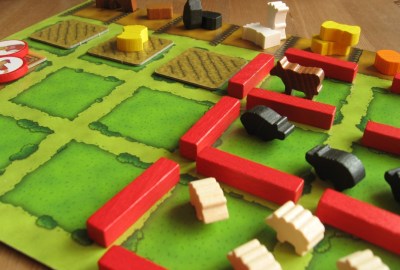
Our farms were slowly growing.  Green still only had one ploughed field and no pastures, but he had learnt several trades, built a number of improvements to his farm and extended his modest cottage to four rooms.  In one move, he upgraded his house to brick and built a clay oven (the one that Indigo had just returned after trading it in for a better model), which enabled him to bake bread and get enough food to feed his burgeoning family.  By this time, Pine had turned into a hardened livestock farmer, his earlier heartache a mere distant memory.  He enclosed his massive second pasture, moved his sheep around and expanded into cattle.  The Master Hedge Maker, Indigo, still had only one pasture and no animals, but the arable part of her mixed farm was very healthy, overflowing with wheat.  The failure of her livestock attempts did not last long either, and she emulated Pine enclosing a large second pasture and captured a couple of wild boar to place in it.

Agricola
– Image by BGG contributor sufertashu

Back on Green’s farm, he had decided that maybe he should do a little farming and finally having got some wood, he built some fences and acquired some pigs. His skill in ceramics had enabled him to get a free pottery and started turning the now unwanted clay into some strange tasting food.  Green then turned his clay house into a stone mansion and quickly fenced in another pasture and got some cattle.  With the game rapidly drawing to a conclusion he had four farmers to work with, but he was still hampered by the availability of resources and actions, often taken by others.  For example, his plans for a third pasture and some sheep were stymied by Pine who nabbed them to add to his ever growing flock.  Meanwhile, Indigo’s farm was flourishing and when she finally got some sheep, it seemed all she needed to to to be able to say she had a finger in every pie was get some some cattle – one was available and she was so keen on it that she let it live with her in her own house.
RedAgricola
– Image by boardGOATS

In contrast, Burgundy’s whole game seamed to have constantly been scuppered at every turn.  Even taking the start token usually only lasted one round and invariably he then seemed to find himself choosing at the end of the round once more. We don’t quite know how he did it, but somehow by the end of the game he had filled every space on his board – clearly he got that wood and fencing in the end.  With only two rounds left, Pine finally moved into wheat and vegetables.  Discussing the game afterwards he commented that he’d been dealt a poor set of cards at the start and on reflection they did look like a very difficult set to work with.  On the other hand, Black on the next table piped up that the cards were not really all that important.  While that may be the case, in this game Green was the winner primarily thanks to having played a great set of cards. In fact, of his forty-three points, he scored twelve from his cards, which was seven more than anyone else.  In contrast, Indigo’s balanced farm netted her a solid second place, just six points behind.  Were the cards that important?  We’ll play it again sometime soon and maybe find out.

Agricola
– Image by BGG contributor nolemonplease

On the other table, meanwhile, The Voyages of Marco Polo was getting a second outing after its introduction at our last meeting.  The game is played over five rounds with players recreating Marco Polo’s journey to China via Jerusalem and Mesopotamia and over the “Silk Road”.  Each player has a different character and special power in the game.  Each round, the players roll their five personal dice and can perform use them to perform one action each per turn.  The actions include:  gathering resources, gathering camels, earning money, buying purchase orders and travelling.  The game ends with players receiving victory points for arriving in Beijing, fulfilling the most purchase orders, and having visited the cities on secret city cards that each player gets at the start of the game.

The Voyages of Marco Polo
– Image used with permission of
BGG contributor bovbossi

Purple (who also played last time) decided to try the teleporting trader, Johannes Caprini again and work more on getting contracts.  Last time, we realised that taking an action first was a huge benefit because it avoided the problem of having to pay to take actions.  So, after that, Black chose Berke Kahn which would allow him to choose actions already taken without having to pay.   Scarlet, who was new to the game, opted for Wilhelm von Rubruk (played by Black last time) for the extra trading stations.  Also new to the game, Pink, felt that having an extra die and contract each round would give her the edge, and chose with Matteo Polo.

The Voyages of Marco Polo
– Image used with permission of BGG contributor punkin312

Despite her teleporting ability, Purple was unable to get to Beijing, but she was the only one who hadn’t made it across the board for the extra points by the end of the game.  It seemed her extra experience could not help her make full use of her special power as she failed to complete her second destination card as well.  Reading opinion of this character on BoardGameGeek, it seems Purple’s fondness of this character is rather misplaced, as it seems to be universally felt to be a poor one to get to work.  Scarlet had done rather better with his choice it seems, although he just failed to get his extra houses out, which is a tough ask in this game.  Others who play this character seem to get varied results, though perhaps for people that can make it work, it can do really well, but otherwise it can trip players up.  The general opinion on Matteo Polo also appears to be good; sometimes it can work really well, but it is never a hindrance.  Pink, however, just struggled to get the game to work for her and it just didn’t seem to fire her enthusiasm. She failed to complete either of her destinations and only managed to place three “houses” and generally found the game difficult all the way through.

The Voyages of Marco Polo
– Image used with permission of BGG contributor henk.rolleman

Looking back at the last time we played, as well as Johannes Caprini and Wilhelm von Rubrukand, we used Mercator ex Tabriz and Kublai Kahn.  Mercator ex Tabriz (who gives the player a free resource when others use the market) seems to be widely regarded as the best character, however, Pine really struggled with him. In contrast, Kublai Kahn appears to be seen as a middling character, who is very reliant on how the city bonuses fall – last time they fell well for Green who made good use of them, but the character could be a lot less effective if the bonuses were less favourable.  There are two characters we have not yet played, Raschid-ad-Din Sinan and the pairing of Niccolo and Marco Polo.  Even though Raschid-ad-Din Sinan looks good (he allows the player to choose their own dice values), it seems most players only rate him average.  Maybe it’s because poor dice rolls can be compensated for and turn into good ones, so the actual values rolled are of less consequence to the game than might be thought initially.  The pairing of Niccolo and Marco Polo can be difficult to make work as two characters does not mean twice the resources, quite the opposite and they can get stuck in a city, although with less players it is felt they might do better (as there are less opponents to steal the city bonuses first).

The Voyages of Marco Polo
– Image used with permission of BGG contributor henk.rolleman

So clearly, although some characters might have a tendency to be more useful than others, ultimately success depends on circumstances and how well the player uses that character.  This was also the case for this, our second game where Black finished first with a massive fifty-eight points, a combination of a good character played effectively. On the geek there seems to be a general consensus that Berke Khan is one of the top characters in this game, demonstrating others appreciate the power of not having to pay for actions. With Agricola still a few rounds from finishing, there was time for a quick game of Click & Crack, a game of simultaneous action selection game in which the players control two penguins each, walking around on a big ice floe – a cold arctic game to contrast with the heat of the eastern deserts.

Click & Crack
– Image used with permission of BGG contributor aleacarv

Learning Outcome:  Sometimes it is best to put even the most deep-seated moral objections to one side for the duration of a game…

31st December 2015

As people arrived, we began setting up the “Feature Game”.  This, as has become traditional at these New Year events, was the gorgeous, dexterity car-racing game, PitchCar. Burgundy and Pink built a fantastic figure-of-eight track that made good use of the ⅛ turns from the second expansion and made a really fast compact circuit. Before long, Black and Purple had arrived and had introduced themselves to the furry host, followed by Grey and Cerise who were armed with Champagne and Polish delicacies.

PitchCar
– Image by boardGOATS

The game is quite simple, players take it in turns to flick their small wooden cars once, starting with the player at the front of the pack. If the car leaves the track or rolls over, the player forfeits stroke and distance (though any collateral gains by other players stand).  We usually have a single solo lap to determine the order on the start grid and to allow new players to get their eye in, before racing two laps of the track.  While Blue and Pink occupied themselves in the kitchen, everyone else began their practice run.

PitchCar
– Image used with permission of
BGG contributor kilroy_locke

Cerise went first and set a very competitive bench-mark of ten flicks mastering the bridge from the first expansion on her second attempt. Asked whether she’d played it before, she replied, not since she was tiny, playing with bottle-tops. It turned out that Grey had also had a similarly mis-spent childhood and this with his competitiveness made him a formidable opponent. Black and Burgundy gave them a run for their money, but Grey took the lead and held off the competition to take first place, with Cerise close behind, a worthy second.

PitchCar
– Image used with permission of BGG contributor garyjames

With pizza already over-cooked, everyone helped to quickly pack up and then sat down for dinner. Once everyone had eaten their fill, Pink began tidying while everyone else began the next game, Ca$h ‘n Guns. This game combines gambling with a little chance and a dash of strategy, based round the theme of gangsters divvying up their ill-gotten gains by playing a sort of multi-player Russian Roulette. For some reason, setting up degenerated into a discussion about the offensive weapons act and Tony Martin and the debate was still going by the time Pink had finished what he was doing, so he joined in.

Ca$h 'n Guns
– Image used with permission of BGG contributor punkin312

Black, (playing “The Hustler”), chose to enact his special power by trading a bullet card for one of Blue’s blanks, much to her delight. Then, Pink (playing “The Doctor”), started as the Godfather, so acted as caller. So, once everyone had “loaded” their weapon with blanks or bullets, on, the count of three, everyone pointed their foam gun at someone. Pink chose to invoke the Godfather’s Prerogative and decided Purple looked most threatening, so directed her to point her gun at Burgundy.  The Godfather then counted to three to give everyone a reasonable chance to withdraw from “The Game”, but also relinquish their claim to a share of the loot for that round.

Ca$h 'n Guns
– Image used with permission of BGG contributor punkin312

Throughout, everyone was feeling quite brave, but it was Burgundy (“The Cute”) who had a particularly strong incentive to stay in, as his special power allowed him to take $5,000 before anyone else got a look in.  It was a power he used to great effect taking an early obvious lead.  Meanwhile, Blue (“The Vulture”) was the first to draw blood, defending her property against Grey (“The Greedy”).  Like The Vulture she was, when Grey picked up a second wound, Blue finished him off and took two pictures from his still warm, lifeless hands. With, Burgundy clearly in the lead, Blue had help taking him down, and Pink got caught in the cross-fire.

Ca$h 'n Guns
– Image used with permission of BGG contributor punkin312

Picking the pockets of two corpses in the same round made her something of a target and in the next round she found the staring down all three remaining barrels which effectively put her out of the game.  Purple (“The Collector”), began collecting diamonds, but, it was Cerise (“The Lucky Man”)’ who picked up the $60,000 for getting the most diamonds.  As “The Collector”, Purple managed to score a staggering five pictures netting her $100,000 giving her a cool $156,000, $6,000 ahead of Black in second place, with Cerise a close third with $146,000.

Ca$h 'n Guns
– Image used with permission of BGG contributor punkin312

With seven of us, we’d normally split into two groups, but the party atmosphere had got to us a little, and with limited table space we were keen to stick together.  With the majority of Blue and Pink’s not inconsiderable game collection at our disposal, we eschewed the usual go-to seven player game, Bohnanza, and decided to play play Between Two Cities. We played this a few weeks ago, but in essence, it is a draughting game, but one that has the depth of 7 Wonders, but with the simplicity of Sushi Go!.  As before, we didn’t use any of the seating randomisers, but since we were all sat in different places and three players were new to it, this didn’t matter.

Between Two Cities
– Image by boardGOATS

Burgundy and Black began to build up a large number of factories and thought they were in with a chance of scoring heavily with them, but didn’t notice that Grey and Pink, had more, as did Blue and Pink. Blue and Black began with a complete row of shops, and followed it with extensive white collar employment opportunities, but were unable to expand the park as much as they wanted.

Between Two Cities
– Image by boardGOATS

Meanwhile, Grey and Cerise had developed a retail outlet centre with no fewer than seven shops and a number of conveniently situated houses and office blocks. Cerise’s other city, shared with Purple began as a paradise with parks and entertainments, until they added a factory to increase the value of their housing stock. Parks had been popular at the start of two other cities too, with Purple starting her other city the same way with Burgundy, and Blue and Pink doing something very similar.

Between Two Cities
– Image by boardGOATS

After three rounds we began the complicated matter of the scores. It was quite close, but Blue and Pink’s City was disproportionately ahead, a problem that was rectified with a quick recount that left two cities jointly leading on sixty. In the normal way, the winning city can only ever be important as a tie-breaker since it is the city with the fewer points that makes each players’ score. In this case, however, Pink owned both, with Blue and Grey. Since Blue’s other city (shared with Black) had fifty-nine points, that put her a close second.

Between Two Cities
– Image by boardGOATS

A quick interlude followed for non-alcoholic Champagne, alcoholic Prosecco, white chocolate, pistachio and Diaquiri fudge, with the chimes of Big Ben and fireworks. Once the New Year greetings were complete, it was onto the important matter of what to play next. Such a large number of players meant the choices were limited, so we went with a couple of old favourites.  Tsuro was first, a quick fun game that we all know well and that featured on our list of ten great games to play with the family at Christmas.

Tsuro
– Image used with permission of BGG contributor kilroy_locke

A game that anyone can play, in Tsuro each player has a “stone” dragon and on their turn places a tile in front of it and moves the dragon along the path. As the board becomes increasingly crowded, the tiles form a maze of paths that the stones must navigate, staying on the board without colliding with anyone else while trying to eliminate everyone else.  Grey and Cerise were the first to go out by collision, followed by Burgundy who was ejected from the board by Purple. Black eliminated both Pink and Blue with one tile, before winning the game by dealing with the only remaining competitor, Purple.

Tsuro
– Image used with permission of BGG contributor zombiegod

With that over, there was just time for another of our favourite games of 2015, 6 Nimmt!.  For a reason none of us understand, this mixture of barely controlled chaos is strangely compelling, so it is a game we keep coming back to again and again. Despite the number of times we’ve played it as a group, somehow Grey had missed out, so we had a quick summary of the rules: players simultaneously choose a card, then starting with the lowest value card the players take it in turns to add their card to the four rows on the table in ascending order. The player who adds a sixth card, instead takes the first five cards to score and the sixth becomes the first card in the new row. As well as the face value of the cards, they also have a number of bulls’ heads (Nimmts) mostly one or two, but some as many as five or even seven.

6 Nimmt
– Image by boardGOATS

The aim is to minimise the number of Nimmts picked up, so things went horribly wrong from the start, with everyone picking up plenty in the first round, though it remained close aside from Purple who picked up nearly twice what anyone else took. The second round was made especially difficult by the fact that three of the four rows were effectively out of commission. Blue struggled with four cards with a value below ten as well as the highest card in the deck. Purple managed to exceed her score in the first round, giving her a near record- breaking fifty-one. Grey and Burgundy both managed a clean sheet in the second round, so it was Burgundy’s better score of just seven, that gave him the win. So with 2016 started in fine style, we decided it was time for bed.

6 Nimmt
– Image by boardGOATS

Learning outcome:  Although seven is a difficult player count, there are some excellent games available when everyone is in the right mood.

15th December 2015

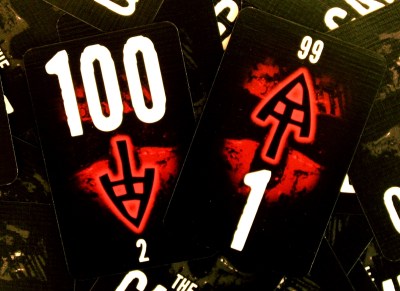
It was a bit of a disparate night: Blue was late thanks to a disastrous day at work and Black and Purple were able to come for the first time in ages, but arrived even later and hadn’t had any supper.  So after Red, Burgundy and Magenta had finished discussing JunKing, Red, Burgundy, Magenta, Pine and Green played a quick game of The Game.  This simple cooperative game has very simple rules:  Play a minimum of two cards on any of the four piles following the appropriate trend – two piles must always increase, two decrease; the exception to this is if you can play a card where the interval is exactly ten in the wrong direction (known as “The Backwards Rule”).  Players can talk about anything so long as there is no specific number information given and the aim is to cooperatively get rid of all ninety-eight cards by playing them on to the four piles.

The Game
– Image by boardGOATS

With a hand of just six cards and some players staring with nothing but high cards and others with only cards between forty and sixty, it was always going to be challenging.  In our experience, playing with five is also more difficult, so as a result, at the start of the game expectations weren’t high.  As usual, there were howls of horror as players were forced to play cards that others didn’t want.  Magenta started out with a really nice combo of four cards, but after that everyone just stepped on everyone else’s toes.  Eventually though, much to everyone’s surprise, the deck was gradually whittled down and before long the final cards were drawn from the deck and players were looking to maximise the number of cards they were going to play from their hand.  With only one playable pile at the end it was always going to be difficult and unfortunately, Burgundy was forced to bring the game to a close leaving a combined holding of five cards.

The Game
– Image used with permission of BGG contributor henk.rolleman

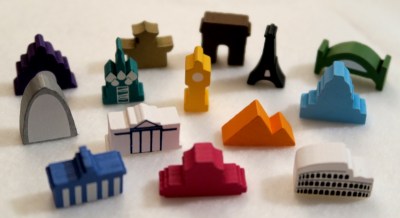
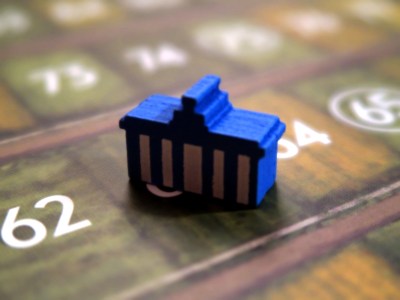
With Blue finished and Black and Purple just arriving, we decided that the week’s “Feature GameBetween Two Cities would be nice and quick.  Sometimes (like last week) “nice and quick” turns out to be “a bit slow”, but this one has simple rules and rattles along at a good pace.  The game is set in the early 1800s, a time of immense construction and urbanization with players designing new cities.  It is an unusual game as players work in pairs building two cities, one with the each person they are sat next to.  The cities are made up of square tiles and the final layout is a four by four grid.  Since players gradually add tiles to their city, the amount of available space decreases and players have to be more discerning about where they build.

Between Two Cities
– Image by boardGOATS

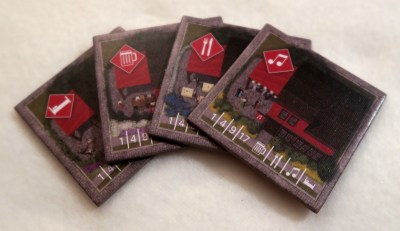
The game is played over three rounds.  The first and third are tile drafting rounds, similar to games like 7 Wonders and Sushi Go!, except that players are drafting small square tiles instead of cards.  So, in these first and last rounds, each player begins with seven tiles, everyone simultaneously chooses two, and passes the rest on.  Once everyone has chosen, players can discuss what to play and where, before placing one tile in each of their cities and then picking up their next hand.  In the first rounds cards are passed to the left, in the third round to the right.  Between these two rounds, players are dealt three double sized tiles each from which they choose two to play.  Since these must be placed the right way up and can be in either horizontal or vertical configurations, the choice and placement of these is quite critical, and are probably key producing the best city.

Between Two Cities
– Image by boardGOATS

Each city is scored separately at the end of the game and the winner is the player with who gets the most points for their lowest scoring city.  Points are awarded to each city for each building in it, but the score depends on the type of building and where it is placed.  For example, yellow shops score when placed in a row.  A single, isolated shop will score just one point, but two adjacent shops score five and three in a row score a total of ten.  Similarly, the first green park tile will score just two points, but if three are placed in a group, they will score twelve points.  The scoring for some buildings depends on what else is present in the city however.  Houses flourish best when there are a variety of other types of building nearby, so their score depends on the number of different buildings across the whole city.  On the other hand, nobody likes living next to a factory, so a brown house tile next to a grey factory tile will score just one point regardless of everything else.

Between Two Cities
– Image by boardGOATS

Only Burgundy and Green had played the game before, but as Burgundy explained when people asked for advice, although he’d played well and even won in the past, he never had any idea how.  So everyone was on their own pretty much,  and when the first hand of tiles were dealt out, it felt like a bit of a lottery.  As the game progressed, everyone discussed what they were trying to do with their neighbours and, before long players were struggling to find the best tiles to play to maximise their final scores.  Magenta was trying to decide which of her two cities (shared with Blue and Red) should have the final entertainment establishment and a complete set, and Pine and Burgundy were busily industrialising their city to pick up a few extra points.

Between Two Cities
– Image by boardGOATS

In the final scoring, it was Blue and Magenta who’s city came out best with sixty-three, though the winning city is usually irrelevant.  In Between Two Cities, players total up the points for both cities, but it is their lowest score that is compared and the higher is only a tie-breaker.  Thus, players are trying to maximise both cities equally.  In this case however, the second best city was built by Blue and Burgundy, so Blue took first, with Magenta in second place.  This game was a win all round though as everyone had enjoyed it.  The game was originally funded though KickStarter, and these games often feel a bit incomplete and lacking in finishing touches.  This one, however, had a really good feel about it, the right amount of length for its depth and beautifully executed – definitely a game that will come out again.

Between Two Cities
– Image by boardGOATS

With Black and Purple finished and ready to play, there was some debate about what to go for.  Green had been desperate to play Rockwell for about three years, so when he heard Blue had brought it, he was keen to give it a go.  Meanwhile, Purple had been feeling aggrieved at the fact that Snow Tails had been shouted down at the previous Didcot Games Club meeting, so when Black said he would play it with her that pretty much set the games and everyone divided into two groups, with Magenta and Red joining Black and Purple to race dog sleds.

Snow Tails
– Image used with permission of BGG contributor punkin312

Snow Tails is a fun dog-sled-racing game where players built round a deck building and control mechanic.  Each player starts with a sled drawn by two huskies.  At the start of the game, each dog has a speed of three, and the break is also applied at a level of three.  Thus, the sled-speed is the sum of the dogs minus the value of the break, i.e. everyone begins with a speed of three so and move three spaces forward.  In addition, since the dogs are pulling evenly, this movement is in a straight line, but the also sled achieves a bonus equal to their position in the race.  On the other hand, if the left dog had a speed of four and the right hand dog had a speed of two, although the sum would be the same, the difference of two means that the sled must also drift two lanes to the left.  This “drift” can be applied at any point during the sleds move, so two of the moves are diagonal rather than just straight ahead.

Snow Tails
– Image used with permission of BGG contributor punkin312

Each player begins the game with the same deck of cards  – five sets of cards numbered one to five, shuffled, from which they draw a hand of five cards.  On their turn, the active player must play at least one card, but may play up to three cards, so long as they all have the same value.  These cards are used to update either or both dogs, and/or the break.  When they have completed their move, players draw cards from their personal deck back up to the hand-limit of five.  Thus, players use their cards to navigate their sleds round the avoiding obstacles and attempting to observe the speed restrictions.  Failure to do either incurs penalty “dent” cards which go into the player’s hand reducing the number of playable cards.  This reduces their ability to control their sled and increasing the chance of them hitting obstacles and getting more dent cards, thus chaos reigns.

Snow Tails
– Image used with permission of BGG contributor punkin312

The track is custom built, and we started off trees and finished with a sharp bend.  Black got the best start and, got lucky through the pines giving him a healthy lead which he held throughout.  The race for second place was very tight however, with Purple, Red and Magenta taking it in turns at the front of the pack.  Eventually, Red lost ground round a sharp corner and Purple finally got her nose ahead of Magenta to take second place.

Snow Tails
– Image used with permission of BGG contributor punkin312

Meanwhile, it was quickly becoming clear that Rockwell was a much more complex undertaking.  Not only were there an enormous number of pieces to sort out, it was also a few weeks since Green had read the rules.  The rules were quite complex and Blue’s, Burgundy’s and Pine’s very puzzled expressions had changed to confused bemusement long before Green had finished explaining.  The gist of the game is that players are the managers of a mining company, each with four drilling teams.  Each round is made up of four phases:  first players deploy their two managers, then they deploy their drilling teams, next they can sell or buy resources in the market and finally players can buy upgrades, for example, making their drilling teams more effective.

Rockwell
– Image by boardGOATS

Thus, at its heart, the game is a worker placement and it is all about how players deploy their managers and then how they use their resources once they have got them.  These are just the sort of game Green likes best and also the sort of game Burgundy excels at.  In the fiddling with the small rules, however, we’d sort of lost sight of how players actually win:  basically there are achievement tiles and when people manage to fulfill the requirements of an achievement tile, they take the top one off the pile.  Since these are sorted so that their value decreases, there is an advantage to getting there first.  The achievements are a little strange and it took Pine a moment to grasp that, for example, players only needed to have eight zinc and eight copper to qualify for a tile; they did not need to actually spend the resources.  Players can also trade resources for points in the upgrade phase, though in this case, the resources are returned to the main supply.

Rockwell
– Image by BGG contributor Rayreviewsgames

There  are definitely a few very clever mechanics in the game and it is also beautifully produced with a lot of thought going into the design and rendition.  The game board is circular, but is made of slightly curved tiles forming concentric layers so that the layout is different every time and players don’t know which resources will be produced where.  Players move their mining teams around and between the strata and a layer is mined when an appropriate number of miners are there.  Since each player starts with four teams of one spread out evenly around the surface and the first layers need a total of three or four, this means there is necessarily cooperation and player interaction in the game.  Once the total for a given mine has been exceeded, the tile is turned over, and a corresponding card drawn indicating the resources to be allocated.  Unusually, these resources are divided up equally regardless of the number of miners each player has contributed, however, the left-overs (dubbed “The Lion’s Share”) are given to the player with “priority”, a point we mostly never truly got to grips with.

Rockwell
– Image by boardGOATS

It was always going to be one of those games.  The other table were well under way before Green had even finished reading the rules and once he had, everyone was still a bit clueless as to what to do, so it was largely through chance that Blue managed to pick up the first achievement tile.  At which point, perhaps in shock, Green dropped a pale blue zinc cube on the floor and the next half hour was punctuated by people hunting for it.  Black took a couple of breaks from the husky racing and made curiosity type noises as he passed and tried to work out how the game was going.  After the first couple of rounds, players finally began to understand what they were trying to do, though the rules of who got “The Lion’s Share” remained pretty baffling right up to the end.

Rockwell
– Image used with permission of BGG contributor punkin312

Before long, Burgundy was also picking up achievement tiles followed by Pine, but by this time Snow Tails was coming to an end.  This led to a discussion about how much longer Rockwell was going to take, at which point, Blue realised her watch had stopped and it was nearly midnight…  Yes, it was definitely one of those games!  Green decided we were unlikely to make it to the end, the game would take some time packing up and his curfew was approaching.  So in the end we just scored what points we had and left it at that.  Everyone felt they were on the way to pulling in points, but it was Burgundy who had the most with fourteen, four clear of Blue with ten.  Despite his confusion, Pine had picked up five points and only Green had failed to score, largely because he was focusing on the rules.  It was a very unsatisfactory end and we definitely have unfinished business with Rockwell.

Rockwell
– Image by boardGOATS

Packing up didn’t take as long as predicted, and Pine did eventually find the missing zinc cube only for Blue to throw a white cube on the floor instead and the Great Cube Hunt to begin again.  With Red and Magenta waiting for their lift, there was some discussion about starting a quick game of Bellz!, but despite its festive feel, there wasn’t really time even for that.  So it was Christmas Greetings all round and time for home.

Rockwell
– Image by boardGOATS

Learning Outcome:  Don’t start long complicated games after 9.30 pm, especially if they are new!