Tag Archives: Bohnanza

Essen 2025

Today is the conclusion of the largest annual gathering of gamers in Europe.  The Internationale Spieltage is known to gamers worldwide simply as “SPIEL” or “Essen” and is a four day fair with lots of new releases scheduled to coincide with the event, just in time for Christmas sales.  This year, there have been lots of exciting new games available to be seen including Galactic Cruise, Brick Like This!, Forest Shuffle: Dartmoor, Waddle, Orloj: The Prague Astronomical Clock (which was sold out before the end of the first day) and Origin Story (which was sold out by Friday).

.Orloj: The Prague Astronomical Clock
– Image by boardGOATS

In addition to new games, the rise of crowd funding has had a large impact, and increasingly there are stands presenting current live projects in the hope of seccuring additional backers.  Examples of this included, Eldertide: A Thousand Lights, the Lodges expansion to Kavango, Cascadia: Alpine Lakes, AstroNavigators, and the re-release of Nippon to name just a few.  There have been a lot of really good deals to be had too, and there will be even more on the final day today.  It was with sadness though that the Snowdonia spin-off, Alubari was found at a discounter for €15, as this was a great game released with much fanfare a few years ago.

Cascadia: Alpine Lakes
– Image by boardGOATS

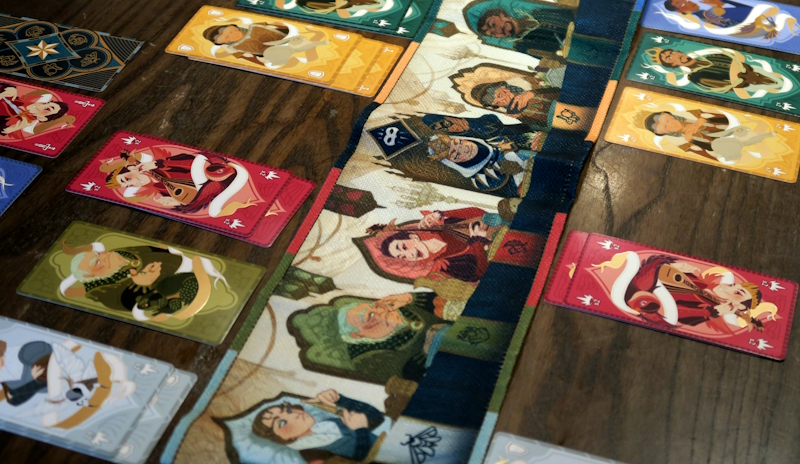
Old favourites typically often get a new lease of life with the release of expansions.  This year, relatively recent releases like SETI (which was confirmed as the winner of the Deutscher Spiele Preis), Faraway, Castle Combo and Windmill Valley recieved new additions, but older games like Underwater Cities and Wingspan also got some love (with the new Data Era expansion and the fan-designed promo packs).  As well as new games and expansions, there were also a number of re-releases of old favourites including Ra, Bohnanza (with Dahlia artwork) and Botswana, and even Ticket to Ride which has had a bit of a face-lift with new artwork.

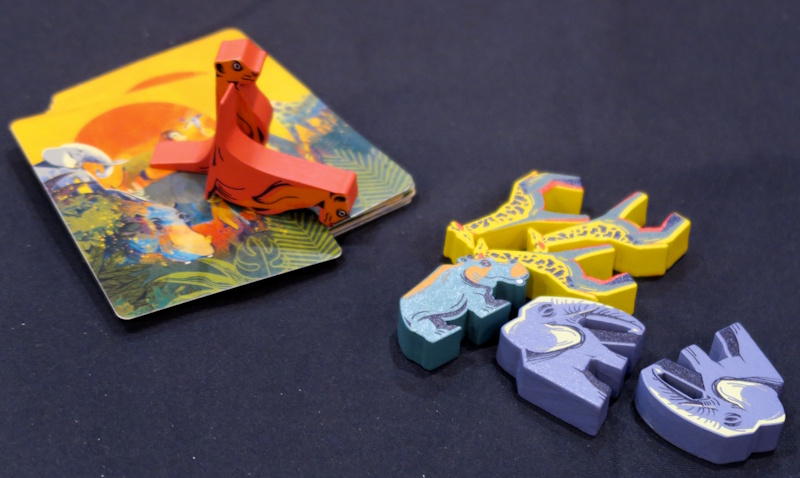
Botswana
– Image by boardGOATS

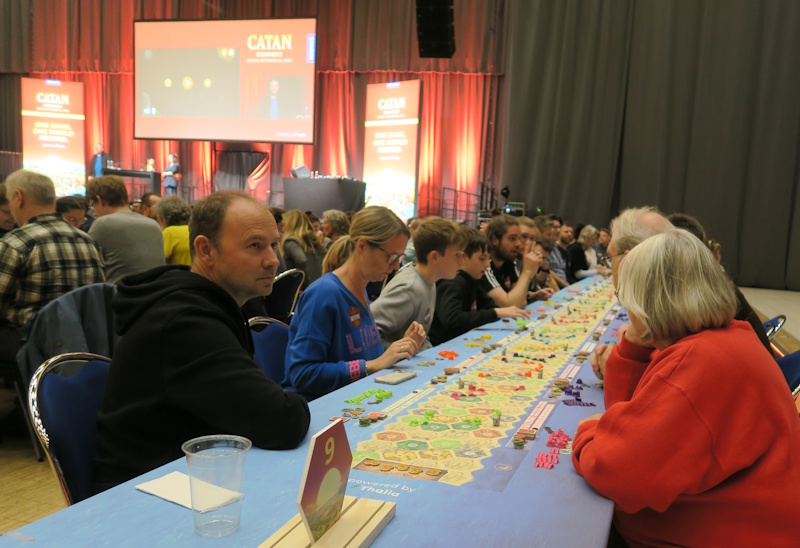
For those that were prepared to stay late on Friday, there was a world record attempt for the most people playing The Settlers of Catan together.  This was achieved with CATAN-Connect, which is a new version of the game designed for large parties that has large groups playing around single islands with elements of simultaneous play and everyone working to one electronic dice roll and a timer.  The record had been set at Essen in 2015 with one thousand and forty, only for Rotterdam to set a new record two years later with one thousand and ninety-six.  At SPIEL, one thousand, one hundred and seventy players joined in the game (watched by a few more who were just curous), successfully bringing the world record back to Germany where it arguably belongs.

CATAN-Connect
– Image by boardGOATS

8th July 2025 (Report)

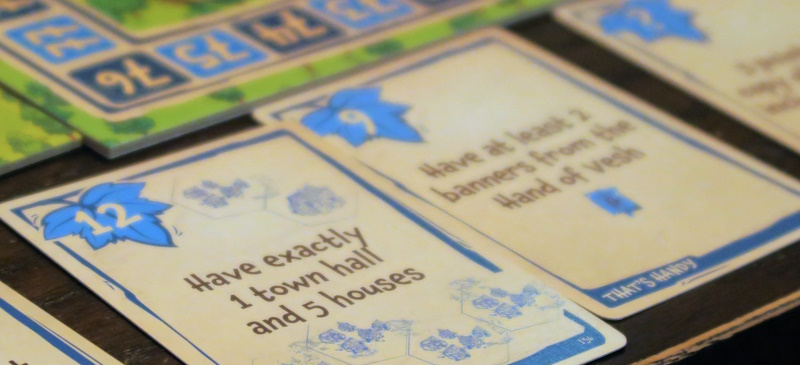
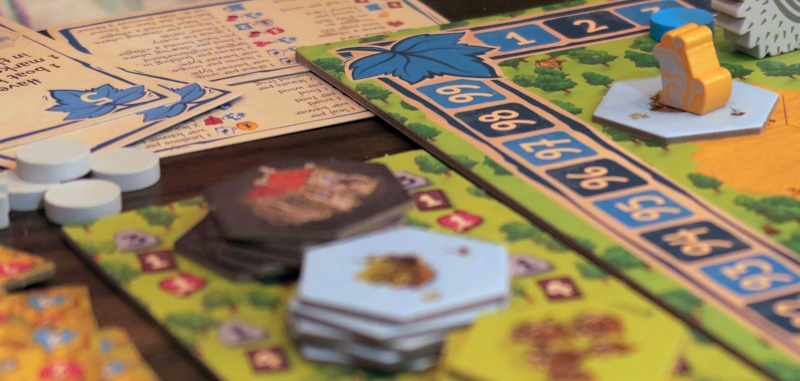
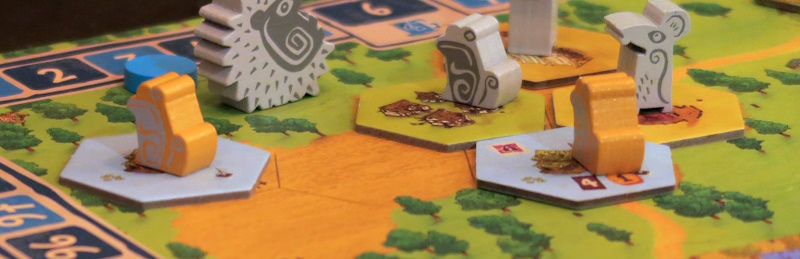
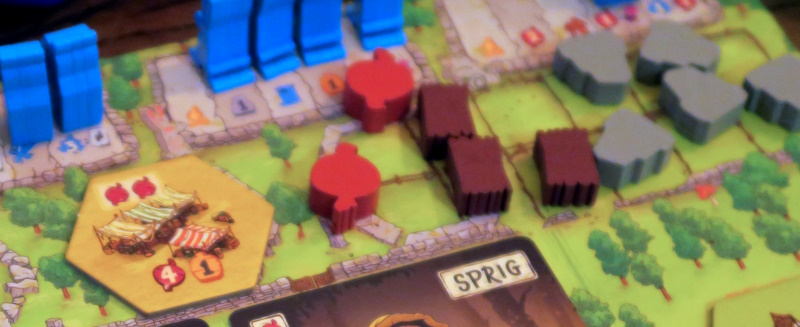
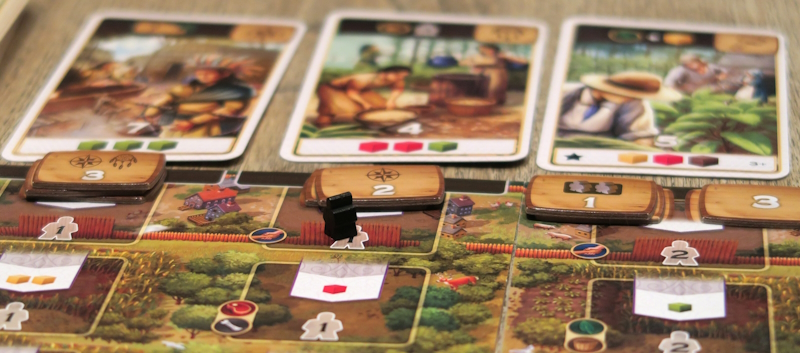
Things were late starting, largely due to the delayed arrival of Blue and Pink with their copy of the “Feature Game“, the the shiny new Emberleaf.  It was Plum’s Special Birthday—there have already been two in the last few weeks (Jade and Pine, with Black a few months ago) and more to come in the not too distant future—so there was a bit of chat, card signing and some amazing chocolate cakes provided by Sapphire.  Eventually, as time was marching on, games were assigned and Blue and Jade started to explain the rules of Emberleaf to Ivory.  This is a “card dancing” and tile placement game from the same stable as The Isle of Cats, where players are trying to re-home their kin in clearings on the central Forest board.

Emberleaf
– Image by boardGOATS

The core mechanic of the game is card placement and movement on the players’ individual Fellowship player boards.  The idea is that on their turn, players carry out one of two possible mandatory actions and as many optional actions as they like.  The two possible mandatory actions are Card Placement and Card Movement (or “Dancing”).  There are five different types of power on the Cards and one of these is the “On Play” action.  This takes effect when they are placed—players start with a two by six space to place cards and can place each card in any empty space.  The other possible mandatory, Card Movement involves starting with the card in the top left corner and progressing down each column, each card is moved left one space and any “Slide” actions are carried out.

Emberleaf
– Image by boardGOATS

When cards reach the left-most column, Sliding moves them off the player’s board (activating any “Drop Off” actions) and back into their hand (not via a discard pile like deck-building games, so there is no probability element; Cards as always available in hand or on the player’s Fellowship board).  The remaining two powers include “Ongoing” and “Charge”.  Ongoing powers are always active as long as the card is on the board, while Charge powers are optional actions that can only be taken a set number of times before they must be refreshed by the Card Sliding off the board.  All these actions broadly come under the categories of Gathering Resources (Wood, Stone, Turnips or Honey), Walking between clearings, Attacking monsters to make dangerous areas in the forest safe, and Building in clearings.

Emberleaf
– Image by boardGOATS

Each player has a space on their Fellowship board to place Resources, which means players have a limited number they can store.  So, for example, Building requires a card to give the action (either placed or moved) and the necessary Resources to be spent, as well their Hero figure at the clearing they are building in.  Each player starts with a super-cute Hero Figure representing their clan chief, located in Hawker’s Crossing—the most westerly clearing, on the edge of the Forest.  From there, players can move their Hero around the board by Walking along paths which go through dangerous areas.  If a player wants to travel through a dangerous area, they need to walk further or, alternatively, they can spend a turn Attacking the monsters in the Dangerous area and make it Safe (which also requires an action either by placing a Card or as part of a Card Movement).

Emberleaf
– Image by boardGOATS

As always, Ivory was on the case, and asked the key question:  Where do the points come from?  In truth, Emberleaf is a bit of a “point salad” with points coming from all sorts of places.  For example, players get points for Building with the number of points equal to the number of different types of building in a neighbourhood.  Players also get points for making Dangerous areas Safe, as well as for collecting Trophies.  There are six Trophies available during the game, and getting these is all about timing with the player who reaches the bottom of the cooperative War Banner Track taking one.  Everyone gets some benefit from this, but the player who takes the Trophy gets an extra bonus.  The game ends at the end of the round when the sixth is taken.

Emberleaf
– Image by boardGOATS

Additionally, in a similar way to the tiny buildings in Tapestry, when players take one of their twenty Emberlings from their Fellowship board and re-home them, they reveal a little bonus and some of these are points (others include Resources etc.).  There is another, more significant way of gaining points, however, and that is through Favour Cards.  These are personal objective cards which can be very lucrative and are scored at the end of the game.  Favour Cards can be acquired as part of rehoming Emberlings, but also by Promising a Favour, one of the optional actions that can be carried out as part of a player’s turn.  Each clearing starts with a Favour token in each player’s colour and if their Hero is currently located in a clearing containing one the player may spend it to take a Favour card.

Emberleaf
– Image by boardGOATS

On the surface, the game is not that complex, though building an engine requires an understanding of what the cards do and how to get the best of them.  Additional Hero cards can be taken from a Card market when a Campfire icon is revealed (likely on re-homing an Emberling).  There are a few little rules niggles as well.  For example, the Card markets (there are two:  Favour and Heros) are refreshed at the end of a player’s turn, but as well as replacing the used cards, the oldest card is also discarded meaning the order cards are drawn in has to be observed.  Similarly, whenever a the bottom of the War Banner Track is reached, the Dangerous Area tiles are refreshed.

Emberleaf
– Image by boardGOATS

Ivory, got a handle on the rules really quickly and was out of the blocks on the “B” of bang.  Jade wasn’t far behind, while Blue was much, much slower as she spent much of her time with her nose in the rules checking queries rather than focusing on her game.  When she finally got round to looking up, the others were distant figures on the horizon and she had a lot of catching up to do.  Ivory had moved quicklywith an initial strategy of building buildings on the areas that gave honey (particularly markets occupied by a mouse for his end game scoring).  This gave him additional spaces on his board and he then picked up a couple of additional Hero Cards and several Favour Cards to further drive his strategy.

Emberleaf
– Image by boardGOATS

The Koala allowed Ivory to battle anywhere whenever he “Danced”, and that gave him a steady stream of points and resources.  Jade and Blue were slow to clear the additional board actions, but Ivory found that opening up the Build Action meant he always had that available and could place a card with only “Dance Actions” at the end, giving me max benefit for that card.  Everyone tried to get end game objective cards early as they give something to aim for.  Ivory was by far the most effective at this however getting cards that gave points for having his mice on markets, mice in at least three different areas and building in exactly four areas, whereas Blue who was slower, found she was trying to take objectives that matched her achievements.

Emberleaf
– Image by boardGOATS

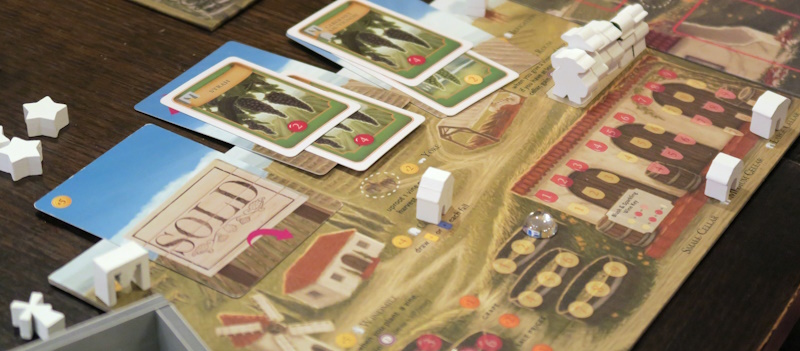
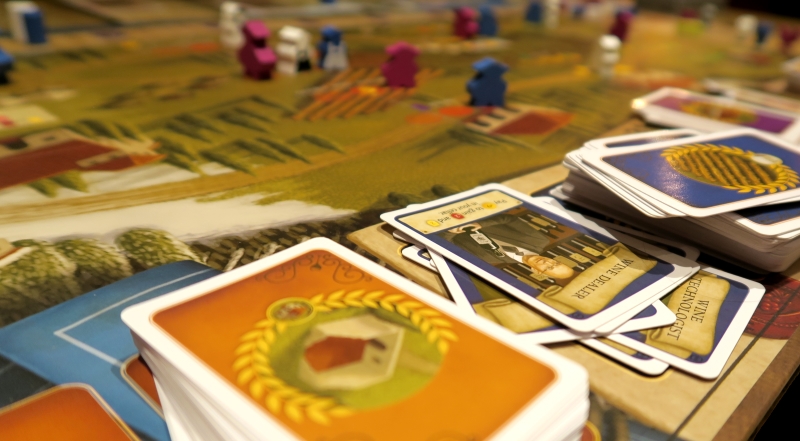
Inevitably, Ivory was the victory by a veritable country mile finshing with one-hundred and thirty-eight, though Blue who had been practically stationary for most of the game, came through strongly in the late stages to take second.  It had been a tough learning game, but everyone had liked it and it definitely deserves anothe outing.  Meanwhile, Plum, the Birthday Girl, was playing one of her favourite games, Viticulture.  This is also one of Pink’s favourites and is also very popular with both Byzantium and Mint who completed the foursome.  There is nothing really innovative about the game—it is “just a standard worker placement game”, but it does the job really, really well, which elvates it above so many other worker placement games, and as a result, it rates highly on ranks very highly on so many lists.

Viticulture
– Image by boardGOATS

The game played over several rounds, which are split into seasons—Players take it in turns to place workers on the Summer part of the board in the first half allowing them to plant grapes and prepare for Winter when players can harvest their grapes, make wine and fulfill contracts for points.  In general, each action has a small number of active spaces, but players also have a Grande worker who can always be used to carry out an action, even when all the usual spaces have been filled.  Winter and Summer are setup phases when turn-order is addressed and Visitors arrive.  Visitors are cards which allow players to bend the rules slightly and/or gain points.

Viticulture
– Image by boardGOATS

This time, however, the group decided play with the Tuscany expansion and the Moor Visitors card deck.  Tuscany replaces the main board with a larger board, but also re-structures the phases so that there are now four seasons to place workers.  It additionally adds a small map where players can place star-eeples to gain a bonus and points at the end of the game for the player with the most influence in this area.  Tuscany also brings in structures, which players can build to enhance their vinyard and use to gain more points.  It also lenghtens the game slightly, ending when a player passes twenty-five points rather than twenty in the base-game.

Tuscany
– Image by boardGOATS

Everyone knew the game well, so after just a few rules clarifications the game was underway with everyone opting for the the now standard trategy of selling a field for an early influx of cash.  Mint started with some really nice building cards including one which enabled her to harvest multiple fields at the same time.  Plum was less enthused by hers and recycled them—as she had begun the game with the Cottage she was picking up extra Visitor cards every Autumn.  She made a concious decision not to choose to “wake up” first, which meant she never went first or last in the turn order and when she chose the start bonus of “age grapes” she forgot to take advantage of it.  This was clearly catching as Byzantium did something similar when he chose the same starting position.

Viticulture
– Image by boardGOATS

The Tuscany expansion also adds Special Workers which have their own special abilities and players can train one of their workers to have each of these.  This time they were the Farmer and the Builder, with the latter from the Special Workers promo.  Respecively, workers with these powers, allow the player to choose a bonus (even if they are not on a bonus space) and save two lira when building.  A priority is always to get more workers early in the game, but whether to upgrade them is a difficult decision as it costs an extra lira and cash is always so tight in this game.  These proved quite popular though as going second in a location with a Farmer still gave a bonus.

Tuscany
– Image by boardGOATS

Pink got his head down making wine early as he picked up two really nice, achievable and valuable contracts early in the game, which gave him a solid start.  However, it was a very long time before anyone actually really started scoring points as everyone concentrated on building their vinyards before putting them into action.  For example, Plum, needed a Trellis for her first grapes, although having a Builder reduced its cost.  Eventually she also built a Penthouse which gave an extra point when making high quality wine over a value of seven and with those in place was in a position to start growing, harvesting and turning grapes into wine.

Tuscany
– Image by boardGOATS

At one point, Plum played a two Visitor card combo that gaver her a grape which she was immediately able to sell at tripple the normal price.  Otherwise, everyone mostly focussed on turning grapes into wine and completing contracts for points, although Pink did turn cash into points as well.  As is always the way with Viticulture, there was a sudden cascade of points, and with four experienced players it was a tight game with all four finishing over the twenty-five point finishing line.  The winner was Pink, however, who finished with thirty one points, three more than Plum who took second (no, Pink wasn’t going to let her win, even on her birthday!), and Byzantium and Mint tied and shared the last spot on the podium.

Tuscany
– Image by boardGOATS

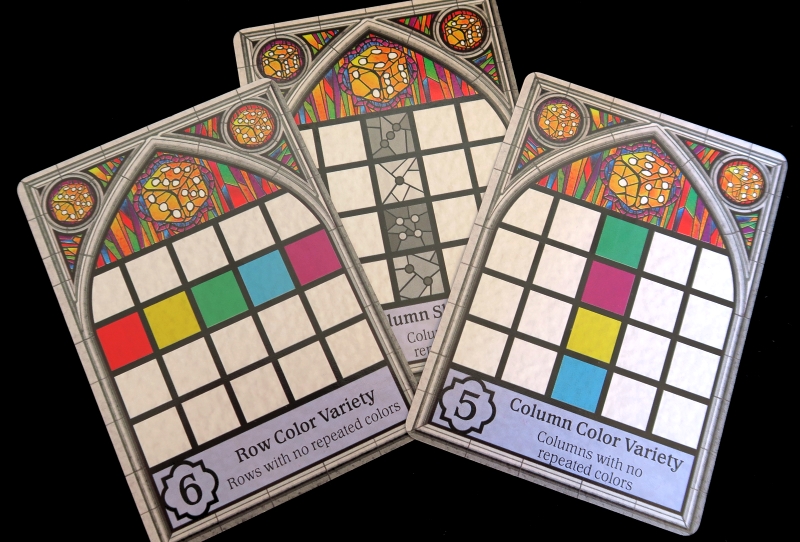
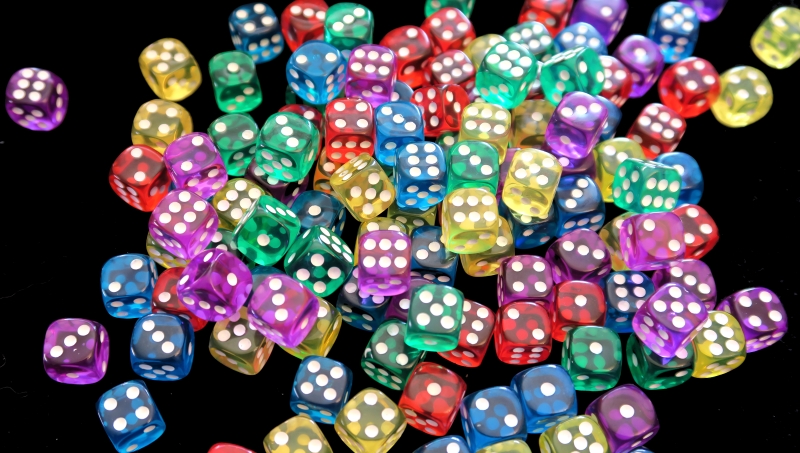
The third table, comprising Black, Purple, Pine, Sapphire and Lime, started with a game of Sagrada (with the 5-6 player expansion).  This is a fairly simple game of dice-drafting, where players are placing dice to create stained glass windows.  Dealt at random, each player begins with a private objective card and two double-sided Window pattern cards, choosing one side to play with and taking the number of Favor tokens marked on the chosen pattern.  Three Tool cards and three public objective cards are placed in the communal central area and the first player rolls all the dice.

Sagrada
– Image by boardGOATS

In “serpentine order” (i.e everyone taking a turn in order then taking a turn in reverse player order), players can use any Tool card (paying one Favour token for the first use, two thereafter) and then choose one die from the pool and place it on an open space in their Window.  The first die must be placed on an edge or corner space and every other must touch another die diagonally or orthogonally.  Dies must match the colour or value depicted on the space if there is one and may never be orthogonally adjacent to a die of same color or value.  Players may choose not to take a die on their turn, but that will leave an empty space and each one costs a point at the end of the game.

Sagrada
– Image by boardGOATS

The game ends after each player has had twenty turns after which players score points for each public and private objective achieved adding one point for each remaining Favour token and and deducting a penalty point for each empty space.  Even though there were five, the group played by these standard rules rather than adding the optional private dice pools from the expansion.  The communal goal cards gave points for placing pairs of dice with a value of three and four; sets of dice with a value of one to six and rows with no repeated numbers.  As is always the case with dice games, this game is all about riding the luck of the roll, but it can play havoc with people’s plans.

Sagrada
– Image by boardGOATS

For example, on Pine’s first turn a roller six of the dice had a value of two, but nobody wanted them.  Later in the game he rolled again, this time rolling no twos when at least two people desperately wanted them!  When the game came to an end, there was just the scoring.  Honours were pretty much even for the first two communal objectives.  Purple managed to score once for the lucrative, one row without repeated numbers objective, while Sapphire and Black scored it twice and Pine three times.  Scores for the private objectives were almost identical for Sapphire, Lime and Pine.  In total that gave Pine victory, nine points ahead of Sapphire in second and sixteen ahead of Black in third.

Sagrada
– Image by boardGOATS

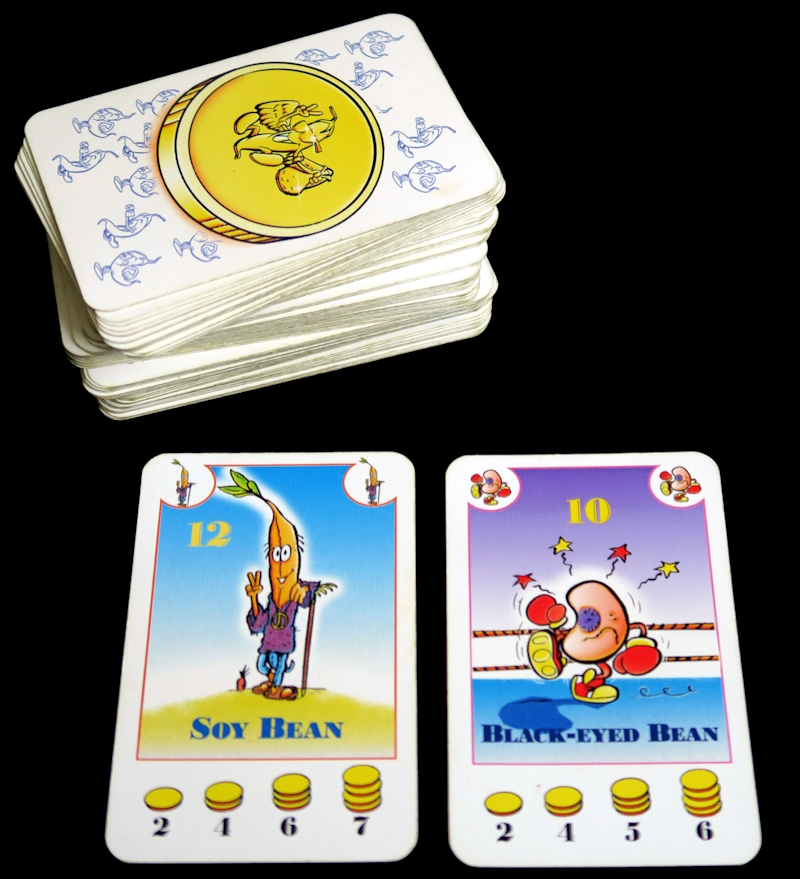
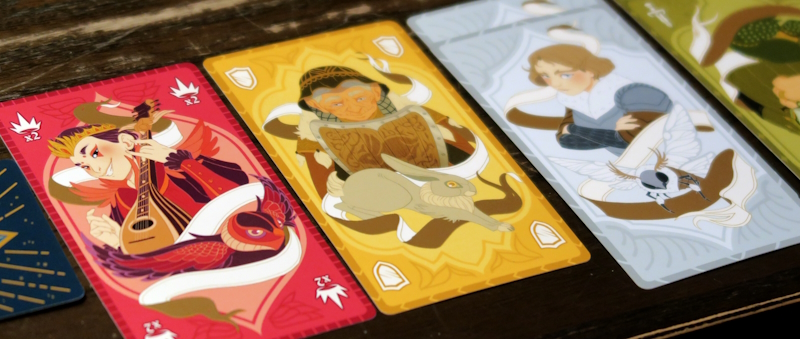
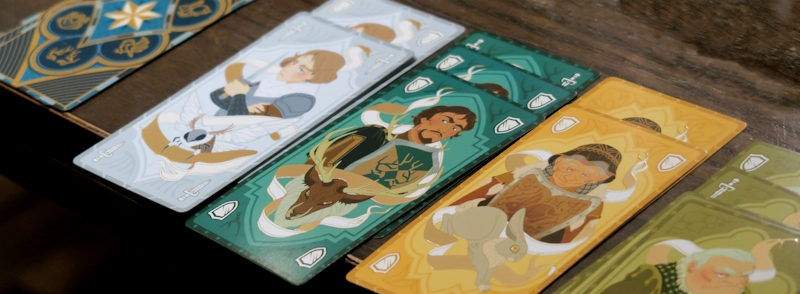
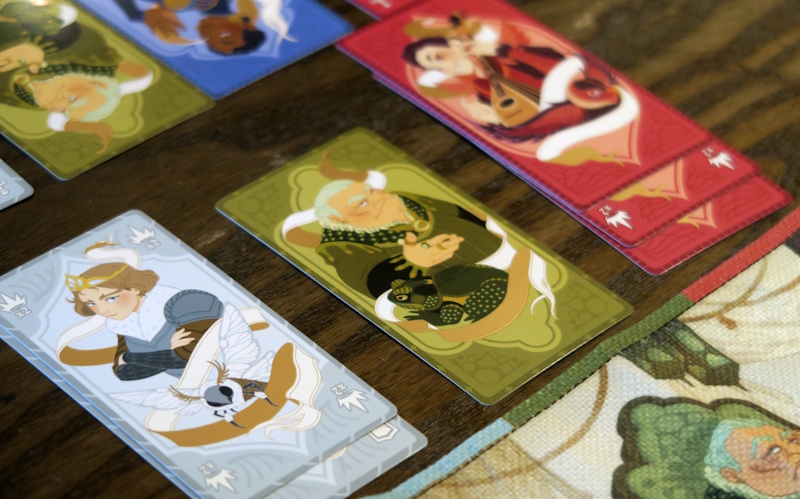
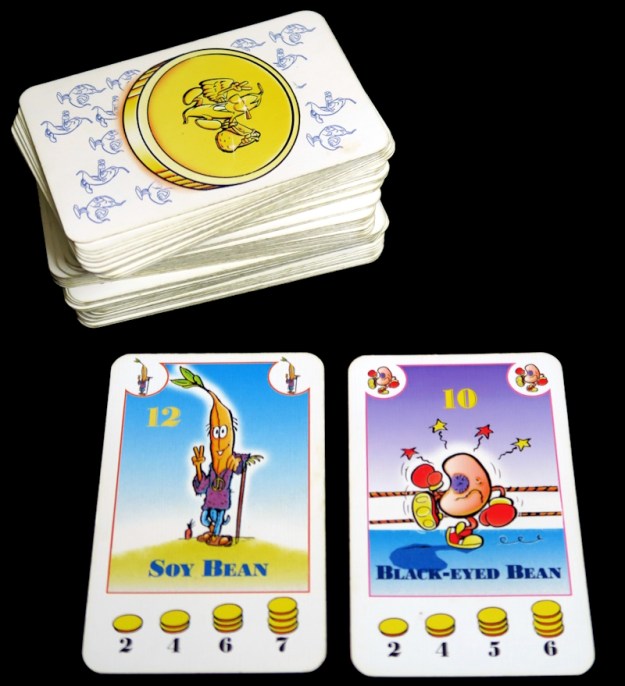
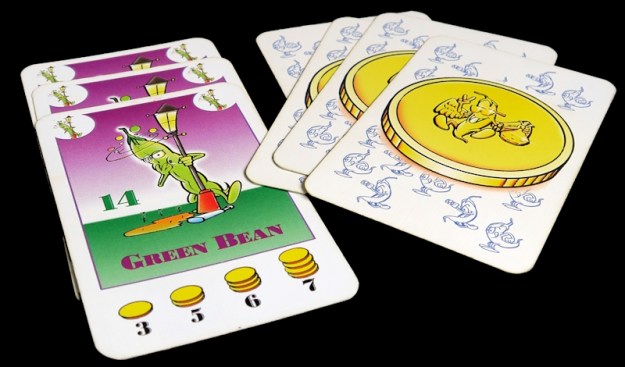
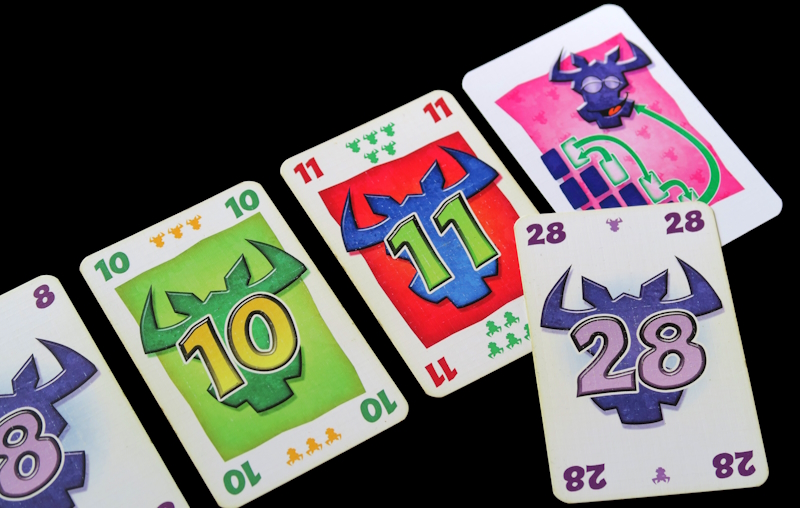
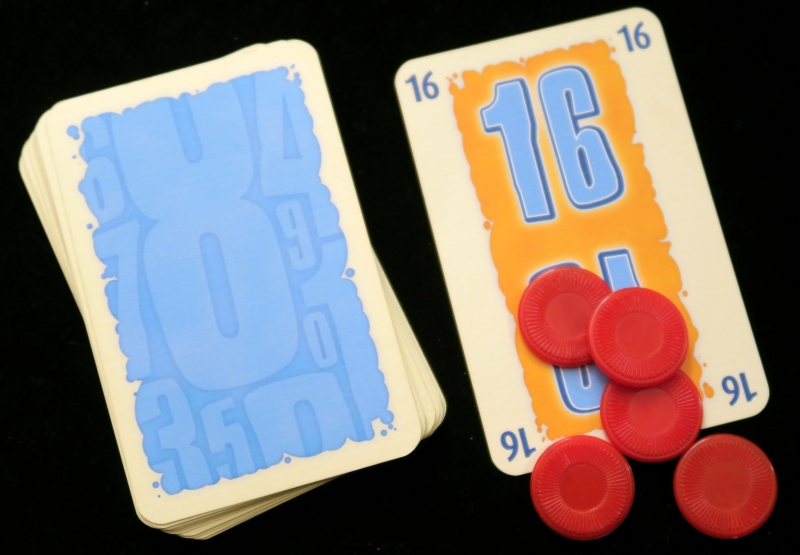
The other games were still going and looking like they were giong to take the rest of the evening, so the group looked around for another game that played five.  From the other side of the room Blue suggested Bohnanza, and as Sapphire thought he’d never played it, the group decided that wasn’t a state of affairs that could continue.  This is a popular game within the group as it is a lot of fun, even though a game about bean farming and trading sounds very unpromising.  Played with cards, the key mechanism is that the order of players’ hands cannot be changed—they can only be manipulated by in-game play.  So, on their turn, players must play the first card in their hand into one of their two “Bean Fields”, and may play a second if they can.

Bohnanza
– Image by boardGOATS

Beans can only be added to empty fields or to fields of the same type.  A field can be harvested at any point, but the aim it to maximise the yield.  Once the active player has played from their hand, there is the flop: two cards are played from the deck onto the table.  These must be planted before the next phase, but can be planted in the active player or by any player with their agreement.  Sometimes these are gifted, sometimes they are traded, and this is how players can manipulate the cards in their hand, by trading away undesirable cards.  Once the cards on the table have been disposed of, then the active player can trade any card in hand before replenishing from the deck to end their turn.

Bohnanza
– Image by boardGOATS

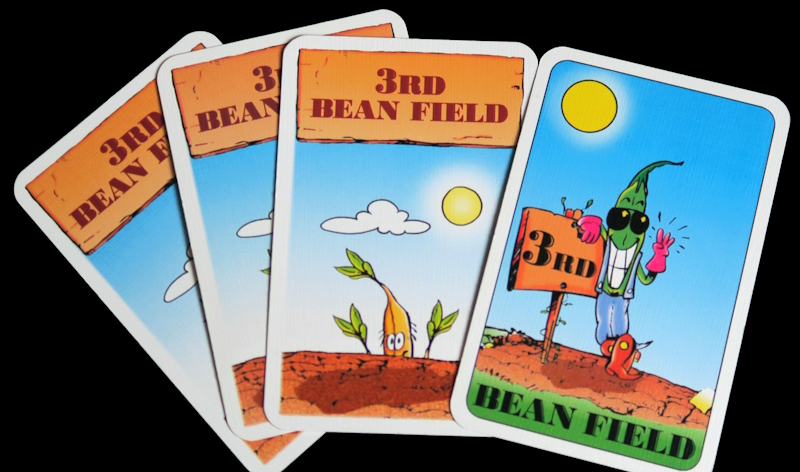
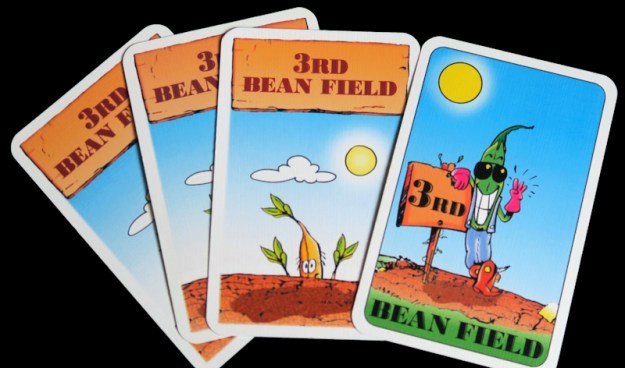
The game ends after three passes threough the deck, but while the first pass seems to take forever, the last always goes like lightening because many of the cards are now in players’ score piles.  Further the balance of the cards changes as the game progresses, with rare cards disappearing as they are turned into “Thaler” and get stuck in players’ stash.  Players can spend some of their riches on a Third Bean Field, but this is only really productive if carried out early in the game.  This was a strategy adopted by Pine this time—unusually for him.

Bohnanza
– Image by boardGOATS

It paid off almost imediately as Pine collected two of the super-rare cocoa beans, and soon added a third.  Black commented that he’d get the fourth, and Pine couldn’t hide his delighted laugh when he immediatly picked it up!  The winner was Lime though who finished three points clear with twenty, leaving Pine to take second and Black to make up the podium.  The question was, however, had Sapphire enjoyed it?  Sadly, the answer was a resounding “no”.  Worse, it turned out that he had played it before, and had disliked it so much that he’d blocked out the experience.  Such a shame, but some games are not for everyone…

Bohnanza
– Image by boardGOATS

Learning outcome:  You don’t have to know how you win, you just have to score more points.

27th May 2025 (Report)

This week, Jade was proactive and quickly got a group together to play the “Feature Game“, which was to be Flip 7.  This is a quick, push-your-luck card game along the lines of Blackjack and recently won a Golden Geek award and received a nomination for the Spiel des Jahres.  The group have already played it a couple of times on a Tuesday, but we wanted to raise its profile and share it more widely amongst our people by making it the Feature Game.  The idea is really simple:  players turn over cards and gamble on not revealing the same number twice.  Unlike Blackjack, the game is played turn-wise, so the the dealer starts by dealing one card to each player.  Then players take it in turns to decide whether they want to “flip” or ” stick”.

Flip 7
– Image by boardGOATS

This mode of play is critical to the game’s popularity because it keeps everyone involved and the turns short. If players stick, they score the total of the face value of their cards.  There are a couple of other things that make the game tick, in particular the fact that each numbered card appears in the deck that number of times (i.e there is one one, two twos and so on).  Thus, the highest scoring cards are also the most risky.  Further driving push to gample, flipping over seven cards in a row gives fifteen bonus points.  There are also some action cards in the deck, “Flip Three”, “Freeze”, “Second Chance” and modifier cards which give extra points, all of which break the rhythm and add interest without adding significantly to the downtime.

Flip 7
– Image by boardGOATS

The game ends when players have reached the pre-agreed total (two hundred, according to the rules, though games can easily be made longer or shorter as desired).  This time, the group played the game as written, to a total of two hundred, which took seven rounds.  Sapphire  and Flint managed to go bust five and six and seven rounds respectively, though Flint did manage to push his luck to get seventy—the most in a single round.   Jade achieved a new low, however, failing to score at all.  The front runner was Teal, but going bust in the sixth round left the door open to Ruby who had been matching him step for step, scoring in every round and triggering the end of the game with her unsurpassed two-hundred and thirteen.

Flip 7
– Image by boardGOATS

Everyone else was playing a longer game, so with six, that left the choice of another six player game or splitting into two groups of three.  The party feel of Flip 7 had got everyone in the mood for playing in a larger group, leaving a fairly limited choice, though there are a couple of really good options.  Bohnanza is one, but instead, the group chose Faraway—another game that received a Spiel des Jahres nomination this year, that we first played in the group over a year ago and has proved very popular since.  This is another relatively simple game, this time  with a market and a trick-taking type element, but with a really clever twist, and one that really messes with the head.

Faraway
– Image by boardGOATS

The story is that players are exploring the mysterious land of Alula in search of its secrets, meeting its inhabitants and listing its wonders in order to gain more fame than everyone else.  Players simultaneously chose one of the numbered cards from their hand to add to their tableau then, starting with the the player that played the lowest card (similar to 6 Nimmt! or Kingdomino), everyone takes it in turns to choose one from the market to add to their hand.  Players then simultaneously choose another card to play, and again, choose one to add to their hand.  The game ends after everyone has played a total of eight cards, and then everyone scores.

Faraway
– Image by boardGOATS

The scoring is the really clever part, because although the cards are played into tableaux from left to right, the scoring is from right to left.  At first glance, this looks like it makes things easy, because early in the game players find out what they need to get points and can then focus on getting the resources they need as the game progresses.  However, the desire to play scoring cards early is tensioned against card choice (the player who placed the lowest numbered card goes first) and the ability to get Sanctuary bonus cards.  Scoring cards are generally higher number and Sanctuary cards are gained when the card played has a higher value than the previous one in their tableau.

Faraway
– Image by boardGOATS

It is always hard to see how players are doing with this game, because if a player has played a high value scoring card early it can be worth a lot, but if the player fails to gain the necessary resources it can be worthless.  In the event, it was quite close with four of the six players scoring over sixty.  The winner, however, was Pink who got lucky early when he played card number fifty-nine first to start a map strategy and finished with five of them.  Sapphire was only two points behind in second though, and Teal two points behind that.

Faraway
– Image by boardGOATS

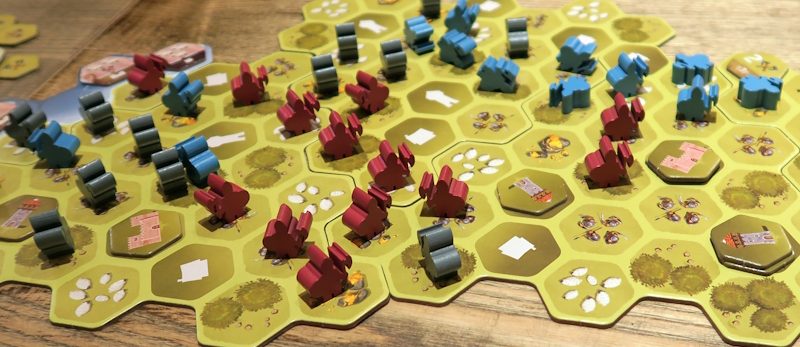
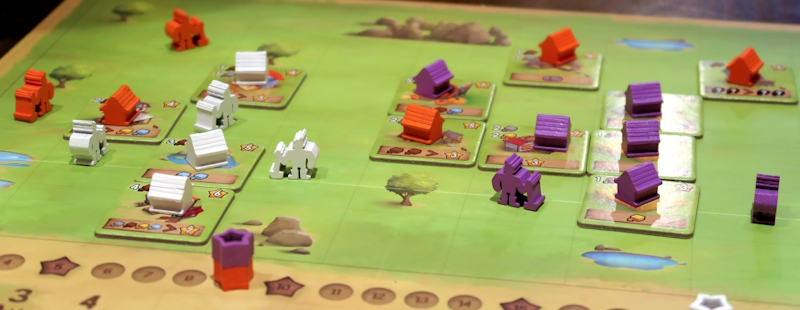
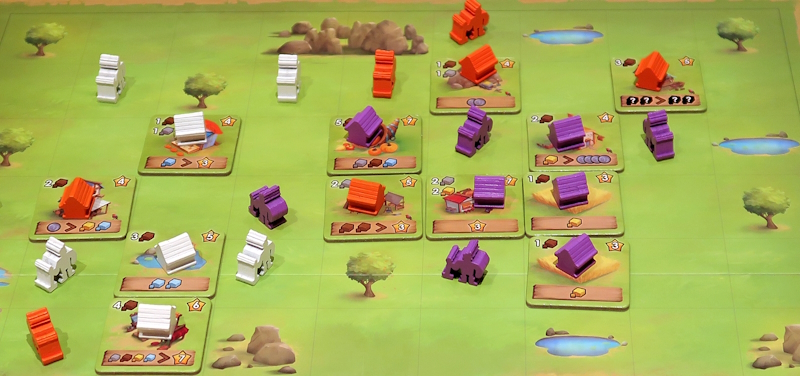
Meanwhile, on the other side of the room, Black and Purple were introducing Pine to Looot, another game that received a nomination, this time for Kennerspiel des Jahres, the “Expert” or “Connoisseur’s” game.  This is a game where players gather resources and capture buildings to develop their fjord, fill their Long Ships and complete buildings to rack up victory points. The player with the most riches is crowned Jarl of the Vikings.  The game is played over several rounds until each player has played all their Vikings, giving a maximum of thirteen turns.  In each, a player first places their Viking on a Resource tile on the central board adjacent to another Viking of any colour and takes the Resource and place it on their personal board.

Looot
– Image by boardGOATS

If possible, they then capture a Building and place that on their board, take a Long Ship and also place it on their board, use a Shield, complete a Construction Site and finally grab a Trophy.  At the end of the game, scoring is a bit of a point salad with points awarded for Castles, Watchtowers, Houses, Gold, Sheep, Trees, Construction Sites, any Trophies the player may have claimed and a five-point penalty for any unfilled Long Ships.  Purple raked in points for her Houses, Construction Sites and Trophies, while Black did better for his Watchtowers and Gold, and Pine top-scored for Trees.  The winner, however, was Purple whose total of ninety-one was five ahead of Black in second.

Looot
– Image by boardGOATS

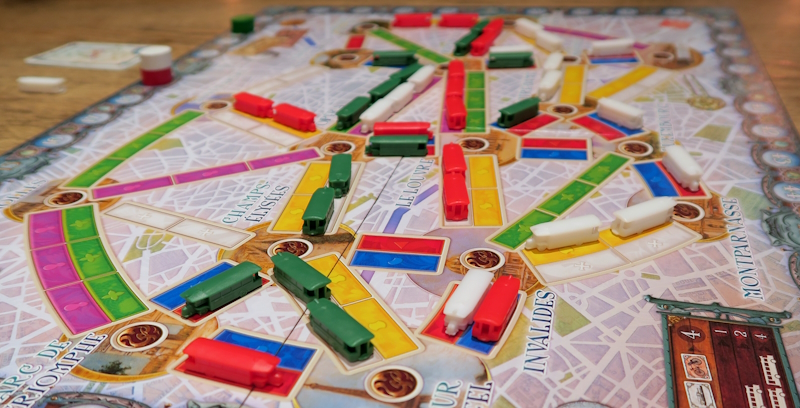
The trio followed this with a shorter game, the Paris version of the 2004 Spiel des Jahres winner, Ticket to Ride (aka Zug um Zug).  Like the original, game-play is very quick and simple:  players take it in turns to take Cards from the market, or spend them to place Trains on the map with the aim of completing Tickets.  Players score points for placing Trains and completing Tickets with penalties for any incomplete Tickets.  Each game variant has its own special rules.  In the case of Paris, when players score bonus points each time they complete a Tricolor: a set of blue, white, and red routes.  This time it was a very close game.  Pine had the most points collected during play (including Tricolors), but Black picked up more for his Tickets and edged it by a single point.

Ticket To Ride: Paris
– Image by boardGOATS

The final game of the night took all evening and was the only one that that has not had a nomination for the Spiel des Jahres, Century: A New World.  This is the final game in the Century Trilogy (preceded by Spice Road, Eastern Wonders), but as they all use some of the same components, Plum and Byzantium had managed to squeeze all three games into one box (with an extra set of cubes so two could be played at once).  In A New World, players are exploring the Americas at the dawn of the 16th century trading with local inhabitants, recording their findings, and hunting and gathering to survive.

Century: A New World
– Image by boardGOATS

The game uses the resource trading mechanisms (Collect, Upgrade and Exchange) found in the rest of the Century series, but instead of using cards as in Spice Road, this is combined with with a worker placement mechanism.  On their turn, players can either Work (place Workers) or Rest (retrieve Workers).  Workers can work at Locations that have neither an Exploration tile nor Workers of their own colour.  If a Location is vacant, they can activate it by placing the number or workers depicted on the space; if it is occupied, the current occupants must be evicted and returned home by placing one extra Worker.

Century: A New World
– Image by boardGOATS

There are four locations types, thee allow players to Collect, Upgrade and Exchange Resource cubes, while the fourth (Forts) allows them to use Resources to claim Points Cards and Bonus Tiles.  Players can only have a limited total number of Bonus Tiles, and can only claim the Points Card associated with the particular Fort.  These Cards are supposed to slide along a conveyor belt so that they move from one Location to another, but thanks to a rules malfunction, this time the didn’t until more than halfway through the game.  The game finishes when one player has their eighth Points Card, so it can end quite suddenly, as players can pick up cards quit quickly due to special powers.

Century: A New World
– Image by boardGOATS

These games are basically race games, and it felt like Byzantium had a good start with points from his Exploration tiles, the only one to have any.  However, as Plum built her engine, she galloped up on the rail, ultimately taking the most points from her Cards. She also took the most points from Bonus Tiles.  In such a tight game, left over resources were critical and they enabled Cobalt to leap-frog Byzantium into second.  Plum was the winner, though by just two points.  It had been fun, though Plum’s comment that she actually preferred the second of the trilogy meant Blue who had not played it would take the opportunity to grab a copy at the UK Games Expo Bring and Buy a couple of days later.

Century: A New World
– Image by boardGOATS

Learning Outcome:  The Spiel des Jahres Jury can spot a good game.

8th October 2024

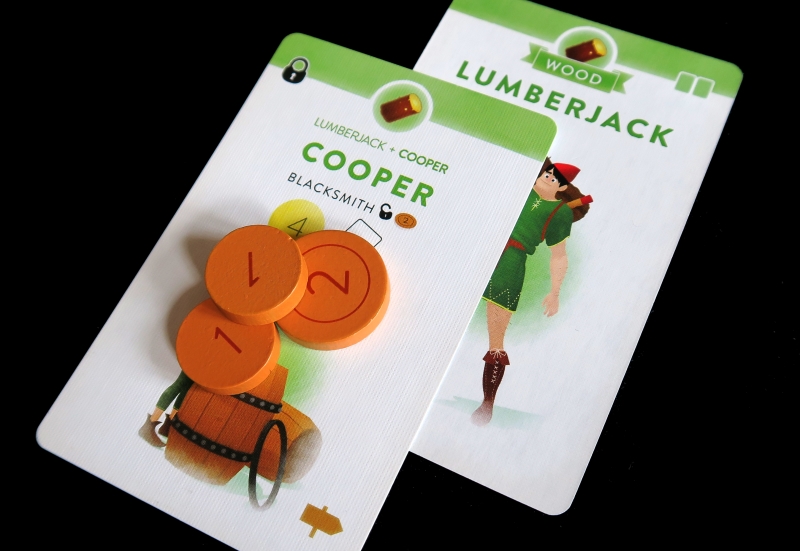
As it was our twelfth birthday party, lots of people arrived early for pizza (or an amazing Mixed Grill in the case of Lime and some lovely veggie curry and fiery chilli for Pine), followed by GOAT cupcakes.  While everyone waited for food, arrivals from Essen were handed out, including Nucleum, Faraway and Flamme Rouge expansions; Let’s Go! To Japan and Cascadia mini expansions, and Die Wandelnden Türme (aka Wandering Towers), Keyflower and Dixit promotional items.   There was a lot of chatter too, about flooding, pot holes, the 34 road closure, full car parks and water leaks, as well as Essen.  Indigo and Navy weren’t eating, so had a play with Villagers while the others entertained themselves.  This is a card game where players “Draft” Villager cards from a market (called the Road) and then add them to their Village.

Villagers
– Image by boardGOATS

Some Villagers have prerequisites before they can be “Built”.  These are cards that must exist in the player’s Village before the Villager can be added on top to make a chain, cards that must be unlocked by paying money to other Villagers in their own Village, someone else’s Village or the Bank.  Some cards allow players to draft extra cards, while others enable players to Build extra Villagers and Special Villagers give powerful special actions.  Twice during the game there “Market” Phases when players get income from their cards, and the player with the most money at the end of the game is the winner. Somewhere along the lines, Indigo and Navy had a bit of a rules malfunction, and as everyone else had already started the now traditional birthday “Feature Game“, Crappy Birthday, they abandoned Villagers.

Crappy Birthday
– Image by boardGOATS

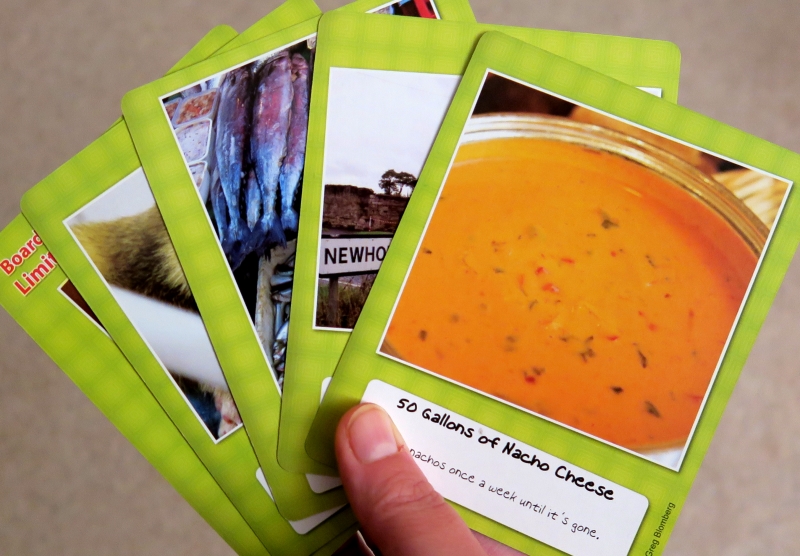
Crappy Birthday is a party game where players give each other comedy birthday presents and the recipient has to decide who gave the best and worst gifts.  We play a slight variant of rules as written, where we play a single year of birthdays with each gamer getting one turn to receive gift cards from everyone else from their hand of five cards.  With lots of players the pile of gifts can get quite substantial and this time everyone was getting thirteen gifts to decide which was the best and which was the worst.  The players who gave these then received a point for knowing the recipient so well and the player with the most points at the end of the year is the winner.

Crappy Birthday
– Image by boardGOATS

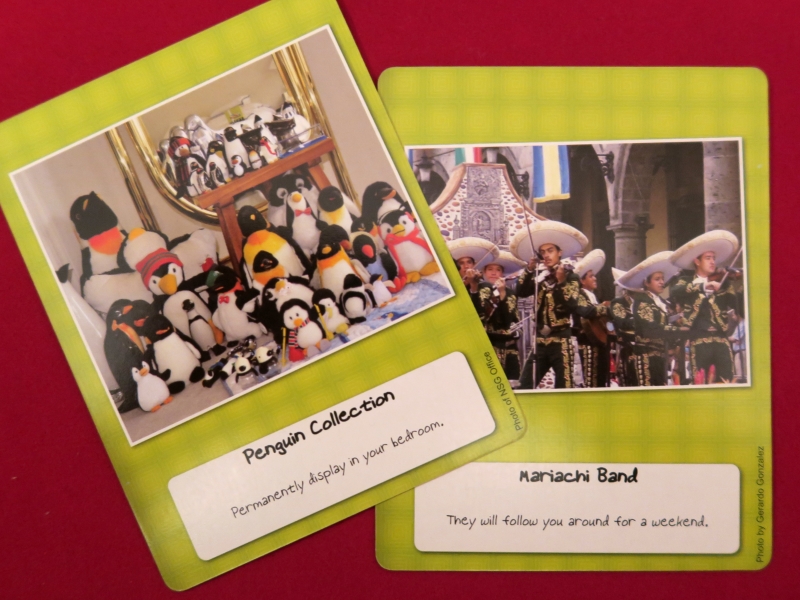
One of the reasons this game is so fun is that we learn a bit about each other.  Pink went first as his real birthday was next.  He liked the idea of an Easter Island Mo’ai for the garden (not that Blue was so impressed with the idea), but disliked the idea of cave scuba diving.  Plum chose a haunted castle as her favourite (because she loves castles), but pulled a face at the idea of earlobe stretching rings.  Purple had the matching neck rings, but these weren’t her least favourite gift, that was a giant swing ride, while she loved the idea of a penguin collection.  Byzantium showed his environmental credentials by picking a Global Warming Study as his favourite, while eschewing Jade’s wing suit dive gift.

Crappy Birthday
– Image by boardGOATS

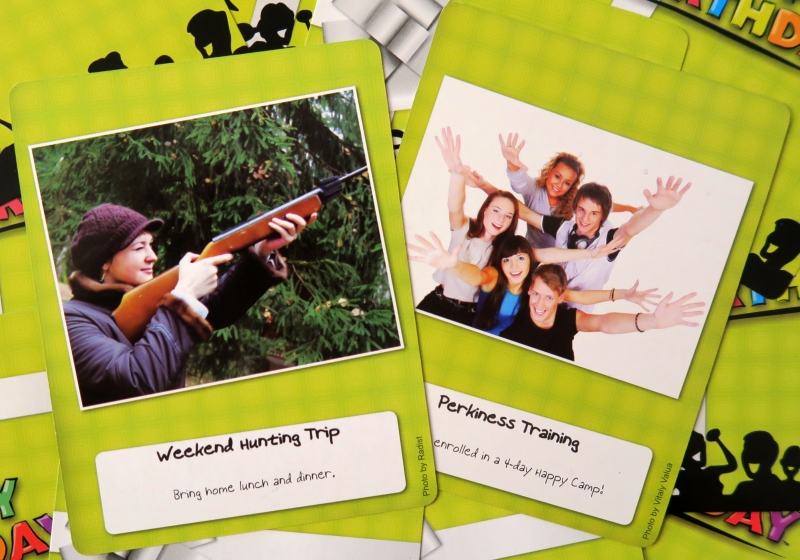
Teal felt that trees were quite beautiful enough without being carved, but really liked the idea of a ride-on bike mower.  Jade wasn’t a fan of Cobalt’s offering of Polka lessons, but loved the idea of trip to Mars from Sapphire, while Sapphire felt “perkiness training” wasn’t something he really needed, but the thrill-seeker loved the reciprocal gift from Jade, a roller-coaster ride.  Lime fancied a three day festival trip, but wasn’t keen on a week eating nothing but Spam.  Blue didn’t fancy the creepy baby sculpture to go with the Mo’ai, but fancied Pink’s gift of a Safari (provided she had time to train for the walking element).  Ivory didn’t feel his life would be improved by a free satellite TV dish, but always one to send his meeples into space in Tapestry, grasped the opportunity to join them with a space walk.

Crappy Birthday
– Image by boardGOATS

It turned out that Navy has a problem with bees, so Teal’s gift of a bee keeping which he personally would have loved, didn’t go down well, but much to Pink’s surprise, his gymnastics camp was received really well.  Indigo was quite abrupt in her negative response to the idea of paparazzi following her about, but liked the idea of exploring a volcano while Cobalt didn’t feel he needed his soul to be searched, but fancied flying lessons.  The final birthday of the year was Pine, who didn’t get his usual pile of horses and meat, instead getting the opportunity to run with the bulls, which having known someone who had done it and been gored, wasn’t something he fancied.  Pine’s favourite was Larry the Lobster (not that he has space in his garden for him), one of the Big Things of Australia, that Pink and Blue happened to see on their visit there last year.

Crappy Birthday
– Image by boardGOATS

Lime was the last to break his duck and was very pleased not to end the game without scoring any points, indeed, nobody finished with the dreaded bagel, which was nice.  The runniest of run-away winners was Teal though, with five successful (or unsuccessful) gifts, with Pink and Cobalt joint runners up with three.  It was interesting though, this time there were quite a lot of gifts that people gave “in error” where as Teal commented, he “Gave pressies he thought people would like, but they all hated them!”  With the birthday formalities dealt with, there was time for something relatively short.  First up was Jade who was very keen to give his new Faraway expansion, Le Peuple du Dessous (aka The People Below).

Faraway
– Image by boardGOATS

Faraway is a fairly simple little game, but one that really messes with your head:  players play cards from their hand of three, adding them to a row of cards, left to right, but at the end of they score the eight cards from right to left.  The Peuple du Dessous expansion adds just seventeen cards, but these include the Guides and the Three-Eyed Ones, two new Peoples with more opportunities to score, as well as giving enough cards to play with seven people.  This time there were only five though, with Sapphire, Byzantium, Indigo and Navy joining Jade.  Navy and Indigo were new to the game and, as usual, it took a little bit of getting used to.  That said, the both did really well with Indigo ending up with seventy-seven points, four more than Sapphire in second with Navy taking third, just one point behind.

Faraway
– Image by boardGOATS

Navy and Indigo headed off and took an early night, but the other three had to wait for Plum who’s game on the other side of the room was ongoing.  Faraway is a fun little game though and the expansion adds a little more, so the trio decided to give it another go.  This time, Byzantium was the victor with seventy-three with Sapphire the runner up again.  Meanwhile, Blue, Pink, Pine and Teal, got out Bohnanza.  This is a game that is generally popular with the group, though Teal had somehow only managed to play it the once almost six months ago.  This is a very simple card game, albeit slightly convoluted and very unpromising when explained, but the key is that players must not rearrange the cards in their hand.

Bohnanza
– Image by boardGOATS

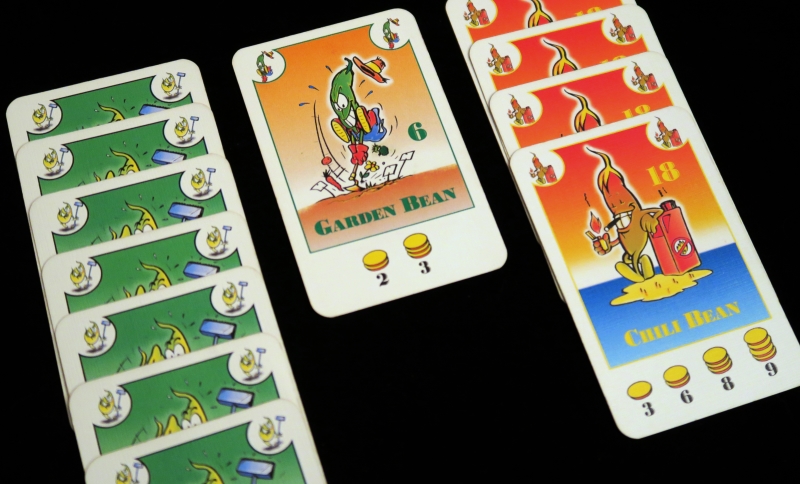
On their turn, players must plant the first card in their hand in one of their two been fields and may plant the second if they choose.  They then turn over two cards from the deck, which must be planted before the player can move on.  Fields can only contain one bean type, but beans can be traded, or even gifted, and it is the trading and negotiation that makes the game such fun.  Once the two cards on the table have been planted, players can trade from their hand, but again all traded cards must be planted.  Players can harvest Fields at any time with some of the bean cards dug up becoming money and larger Fields giving more money and at a better rate.

Bohnanza
– Image by boardGOATS

Blue took some high valued Garden Beans and then sold them off to buy a third Bean Field, causing a lot of confusion for Pink who couldn’t believe it when they kept appearing even though there were only six in the deck.  Teal scored well from his Chilli and Wax and Soy beans, while Pine and Blue ended up in competition for Green Beans.  This time with just four, the scores were a little more varied, but Blue was the clear victor with twenty-five Bohn Thaler, five more than Pine who came second.  The final game of the evening was Villagers, which was getting another outing on the other side of the room with Cobalt leading Ivory, Purple and Plum.

Villagers
– Image by boardGOATS

After a reminder of the rules, Purple started and grabbed the Carpenter then Cobalt went next taking the Blacksmith.  Both of these guaranteed their owners an income of coins (and hence points) at the expense of other players paying to use them. However, this did mean that they fell behind on building an engine to Draft and Build more cards (which Plum and Ivory focused on).  From there, the first half of the game went quite quickly with everyone focusing on building their engine. Ivory managed to get a Wine Trader using a Monk as a Graper, as well as playing a Scavenger, enabling him to take slender lead after the first scoring, although the scores were all very close.

Villagers
– Image by boardGOATS

In the second half of the game, Purple and Cobalt were beginning to have to make tough choices, being unable to play as many cards as they would like and not having the building cards they needed, which were also hard to come by. However, they continue gaining coins from all players. Purple had to discard quite a few cards to get starter cards which slowed her down a little, though Plum and Ivory were able to quickly get to the position to Draft and Build the max number of cards allowed; Plum in particular seemed to always have a fist full of cards.  As the game progressed, more people began taking cards that others might want, with Cobalt taking Wool cards that might have been of use to Purple or Ivory.  Ivory, however, was actually more focused on getting a second Vintner, already having a second Wine Trader in hand.

Villagers
– Image by boardGOATS

Towards the end of the game, there was face down Grape card which Ivory debated taking a gamble with, but decided not to take the risk.  Inevitably, when it was flipped over it turned out to be Vintner and Plum grabbed it. Ivory got very lucky during his next draft though, taking a face down Special card that was Monk, which he could then play as Vintner. Elsewhere, Purple played some Wool cards, getting two Weavers, Plum picked up some good end-game scoring cards in the Locksmith and Freemason. Cobalt focused on Solitary cards and Silver end game scoring, doing well from his Priests, Agent and Blacksmith combo. Ivory ended up focusing on the Hay cards, which scored well and that plus the two Wine Traders (and a second Scavenger), gave him a hundred and twenty-six and a two point victory over Cobalt.

2024 Birthday Cupcakes
– Image by boardGOATS

Learning Outcome:  Getting old is not necessarily a bad thing.

9th July 2024

When Blue and Pink arrived, Crimson and Cyan were already there on their first visit, finishing their supper and playing a game of Molehill Meadows.  This is a new game by the designer of Zuuli, that they had picked up at the UK Games Expo (meeting the designer Chris Priscott and his delightful family in the process).  In Molehill Meadows, players take on the personality of Mika the Mole, who has an affinity for shiny things, a hunger for juicy worms and an innate desire to dig  A flip-and-write game, players dig tunnels using polyomino shapes to carefully expand their molehill home.

Molehill Meadow
– Image by boardGOATS

Their game was somewhat interrupted as people arrived and were introduced and they were surrounded by the general chatter of arrival and Blue and Pink munching their pizzas.  Crimson and Cyan carried on playing, flipping polyomino cards and then drawing the shapes on their map.  Extending their tunnel to find Worms gave both players four “Worm Powers”, and fining treasure gave them points.  Cyan collected twice as much treasure and picked up more than twice the number of bonus points than Crimson (for collecting all of the two sets of flowers on the Objective Cards) and thus was the eventual victor by something of a landslide (or should it have been a tunnel collapse?).

Molehill Meadow
– Image by boardGOATS

Then, while everyone else generally gossiped and caught up with the events of the last week or so, Jade and Sapphire joined Crimson and Cyan for a quick couple of rounds of the trick-taking, climbing game, SCOUT.  We’ve played this a few times on a Tuesday and everyone has always enjoyed it.  The game is simple in that on their turn, the active player either plays a set of cards to beat and replace the set on the table (a run or a meld), or take one card from either end of the set on the table and add it to their hand.  The round ends if a player plays the last card in their hand, or if it is a player’s turn and they played the current active set of cards on the table.
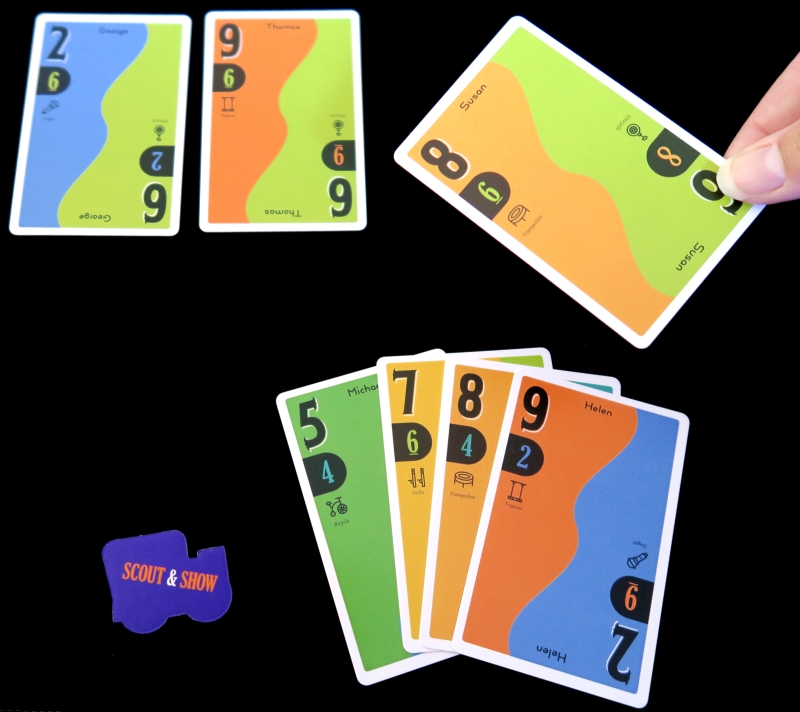
SCOUT
– Image by boardGOATS

At this point, player score for cards in their scoring pile (cards they have beaten during the round), for “chocolate bars” (rewards given when another player takes a card from their active set), and deducts a point for every card left in hand.  The clever part of the game is that, like Bohnanza, cards cannot be rearranged in hand, this with the fact that cards have different values depending which way up they are make this little card game really clever.  In the interests of time, the group only played two rounds, and although the scores can be very disparate, this time it was really tight with only five points between first and last and Sapphire taking the honours one point ahead of Crimson.

SCOUT
– Image by boardGOATS

By this time, Blue and Pink had just about finished eating and everyone else had mostly finished chatting, so with twelve, the group split into three groups of four, starting with Pine, Sapphire and Cyan who joined Jade in the “Feature Game“, Happy Home.  This is another polyomino game, with similarities to games like New York Zoo and Bärenpark, but with a theme of home decorating rather than building an animal park.  Like New York Zoo (or indeed Jokkmokk), the game has a central market, in this case representing a Store, which players move their Meeple round.
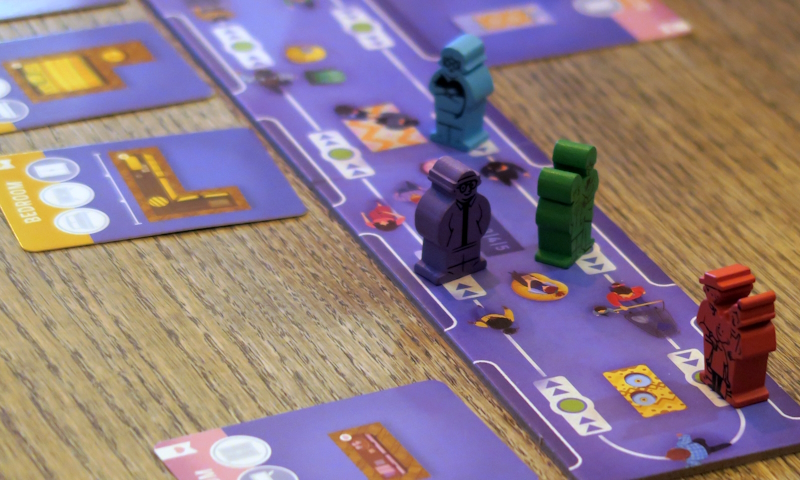
Happy Home
– Image by boardGOATS

On their turn, the active player moves their Meeple (or should that be Muman?) to an available space, takes the card and matching tile and then adds it to their home.  When all the cards are used up, players instead place a “Welcome Mat” on their doorstep to show they are ready to welcome visitors.  When everyone has finished , the game is over and players score their Home for Furniture, Colours, Pot Plants, their Welcome Mat and Design Objectives, losing points for any scratches still visible and not covered up by Furniture.
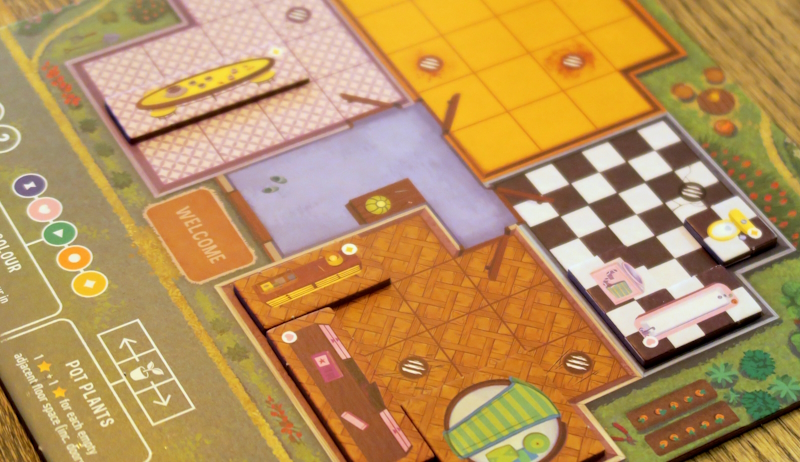
Happy Home
– Image by boardGOATS

There was a wee bit of misunderstanding on how the scoring worked even though Jade had done his best to explain it at the beginning.   Each Room scores one, three or six points if it has one, two or all three different core pieces of Furniture in it, and each Pot Plant is worth a point plus a bonus point for each empty space orthogonal to it.  That wasn’t where the problem was however, that was with the Colour scoring. Essentially players need to have the same Colour across at three different rooms to get two points and across four rooms to get five points, but somehow, this caused more confusion than it should have done.
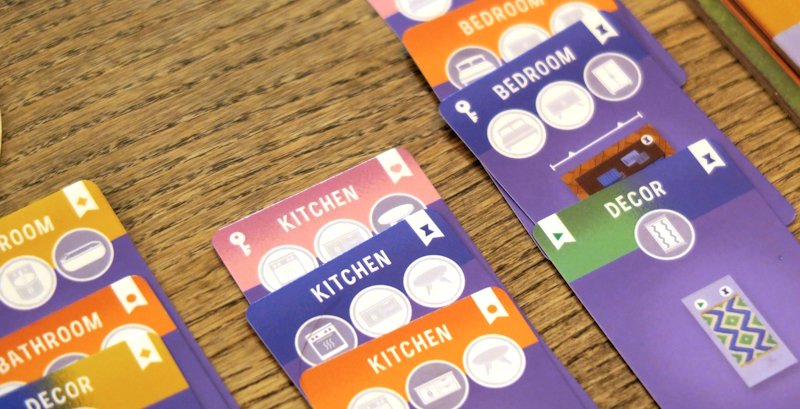
Happy Home
– Image by boardGOATS

The group also made life more difficult for themselves by shuffling the cards and removing twenty-four cards as per the rules for the four-player game, but somehow the bulk of those removed seemed to be Furniture for just one of the rooms, the Bathroom.  It was a good learning game as the value of Rugs, for example, became evident later on—players were a bit confused as they don’t score in their own right, but they add Colour to a Room and thus can score at the end of the game.
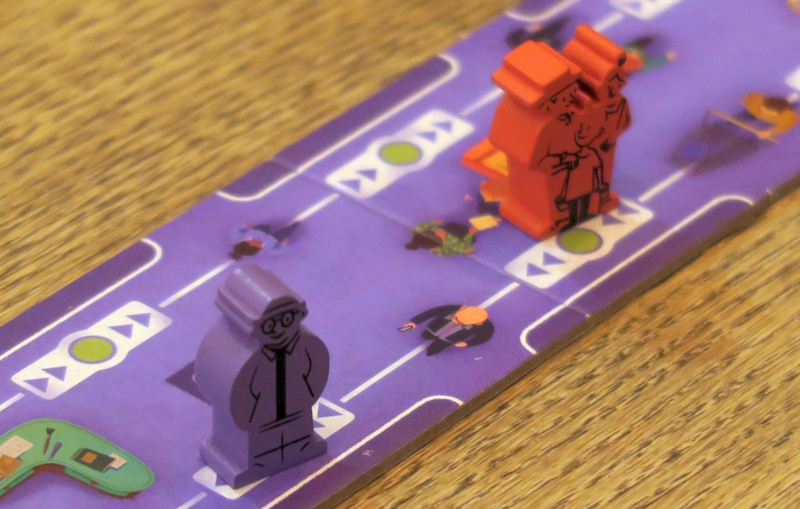
Happy Home
– Image by boardGOATS

This time the Design Objective was “Bigger is Better”, so players lost a point for each empty floor space in their Room with the most empty spaces.  The lack of Bathroom fittings, meant Pine didn’t have a loo in his house and had to resort to “wafflestomping“, but he did have what looked like two pink ironing boards furnishing his Lounge.  Next door, Sapphire filled his Living Room with a pink sofa and an enormous matching pink widescreen TV (that was the same size as the sofa!).  In the end, the victor was a bit of a runaway winner.
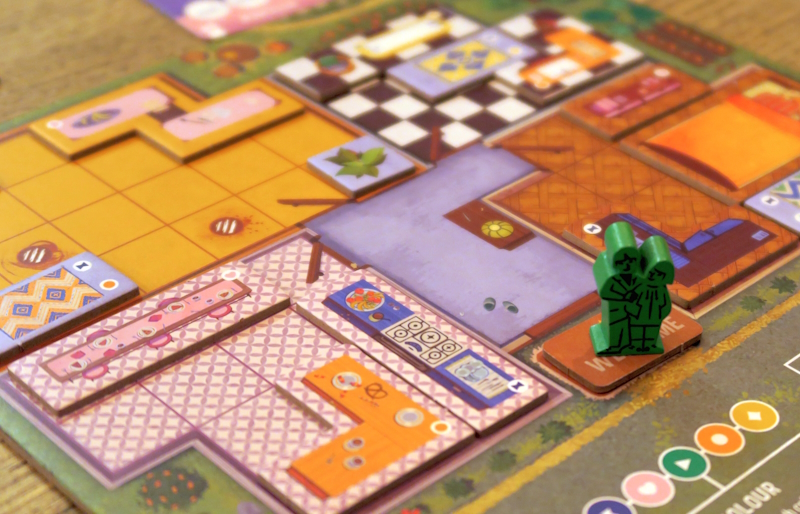
Happy Home
– Image by boardGOATS

In spite of his lack of toilet facilities, Pine finished with twenty-four points, some seven ahead of Sapphire in second, with Jade taking the last place on the podium.  Before the game, Pine had said he wasn’t sure about it from the description, but in the event he really enjoyed it, as indeed did everyone else.  Meanwhile, there were two other games underway.  The first of these was Keyflower—a very popular game with certain members of the group, but one that hasn’t had an outing for a long time, in fact the last time the group played it was online in 2020, and the much-missed Burgundy was involved.
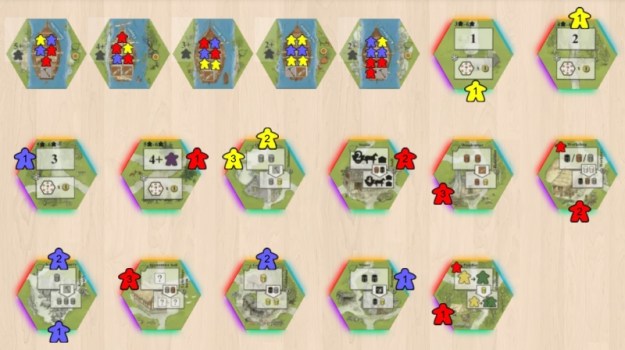
Keyflower on boardgamearena.com
– Image by boardGOATS from boardgamearena.com

This time, the four players were Blue, Pink, Black and Ivory, all of whom had played Keyflower before (albeit a while ago).  The game is fairly simple in terms of concepts, but like many good games, challenging to play well.  Each round, players take it in turns to bid on a tile, or activate a tile.  The clever part of the game is that both bidding and activating is done with red, blue, yellow or occasionally green Keyples (Meeple-shaped workers).  In each of the four rounds (or Seasons), a set number of tiles are put out for players to bid on.  Players take it in turns to bid or activate and when everyone passes in succession, any tiles won are added to the winner’s village, any losing bids and any Keyples used for activating return to their owner.

Keyflower: The Farmers
– Image by boardGOATS

At the end of each round, a boatload of new Keyples arrive in each village (players can bid to get the one of their choice), before the tiles for the next Season are set out.  In general, tiles are drawn at random, and in the first season, Spring, mostly provide Resources with Summer and Autumn tiles providing special powers and Autumn and Winter tiles providing scoring opportunities.  The Winter tiles are different to those for the other Seasons in that instead of being drawn at random at the start of the Season, they are dealt our to each player at the start of the game.  Then, at the start of Winter, players choose from their pile which ones they want to make available—in this way, the Winter tiles act as sort of objective tiles.
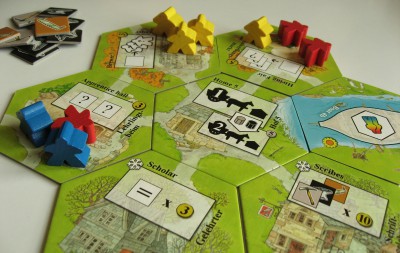
Keyflower
– Image by boardGOATS

The Keyflower box also contained The Farmers expansion and the question arose whether to include it or not.  Blue, Pink and Ivory were on the fence until Black said he’d never played with the Farmers, so of course that was a problem they had to urgently fix.  In the base game, the different tiles are connected by roads which are used for transporting goods to places where they can be used to upgrade tiles or score points.  In The Farmers expansion, these roads now define fields where animals can be left to graze and with each occupied field scoring points at the end of the game.
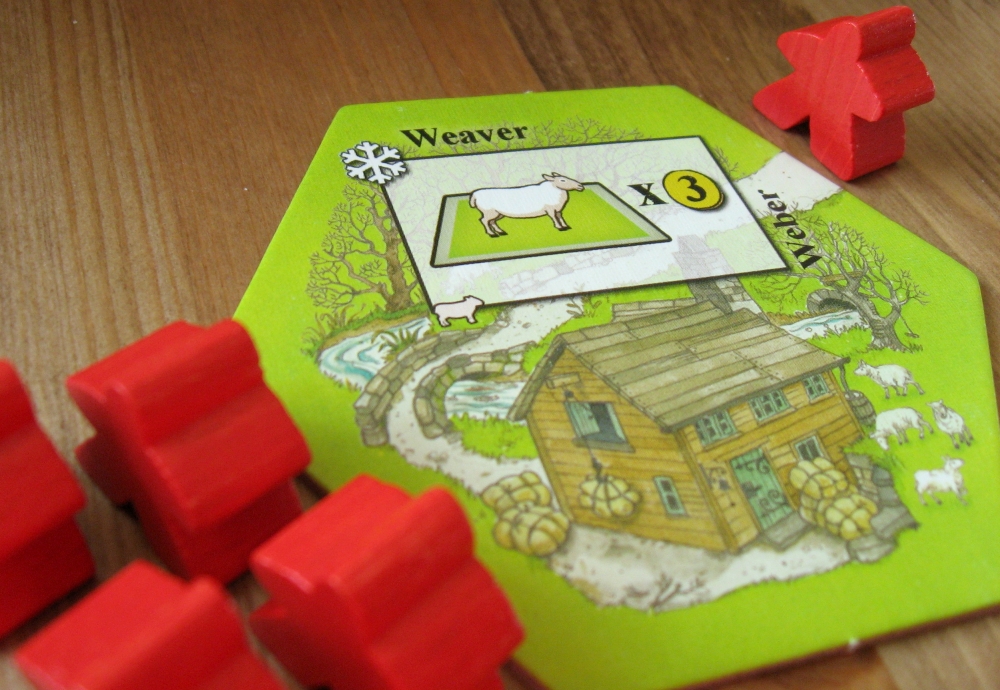
Keyflower: The Farmers
– Image by boardGOATS

Additionally, The Farmers expansion introduces wheat as a new resource, which can be used to add distance/quantity to the movement action, enabling players to move more animals and resources further.  There are several ways to set up the game with The Farmers expansion, but this time the group used The Farmers Variant, where all the tiles from the expansion are used and the number made up with tiles from the base game.  After setting up and explaining the additional rules to Black, Ivory went first, taking the waving purple start-player Keyple, and began the bidding.

Keyflower: The Farmers
– Image by boardGOATS

In Spring, Blue failed to get anything useful at the start of the game (or so she thought) taking just the Key Mine tile which gives Coal and didn’t match any of her Winter tiles.  Pink started off taking the Sheep Fold which gave him a source of sheep and the Paddock which gave him more Movement and upgrade ability together with some Wheat.  Then, he took the Workshop which gave him one resource of his choice from Wood, Coal or Stone, upgradeable to three resources, one of each, which matched his Winter tile, the Mercer’s Guild.  Ivory won the Quarryman, which gave him some very useful gold, and in Summer took the Shepherd’s Hut which gave him Wheat and Sheep and then embarked on a concerted breeding and movement programme.

Keyflower
– Image by boardGOATS

Black picked up a few tiles early in the game, which ultimately led to a lightly sprawling Village by the end of the game.  These included the Wheatfield in Spring and the Tavern, the Smelter and Boat 3a in the Summer.  By this time, Pink had decided that the sheep weren’t doing it for him so moved on to pigs, with the Pigsty.  Blue, having missed out on the Tavern which converts one Keyple into two, instead took the only tile that generated green Keyples, the Store which went well with one of her Winter tiles, the Key Market, but gave the added power of preventing other players from following if she was the first to Bid with Green, as they were highly unlikely to have any.

Keyflower: The Farmers
– Image by boardGOATS

In Autumn, Blue discovered the value of the Key Mine tile she had picked up in the first round, when the Blacksmith tile appeared which gave points for each Coal on the tile at the end of the game.  She added the Ranch to this which gave Cows and Wheat, and then began mining Coal in earnest and hoarding large numbers of sheaves for a super-movement move later in the game to get everything where it was needed as efficiently as possible.  Black got the Goldsmith which went well with his Smelter which gave him the Gold he needed to upgrade it and get ten points, while Ivory and Pink continued their procreation programmes.
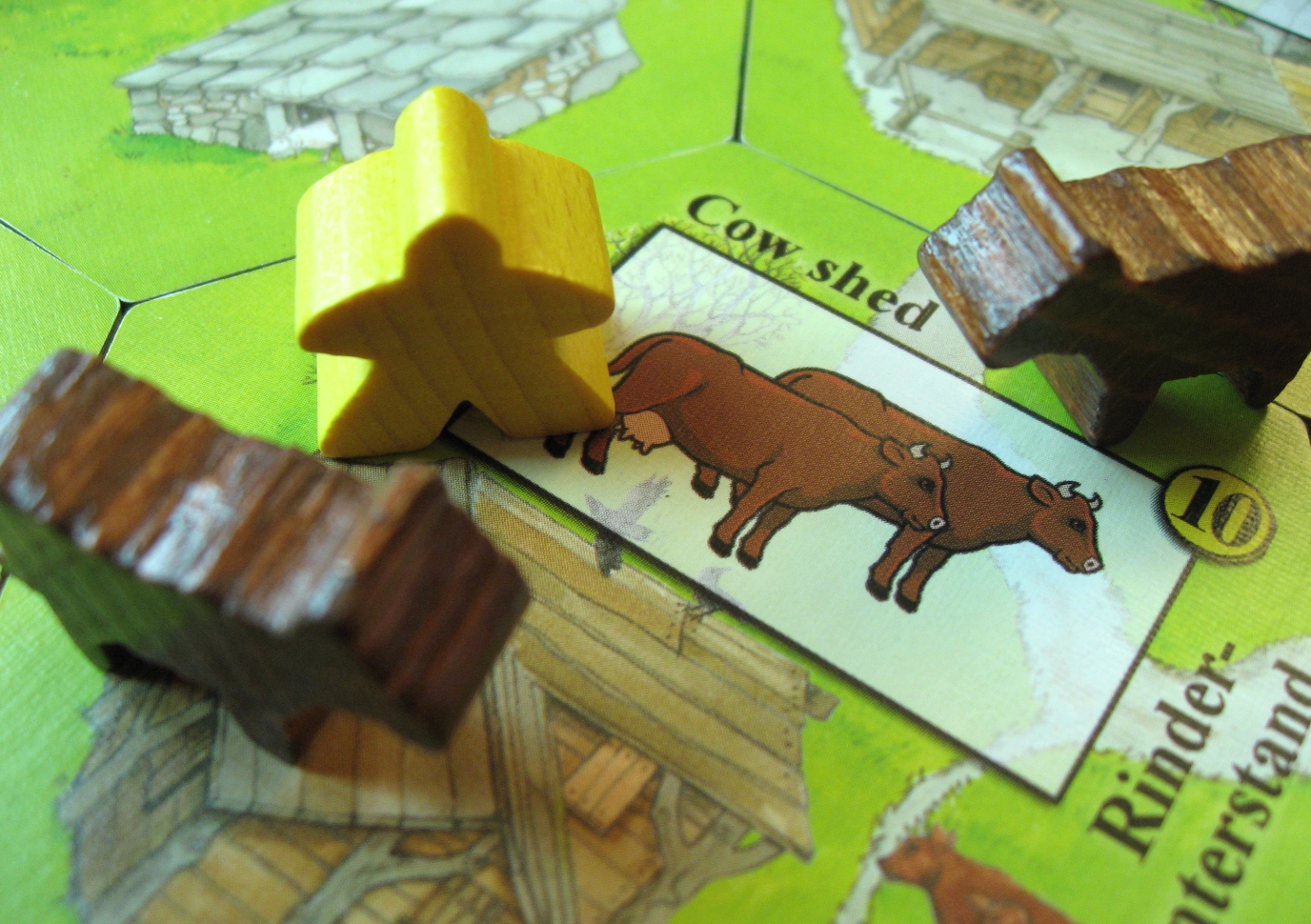
Keyflower: The Farmers
– Image by boardGOATS

As the game progressed there were several visits from the other gamers in the room, many of whom, much to the people who were playing it’s surprise, had not played Keyflower. It is, of course, Blue’s favourite game and was a favourite of Burgundy’s, as well as being generally very popular with almost all of the regulars pre-2020.  So as the game continued into Winter, it was clear it would have to get another outing or two reasonably soon to rectify the situation. There is also The Merchants expansion which has not been played with the group, so that might be the “Feature Game” in the coming months.

Keyflower: The Farmers
– Image by boardGOATS

Only eight out of a possible sixteen Winter tiles were introduced by the players and the Scribes, which Ivory commented usually ensured victory was not there (it turned out nobody had started with it).  Black took the Granary which gave him points for his Wheat and Pink got his Mercer’s Guild that he’d been working towards.  Ivory won the Cathedral giving him a straight twelve points; the Weaver giving two extra points per sheep field, and the Bakery giving four points for each set of a Resource, a Skills tile and a Wheat Sheaf.  Blue had lots of options, so concentrated on building her piles of resources before bidding for her end of game scoring.
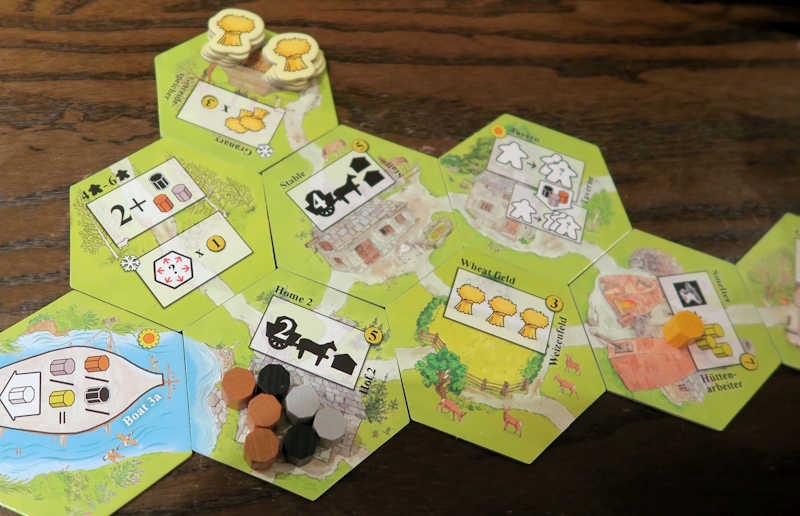
Keyflower: The Farmers
– Image by boardGOATS

This required a lot of nerve as Ivory had there wherewithal to take some of the tiles she obviously wanted.  Ivory hummed and hawed over it and as Black and Pink passed, twice he had the chance to begin a war, but decided not to as “that’s not very nice” and it can also backfire spectacularly.  Instead he generated the odd Gold for a point (“in case it was close”) and waited and watched.  In the end he passed and then Blue passed and that was that bar the counting.  And as it turned out, it was close, very close, but Blue just took victory, by a mere three points, with a total of ninety-five.
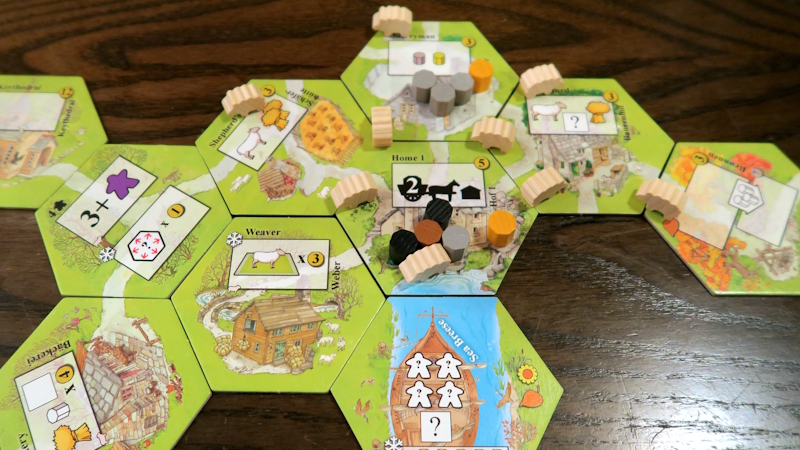
Keyflower: The Farmers
– Image by boardGOATS

The jury is out as to whether it was Ivory’s kindness that cost him the game because Blue did, of course, have contingency plans if someone had tried to take some of the tiles she wanted, and she could have cost him a lot of points.  However, by the end, Blue had no Keyples left and Ivory had a couple that he could have used, so depending on how things had panned out, he might have just nicked it or still lost.  Instead, his kindness and generous good nature won him a lot more respect from his fellow gamers, especially given that everyone knew how fond Blue is of Keyflower successfully destroying her plans might have made her just a little bit sad.
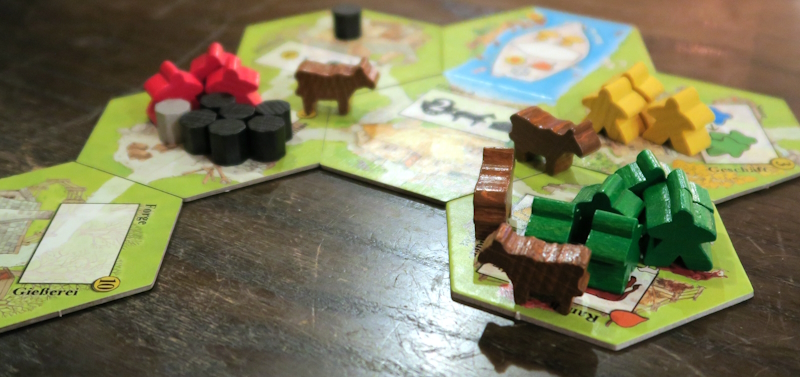
Keyflower: The Farmers
– Image by boardGOATS

Finally, the third table began their evening with Azul: Summer Pavillion, the third in the series based on the essentially abstract game of tile collecting, Azul.  Crimson kindly obliged in offering to lead the game with Lime, Teal and Purple, none of whom had played this variant before.  This is more similar to the original than the second in the series (Stained Glass of Sintra), but is built on lozenge-shaped pieces that make up hexagons.  Like the original, players take tiles from a central market and add them to their player-boards claiming points as they do so.  In contrast to the original, players store the tiles and add them all to their board at the end of the round (taking it in turns to do so).
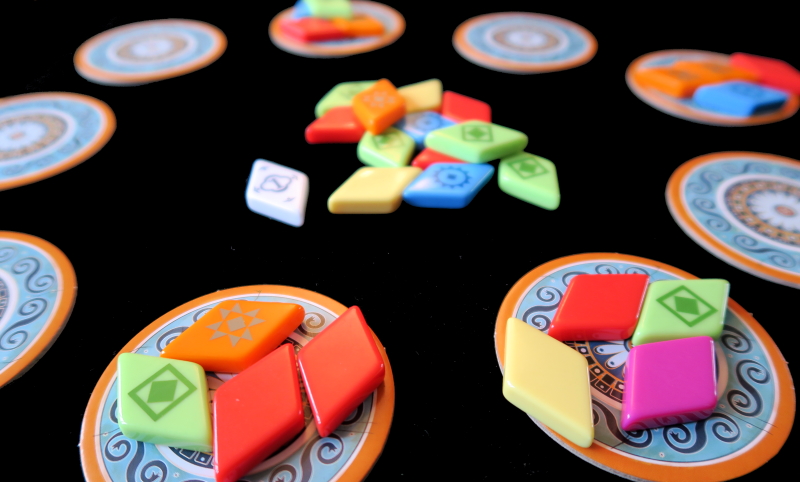
Azul: Summer Pavilion
– Image by boardGOATS

After some initial confusion caused by the additional bag and player boards from the Objective Tiles and Glazed Pavillion expansions, the game got underway.  Unfortunately, there was a bit of a rules malfunction:  initially it was thought that every time a tile was placed it scored one point for itself, two for one next to it and three for a third one in sequence (totalling six).  The group soon realised this wasn’t right though.  So they then thought you scored at the end of the round after playing all the tokens, however, they soon realised there was no way anyone could remember when a new tile that round had been placed.
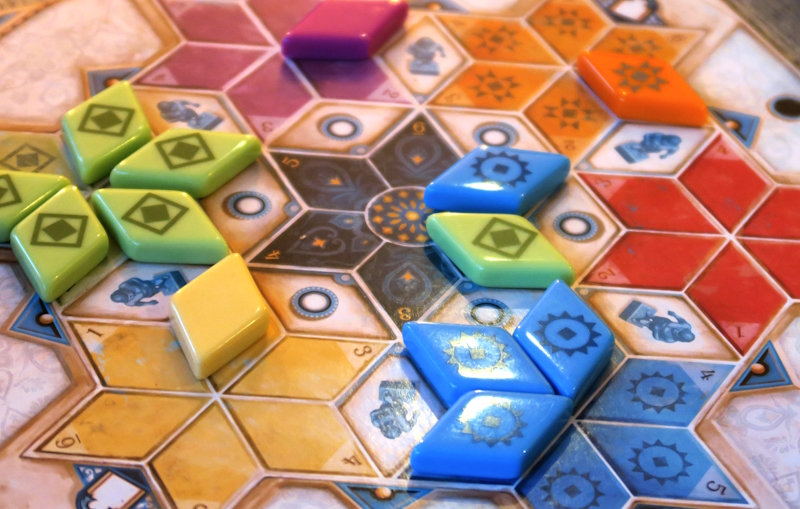
Azul: Summer Pavilion
– Image by boardGOATS

At this point, they then read the rules and from that decided players score one point for the tile and one for each tile it was adjacent to, thus scoring from one to three points per tile as they were placed and this is how they continued to play.  Cyan immediately identified they had come a cropper when he looked at the low end-game scores. He explained that they should have scored one point for the tile placed and one point for each tile connected to that group, so potentially up to six points could be scored for some tiles!
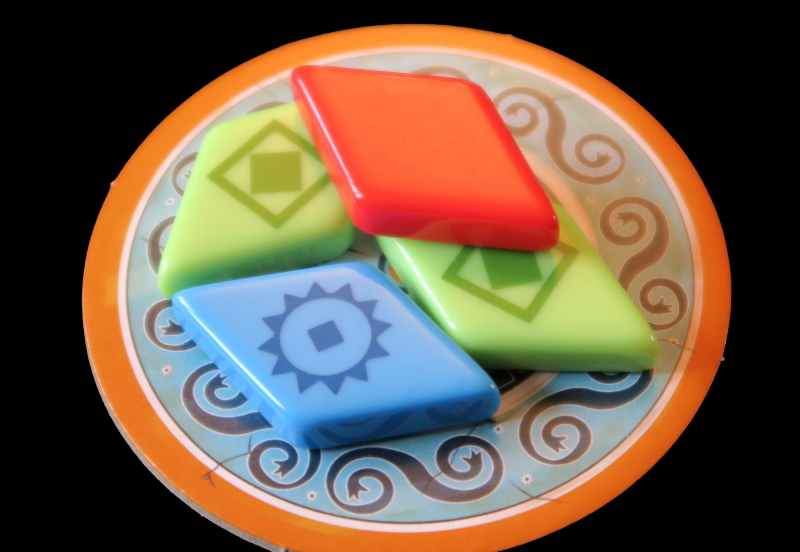
Azul: Summer Pavilion
– Image by boardGOATS

Although it wasn’t played by “the rules as written”, everyone had the same disadvantage, and the group resolved to give it another go again soon, but with the right rules next time.  As it was, it was a very close game with Crimson, beating Lime by a single point and Teal finishing some half a dozen points behind.  It is a very pretty game, and despite the issues, players had enjoyed making patterns and pushing the tactile bright tiles around, which was very therapeutic after a hard day at work.

Azul: Summer Pavilion
– Image by boardGOATS

Keyflower was ongoing (and would be for the rest of the evening), but Happy Home had finished so there was a quick game of musical chairs and Purple began by leading Lime, Cyan and Pine in a game of the group’s currently popular filler, Rome in a Day.  This is a little tile laying game built round the “I divide, you choose” mechanism.  The idea is that players draw five land tiles at random and place two buildings on tiles one and two. They then divide the five tiles into two groups—a bigger and a smaller one (in any ratio), and add a Crystal Gem to the smaller land set before offering the choice to their neighbour.
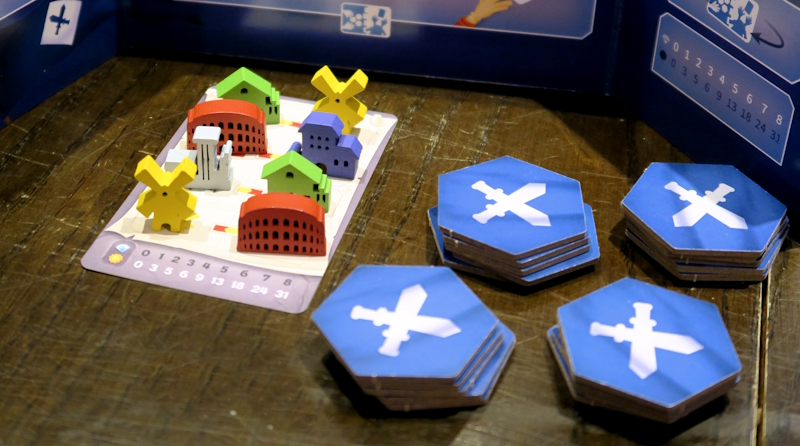
Rome in a Day
– Image by boardGOATS

During the four rounds that the game is played over this neighbour alternates, right, left, right, left. So, each round, players choose a set from their neighbour and these and the tiles they were left with are added to their domain.  At the end of the game, any building that stands on or adjacent to land of its own colour will score for each tile in the group and then players score for the diamonds they have collected—the player with the most points is the winner.  The game has had a couple of outings recently after Black and Purple picked it up at UK Games Expo a few weeks back.  Pine, Lime and Cyan had not been part of those games, so Purple explained the rules.
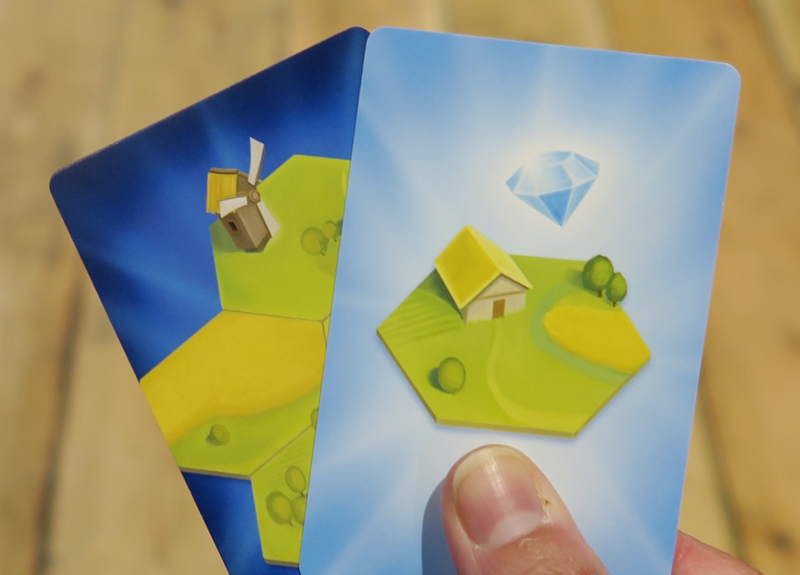
Rome in a Day
– Image by boardGOATS

The game was a bit of a struggle, probably not helped by the fact that on both the previous occasions the rules have not been strictly adhered to.  This is partly because the rules are not the best written and partly because when the game was explained to Black and Purple at UK Games Expo they were different to those published online.  Although it wasn’t entirely clear to everyone during the game, it was actually very close.  In fact, Lime and Cyan finished tied for first place with forty-four points each despite quite different tactics with Cyan prioritising collecting Gems and Lime making hay in his Wheat fields and wine in his Vineyards.
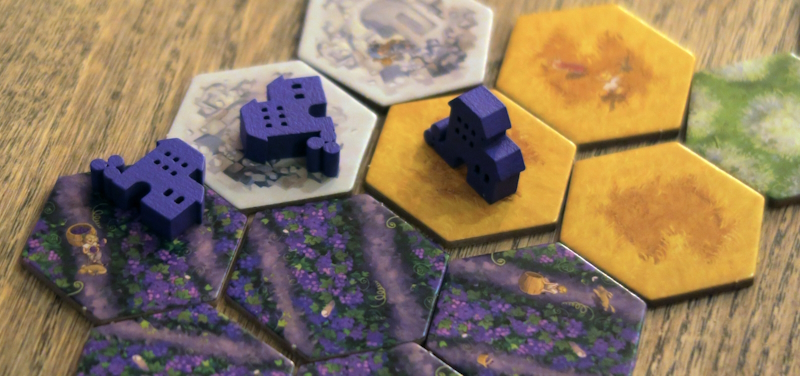
Rome in a Day
– Image by boardGOATS

While the group were fighting their way through Rome in a Day and Keyflower was coming to an end, Jade led Sapphire and Crimson in the 2024 Spiel des Jahres recommended game, Harmonies.  This was described by Jade as a sort of cross between Splendor and Cascadia, with an Azul-type market.  On their turn, the active player takes three wooden Tokens from one of the spaces on the central player board and places them on their player board. These Tokens represent Mountains, Trees, Buildings, Water and Fields.  Some tokens can stack, others cannot: the reasons why are thematic (e.g. tall Mountains and Forests, no tall Rivers etc.), but otherwise Tokens can be placed on any empty space.

Harmonies
– Image by boardGOATS

Players may then take an Animal card from the central display—they can have a maximum of four at any one time and each has a number of Animal cubes on them.  Each time the pattern on an Animal card is fulfilled, one of these Animal cubes is removed and placed on the token indicated on the card.  At the end of the game, players score for the highest achieved Animal on each card and for each Mountain, Tree, Building, Field and River (or Island, depending on  which side of the board players are using).  Mountains are made of stacks of up to three Rock Tokens, while Trees are a green Leaf Token on zero, one or two Wood Tokens.
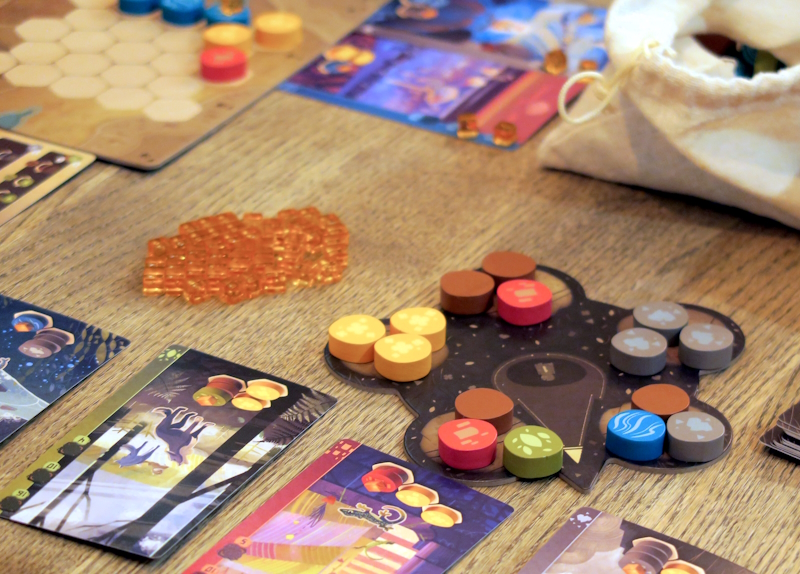
Harmonies
– Image by boardGOATS

Taller Mountains and Trees give more points (one, three or seven points), while Buildings (made of two Tokens, at least one Brick and a Wood, Rock or another Brick), and Fields (two adjacent Wheat Tokens) score five points each.  Finally, depending which side of the board is used, players score points for the length of their River, or five points for each Island they make.  This time, the group played with “Side A” which scores for Rivers.  It was a learning game for Crimson, but was quite close quite between Jade and Sapphire, but Sapphire’s one hundred and eight gave him victory in what is an interesting point-salad tile-placement game that deserves another outing soon.

Harmonies
– Image by boardGOATS

Learning Outcome:  You don’t need a toilet to have a Happy Home.

11th June 2024

The pub was not as busy as last time, and in any case, Pink, Blue, Black and Purple were there in good time for food.  Once they had finished, they managed to squeeze in a quick game of Rome in a Day while they were waiting for food and eating.  This is a cute little tile-laying game Black and Purple picked up from UK Games Expo as few days back.  It is a bit like Kingdomino with the “I cut, you choose” mechanism to allocate the tiles.  The “I cut, you choose” mechanism is used in a number of other games like, Castles of Mad King Ludwig, Isle of Skye, and Dice Hospital, but it is a more fundamental part of games like San Marco, and particularly …aber bitte mit Sahne and New York Slice.

Dice Hospital
– Image by boardGOATS

In the case of Rome in a Day, Players start by taking five land tiles drawn at random and place two buildings on tiles one and two.  They then divide the five tiles into two groups—a bigger and a smaller one (in any ratio) and add a crystal to the smaller land set before offering them to their neighbour.  During the four rounds the game is played over this neighbour alternates, right, left, right, left.  So, each round, players choose a set from their neighbour and these and the tiles they were left with are added to their domain.  At the end of the game, any building that stands on or adjacent to land of its own colour will score for each tile in the group and then players score for the diamonds they have collected—the player with the most points is the winner.

Rome in a Day
– Image by boardGOATS

Like in Kingdomino where players score better for a medium number of crowns in a medium sized area than for a combination where one is large and the other small, players benefit more if they can surround one large area of coloured tiles with multiple buildings of the same colour.  The most successful at this was Pink who scored well for three coloured areas, the green Olive Groves, the blue-purple Vineyards and the yellow Wheat Fields, while the others didn’t score at all.  As a result of his ruthless scoring strategy, he finished with fifty four points, eight points clear of second place, which went to black by a single point.

Rome in a Day
– Image by boardGOATS

The game was just coming to an end when Jade, Sapphire, Plum and Byzantium arrived, followed by Pine, Ivory and Teal, and then the inevitable debate as to who would play what began.  In the end, Jade led a group of four including Black, Purple and Sapphire in the “Feature Game“, Courtisans (the French for Courtier as it is spelled with an “i” rather than an “e”), which also came from UK Games Expo.  The first game was essentially a learning opportunity where players tried to understand the learning the mechanics of the game.  On their turn, each player receives and plays three coloured Family cards.

Courtisans
– Image by boardGOATS

One card is played at the Queen’s table to sway a family’s influence in a positive or negative way depending on whether it is placed above the table or below—at the end of the game, those with more cards below than above will have “Fallen from Grace”.  The other two cards are then played, one in the player’s own Domain and the other in an opponent’s Domain. At the end of the game, each card a player has from an “Esteemed” Family is worth a point, while each card from an Family that has “Fallen from Grace” loses them a point.  Thus the cards can be worth positive or negative points, depending on the Family’s status at the end of the game.

Courtisans
– Image by boardGOATS

Some of the Courtier cards have a special power, for example, Nobles count as two cards, Spies are played face down and their allegiance is only revealed at the end of the game, Assassins can be used to eliminate other Courtier cards, while Guards are not affected by Assassins.  The game ends when the card deck has been exhausted and nobody has any cards left in hand.  Players then total up their score and add any points earned from successful Secret Missions (each worth three) and the player with the most points is the winner.

Courtisans
– Image by boardGOATS

Black went first chosen by an app and began feeling his way forward.  The group only realised there was a slight issue towards the end as they ran out of cards a bit early.  It was then that it was discovered that at some point Black had acquired a second hand which he had placed on the table beside him.  Despite only a few personal objectives being met mostly players scored scored well; the exception was Purple who was the only one to complete both objectives which added six points to her score at the end.  It wasn’t enough for victory though, that went to Sapphire who had fifteen points, with Jade a point behind in second.

Courtisans
– Image by boardGOATS

Having felt their way through the first game, the group decided to play again.  As the winner, Sapphire went first, and from the off, it was like everyone woke up together and all decided to attack.  This time, everyone completed at least one objective, but this second game was a lot more treacherous and this was evidenced in the scoring.  One of Jade’s objectives was to ensure at least one of the Houses had at least five cards bringing them into disrepute—Jade chose yellow which caused others problems.  It didn’t have as much of an effect as his second objective though,which was to have fewer red cards than the player to his left.  As a result of this, Black was the kind recipient of any red cards he acquired.

Courtisans
– Image by boardGOATS

While he tried to bring the reds into disrepute too, it wasn’t possible to do both.  So, despite his best efforts they still scored positively and probably helped ensure Black’s victory with seven points, four more than Jade himself.  The scores were much more diverse in the second game though with a range of sixteen points with the person at the back finishing with minus nine!  Although savage, it had been a lot of fun; Jade commented that the game felt a bit like a dance with lots of nuance.  Definitely one to play again, especially given the truly beautiful foiled cards which are a delight to play with.

Courtisans
– Image by boardGOATS

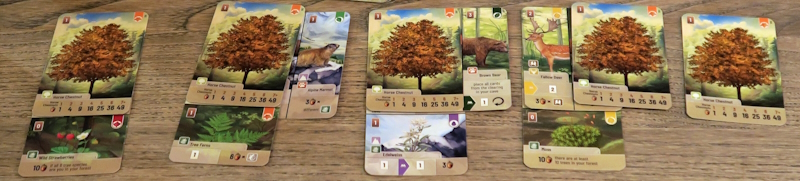
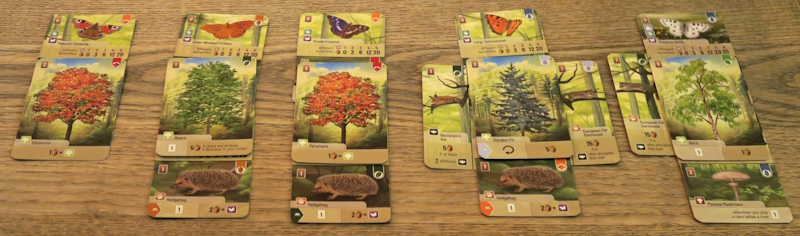
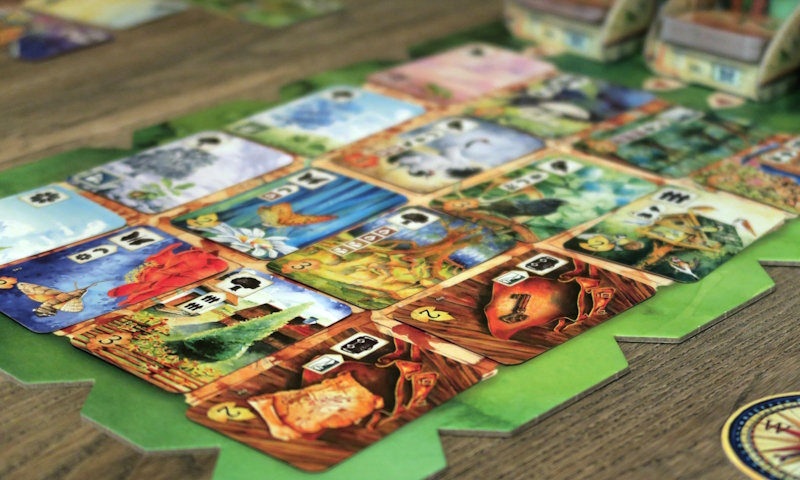
Meanwhile, Teal had picked up the Alpine expansion for one of his favourite games of the moment, Forest Shuffle, and was keen to give it its first outing.  He was therefore joined by Plum, Byzantium and Pink who were also keen to see how it changed things.  Forest Shuffle is mechanically a fairly straight-forward game, but playing it well is comparatively difficult as it requires good, robust strategies and an understanding of how to get the best from the cards.  The idea is that players start with a hand of cards and, on their turn draw two more from the market (or “Clearing”) or play one into their tableau.

Forest Shuffle: Alpine Expansion
– Image by boardGOATS

There are two sorts of card, Trees and “Critters”.  Before playing a Critter, players must have played a Tree, which then has spaces on all four sides.  Birds and Butterflies are played to the canopy (i.e. above tree cards), Fungi and Amphibians are played at the bottom of the tree (i.e. below them) and Mammals are played either side.  The clever part is that Critter cards are split so they show two critters (either left and right or top and bottom), so players choose which they would like to play, and where, tucking the other side under the tree, making the unplayed half invisible.

Forest Shuffle
– Image by boardGOATS

The new Alpine expansion for Forest Shuffle only adds some thirty six cards to the game and, since roughly twenty additional cards are removed during setup, in practice it adds just sixteen to the deck.  Of course, the cards are removed at random so many should be from the base game and the expansion adds new cards like the Mountain Hare, who scores as for the European Hare, but wants to stay alone so can’t share a space with another Hare.  There is an extra Butterfly and more Trees too, which make these easier to score and help to balance the game somewhat.  Additionally, there is the new Alpine Newt provides a new way of scoring, for players who have managed to pick up a lot of cards from the Alpine expansion cards.

Forest Shuffle: Alpine Expansion
– Image by boardGOATS

This time, Plum went for Trees in a big way with loads Horse Chestnuts which give more points the more you have on them up to forty-nine for seven or more.  While she didn’t quite make the full seven, she scored a total of forty-eight for her Trees, fifteen more than the nearest player (Byzantium) and more than double what anyone else took.  They, of course, got points elsewhere though.  Pink, for example, went for Butterflies and, with the additional Phoebus Apollo Butterfly, took thirty-five points for them alone.  Byzantium opted for a deer strategy and received a total of sixty-one points for all his Critters.

Forest Shuffle: Alpine Expansion
– Image by boardGOATS

The winner was Teal however, with everyone else totally overcome by “The Lynx-Effect”, where each Lynx he had gave ten points as long as he had a Roe Deer to keep them fed.  Perhaps his victory was to be expected as he has played the game quite a bit with family, but his finishing score of a hundred and fifty was some way ahead of Pink and Plum who tied for second place with a hundred and nineteen.  Overall, the Alpine expansion adds some pretty artwork and made a few of the alternative strategies a lot more viable, reducing the apparent dominance of Wolves and Deer which it has often been claimed are overly powerful.

Forest Shuffle: Alpine Expansion
– Image by boardGOATS

With the Courtisans and Forest Shuffle groups sorted, that left just three players without a game.  Since Ivory and Pine both missed out on playing Little Town last time and neither wanted a particularly late night the decision was made to eschew Key Flow in favour of the lighter, quicker, tile-laying game.  Play is very simple:  players take it in turns to place their Workers in a space on the central board and then activate the eight spaces around them.  These eight spaces could be Buildings, but may also be Trees, Rocks or Lakes pre-printed on the board giving resources (Wood, Rock or fish respectively).  With three players, there are four Workers in each of four rounds and the player with the most points at the end is the winner.

Little Town
– Image by boardGOATS

Little Town has had a few outings, but was the “Feature Gamelast time, with two games played simultaneously, both with the starting tile set up.  This time, a random tile setup was used drawn from the full set that included the Pier, the Marketplace, the Bar, from the variant set as well as the Shop, the Workshop, the Goldmine, the Bakery, the Pawnshop, the Quarry and Wheat Fields from the basic set.  The twelve Buildings were completed by the Temple, the Cornucopia, and the Sushi Bar from the Goodie Buildings mini expansion.  Blue and Pine both complained that their Objectives were considerably more difficult than Ivory’s as he claimed all his quite quickly.

Little Town
– Image by boardGOATS

Eventually though, all three managed to complete all their Objectives.  Pine misunderstood the fact that each Worker needs to be fed at the end of every round, rather than just at the end of the game.  As it was a genuine error, rather than cripple his game at the end of the first round, Blue and Ivory let him pay with other resources leaving his unfortunate workers to gnaw on bits of stone, wood and coins.  Other than that, the game proceeded according to the rules.  Ivory majored on trying to convert Fish into points, while Blue tried to do the same with Wheat and Pine played the merchant, building the Gold mine and the Shop.

Little Town
– Image by boardGOATS

As the game came to a close, Ivory had a substantial lead with forty-two, ahead of Blue in second with thirty and Pine with eighteen.  This was without any of the points from the buildings (which Blue had a lot of) or from leftover money (of which Pine had an enormous pile).  As it turned out, money is not worth much at the end of the game, and although Blue’s buildings were worth considerably more than Ivory’s, she still fell two points short of his final total of fifty-seven.  So although we’ve still not been able to use the “sixty point tokens” we were only a handful of points shy.

Little Town
– Image by boardGOATS

The others were still playing, so after some discussion, Blue, Pine and Ivory decided to give the 2022 Spiel des Jahres nominee, SCOUT, an outing.  This is a clever little card game with two key features: firstly, as in Bohnanza, players can’t rearrange their hands, and secondly, the cards have different values depending which way up they are.  Like Tichu or Haggis, SCOUT is a climbing game, that is to say, on each turn players are aiming to beat the previous score.  In SCOUT, that means players have to play a higher value or larger meld, or a longer run or one of a higher value (and a meld of the same size always beats a run).

SCOUT
– Image by boardGOATS

These cards are played from hand, but have to be consecutive.  In the event that a player can’t or doesn’t want to play cards from their hand (aka “Showing”), they may instead take a card from either end of the current winning set and add it to their hand anywhere, and either way up (aka “Scouting”).  Additionally, once per round, players can “Scout and Show” which is take a card and then also play cards.  The round ends when either nobody in the round has been able to Show or a player plays their last card and has nothing left in hand. At the end of the round, players lose a point for every card they have left, and this is taken from the total from their scoring cards and points earned when others Scout from their display.

SCOUT
– Image by boardGOATS

With three players, there were three rounds, the first of which was finished by Pine, though Ivory nearly managed to check out, leaving Blue with a large handful.  The second round was much closer with Blue playing a nine-card run (though as cards in front of players at the end don’t score, and very quickly nobody could beat it, she didn’t get the advantage she felt she deserved).  The final round was taken by Pine again, but it was also close again.  The total favoured Pine, who finished with a total of twenty-six, a clear victory with Blue just pipping Ivory to second place by a single point.

SCOUT
– Image by boardGOATS

Forest Shuffle and SCOUT were both still going when the Courtisans finished, so they quickly set about playing a light filler that Jade had picked up from the Hachette UK stand that he had worked on at UKGELine-it, is another card game, played with a deck that consists of cards in four colors, numbered one to a hundred and six “Bet” cards (numbered three to five), which are shuffled together and laid out to create a market consisting of slightly more cards than there are players.  Players then take it in turns to take a card and either add it to their hand or add it to the row of cards in front of them (their Line).  There is a hand limit of two and the row must continue either increasing or decreasing.

Line-it
– Image by boardGOATS

If a player can’t add the card to their hand or their Line (because it would break the ascending/descending pattern), they have to score their Line, then play that card to start a new Line.  After drafting a card, players may choose to add one card from their hand to their Line and then score it. When scoring, if there is a Bet card in the Line, if there are more cards added since the Bet card than the value depicted on the Bet card, players get chips equal to the value of the Bet.  If the Bet is lost, the player takes negative points instead. Finally, three cards are discarded from the Line and the others turned over and placed in the player’s scoring pile.

Line-it
– Image by boardGOATS

Once each player has had a turn, all remaining Bet cards are discarded, and the other cards are placed under the Jackpot token that corresponds to their colour—these can be claimed whenever a player adds the third card of the respective color to their Line.  The game ends when the draw deck depleted, and each player plays one last card from their hand, then scores their line and tallies their points, the player with the most points is the winner.  As he had won the second game of Courtisans, Black went first.

Line-it
– Image by boardGOATS

Black and Purple both took (and completed) Bet cards early in the game, whereas Jade didn’t even take because his Lines weren’t right when the Bet cards were available because just didn’t make sense.  Purple won the first jackpot of the game which was a tidy little stack of blue Diamond cards and Sapphire also picked up Jackpot cards later in the game.  The game plays quite quickly and smoothly and this time out, it was close, well, close between Black, Jade and Purple—Sapphire was streets ahead, finishing with twenty-six points, a long way clear of Black in second with fifteen.

Line-it
– Image by boardGOATS

Learning Outcome: UK Games Expo is a good source of new games.

30th April 2024

Blue and Pink were unusually early and had already finished their pizzas when Pine rolled in.  He was soon followed by Black and Purple and then Lime and Teal giving a total of seven for one of the quietest nights for a long time.  With seven, the question was how to split the group and what would everyone play.   For seven players, the go-to game is generally Bohnanza, which Blue inevitably suggested.  Pink suggested playing it later, but when Teal commented that he’d never actually played it, that was the decision made.  There was no way that state of affairs could continue, so the “Feature Game” (which was to be Canvas) was put on the back burner until later, and the Beans came out.

Bohnanza
– Image by boardGOATS

Bohnanza is best part of thirty years old and is, despite him designing a huge number of excellent and popular games since, including Agricola, Caverna, Le Havre, A Feast for Odin and Patchwork, is arguably, still one of Uwe Rosenberg‘s best games.  It is a really simple game of set collecting and trading, that when explained sounds strange, but when played is great fun.  While everyone else chatted, Blue explained the rules and how to play to Teal.  The important thing is players cannot rearrange the cards in their hand (similar to recent Spiel des Jahres nominee, SCOUT).

Bohnanza
– Image by boardGOATS

So, players start with a hand of cards, and, on their turn, must plant the first Bean card in the front of their hand into one of the two “Bean Fields” in front of them.  Then they may, if they wish plant the next Bean into one of their Fields, but each Field can only contain one type of Bean.  Once they have finished planting from their hand, the active player turns over the top two Bean cards, which must be planted, but may be traded and planted in another player’s Field if agreements can be reached.  Once these Beans have been dealt with, the active player can trade any cards from their hand, but all cards involved in any trades must be planted straight away.

Bohnanza
– Image by boardGOATS

Finally, the active player tops up their hand taking Bean cards into their hand (three in the case of the seven player game).  At any point, players can harvest one or both their Bean Fields converting some of the cards into Bean Thaler (according to the “Beanometer”), placing them face-down in their scoring pile, returning the other cards to the discard pile.  However, players cannot harvest a Field with a single single bean in it unless all their Fields have only the one Bean in them (a rule that can sometimes make things unbelievably difficult).  The game ends after three passes through the deck and the player with the most Thaler at the end is the winner.

Bohnanza
– Image by boardGOATS

There are a few, very clever things that really make the game work.  Firstly, there are different numbers of the different types of Beans in the deck—some beans are very common and give a small return, others are quite rare and give a better return.  The number of each card present in the deck at the start of the game is printed on them.  This is key, because it helps players to work out the rarity and therefore the value of different Beans when arranging trades.  However, the value also changes according to the situation in the game and how many players want each Bean type at the time.

Bohnanza
– Image by boardGOATS

Further, because the rare Beans give a larger yield, more of these are removed from the deck, which makes them increasingly rare as the game progresses.  This is because there are disproportionately fewer in the discard pile when it is shuffled to give the new deck.  Players can also buy a third Bean Field, but choosing to do this is a real gamble and only worthwhile if it can be done early in the game.  Choosing when to harvest is also critical, because harvesting a big Field just before the discard pile is shuffled will increase the length of the game.  Finally, players can be generous in their trades in the hope that the generosity will be returned, however, giving away trades too cheaply can cost a player the game.

Bohnanza
– Image by boardGOATS

Once Blue had finished explaining the game, Black started and explained his way through his turn.  Teal quickly caught on and got engaged in trading and planting Beans with everyone else.  There was a lot of debate about players buying their third Bean Fields with about half the players buying one and Teal leaving it to the second round (much against Black’s advice). Several people, including Purple, Teal and Pine got into Black-eyed Beans—quite an achievement given how few of them there are in the pack—and Blue had a couple of goes with the similarly rare Red Beans.  Pink tried for Soy with mixed success and almost everyone planted some combination of Wax, Coffee and Blue Beans at some point during the game.

Bohnanza
– Image by boardGOATS

Teal quickly realised how quick you have to be declaring an interest in a trade in a game where if you snooze, you lose.  And with seven you have to be keep an eye on what’s going on, which can be difficult given how far away some players are.  In the corner, Black quietly got on with his game eschewing the third Bean Field option as he felt there wasn’t time in the seven player game to recoup the cost, and perhaps he was proved right as he ran out the eventual winner with twelve Bean Thaler, closely followed by Pine with eleven and Blue with ten.  It had been a lot of fun, but as usual, had lasted longer than it really should, leaving little time before the first people needed to head home.
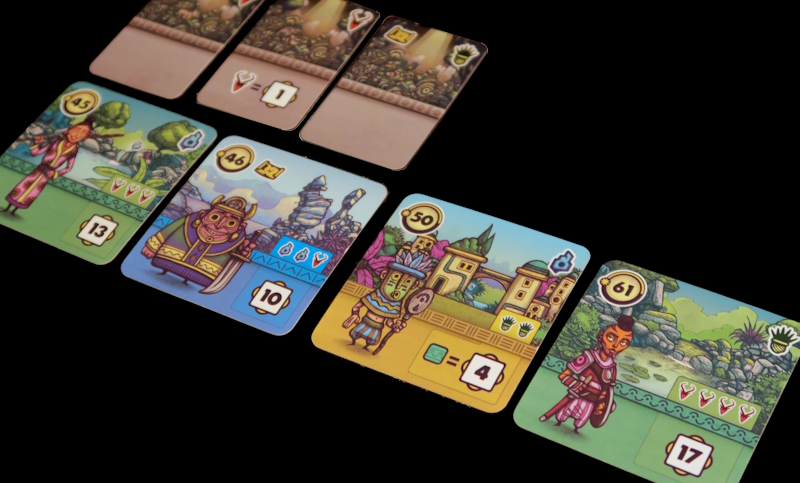
Bohnanza
– Image by boardGOATS

So after some discussion (where pink suggested Ticket to Ride: Northern Lights again), everyone settled down to play 6 Nimmt!.  This had recently had an outing with the new Jumping Cow mini-expansion, but this time the group chose to play it without the additional madness.  6 Nimmt! is also a simple game that is a lot of fun:  Players start with a hand of cards and simultaneously choose one to play, then, starting with the lowest value, these are added one at a time to the four rows on the table.  If a player’s card is the sixth in the row, instead, they take the first five into their scoring pile and their card becomes the first in the row.

6 Nimmt!
– Image by boardGOATS

This is another very clever game that does a lot with very little (which is probably why it is still so popular despite the fact it is thirty years old).  Different cards give a different number of points (or Nimmts), and players can also introduce a little bit of their own randomness by playing a card lower than the final card in all the available rows and thus, taking a row of their choice, upsetting everyone else’s plans.  The Jumping Cow mini-expansion adds more of this, but the group felt it didn’t really improve the game, so stuck with the chaos and fun of the original game, also eschewing the mathematical complexity of the Professional Variant.

6 Nimmt!
– Image by boardGOATS

This time, both Pink and Pine managed to avoid picking up any cards in the first round.  However, Blue only picked up two Nimmts and Teal collected seven leaving it all to play for, at least for most people—Black’s twenty Nimmts had already put him out of the game.  In the second half, Lime picked up twenty-four giving him the top score of thirty-eight (some way ahead of Purple with total twenty-nine).  Black managed a clear round, but there was nothing he could do about his pile of Nimmts from the first round.  It was tight between the top three, but Pink just took victory with ten, three fewer than Blue and Pine who tied for second place.  From there, the evening deteriorated into chatter and we decided to leave the “Feature Game“, Canvas, for another day.
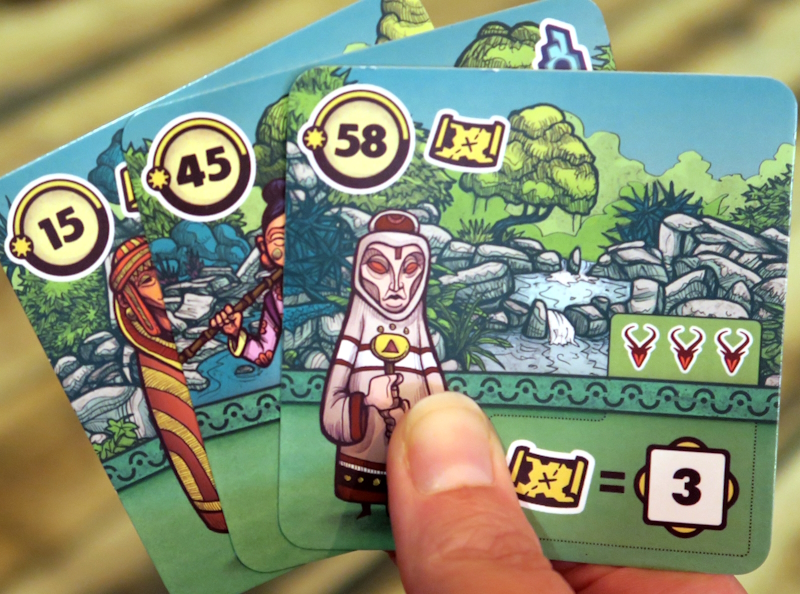
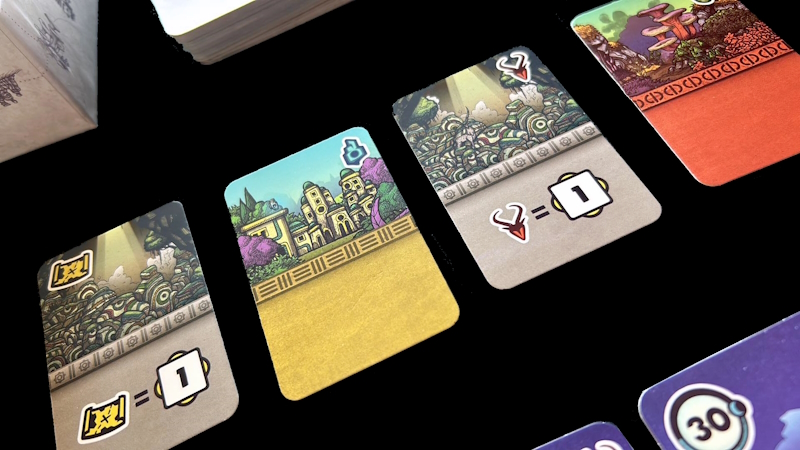
6 Nimmt!
– Image by boardGOATS

Learning Outcome:  You can have a lot of fun with nothing but an old deck of cards.

2nd April 2024

While Blue, Pink and Cobalt were finishing their supper, Plum led a quick game of Draftosaurus with Black, Purple and Cobalt (who had already finished his pizza).   Cobalt was new to the game, so after a quick rules explanation the group were passing dino-meeples left and right and building themselves exciting dino-parks.  The game is really quick and simple:  players start with a handful of wooden dino-meeples, and on each turn, they draft one, that is to say, they choose one and pass the rest on.  The chosen dino-meeples are then placed in the players’ parks, obeying the rules on the Die (the active player who rolled the Die excepted).

Draftosaurus
– Image by boardGOATS

The Die roll forces players to choose from locations in one half of the board, or restricts them to playing in an empty pen or one without a T-rex, making things considerably harder.  Players draft a hand clockwise, and then a second hand anti-clockwise, after which, points are scored for each pen and totalled up to find the winner.  This was Plum’s fiftieth game—it was one of their group’s go-to warm-up and filler games played remotely during the global pandemic on BoardGameArena.  Although her 24% success rate seems really good at first, at four players, one out of four could be seen as about par.

Draftosaurus
– Image by boardGOATS

Plum marked her milestone with a change of strategy, forced by the Dice to go for the most T-rexes, but it worked giving her victory with forty-one points.  Purple took a very respectable second with thirty-five points—one of her best scores in this game.  From there, Cobalt headed off to play Meadow with Blue, Jade and Sapphire, while everyone else joined Plum, Black and Purple to play the “Feature Game“, which to mark the thirtieth anniversary of 6 Nimmt!, was the new Jumping Cow mini-expansion.  6 Nimmt! is one of the group’s favourite games and was arguably responsible for keeping us sane when we were stuck at home in 2020 and as a result, won the Golden GOAT Award.

6 Nimmt!
– Image by boardGOATS

The game is super-simple:  players simultaneously choose a card from their hand and then, starting with the card with the lowest face value, they are added to one of four row.  Each card is added to the row that ends with the highest value card that is lower than the card to be placed.  If that means the row now has six cards, the active player takes the first five cards in the row into their scoring pile, with their card becoming the new first card.  The new Jumping Cow expansion is a single additional card that lurks at the end of the row.  Cards are added as normal, however, when one is added to the Jumping Cow row, the Cow jumps to another row, the one with the lowest face value at the end.

6 Nimmt!: The Jumping Cow
– Image by boardGOATS

The Jumping Cow Card does not have a value itself, but it does add to the number of cards in the row.  So if the card added is the sixth, the player takes the other four cards and then the Cow jumps.  If the row the Cow jumps to has five cards in it, the active player takes four of those too before the Cow jumps again…  Thus, as Plum discovered this time, multiple jumps can lead to collecting a lot of points!  The game was the usual entertaining fun, but although the Jumping Cow expansion adds more madness, 6 Nimmt! is a near perfect game that needs little to no improvement (although we have found the Professional Variant an occasional worthwhile addition).

6 Nimmt!
– Image by boardGOATS

This time, the top scorer (aided by the Jumping Cow) was Plum with sixty-one, closely followed by Ivory with fifty-seven.  Purple did very well to limit her takings to nineteen, but she was beaten into third place by Pink who just kept his to single figures with nine.  The winner was Teal, however, with just four from the first hand and a clear round from the second.  From there, with six, the options were limited, but the group decided to stick together and, after eschewing Bohnanza, opted for another golden oldie: For Sale.  Remarkably, Ivory had somehow not played this before, and was really taken with it, so much so that he immediately looked to see if he could get a copy and everyone was shocked to find it was out of print and the only copy available was for forty pounds on ebay!
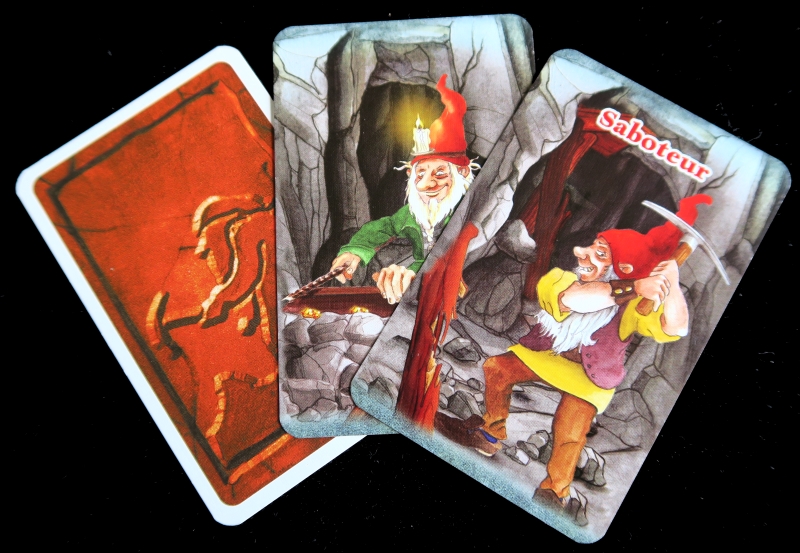
For Sale
– Image by boardGOATS

For Sale is really simple:  Players start with a hand of cash and use this to bid for buildings, with a face value from one to thirty.  In the second half of the game, cheques are revealed and players have to choose one of their properties—the player with the highest value building then takes the highest value cheque, thus the idea is not to waste high value buildings when the takings available are low.  Pink, Plum and Teal were all really close and ended in a three-way tie for third place.  Ivory and Purple were some way in front, but separated by a single point with Purple just taking victory, with a final taking of fifty-six thousand dollars.

For Sale
– Image by boardGOATS

Casting about for another game that plays well with six, Bohnanza was passed over once again, this time in favour of Saboteur.  Saboteur is a hidden traitor game where players are Dwarves tunneling to find gold.  With six players, the rules have either one or two Saboteurs, however, as the game is always difficult for the Saboteurs and impossible alone, the group chose to forgo the ambiguity and go for a guaranteed two Saboteurs.  Once the Saboteurs knew who they were, everyone got a hand of cards: a mixture of tunnel cards and special cards.  On their turn, players play a card and draw a new one.  Tunnel cards extend the network, while special cards allow players to break or mend tools stopping other players from building tunnels (or reinstating that ability).

Saboteur
– Image by boardGOATS

Additionally, there are Treasure Map cards which allow players to look at one of the three potential gold cards to see if it is gold or coal, and Rockfall cards which allow players to collapse the tunnel by removing one card.  Usually, the Saboteurs hide for as long as possible in an effort to acquire some good “Saboteury cards” and play them with a lot of impact.  Choosing the right time for that reveal is really critical though, leaving it too late means there isn’t time to do enough damage.  This time then, Black announced his position very early by playing an obviously obstructing tunnel card and was swiftly followed by Pink who compounded the poor Dwarves’ problems by playing a Rockfall card.

Saboteur
– Image by boardGOATS

The Evil Criminal Masterminds were aided by the fact that when the Dwarves played their Treasure Map cards they struggled to find the gold.  The game turned out to be quite epic, but success just fell to the Saboteurs, giving them a rare victory.  As Teal and Ivory waved farewell, the others looked for something else to play.  Saboteur is a great game, and although it is not as old as 6 Nimmt!, this year is also Saboteur’s anniversary year. It is celebrating twenty years, as is another old favourite, No Thanks!.  In choosing this, those that had played all five games had played over a hundred years of popular games in one evening.

No Thanks!
– Image by boardGOATS

No Thanks! is a super simple, push-your-luck game, where players are trying to finish with the lowest score from the total face value of their cards minus any chips they have.  On their turn, players either take the top card and any chips on it, or pay a chip to pass the problem on to the next player.  There are thirty-three cards in the deck (numbered three to thirty-five), but nine are removed at random, which is what makes the game really tick—when scoring, players only count the lowest card of a run.  This time. Pink top-scored with forty-nine points.  Plum and Purple both took forty-eight points for their cards, but in Plum’s case this was off-set by her enormous pile of chips, leaving her with just twenty.

No Thanks!
– Image by boardGOATS

It wasn’t enough though. Black managed to just scrape through with only a single chip left at the end, giving him a total of thirteen points, and with it, victory.  While everyone else had been sampling a smorgasbord of golden oldie games, Jade, Blue, Cobalt and Sapphire were revisiting the relatively new Meadow, which they’d missed out on playing last time.  This is a fairly simple game, where the complexity is in choosing and placing tokens to get cards that combine well together.  Players take it in turns to play an Action Tokens either in the Market or round the Campfire, and complete the associated Actions. The Market consists of a four by four grid of face up cards.

Meadow
– Image by boardGOATS

Players play an Action token in the market to define a row or column with the number on the token dictating which card they will take from that row or column.  They then place a card in their play area.  This can be the card just collected or one from the player’s hand, but the prerequisites must be satisfied. Playing around the Campfire gives a special action and the option to additionally place a bonus point token on a tree-stump between any pair of symbols currently displayed in the player’s area.  At the end of the game, the total score for the cards played is added up together with any bonuses and the winner has the most points.

Meadow
– Image by boardGOATS

Last time, the general feeling was that the game dragged a little with four, so Blue suggested that instead of playing with the full eight rounds, maybe playing with six (as for the three player game) would make things easier.  Jade interpreted that as the suggestion to play with the three player board, but as quickly became apparent, the campfire circle is smaller with three, leaving fewer bonus spaces available making that element of the game very competitive.  Blue and Sapphire were already committed to their strategy as placing later bonus tokens give more points, so they went for the bonuses doubly hard.

Meadow
– Image by boardGOATS

Jade kept getting Cobalt’s name wrong in a way reminiscent of Blue with Ivory’s name some ten years ago—that lasted the best part of a year, but hopefully Jade will sort it out before then.  It didn’t seem to put Cobalt/Chromium/Cadmium off his game though.  From early on, he focused on building some Landscape cards adding some valuable Observation and Discovery cards.  Sapphire’s starting hand included a Wolf icon for his card from the North deck, and he played that nice and early giving him the opportunity to use it to claim a couple of the bonus spots giving him all three and a total of nine points.  Blue also claimed her third quite early leaving only two for Jade and Cobalt/Chromium/Cadmium to share between them.

Meadow
– Image by boardGOATS

Although she couldn’t see it, going into the final couple of rounds it was tight between Blue and Cobalt/Chromium/Cadmium.  The game is very tight though, with only four turns per round, so it is important to make sure they all count.  In the final round, Blue was fortunate in going first and was able to grab and play a couple of high value cards.  Jade and Sapphire also added a couple more cards to their tableau all of which made it really hard to call.  In the end, Jade (who had the most valuable tableau) pipped Sapphire by a single point (after a couple of recounts) and Cobalt/Chromium/Cadmium was two points clear, finishing with forty points.  The winner, however, perhaps thanks to those final couple of cards, was Blue with a total of forty-three.

Meadow
– Image by boardGOATS

Learning Outcome:  Golden Oldies are golden for a reason.

6th February 2024

People were still eating when Ivory rolled up nice and early to start setting up Ark Nova.  Although it was not the “Feature Game“, we are planning to feature the Marine Worlds expansion in the next few weeks and wanted to play the base game before we did.  So, Ivory was soon joined by Cobalt, Plum and Green on the other side of the table, leaving the rest to decide who would play the “Feature Game”, CuBirds, and what everyone else would play while they did.  Before long, Pine, Pink, Lime and Blue were dealing out the bird cards while Purple, Black and Teal moved to the next table and rummaged through the game bags to decide what to get out.

CuBirds
– Image by boardGOATS

CuBirds is a fairly simple set-collecting game built round a central market.  Players start with a hand of seven cards and, on their turn must place cards from their hand.  They have to place all the cards they have of one type, adding them to one of the four rows on the table, at either end.  If there is already a card of this type in that row, then they take all the cards between that card and the newly added cards into their hand.  Optionally, if they have enough cards of a given type in their hand, they can complete a flock of them, that is play the cards, keeping one or two in their display (a bit like harvesting a been field in Bohnanza, where harvesting a field of five beans might leave a player with two Bean Thalers).

CuBirds
– Image by boardGOATS

The game ends immediately when one player’s collection has either three cards of each of two bird types, or seven different bird types (of the eight available) in front of them.  It should play out in about half an hour, though inevitably, the first play through took longer as everyone felt their way through.  When any player places the last card in their hand, everyone has to ditch their whole hand which can be quite brutal with players losing partial sets and having to start collecting again. Pink was the first to upset everyone’s plans, quickly followed by Pine.

CuBirds
– Image by boardGOATS

A lot of fun was had identifying the bird types, and nobody got close to guessing what the tall, thin, “little brown job” was, which turned out to be a reed warbler, but was soon universally known as “WeirdBird”.  When the end of the game was triggered, both Blue and Lime had a magpie apiece with Lime’s paired with four toucans and Blue’s with three robins, while Pink just had two little ducks.  Fittingly, as by far the most dedicated birder in the group, the winner was Pine with three flamingos and three “wols” with a spare parrot.  It had been fun, but rather than play again, as he’d missed out on both the previous plays, Pink had been keen to give the new full-sized, Scandinavian Northern Lights version of Ticket to Ride a go.

Ticket to Ride: Northern Lights
– Image by boardGOATS

Like the other variants, Ticket to Ride: Northern Lights has slight changes to the rules and a new map, which in this case, similar to the older, festive themed Nordic Countries, though it plays up to five instead of just three.  The base rules are quite simple: on their turn, players either take train cards from the face-up market (or the blind draw deck), or spend cards to place trains on the map for points. Once or twice during the game, players may instead choose to draw Tickets, which give players points at the end of the game if they are completed (i.e. the owner has connected the two locations with their trains) and score negative points if they are not.

Ticket to Ride: Northern Lights
– Image by boardGOATS

Northern Lights additionally has some triple routes (which only take effect with five players) and some routes have a “+X” next to them and when trains are laid on these the player takes X train cards from the face down pile.  In general, Locomotive (wild) cards can replace any other card but for ferry routes they can be replaced with a pair of the same colour (that doesn’t have to be the same as the rest of the cards used).  Unlike most of the other versions, however, if there are three or more face-up Locomotive cards in the market, the market is not refreshed.  The biggest differences are the addition of Bonus cards, however, which extra points at the end.

Ticket to Ride: Northern Lights
– Image by boardGOATS

This time the Bonus cards used were Capital Investment (B), Local Area Network (F), International Tycoon (G) & Ferry Master (J).  These gave Bonus points for completing Tickets to the capital cities (Stockholm, Copenhagen, Oslo and Helsinki); completing the most short Tickets; connecting to the most countries; and completing the most Ferry routes.  The map is very tight with a lot of short routes, spread over a fairly long thin map and a wide variety of Ticket lengths.  Everyone complained that their starting Tickets weren’t compatible, though Blue and Lime both kept all three of theirs, even so Pink surprised everyone when he took his first set of Tickets very early.

Ticket to Ride: Northern Lights
– Image by boardGOATS

Pine soon followed and his sniggering as he kept all the new Tickets was ominous, signalling that he’d already completed all three—a fact confirmed when he drew more on his next turn too.  Blue and Lime covered similar spaces,connecting the north-west to the south-east, while Pine’s network dominated the east and Pinks sprawled over the south.  Everyone was getting on with doing their thing when suddenly, Lime brought the game to a rather abrupt end, catching everyone else out.  As a result, Pink and Pine both had an incomplete ticket that costing them fourteen and twelve points respectively, while Blue had two giving her a combined loss of sixteen points (though part of that was her own fault as she’d overstretched her self and would have run out of trains anyhow).

Ticket to Ride: Northern Lights
– Image by boardGOATS

In spite of that, it was a very, very tight finish with just six points between first and third place, meaning the Bonus cards became much more critical than might have been expected earlier in the game.  Lime set the target with a nice round hundred points, but he did not take any of the Bonus points and was just pipped by Pine who took several of them with Blue making up the podium.  It had been an imperious game from Lime, and he was unlucky to have lost to Pine who was the first to admit that he’d got very lucky with his Tickets, especially the draw where he’d already completed the Tickets, quite remarkable given how spread out the network is on this map.

Ticket to Ride: Northern Lights
– Image by boardGOATS

Meanwhile Purple, Black and Teal had been playing Azul.  This is a favourite game within the group, which is unusual as we tend to eschew abstract games. Players are mosaic building, taking tiles from a shared array of factories, adding them to their Storage on their personal player boards.  At the end of the round, any full rows are scrapped with one tile progressing into the player’s mosaic.  Players score when the tiles added form rows or columns, and the longer they are, the more points players get.  The catch is that each Storage space can only hold one tiles of one colour.  If there is nowhere to put tiles taken from the Factories, left over tiles go into the Scraps bin costing players points which can be very costly as Black found out when he lost fourteen in the final round.

Azul
– Image by boardGOATS

For a little variation, the trio added the Joker tiles and the five double score markers from the Special Factories Promo tiles.  The Joker tiles are a set of ten beautiful promotional tiles that can serve as a proxy for any of the other tiles, though their aesthetic comes at a price as players can’t use them for end of game color Bonuses.  The five double score markers allow players to double the points scored for a row or column, by taking the marker of the matching colour.  Everyone took one of these during what was a hard-faught game where Purple and Black tied for with seventy points.  The clear victor was Teal, however, with eighty-eight points.

Azul
– Image by boardGOATS

Teal and Pine took their leave, so after some chatter, Purple and Black joined Lime, Pink and Blue in another game of CuBirds.  This time, Black collected magpies but twice had enough for sets but kept losing them.  Pueple got three WeirdBirds and was busy collecting parrots when the game came to an end.  Both Lime and Blue tried to collect a set of seven different birds, but while Blue got close with five (and a duplicat “wol”), Pink was imperious.  Before his final turn he had a set of three toucans and two sets of two (flamingos, ducks and robins), pretty-much guaranteeing him victory, regardless what he was left with, though he chose to check-out with another flock of flamingos.

CuBirds
– Image by boardGOATS

While all this was going on, on the other side of the room an epic game of Ark Nova was underway between Ivory, Cobalt, Green and Plum.  This is a much longer game than we usually play with an advertised playing time of upwards of two hours and reputedly considerably more with inexperienced players and setup time included.  It is all about planning and designing a modern, scientifically managed zoo, but the game-play is more like Terraforming Mars with animals, than Zoo Break or Zooloretto.  That said, although it is quite complex, functionally it is not difficult to play on a turn by turn basis, though there is quite a lot to manage and keep a track of.

Ark Nova
– Image by boardGOATS

On their turn, players take one of six possible actions:  activating one of the five action cards (Cards, Build, Animals, Association and Sponsor) with a strength equal to the number above the card, or move a card back to the first space and take a cross token instead.  When activating a card players perform the action based on its power level which is dictated by its position in the row.  Once a card has been played, it is moved the first space in the player’s five card row (i.e.to the lowest power position on the left) moving the other cards to the right to replace the card removed, effectively incrementing their power by one.  During the game, players can upgrade and turn over the action cards to a more powerful second side using various Bonuses.

Ark Nova
– Image by boardGOATS

The Cards action is the simplest action, which lets players draw cards from the deck (the number depending on strength) then advance the marker two spaces along the break track which defines when the round ends.  The Build action allows players to pay to construct one building on their zoo map.  Players can build basic enclosures with a size of one to five, but they can also build a petting zoo for animal storage or pavilions and kiosks (which give players Appeal and money respectively based on adjacent filled enclosures).  With the upgraded build action, players can build multiple different buildings and have access to the large bird aviary and reptile house which allow the storage of multiple animals.

Ark Nova
– Image by boardGOATS

The Animals action allows players to add animals into enclosures in their zoo. Some animals have a special requirement and need a symbol in their tableau and/or the upgraded animal card. Adding an animal to an enclosure has a cost, and then the player turns over the empty enclosure of at least the size needed or places the listed cubes into a special enclosure (an aviary or a reptile house).  The player then adds the animal card to their tableau and resolves the abilities on it and receives ticket sales along with possibly Conservation points and Reputation.

Ark Nova
– Image by boardGOATS

The Association action allows players to take one task on the Association board with different tasks available based on their power level.  This allows people to gain Reputation points, acquire a partner zoo they don’t already own, gain a partner university, or support a Conservation.  Finally the Sponsor action allows players to play exactly one Sponsor from their hand which offer ongoing abilities.  They can allow players to place unique tiles in their zoo and offer end game Conservation point opportunities. Some Sponsor cards have conditions on their play similar to the animal cards.

Ark Nova
– Image by boardGOATS

Players take it in turns to take actions, resetting every time a break occurs, until the end game has been triggered.  There are two tracks, Appeal (Tickets) and Conservation that follow the same course, but in opposite directions.  The game end is triggered when one player’s pair of scoring markers cross, after which, everyone gets one more turn and then the end-game cards are scored.  The player with the largest overlap between their Conservation and Appeal values is the winner.  Everyone was familiar with the game and had watched the rules refresher video, so the group could make a fast start, however, Cobalt and Green had played a lot online and Plum had only played once, so there was a difference in experience levels.

Ark Nova
– Image by boardGOATS

Green and Plum took early Association actions taking the two Reputation universities, scuppering Cobalt’s first turn who couldn’t make use of the double science university.  Cobalt therefore took a partner zoo and snapped a Conservation project from the display in the first few turns. Early game sponsors included: “Veterinarian” by Green (grabbing him an additional university and allowing Conservation projects to be performed at Association level four instead of five, although he didn’t make use of this throughout the game); “Quarantine Lab” by Plum (providing her immunity to venom, constriction, hypnosis and pilfering); “Expert in small animals” by Cobalt (reducing the cost of two-sized animals by three); and “Expert in Herbivores” by Ivory (providing three money each time a herbivore is placed into any zoo).

Ark Nova
– Image by boardGOATS

Plum was very pleased with her “Quarantine Lab” as it meant she didn’t really have to bother with the effects of red tokens that say you have been bitten or poisoned because it meant there was one less thing to get in here way and complicate her game.  Cobalt used his expertise in small animals to good effect, especially when combined with partner zoos, with a petting zoo and several small animals, allowing his money to stockpile. Ivory concentrated on reptiles while Green played several negative effect cards early (e.g. boa constrictor), which hit Ivory and Cobalt (the latter multiple times, and grabbing some of that stockpiled cash). Plum appeared to take an early lead possibly due to her Quarantine Lab which kept her out of all the early pilfering and poisoning.

Ark Nova
– Image by boardGOATS

Cobalt was first to complete a Conservation project, using the snapped card to release a herbivore into the wild and gaining the two-enclosure Bonus, immediately followed by Ivory.  In the middle-game, the African Bush elephant and Serengeti National Park appeared side-by-side in the display, so Cobalt took the risky decision to nab these over two consecutive rounds, but was forced to discard five or six cards from an unexpected break. Having kept the elephant and Conservation project, Cobalt played these to grab an extra scoring card and race up the Conservation track and triggered the scoring card discard. Ivory and Plum took to the Appeal track. Green remained languishing on both tracks, particularly the Conservation track where he barely moved all game.

Ark Nova
– Image by boardGOATS

Cobalt was first to upgrade his cards, leaving only the Association action not upgraded, whereas Green concentrated on Sponsors and Association actions. Plum was working through some difficult choices, ultimately deciding to having to flip the Animals card so that she could play the Elephant she had been nursing. She left the Reputation as the non-upgraded card, which unfortunately removed some of the better options that the Elephant gave.  Plum was just a Europe icon away from being able to take the multi-regional goal, but ultimately forgot that having high Appeal is the negative element to the score and didn’t do the things to convert her Appeal to give her points.

Ark Nova
– Image by boardGOATS

Green was slow to get going, but eventually, managed a master move with his first Conservation project and flew up the scoring to overtake Plum, and began chasing down Ivory and Cobalt.  It was very close between Ivory and Cobalt on who would trigger the end game: Cobalt managed to keep his counters from crossing, causing Ivory to trigger the end game and allowing Cobalt one last turn. Although Ivory scored well on the final turn, Cobalt covered his zoo (giving him seven more Appeal) and scored more than twenty points in the final turn.  In end game scoring, it became apparent that Plum had misunderstood her end game scoring card.  She had thought it gave points for empty enclosures in her zoo (rather than empty spaces) and had set about building lots of them towards the end.  Without this, her game would have ended very differently.

Ark Nova
– Image by boardGOATS

Ivory took the third place on the podium having realised Green was closing and decided to end the game perhaps a turn or two earlier than he really wanted which may have inadvertently caused himself more damage as Green needed some three turns to score anymore.  Green did exceptionally well taking a full four Conservation points from his Bonus card and three extra points from Sponsors, and with it, almost taking victory with a total of eighteen points.  However, Cobalt’s final turn plus two scoring cards (one of which was for small animals) meant he won with a convincing score of thirty.

Ark Nova
– Image by boardGOATS

It had been quite stressful getting the game completed in time, especially with some long turns where actions were chained together, for example Plum played one card which enabled another full turn, but with two new cards it was tough to decide which gave the better option.  All that said, it had been very enjoyable and everyone had got on with their game and helped each-other where necessary.  The group clearly demonstrated that the game can be played in around four hours even with four, so long as everyone knows what they are doing and keeps moving.  It will be a few weeks before the Marine Worlds expansion gets an outing, but it will be exciting when it does.

Ark Nova
– Image by boardGOATS

Learning Outcome:  Reed warblers are weird warblers.

25th July 2023

After Blue and Pink had sampled the new pizza menu at The Jockey, people started to roll up and join them for the usual chatter.  There were a total of nine, which was one more than  required for the “Feature Game“, the recently announced Kennerspiel des Jahres winner, Challengers!.  This is a deck-building, dueling “capture the flag” game where players battle head-to-head to find the winner.  It is a very light game, with a largely random element, at least on the face of it, so it was always going to be a bit of a “Marmite” game.  Green commented that he wasn’t very interested in it, but as everyone else was quite keen to give something novel a go, he sportingly joined in.

Challengers!
– Image by boardGOATS

The game is very simple, and seems, at first glance to be quite random.  Players start with a hand of cards, and then draw five more and choose a set number to add to their hand.  The clever part is that (with eight players) the game is played over seven rounds, and each round the decks players draw from and/or the number of cards they can keep changes.  There are three decks, A, B and C, and the cards become increasingly powerful as the game progresses.  Once players have fettled their deck, they duel against their designated opponent by drawing the cards from their deck.  In this, one player starts by playing a card and taking the Flag, then the other plays cards until their total equals or exceeds that of their opponent.

Challengers!
– Image by boardGOATS

This initially seems quite random in that players have no agency in this element of the game.  There is a suggested variant that can change this by allowing players to draw two cards and choose one to play—this was an option for later in the game, but in the end, the group stuck to the rules as written.  The game focuses on this duel aspect, but really it is more about building card combinations during the first part of the game and deciding what cards to shed and how many.  Shedding cards is just as important as acquiring cards as, as the winner of a duel is the last player with the flag, so running out of cards can lose a match.

Challengers!
– Image by boardGOATS

Having too many cards can be a problem as well though—when they take the Flag, players move all their cards except the last played to the “Bench”.  The Bench has six seats, and when a card needs a seat and there isn’t one, that player loses.  The winner of the match, the last player with the Flag, then takes a winner’s token which is worth points at the end of the game.  The game is all about the cards which make it less random than it seems at first; some cards have special powers, while others give points.  Additionally, identical cards can share a seat on the Bench, so effectively allow players to have more cards, however, those tend to be weaker cards from the A deck.

Challengers!
– Image by boardGOATS

As such, Challengers! should perhaps be thought of more as a programming game, more in the mold of games like Colt Express, rather than a dueling “capture the flag” game.  After each match, players play musical chairs and after seven rounds (with eight players), the players with the most points duel for overall honours.  Although the idea is very simple, it took a little while for people to get to grips with the procedure.  Blue, who was suffering with the after-effects of a bad cold, acted as much needed umpire and guide, explained the rules and demonstrated how the duel worked using Pink’s hand of cards.

Challengers!
– Image by boardGOATS

Possibly thanks to her fuzzy head, but Pink despite the fact that he was sat in front of her, was onto the second round before Blue realised that something wasn’t right.  Instead of taking his starting hand back after the demo, he had just drawn five blind cards from the A deck, making his hand immensely over-powered.  There were the usual tongue-in-cheek cries of “Cheat!”, but it was a genuine error, albeit one that wasn’t easy to fix by this time.  As a result, the quickest and easiest solution was for him to forfeit the first round and fix his hand before re-starting the second round.

Challengers!
– Image by boardGOATS

One of the nicest aspects of the game was the way everyone played against everyone else.  The GOATS are a nice, friendly group, and although some people end up playing together more often, the group always makes a point of trying to avoid cliques caused by the same people playing together all the time.  The Musical Chairs element of the game meant everyone played against everyone else which gave it a fun, party feel that we usually only experience in October (when we play Crappy Birthday).  It was clear that some people enjoyed it more than others though.  Ivory, Teal and Black, really got to grips with the deck-building element and found the game exceeded their expectations, Ivory in particular really enjoyed it.

Challengers!
– Image by boardGOATS

Lime, Pink, Pine and Purple were a little less enthusiastic, while Green felt it was a clever little game enjoyable for a short while, but that it out-stayed it’s welcome—too long for the game-play within it, he couldn’t wait for it to finish.  It wasn’t much of a surprise, therefore, that Ivory, Teal and Black were the winners of the “Round Robin” tournament phase, finishing with thirty-five, thirty-three and thirty-one points respectively (some way ahead of Lime in fourth with twenty-three).  The play off between Ivory and Teal, therefore, was quite close and tense, but Ivory ran out the eventual winner, largely thanks to his handful of yellow Vendor cards.

Challengers!
– Image by boardGOATS

From there, everyone was keen to play something they were familiar with, but it had to be something quite quick.  Teal suggested SCOUT, which Blue was keen to give another try (having played appallingly last time) and Ivory and Purple were very happy to join them.  This is a very simple, but clever hand management game that was nominated for the Spiel des Jahres award last year.  The theme is almost non-existant (something to do with circus performers), and isn’t even reflected in the card art, which is not unpleasant, but very functional (and therefore useful).  The idea is that players have a hand of cards which, like in Bohnanza, they cannot rearrange.

SCOUT
– Image by boardGOATS

Unlike Bohnanza, on their turn players may play any set of adjacent cards from their hand as long as they beat the current winning set, taking any cards they beat into their scoring pile.  Cards can be a a run of cards with consecutive numbers, or a meld of the same number.  Sets are ranked by size and value and a meld always beats a run of the same size.  Players take it in turns to play, and if they can’t or choose not to “Show” a set of cards that beats the current winning set, they instead “Scout”, taking one of the two cards from either end of the set on the table, adding it to their hand (paying the former owner a point from the supply).

SCOUT
– Image by boardGOATS

And this is where the game gets clever:  all the cards have two values, one for each end, so players can add any cards to their hand anywhere they like and either way up (i.e. making either value active).  In this way, players can manipulate their hand making larger melds or longer runs.  The round ends when either every body “Scouted” in succession, or where one player has run out of cards.  Players then score points for each card in their scoring pile and for each chip for cards taken by “Scouting” with negative points for any cards left in hand.  The first time we played this with the group, it had all been a bit of a voyage of discovery, and last time, Ivory gave everyone a bit of a spanking, so Teal and Blue were keen to prevent that from happening again.

SCOUT
– Image by boardGOATS

Things started off well, with Blue beating Ivory in the first round, though Teal and Purple did less well ending up with a hand of cards.  The second and third rounds went better with everyone taking positive points and it was very close going into the final round leaving it all to play for.  Sadly for everyone else, Ivory brought his A-game to the last round ending the round swiftly leaving Purple and Teal with a hand that more or less off-set their takings and Blue with a positive score, though one with fewer points than Ivory.  The end result wasn’t really very close, though it felt less of a stomping than last time:  Ivory finished with fifty-five points and Blue took second with forty-one, ahead of Purple and Teal who tied for third.

SCOUT
– Image by boardGOATS

On the next table, Green, Pink, Pine and Black played a close fought enjoyable game of Les Aventuriers du Rail Express, a variant of the Spiel des Jahres winning Ticket to Ride series, but one that is a sort of half-way house between the original full versions of the game and the mini “city” games (like Ticket to Ride: London).  The game only plays four and takes less time, but is quite a nice variant and has a couple of differences to the original, being shorter without losing too much of the main game’s challenge.  As in the original, players can either take two cards from the market (face up cards, or the draw deck), or pay cards to place trains on the board.  Unusually, however, the Locomotive “wild” cards are kept in a single pile and therefore are always available.  This is quite a nice variation, as it means that players never feel forced to take blind cards because what they need isn’t available.

Les Aventuriers du Rail Express
– Image by boardGOATS

This effectively means players are guaranteed to get at least one train card they want.  The other major difference is the presence of the long route ticket.  This is one route that everyone can claim, however the highest scores go to the first to claim it.  It additionally means that failing to complete it does not lead to negative points, so players can ignore it and concentrate on normal short route tickets if they prefer.  There was a moment when the group had three identical coloured cards in the face up market which made them whether they should be scrubbed (as with three Locomotive cards in the base game).  It couldn’t be found in the rules and it was pointed out that in the original games it is possible to have five cards of the same colour, so they stayed and someone eventually found a use for them.

Les Aventuriers du Rail Express
– Image by boardGOATS

Pine took an early point lead which he maintained for quite a while until Green and Pink caught up, and not long after, Black too.  However, as the game neared its conclusion Pine pulled ahead again. Pink had completed the long route already and, at the cost of not being able lay his last two trains, Green decided to get the game finished before anyone else managed it. That long route helped Pink finish in front with sixty-four points, while Black’s slow start demonstrated that getting trains down early is no guarantee of success.  That said, he managed to pull into the station in second place with sixty-one points. Green and Pine fought to not be last and ended up tied just a couple points behind with fifty-nine points.

Ticket to Ride: Europe
– Image by boardGOATS

Learning Outcome:  Winning the Spiel des Jahres award means a game is good, but doesn’t mean it will suit everyone.