Tag Archives: Botswana

Essen 2025

Today is the conclusion of the largest annual gathering of gamers in Europe.  The Internationale Spieltage is known to gamers worldwide simply as “SPIEL” or “Essen” and is a four day fair with lots of new releases scheduled to coincide with the event, just in time for Christmas sales.  This year, there have been lots of exciting new games available to be seen including Galactic Cruise, Brick Like This!, Forest Shuffle: Dartmoor, Waddle, Orloj: The Prague Astronomical Clock (which was sold out before the end of the first day) and Origin Story (which was sold out by Friday).

.Orloj: The Prague Astronomical Clock
– Image by boardGOATS

In addition to new games, the rise of crowd funding has had a large impact, and increasingly there are stands presenting current live projects in the hope of seccuring additional backers.  Examples of this included, Eldertide: A Thousand Lights, the Lodges expansion to Kavango, Cascadia: Alpine Lakes, AstroNavigators, and the re-release of Nippon to name just a few.  There have been a lot of really good deals to be had too, and there will be even more on the final day today.  It was with sadness though that the Snowdonia spin-off, Alubari was found at a discounter for €15, as this was a great game released with much fanfare a few years ago.

Cascadia: Alpine Lakes
– Image by boardGOATS

Old favourites typically often get a new lease of life with the release of expansions.  This year, relatively recent releases like SETI (which was confirmed as the winner of the Deutscher Spiele Preis), Faraway, Castle Combo and Windmill Valley recieved new additions, but older games like Underwater Cities and Wingspan also got some love (with the new Data Era expansion and the fan-designed promo packs).  As well as new games and expansions, there were also a number of re-releases of old favourites including Ra, Bohnanza (with Dahlia artwork) and Botswana, and even Ticket to Ride which has had a bit of a face-lift with new artwork.

Botswana
– Image by boardGOATS

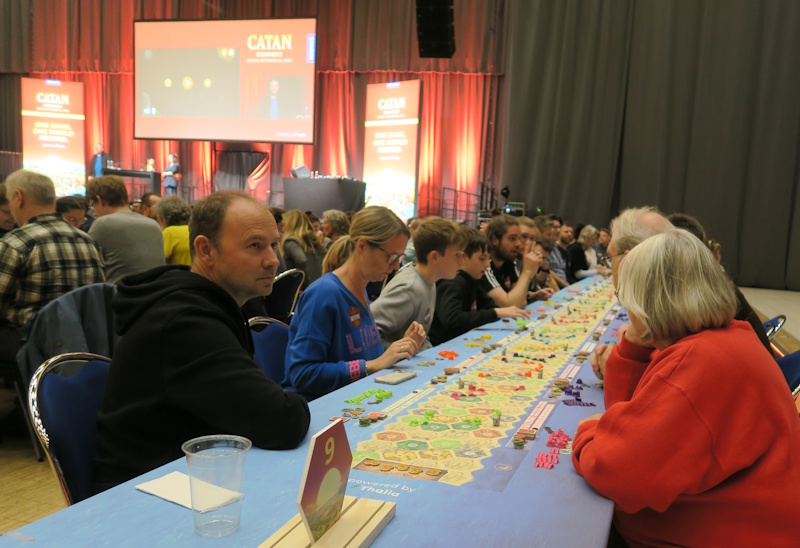
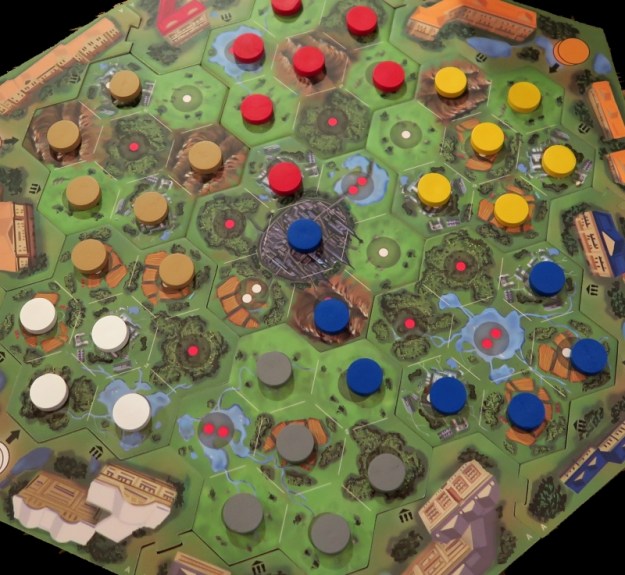
For those that were prepared to stay late on Friday, there was a world record attempt for the most people playing The Settlers of Catan together.  This was achieved with CATAN-Connect, which is a new version of the game designed for large parties that has large groups playing around single islands with elements of simultaneous play and everyone working to one electronic dice roll and a timer.  The record had been set at Essen in 2015 with one thousand and forty, only for Rotterdam to set a new record two years later with one thousand and ninety-six.  At SPIEL, one thousand, one hundred and seventy players joined in the game (watched by a few more who were just curous), successfully bringing the world record back to Germany where it arguably belongs.

CATAN-Connect
– Image by boardGOATS

10th June 2025 (Report)

The evening started with a lot of chat about the new and used games people had picked up at UK Games Expo a few days ago, with everyone very keen to play their new acquisitions.  The “Feature Game” was to be one of these, a a shiny new pre-release copy of Sierra, flown in specially for the fair by a chap from Hachette Boardgames UK called Flavien Loisier who was recognisable by his memorable, playable, MicroMacro suit.  Sierra is card game about traveling the Andes that received a UK preview at UK Games Expo, and is a very unusual game.  There are several different ways to play the game including cooperatively and competitively, but this time the group went with working in pairs, playing with the person opposite.

Sierra
– Image by boardGOATS

The pairs were Jade & Sapphire, Blue & Ivory, Black & Byzantium, and Purple & Plum.  The idea is that in their pairs players place cards from their shared hand to create a landscape and earn points for satisfying their objectives.  The catch is that while the Landscape cards are shared, all but one of the objectives are not.  In each round, the player with the Landscape cards draws two and plays two, while the other player draws two Objective cards and keeps one for themselves.  At the end of the round, the player with the Landscape cards passes them onto the next couple and the player who drew the Objective cards receives two Landscape cards—thus, the roles are swapped over for the next round.

Sierra
– Image by boardGOATS

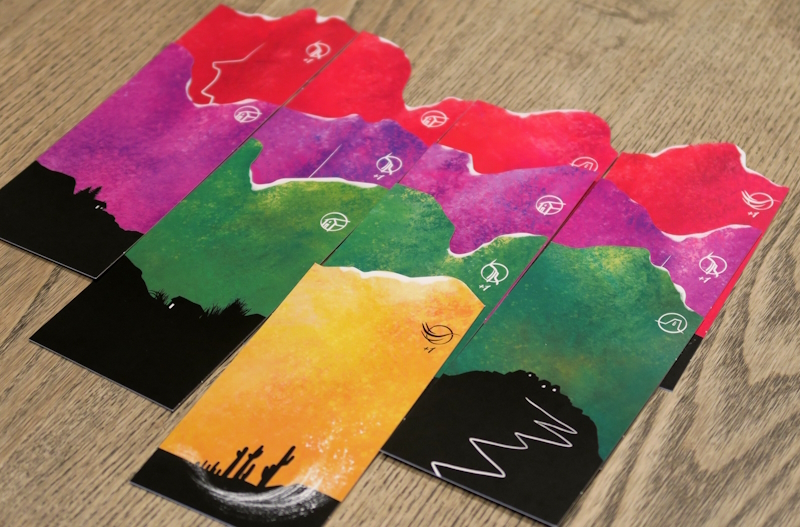
The Landscape cards come in four different colours and can be placed at either end so that the colours match, or they can start a new row.  The tops of the cards makes them look like mountain ranges, the cards form an interesting tableau.  As well as the colour, each card also has one of six symbols: Mammals, Birds, Houses, Ruins, Rivers and Wind—these are used for scoring.  After eight rounds each player will have four Objective cards and each pair’s shared Landscape will contain sixteen Landscape cards.  The game play was very different with so many players and playing in pairs.  The cards and the Landscapes the formed were beautiful.  Everyone who was new to the game started feeling their way somewhat, but eight rounds doesn’t last long and it was all over really very quickly.

Sierra
– Image by boardGOATS

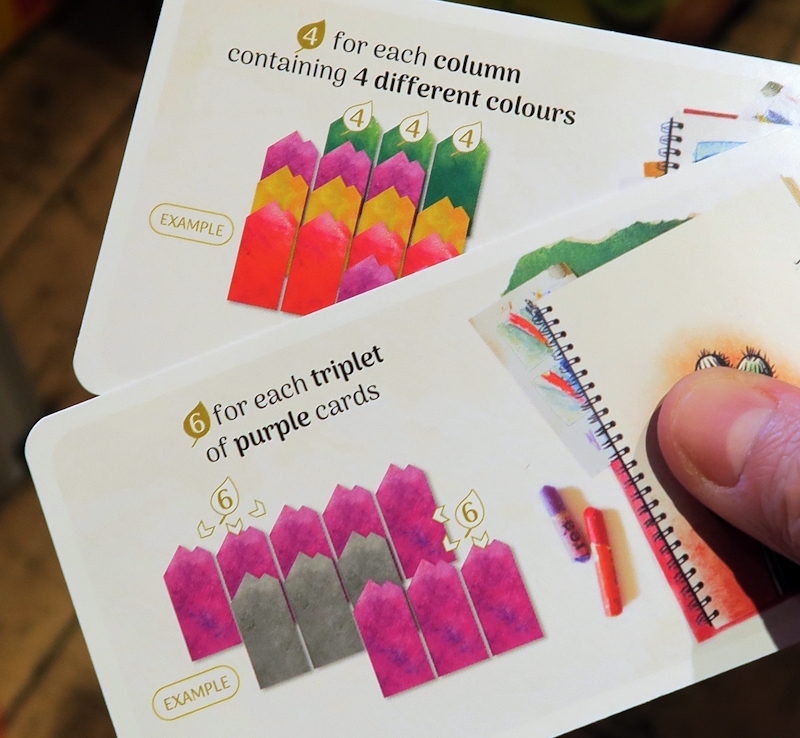
The scoring turned out to be a little quirky and in the end took almost as long as the game.  Each player then scores one point for each River and Wind cards in their shared Landscape and scores for their shared Objective.  Players then count the number of points they have earned  for their individual objectives.  The player with the highest total wins, however, the partner of the player with the largest total receives a bonus of five points If, with this bonus, the partner has more points than anyone else, then the pair win as a team.  This time, Blue and Ivory scored the most for their shared Landscape.  Individually though, it was a tie between Plum and Ivory  as Plum scored much more for her personal Objectives (as indeed did Purple).

Sierra
– Image by boardGOATS

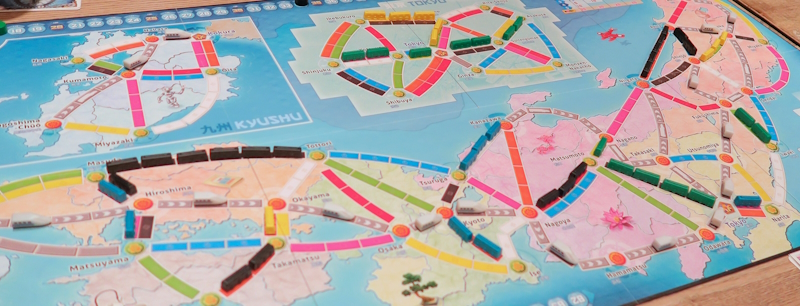
Because the individual winner was tied, there were no “team bonuses” awarded, which left the scoring feeling a little unsatisfying somehow and nobody fancied playing again straight away.  Instead, the group split into two groups with Ivory, Sapphire, Jade and Blue deciding to squeeze in a quick game of Ticket to Ride with the Japan map.  This had an outing fairly recently (when Pink hilariously took a fifty point hit when Purple played a single train claiming the route from Hiroshima to Okayama and blocked all his Tickets), but all the people involved in that game were elsewhere.

Ticket to Ride Map Collection: Volume 7 – Japan & Italy
– Image by boardGOATS

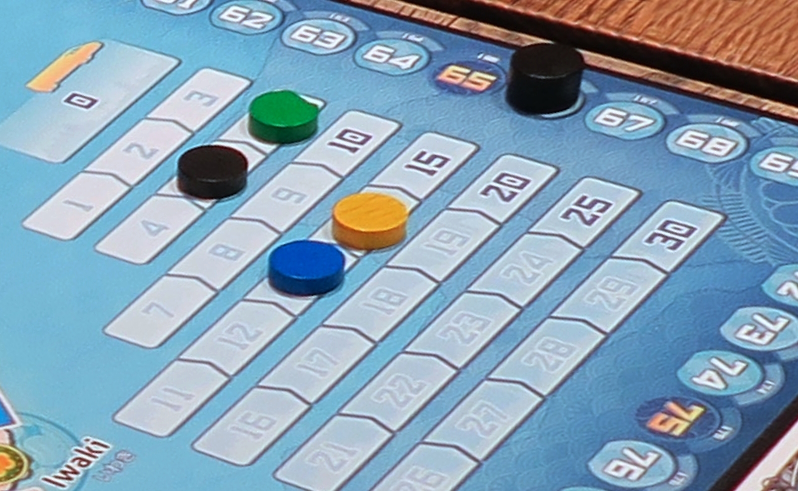
The Japan map is played exactly the same way as all the other versions of Ticket to Ride (i.e. take cards from the market or spend them to place trains in order to fulfill Tickets), but on a map of Japan and with the addition of the Shinkansen or “Bullet Train”.  Once a player has completed a section of Bullet Train, any player can use it to complete Tickets, but the player who completed that section moves along the Bullet Train Track. At the end of the game, the player who progressed the furthest, who contributed the most to this shared project receives the largest bonus, with the player who contributed least being penalised.

Ticket to Ride Map Collection: Volume 7 – Japan & Italy
– Image by boardGOATS

This time, everyone went for the Bullet Train early, so much so that there was quite a battle and by the time Sapphire realised what was going on, it was too late and he was left with the penalty.  That forced him to switch tack however, which might actually have done him a favour as he left Blue and Ivory to fight for the biggest, twenty-point bonus.  It was all really tight, but Sapphire was some way out in front as the Shinkansen points were evaluated.  And despite picking up a five point penalty, there he stayed to claim victory—Ivory who finished in third, pipped Blue on the Bullet Track, leaving her runner up with an eight point deficit (instead of a two point lead).

Ticket to Ride Map Collection: Volume 7 – Japan & Italy
– Image by boardGOATS

The other half of the Sierra group had moved on to play another game picked up at UK Games Expo, Tegula.  This is a very beautiful game played with beech wood hexagonal tiles with artwork based on Roman mosaics.  The idea is that players have to match the edges in order to place them.  Players can use actions to swap tiles, give tiles or play extra tiles and the first player to run out is the winner.  This time that was Black, with Purple the best of the rest (i.e. the player with the fewest tiles left, and Plum and Byzantium tied for third.

Tegula
– Image by boardGOATS

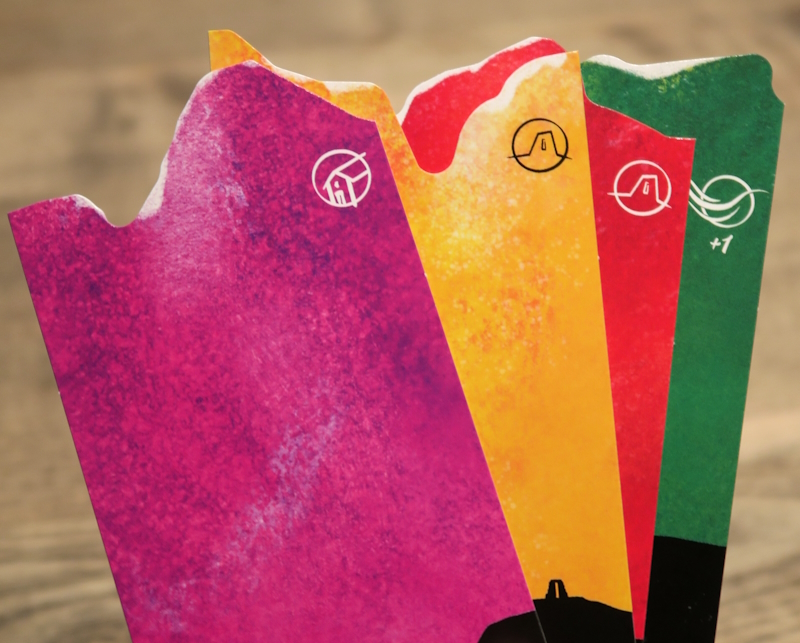
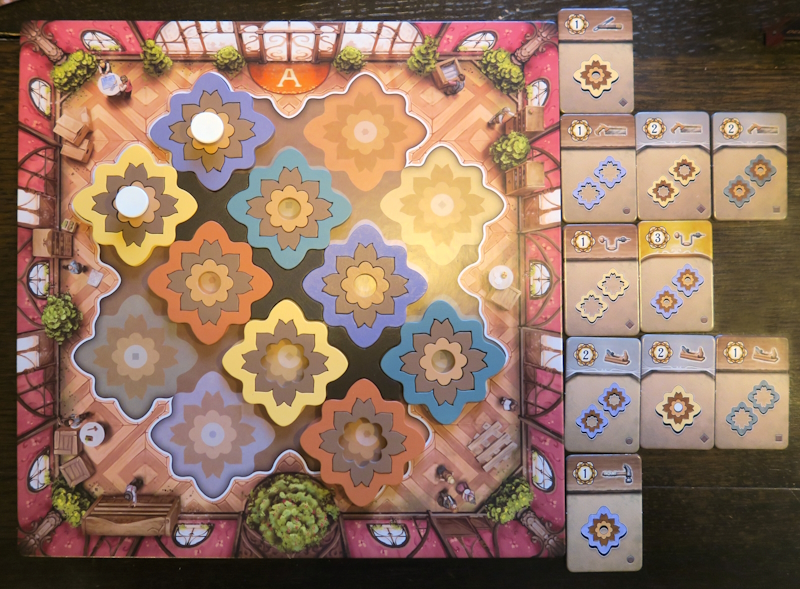
Meanwhile, Mint had also brought her new acquisition from the UK Games Expo, Intarsia, and taught it to Pink and Pine.  Although this had a most uninspiring box cover and the uninteresting theme of polishing wooden floors, the game itself is really pretty and fun to play.  Like Tegula, it is also made out of wood, the game is played over three rounds with eacvh round comprising three phases. First, each player takes the ten Material Cards depicted on their Starting Hand Card from the general supply. Players then take it in turns placing wooden elements onto their Flood Boards by paying the necessary Material Cards and taking new ones where possible and claiming and scoring Tool Tiles when their requirements are complete.

Intarsia
– Image by boardGOATS

Finally, players score points based on the number of connectors they’ve placed and choose a new Starting Hand Card to begin the next round. At the end of the game, players calculate their scores for the number of intarsias they’ve built and add them to their running total and the winner is the player with the most points.  The game was very tight… for second place!  In the end Pine pipped Pink’s ninety by a single point, but Mint took victory by a bit of a landslide with a hundred and eight, as she had four intarsias, compared with three and two for the others.  It had been a very enjoyable, lovely tactile game though and that hadn’t out-stayed its welcome.

Intarsia
– Image by boardGOATS

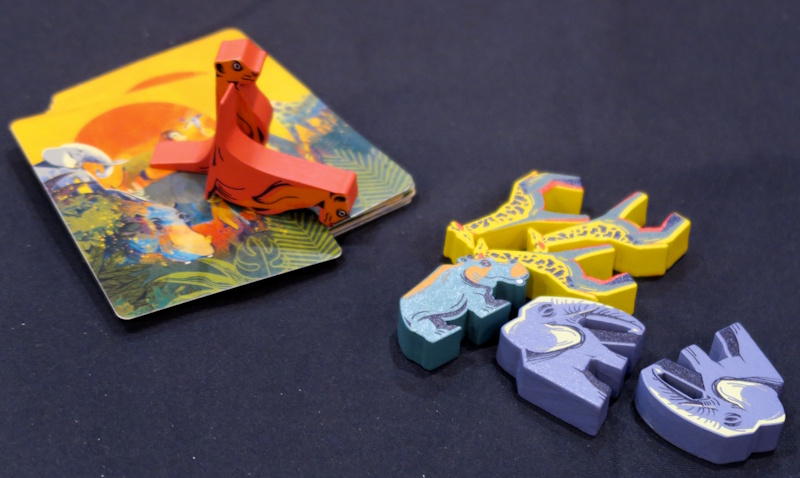
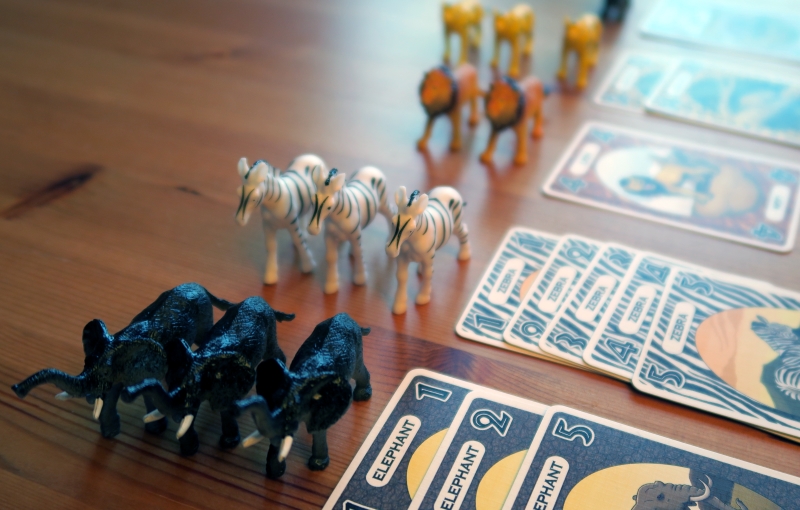
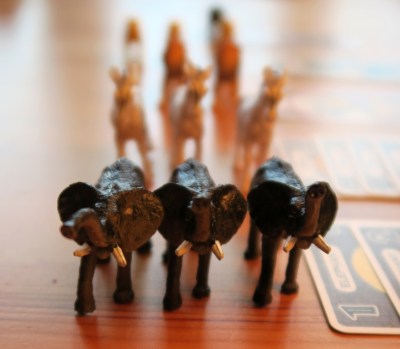
With the floor duly polished, the trio moved on to introduce Mint to the weird and wonderful game that is Botswana.  This is a sort of stocks and shares game played with cards and plastic animals.  Players start with a hand of cards and, on their turn, choose one to play taking a plastic animal of their choice from the central supply to add to their holding.  At the end of the game, each player scores for each animal with points equal to the total number of animals of the type they hold, multiplied by the face value of the last card of that type that was played.  Thus a player with five elephants might be scoring twenty-five points until another player replaces the “Five of Elephants” with a zero and crashes their value.

Botswana
– Image by boardGOATS

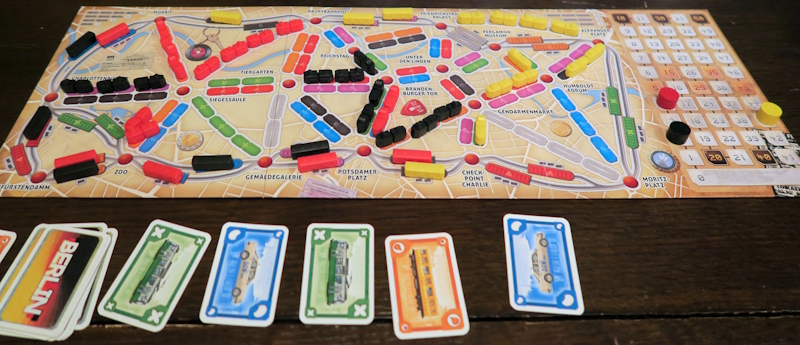
This game went down to the wire, but Pine just got his nose in front, with twenty points for his lions and fifteen for his rhinos giving him a total of thirty-five, on point more than Mint, while Pink finished a few points behind that.  There was just time for another very quick game and the game they chose was Ticket to Ride: Berlin—one of the city versions of Ticket to Ride.  These are much quicker to play, but still follow the same collect cards and spend them to place pieces in order to complete Tickets pattern. However, in Berlin, players have two different kinds of train car to place—trams and U-bahn trains.  On the board, there are specific single-space routes that can only be filled using an U-bahn train.

Ticket to Ride: Berlin
– Image by boardGOATS

The number of coloured cards required to complete the U-bahn is indicated on the game board (up to three), but similar to the Bullet Train in Japan, players only ever place one piece on than U-bahn route. Players only have a total of five U-bahn carriages to work with and their placement is critical, which makes Berlin one of the more interesting of the city games.  Once again, this was a close game with everyone using all their pieces.  Pink was the victor however, beating Pine into second by two points, but that meant that all three of them had won a game, so everyone went home basking in the warm glow of success.

Flavien Loisier
– Image from facebook.com
adapted by boardGOATS

Learning Outcome:  You can get some great games from UK Games Expo.

5th March 2024

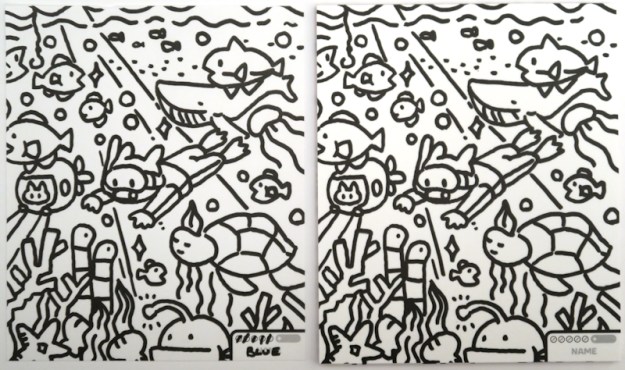
The evening started with everyone unsure who was coming, so the nine players present split into three groups of three, with Blue, Pine and Lime starting with the “Feature Game“. This was the very short, light, Make the Difference, a game that is basically “spot-the-difference” in board game form.  The idea is that each player gets a pre-printed picture and simultaneously add five extra “features” to their pictures.  Once everyone has added their “extras”, players take it in turns to place their pictures in the centre of the table (covered with a sheet of acetate to make it a little more difficult to spot the difference between printing and drawing), together with an unadulterated copy.
Make the Difference
– Image by boardGOATS

Players have one minute (timed with a slightly grumpy egg-timer), during which a player spotting an addition gets a point, then a second minute, during which both the spotter and the modifier get a point.  After the two minutes, any un-spotted additions are assessed for size, and if they are large enough, the modifier gets two or three points.  The additions have to be a single line, may extend an existing feature, and can’t just increase the width of an existing line.  This time, Pine went first with his picture, and the slightly mardy timer gave Lime and Blue a few extra seconds to spot his additions as Pine encouraged it to behave.  Most of his additions were spotted, partly as a result.

Make the Difference
– Image by boardGOATS

Lime went next, and players were slower to spot his additions giving him extra points.  Blue was the last, but this time Pine and Lime really struggled.  For some reason, Blue seemed to be better hiding hiding her additions, taking six points for lines that weren’t spotted during the two minutes of play.  In contrast, her poor spotting let her down, giving her a total of eight points, and just enough for second place.  The winner was Lime, however, with ten points.  There was a little chatter while they packed away, but as there were no new arrivals, the trio moved on to play something else, and quickly chose to give the recent Northern Lights edition of Ticket to Ride another outing.
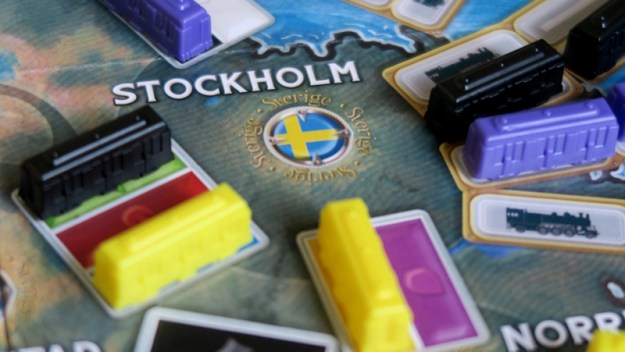
Ticket to Ride: Northern Lights
– Image by boardGOATS

Ticket to Ride: Northern Lights has had a couple of outings since it’s group debut last summer, and has been quite popular in the group.  The game is a fairly standard edition of Ticket to Ride (take cards from the market, or play cards to place trains), but the map is set around the Scandinavian countries of Denmark, Norway, Sweden and Finland.  Like all the variant games, this one has a couple of minor rules tweaks, principally, the addition of bonus cards which give points at the end of the game and bonuses for completing some of the longer Ferry routes.  Locomotives are also handled slightly differently as the market is not refreshed when saturated by them, and for Ferry routes only, they can be replaced by any two cards of the same colour.

Ticket to Ride: Northern Lights
– Image by boardGOATS

This time, the bonus cards drawn at random were the Locomotive Collector (A), International Tycoon (G), Polar Express (H) and the Ferry Master (J).  Pine went first and started placing trains much to Lime and Blue’s horror.  A few turns later, Lime headed up the Norwegian cost, while Blue started building an extended route from Bergen in the west through Stockholm to Tallin in the east.  It was then that Pine, with his north-south route got in her way and began costing her points thanks to the fact that with only three players the double routes weren’t in play.
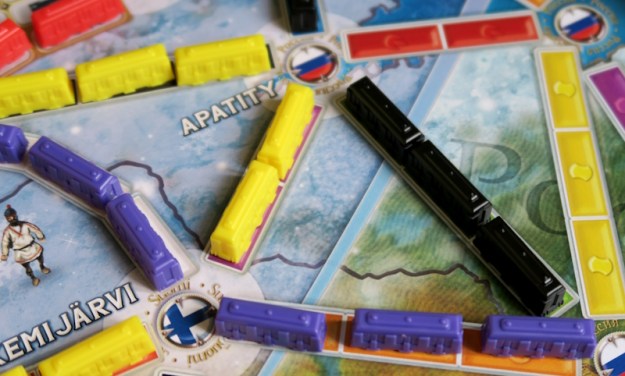
Ticket to Ride: Northern Lights
– Image by boardGOATS

As he had done last time the group played, Lime churned through his trains remarkably quickly catching Pine and Blue on the hop slightly. After the last few turns had been played, the bonus points were allocated with each player winning one (Lime for the most Ferry routes; Pine for the most tickets ending in the Arctic Circle and Blue connecting the most countries while nobody had any Locomotive cards at the end of the game).  Pine claimed a completed Ticket for eighteen points which he had almost completed when he drew it (AGAIN!).  Also like time, Lime finished with a nice round hundred points, and once again was pipped pipped to victory by Pine, albeit by a larger margin (ten points rather than three).
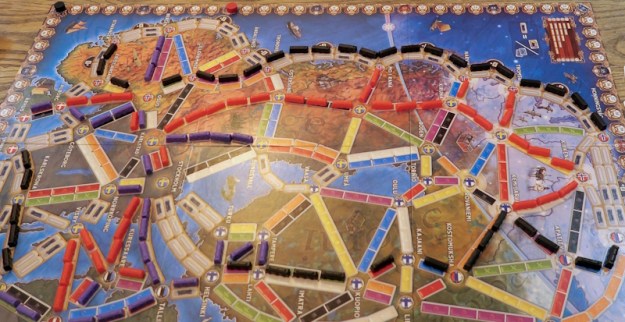
Ticket to Ride: Northern Lights
– Image by boardGOATS

With that over, Lime headed home, leaving Blue and Pine to kill time while waiting for one of the other games to finish.  In this, they played a little “wallet game” called Circle the Wagons.  This is a simple, quick game where players take cards from a market and add them to their player area, building a map, scoring points according to the largest areas of each terrain type and three addition scoring criteria selected at random.  These scoring criteria are printed on the reverse of the cards and are drawn at random at the start of the game.  The first bonus card drawn was “Boom or Bust which gives points for two or fewer Mines/Pickaxes, none for three to six and four or five points for seven or eight (or more).
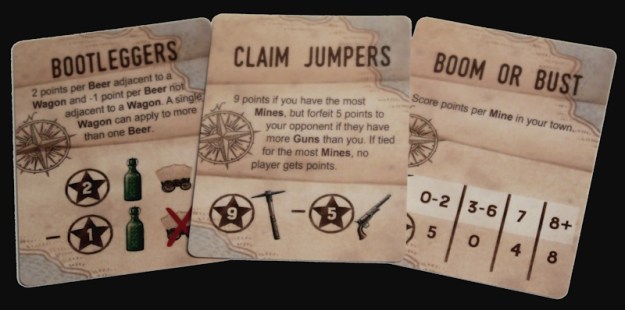
Circle the Wagons
– Image by boardGOATS

The other bonus cards were Claim Jumpers which gives the player with the most Mines/Pickaxes nine points (though they lose five if their opponent as more Guns), and Bootleggers which give two points for each Beer Bottles next to a Wagon (and minus one for any not next to a Wagon).  Once the bonus cards had been picked, the remaining fifteen cards were shuffled and arranged in a circle.  The first player, in this case Pine, could then choose to either take the first card, or take another, later card, leaving any that had been skipped for his opponent, Blue, who then had the same choice.  Play continues until all the cards had been taken.
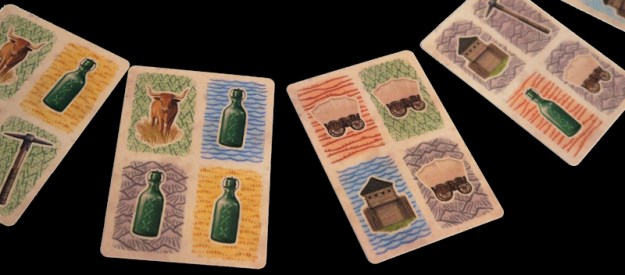
Circle the Wagons
– Image by boardGOATS

This time, Pine started prioritising Pickaxes, given the fact that two of the bonus points scored for them.  Blue was slow to get started with these and ultimately scored nothing for Boom and Bust and for Claim Jumpers.  She collected Beer Bottles instead and prioritised scoring for her terrain.  Blue’s thirteen points for Beer Bottles exactly matched Pine’s for his Pickaxes, though he picked up half a dozen points for his Beer as well.  Blue took six points for her Forest and four for her Plains, while Pine got five points for each of his Desert and Water terrain.  It was closer than it seemed during the game, however, with Pine finishing with thirty-five points, just three more than Blue.
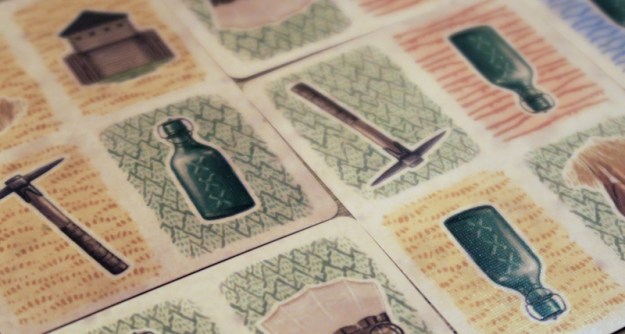
Circle the Wagons
– Image by boardGOATS

By this time, Pink, Teal and Ivory were bringing Viticulture to a close.  This is one of the group’s most popular worker-placement games and a particular favourite amongst Pink and Teal who have been promising each other a game for months.  The game is quite simple and doesn’t really do anything fancy, it just does what it does very well.  The idea is that players are making wine, which they do by placing their workers on spaces on the central board.  Each space has a limit to how many workers can occupy it, with each player having a “Grande” worker who can muscle in anywhere.  This time, the group played with the Tuscany expansion, which adds a few little extras.

Tuscany
– Image by boardGOATS

Firstly, whereas the base game has essentially two seasons spring and autumn (with visitors in summer and winter), the Tuscany expansion has actions for all four seasons.  Players can also build special buildings (which give additional powers and special options for those that make the effort to build them), and claim regions to gain influence (and bonuses) which scores points at the end of the game.  The player order works slightly differently to the base game and the end of the game is triggered when someone passes twenty-five points (rather than twenty in the original game).  This time, however, nobody took advantage of the opportunity that Tuscany provides to build buildings, instead focusing on the basics of planting grapes and harvesting them.
Viticulture
– Image by boardGOATS

There is a now a well-known and frequently used tactic of selling a field at the start of the game to provide equity in the early part of the game.  Teal and Ivory both went down this route while Pink decided to try something else, but that didn’t go well for him.  His problems were exacerbated by his inability to get access to fulfilling orders later in the game.  Ivory started acquiring points early taking an early lead.  Teal wasn’t far behind, but never quite managed to overhaul Ivory who triggered the end of the game and finished with thirty-one points, seven more than Teal in second place.
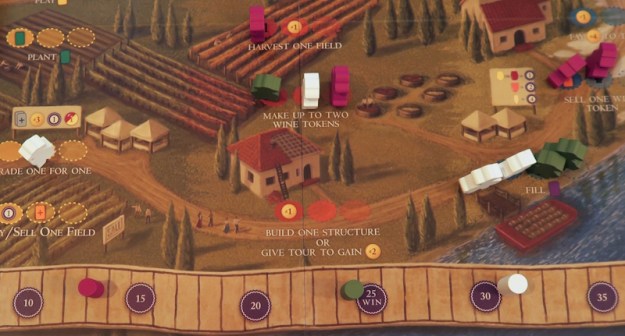
Tuscany
– Image by boardGOATS

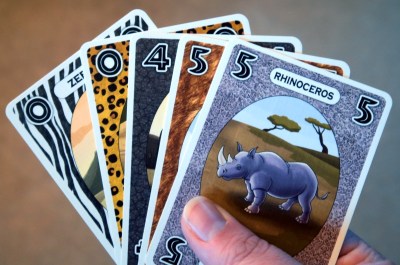
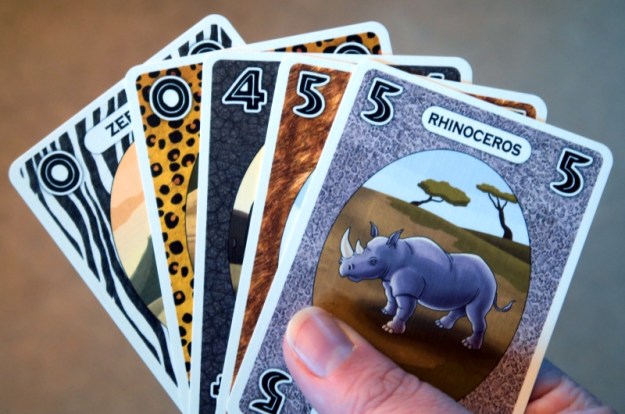
When Viticulture finished, Ivory and Teal headed home, leaving Pink to join Blue and and Pine in a couple of quick games of Botswana.  This is a sort of simple stock-holding game where players are collecting animals.  The idea is that there are five suits of animal cards, each numbered from zero to five—these are shuffled and dealt out to the players with a small number left out for ambiguity.  Matching the suits, there are five sets of five plastic animals.  Players take it in turns to play a card (any card) and then take an animal (any animal) until someone plays the sixth card in any suit.

Botswana
– Image by boardGOATS

When the last card is played in any suit, the game ends immediately and players score points for their animals with each animal being worth the face value of the last card played in that suit.  Thus, Zebras might have been worth five points each, right up until the last card was played which could be a zero, rendering them totally, point-less.  Somehow, it is a hard game to understand—far from random, a bit like 6 Nimmt!, it is very hard to control and manipulate the scoring in a particular direction.  This was quite evident in the two rounds played this time.
Botswana
– Image by boardGOATS

In the first round, Blue held a few key Elephant cards and was able to manipulate the game end to ensure they scored well.  With a couple of high scoring Lions added to her menagerie, she ended the game, ensuring she finished with thirty-five points.  It was very tight between Pink and Pine, but Pink just edged second place with twenty-two.  The second round was also close with just two points between Pink and Pine, but this time they were vying for victory.  In the end it was Pink again, this time triggering the end of the game allowing him to ensure his Leopards scored well.

Botswana
– Image by boardGOATS

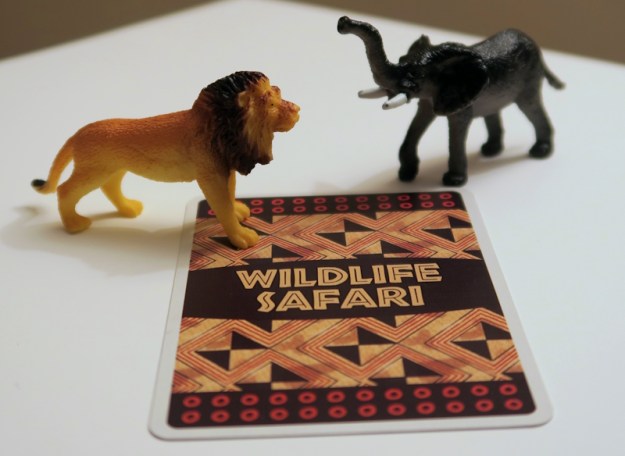
Botswana is a lot of fun and as they packed up, there was quite a bit of chatter.  Pine pointed out that the backs of the cards said “Wildlife Safari” and wondered why.  Blue commented that there were lots of different versions, but couldn’t remember the differences.  A little bit of research shows that the game was originally released as “Flinke Pinke” and then “Quandary” and eventually “Loco!”, all with simple colour suits.  Then, in 2010, the boring colour suits were changed for animals by Eagle-Gryphon Games, who initially republished the game as “Botswana”, before increasing the size of the box and calling it “Wildlife Safari”.  Presumably this particular copy was released when small boxes were still available, but the company had run out of matching cards…
Botswana
– Image by boardGOATS

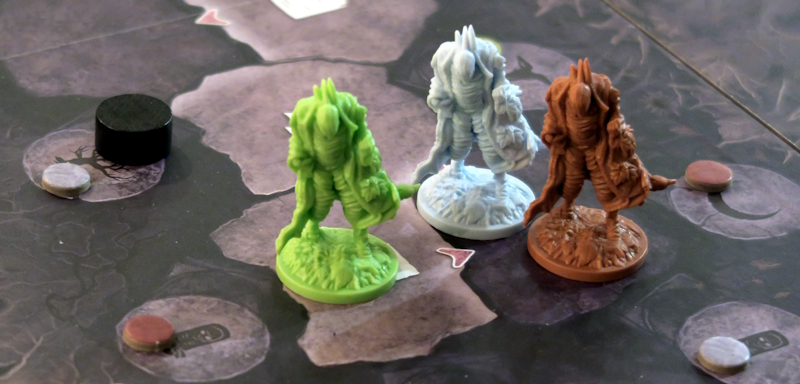
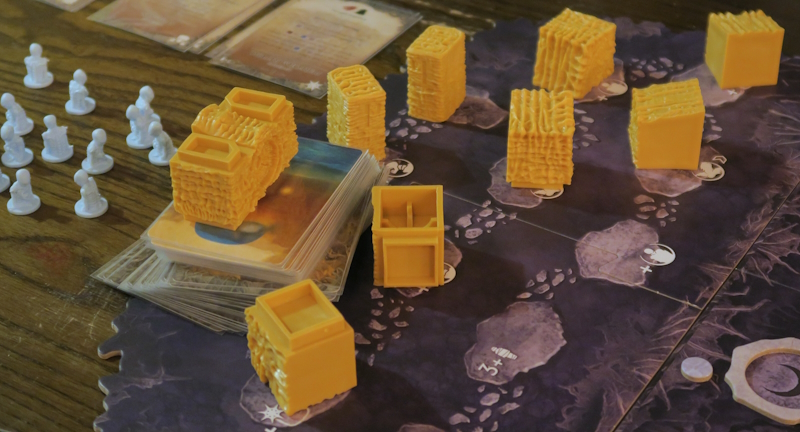
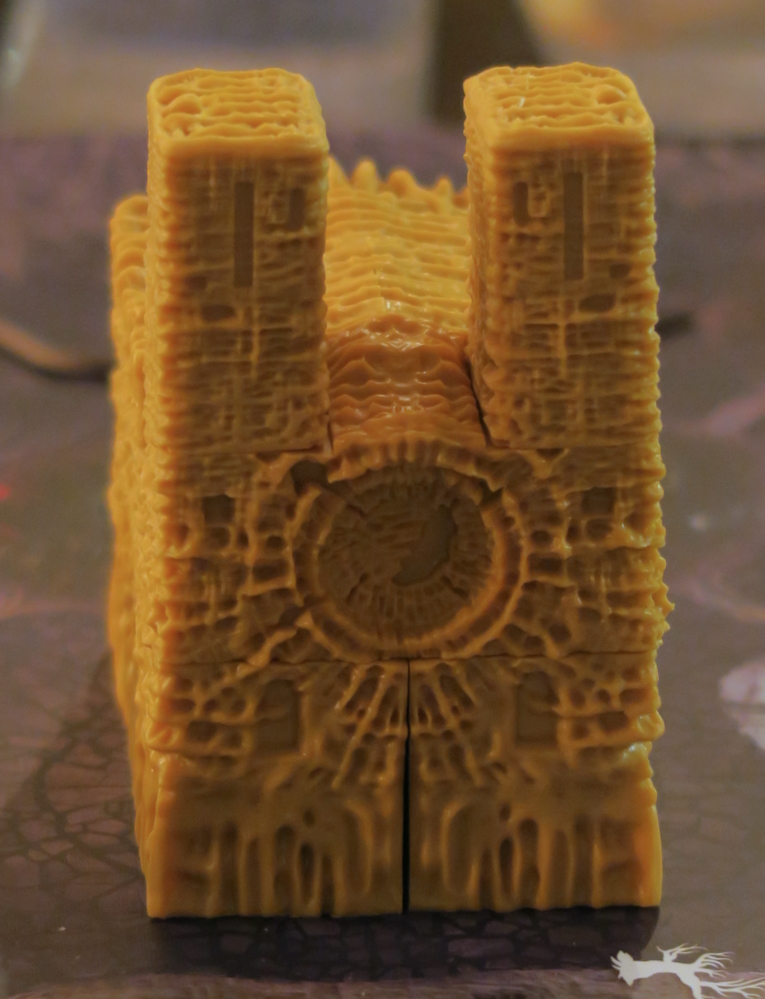
Meanwhile, on the next table, Cobalt had persuaded Plum and Byzantium to join him playing the rather epic-looking Nightmare Cathedral. This is a card-driven action-selection area-control game set in the fantasy world of late Polish surrealist painter and sculptor Zdzisław Beksiński. The game is adorned with his artwork and beautifully sculpted miniatures. Players control Units, which act as a resource, whilst an imposing Cathedral is built in the centre of the board. Once the Cathedral is completed, two Nightmares (out of a selection of eight) appear next to the Cathedral and can be controlled by a player on their turn if a certain condition is met. Each Nightmare, represented by a unique sculpt, has varying abilities such as converting or devouring units as they move around the map.

Nightmare Cathedral
– Image by boardGOATS

The game ends when a certain number of Units have been devoured, or, less likely, after completing three rounds. The winner is determined by points, which can be obtained from climbing the Ritual track, building Forts, Devouring the most Units, or completing objectives on Dream cards (the latter being the largest source of points). On a their turn, the active player selects an action with their Dreamer from one of five on the day/night action track, although they cannot select an action adjacent to their dreamer’s current space. After performing the action, other players get to follow, either Conforming or Dissenting depending on whether their dreamer is adjacent to the current action space.
Nightmare Cathedral
– Image by boardGOATS

The active player then moves their Dreamer to the adjacent Night space, a section of the Cathedral is built, the turn marker moves to the subsequent space and the next player takes their turn.  Each player starts with a tableau of five cards, one for each action type, that details how each action can be performed, as well as the Conform/Dissent actions. The players also have a hand of cards, which come in two forms: action Upgrades or one-time Effects; each card also contains combat symbols.  The five basic actions are: Ritual (spending/removing followers to move up the Ritual track); Summon (producing Followers); Fortify (spending Followers to Build/Upgrade Forts); Manoeuvre (moving Units and/or Shaper, performing a conversion and then initial Conflicts); Develop (playing Development cards from hand, either to Upgrade actions or gain one-time benefits).

Nightmare Cathedral
– Image by boardGOATS

A player controls an area if they have a Fort present, or if there is no Fort and they have the most Units in the area. The board is also populated with a “neutral” player, called The Shadows, that can participate in conflicts and be Devoured for benefits. Each area is associated with one of four symbols, with the active symbol being determined by the turn marker (which changes every turn, cycling through each symbol). Certain actions refer to these symbols, for example when moving up the Ritual track, players must spend Units from areas matching the symbol on the next level of the track, or areas marked active by the turn marker produce if that action is selected. When producing Units by marked areas, the unit is produced by the player who controls the area, not by the active player.
Nightmare Cathedral
– Image by boardGOATS

A player may forgo the action on the card to draw two Development cards to hand. Each player may have up to two Dream (objective) cards at any time, and may complete them on their or another player’s turn provided they match the criteria at the appropriate time as specified on the objective card.  However, they may only draw new cards at a specific point in their turn from a display. Once the Cathedral is nearly complete, the Level II Development and Dream cards are mixed in with the initial Level I cards to provide enhanced benefits and more points. When a player initiates Conflicts, they get to choose which of the valid areas the Conflict(s) occur, and they do not need to participate in the conflict themselves.

Nightmare Cathedral
– Image by boardGOATS

To resolve a Conflict, the two players involved reveal a number of Development cards from hand—the number determined by the number of units present in the Conflict area (plus one if they also have a Fort). Each card depicts claws and shields: a Unit is removed for each claw that was not deflected by a shield. The winner of the Conflict is the player who has a Fort remaining, or, failing that, the most Units in the area; the looser must retreat all remaining Units to adjacent areas.  Each player starts with one action upgraded, drawn at random—each player drew an upgraded summons card.

Nightmare Cathedral
– Image by boardGOATS

Cobalt played first, and was able to complete one of his Dream cards immediately. In the first few turns, Byzantium managed to pin Cobalt in one corner of the board, which severely limited his ability to expand and produce Units, whereas Plum was able to grow relatively peacefully on the opposite side of the board. Byzantium, and to some extent Plum, were able to make use of their expansion to move up the Ritual track. Plum was also able to expand her Forts to several areas. Cobalt was able to upgrade his forts in the limited areas he controlled, as well as draw up to the hand limit of eight development cards over the first half of the game.
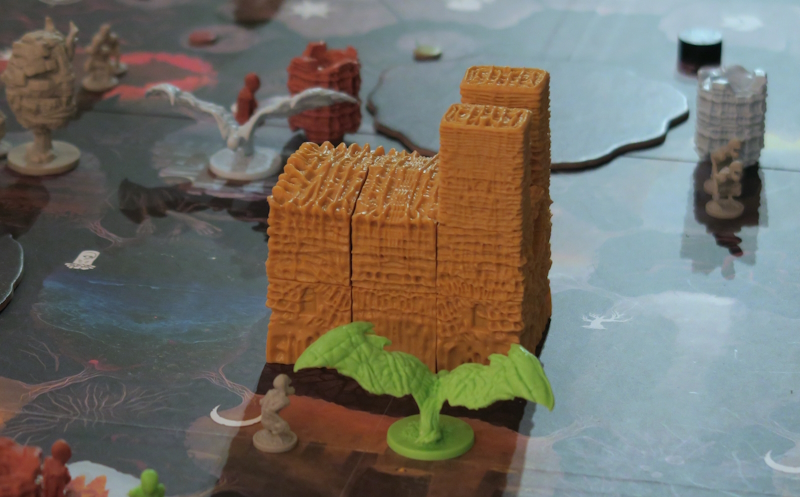
Nightmare Cathedral
– Image by boardGOATS

During the second half of the game, after the Cathedral was built and the Nightmares came out, Cobalt was able to make use of his Development cards (especially due to a very well timed fortunate draw) to control both Nightmares in a single turn to Convert and then Devour a sufficient number of his own Units to claim a high-scoring Dream card as well as ensure he had the most Devoured units for end-game scoring.  Unfortunately, this time, the group ran out of time so had to end the game early, stopping after everyone had completed an equal number of turns (time which Byzantium used to move up the Ritual track and Plum used to built a few more Forts).

Nightmare Cathedral
– Image by boardGOATS

Long before the game finished, it was clear that Cobalt was miles ahead and nobody was going to catch him.  Plum held on to he Dreams for too long, while Cobalt and Byzantium were better at completing theirs.  She did manage to get a Fort in the fourth corner of the map fairly early on which gave her somewhere to spawn her Units from, though.  Ending the game early meant players didn’t get to make as much of their Upgraded Action Cards as they might have done and there were cards left in hand which could have come into play with another few more rounds. As a taster game, it proved quite different, however, and deserving of another try sometime, as long as there is time to complete it.
Nightmare Cathedral
– Image by boardGOATS

Learning Outcome:  You are never too old to play “Spot-the-Difference”, but that doesn’t make you good at it.

8th August 2023

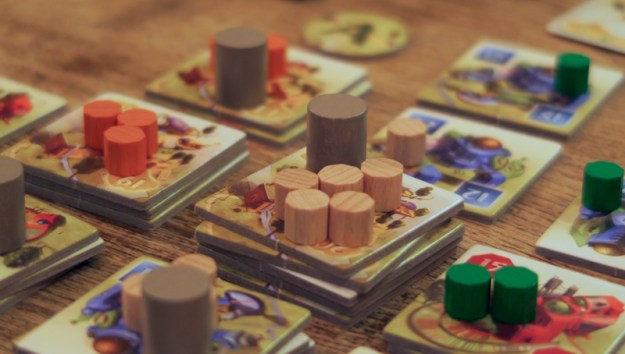
Blue and Pink were first to arrive, and, as they finished their pizza, others began to turn up too.  It was a slow start on a relatively quiet night, but eventually Blue Ivory, Black and Jade were settling down to play the “Feature Game“, Ginkopolis.  This is a medium weight tile-laying game with an area control element.  Blue explained that it was one of those games that had been through a phase of being very out of print and therefore inevitably in high demand, though now was much more available.  The game is set in 2212 where players are urban planners trying to building the eco-city, Ginkgopolis, though the theme is quite loose and in reality, it is much more more abstract that that.

Ginkgopolis
– Image by boardGOATS

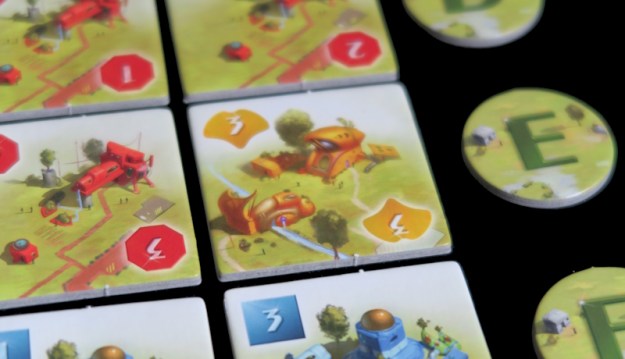
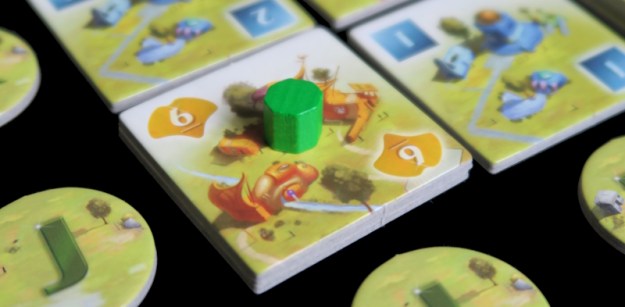
The game is card-driven, with players simultaneously choosing a card and any tiles they are going to play with it, and then, starting with the first player, taking it in turns to carry out one of three possible actions: Urbanise, Construct or Exploit.  There are two different sorts of cards in the game, Urbanisation cards which feature a letter, and Construction cards which come in three different colour suits, red, blue and orange, and are numbered one to twenty. When choosing either an Urbanise action or a Construct action, players additionally choose a Tile to play from their personal stash.  Urbanising involves placing a tile in the space matching the letter on their Urbanise card, adding a wooden Resource block in their colour to claim it.
Ginkgopolis
– Image by boardGOATS

There is a little upkeep, in that they move the Urbanisation letter marker to a space orthogonally adjacent to the Tile they placed and mark it with a grey cylinder.  As a reward for urbanising, players get to Activate all orthogonally adjacent buildings.  This is claiming a number of  Tiles, Resources or Ginkgo Points (a sort of currency used in the game), with the item dependent on the colour and the number received equal to the height of the Building activated.  Constructing is similar, except the Tile chosen is placed on top of another Tile, returning any Resources on the tile to their owner and claiming Ginkgo Points from the bank for each one.

Ginkgopolis
– Image by boardGOATS

In addition to this immediate reward, there are also costs:  if the Constructed Tile has a lower number than the tile it is built on, they must pay the difference in Ginkgo Points and if the colour is different, they must also pay one Resource to the general supply.  In addition to these potential costs, the active player must also place Resources from their stash on top of the newly expanded building to claim it (with the number equal to the height).  This can make Constructing expensive, though as the game progresses, they get Resources back as other players build on buildings they have Urbanised or Constructed.  Still, particularly early in the game, players can find themselves running out of supplies, in which case, they can Exploit.

Ginkgopolis
– Image by boardGOATS

Exploiting involves playing cards (without a tile) to gain Tiles, Resources, or Ginkgo Points.  How they Exploit depends on whether the card they are Exploiting is an Urbanisation card or a Construction card.  For Urbanisation cards, players just take either a Resource or a Tile from the supply, whereas for Construction cards, players Activate the building on the card to receive Tiles, Resources or Ginkgo Points equal to the height of the building. This is not the only way to get resources, however.  Once a player has carried out their chosen action, they either recycle the card (if they Urbanised or Exploited) or, if they Constructed, they keep it in front of them.  Each Construction card has an action as well as a number and a colour, and these are activated during the game, most after carrying out actions, with some providing end-game Points.

Ginkgopolis
– Image by boardGOATS

And scoring is where the game gets tricky.  The winner is the player with the most Ginkgo Points at the end of the game, but in addition to chips acquired during the game and end-game points from Construction cards, the majority of the points come from the area control element of the game.  The city is divided into districts with districts defined as areas containing at least two buildings of the same colour.  The player with the most Resources in the district wins control and takes Ginkgo Points equal to the total number of Resources in the district.  The player to take second gets Ginkgo Points equal to the number of their Resources in the district.  Ties are broken in favour of the player with the highest building.
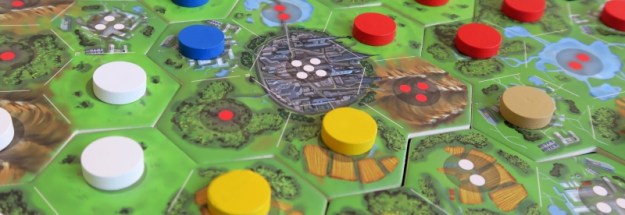
Ginkgopolis
– Image by boardGOATS

There is quite a lot of critical upkeep in the game, but the most important it to remember to put a grey construction cylinder on buildings during Urbanisation and Construction.  This is because at the end of each turn, players top their hand back up to four cards drawn at random—when the draw deck is empty, however, the discard deck is recycled and topped up with cards that correspond to the newly constructed buildings.  Since cards that correspond to buildings are kept when the building is over-built, and everything else is recycled, the draw deck (and the cards in hand) comprise all the buildings currently visible, together with all the Urbanisation cards, and nothing else.

Ginkgopolis
– Image by boardGOATS

Getting this wrong, breaks the game spectacularly, as Blue and Ivory had found out on the one other occasion they played it (with Pink, during one of the sporadic meetings in the pub late in the Summer of 2020).  This time, they were aware of the importance of placing the grey markers and mostly managed to stay on top of that so everything went a bit smoother, allowing players to concentrate on the nuances of the game.  And there are lots of nuances.  For example, over-building can help a player to take control of a district, or, if they change its colour, break one up, but it also gives Resources to the previous owner.  Similarly, Urbanising expands the city, but provides a cheap way for other players to expand districts and perhaps muscle in.

Ginkgopolis
– Image by boardGOATS

The game started with everyone feeling their way, trying to make the most of the Character cards they were dealt at the start of the game.  These give bonuses to players to get them going in the early stages of the game.  It is possible to draft these character cards, but the group began with the preconstructed sets:  Ivory got set one, Black got set six, Jade got set two and Blue got set five.  These give players a strategy steer in the early part of the game, for example, Blue and Black’s cards gave them two bonuses for Exploiting while Jade and Ivory both benefited twice for Constructing.  Quite early in the game, it became clear that there was one building towards the middle that was going to be quite critical in the area control battle and Blue, Black and then Ivory all over-built and tried to claim it for their own.

Ginkgopolis
– Image by boardGOATS

The game has the ability to feel very swingy, and lacking in control, and yet it is actually an extremely smart, tactical game—one clever tile placement can completely change the game by breaking up a district or joining two districts together and totally change the balance of power.  This game was no different in that regard, though it took a little time for everyone to really start to see its potential.  There were other elements of the game that players gradually came to appreciate.  For example, Black ran into the unexpected difficulty of running out of Resource markers, because he had a lot in the city.  This gave the others a problem—building over his buildings relieved that pressure, but because he had so many on the board, it was hard to avoid doing it.

Ginkgopolis
– Image by boardGOATS

Jade also had difficulties getting the tiles he wanted to match his cards, while Ivory had difficulties getting the cards he wanted (and was the only one to spend one of his refresh hand tokens, which cost him two points in the end-game scoring).  The game ebbed and flowed, and although it vastly exceeded its advertised forty-five minutes, it wasn’t long before the stack of tiles dwindled and triggered the end of the game.  At this point, players could choose whether to add tiles from their hand back into the game.  Jade was aghast at the idea having struggled to get tiles throughout, but Ivory had an enormous stack and put a few back into the supply to keep things going for another couple of rounds.

Ginkgopolis
– Image by boardGOATS

As the game drew to a close, the question was whether anyone would be able to make a move on the largest districts.  The highest building that had been long fought over now belonged to Ivory, but had been cut off, leaving it pointless, which left two large red and one large blue district as well as some smaller efforts.  Key was the number of Ginkgo points picked up during the game—everyone thought Ivory had a lot, but it turned out Black was the king of the Ginkgo tokens with a massive thirty-six. Blue was a little way behind him, but made up for this with her city scoring, which ultimately gave her victory with sixty-six points, nine more than Black in second who was well clear of Jade and Ivory who tied for third.

Ginkgopolis
– Image by boardGOATS

Meanwhile, on the next table, Purple, Green and Pink were deciding what to play while they waited for Pine who was running late.  Green commented that he didn’t want to play something new, so in the end the group settled on Splendor.  This is an old favourite, though one with poignant memories for most in the group as it was a favourite of Burgundy who sadly passed away eighteen months ago—it would have been his sixty-fifth birthday at the end of the month.  As always, with Burgundy in mind, the trio set the game up.  It is a very simple, tactical engine builder, where players take it in turns to either take chips from the supply, use chips to buy a face up card from the market or, occasionally, reserve a card.

Splendor
– Image by boardGOATS

Players win points for the higher value cards, or for collecting enough cards of specified colours to claim a Noble.  This time, Pink tried a strategy that concentrated on going for cheap cards with the primary aim of scoring for Nobles.  This had the benefit of giving him lots of cards which builds the engine quickly making other cards cheaper.  The strategy worked well, but not as well as Pink needed it to for him to beat Green who ended the game, with a lead of three points.  As Splendor came to a close, Pine rocked up, so the newly expanded, now quartet looked for something fairly light to play, and Pink suggested one of his favourites, For Sale.

For Sale
– Image by boardGOATS

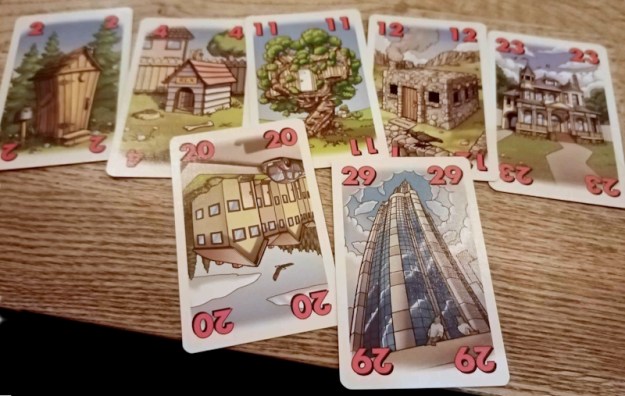
As Pink described it, like football, For Sale is a game of two halves.  In the first half, players bid for properties which they then sell in the second half of the game.  This time, Purple became a bit of a tent specialist (with tents of various quality), which turned out not to work so well for her.  Pine ended up with the outside netty (one of the lowest value cards), but one that you are almost guaranteed not to loose money on.  Once again, however, the winner was Green with Pink taking his second second place.  So the question was, could anything upset that pattern?

For Sale
– Image by boardGOATS

The group moved on to Botswana, a sort of set collection stock-holding card game that it is really hard to get your head round despite actually being very simple.  The five animal suites each have six cards, which are shuffled together and dealt out.  Players then play a card from their hand, and take any one of the animals on the table.  The round is over when any one of the five animals has the sixth card played, at which point players score points for each animal they have, equal to the final card played.  After three rounds, the player with the most points is the winner.

Botswana
– Image by boardGOATS

This time, all three rounds were remarkably even.  Purple was just one point behind green going into the final round, though Pink had some ground to make up if he was going to continue his run of second places.  In the end, Green made it three from three, and relatively poor final rounds from both Pink and Purple left Pine to take second with Purple just behind.  Green decided three was enough, and didn’t fancy tarnishing his winning streak, so headed off while Purple and Pink waited for their other halves to finish Ginkopolis, and looked round for a suitable filler.

Coloretto
– Image by boardGOATS

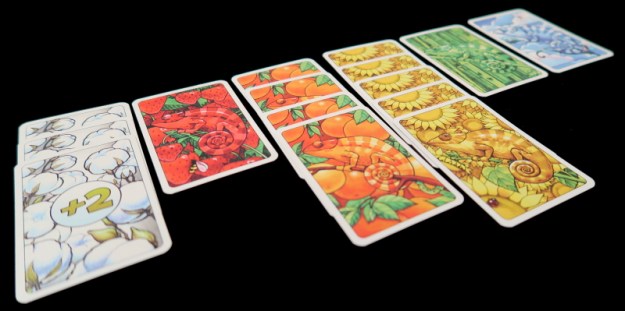
Coloretto is another old favourite, and one that plays really well with three.  A really simple set collecting game, on their turn, players either turn over a coloured chameleon card and place it on a truck, or take a truck.  At the end of the game (when the draw deck has been mostly depleted), players score points for each coloured set of cards.  In general, the larger sets score more, but only the largest three score positively, everything else gives negative scores.  For a bit of variety, the group used the scoring card from the Limit Cards/Extra Cards mini expansion (but without any of the other rules and cards).  This gives low scores for the small groups, but very high scores for the large sets.

Coloretto: The Extra Cards
– Image by
boardGOATS

Aside from a query about the Golden Joker (which like the normal multi-coloured Joker can be added to any set at the end of the game, but additionally gives an extra card drawn at random from the deck), there was no real need to revise the rules.  It was a good game, though Pink blotted his copy book with quite a lot of negative points and wasn’t able to improve on his two second places as a result.  The run-away winner was Purple though, who finished with forty-eight points, eight more than Pine in second place.  And with Ginkopolis coming to an end too, that was it for another week.

Coloretto
– Image by boardGOATS

Learning Outcome:  In some games, you have to start building right from the gink-go…

23rd September 2021

Burgundy and Blue were just finishing their supper when Teal introduced himself.  The three were chatting when Lime, who hadn’t been able to come for over a month, also joined the group.  It was expected to be a quiet night with Green and Lilac away on holiday, Pine working late, and Pink stuck somewhere on the Warwick bypass.  So, there was a lot of chat, but eventually, the group decided to play something and settled on Love Letter.

Love Letter
– Image by boardGOATS

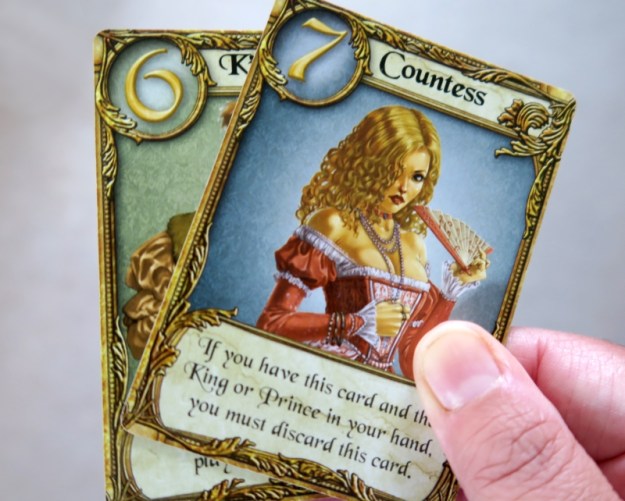
This is a very simple little game that we’ve played a lot, but somehow Lime had missed out.  So, there was a very quick rules explanation:  players start with a hand of one card, draw a second and choose one to play and do the action on the card.  The cards are numbered and the aim of the game is to finish the round with the highest card, or more commonly, avoid being knocked out.  There are only sixteen cards in the deck (and one of those is removed at the start of the round), so it doesn’t take long.

Love Letter
– Image by boardGOATS

The group were only three rounds in when everyone else turned up (including Pink who had escaped the roadworks), so Lime was declared the winner with two tokens and everyone else was introduced to Teal and started to discuss what to play.  In the end, Burgundy took matters into his own hands and started a game of Wingspan, so while Pink waited for his pizza to arrive, Blue explained the “Feature Game“, Mini Rails.

Mini Rails
– Image by boardGOATS

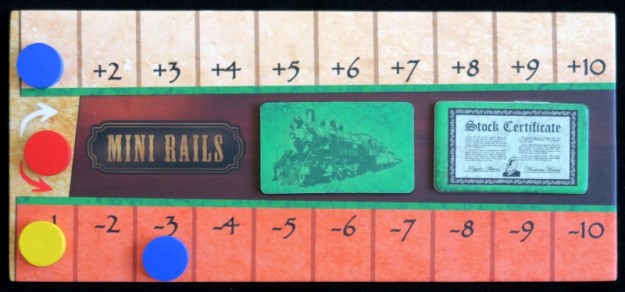
Mini Rails is a very simple little stock-buying and track-laying train game that compresses a lot of the game play of long and complicated games like the 18xx series into under an hour.  Players have two turns in each round, on one they buy shares in one of the companies and on the other they extend the “track” of one of the networks.  If it is built on a white space, players with holdings in that colour increase their value by the marked amount.  If the network is built on a red space, the stocks in that company are decreased in value.

Mini Rails
– Image by boardGOATS

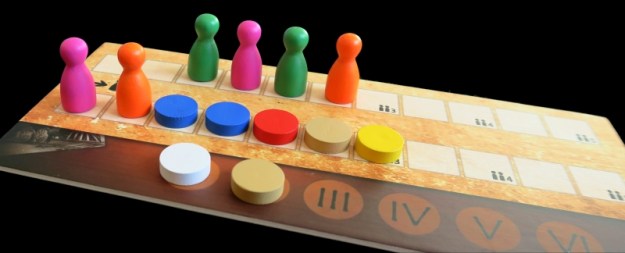
The game is very simple, but there are a couple of clever little tweaks.  Firstly, there are two “tracks”, one is the turn-order track, while the other holds train disks drawn at random from a bag.  On their turn, players choose one of tokens and decide which action to use it for, “build track”or “buy shares”.  The position of the token that is taken dictates where they will be in the turn order in the next round.  Manipulating this turn order is one key aspect of the game, as is deciding whether to buy and then build, or build and then buy.

Mini Rails
– Image by boardGOATS

Perhaps the most complicated aspect of the game is the end-game scoring.  At the start of each round train discs are drawn from a bag; one more than there are turns.  This means everyone always has a choice, but the token the last player does not use is put to one side indicating they have paid “taxes”.  For the companies that have “paid taxes” any negative dividends are erased and positive dividends are counted.  For those companies that have avoided paying their taxes the reverse is true and negative points will be scored while positive points are lost.

Mini Rails
– Image by boardGOATS

This means it is in the interest of players with both large positive or significant negative scores to forgo building track or buying shares and leave a potentially valuable token as taxes.  Similarly, if a player is left with a choice of two tokens, it may be in their interest to buy/build a relatively unfavourable track to deprive other players of points.  With three players, the game doesn’t take too long to play, and with more it would likely become quite random.

Mini Rails
– Image by boardGOATS

Lime took an early lead, though of course lots of early points are… pointless, if the company doesn’t pay taxes.  In the end it was extremely tight, but in the end, Blue just pipped Lime by a single point.  With just three there isn’t much downtime and the game rocks along nicely with plenty of interaction, though as Pink said, “That’s one hell of an abstraction for a train game.”  Blue pointed out that this was what a lot of gamers thought of when someone said “Train Game”.  Pink felt disappointed at the lack of actual trains and tracks so to make it up to him, the group moved on to play Ticket to Ride Demo.

Ticket to Ride Demo
– Image by boardGOATS

Ticket to Ride Demo is one of the small games based on the Spiel des Jahres winner, Ticket to Ride Europe.  The Demo game has an interesting history—it was designed as a sales tool and had only a small print run.  It was so popular though, that it ultimately spawned a new range of small “City” games, New York, London and Amsterdam.  These games are essentially played the same way as the full-sized versions, but with fewer pieces on a smaller map which means they typically take less than half the time.

Ticket to Ride Demo
– Image by boardGOATS

On their turn players can do one of three things:  take cards from the market, spend cards to place trains or take tickets.  Players score points for placing trains, but also for connecting the places on their tickets.  The catch is that any tickets that are not completed score negative points.  The small versions of the game are much tighter with less room for error.  Unlike the others, Ticket to Ride Demo has a double sided map, one USA and one Europe.  This time the group played the Europe map.

Ticket to Ride Demo
– Image by boardGOATS

Compared to the full-sized equivalents, all the little games are like a knife-fight in a phone-box, and this game was no exception.  Lime only completed three of his four tickets as Blue brought the game to a quick and sudden end.  Pink completed all four of his tickets and they were high-scoring too.  Blue’s tickets were less lucrative, but she managed to place all her trains and took the European Express bonus points for the longest continuous route, and with it victory, by just two points.

Ticket to Ride Demo
– Image by boardGOATS

Meanwhile, on the next table an epic, five-player game of Wingspan was underway.  We’ve played Wingspan quite a bit since it came out and always found it very enjoyable.  We’ve played it enough that we’ve also explored the European expansion, but thanks to the restrictions over the last year or so, this was the first opportunity to play the new Oceania expansion.  The base game is a reasonably light, card-driven, combination building game.  On their turn, players can place a bird card from their hand in one of the three habitats, or activate all their cards in one of the habitats and carry out the associated action.

Wingspan: Oceania Expansion
– Image by boardGOATS

The habitats are Woodland, Grassland and Wetland and the actions associated with them are collecting food, laying eggs or collecting cards (respectively).  Once the action has been carried out, the active player activates each card in the habitat in turn.  The game is played over four rounds, with a decreasing number of actions per round as the game progresses.  At the end of each round there are goals and each player also starts with a personal bonus card which is evaluated at the end of the game.

Wingspan
– Image by boardGOATS

The European expansion really only adds extra cards, though this includes a number of birds with abilities that are activated at the end of rounds, and others that increase player interaction.  The new Oceania expansion also adds more cards, but additionally mixes things up a little more with the addition of a new food type, nectar.  Nectar can be used as wild food type, although some of the new bird cards have nectar specified in the cost.  Whenever players spend nectar though, they don’t put it back in the supply, instead they store it in the habitat they spent it on.

Wingspan
– Image by boardGOATS

At the end of the game, the player with the most nectar stored in each habitat scores five points at the end of the game with the player coming second scoring two points.  Nectar is therefore a very important resource giving a potential fifteen points at the end of the game, although it requires some skill to use it effectively as it can’t be carried over between rounds.  Burgundy and Black really invested in nectar and managed to make good use of it during the game as well as take the lion’s share of the nectar points at the end of the game.

Wingspan: European Expansion
– Image by boardGOATS

Burgundy and Black also prioritised valuable birds and tried to ensure they stayed in the running for the end of round bonuses.  Three out of the four of these involved eggs, which fitted with Ivory and Teal’s strategies which focused on an end-of-game egg rush.  Ivory also picked up a lot of points from his Common Starling which enabled him to discard up to five bits of food and tuck a card for each one.  With a maximum of twenty points, Ivory did well to take eighteen during the game, but it was only enough for third place this time though.

Wingspan
– Image by boardGOATS

It was very close at the top between Black and Burgundy.  Burgundy had four bonus cards one of which proved quite lucrative.  The big difference was in the value of the bird cards, however, while Black edged it in many departments Burgundy had a ten point head start.  This wasn’t simply because he had high value birds, more that he had lots of them.  In the end, Burgundy finished five points ahead of Black with ninety-five, in a good game that had been enjoyed by everyone round the table.

– Image by boardGOATS

Wingspan was still only on its third round when Ticket to Ride Demo came to an end.  At around the same time, Pine pitched up, so the, now foursome settled down for something else which ended up being a game of Reiner Knitzia’s Botswana (aka Wildlife Safari).  This is an unusual auction-like game made all the better by the inclusion of plastic animals.  Played over several rounds, players are dealt a hand of cards and on their turn play a card and take an animal of their choice.  The cards are numbered zero to five and come in five different animal suits.

Botswana
– Image by boardGOATS

The cards are played in the centre of the table in suits and the game ends when all six cards of one suit have been played.  The top card in any suit is the current value of that animal.  Thus, if the top zebra card is a five, a player that has three zebras will earn fifteen points for them if the game ends.  However, if the zero just before the game ends, the zebras will become worthless.  It is a deceptively simple, yet fun little game.  Blue thought she’d won until a recount docked her ten points and she finished just two points behind a delighted Pink.

Botswana
– Image by boardGOATS

As Botswana came to an end, so did Wingspan, and although time was marching on, and Lime and Ivory took an early night, there was still time for everyone else to play one last game.  After a little discussion, we settled on 6 Nimmt!, a game we all know and love.  Players simultaneously choose a card and these are sequentially added to the end of four rows of cards, specifically the row with the highest number that is lower than the card itself.  If the card is the sixth card in the row, instead, the player takes other five and adds them to their scoring pile.  The player with the lowest score at the end of the game is the winner.

6 Nimmt!
– Image by boardGOATS

We’ve all played this a lot online over the last year, but doing the maths ourselves was a little daunting, so we decided to go back to playing the non-professional version.  We play over two rounds using half the deck in first and the other half in the second.  This time Teal top-scored in the first round with nineteen, while Burgundy kept a clean sheet with Pink just behind.  Blue’s killer thirty-three in the second round gave her a total of forty-eight, but the winner for the second time in the evening was Pink with just four points.  And with that, it was bedtime.

6 Nimmt!
– Image by boardGOATS

Learning Outcome:  Today’s railway industry is no longer about trains and tracks. ☹

19th March 2019

Yet again, the evening began with a discussion of everyone’s ailments: Pine had spent the last fortnight visiting Swindon for a daily dose of intravenous antibiotics; Green’s absence was explained by his contagious skin condition, and Blue was feeling particularly blue thanks to a nasty cold (a present from Pink).  The general itchiness of the group was increased by the addition of everyone’s favourite nit-nurse stories.  Perhaps it was the general malaise, but there seemed to be a lot of food eaten, including several helpings of ice-cream, but eventually we got down to playing games, beginning with the “Feature Game”, Botswana (aka Wildlife Safari).  Unusually, this was very, very popular, and Mulberry drew the short straw, so she was promised a chance to play it soon.

Botswana
– Image by boardGOATS

Botswana is deceptively simple:  Players have a hand of cards and take it in turns to play one card onto central set piles and then take any one of the plastic animals.  There are five “animal suits” and six cards in each, numbered zero to five.  At the end of the round, players multiply the number of plastic animals they have in each suit by the face value of the last card played in that suit.  Thus, a player with three plastic elephants where the last card played was a four would score twelve for that suit.  The game is played over as many rounds as there are players.

Botswana
– Image by boardGOATS

It took a round for people to get a feel for the game, but it quickly became clear how clever it is.  A bit like 6 Nimmt!, Botswana has a feeling of luck about it, but it is also very tactical.  Players want to make sure they play the high value cards that they have and get as many animals as possible in those suits, but play them early and someone else may subsequently play a zero making them worthless.  On the other hand, waiting to the end to play high cards risks someone else ending the game and failure to maximise the score.  So the game is all about timing and second guessing everyone else.

Botswana
– Image by boardGOATS

Blue and Pine took the first round, and while the second and third were more level, going into the final round, Black commented to Burgundy that it was clearly a two horse race.  Blue’s answer that it was surely a “two zebra race”, was met by Pine’s response that he’d rather ride an elephant as they are generally better tempered and can be trained to carry people.  After a  discussion about whether the plastic, model elephants were African or Asian, the appearance of the leopards and their spots, and the collective noun for rhinoceros, the game continued.  Like a crush of rhino, Pine could barely contain his pride as he trampled over the rest of the herd in his stubbornness.  In a bit of a dazzle, Blue came in second with a late leap.

Botswana
– Image by boardGOATS

Meanwhile, on the next table, Ivory, Mulberry and Purple were playing Splendor. Although we’ve played this very extensively, somehow Mulberry had missed out.  The game is very simple however:  on their turn, players either take three different coloured gem-chips or use gem chips to buy cards.  The cards are effectively permanent gems that can be reused without loss, but some of them give victory points as well.  The other source of points are Nobles: players who collect a given number of cards featuring certain gems get a visit from a noble and a bunch of points as a result.  Despite Burgundy being occupied with the safari on the next table, it was still a bit of a landslide.  Diamonds were scarce, and Purple had a bit of a melt-down.  With Mulberry new to the game, the way was clear for Ivory who took two of the Noble tiles and finished the game with an unassailable sixteen points.

Splendor
– Image by boardGOATS

Everyone was feeling a bit washed out, and nobody was particularly enthusiastic about suggesting games to play.  Ivory was the most proactive suggesting Altiplano, Dice Forge, Dinosaur Island and Bohnanza, but nobody looked terribly interested.  After a discussion about which throat sweets people preferred (where Fisherman’s Friends were equated to “Toilet Duck Pastels”, eventually the inevitable happened and the whole group settled down to a  game of Bohnanza.  This is one of our most popular games when everyone’s a bit tired and can’t be bothered with anything more complex, and often gets an outing when everyone wants to play together.

Bohnanza
– Image by boardGOATS

The game is quite simple and everyone in the group knows it well now, but the game always starts with everyone chorusing “Don’t rearrange your cards!” as the habit is so ingrained.  On their turn, the active player must play the first bean card into a field in front of them, playing a second if they wish.  Two cards are turned over from the central deck which can also be planted or traded, but must be planted by someone before the active player can trade cards from their hand with anyone else round the table and finally draw cards into the back of their hand.

Bohnanza
– Image by boardGOATS

As a group, we usually “play nice”, that is to say, players trade positively rather than negatively and gratefully accept freebies if offered (by players keen to get unwanted cards out of their hand).  With a full compliment of players, the game is always tight, often coming down to luck and this was no exception, and no less enjoyable as a result.  With only three points between first and sixth place it looked like it was going to be a three way tie between Pine, Purple and Ivory who all finished with eleven points.  Suffering with a think head though, Blue was slow counting and they were all disappointed when, after a couple of recounts (just to check) she pipped them to first place.

Bohnanza
– Image by boardGOATS

With Ivory and Mulberry wanting an early night, we were looking for something short before they went.  Not many games play seven well, but 6 Nimmt! is always popular and this was no exception.  People often claim 6 Nimmt! is a game of luck, but in reality it is one of walking a tightrope of perfect timing:  get it wrong and everything falls apart, but get it right and with Lady Luck in support a perfect round is possible.  Indeed, Ivory managed just such a perfect round, not once, but TWICE, last time we played, and everyone was determined he wasn’t going to manage the same this time.  Ivory’s “ivory tower” quickly fell, as he picked up nine points; Pine and Blue did well  taking a single point each, but Mulberry managed to keep a clean sheet.  We play over two rounds, so the question is usually not so much who manages to do well in the first round as who manages to sustain it over both rounds.

6 Nimmt!
– Image by boardGOATS

Ivory’s game went completely to pot in the second round when he top scored with twenty-five, leaving him to fight for the dubious honour of the Wooden Spoon.  That was close between Purple, Burgundy and Ivory, but this time, Burgundy won the race for the bottom with forty-three.  Black managed a clear round at the second attempt, but it couldn’t make up for his fourteen in the first round.  It was very tight at the front, with all three of the lowest scorers maintaining their timing for the second round; Mulberry followed her clean sheet with five, but Pine went one better finishing with a total of four.  Normally either of these scores might have been expected to be enough to secure a win, but Blue, despite her lurgy, added a second single point round to her first, ending with the lowest score, with just two.

6 Nimmt!
– Image by boardGOATS

Once Ivory and Mulberry had said their farewells, the rest of the group were looking for something light that would play five.  Coloretto was an option, but …Aber Bitte Mit Sahne (aka Piece o’ Cake) was on top and hadn’t had an outing for a while and with general laziness and lethargy the order of the day it was inevitable that Coloretto was going to lose out this time.  …Aber Bitte Mit Sahne is just about the simplest game to use the “I divide, you choose” mechanic, but simple is sometimes simultaneously very clever and in this case, it is also very well rendered.  The game consists of a pile of fifty-seven pieces of “cake”, each one an eleventh of a complete cake, randomly shuffled to form five stacks (with two left out).  As well as artwork showing the type of cake, each piece also has a number on it (the number in the deck), and some have a blob of cream as well.

…Aber Bitte Mit Sahne
– Image by boardGOATS

On their turn, the “Master Baker” take one of the piles of face down pieces and turns them over one at a time to make a complete cake.  They then divide this into “slices”.  The player to the Master Baker’s left chooses a slice, and for each individual piece they can either keep it, putting it face up in front of them, or eat it, turning it face down and putting it to one side.  At the end of the game, each player scores points if they have kept the most slices of a particular type, and scores points foe each blob of cream they have eaten.  It was quite a cagey game and was very close as a result.  Blue was the only one not to eat any of her cake, not due to any dairy or low fat diet, simply because her head was too fuzzy to deal with the extra option.  Somehow though, she got lucky and nearly everything she kept scored her points.

…Aber Bitte Mit Sahne
– Image by boardGOATS

Learning Outcome:  It’s possible to win, even with a bad cold.

Next Meeting – 19th March 2019

Our next meeting will be on Tuesday 19th March, at the Horse and Jockey pub in Stanford-in-the-Vale.  As usual, we will be playing shorter games from 7.30pm as people arrive, until 8pm when we will start something a little longer.

This week the “Feature Game” will be Botswana (aka Wildlife Safari).  This is a very clever little set collecting card game with an African animal theme and some very cool, plastic, safari animals.

Botswana
– Image by boardGOATS

And speaking of safaris…

Jeff was on safari with his wife and mother-in-law.  One evening, while still deep in the jungle, Jeff’s wife awoke to find her mother gone.  Rushing to her husband, she insisted on them both trying to find her mother.  Jeff picked up his rifle, put on his hat, and started to look for her.  In a clearing not far from the camp, they came upon a chilling sight:  Jeff’s mother-in-law was backed up against a thick, impenetrable bush, and a large male lion stood facing her.

Jeff’s wife cried, “What are we going to do?”

“Nothing,” replied Jeff. “The lion got himself into this mess, let him get himself out of it.”