Tag Archives: Castles of Burgundy

18th March 2025

The evening began with the arrival Ruby and Flint, friends of Teal, who had come along despite the fact he wasn’t able to be there to introduce them to everyone himself.  They introduced themselves as people finished their supper and prepared to play the “Feature Game” which was to be Cartographers Heroes, the standalone sequel to Cartographers.  Cartographers was probably the best of the roll and write games the group played online during the global coronavirus pandemic, so we chose to play it to mark the fifth anniversary of our last meeting in the pub before we moved online.  It was a very difficult time for everyone, though as a group we stuck to it and tried to look after each other, continuing to meet fortnightly, online.
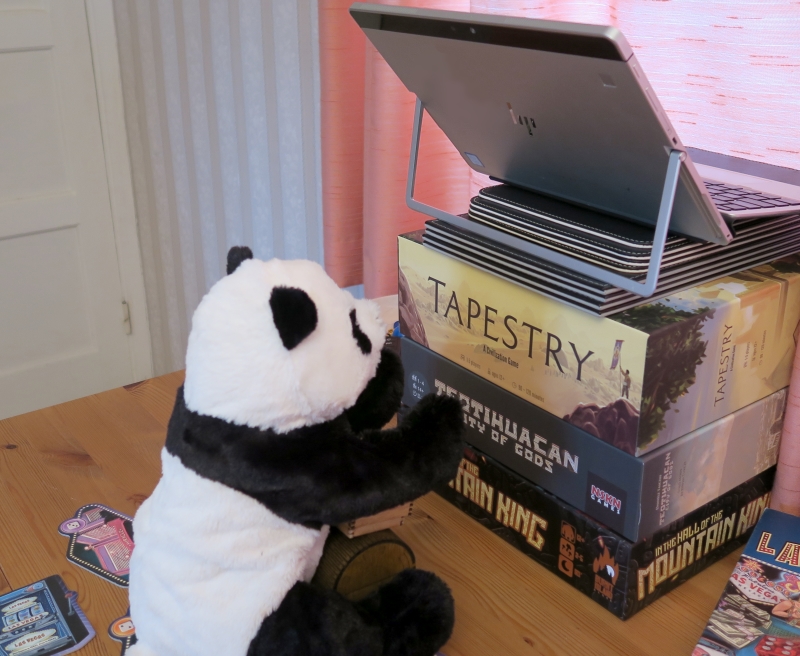
Setting up for online gaming
– Image by boardGOATS

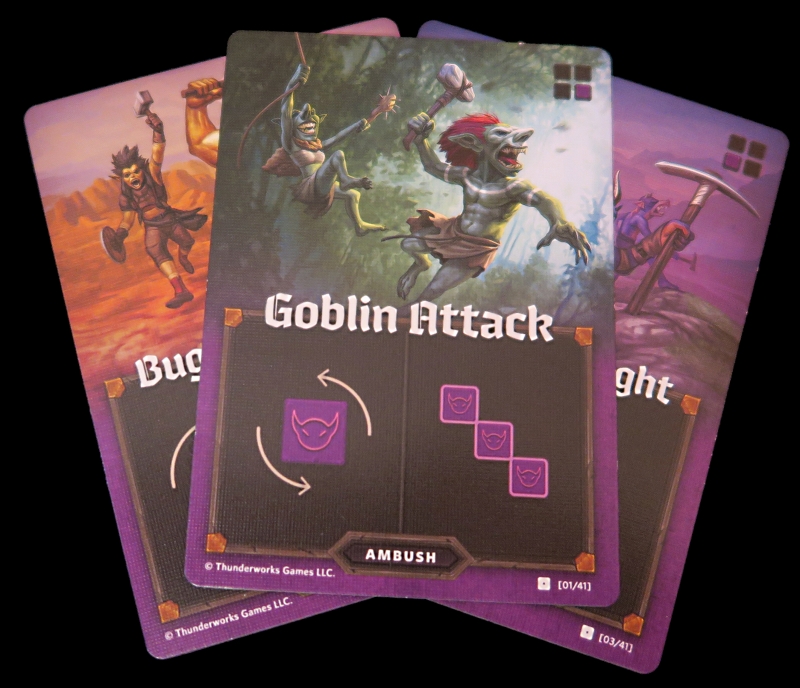
Strictly, Cartographers is a “flip” and write rather than roll and write game as it is card-driven.  Played over four seasons, cards are turned over to reveal choice of “Tetris-like” shapes and/or terrains that players draw on their map.  The game is played over four rounds, each with a different scoring criteria—a total of four during the game, with two active in each round (similar to Isle of Skye).  In addition to the normal terrain cards, there are also Ambush cards, which are nasty as they score negatively with a point lost for each empty space next to an Ambush space at the end of each round.  They can be played in two ways depending on the number of players and the circumstances of the game.
Cartographers: A Roll Player Tale
– Image by boardGOATS

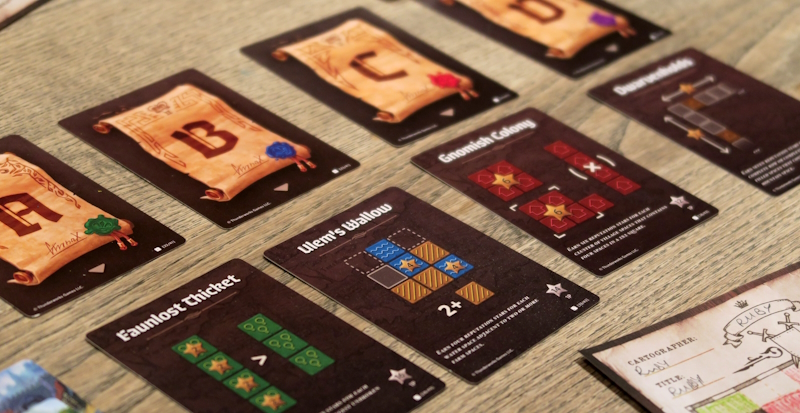
Online, we played these using the Automa rules, where the Ambush “pieces” are placed via a set of rules, whereas in person, players pass their map to a neighbour who places the Ambush piece in as awkward a place as possible.  In addition to Ambush cards, the Heroes game adds Hero cards which can be used to off-set the effect of the monsters from the Ambush cards.  The distribution of cards is also slightly different and the map layout is slightly different too.  This time, although the game can play up to a hundred people simultaneously, because of the difficulty seeing the cards, the group chose to split and play two separate games.
Cartographers Heroes
– Image by boardGOATS

The first of these included Blue, Pink, Flint, Ruby, Purple and Lime, while the other comprised Jade, Sapphire, Pine, Byzantium and Mint.  The first group were using the Collector’s Edition which comes with pencils in colours that match the different terrains.  The second group cast envious eyes on the pretty maps as the games started, but despite offers, refused to take a set and stuck to the slightly more elegant monochrome maps relying on symbols to indicate the different terrain types.  Although the original Cartographers and the Heroes games can be mixed, both groups used the decks and maps from the Heroes game.

Cartographers Heroes
– Image by boardGOATS

The first group began with a sequence of woodland terrain, which fitted with their first objective, but the shapes wrapped nicely round the mines.  The mines give money—when surrounded by terrain, players can tick off a one of the coins marked at the bottom of the map, which gives a point at the end of each round.  Thus collecting them early makes them more valuable each giving up to four points throughout the game.  So, most people started by prioritising them as an easy way forward.  Consequently everyone’s first rounds gave similar scores, but by the second round Lime and Pink had edged a bit of a lead.  Nobody scored particularly well in the third round, so it was all down to the final round to make the real difference.

Cartographers Heroes
– Image by boardGOATS

Most people scored around twice what they’d picked up in earlier rounds, but it was Pink who top scored with a massive fifty-five, giving him a bit of a landslide with a grand total of a hundred and thirteen (after a couple of recounts).  Blue just edged into second, ahead of Lime, but they were some twenty points adrift.  The second game followed a similar pattern with massive scores in the final round, though it was a much closer game, with it possible to cover the top three with a postage stamp.  The scores were generally higher than for the first game, but the victor was Mint who finished with a hundred and twenty-six, three more than Jade in second who pipped Byzantium by a single point.

Cartographers Heroes
– Image by boardGOATS

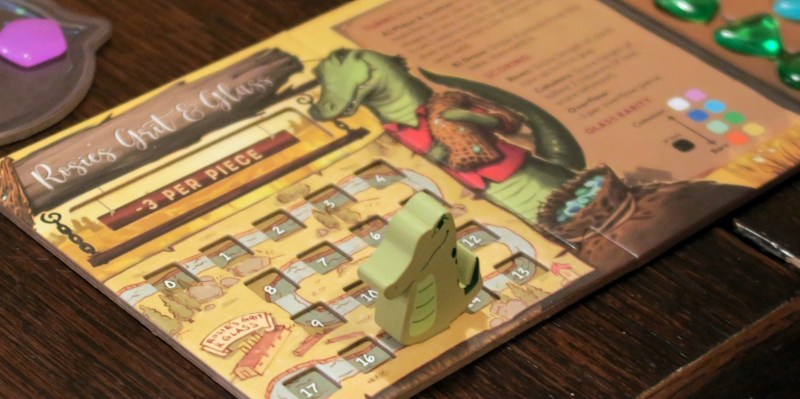
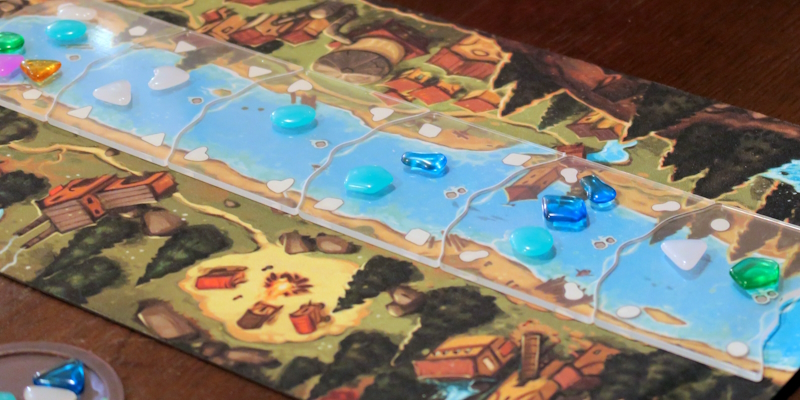
With the second game finishing first, the group moved on to play River Valley Glassworks, a re-implementation of the card game Subastral.  In River Valley Glassworks, players take the role of entrepreneurial of woodland creatures drafting glass from the market of river tiles by playing a piece from their inventory into the river. Each river tile can take only a specific shape, and players have to play into a space adjacent to where they want to draft from. After claiming their glass, the river shifts forward (in a way that is vaguely reminiscent of Niagara), revealing new pieces.
River Valley Glassworks
– Image by boardGOATS

Glass is stored in players’ shops, and the scores depend on where the glass is placed—completed rows and columns gain bonus points, but too many of one type gives negative points.  The game is generally cosy, quick and fun, and this time was no exception.  Jade explained the rules which are simple enough: either place a piece of glass onto a river tile or draw exactly four pieces from the lake with the aim of collecting a rainbow of glass pieces. Getting the balance right can be a little tricky, so it was no surprise that the most experienced players came out best with Jade taking victory with eighty points nearly ten ahead of the other person who had played it before, Sapphire.
River Valley Glassworks
– Image by boardGOATS

When the other game of Cartographers finished, the group continued with the roll and write theme, moving on to another game that went down well online, Second Chance.  This is a similar “Tetris-like” card driven game, but much simpler.  Everyone has a square grid and as cards are turned revealing shapes, they add them to their grid.  Players are eliminated when they can no-longer add the latest shape.  The game gets its name from the fact that when a player gets stuck, they get one card flipped, just for them, and can carry on if they can add that shape to their grid.  The player with the fewest gaps at the end, is the winner.  This time, Purple was eliminated first, but it still got quite close to the wire and the tension was palpable.  The winner was Flint, however, who very nearly managed to fill his whole grid, leaving just two spaces unfilled.

Second Chance
– Image by boardGOATS

Meanwhile, on the third table, Cobalt was joined by Black, Plum and Ivory in a game of Castles of Burgundy using the new fancy “Special Edition”.  In Castles of Burgundy, players take on the role of an aristocrat controlling a small princedom, building settlements and castles, trading along the river, mining silver, and use knowledge of travelers.  The game is a tile playing game that is played in five phases, each consisting of five rounds. At the start of each round all players roll their two dice, and first player also rolls a goods placement die.  During their turn, players carry out two of the four possible types of action.  These include: take a settlement tile from the numbered location corresponding to one of their dice and place it in storage; take a settlement tile from storage and place it on their player board on a space with a number matching one of their dice;  deliver goods with a number matching one of their dice, or take worker tokens (which allow players to adjust the roll of their dice).

Castles of Burgundy
– Image by boardGOATS

Additionally, players may buy a settlement tile from the central depot and place it in their storage area. The Settlements offer benefits, additional actions, money, advancement on the turn order track, more goods tiles, die roll adjustment or victory points with bonus points awarded for filling a region with tiles.  Cobalt and Black both started on the east side of the map, with Black building to the south with Ships to move up the turn order.  He also got a mine to start generating coins at the end of each of the four rounds. He also managed to completed an area to move up in points (Ships). Cobalt went the other way with yellow and beige buildings and managed to get a second castle (and effectively an extra turn), whilst also completing areas for early points.

Castles of Burgundy
– Image by boardGOATS

Plum started at the bottom and managed to get a Mine, setting up for the future, as well as Ships to move up the turn order, but started accruing points more slowly.  Ivory on the other hand started in the north and went for a different strategy, grabbing animals (specifically goats!) and made a faster start with regards to points, at the expense of turn order.  In the second round, Ivory continued to focus on animals, grabbing more animal tiles and end of game tiles giving points for different animals, to go along with his yellow tile from the first round giving him extra points when scoring animals. He also built his second castle and started to fill the eight beige area, needing one of each beige building in that area for a challenging thirty points.

Castles of Burgundy
– Image by boardGOATS

Plum focused on engine building, getting two more Mines, giving her significant income for the rest of the game, as well as a building which allowed her to build duplicate buildings in an area, making it much easier to achieve thirty points in the eight beige area, as well as a tile allowing her more flexibility in getting tiles (as it allowed her plus/minus one on the die).  Black was also engine building and doing a little bit of everything else, while Cobalt, Like Plum and Ivory was focusing on the beige “Eight” area.  Cobalt also had tiles that allowed him to spend workers to get a tile (as well as change die results) and also get extra workers when he took that action and gain a coin—a very efficient engine! At the end of the round, Cobalt and Ivory had taken the lead, followed by Black and then Plum.

Castles of Burgundy
– Image by boardGOATS

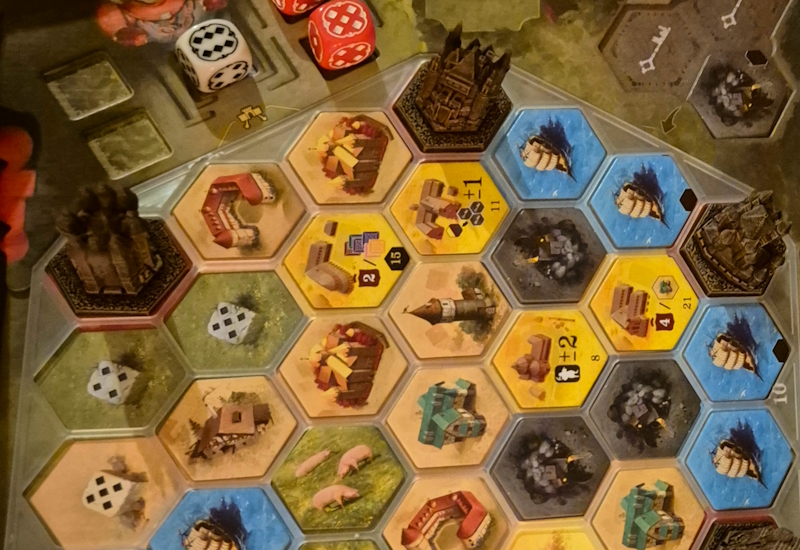
In the third round, Ivory managed to fill all his animal spaces and get the bonus for doing so as well as get more points from his animals, but was generally slowed down by the fact he’d stopped developing his engine.  In contrast, Plum’s engine had kicked in, giving her lots of points and bumping her up the rankings leaving her snapping at Ivory’s heels by the end of the round.  Black was continuing to do a bit of everything, but now had an end game objective for different goods while Cobalt continued to develop his engine.  In the penultimate round, Ivory continued to struggle due to his lack of engine development and his ships paucity of ships meant he had taken his turn last for most of the game, although he was “building beige” where possible for the thirty points.
Castles of Burgundy
– Image by boardGOATS

Plum on the other hand, stormed ahead, filling the “Eight” area and taking thirty-four points as she was able to fill it with the same building.  With other scoring opportunities as well (like animals), it looked like she was a certainty to win being as she had a lead of over thirty points at the end of the round. Cobalt and Black also pushed past Ivory with Cobalt having focused on mines and Black completing all four of his castles, taking bonus points for doing so.  In the final round, Cobalt and Ivory both managed to fill their beige area for thirty-two points and Ivory finally got his first ships, albeit too little too late for anything other than a few points. Plum, having filled in the large beige area, slowed down a little, lacking a focus having done so much in the previous round, but still managed to score significantly.

Castles of Burgundy
– Image by boardGOATS

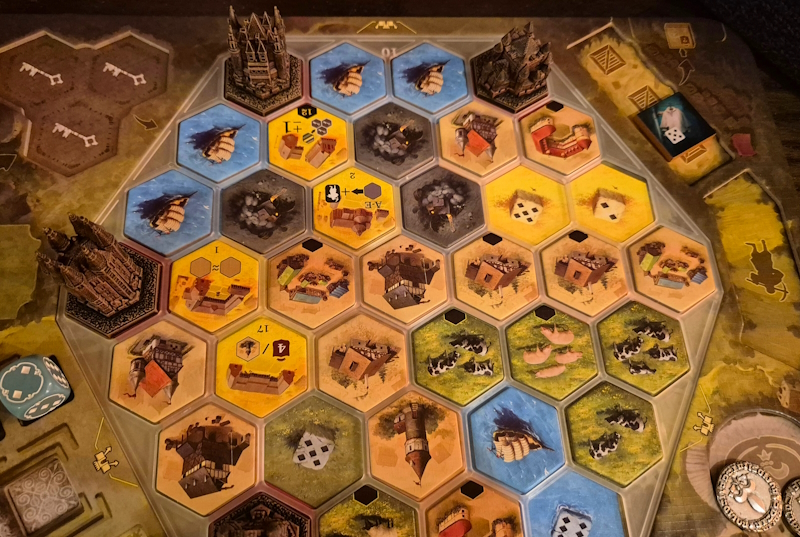
Black was still doing a bit of everything, particularly focusing on goods, but failure to score the large beige area cost him dearly.  By this time, Cobalt, on the other hand, was using his engine to maximum effect, with his ability to grab tiles using workers to give him more actions than everyone else, filling in almost all of his map. This also allowed him to slowly catch up and eventually overtake Plum, taking lots of bonus points for filling in each colour area, giving him the victory with a grand total of two-hundred and forty-four points, some fifteen more than Plum with Ivory some distance behind her.
Castles of Burgundy
– Image by boardGOATS

Learning Outcome:  Some Roll and Write games are much better than our slightly tarnished memories of them.

Boardgames in the News: 20 Years of Alea

Latin for “dice”, Alea is a brand of Euro games that celebrates their twentieth anniversary this year.  Alea is owned by Ravensburger, a company that has been around for nearly a hundred and fifty years producing everything from instruction manuals to children’s books under their familiar Blue Triangle trademark.  Alea is a more recent development intended to develop a range of strategy games distinct from their more family-friendly range.  Dating from 1999, the Alea range is credited with bringing a lot of “modern classics” to our tables, including Puerto Rico, Ra, Taj Mahal, San Juan, The Castles of Burgundy, Broom Service and one of our groups all time favourites, Las Vegas.  There are four series in the range, the “Big”, “Medium”, “Small” and “very Small” box games, each game in the series is numbered with the artwork on the covers designed to have a “book-shelf” look.

Alea Big Box Games
– Portmanteau image created by boardGOATS

It looked like the end was nigh when Asmodee bought Heidelberger Spieleverlag in 2017, and with it the distribution rights to the Alea brand.  However, Ravensburger reclaimed the rights last year, so to celebrate that and Alea’s twentieth anniversary, they are relaunching the line with new graphics.  They are starting with a new version of The Castles of Burgundy, a boxed set including all the current expansions, and Las Vegas Royale, a big-box version of Las Vegas, including selected elements from the Boulevard Expansion and some new action tiles.  It remains to be seen how many of the old familiar titles will also get a face-lift and make an appearance in the new line and how many new exciting titles will be introduced.

The Complete Original Alea Range
No. Big Box Medium Box Small Box
1 Ra (1999) Louis XIV (2005) Wyatt Earp (2001)
2 Chinatown (1999) Palazzo (2005) Royal Turf (2001)
3 Taj Mahal (2000) Augsburg 1520 (2006) Die Sieben Weisen (2002)
4 The Princes of Florence (2000) Witch’s Brew (2008) Edel, Stein & Reich (2003)
5 Hoity Toity (2000) Alea Iacta Est (2009) San Juan (2004)
6 The Traders of Genoa (2001) Glen More (2010)
7 Puerto Rico (2002) Artus (2011)
8 Mammoth Hunters (2003) Las Vegas (2012) &
Las Vegas Boulevard (2014)
9 Fifth Avenue (2004) Saint Malo (2012)
10 Rum & Pirates (2006) La Isla (2014) V. Small Box
11 Notre Dame (2007) San Juan (2014) The Castles of Burgundy:
The Card Game
(2016)
12 In the Year of the Dragon (2007) Broom Service:
The Card Game
(2016)
13 Macao (2009) Las Vegas:
The Card Game
(2016)
14 The Castles of Burgundy (2011) The Castles of Burgundy:
The Dice Game
(2017)
15 Bora Bora (2013) Puerto Rico:
Das Kartenspiel
(2018)
16 Puerto Rico with Expansions (2014)
17 Broom Service (2015)
18 Carpe Diem (2018)


23rd August 2016

A little unsure as to who was coming, we decided to start with the “Feature Game”, which was the filler, Abluxxen (also known as Linko!).  This is a “get rid of all your cards” type of game, and although it is initially a little confusing to understand, it mostly became clear as we played.  On their turn, players play any number of cards as long as they are all the same. The cards are then sequentially compared with the last cards played by all the other players:  if the number of cards played is the same, and the face value of the cards played is higher, then the other player’s cards are “snatched”.  They can either be “snatched” by the active player (the “snatcher”) who takes them into their hand, or alternatively the “snatchee” has to do something with them.  The “snatchee” can either choose to take them back into their hand or discard them.  If they decide to discard, then they must replace the cards with the same number from the face up display in the centre or drawn blind from the draw deck.

Abluxxen
– Image by boardGOATS

Thus, the idea is that players are trying to get rid of cards and force other players to pick cards up, however, picking up cards an also be a good thing as it can be an opportunity to improve the cards in hand.  Better, having a lot of identical cards in hand means that when they are played they go on top of any cards previously played making it more difficult for anyone to “snatch” them or force them to be picked up.  The game ends when either one player runs out of cards or the draw deck and central pool has been depleted.  Just to add to the the confusion, however, the winner is then the player who has played the most cards, but any cards left in hand give a penalty of minus one.

Abluxxen
– Image used with permission of BGG contributor punkin312

Although it was a simple game and everyone knew what they had to do, at first nobody really understood what they had to do to win.  Gradually people began to work it out though, starting with Burgundy who had watched a video of the game online, then Ivory who was new to the group, but had played plenty of games before.  Pine and Blue eventually joined the “in the know” club, but Red continued to struggle.  Every time it was her turn, Red said, “Sorry, I know I keep asking, but if I play two sevens what will happen?”  Despite this apparent lack of understanding, Red was the first to check-out and with a huge pile of cards too.  This was particularly amusing as Red had just been explaining to Ivory that he shouldn’t believe Burgundy and Blue when they claim to be doing badly or have no idea what they are doing as they usually go on to win.  Inevitably then, although most people were only one or two turns away from finishing, Red was miles ahead much to Burgundy’s chagrin as he needed just one more turn and was left with six cards in hand compared with the seven in his pile.  Blue who had just played seven “fives” and had only a couple of cards in-hand was second, just ahead of Ivory and Pine.

Abluxxen
– Image used with permission of BGG contributor punkin312

Black and Purple had walked in just as Abluxxen started, so amused themselves reading game rules and trying to work out what everyone else was doing.  Abluxxen had taken a little longer than expected so with everyone present and a group of seven, we decided to split into two.  Red was keen to play Niagara, a really unusual game with a moving river.  It won the Spiel des Jahres in 2005 and still holds up as a good family game more than ten years on.  The group has played it before, but in summary, players have two boats that they move up and down the river, trying to collect gems and return them home, to the top of the river.  There are a couple of catches.  The first is that each player has a set of Paddle Cards and must play each one once before they can play any of them again.  These Paddle Cards dictate how far they can move on the river, but can also affect how much the river will move.  Paddle Cards are selected simultaneously at the start of the round, so there is an element of programming involved, though not as much as in games like Colt Express or Walk the Plank!, but it does mean there is an element of anticipation.

Niagara
– Image used with permission of BGG contributor Marsh

The second “catch” is the river.  The river flows after everyone has moved their boats and the rate is dependent on the lowest Paddle Card played in the round and the weather.  Each player has a weather Paddle Card, which they use to speed up or slow the river down, however, as this has to be played instead of moving boats, this can be a trap for the unwary.  In the worst case this can lead to the loss of a boat and its contents with a penalty to get the boat back.  The game ends when one player fulfills one of three criteria:  four gems of the same colour, one gem of each of the five colours or any seven gems.  Gems are limited, and this leads to the third “catch”, which is that once a player has picked up a gem and has it safely in their boat, another player can steal it so long as they are paddling up stream and land on the same river segment.  So a nice little game with a nasty edge.

Niagara
– Image used with permission of BGG contributor erfalucho

Red was joined by Pine, Ivory and Burgundy in what was to be a very close game.  With four players, each boat should only hold one gem at a time, but a minor rules malfunction meant that everyone played with the double boats from the Spirits of Niagara expansion.  Red and Burgundy took full advantage of this collecting the difficult blue and pink gems first and in one trip.  It quickly became clear that five unique gems was going to be difficult so everyone went for the slightly easier seven random gems.  Pine was the only “proper adventurer” exploring the limits of the river.  Misinformed by Burgundy with respect to the effects of the weather, Pine become intimately acquainted with the waterfall, turning one of his boats to matchwood, but he was the only one to experience the long soggy drop.  Otherwise, the weather was fairly muted and everyone was fairly close to getting a full set of gems when Red, kicking on from her successful start got her nose over the line first, finishing with a total of eight gems.

Niagara
– Image used with permission of BGG contributor William Hunt

With Niagara done, the group moved onto Splendor.  In this game, players have just three options on their turn:  collect gem tokens, buy a gem card using gem tokens (and/or cards), or reserve a gem card and receive a gold (wild) token at the same time.  Players can have a maximum of ten tokens, though unlimited cards and the cards act as permanent tokens.  Thus, at its heart Splendor is an engine building game built on a set-collection mechanism.  Players score points when they buy some gem cards and for attracting Nobles which are awarded to the first player collect certain combinations of gem cards; the game end is triggered when one player reaches fifteen points and the player with the most at the end wins.

Splendor
– Image by boardGOATS

Despite being a very simple game, it is one we still enjoy as a relaxing little filler.  Indeed, it got an outing last time when Blue succeeded in snatching defeat from the jaws of victory when Burgundy came steaming through from nowhere to win.  It could have been this, or perhaps it was previous alleged trouncings that inspired Blue and Purple to let out an emphatic war cry from the neighbouring table exhorting everyone to stop Burgundy at all costs.  So, Burgundy did lots of sighing as everyone rallied to the clarion call and went out of their way to bring him down.  Pine had been one of the victims last time and, understanding his likely fate commented that he wished he could record all of Burgundy’s deep sighs and general moaning and then play it back to him when he won.

Splendor
– Image used with permission of BGG contributor henk.rolleman

The tactics appeared to be working, however, as about half way through, Pine had eight points as Burgundy took his first.  It wasn’t long before Burgundy took the first Noble too, but he was still some way behind and nobody was terribly concerned.  Meanwhile, Ivory was quietly building his engine taking lots of freebees, looking like the new threat.  Red was enjoying herself hoarding rubies just to annoy Burgundy even though she was well aware that it wasn’t actually doing her any favours.  Then suddenly, Burgundy took his second Noble and the writing was on the wall:  everyone knew they were doomed.  It wasn’t long before Burgundy took his third Noble and nobody had an answer as he repeated the trick he’d pulled off so successfully last time winning from the back of the pack.

Splendor
– Image used with permission of BGG contributor henk.rolleman

Meanwhile, on the next table Black, Blue and Purple were engaged in a slightly protracted game of Castles of Burgundy.  This is a game we’ve not played before with the group, though Blue had played it a few times as a two player game and Black had played it quite a bit online.  It is one of those games with fairly simple mechanics, but a lot of complexity in the game play.  The idea is that each player has two dice which they roll at the start of the round.  On their turn they then spend the two dice, trading them for two separate actions.  Players can take a building from the pool on the central player board that matches the number on their die, for example, if a player rolled a six, they can take any of the buildings in the “six” poll and place it in their own supply.  Their supply is limited in size and there must be space for them to be able to do this.

Castles of Burgundy
– Image by BGG contributor thatmadgirl

Alternatively, the player could take a building form their supply and place it on their personal player board on a space that matches both the number of the die and the colour of the building.  Both of these actions are quite restrictive, so players can instead choose to collect two worker tiles and add them to their store.  These worker tiles are the oil that greases the wheels a little, since they allow players to alter one of their dice by one for each tile used (e.g. spending two worker tiles will allow a player to change a five to a three or a one).  The last action is selling goods.  Players can acquire goods tiles during the game, but can only store three different types.  each of the six types correspond to a different number and, on their turn, as an action players can sell all their goods that correspond to the die (modified by workers if they choose).  In return they get a silverling and some points.  Silverlings are a form of currency and can be used to buy one extra building per round.  These are taken from a special pool, though there is nothing particularly special about the buildings themselves except that they are harder to obtain and therefore are generally only taken by players that really want them.

Castles of Burgundy
– Image by BGG contributor verminose

Points is what the game is all about, and being a game designed by Stephan Feld, there are lots of different ways to get them.  Although the actions within the game are simple, how points are achieved is where the complexity of the game really lies.  Each building placed on their board gives the active player a bonus.  Sometimes it is a bonus action, sometimes it is bonus points and sometimes it is a strategic advantage; it is the player that makes the most of these bonuses that will win the game.  Players then also score points for placing buildings to complete regions on their own board.  The larger the region, the more points they get, however, there are also bonus points for completing regions early.  Extra points are also available to the first players place the maximum number of each type of building in their province.

Castles of Burgundy
– Image by BGG contributor 3EBC

Black, by far the most experienced, began by investing in the special buildings that give one off strategic bonuses (e.g. an the opportunity to place an extra tile or take another from the central board).  Blue began without a strategy and, as is her wont played very tactically, without a real strategy and see what unfolded.  Purple, on the other hand, went for animals early.  These give points, but in an unusual way:  every time an animal tile is added to an area, all the other animals of the same type score again.  Blue picked up four pigs in the first couple of rounds, then added two, then three then another four more, and before long she was following Purple down the animal route.  Their strategies were very different, however, with Purple taking anything she could get while Blue was much more targeted.  So, as Blue went heavily into pigs, she was able to keep re-triggering their scoring building a tidy number of points.  Purple could have made up for with the yellow knowledge tile that rewards players with four points at the end of the game for each different sort of animal they have, but Blue had her eye on it too and got there first.

Castles of Burgundy
– Image used with permission of BGG contributor kilroy_locke

While Blue and Purple were engaged in a agricultural battle Black was able to continue with his plan pretty much unchallenged.  So he moved into shipping and completed lots of areas picking up the corresponding bonuses.  Purple took the bonus for finishing the farming tiles first and picked up points for finishing several others too including mining – quite an achievement since she was the last to get a mine at all.  It was the compound scoring for the animals that clinched it though coupled with the knowledge tile that enabled Blue to place her green farming tiles more flexibly and she ran out the winner with one hundred and eighty-five points, nearly twenty ahead of Black in second place.

Castles of Burgundy
– Image by BGG contributor Korosu_Itai

Ivory headed off, and Castles of Burgundy was still well under way, which gave Red an opportunity to suggest one of her favourite games, Bohnanza.  The original bean-trading game, this is a staple family game and is still very popular with the group as it keeps everyone involved throughout and is usually very popular as a “gateway” game.  Last time he’d played it, Pine had really struggled, which both surprised the rest of the group and caused us a certain amount of consternation as it should have been a game Pine would have enjoyed.  It seemed he couldn’t remember the disaster last time though and he was happy to try again.

Bohnanza
– Image used with permission of BGG contributor spearjr

The game is very simple, but players have to keep their eye on what is going on around them.  Players start with a hand of cards and are not allowed to change the order – a simple mechanic that is the critical part of the game.  In front of each player are two “Bean Fields” and on their turn, players must plant the first card in their hand and may plant the second.  Thus, the key to the game is managing the order of cards in their hand, as they cannot be rearranged and must be “planted” in the order they arrive.  However, it is possible to remove unwanted cards by trading them away.  Once the active player has planted the card(s) from their hand, then they turn over the top two cards from the draw deck:  these must be planted by the end of the turn, though not necessarily in one of the active player’s fields if they can be traded.  Once all these cards have been planted, the active player can then offer to trade any unwanted cards in their hand before their turn ends with them replenishing their hand from the draw deck.

Bohnanza
– Image by boardGOATS

There are lots of different strategies players use:  the cards have different values which reflect their rarity so some go for high value rare cards and others for more common cards that are easy to get.  The best players are usually the most flexible and those that fit in best with what other players around are trying to do.  Another aspect players need to keep an eye on is harvesting.  Each field can only contain one type of bean and when they are harvested some of the cards are kept as profit.  In this way, the rare cards (which are also the most profitable) are gradually depleted from the deck.  So towards the end of the game, they become increasingly difficult to find.  Worse, sometimes there might only be one card left and woe-betide the player that gets stuck with it in a field as there is a nasty little rule that says players can only harvest a field with one bean card if all their fields have only one bean card.

Bohnanza
– Image used with permission of BGG contributor spearjr

This time, Pine began well offering lots of generous donations which earned him lots of good will as well as getting him off to a flying start.  In contrast, Burgundy was repeatedly forced to plough up fields before promptly picking up the beans he had just disposed of.  The first trip through the deck always seems to take ages, but as usual, the second time through was much quicker.  With three players, everyone got a couple of turns in the final, third pass and everyone was looking nervously at each others’ piles of “coins”; it looked very close.  In fact, there was only one point in it as Red finished just ahead of Pine who finished with a very creditable twenty-seven.

Bohnanza
– Image by boardGOATS

With Castles of Burgundy finally over, Blue was keen to play something quick and light to finish the evening and, knowing how much Purple likes it, suggested Om Nom Nom.  This is a really sweet little game with elements of double-think.  The idea is that there are three food chains each with three tiers, a primary predator, a secondary predator and pray.  Each player has a hand of cards representing the top two predator tiers and dice are rolled to represent the bottom two tiers.  Once the dice have been rolled and assigned to their spaces on the board, everyone simultaneously chooses a card and the food chains are resolved starting from the top.  Any predator with no prey (or where there is insufficient for all the animals played) goes hungry and is discarded.  Otherwise, prey is divided equally amongst its predators leaving any left-overs for later.

Om Nom Nom
– Image by BGG contributor jancis

A bit like 6 Nimmt!, it is all about synchronising with everyone else, or rather in this case, getting out of synch with everyone else.  This is because everyone has the same set of cards, so if every player except one plays the same cards, all the players who played the same cards will likely cancel each other out and get no reward.  On the other hand, irrespective of whether they get any reward for playing something different, the very fact they did not play the same card means they have it to play later when there is no competition.  This worked particularly well for Blue in the first round, when she managed to pick up lots of carrots and cheese uncontested.  Since prey at the bottom of the food chain are worth two point, this netted her a massive seventeen points.  In contrast, the second round was very low scoring with lots of animals going hungry.  Blue was less effective this time, but still won the round so going into the final round the game was hers to lose, and she tried her best.

Om Nom Nom
– Image by boardGOATS

Pine struggled throughout and Red couldn’t get to grips with the double think aspect so was curious as to whether random draw would work better  Since she won the final round it is possible that it did.  Meanwhile Blue was doing her best to throw the game, demonstrating that while it was important to be out of synch with everyone else, it was important to be out of synch in the right way.  First her rabbit got eaten, then her cat went hungry, but somehow she managed to scrape together enough points to ensure she ran out the winner.

Om Nom Nom
– Image by boardGOATS

Learning Outcome:  You don’t have to know what you are doing to win.