Blue and Pink were early for a change and had mostly finished their supper when everyone else arrived. The “Feature Game” was to be Concordia Venus which is a reimplementation of Concordia, but can also be played with an upgrade-expansion to the original game. Concordia is a strategy game of economic development in Roman times and although the rules are relatively simple, the game has a lot of depth. Plum had been super-keen to play this, and, as it turned out, there were several others who were also very keen to give it a go, so as a result, there were soon two games underway.
 |
| – Image by boardGOATS |
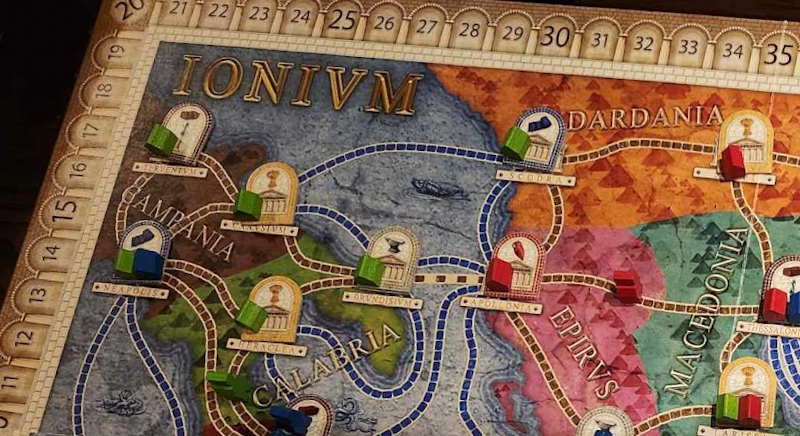
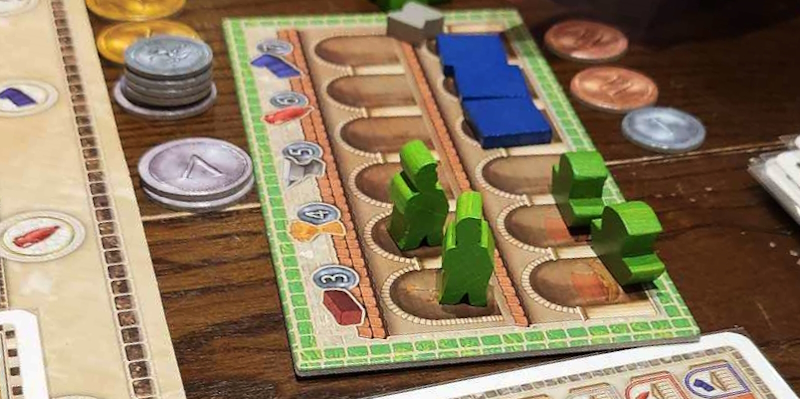
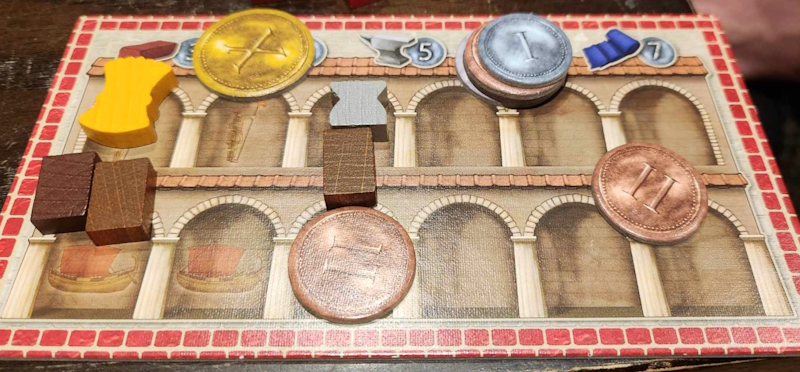
The first of these involved Plum, Sapphire and Teal, playing with Burgundy‘s copy of the original Concordia with the Venus expansion. This was one of Burgundy‘s favourite games and many people in the group fondly remember being taught it by him. Game play is super-simple: each player has a hand of cards, so on their turn, they play one and do what it says. And that is all there is to it. Players start with a hand of seven Personality Cards which provide a simple array of actions: move Colonists and build, produce Resources, trade Resources, use another player’s most recently played Card, buy more Cards, recycle their Card deck.
 |
| – Image by boardGOATS |
Players use their Consul card to buy more Personality Cards during the game. As well as providing more and increasingly powerful options, they are also key to scoring. Each card is related to an ancient god who rewards its owner with victory points according to different scoring criteria. This reward is then multiplied by the number of Cards the player has that are dedicated to that god. For example, Saturnus rewards players for having buildings in different provinces. If a player has built in seven different provinces and has four cards dedicated to Saturnus, they receive twenty-eight points.
 |
| – Image by boardGOATS |
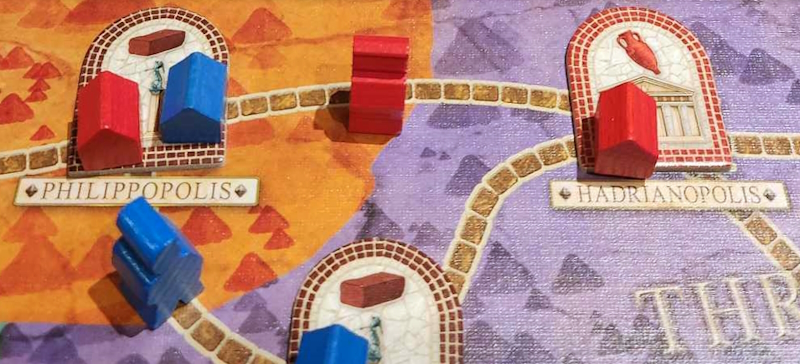
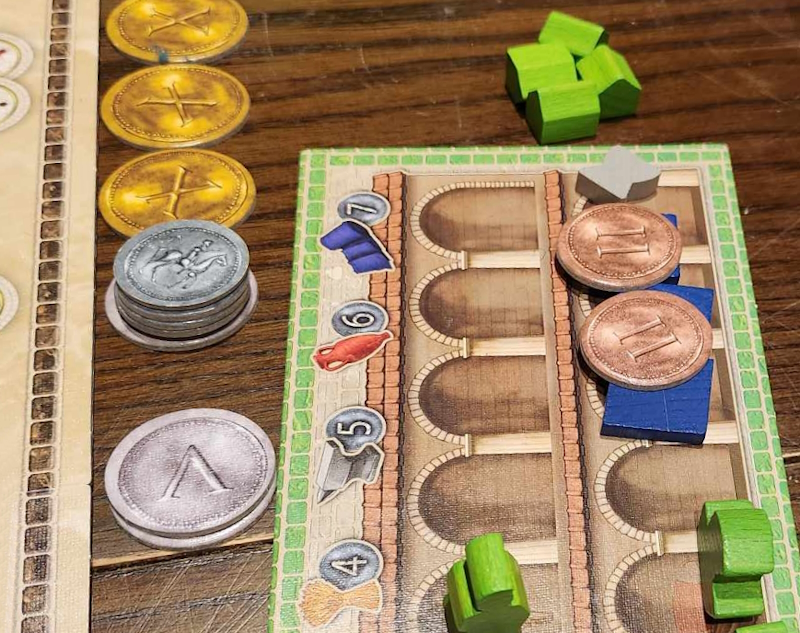
The game ends either after a player purchases the last card from the display, or after one player builds their fifteenth house after which everyone else completes their final turn before scoring. One of the things that is very clever about the game is how much variety is achieved from very little variation. Players all begin with the same starting cards and the same resources; the only change from game to game is the order the Cards appear in the market and the distribution of City Resource tiles at the start of the game which dictate which cities produce what. With these small variations the game can change hugely as players fight to control the area that gives the most lucrative cities during the game and when combined with their Cards to give the most points.
 |
| – Image by boardGOATS |
There is even more variation to be had with alternative maps, but the reimplementation of Concordia, Venus, introduces an eighth Card to the starting hand (the Magister, which allows a player to repeat their previous action), the addition of the Minerva scoring Cards (which give players extra points for each city of the type indicated by the specialist), as well as three new maps (Cyprus, Hellas and Ionium). These can also be added to the base game using a combination of the Venus expansion and the Balearica / Cyprus expansion; this was was the version Plum, Sapphire and Teal played, which meant they started by sorting out what they needed to play the game.
 |
| – Image by boardGOATS |
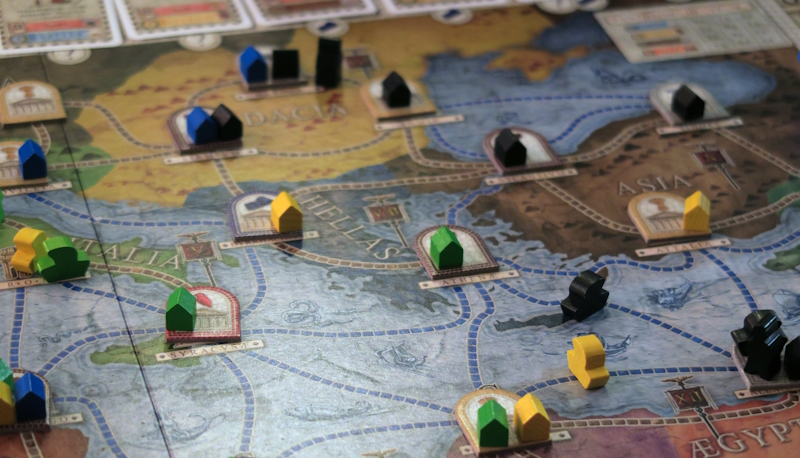
The group chose to use the Ionium map from the Venus expansion as it plays well with three. Sapphire had a positively storming game—he was perhaps helped by the fact that Teal and Plum started the game by heading east leaving Sapphire to explore the west unopposed, but he still had to make it work for him. And make it work he did, with two turns in which he claimed four cities. Later in the game, he made good use of his Diplomat Card to copy the Consul Plum had used. Sapphire had a couple of Provinces to himself so Prefecting in those areas helped only him. Teal and Plum had both built in a couple of Cloth-rich areas, but Plum wasn’t always able to make the best of hers and on two occasions her storage are was full when she could have received goods.
 |
| – Image by boardGOATS |
In the end game scoring, Sapphire led in the Jupiter, Saturn and Venus scoring and jointly in the Mars scoring. To top that, he also triggered the end of the game giving him the Concordia Card (and seven points) as well as getting fifteen points for the Minerva scoring with his Smith card. As a result, he finished with a hundred and twenty-nine points, sixteen more than Teal who finished a very creditable third in a game where it is notoriously hard to to well in the first game. Meanwhile, Black and Byzantium were leading another game of Concordia, with Purple and Cobalt.
 |
| – Image by boardGOATS |
As Cobalt was new to the game, this group played with the classic Imperium map and included the intermediate individual scoring for each player when they played their Tribune card for the first time. Black spread out over the board while Purple and Byzantium were more restrained, with Byzantium only spreading his tentacles at the end of the game Cobalt collected a lot of Cards, although Byzantium had most of the Colonist Cards. Despite the differences in approach, this game was really tight, so much so that Black and Byzantium tied for victory on one hundred and forty-nine points with Cobalt some fifteen points behind.
 |
| – Image by boardGOATS |
As is always the case when there is a tie, there was a rummage in the rule book for a tie-break. In this case, the tie is won by the player owning the Præfectus Magnus Card, or by the tied player who would receive him next in the course of the game. This nominally went to Black, but it was agreed this was a rubbish tie-break rule as players can’t plan for this and just get given it when someone else plays their Prefect Card. While all this harmony was on-going, Jade was introducing Ivory to Fromage, with the help of Blue and Pink who had both played it once before elsewhere. This is a really cool worker placement game where the actions have a time component to them.
 |
| – Image by boardGOATS |
This sort of thing is not new—Tzolk’in does something similar where players place workers on wheels which are turned at the end of each round and, the longer the workers stay, the more powerful the action they can do. In the case of Fromage, this is sort of reversed in that players do the action and, if they do a more powerful action, then their workers stay on the board for longer. The peril here is that, whereas in Tzolk’in players can always do a less powerful action and take workers off early if they have to, in Fromage players only have four workers and it is very easy to end up with all of them sat on the board leaving people unable to do anything at all. Fromage has proved popular since its release just before Christmas, and as a result, it is on its second Tuesday outing already.
 |
| – Image by boardGOATS |
The actions are tied up in four “mini-games” which players take it in turns to participate in. It has proven quite a popular little game because once everyone knows how to play, there is relatively little down time and despite playing different areas at different times, quite a lot of interaction. Players simultaneously choose where to place their workers, in their quadrant of the board, and once everyone is done, the board is turned and then players retrieve any workers they can and then place workers on their next quadrant. Players score points for occupying tables in the Bistro quadrant, holding the majority in regions in the Villes quadrant, filling different tables in the Fromagerie quadrant, occupying contiguous areas in the Festival quadrant, and for fulfilling Orders.
 |
| – Image by boardGOATS |
This time, the game was very close, especially between Ivory and Pink, despite there being a lot of different strategies at play. Pink, for example, scored very heavily for the Bistro getting forty-five points (more than half his total) from the one location. In contrast, Blue scored thirty points for her contracts and nineteen from the Fromagerie, but very little anywhere else, while Ivory and Jade scored much more evenly in the different categories. There was only one point between Pink and Ivory in the final reckoning, however, with Pink’s eighty-one just giving him victory. With the rest of the group remembering Burgundy while playing Concordia, it seemed only fitting that this group should move on to another of Burgundy’s favourites: Splendor.
 |
| – Image by boardGOATS |
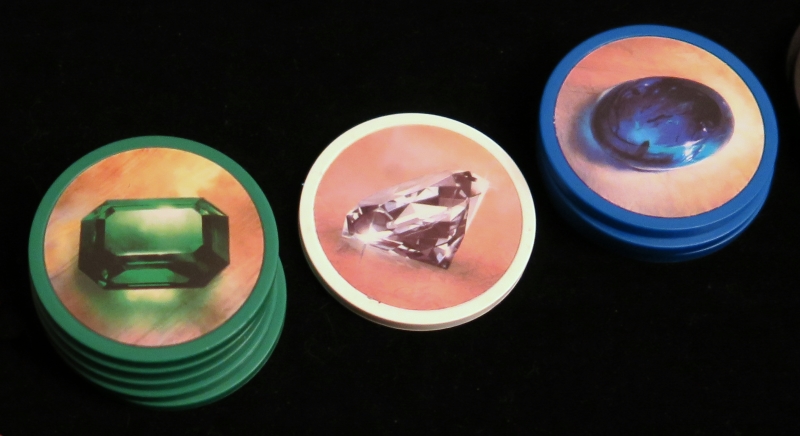
Burgundy was almost unbeatable at Splendor and at one point had a two-year unbeaten run on Tuesdays—so much so that others in the group would choose to play Splendor when he was occupied elsewhere, just to break the monotony! The game is quite simple: on their turn, players either take Gem-stone chips, or use them to buy Cards. The Cards act as a perpetual source of Gems. Thus, the aim of the game is to build a robust engine to enable players to buy the more expensive Cards that also give points, or allow players to collect Noble tiles for having sets of Cards associated with particular combinations of Gems. This was another close game with Jade looking like he was going to end the game for a couple of rounds and Blue and Ivory looking for a couple of large turns.
 |
| – Image by boardGOATS |
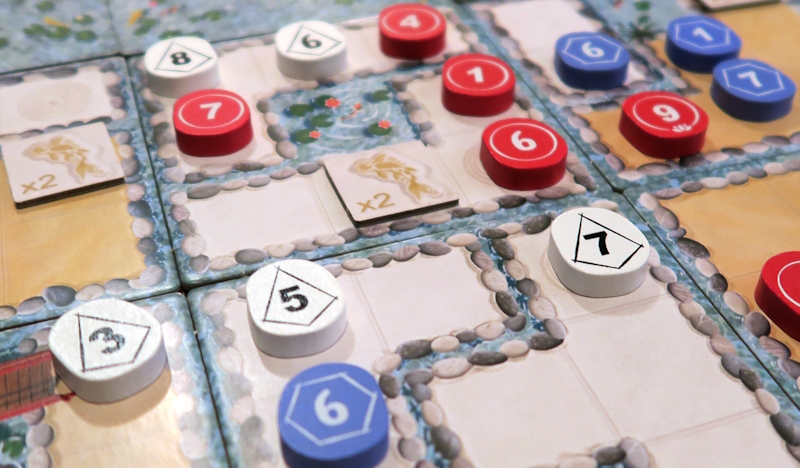
That was until Pink did it for him by ending his turn with sixteen points and as he was last in the round, that meant nobody else got another turn. So Jade finished second with fourteen with Blue in third. Ivory decided to call it a night there, leaving Blue, Pink and Jade to play one last game, which ended up being Hiroba. This is a sort of area-control filler game, where players take it in turns to place one of their nine Stones in the nine-by-nine grid following some simple, Sudoku-like rules. Each Stone is numbered one to nine, but they are numbered on both sides such that the total adds up to ten.
 |
| – Image by boardGOATS |
After players have placed their first Stone, others must be placed in the same row or column as one they have already placed, while ensuring that none of the Stones in any row, column or Garden has the same number. There are typically two Gardens on each of the nine, three-by-three tiles that make up the board and players are trying to win control of them. At the end of the game, the player with the highest total face value in each Garden will score points equal to the total size of that Garden. However, for each Koi Pond on the board, a “times two” token is awarded to the player with the lowest value orthogonally adjacent pebble.
 |
| – Image by boardGOATS |
Players who are awarded one of these place them in any empty square in any garden on the board, where it will double the points scored for that garden. Thus, while players want to place the highest value stones to win control of Gardens this is tensioned by the desire to place low value Stones near Ponds in order to gain the multipliers and get a good score. This game was less close than the previous ones, well—it was close for second place, but Blue who had finally woken up manged to take a couple of large areas and winning a lot of “times two” multipliers, she finished with an unassailable total of thirty-seven points. This was some twelve more than Pink who won the battle for second.
 |
| – Image by boardGOATS |
Learning Outcome: Burgundy had great taste in games.




 boardGOATS