Tag Archives: Die Quacksalber von Quedlinburg

Spiel des Jahres Winners – 2025

Last weekend, this year’s Spiel des Jahres (German Game of the Year) winner was announced as Bomb Busters, by Hisashi Hayashi, the designer of Trains, MetroX (aka Voll Verplant), String Railway and Yokohama.  Based on the earlier Bomb Squad by the same designer, this is a cooperative, card driven game, where players work together to try to defuse a bomb before it explodes.  Players begin with a hand of numbered Wire cards (four each, numbered one to twelve) and then take turns pointing at each others’ wires and guessing their values.  Correct guesses lead to wires being cut, incorrect guesses and the detonator advances…

Bomb Busters
– Adapted from image by BGG contributor spiritraw

The winners of the Kinderspiel des Jahres (Children’s Game) and the Kennerspiel des Jahres (“Expert” or “Connoisseur’s” Game) were announced at the same time. The Kinderspiel des Jahres went to Topp die Torte!, which is a tile laying game by Wolfgang Warsch—a previous winner of the Kennerspiel de Jahres in 2018 with Die Quacksalber von Quedlinburg (aka The Quacks of Quedlinburg) and designer of The Mind, Ganz Schön Clever and Quacks & Co., all of which have received recognition from the jury in recent years.  This year, the Kennerspiel des Jahres award went to Endeavor: Deep Sea by New Zealand designers Carl de Visser and Jarratt Gray, a game where players explore the deep sea using the action mechanism from Endeavour: Age of Sail (and its predecessor Endeavor).

Endeavor: Deep Sea
– Image from kickstarter.com

Endeavor: Deep Sea can be played competitively or cooperatively with up to five players (using the Deluxe edition). This means that as last year, both the “senior awards” have gone to cooperative games.  Indeed, the last four Spiel des Jahres awards (Sky Team, Dorfromantic, MicroMacro and Just One) and three of the last five Kennerspiel awards (Paleo and The Crew as well as e-Mission/Daybreak) have gone to cooperative games.  This style of game is clearly very popular with families (where arguments are often best avoided), but can be less so with more traditional gamers who prefer a bit of competition.  As such, cooperative games very much have the “Marmite Factor”, but in such cases, the nominees and recommended lists cater for every taste, with games like Looot, Castle Combo, Faraway and Flip 7.
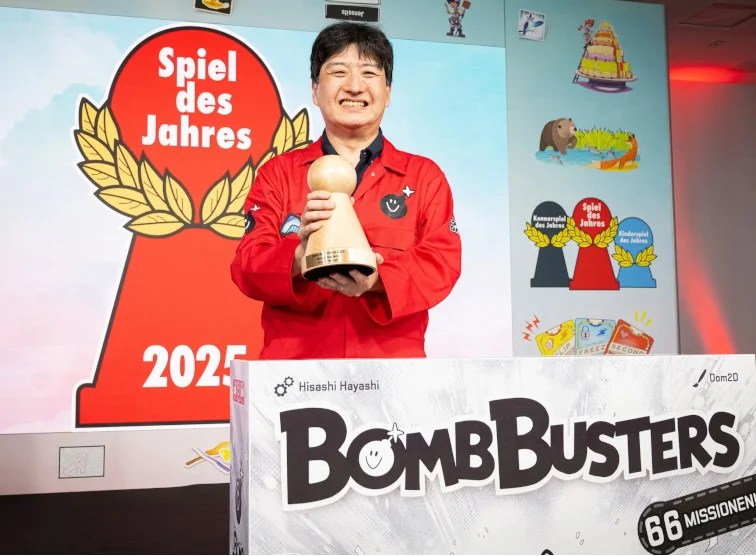
Bomb Busters
– Image from spiel-des-jahres.de

Deutscher Spiele Preis – 2018

This week the The Deutscher Spiele Preis, or German Game Prize list was announced with first prize going to Azul.  Typically the Deutsche Spiele Preis rewards a slightly heavier game than the the Spiel des Jahres awards, but for the first time since Dominion in 2009, one game took both awards.  This year we haven’t played many of the games on either list, but our first game of Azul was shortly after it’s release at Essen last year and our local groups have played the spots off it since.  So, it is no surprise to us that it has been recognised by both the Spiel des Jahres Jury and the voters from the industry’s stores, magazines, professionals and game clubs, as well as taking the French award at Cannes, the As d’Or and the Origins “Best Family Game of the Year”.

Azul
– Image used with permission of boardgamephotos

Other games that featured on the top ten list included the winner of the Kennerspiel des Jahres award, Die Quacksalber von Quedlinburg (currently only available in German) and one of the runners-up, Heaven & AleThe Mind, which received a nomination for the Spiel des Jahres Award, also featured in the top ten, as did the inevitable Pandemic Legacy: Season 2.  Other than Azul, the only game we’ve played is Altiplano, and that squeaked in at number ten, but Rajas of the Ganges and Clans of Caledonia may feature in the not too far distant future.  The Deutscher Spiele Preis for Best Children’s game went to Memoarrr!.  The prizes will be awarded at the Internationale Spieltage, Essen.

Azul
– Image used with permission of
BGG contributor Vacabck

Spiel des Jahres Winners – 2018

The 2018 winner of the coveted German Game of the Year or Spiel des Jahres award is Azul.  This has been a very popular game within the group and to us has been the stand-out game this year since Essen.  It is very easy to teach with a surprising amount of depth and is beautifully produced, making it a game we are always happy to play.  The Kennerspiel des Jahres was awarded at the same time.  This honours more challenging games and this year was awarded to Die Quacksalber von Quedlinburg.  So far this has only been released in German, so we have not been able to play it yet.  In addition, there was a special award for for Pandemic Legacy: Season 2, which the jury felt was the benchmark against which all other legacy games should be judged.  The Kinderspiel des Jahres award was announced last month and went to Funkelschatz (aka Dragon’s Breath) which is dexterity gem collecting game.

Azul
– Image used with permission of boardgamephotos

Spiel des Jahres Nominations 2018

Almost every time we’ve played Azul, the topic of conversation has moved on to the Spiel des Jahres and how it would be a travesty if it did not receive at least a nomination. It was with this in mind that we read the Spiel des Jahres nominations when they were announced this morning.  There are three nominees in each of the three awards:  a children’s game award (Kinderspiel des Jahres), the “Advanced” or “Expert” Kennerspiel des Jahres, and the main Spiel des Jahres (often interpreted as the “Family Game” award).  In addition, for the first time since 2010, there is also a special award for Pandemic Legacy: Season 2 by Matt Leacock & Rob Daviau, reflecting Pandemic, Forbidden Island and Pandemic Legacy: Season 1 that were all nominated, but failed to win a prize, and have had a significant influence on cooperative and legacy games as a whole.  The other nominees are:

  • Kinderspiel des Jahres
    Kinderspiel des Jahres 2018Emojito! by Urtis Šulinskas
    Funkelschatz (aka Dragon’s Breath) by Lena & Günter Burkhardt
    Panic Mansion (aka Shaky Manor) by Asger Harding Granerud & Daniel Skjold Pedersen
  • Spiel des Jahres
    Spiel des Jahres 2018Azul by Michael Kiesling
    Luxor by Rüdiger Dorn
    The Mind by Wolfgang Warsch

Firstly, more than half of the nominees were designed by either Wolfgang Warsch, or Michael Kiesling, so huge congratulations to them.  In our view, Azul richly deserves it’s nomination and it would be no surprise if it ultimately wins the award.  Of the other two nominations for the “red pöppel”, The Mind has received quite a lot of attention, and is a bit like a cross between Hanabi and The Game (both of which have been acknowledged by the Jury in the past, in 2013 and 2015 respectively).  Luxor has a good pedigree as it is designed by Rüdiger Dorn (also designer of The Traders of Genoa, Goa, Istanbul, and one of our group favourites, Las Vegas), but it is a bit more of an unknown as it has only just come out.  Usually the Kennerspiel Prize winners are a good fit to our group, but this year they are also largely unknown to us, so there is clearly a lot to discover before the winners are announced in Berlin on 23rd July (Kinderspiel des Jahres winners will be announced in Hamburg on 11th June).

Spiel des Jahres
– Image from spieldesjahres.de