Tag Archives: Les Aventuriers du Rail Express

22nd April 2025

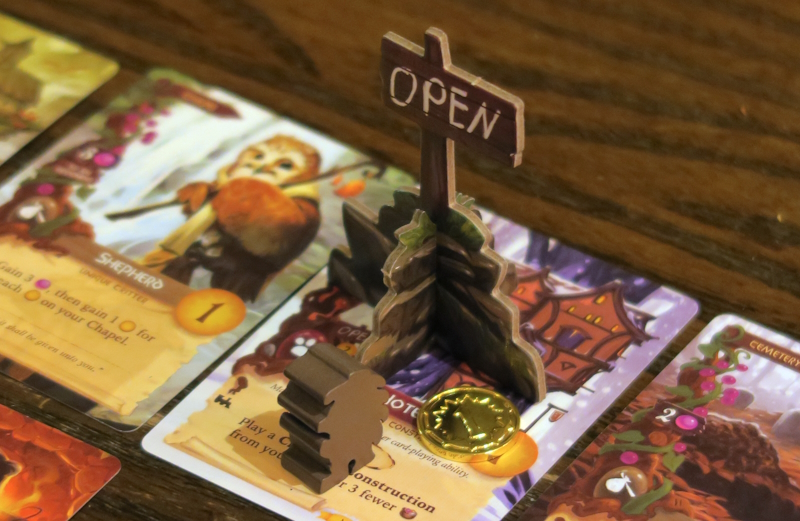
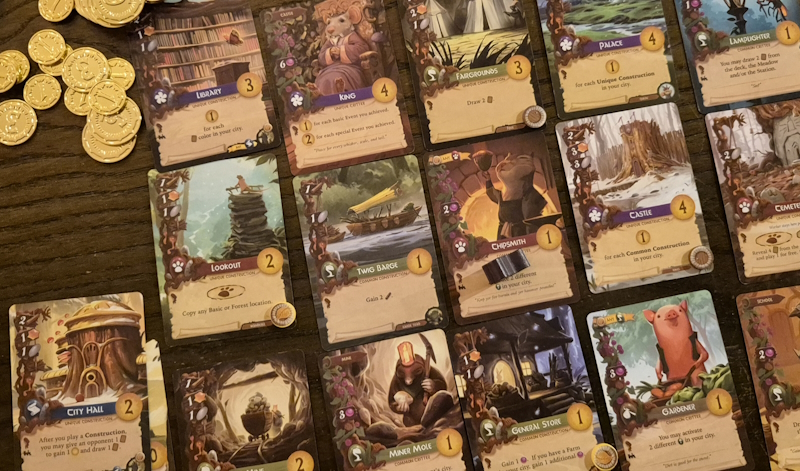
The evening began with the sad news that Kath and Ian and their daughters were leaving for a new pub in Shipton Abbot (or was that  Newton Abbot?).  They have been good to the group and worked hard to give us an environment that conducive to gaming, so it is sad to see them moving on, though Devon is quite a nice place.  Everdell is also reputed to be a nice place, and one that some of the group were to travel to perhaps using its new railway station, as the Newleaf expansion to Everdell was the to be the week’s “Feature Game“.  The game got going after about fifteen minutes of general faffing about and reminding everyone of the rules to the base game and explaining the additional features of the expansion.
Everdell: Newleaf
– Image by boardGOATS

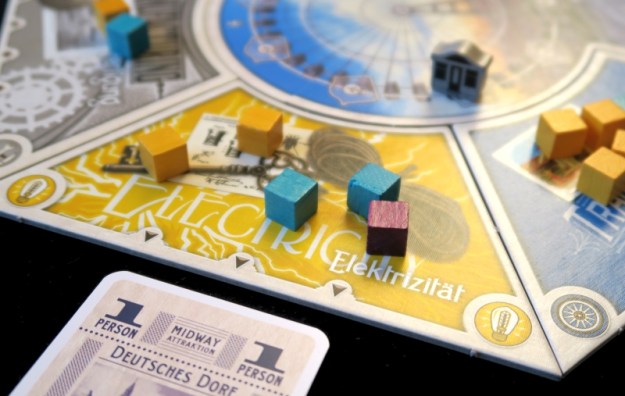
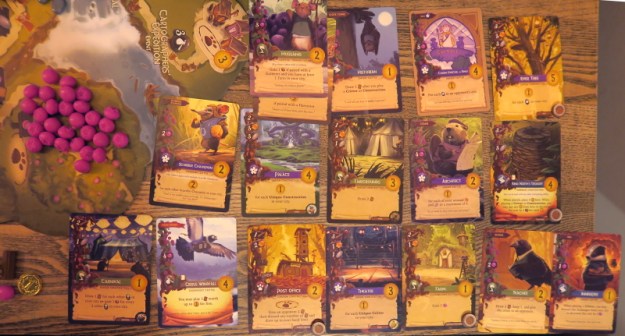
The base game is a fairly simple one of worker placement to collect Resources and spend them to place Cards.  Players keep playing until they run out of workers when they get them all back (vacating the associated Action spaces), and then start again.  The game is played over four rounds (or Seasons), with players with the most points from Construction and Critter Cards as well as Event (end-game scoring) Cards.  The Newleaf expansion adds new Critter, Construction and Event Cards, but more obviously, it a new railway station.  This and associated Visitor Cards, Freight Trucks (which provide an alternative way to get Resources), Travel Tickets, and Reservation Tokens.

Everdell: Newleaf
– Image by boardGOATS

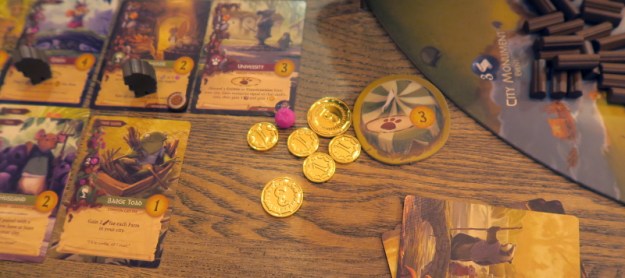
Plum (who obviously chose to play with Cat-eeple Workers) went first, grabbing some Resources, followed by Purple (Butterfly-eeples), Cobalt (Hedgehog-eeples) and then Ivory (Duck-bill Platypus-eeples).  Everyone started setting up their town, particularly focusing on green Constructions and Critters that could give income in spring. Plum built up a large pile of Resources and grabbed a Freight Truck with Resources loaded on it and her choice of discount when producing (paid in part using the Reserve Token to gave her a discount) . Purple didn’t go for green Cards, but red Cards with additional worker spots (in particular the Hotel and Chapel), whereas Cobalt and Ivory both got a Mine and Miner Mole, giving them access to valuable pebbles.
Everdell: Newleaf
– Image by boardGOATS

The length of Seasons in this game is variable, with some players doing more than others before they are forced to reclaim their Workers.  Purple passed on to Spring first, followed by Plum and then, sometime later, Cobalt and Ivory.  Cobalt gained a few blue Cards which had given him Resources (and in particular Cards) when playing Constructions and Critters, whereas Ivory had built quite a collect of green Cards, giving him a significant pile of Resources going into Spring. Spring was very similar to Winter, with everyone focusing on engine building, although Purple was beginning to struggle, due to a shortage of green Cards. Ivory made an early grab for Harvest Festival Event which gives a points bonus for having four green Cards in his city—he was already building quite a big tableau including a Castle.

Everdell: Newleaf
– Image by boardGOATS

Cobalt was taking things slightly more slowly, still focusing on blue Cards, which was enabling him to draw three cards every time he played a Card, so he was always at the hand limit.  Moving into Summer, Cobalt significantly stepped up his building, as did Plum.  She grabbed the Ever Wall Tower card which rewarded her for having nine Constructions. Having already taken Grand Tour event for having three red Constructions, Ivory was eyeing up the Royal Tea special event for having three green and two purple Cards in his town.  However, whilst focusing on collecting resources for buildings to complement his already built Castle and the Palace Card he had in his hand, he failed to notice Cobalt had already played three purple Critters/Constructions.

Everdell: Newleaf
– Image by boardGOATS

As a result, Cobalt beat Ivory to both the Royal Tea and the Scenic Flight awards. Much to Ivory’s disgust, Cobalt was then also able to claim the Sunflower Parade achievement award for having three Events too.  So, Ivory went into damage limitation mode, and began focusing on the passengers at Newleaf station as an alternative way to score points.  Purple was first to move into Autumn and as everyone else followed the focus was firmly on points.  Cobalt was able to collect the Juniper Jig Dance Contest Event card for having nine Critters (in part due to Ivory giving him the Fool!).  Ivory was collecting more passengers using his special ticket to enable him to take a worker back, something everyone had from the from the expansion while Plum was building as many building as possible.
Everdell: Newleaf
– Image by boardGOATS

It was all a bit of a rush at the end as it was nearly midnight when the game finally finished.  Largely due to the scores for his huge number of Events, the winner was Cobalt with ninety-three points.  Ivory took second some ten points behind, closely followed by Plum who got over half her points for Critters and Constructions.  The game had taken all evening, but during this time, Pink, Pine and Lime had managed to get through no less than five games.  The first was one of Pink’s favourites, Zoo Break.  In this game, players work cooperatively to try to prevent the escape of animals from their zoo.  It is one of Pink’s favourite games, but this time it was very, very short-lived.

Zoo Break
– Image by boardGOATS

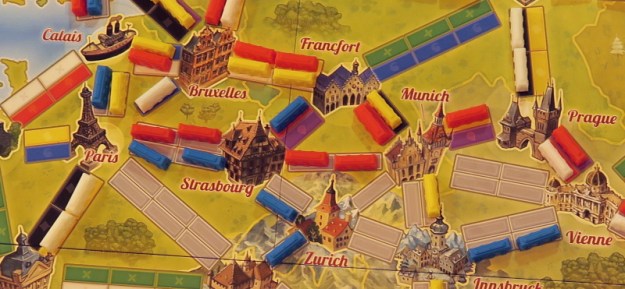
Things started well as the group locked up the Capuchins, Snakes and the Rhino.  But then the Meerkats, who were partying in the fountain, decided to make a bid for freedom.  Three tigers and four elephants were already on the loose and rampaging round the zoo and while Pink put two Pandas back in their cage, five of the Meerkats made it to the exit and headed out.  And thus a handful of mischievous Meerkats led to the sad demise of Bedlam Zoo (which really had been Bedlam this time).  To help get over the disappointment of the epic failure, the group decided to go on a a train ride around France with Les Aventuriers du Rail Express, a light version of one of the group’s favourite games, Ticket to Ride.

Ticket to Ride: Europe
– Image by boardGOATS

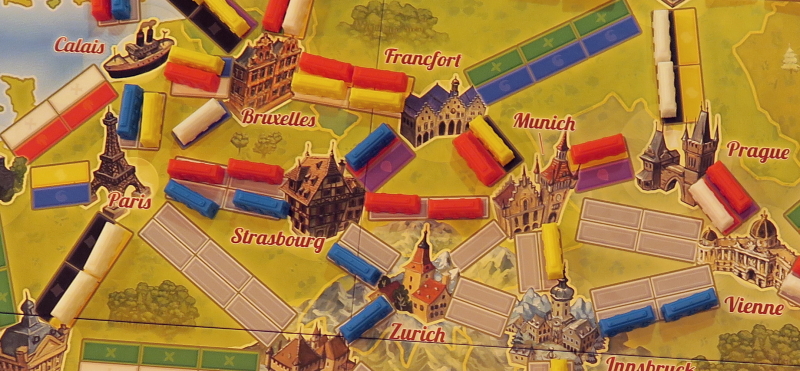
There are lots of versions of Ticket to Ride, from the teeny-tiny city editions through to the rather epic Rails & Sails and Legacy versions.  Les Aventuriers du Rail Express is a French map that is a step up from the city editions and fits between the standard games (Like Europe) and First Journey, making it slightly quicker than the full games, as it is played on a slightly smaller map with slightly fewer trains.  Aside from that, it is essentially very similar in game play to all the others:  on their turn players either take cards from the market, or spend them to place plastic train pieces on the map.
Les Aventuriers du Rail Express
– Image by boardGOATS

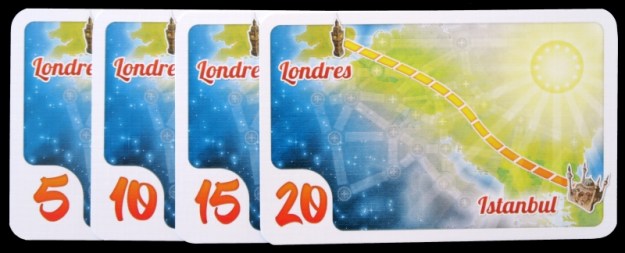
As in the larger version players can also take tickets, but this has to be balanced with the bonus for completing a route from London to Istanbul, the most distant pair of cities.  The first player do so gets twenty points, the second gets fifteen and the third gets ten.  Additionally, the wild Locomotive cards also work slightly differently in this game in that, instead of being mixed in with the market, they are always available from a separate stack, but as usual, players can only take one per turn.  Being a quick game, and with everyone feeling they knew the game and was in with a chance of winning, the group ended up playing it twice.
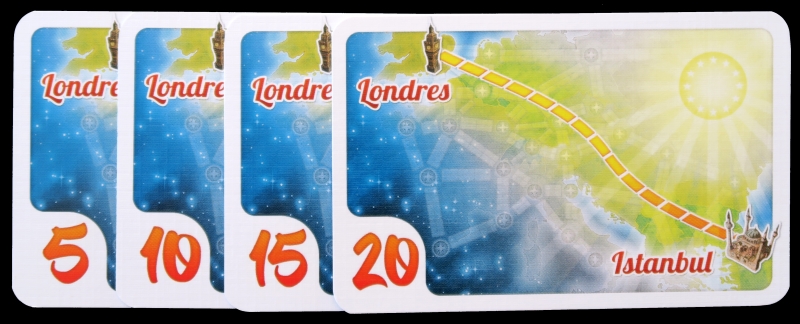
Les Aventuriers du Rail Express
– Image by boardGOATS

The first time, Lime finished with the most points from placing Trains, but both he and Pine carried negative points from incomplete Tickets.  Incomplete tickets are a real drag as they effectively, carry a swing double their face-value.  As a result, Pine just pipped Lime to second place.  The winner was Pink, however, despite the fact that he had the lowest points for his tickets; he did finish the London to Istanbul connection first though.  In the second game, the roles were somewhat reversed with Pink taking the most points for placing trains, but failing to complete the London to Istanbul route at all.  The winner was Pine who, like Pink in the first game, also claimed the maximum of twenty bonus points, while Lime was the runner up.

Les Aventuriers du Rail Express
– Image by boardGOATS

Everyone else was still playing, so the trio managed a quick couple of games of the card-drafting game, Sushi Go!.  This is a very simple game, where players start with a hand of cards and choose one to add to their tableau before passing the rest on.  Played over three rounds, players collect points for collecting Maki Rolls, Sashimi and Nagiri (which is all the better when combined with Wasabi).  At the end of the game, players with the most Pudding cards score an extra six points, while those with the least lose six points.  The player with the highest total is the winner.  The points throughout both games were fairly even with nobody crashing out or having a golden round.
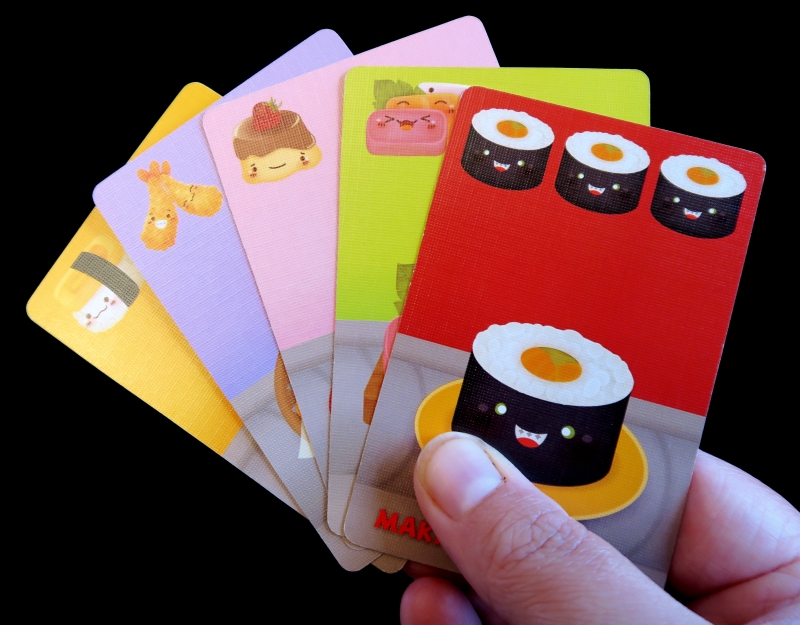
Sushi Go!
– Image by boardGOATS

Despite this, the winner of the first game took it by a bit of a land-slide.  It’s true that Lime top-scored in two of the three rounds, but they were all really close.  The real difference, therefore, was made by the Puddings which he had the most of and left him with a total of forty-five, a dozen more than Pink, the runner-up.  It was fairly inevitable then that in the second game, there was quite a battle for the Pudding cards.  The scores were close again, and again Lime won two out of the three rounds.  The overall winner was arguably Pink, who despite losing all three rounds had the most Puddings and therefore took victory from Lime on a tie-break.
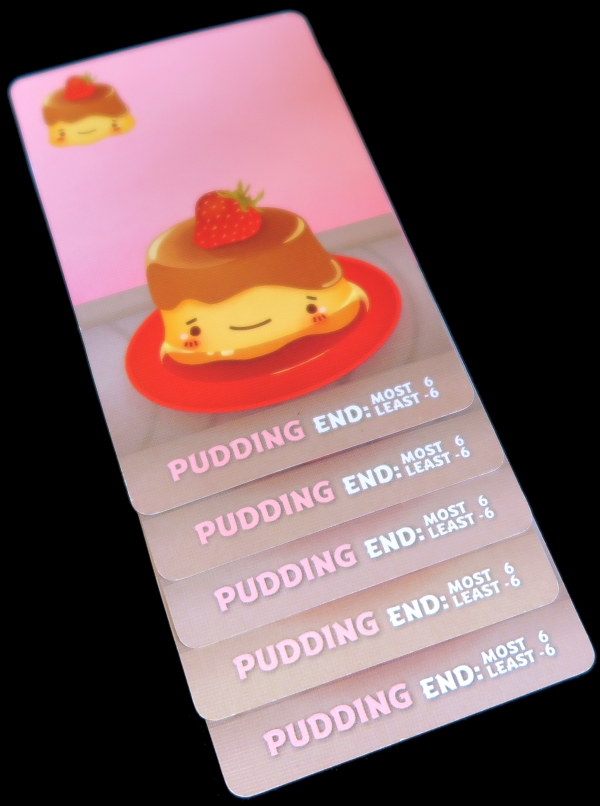
Sushi Go!
– Image by boardGOATS

The final table for the evening, consisted of Jade, Sapphire, Black and Blue playing Meadow with the Adventure Book expansion.  Meadow is a clever little card game where players collect cards to add to their tableau from a central market.  On their turn players place one of their tokens next to the grid with the type of token and the location combining to dictate which card they take.  Players can then add a card from their hand (which may or may not be the one they picked up) to their tableau.  In the base game, there is an additional campfire board, but the Adventure Book replaces this.  Each “page” from the book changes the mechanics to a greater or lesser extent.
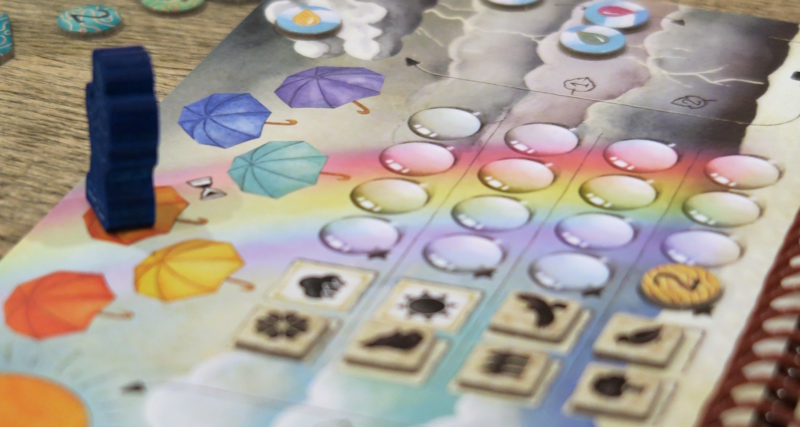
Meadow: Adventure Book
– Image by boardGOATS

The group played with the first scenario, which introduces Weather.  There are two token that indicate a row and a column in the market, and every time a card is taken from these, players can move along the appropriate Weather track.  Reaching the end of these gives players extra cards.  Additionally, placing a token in a space in the Book allows players to claim rewards if they have fulfilled the criteria and have the two symbols shown visible in their tableau.  These give extra points at the end of the game.  There was a lot of faffing about and getting to grips with the rules changes, especially as initially, the wording in the rules for the expansion was a little unclear.  Added to which, Black hadn’t played the base game at all before.

Meadow: Adventure Book
– Image by boardGOATS

Once the rules had been fathomed out and explained, the group got the game underway.  Different players targeted different card types with some going for the harder to place higher up the food-chain cards, while others tried to diversify.  Blue tried to get as many of the bonus points for collecting pairs of symbols as she could and as a result finished at the back of the pack.  The game is not a high scoring one though and those bonus points made a big difference.  It was not quite enough to give her the victory, however, and she finished one point behind Jade who topped the rankings with forty-six points, with Black in third.  It had been a very enjoyable evening all round though, regardless of the number or type of game played.

Meadow: Adventure Book
– Image by boardGOATS

Learning Outcome:  Cards are a critical part of most modern games.

25th July 2023

After Blue and Pink had sampled the new pizza menu at The Jockey, people started to roll up and join them for the usual chatter.  There were a total of nine, which was one more than  required for the “Feature Game“, the recently announced Kennerspiel des Jahres winner, Challengers!.  This is a deck-building, dueling “capture the flag” game where players battle head-to-head to find the winner.  It is a very light game, with a largely random element, at least on the face of it, so it was always going to be a bit of a “Marmite” game.  Green commented that he wasn’t very interested in it, but as everyone else was quite keen to give something novel a go, he sportingly joined in.

Challengers!
– Image by boardGOATS

The game is very simple, and seems, at first glance to be quite random.  Players start with a hand of cards, and then draw five more and choose a set number to add to their hand.  The clever part is that (with eight players) the game is played over seven rounds, and each round the decks players draw from and/or the number of cards they can keep changes.  There are three decks, A, B and C, and the cards become increasingly powerful as the game progresses.  Once players have fettled their deck, they duel against their designated opponent by drawing the cards from their deck.  In this, one player starts by playing a card and taking the Flag, then the other plays cards until their total equals or exceeds that of their opponent.

Challengers!
– Image by boardGOATS

This initially seems quite random in that players have no agency in this element of the game.  There is a suggested variant that can change this by allowing players to draw two cards and choose one to play—this was an option for later in the game, but in the end, the group stuck to the rules as written.  The game focuses on this duel aspect, but really it is more about building card combinations during the first part of the game and deciding what cards to shed and how many.  Shedding cards is just as important as acquiring cards as, as the winner of a duel is the last player with the flag, so running out of cards can lose a match.

Challengers!
– Image by boardGOATS

Having too many cards can be a problem as well though—when they take the Flag, players move all their cards except the last played to the “Bench”.  The Bench has six seats, and when a card needs a seat and there isn’t one, that player loses.  The winner of the match, the last player with the Flag, then takes a winner’s token which is worth points at the end of the game.  The game is all about the cards which make it less random than it seems at first; some cards have special powers, while others give points.  Additionally, identical cards can share a seat on the Bench, so effectively allow players to have more cards, however, those tend to be weaker cards from the A deck.

Challengers!
– Image by boardGOATS

As such, Challengers! should perhaps be thought of more as a programming game, more in the mold of games like Colt Express, rather than a dueling “capture the flag” game.  After each match, players play musical chairs and after seven rounds (with eight players), the players with the most points duel for overall honours.  Although the idea is very simple, it took a little while for people to get to grips with the procedure.  Blue, who was suffering with the after-effects of a bad cold, acted as much needed umpire and guide, explained the rules and demonstrated how the duel worked using Pink’s hand of cards.

Challengers!
– Image by boardGOATS

Possibly thanks to her fuzzy head, but Pink despite the fact that he was sat in front of her, was onto the second round before Blue realised that something wasn’t right.  Instead of taking his starting hand back after the demo, he had just drawn five blind cards from the A deck, making his hand immensely over-powered.  There were the usual tongue-in-cheek cries of “Cheat!”, but it was a genuine error, albeit one that wasn’t easy to fix by this time.  As a result, the quickest and easiest solution was for him to forfeit the first round and fix his hand before re-starting the second round.

Challengers!
– Image by boardGOATS

One of the nicest aspects of the game was the way everyone played against everyone else.  The GOATS are a nice, friendly group, and although some people end up playing together more often, the group always makes a point of trying to avoid cliques caused by the same people playing together all the time.  The Musical Chairs element of the game meant everyone played against everyone else which gave it a fun, party feel that we usually only experience in October (when we play Crappy Birthday).  It was clear that some people enjoyed it more than others though.  Ivory, Teal and Black, really got to grips with the deck-building element and found the game exceeded their expectations, Ivory in particular really enjoyed it.

Challengers!
– Image by boardGOATS

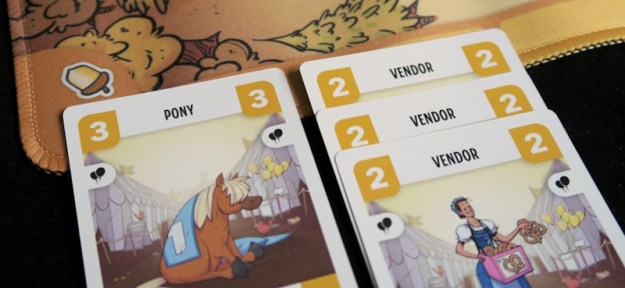
Lime, Pink, Pine and Purple were a little less enthusiastic, while Green felt it was a clever little game enjoyable for a short while, but that it out-stayed it’s welcome—too long for the game-play within it, he couldn’t wait for it to finish.  It wasn’t much of a surprise, therefore, that Ivory, Teal and Black were the winners of the “Round Robin” tournament phase, finishing with thirty-five, thirty-three and thirty-one points respectively (some way ahead of Lime in fourth with twenty-three).  The play off between Ivory and Teal, therefore, was quite close and tense, but Ivory ran out the eventual winner, largely thanks to his handful of yellow Vendor cards.

Challengers!
– Image by boardGOATS

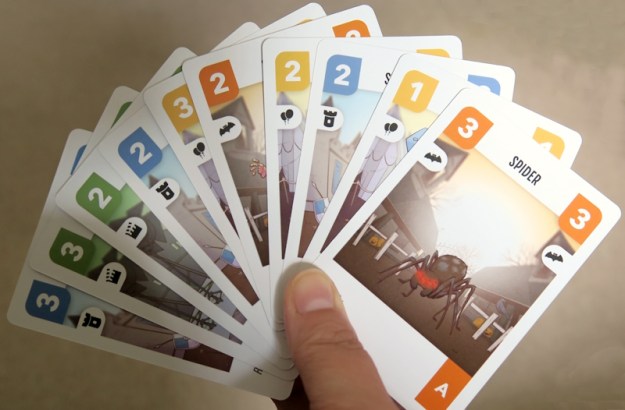
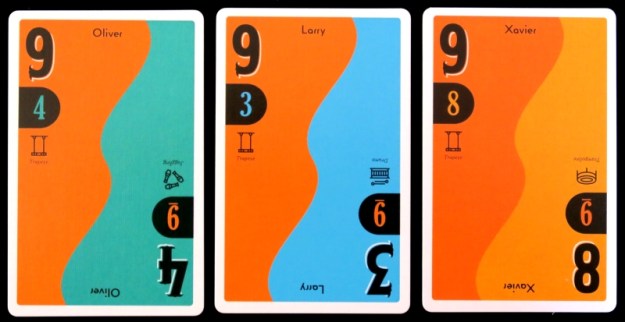
From there, everyone was keen to play something they were familiar with, but it had to be something quite quick.  Teal suggested SCOUT, which Blue was keen to give another try (having played appallingly last time) and Ivory and Purple were very happy to join them.  This is a very simple, but clever hand management game that was nominated for the Spiel des Jahres award last year.  The theme is almost non-existant (something to do with circus performers), and isn’t even reflected in the card art, which is not unpleasant, but very functional (and therefore useful).  The idea is that players have a hand of cards which, like in Bohnanza, they cannot rearrange.

SCOUT
– Image by boardGOATS

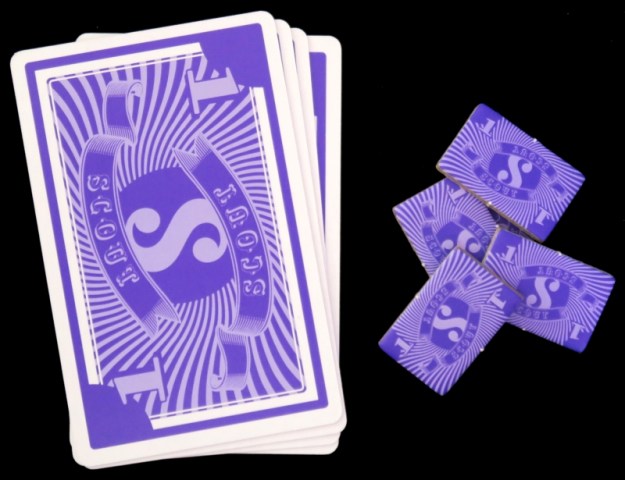
Unlike Bohnanza, on their turn players may play any set of adjacent cards from their hand as long as they beat the current winning set, taking any cards they beat into their scoring pile.  Cards can be a a run of cards with consecutive numbers, or a meld of the same number.  Sets are ranked by size and value and a meld always beats a run of the same size.  Players take it in turns to play, and if they can’t or choose not to “Show” a set of cards that beats the current winning set, they instead “Scout”, taking one of the two cards from either end of the set on the table, adding it to their hand (paying the former owner a point from the supply).

SCOUT
– Image by boardGOATS

And this is where the game gets clever:  all the cards have two values, one for each end, so players can add any cards to their hand anywhere they like and either way up (i.e. making either value active).  In this way, players can manipulate their hand making larger melds or longer runs.  The round ends when either every body “Scouted” in succession, or where one player has run out of cards.  Players then score points for each card in their scoring pile and for each chip for cards taken by “Scouting” with negative points for any cards left in hand.  The first time we played this with the group, it had all been a bit of a voyage of discovery, and last time, Ivory gave everyone a bit of a spanking, so Teal and Blue were keen to prevent that from happening again.

SCOUT
– Image by boardGOATS

Things started off well, with Blue beating Ivory in the first round, though Teal and Purple did less well ending up with a hand of cards.  The second and third rounds went better with everyone taking positive points and it was very close going into the final round leaving it all to play for.  Sadly for everyone else, Ivory brought his A-game to the last round ending the round swiftly leaving Purple and Teal with a hand that more or less off-set their takings and Blue with a positive score, though one with fewer points than Ivory.  The end result wasn’t really very close, though it felt less of a stomping than last time:  Ivory finished with fifty-five points and Blue took second with forty-one, ahead of Purple and Teal who tied for third.

SCOUT
– Image by boardGOATS

On the next table, Green, Pink, Pine and Black played a close fought enjoyable game of Les Aventuriers du Rail Express, a variant of the Spiel des Jahres winning Ticket to Ride series, but one that is a sort of half-way house between the original full versions of the game and the mini “city” games (like Ticket to Ride: London).  The game only plays four and takes less time, but is quite a nice variant and has a couple of differences to the original, being shorter without losing too much of the main game’s challenge.  As in the original, players can either take two cards from the market (face up cards, or the draw deck), or pay cards to place trains on the board.  Unusually, however, the Locomotive “wild” cards are kept in a single pile and therefore are always available.  This is quite a nice variation, as it means that players never feel forced to take blind cards because what they need isn’t available.

Les Aventuriers du Rail Express
– Image by boardGOATS

This effectively means players are guaranteed to get at least one train card they want.  The other major difference is the presence of the long route ticket.  This is one route that everyone can claim, however the highest scores go to the first to claim it.  It additionally means that failing to complete it does not lead to negative points, so players can ignore it and concentrate on normal short route tickets if they prefer.  There was a moment when the group had three identical coloured cards in the face up market which made them whether they should be scrubbed (as with three Locomotive cards in the base game).  It couldn’t be found in the rules and it was pointed out that in the original games it is possible to have five cards of the same colour, so they stayed and someone eventually found a use for them.

Les Aventuriers du Rail Express
– Image by boardGOATS

Pine took an early point lead which he maintained for quite a while until Green and Pink caught up, and not long after, Black too.  However, as the game neared its conclusion Pine pulled ahead again. Pink had completed the long route already and, at the cost of not being able lay his last two trains, Green decided to get the game finished before anyone else managed it. That long route helped Pink finish in front with sixty-four points, while Black’s slow start demonstrated that getting trains down early is no guarantee of success.  That said, he managed to pull into the station in second place with sixty-one points. Green and Pine fought to not be last and ended up tied just a couple points behind with fifty-nine points.

Ticket to Ride: Europe
– Image by boardGOATS

Learning Outcome:  Winning the Spiel des Jahres award means a game is good, but doesn’t mean it will suit everyone.

24th January 2023

Blue and Pink were first to put in an appearance and availed themselves of the burger offerings at the Jockey before everyone else began to arrive.  Ivory turned up cradling his enormous copy of the Collectors’ Edition of Everdell, complete with its Bellfaire expansion (as well as pretty much everything else available).  And from then on, it was a matter of deciding who was going to play what.  As Ivory began building the Evertree, Green commented that he’d really enjoyed playing it last time and would like to play it again, but wanted to give everyone else the opportunity.  Everyone else similarly followed this gentlemanly gesture, but in the end Ivory took first Teal, then Green and finally Purple to the end of the table and started the mammoth task of unpacking.

Everdell
– Image by boardGOATS

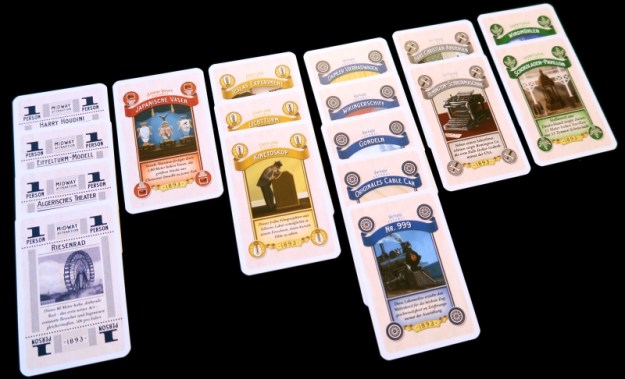
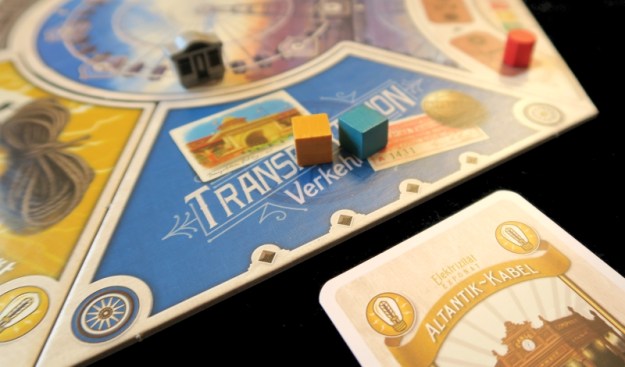
As they began setting up, the other four began deciding what to play.  After suggestions that largely fell on deaf ears, Blue eventually began unpacking World’s Fair 1893.  This is a clever little game that integrates area majority and set collecting mechanics.  The idea is that players choose a segment of the board and place a population marker in it before taking all the cards in that section.  Three cards are then added to the board, with the first added to the section cards have just been taken from and one each added to the next two segments.  Cards come in three types:  Character Cards, Midway Tickets and Exhibit Cards.

World's Fair 1893
– Image by boardGOATS

Character cards can be used to move cubes about or add extra cubes and are played by the active player between placing their token and taking the cards from that section.  When the Ferris wheel car has travelled all the way round there is an interim scoring stage.  Midway tickets are exchanged for one point, with the player who has the most earning bonus points.  Exhibit Cards are exchanged for tokens:  each of the five segments of the board are evaluated and the player with the most population tokens gains a couple of bonus points and the opportunity to trade up to three exhibit cards for matching coloured tokens. The player who comes second also gets points and can exchange fewer Exhibit Cards for tokens.

World's Fair 1893
– Image by boardGOATS

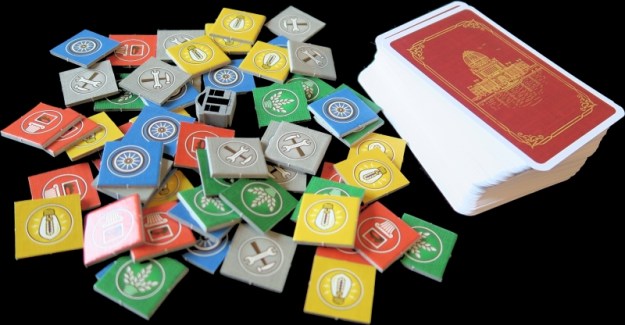
The tokens are combined into sets at the end of the game with the larger sets worth more points; sets containing all five different coloured tokens are worth fifteen points, with sets of four worth ten, and three, two and one worth six, three and one point respectively.  Played over the three rounds, the winner is the player with the most points at the end of the game.  Blue didn’t do a great job of explaining the point of tokens, so in the first round, Lime focused on collecting Midway Tickets, lots and lots of Midway Tickets taking lots of points and the bonus too.

World's Fair 1893
– Image by boardGOATS

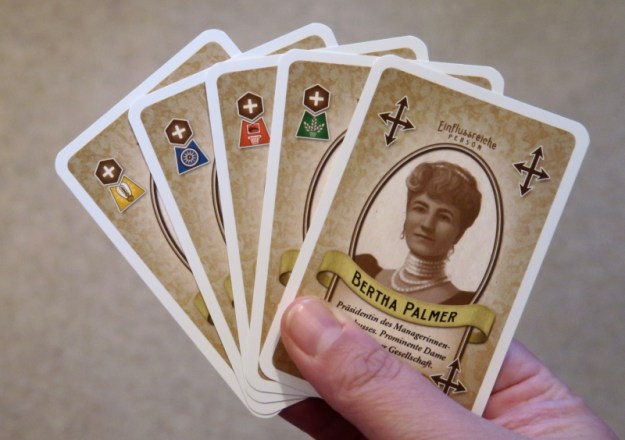
Pink, on the other hand, had played it before and better understood the relationship between Exhibit Cards, Tokens and points at the end of the game.  That said, he seemed to have a bit of a mental block on how to use the his character cards (after placing a population token, but before taking cards).  Bertha Palmer seemed to cause a particular problem and her function had to be explained at least three times before the message got through.  Through the second and third round, Lime continued to collect Midway Tickets while Blue, Pink and Pine tried to manipulate the majorities in the areas for which they wanted tokens for.

World's Fair 1893
– Image by boardGOATS

Lime kept doing well in the green Agricultural region, but was unable to get the cards to match.  This is the catch with the game:  in order to obtain tokens in a specific colour, players need the majority of population markers in that region, but also need to gain Exhibit cards to match, which quite likely are only available from other segments.  Pine commented that he thought this game should be played with ties cancelling each other out like in Las Vegas—funny, that that would have left him in pole position in several key areas that he needed…

World's Fair 1893
– Image by boardGOATS

As the game came to an end, the question was whether anyone would have enough sets of tokens to catch Lime with his huge pile of coins from his Midway Tickets.  It looked like Pink might make it with his two sets of five giving him thirty points, but he fell two points short.  Blue however did slightly better with sets of five, four, three and two and finished with sixty-two points, five more than Lime.  When Pine asked how Pink collected so many tokens, Pink’s response was, “Never underestimate the value of coming second…”

World's Fair 1893
– Image by boardGOATS

Everdell was very much still underway and although time was marching on, there was still time to play something else.  So a decision was made very quickly as Blue got out Les Aventuriers du Rail Express.  “Les Aventuriers du Rail” is the french name for Ticket to Ride, and this “Express” version originally released only in French and Italian, was a “light” version of the game, positioned somewhere between the “City” editions (like New York, London, Amsterdam etc.) and the full sized games.  Thus it plays quicker than the full sized game, but is longer than the City editions, and has a maximum of four players like the smaller games
Ticket to Ride: Switzerland
– Image by boardGOATS

The basic principle of all the games is the same however:  on their turn players either take two coloured carriage cards from the market, pay sets of cards to claim a route and place plastic pieces on the map, or draw tickets giving cities that players need to connect to score points.  Each edition has its own special rules and this one has a shared ticket:  London to Istanbul.  The first player to connect these cities gains twenty points with the second getting fifteen and so on.

Les Aventuriers du Rail Express
– Image by boardGOATS

Additionally, instead of Locomotive (Wild) Cards being included in the Carriage Card market, they are always available from a separate face up deck with players taking one card on their turn instead of two).  It didn’t take long before the group had checked they had the right number of trains and had identified the special rules for this version of the game.  Blue went first, but Pine was the first to place trains on the map, at which point everyone else realised they were going to have to go hard and fast to compete.

Ticket to Ride: Europe
– Image by boardGOATS

Blue also placed an early train, but Pink opted for the “expert strategy” espoused by Black, to pick up tickets early.  The idea is that knowing the destinations you need to connect early is an advantage, but this is offset of course, by the fact that it gives everyone else an extra turn to claim some of the routes you might need.  This time, unbeknownst to the others, Pink got lucky with long overlapping routes and, as a result picked up another batch of tickets.  Pine tried to follow the ticket strategy, but got less lucky.

Les Aventuriers du Rail Express
– Image by boardGOATS

Blue thought the London to Istanbul ticket was quite a good option as it was almost zero risk since it wouldn’t cost her if she failed to complete it, it was also relatively complementary to her starting tickets.  This strategy meant she had to go through the middle of Europe and, as a result, got caught up in the three-way punch-up with Lime and Pine centred on Strasbourg.  Pine came off worst, but unquestionably, Pink came off best as he eschewed central Europe, instead focusing on taking the route to Warsaw via Berlin which also included two slightly more lucrative five car connections.

Les Aventuriers du Rail Express
– Image by boardGOATS

Blue claimed the London to Istanbul route first and with it twenty points, followed by Lime who had completely forgotten about it in his tussle to make his other tickets.  Blue was then left with a choice:  pick up tickets or try to end the game quickly.  Knowing Pink and Pine in particular had a lot of tickets to complete and with plastic trains beginning to run low, she opted for the latter.  Unfortunately for her, Pink had already nearly finished his tickets and was able to complete his last one on his final turn.  That just left the scoring, and it wasn’t really close with Pink finishing with eighty-two and Blue the best of the rest some fifteen points behind.

Les Aventuriers du Rail Express
– Image by boardGOATS

On the next table, Ivory, Green, Teal and Purple played the “Feature Game“, the Bellfaire expansion to Everdell, the winner of the Golden GOAT just before Christmas.  Everdell is a fairly simple game in principle, with players either placing a worker to collect resources or then using the resources to pay to play cards from their hand into their tableau.  The game is very smooth to play, well balanced and has beautiful artwork.  One of the things that makes it different to many other games is that when a player runs out of actions (or earlier if they choose), they can end their season and reclaim all workers and start again.  This is important because some of the action spaces can only be occupied by one critter at any one time.

Everdell
– Image by boardGOATS

The cards come in different types, but one of the key aspects is that critter cards can be played by paying their cost or as a bonus for playing the associated construction card.  For example, if a player builds a Courthouse, they can play the Judge at the same time if they have it in their hand.  Cards give players special powers, extra resources, actions and points at the end of the game.  Each player’s tableau can only hold a maximum of fifteen cards; when a player cannot perform any more actions (or does not wish to) they pass and their tableau is completed.  Everyone else carries on playing and the game continues until everyone has passed with the winner being the player with the most points.

Everdell
– Image by boardGOATS

The Bellfaire expansion adds a little bit of variety to the game, in particular the Market, a Bonus for one of each card category, and a randomly selected Beauty Bonus for the most purple flower cards.  The group also included the Extra! Extra! and Legends cards with the Corrin Evertail cards (from the Mistwood expansion).  One of the joys of Everdell is selecting playing pieces. With sixteen different creature meeples to choose from there is something for everyone.  Ivory  was quick to nab the purple coloured Platypus, Teal selected grey Hedgehogs, Purple chose red Squirrels and Green wanted the green Lizards.

Everdell
– Image by boardGOATS

On pulling out all the Lizards from the Box, Green declared that one of his meeples was disabled. It was missing the bottom half, its legs and its tail, poor thing!  To give this one an easy ride green selected it for later use as part of the Autumn cache.  As expected Ivory got off to a flying start.  While Purple was the first to leave winter and head into spring, Green and Teal were not far behind. Ivory, however, seemed to be able to keep going in Winter for many turns after everyone else had left.  He had been quite lucky with the card draw and was able to pair critters with his buildings to a much greater extent than everyone else.

Everdell
– Image by boardGOATS

Teal noticed that Ivory had completed all the card categories and could claim the bonus tile, but he kept quiet and instead was the first to claim a bonus tile: for having three forest tags.  A short while later Green also noticed that Ivory could claim the bonus, but he, perhaps due to silliness or perhaps innate honesty, did not keep quiet.  Ivory had not noticed, so promptly claimed it on his next turn.  No-one else was able to fulfill that requirement for quite some turns.

Everdell: Bellfaire
– Image by boardGOATS

The Bellfaire Market allows players to choose to either gain resources, or to trade them.  When gaining resources, players choose one token, gain the resources and cards, then move that token to the “trade” side of the market.  When trading, players pay resources and discard cards to gain three points and any two resources, before moving the token back to the “gain” side.  This time, players used the market to collect initial resources, but once they had all been used, no-one seemed to show much interest in trading to bring them back into play.  Trading did happen a couple of times later in the game, but no-one could really see the benefit of the trading versus collecting resources outright, especially since two of the randomly drawn extra forest spaces included the ability to trade cards or wood for “any” resource.

Everdell
– Image by boardGOATS

The pattern of Purple going into the next season first and Ivory going last remained all the way through Spring and Summer.  Ivory did slow down somewhat though, and did not enter Autumn much later than Teal and Green.  By this time, most the group had managed to play at least one of their Legends cards and were beginning to use them to good effect.  Green’s Ranger Strey Softpaw which enabled him to use two already used forest action spaces for one worker was generally remarked as a very useful legend card.  Maybe that was how he was able to catch up a little, but one of the key challenges he struggled with was being able to get the Critter and Construction pairs.

Everdell
– Image by boardGOATS

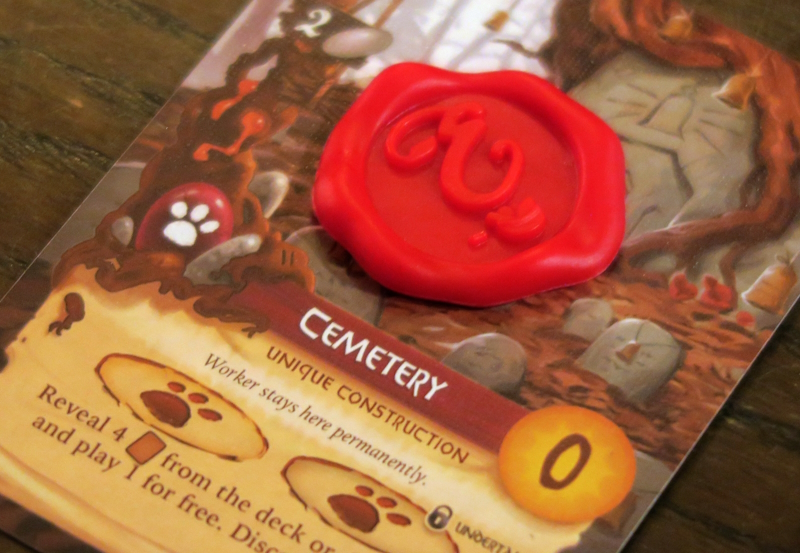
Once Autumn came round, it was time for the poor disabled lizard to play a part on Green’s behalf.  That part was, to cries of being cruel, to go straight to the Cemetery so he could select a card to play for free—unfortunate critter!  Although Ivory kept going longer than anyone, he already had all fifteen cards played, and found himself unable to do much else, even though he still had workers left.  Purple finished early with a similar problem, although she was unable to afford any more cards even with gathering from her last worker.

Everdell
– Image by boardGOATS

Eventually, everyone finished their final season and in the final scoring, Ivory scored big on the card totals.  Green did quite well and finished a few points ahead of Teal, though Purple suffered as she had not been able to play as many cards.  Ivory also scored well on other bonuses and Teal and Green were similarly matched with several bonuses, except that Teal managed to accrue more coins and score Journey points.  As a result, Teal took second, though Ivory was way ahead of everyone else.

Everdell
– Image by boardGOATS

Learning outcome:  We’ll have to brush up the Everdell skills if we ever want a chance of beating Ivory in future.