Tag Archives: Libertalia

5th September 2023

The evening began with Green and Purple arriving to find Plum and Cobalt sitting outside the pub chatting.  This was partly because the weather was warm, but also because someone else was sitting at our usual table and we had been relegated to another long table on the other side of the room.  Pine arrived soon after and once introductions between Cobalt and those who had not been about last time were concluded, the group decided to play a short intro game while they waited for everyone else to arrive.  The game settled on was Coloretto, which had only just begun when Ivory arrived, but he was happy to watch.

Coloretto
– Image by boardGOATS

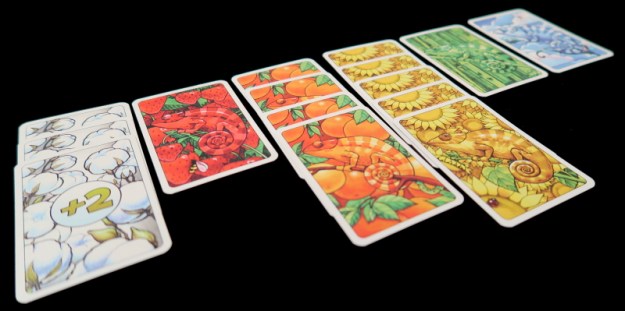
Coloretto is a quick and simple game that is very popular with the group.  Players either turn over the top card and add it to a “Truck”, or take a Truck and add it’s contents to their collection, sitting out until everyone else has taken a Truck.  Players are collecting coloured sets of Chameleon cards, but the key is that only three sets score positive points, with the others scoring negatively.  Thus players are trying to get as many cards in three colour suits, and as few as possible in each of the rest.  This time, everyone started with a different colour, so there were no obvious clashes.  As is usual for this game, it took a few turns for each players position to become clearer.

Coloretto
– Image by boardGOATS

By this time Plum was keeping the number of colour sets she had low with only two, but also had a couple of +2 bonus point cards and a Rainbow Chameleon (a wild) . Purple’s set was similar but with three colours.  Green was making steady progress and Cobalt was low on any particular colour, but only had four sets and a Rainbow Chameleon, so was poised for a good score if the cards fell in his favour. Pine meanwhile seemed to be in the process of collecting at least one of each colour!  By the end of the game, Plum had managed to collect Chameleons in just three colours and so scored no negatives, while Pine just seemed to have sets of everything. Purple had three extra colours, but with only one of each; her Rainbow Chameleon and +2 cards helped to give her a good score.
Coloretto
– Image by boardGOATS

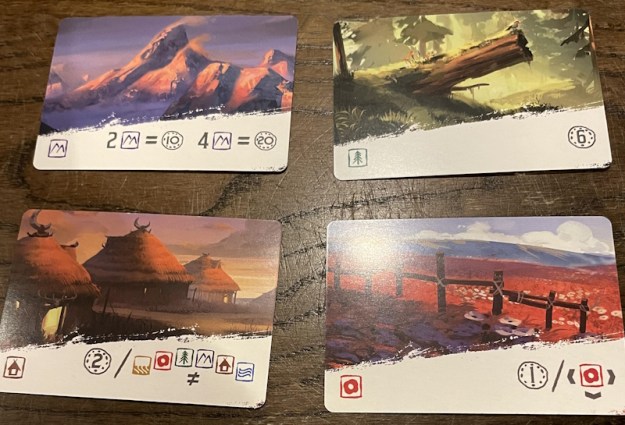
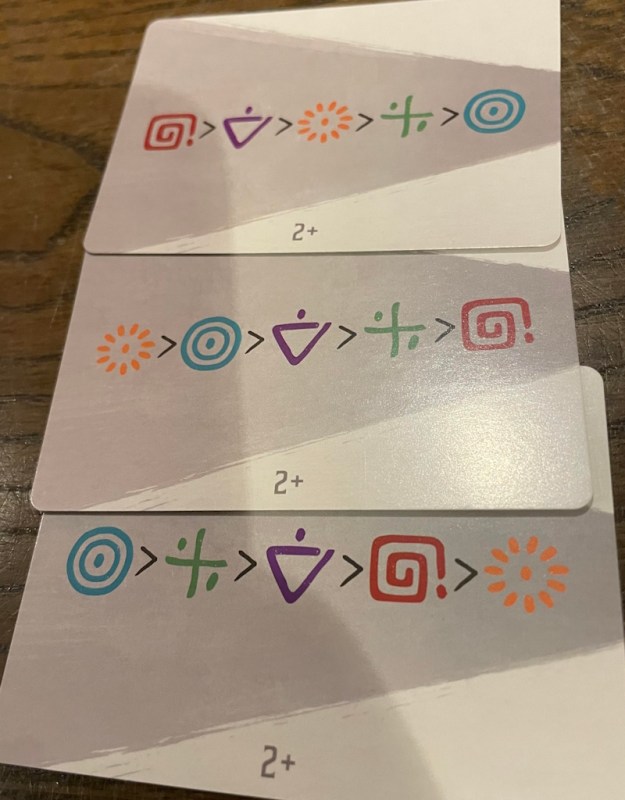
Green managed only one negative point, but had no bonuses, while Cobalt had his cards fall right and ended with a couple of good colour sets and with it, victory.  By the conclusion of Coloretto, Jade and Sapphire had arrived bringing with them the feature game, Vaalbara.  In this game, each player is a clan leader trying to take over some territories with game-play which is vaguely reminiscent of Libertalia/Winds of Galecrest.  Players all have the same deck of twelve cards representing the members of their tribe.  Each turn, players choose secretly one card, then in the order of initiative of the revealed Characters, players activate their powers and take over one of the available Territories. Each type of Territory has its own way of scoring points (Collection, Pair, Diversity, Risk etc.).
Vaalbara
– Image by boardGOATS

Thus the game is about timing and playing the best powers and the high initiatives at the most opportune moments. After nine rounds, the player with the most points wins.  Jade and Sapphire had played Vaalbara about a dozen times together, and Green had played a similar number of games on Board Game Arena with reasonable success. Pine was entirely new to it the game and joined the other three.  Jade and Pine took the Mountains in the first round, and then Jade managed to snatch the only one on offer in the second round.  Green ended up with the final card in the first round—the All Rounder, so scored poorly with it.

Vaalbara
– Image by boardGOATS

By the middle of the game Sapphire was going all out for Fields, Jade was on to his third Mountain and Pine was beginning to get the hang of things.  Green was struggling with his all rounder strategy:  all he could get was a River and several Forests and even after he’d swapped one of those for something else (he’d mixed up the cards and instead of swapping a card between first and second row, it was any card with the top card of the deck) it didn’t work out.  Pine managed to complete his second Mountain, but Jade amazingly managed all four which catapulted his score. It was only then that Pine and Green realised that the fourth Mountain was twenty points on top of the ten for the first three (i.e. a very thirty in total from four cards).
Vaalbara
– Image by boardGOATS

By the end of the game the Poppy Fields were coming out in profusion and started to really score a lot of points.  Unfortunately for Green, Jade managed to nab the Field card ahead of him for a five type bonus and Green was still only on four terrain types.  Once the dust had settled and the final scores were compiled, it was quite close with Jade and Pine were tied for first on seventy points, and Green only three points behind and just ahead of Sapphire. Pine joked that maybe the tie-break would be the player position on the last card back, thinking that would about as arbitrary as some of the other tie breaks had been recently. A quick check of the rules confirmed it and ultimately gave victory to Jade.
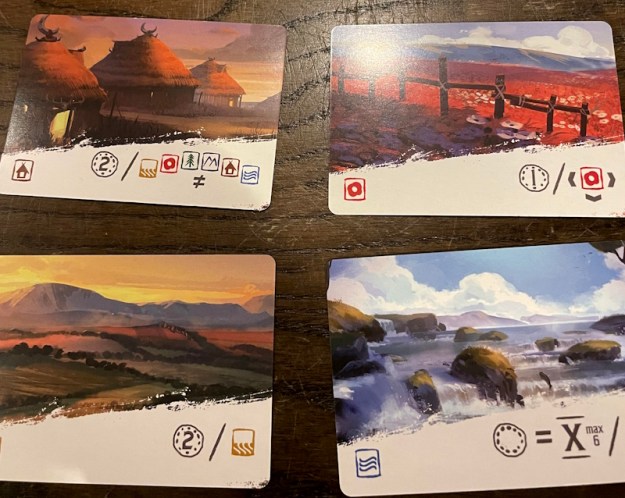
Vaalbara
– Image by boardGOATS

From there, the quartet moved on to play an old favorite, Azul.  In this game, players are tile-laying artists challenged to embellish the walls of the Royal Palace of Evora.  On their turn, players draft colored tiles from the marketplace onto their player board.  At the end of the round, players score points based on how they’ve placed their tiles to decorate the palace with wasted tiles scoring negative points.  Bonuses are awarded at the end of the game for completing rows and columns and sets of the same colour, and then player with the most points is the winner.  A pretty game, the group started with a short discussion about what colour one of the tiles really was.
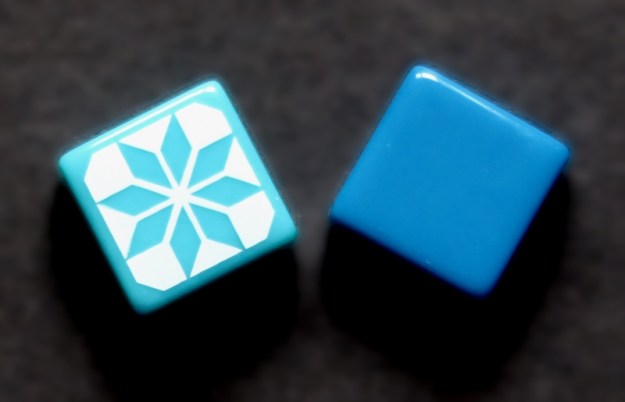
Azul
– Image by boardGOATS

People wanted to call it blue, but there is already a fully blue tile, and this one was a little more turquoise with a white pattern—they did not come up with answer to the problem.  The game played much as it always does with complaints about the tiles that were not coming out of the bag when needed and at one point there was one Marketplace with four tiles all the same colour (that colour that we could not quite pin a name on).  Mid-way through the game no-one seemed to want the orange tiles, and it ended up with about eight of them in the middle of the table. It finally fell to Pine to take them, but he could not place any of them and they all had to go on his negative score line!
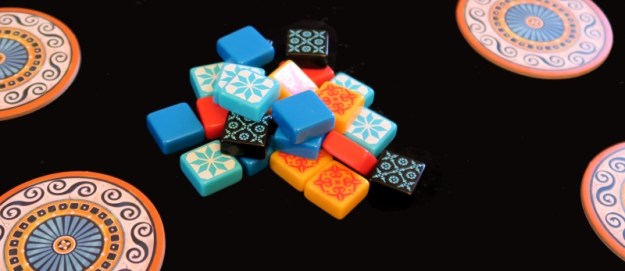
Azul
– Image by boardGOATS

The game was reluctantly brought to a conclusion by Sapphire, at the urging of everyone else.  He did not want to complete his row, wanting to hold out and complete a different colour later, but if he hadn’t taken the tile he would have ended up with a larger negative score and it had already not been possible to fully populate market. After final scoring, Jade and Sapphire shared the lead with ninety-five points with Green, who’d had a much better game than he usually has in third.  Tie break time again, but this time Sapphire won it because he was the only player to have completed a full row (the tile he hadn’t wanted to take).
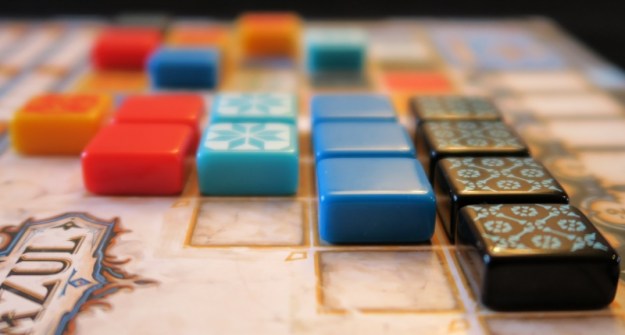
Azul
– Image by boardGOATS

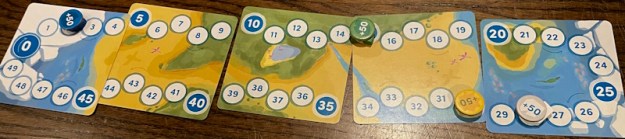
There was still time for something else, and the group settled on Nimalia, a new, interesting card-laying game where players are designing the best Animal Sanctuary.  Each card has four “Biome” squares on it of potentially different terrain, and different animals.  Players start each round with three cards and draft them, placing the chosen card partly (or wholly) on top the already laid cards in a simlar way to Sprawlopolis or Honshū.  The Sanctuary must remain within a six by six grid made of the squares (not the cards).  The game is played over a series of five rounds, where two or three different conditions are scored at the end of each drafting round.  This time, the first round would score for the largest area of Savannah and for connected Polar Bears and in the second round the scoring switched to Polar Bears and Gorillas next to Water.

Nimalia
– Image by boardGOATS

In the third round it returned to the largest Savannah, but with the complication of scoring maximum for no Giraffes down to scoring nothing with three or more giraffes—of course giraffes live in the Savannah!  Rounds four and five used both the Giraffes and the Gorillas to score while adding in the Savannahs in the fourth round and polar bears in the fifth.  The nature of the scoring meant that any cards with Giraffes were quickly passed on leaving some players with a double giraffe card to lay as the last card on a giraffe scoring round.  Since it wasn’t possible to lay a new card underneath an old one, those giraffes caused scores to tumble!
Nimalia
– Image by boardGOATS

In the first round Pine roared into the lead while everyone else stayed within a point or two of each other.  After the second round, Sapphire was the one who lost out, with Pine retaining his significant advantage. During the third and fourth rounds Jade and Green managed to catch Pine, with Jade pulling into the lead.  Sapphire managed a good score in the fourth round, but he had a lot of ground to make up and he’d left his charge to the finish a little too late.  In the final scoring, Jade and Green pulled ahead in a tight battle, which Jade won by just two points with his total of eighty. Pine was third after flailing around in the final round and having been left with a double giraffe.

Nimalia
– Image by boardGOATS

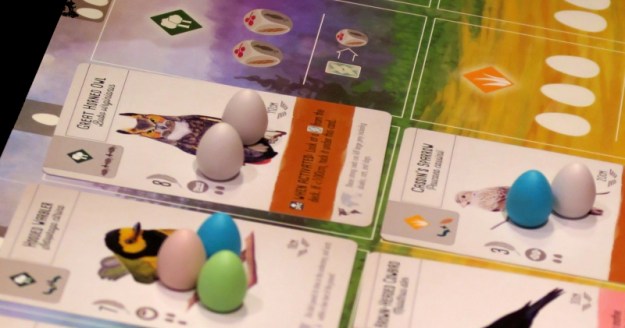
While all that was on-going, the rest of the group, Plum, Ivory, Purple and Cobalt, opted for a club favourite, Wingspan, enhanced by the European Expansion.  This is a card-driven engine-building game where players choose one of four possible actions (activating their Woodland, Grassland or Wetland areas or placing a bird card in one of those locations).  Points come from each individual card end of round goals, and eggs left at the end.  The game is all about building combinations of cards that work together efficiently, so the it took all night as everyone wanted to do their absolute best.
Wingspan
– Image by boardGOATS

Ivory as always was very good at this, but was also quite generous giving everyone food each time he activated his Woodland area.  Cobalt was the first to get three bird cards in his Reserve, though Ivory  ended up with the most valuable birds on his board, with Plum’s next highest.  One of Plums birds moved at the end of each round though, which was very useful for saving costs and improving yields.  It was Ivory and Cobalt who tended to come out best with the end of round goals.  As is often the case Ivory continued to score well with a good haul of bonus card points too.

Wingspan: European Expansion
– Image by boardGOATS

Purple failed to complete any of her bonus cards, but did make sure all her birds laid purple eggs.  Cobalt finished the game with the most eggs, however, inevitably followed by Ivory.  As for cached food and cards, Plum got the most food, but Purple had the most Tucked cards.  With all the scores added up, Ivory was the almost inevitable winner on ninety-three with Cobalt not far behind with eighty-three and Plum taking the battle for third by just three points in what was a hard-fought game.

Wingspan
– Image by boardGOATS

Learning outcome:  Goats love playing with colours.

20th April 2022

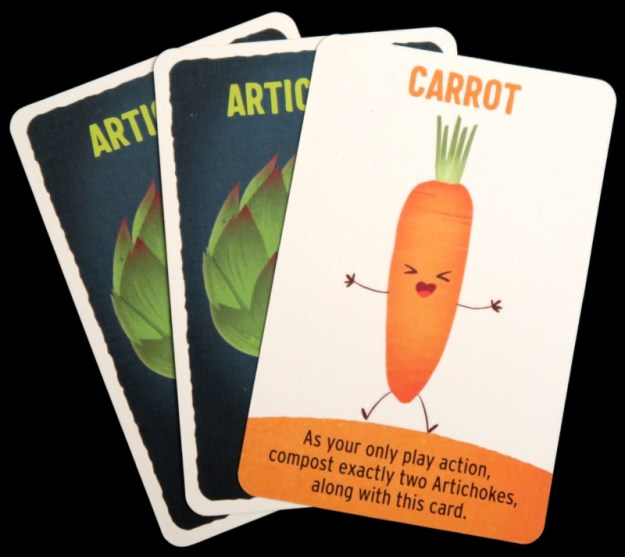
Meeting for the first time on a Wednesday, Pink and then Blue were the first to arrive, and like last time, played a game of Abandon all Artichokes (with the Rhubarb mini-expansion) while they waited for food to arrive. This is a very quick and simple “deck shredding” game: on their turn the active player takes a card from the face up market, adds it to their hand and then plays as many cards as they can before they discard the rest and draw five new cards. If this new hand contains no Artichoke cards, the player wins.  Although it is very simple, it seems the function sequence is somehow challenging.  Pink struggled last time, but seemed to have got the better of it as he won.

Abandon All Artichokes
– Image by boardGOATS

As they were finishing, Pine turned up and, while Pink went to the bar, Blue explained the rules to him and then they played again.  Pine also struggled a bit with which pile was the discard pile and which the draw pile, and where to take cards from and where they were going to.  There is hope though as, despite the arrival of food in the middle, Pink won the second game too.  Pink and Blue were just finishing their supper when Purple and Black arrived, soon followed by Green, Lime and Ivory.

Abandon All Artichokes
– Image by boardGOATS

This week, the “Feature Game” was the new edition of Libertalia, Libertalia: Winds of Galecrest, a card driven game where players are admirals commanding a crew of sky pirates in search of adventure, treasure, and glory.  Pine had watched the advertised play-through video and professed it “looked” fun, so was keen to give it a go.  Ivory and Pink joined the party, while Green shouted across from the other end of the table that he would be happy either way as he knew nothing about it.  In the end, after considerable debate, Ivory, Pink and Pine were joined by Blue and Purple, leaving Green, Black and Lime to find something else to play.

Libertalia: Winds of Galecrest
– Image by boardGOATS

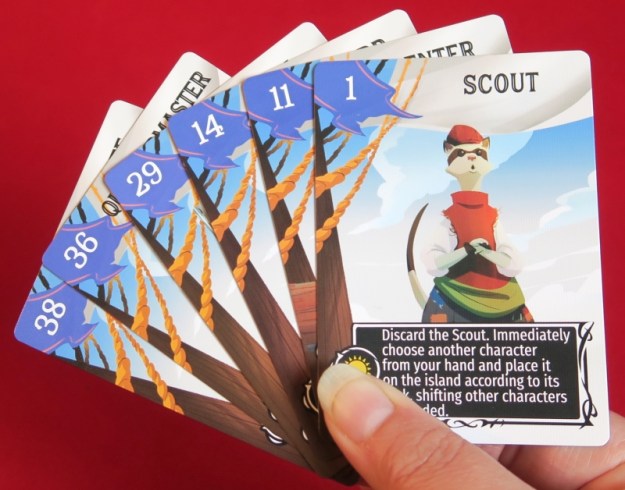
Although Blue had read the rules, she had very deliberately not looked at the character cards, so Pine arguably knew most about Winds of Galecrest.  It is a rejuvenated version of the older game, Libertalia, but with new, lighter artwork, additional characters and streamlining of some of the mechanisms.  Very simply, each player starts with a deck of forty cards, of which six are drawn into their hand.  The idea is that players have the same character cards to play, but can play them in different orders.  Thus, one player (in our case Pink) shuffles their forty numbered cards and then draws six, which the the others find in their numbered and sorted decks.

Libertalia: Winds of Galecrest
– Image by boardGOATS

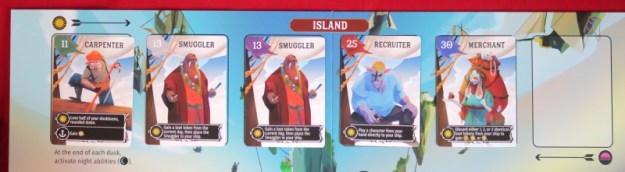
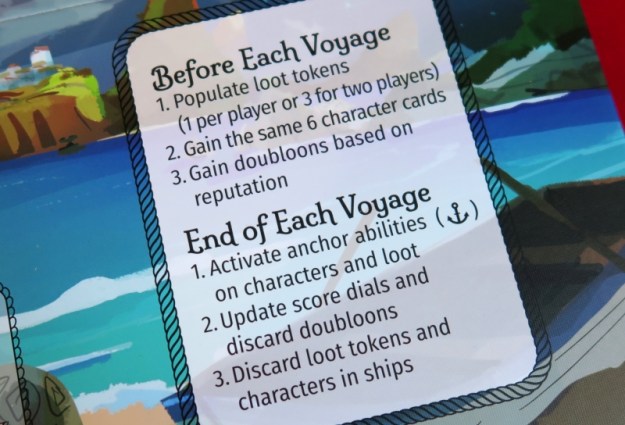
The game is played over three voyages, the first of which takes four days, the second, five days, and the final voyage takes six days.  Each day, players simultaneously choose a card to play, which when revealed are laid out in numerical order on the island.  The are then played three times: first in ascending order (daytime), next in descending order (dusk) and finally simultaneous (night).  Some cards only have actions that activate in one or two of the time-frames, but any characters still on the island, move back to that player’s ship and stay there till the end of the voyage.  At the end of the voyage, players activate any loot and characters they have with end of voyage actions.  Despite that being pretty much all there is to the game (and it being written clearly on the board), the group still managed to make a bit of a meal of it.

Libertalia: Winds of Galecrest
– Image by boardGOATS

The first hand consisted of six relatively uninteresting cards (or so it seemed at the time), which all had daytime actions.  The first voyage, and to some extent the second too, players were feeling their way.  Because the group failed to remove the Character cards from their ships at the end of the first voyage, that skewed things somewhat, especially as some players had the First Mate in their ship which in some cases scored twice giving points for the number of characters in their ship which was also artificially inflated.  Ivory knew which cards he’d played and when, but others were unsure and some had built a strategy that relied on having certain Characters in their boat at the end of the second voyage.  So rather than trying to back-track, ships were emptied for the first time at the end of the second round.

Libertalia: Winds of Galecrest
– Image by boardGOATS

It took the group a bit of time to understand when the actions for the loot happened—most occur at the end of the voyage, but some occur on the day they are collected, during the dusk phase.  As a result, several players missed some of those dusk actions, the additional reputation gained from picking up a Barrel in particular.  At the beginning of the second round, Blue, Pine, Ivory and Pink agreed they were all playing the “obvious card”.  On revealing their cards they discovered they had differing ideas of what the obvious play was, which gave the first inkling that there was much more to the actions than had first appeared, but the players really got to grips with the planning aspects of the game in the final round.

Libertalia: Winds of Galecrest
– Image by boardGOATS

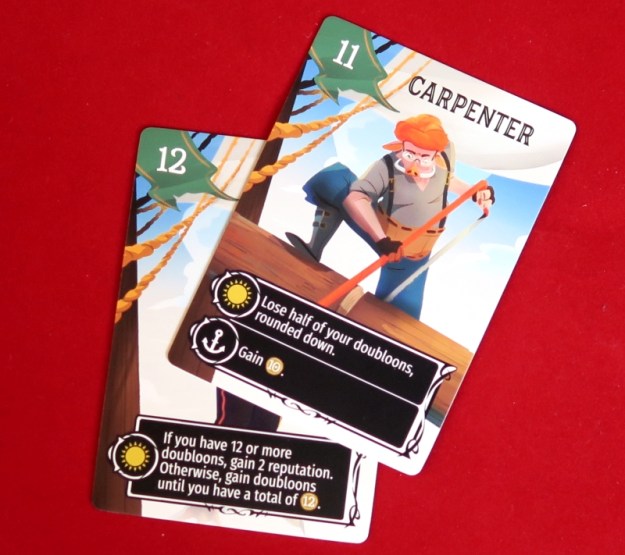
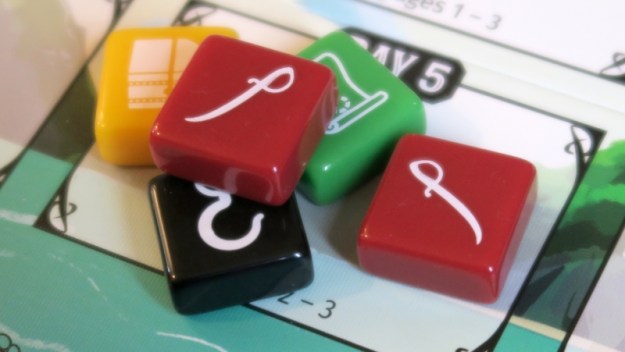
Ivory played his Carpenter, which reduced his funds by half, and immediately followed it with the Officer which increased his kitty to twelve doubloons.  Then, because he is always a threat, he was targeted by Pine and then Blue, losing first his Carpenter and then his Gambler from his ship (both give money at the end of the round).  Blue then assassinated Pink’s Carpenter and he took out her Gambler in revenge.  Pink discovered that the Saber type loot was much more dangerous than he gave it credit for as yet another of his Characters on the island bit the dust.  Meanwhile, Purple was building the contents of her treasure chest largely unmolested, mostly only suffering as collateral damage.  Pine also made killing by playing his Bodyguard with perfect timing, simultaneously taking lots of gold for discarding all the Sabers and Hooks from the loot pile, and starving everyone else of treasure.

Libertalia: Winds of Galecrest
– Image by boardGOATS

In the final accounting Blue was the most successful pirate, though she was one of the beneficiaries of the “rules malfunction” at the end of the second voyage.  Purple made an excellent second place though, picking up loads of gold from her loot while largely managing to avoid being caught in the cross-fire as the others attacked each other.  Libertalia is a much more vicious game than those we usually play, even though it was a “Calm” game and supposedly “easy and friendly”—Heaven only knows what Stormy will be like!  It was a lot of fun though, especially when the group started to get to grips with it properly during the final round.  It’s clear the game could cause a lot of relationship trouble, but that won’t stop it getting another outing soon.

Libertalia: Winds of Galecrest
– Image by boardGOATS

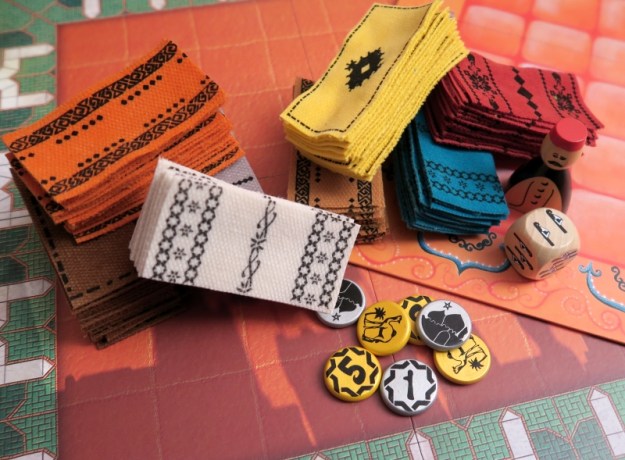
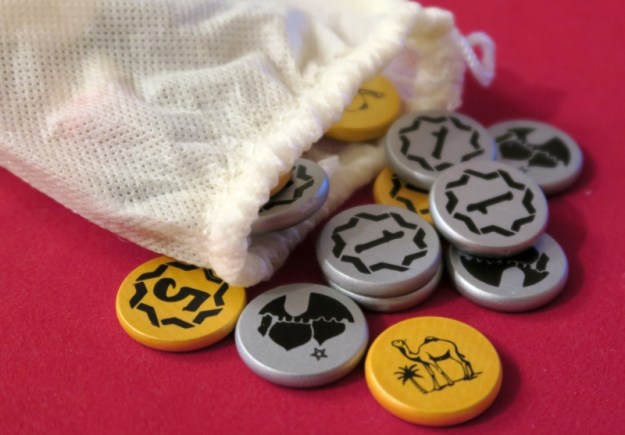
Meanwhile, on the next table things were much more peaceful with Green, Black and Lime laying carpets.  No-one felt up to anything too taxing or long tonight, so after reviewing the selection of games available Black suggested they play Marrakech, which certainly fitted the bill. Marrakech, is an unusual little game, with fantastic little rugs made of fabric and coins made out of wood, where players take the role of a rug salesman who tries to outwit the competition.  Each player starts with ten Dirhams and an equal number of carpets.  On their turn, players may rotate Assam ninety degrees, then roll the die and move him forward as many spaces as shown (up to four).

Marrakech
– Image by boardGOATS

If Assam lands on another player’s carpet, the active player must pay one Dirham per contiguous carpet square of that colour.  Finally, the active player then places one of their carpets orthogonally adjacent to Assam.  The winner is the player with the most money after the last carpet has been laid.  After a quick explanation to Lime (who hadn’t played it before), the group had to decide the Role of the Merchant.  On Board Game Arena, there are two options:  one where the player turns him himself before rolling the dice, and another where the player who just played gets to turn him at the end of their turn and before the next player.

Marrakech
– Image by boardGOATS

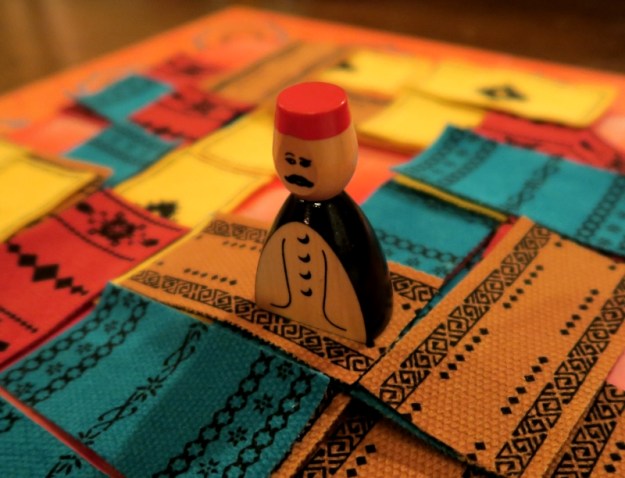
After a brief check of the rules, the group discovered that the first option was the original rule (move the merchant before rolling the dice) and so they went with that.  As a result it took several turns before anyone landed on anyone else’s carpet, then Black landed on a single square of Lime’s.   A couple more turns and landing on carpet became a regular activity.  When Green landed on a five square of Black’s, it became apparent that Lime had been labouring under a false understanding about what counted as a paying patch of carpet. He had thought that players have to pay for all the carpet squares connected, by any means including other people’s carpets, but of course only the patch that the Merchant is stood on counts.

Marrakech
– Image by boardGOATS

At various points in the game everyone had a large patch of carpet posing a hazard to the other players: Green had a large area in one corner, Black a large squarish patch in the middle, and Lime managed to get a zig-zag line from one corner all the way to the opposite one.  Mostly everyone managed to avoid landing on these until they were broken up, but that duck was broken when Green landed on a large Black area, shifting the coin balance heavily in Black’s favour.  At the end of the game carpet value was added to coins, and although Green had the most carpet showing, Black had significantly more coins than the others and finished as the winner by five points.

Marrakech
– Image by boardGOATS

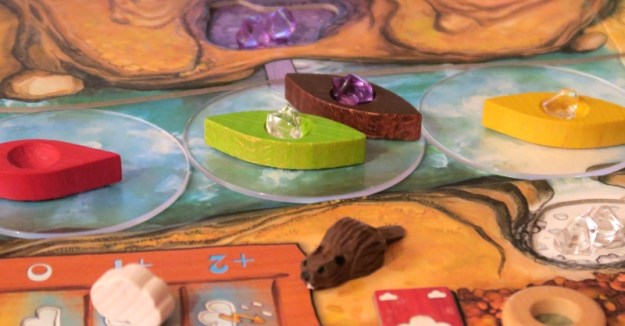
Libertalia was still ongoing, and Marrakech had served as an excellent aperitif, but it was now it was time to move on to something more substantial, and the game of choice was Niagara. This is fantastic family game, that won the Spiel des Jahres Award in 2005, but is still a lot of fun seventeen years later.  The idea is that players have two canoes that they are using to navigate up and down the river while trying to collect gems and land them safely on shore.  Players simultaneously choose a paddle card from their hand, which dictates the distance their canoes travel.  Once everyone’s boat has travelled, the river moves and any canoes that are too close to the falls take the long drop and are turned to matchwood.

Niagara
– Image by boardGOATS

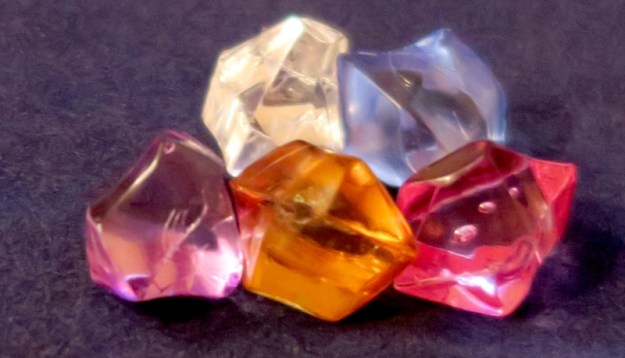
Players are trying to land five gems of the same type (or seven different colours) and the first to do so is the winner.  We last played this about nine months ago, online, through the medium of Board Game Arena.  On that occasion, Pink had betrayed everyone’s trust and stole several people’s precious loot.  The victims (in particular Burgundy), were vociferous in their grievance, and as a result, despite Pink being enthusiastic about playing again, nobody was keen to join him.  With Pink tied up in a quite different loot battle, this was a good opportunity to play again as it was still quite early and it was also an opportunity to introduce Lime to an old classic.

Niagara
– Image by boardGOATS

The first round played relatively gently and much the way it normally does with everyone holding their cloud paddle tile (which allows them to change the speed of the river) back for the last round.  Going into the second round however, Black and Green conspired to shake things up a notch. After putting a canoe onto the river, Black then moved the cloud from the plus one space it had been left on at the end of first round, to the plus two space. However, Green had also thought this was a bold move and had planned to do the same, but unfortunately, he had to move the cloud and as plus two is the maximum, the only direction to go from plus two was back to plus one.  The result was that everyone spent the rest of that round moving five steps forward and four back.

Niagara
– Image by boardGOATS

The highest cards were not enough to get players’ boats off the river and each time they just got dragged back again, with the landing stage forever out of reach.  Green tried to “go against the flow” using some lower cards earlier in the round and holding a bigger card for later, but apart from moving around on different river discs, the end result was still the same.  Everyone ended up on the same disc a couple of times too, and Lime was unfortunate when he lost one of his boats over the rapids.  At the beginning of the third round players got their boats off the river.  By this point, Black had managed to collect four different coloured gems and only needed that elusive pink. Green also had four gems, but that included two purple ones.  Lime had just two gems as he decided to trade one to get his second canoe back.

Niagara
– Image by boardGOATS

Black tried to inch down the river, sometimes choosing not to move a canoe in order to arrive at that last spot to collect his game winning pink gem. However Lime slowed the river down to minus one, and this left Black’s canoes in the wrong place.  In the meantime, Lime also collected another couple of gems and Green managed to pick up another two as well, one purple and one blue.  This left Green needing just one gem to win with seven (the fact that a pink would give him one of each did not matter—there is no double win in this game).  As the new round began, Green got on the river, collected the final purple gem and there was nothing the others could do to stop him landing it on his next turn.  And with that, the paddling was over with Green the victor.

Niagara
– Image by boardGOATS

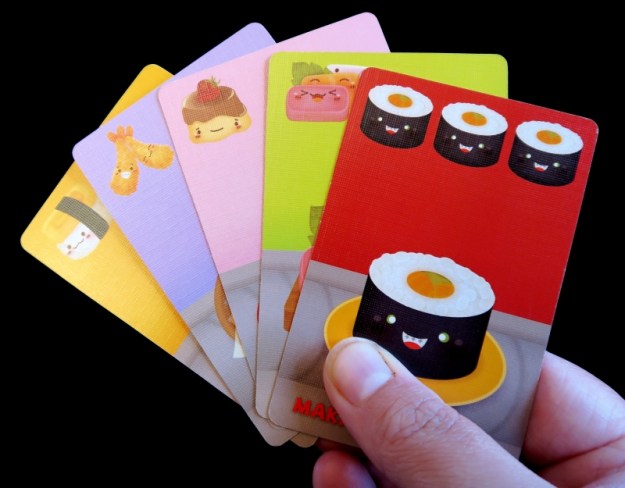
Although it was not that late, Lime and Green left for their respective homes, leaving Black to watch the final few turns of Libertalia.  When that wound up, Ivory headed home and there was still time left for something short. While everyone else discussed the options, Pink went to the bar for a “tot” of Dead Man’s Fingers Rum.  In his absence, Bohnanza was eschewed as “not short” and 6 Nimmt! and Coloretto had both been played recently.  Saboteur doesn’t play so well with smaller numbers so in the end, the game chosen was Sushi Go!.  The first thing to do was to remove the promotional expansions for its big brother Sushi Go Party! (Sukeroku, Inari, Sake and Pickled Ginger; these can be played with the original version but other cards need to be removed), however the Soy Sauce promo cards included as usual.

Dear Man's Finger Rum
– Image by Pine

The game is really simple:  from their hand of cards, players simultaneously choose one to keep and pass the rest on before repeating until everyone has no cards.  At the end of the round the different cards are scored according to their individual characteristics.  After three rounds, puddings are evaluated and the winner is the player with the largest total number of points.  This time there was a serious shortage of puddings in the first round and Blue seemed to have more than her fair share.  It wasn’t clear whether it was because she was overly focused on deserts or whether it was just because she’s rubbish at the game, but her score was lower than everyone else except Pine.

Sushi Go!
– Image by boardGOATS

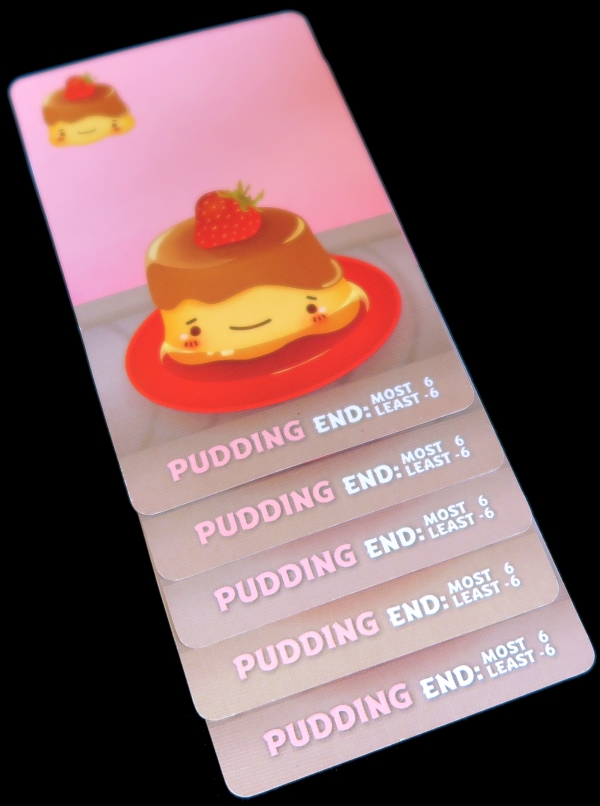
Pine made up for it in the second and third rounds.  In general, consistency is usually the winning factor in Sushi Go!, so Pink should have been in a good position, but both Black and Purple had a couple of really strong rounds, as indeed did Pine.  As a result, it was a really close game.  Pine was undone by the combination of his poor first round and the fact he was the only one with no puddings and lost six points as a result.  In contrast, Blue’s score was boosted by six points as she had a clear majority.  It was Purple and Black who were the ones to beat though, as they tied for the lead on thirty points and tied on the pudding tie break as well, so shared victory.

Sushi Go!
– Image by boardGOATS

Learning Outcome:  If you are looking for job security, don’t become a pirate.