Tag Archives: Little Town: Goodie Buildings

24th June 2025 (Report)

The evening began quietly and for a while Blue, Purple and Black wondered whether they were going to be the only ones and had got the wrong week, but before long, people trickled in.  The hot weather seemed to have sapped a lot of the enthusiasm from everyone, but eventually, two groups began playing Port Royal. This is a fairly simple “Push-your-Luck” game where players are merchants in the Caribbean.  It has an interesting history as it was originally released by the Österreichisches Spiele Museum, the Austrian Games Museum as Händler der Karibik (Traders of the Caribbean).
Port Royal
– Image by boardGOATS

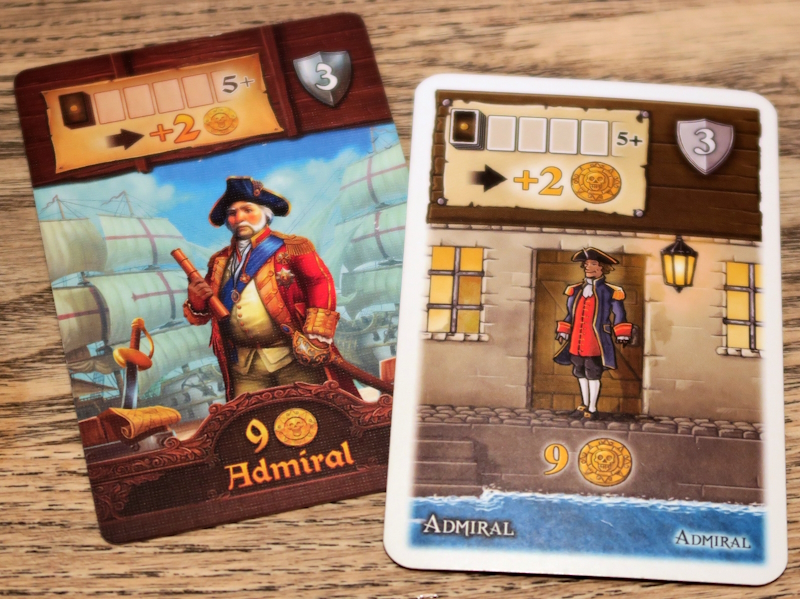
When it won the Austrian Game Designers Competition, the game was taken up by the publisher Pegasus Spiel in 2014, who added a few cards and tweaked the rules including adding a few cards so it works with five players.  The artwork didn’t change significantly though, that happened much more recently, in 2022, when Pegasus brought out a Big Box edition which included both the Contracts and Campaign expansions, the Gambler promo and the lighter “expandalone” Unterwegs game.  This time both the 2014 version and the Big Box edition got an outing, with Jade leading Lime, Ivory and Mint with the new edition, while Plum set up the older game in a much smaller box with Sapphire, Black and Flint.
Port Royal
– Image by boardGOATS

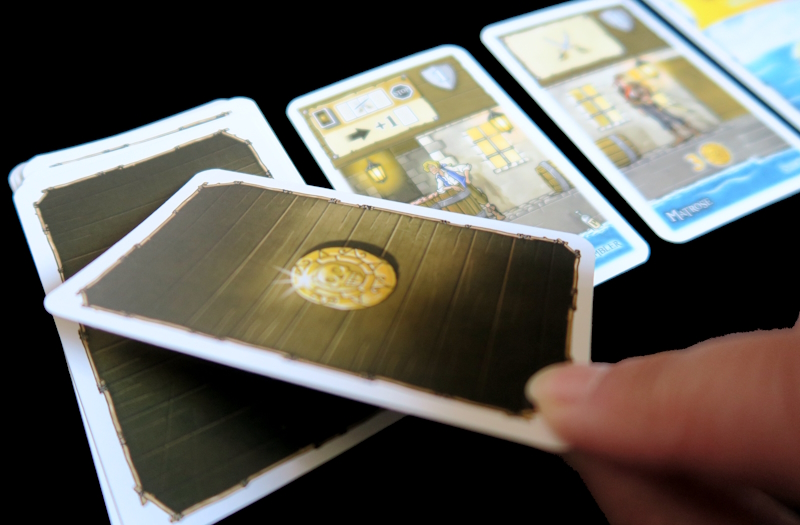
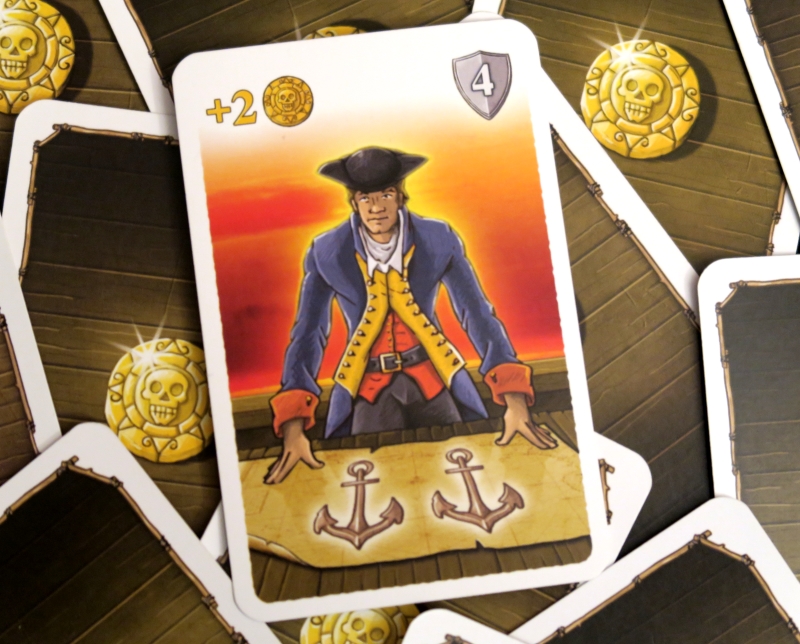
The basic game is quite simple:  players draw cards, as many cards as they like until they choose to stop and take cards, or go bust by drawing a second Ship card of one colour.   There are four different types of cards, but most are Ships or Characters.  Ships come in different five colours and are worth Doubloons (like San Juan and Bohnanza, these are just cards that are stored face down to show the Coin on the reverse), whereas Characters generally give some sort of on-going power, are worth Points, and are paid for with Doubloons.  Some of the Character cards (Pirates and Sailors) provide Cutlasses, which enable players to repel Ship cards that they don’t like, thus extending the number of opportunities to draw cards without going bust.
Port Royal
– Image by boardGOATS

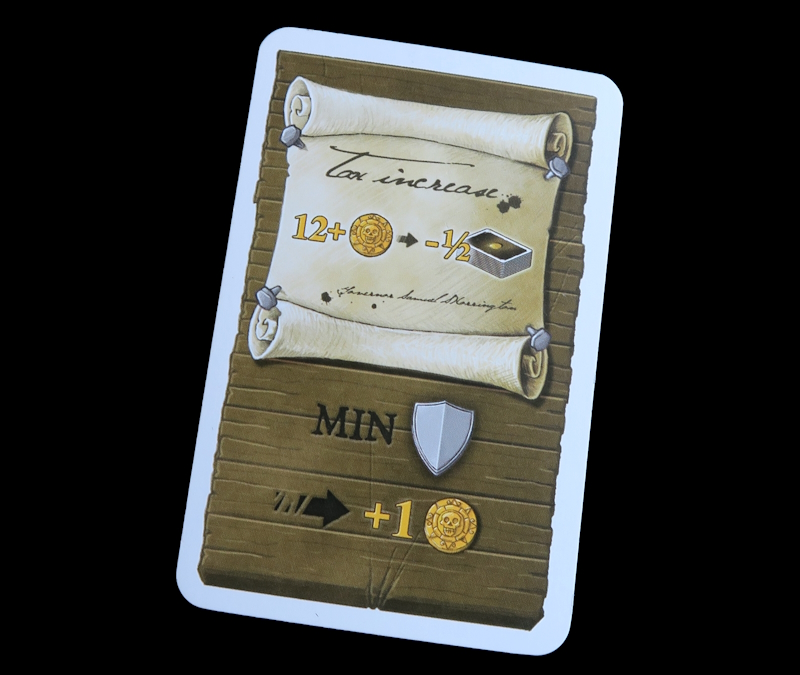
In addition to Ships and Characters, there are also two other types of cards in the deck:  Expedition and Tax cards.  Expedition cards, once drawn are placed in the centre to become communal objectives that give points, but once achieved by one player they are gone.  In general, these involve collecting symbols shown on some of the cheaper Character cards.  There are two Tax cards in the deck, and when one is drawn anybody with twelve or more Doubloons has to discard half their cash.  Additionally, depending on which card, either the player with the fewest Points gains or the player with the most Cutlasses gains one Doubloon.
Port Royal
– Image by boardGOATS

So, players draw and reveal cards until they go bust or decide to stop and take cards.  The player can stop whenever they like, then take one card if there are three or fewer Ships in the Harbor display, take two cards if four ships are present, and three cards if five ships (one of each of the five colours) are present.  Thematically, players either rob Ships (collecting the number of Doubloons depicted, then discarding the card) or hire Characters, paying from their stash.  The game ends when one player has at least twelve Points, and the round is completed before scoring—the player with the most points is the winner.

Port Royal
– Image by boardGOATS

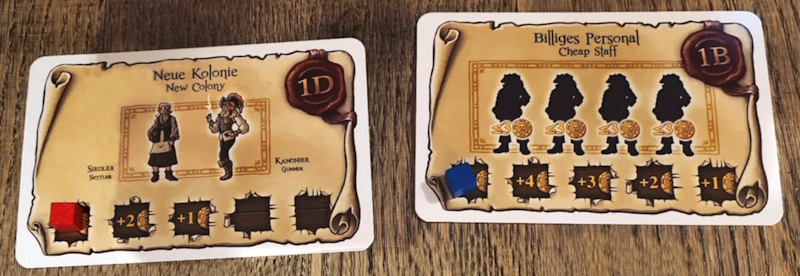
The Ein Auftrag geht noch expansion (aka Just One More Contract…) adds solo and cooperative modes, but aside from these it doesn’t change the game significantly, just adding a handful of cards and an alternative mechanism to gain Doubloons and score points.  The new game element is “Contracts”, which provide additional ways to score victory points and get coins by meeting the listed conditions.  At the start of the game, each player gets three tokens and four Contracts are revealed.  If a player meets the requirements of a Contract at any time (including not on someone else’s turn) they can place one of their cubes on the leftmost spot on the contract taking the financial benefit.
Port Royal: Ein Auftrag geht noch...
– Image by boardGOATS

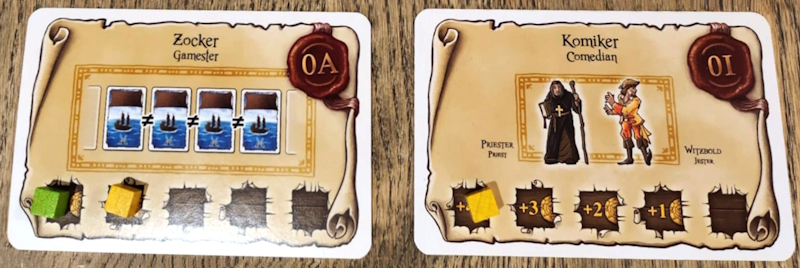
This reward decreases each time the Contract is subsequently completed.  When the player completes their second contract they additionally receive one point taking a Contract card from the unused stack and keeping it face down to display the Point shown on the reverse.  On completing their third Contract, players receive the financial reward and two additional Points.  Plum led one group, comprising Sapphire, Black and Flint.  The contracts they draw out were New Colony, Comedian, Cheap Staff, and Gamester.  New Colony and Comedian required a a specific pair of Character cards (Settler/Gunner and Priest/Jester respectively), while Cheap Staff needed four Characters with a cost of three or less.
Port Royal: Ein Auftrag geht noch...
– Image by boardGOATS

The Gamester Contract was a bit different as it was based on Ships, and could be claimed by the active player as soon as there were four of different coloured Ships in the Harbour at the same time.  Early in the game, Plum and Flint claimed a Gunner, while Flint added and a Clerk from the expansion and Black took an Admiral.  The Gunner and the Admiral provide benefits if conditions are met just before they take a card, respectively giving money if there are multiple ships available or two extra coins if there are more than five cards in the Harbour display.  The Clerk gives the owner the option to take a second card if they take a ship of the right colour from the Harbour.

Port Royal
– Image by boardGOATS

Sapphire took a slightly different approach.  He collected Traders, getting one of each colour which meant that whenever he took a ship, whatever the colour, he always got an extra coin and together with his Vice Admiral (who gave an extra coin coin if there were three or four cards in the Harbour on his turn) meant he always had plenty of cash.  Plum was the first to complete an expedition, the Gamester, but everyone completed one, although Black managed a second.  Black, Plum, and Flint also completed an expedition giving more points, but the winner was Flint who finished with thirteen points while Plum and Black tied for second.

Port Royal
– Image by boardGOATS

Elsewhere, there was a second game of Port Royal underway with Lime, Ivory and Mint, led by Jade.  This group were playing with the 2022 Big Box editionwith the new artwork that includes both expansions. However, as they were playing with people who were new to the game, they chose to stick to the base game and spent a lot of time at the star sorting out cards.  Once they got going a lot of hilarity ensued, particularly when Lime, who desperately needed some cash turned over twenty cards in succession without a single ship!  The victor was Mint, however, with Jade and Ivory tying for second.

Port Royal
– Image by boardGOATS

They had enjoyed it so much and with time left, the decided to “do a Lime” and give it another go.  This time, the winners were tied with Ivory and Mint both finishing with twelve just ahead of Lime in third.  With the winners tied, there was more interest in what the tie-breaker was.  Both also had the same amount of money and the rules state that in such cases victory is shared.  However, according to the rules there is a end of game variant which requires the winner to have an Expedition card.  As Ivory had completed an Expedition and Mint had not that was assumed to be the tie breaker leaving Ivory the victor.

Port Royal
– Image by boardGOATS

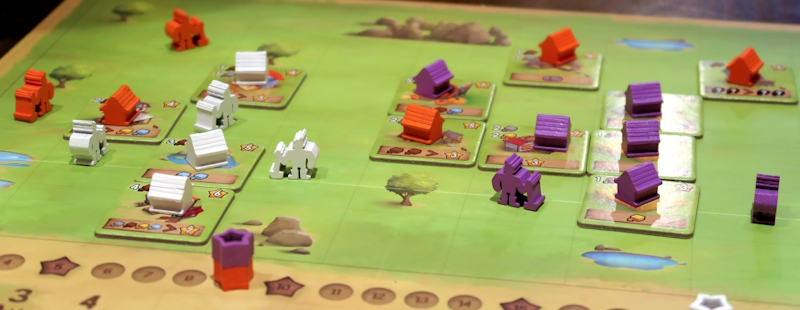
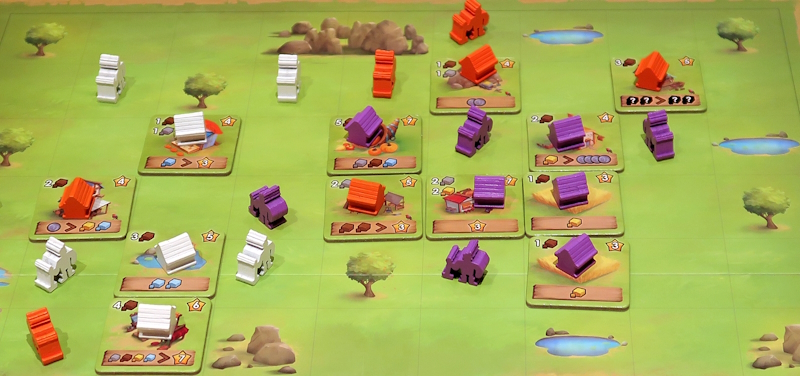
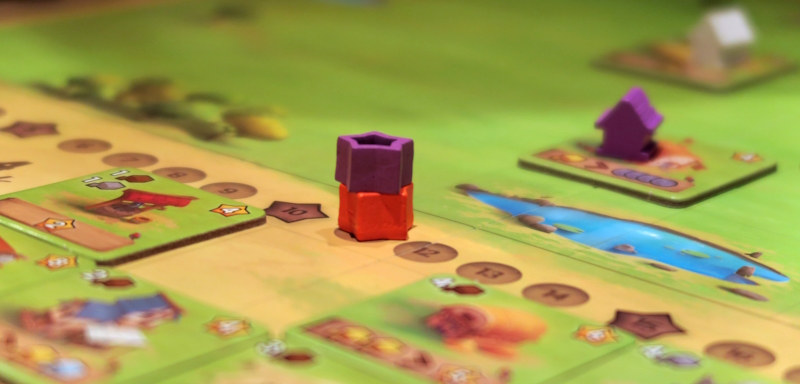
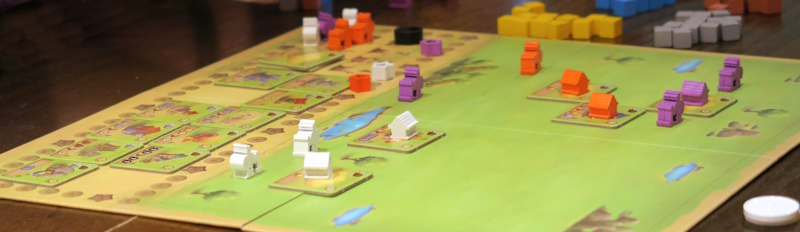
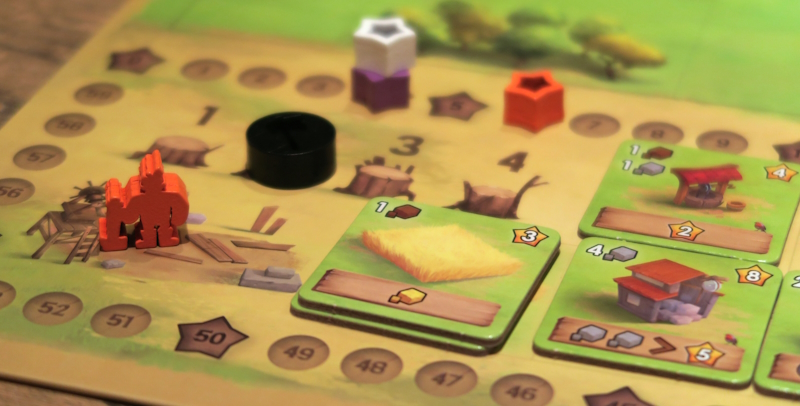
Meanwhile, Blue and Purple introduced Ruby to Little Town, another popular game within the group, but this time, one with much less luck.  It is a fairly simple little worker placement and tile laying game based on a central board.  The idea is that players have five workers and on their turn players can place them on the terrain area and activate the space, or in the build area and place a building on the board paying the costs and placing an ownership marker on it.  When activating a space, players also activate the eight surrounding spaces.  Some of these will be spaces printed on the board which allow players to collect resources (Wood, Stone or Fish), while others might be buildings tiles placed, by themselves or one of the other players.
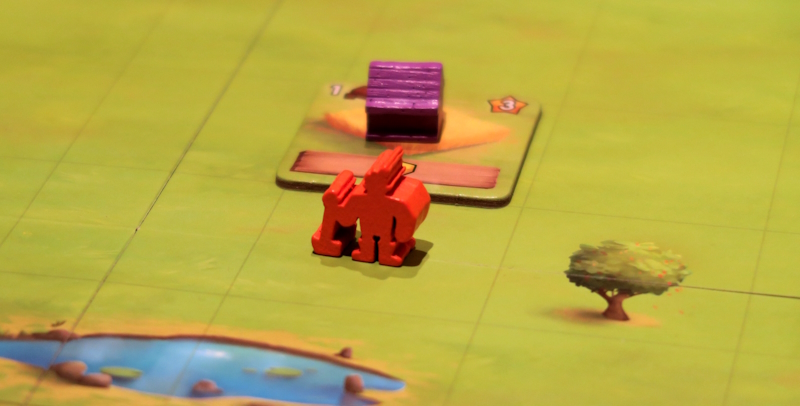
Little Town
– Image by boardGOATS

Players musty pay to use other players’ buildings, only one coin, but coins can be difficult to acquire.  Players get points during the game by activating some buildings, lose points if they are unable to feed their workers.  They also start with three personal objective cards which are scored as and when they are achieved.  At the end of the game, after four rounds (just twenty actions per player), the player with the most points is the winner.  The first draw of tiles included three from the Goodie Building promo set, but as the rules for these had gone walk-about, two were thrown back and re-drawn.  Blue explained the rules, and then Purple started unfortunately, this meant that Ruby going last had fewer good placement options, and worse, was the only player to go last twice during the game.
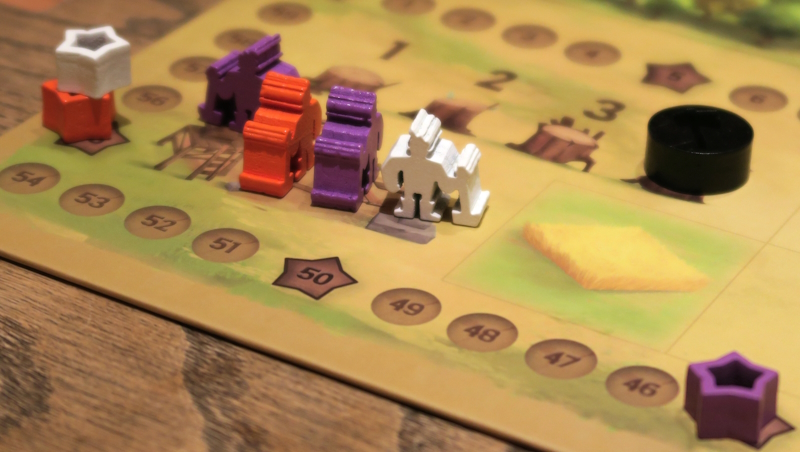
Little Town
– Image by boardGOATS

Both Blue and Purple offered what help and advice they could they could and all three players were pretty much dead level for the first couple of rounds. Cash is often hard to come by in this game, but this time with the Gold Mine present, which was built early by Purple, there was enough to grease the wheels and keep the game moving.  In addition to the Goldmine, other buildings included the Fishmonger which Ruby built and enabled players to sell fish, getting money.  Blue began by building a little fish engine with a Pier and a Sushi Bar (from the Goodie Buildings) placed near a Lake, then Purple widdled on her bonfire a little, by turning one of the neighbouring spaces into a Wheat Field.  Even so, with just two turns she could gain Fish and turn them into a total of six points, picking up a bit of Wood and some Wheat (at a cost of one coin) on the way.

Little Town
– Image by boardGOATS

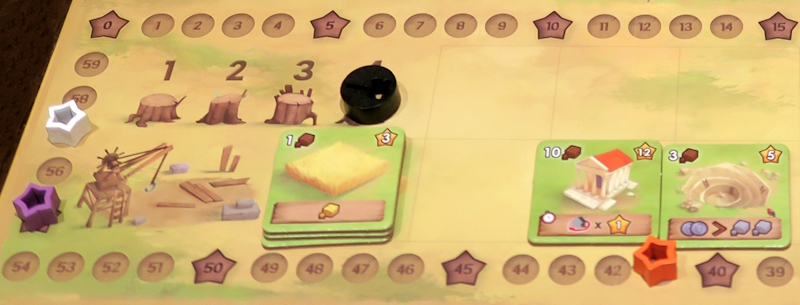
It had been back and forth between Blue and Ruby until Blue nabbed the Statue from under Ruby’s nose giving her a straight ten points.  That forced Ruby to switch tack and build the Church which allows players to convert Cash into points.  Although there wasn’t really time to activate it more than once, it was also worth eight points in its own right.  All three players managed to complete their Objectives, even Purple who had some tough ones.  Before the game, Purple had made a comment, that nobody would need the Sixty Point Token, but as the end of the final round approached it looked like both Blue and Ruby might actually manage it.  In the end, it was close, but Blue just managed it finishing with sixty-four, while Ruby didn’t quite make it in second place.

Little Town
– Image by boardGOATS

Learning outcome:  Popular games are popular for a reason.

11th June 2024

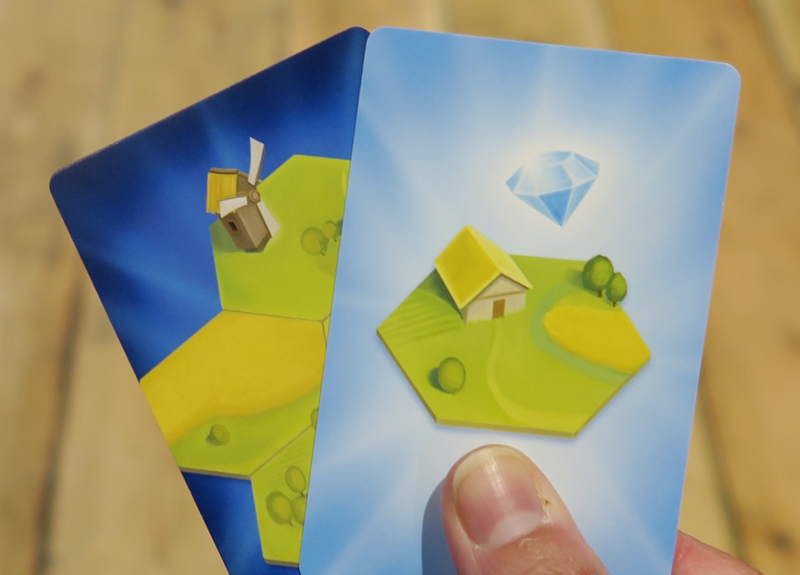
The pub was not as busy as last time, and in any case, Pink, Blue, Black and Purple were there in good time for food.  Once they had finished, they managed to squeeze in a quick game of Rome in a Day while they were waiting for food and eating.  This is a cute little tile-laying game Black and Purple picked up from UK Games Expo as few days back.  It is a bit like Kingdomino with the “I cut, you choose” mechanism to allocate the tiles.  The “I cut, you choose” mechanism is used in a number of other games like, Castles of Mad King Ludwig, Isle of Skye, and Dice Hospital, but it is a more fundamental part of games like San Marco, and particularly …aber bitte mit Sahne and New York Slice.

Dice Hospital
– Image by boardGOATS

In the case of Rome in a Day, Players start by taking five land tiles drawn at random and place two buildings on tiles one and two.  They then divide the five tiles into two groups—a bigger and a smaller one (in any ratio) and add a crystal to the smaller land set before offering them to their neighbour.  During the four rounds the game is played over this neighbour alternates, right, left, right, left.  So, each round, players choose a set from their neighbour and these and the tiles they were left with are added to their domain.  At the end of the game, any building that stands on or adjacent to land of its own colour will score for each tile in the group and then players score for the diamonds they have collected—the player with the most points is the winner.

Rome in a Day
– Image by boardGOATS

Like in Kingdomino where players score better for a medium number of crowns in a medium sized area than for a combination where one is large and the other small, players benefit more if they can surround one large area of coloured tiles with multiple buildings of the same colour.  The most successful at this was Pink who scored well for three coloured areas, the green Olive Groves, the blue-purple Vineyards and the yellow Wheat Fields, while the others didn’t score at all.  As a result of his ruthless scoring strategy, he finished with fifty four points, eight points clear of second place, which went to black by a single point.

Rome in a Day
– Image by boardGOATS

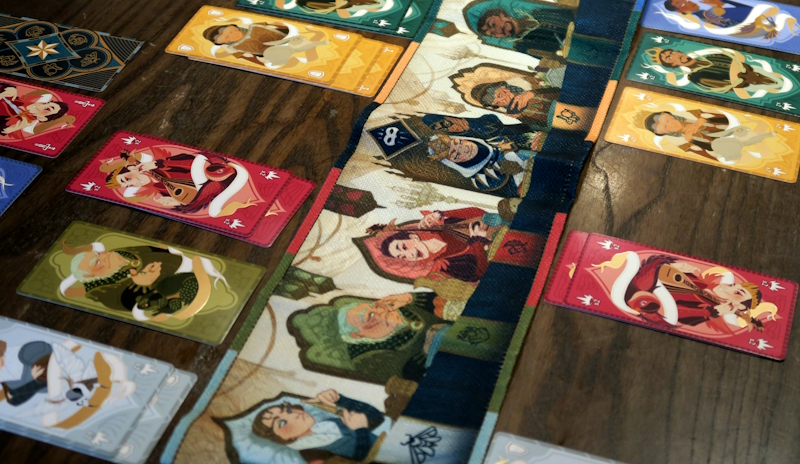
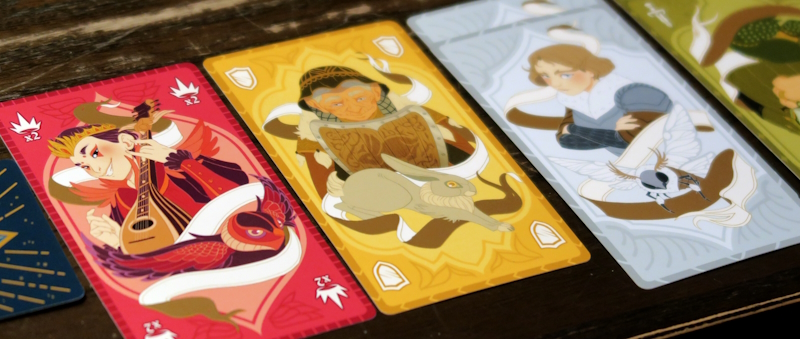
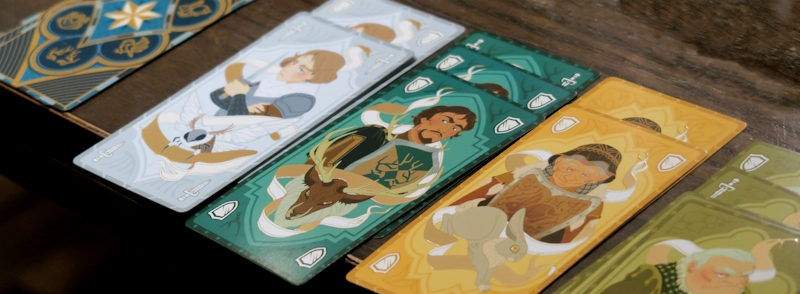
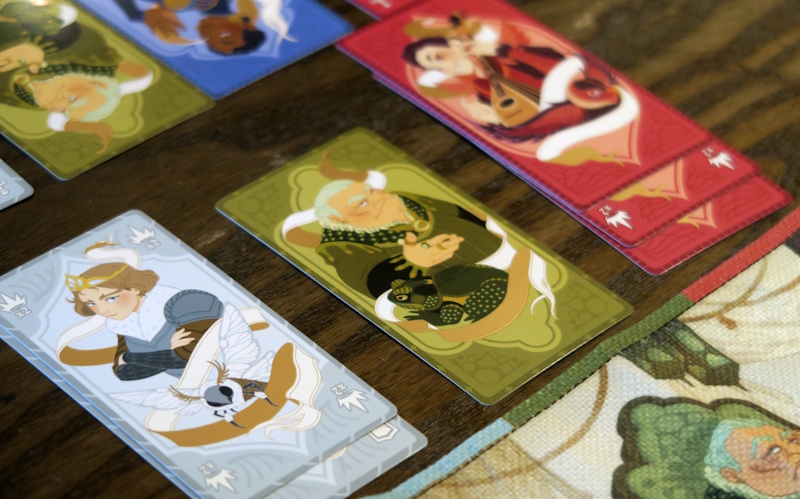
The game was just coming to an end when Jade, Sapphire, Plum and Byzantium arrived, followed by Pine, Ivory and Teal, and then the inevitable debate as to who would play what began.  In the end, Jade led a group of four including Black, Purple and Sapphire in the “Feature Game“, Courtisans (the French for Courtier as it is spelled with an “i” rather than an “e”), which also came from UK Games Expo.  The first game was essentially a learning opportunity where players tried to understand the learning the mechanics of the game.  On their turn, each player receives and plays three coloured Family cards.

Courtisans
– Image by boardGOATS

One card is played at the Queen’s table to sway a family’s influence in a positive or negative way depending on whether it is placed above the table or below—at the end of the game, those with more cards below than above will have “Fallen from Grace”.  The other two cards are then played, one in the player’s own Domain and the other in an opponent’s Domain. At the end of the game, each card a player has from an “Esteemed” Family is worth a point, while each card from an Family that has “Fallen from Grace” loses them a point.  Thus the cards can be worth positive or negative points, depending on the Family’s status at the end of the game.

Courtisans
– Image by boardGOATS

Some of the Courtier cards have a special power, for example, Nobles count as two cards, Spies are played face down and their allegiance is only revealed at the end of the game, Assassins can be used to eliminate other Courtier cards, while Guards are not affected by Assassins.  The game ends when the card deck has been exhausted and nobody has any cards left in hand.  Players then total up their score and add any points earned from successful Secret Missions (each worth three) and the player with the most points is the winner.

Courtisans
– Image by boardGOATS

Black went first chosen by an app and began feeling his way forward.  The group only realised there was a slight issue towards the end as they ran out of cards a bit early.  It was then that it was discovered that at some point Black had acquired a second hand which he had placed on the table beside him.  Despite only a few personal objectives being met mostly players scored scored well; the exception was Purple who was the only one to complete both objectives which added six points to her score at the end.  It wasn’t enough for victory though, that went to Sapphire who had fifteen points, with Jade a point behind in second.

Courtisans
– Image by boardGOATS

Having felt their way through the first game, the group decided to play again.  As the winner, Sapphire went first, and from the off, it was like everyone woke up together and all decided to attack.  This time, everyone completed at least one objective, but this second game was a lot more treacherous and this was evidenced in the scoring.  One of Jade’s objectives was to ensure at least one of the Houses had at least five cards bringing them into disrepute—Jade chose yellow which caused others problems.  It didn’t have as much of an effect as his second objective though,which was to have fewer red cards than the player to his left.  As a result of this, Black was the kind recipient of any red cards he acquired.

Courtisans
– Image by boardGOATS

While he tried to bring the reds into disrepute too, it wasn’t possible to do both.  So, despite his best efforts they still scored positively and probably helped ensure Black’s victory with seven points, four more than Jade himself.  The scores were much more diverse in the second game though with a range of sixteen points with the person at the back finishing with minus nine!  Although savage, it had been a lot of fun; Jade commented that the game felt a bit like a dance with lots of nuance.  Definitely one to play again, especially given the truly beautiful foiled cards which are a delight to play with.

Courtisans
– Image by boardGOATS

Meanwhile, Teal had picked up the Alpine expansion for one of his favourite games of the moment, Forest Shuffle, and was keen to give it its first outing.  He was therefore joined by Plum, Byzantium and Pink who were also keen to see how it changed things.  Forest Shuffle is mechanically a fairly straight-forward game, but playing it well is comparatively difficult as it requires good, robust strategies and an understanding of how to get the best from the cards.  The idea is that players start with a hand of cards and, on their turn draw two more from the market (or “Clearing”) or play one into their tableau.

Forest Shuffle: Alpine Expansion
– Image by boardGOATS

There are two sorts of card, Trees and “Critters”.  Before playing a Critter, players must have played a Tree, which then has spaces on all four sides.  Birds and Butterflies are played to the canopy (i.e. above tree cards), Fungi and Amphibians are played at the bottom of the tree (i.e. below them) and Mammals are played either side.  The clever part is that Critter cards are split so they show two critters (either left and right or top and bottom), so players choose which they would like to play, and where, tucking the other side under the tree, making the unplayed half invisible.

Forest Shuffle
– Image by boardGOATS

The new Alpine expansion for Forest Shuffle only adds some thirty six cards to the game and, since roughly twenty additional cards are removed during setup, in practice it adds just sixteen to the deck.  Of course, the cards are removed at random so many should be from the base game and the expansion adds new cards like the Mountain Hare, who scores as for the European Hare, but wants to stay alone so can’t share a space with another Hare.  There is an extra Butterfly and more Trees too, which make these easier to score and help to balance the game somewhat.  Additionally, there is the new Alpine Newt provides a new way of scoring, for players who have managed to pick up a lot of cards from the Alpine expansion cards.

Forest Shuffle: Alpine Expansion
– Image by boardGOATS

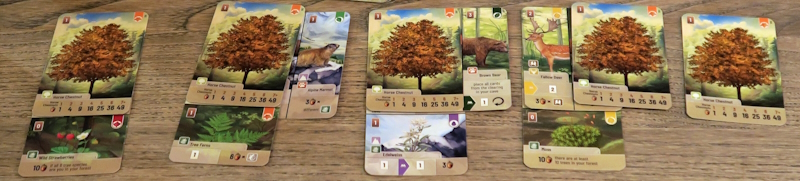
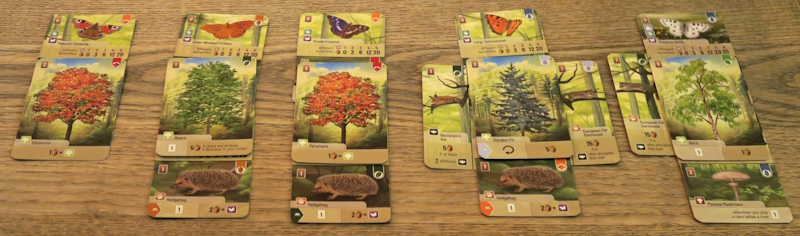
This time, Plum went for Trees in a big way with loads Horse Chestnuts which give more points the more you have on them up to forty-nine for seven or more.  While she didn’t quite make the full seven, she scored a total of forty-eight for her Trees, fifteen more than the nearest player (Byzantium) and more than double what anyone else took.  They, of course, got points elsewhere though.  Pink, for example, went for Butterflies and, with the additional Phoebus Apollo Butterfly, took thirty-five points for them alone.  Byzantium opted for a deer strategy and received a total of sixty-one points for all his Critters.

Forest Shuffle: Alpine Expansion
– Image by boardGOATS

The winner was Teal however, with everyone else totally overcome by “The Lynx-Effect”, where each Lynx he had gave ten points as long as he had a Roe Deer to keep them fed.  Perhaps his victory was to be expected as he has played the game quite a bit with family, but his finishing score of a hundred and fifty was some way ahead of Pink and Plum who tied for second place with a hundred and nineteen.  Overall, the Alpine expansion adds some pretty artwork and made a few of the alternative strategies a lot more viable, reducing the apparent dominance of Wolves and Deer which it has often been claimed are overly powerful.

Forest Shuffle: Alpine Expansion
– Image by boardGOATS

With the Courtisans and Forest Shuffle groups sorted, that left just three players without a game.  Since Ivory and Pine both missed out on playing Little Town last time and neither wanted a particularly late night the decision was made to eschew Key Flow in favour of the lighter, quicker, tile-laying game.  Play is very simple:  players take it in turns to place their Workers in a space on the central board and then activate the eight spaces around them.  These eight spaces could be Buildings, but may also be Trees, Rocks or Lakes pre-printed on the board giving resources (Wood, Rock or fish respectively).  With three players, there are four Workers in each of four rounds and the player with the most points at the end is the winner.

Little Town
– Image by boardGOATS

Little Town has had a few outings, but was the “Feature Gamelast time, with two games played simultaneously, both with the starting tile set up.  This time, a random tile setup was used drawn from the full set that included the Pier, the Marketplace, the Bar, from the variant set as well as the Shop, the Workshop, the Goldmine, the Bakery, the Pawnshop, the Quarry and Wheat Fields from the basic set.  The twelve Buildings were completed by the Temple, the Cornucopia, and the Sushi Bar from the Goodie Buildings mini expansion.  Blue and Pine both complained that their Objectives were considerably more difficult than Ivory’s as he claimed all his quite quickly.

Little Town
– Image by boardGOATS

Eventually though, all three managed to complete all their Objectives.  Pine misunderstood the fact that each Worker needs to be fed at the end of every round, rather than just at the end of the game.  As it was a genuine error, rather than cripple his game at the end of the first round, Blue and Ivory let him pay with other resources leaving his unfortunate workers to gnaw on bits of stone, wood and coins.  Other than that, the game proceeded according to the rules.  Ivory majored on trying to convert Fish into points, while Blue tried to do the same with Wheat and Pine played the merchant, building the Gold mine and the Shop.

Little Town
– Image by boardGOATS

As the game came to a close, Ivory had a substantial lead with forty-two, ahead of Blue in second with thirty and Pine with eighteen.  This was without any of the points from the buildings (which Blue had a lot of) or from leftover money (of which Pine had an enormous pile).  As it turned out, money is not worth much at the end of the game, and although Blue’s buildings were worth considerably more than Ivory’s, she still fell two points short of his final total of fifty-seven.  So although we’ve still not been able to use the “sixty point tokens” we were only a handful of points shy.

Little Town
– Image by boardGOATS

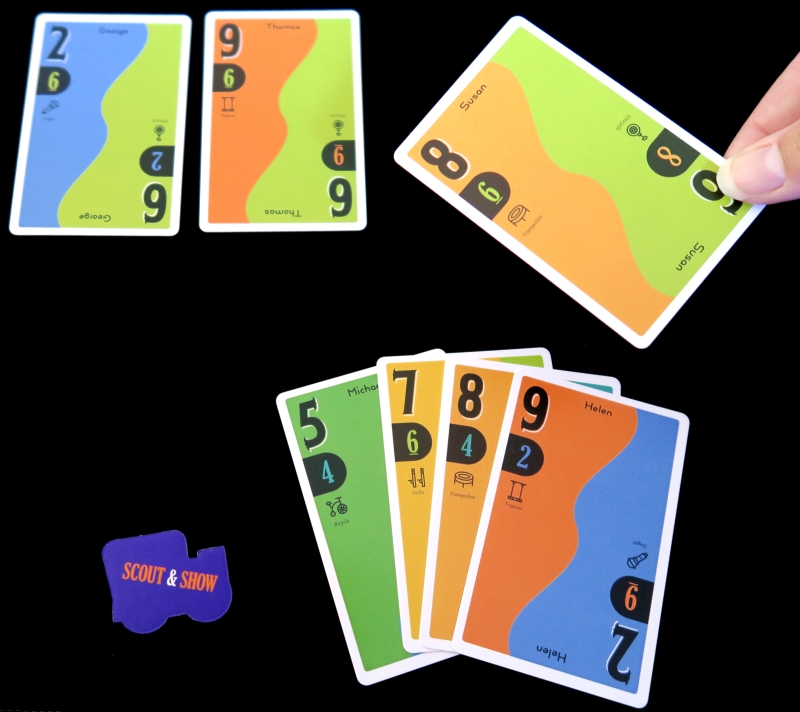
The others were still playing, so after some discussion, Blue, Pine and Ivory decided to give the 2022 Spiel des Jahres nominee, SCOUT, an outing.  This is a clever little card game with two key features: firstly, as in Bohnanza, players can’t rearrange their hands, and secondly, the cards have different values depending which way up they are.  Like Tichu or Haggis, SCOUT is a climbing game, that is to say, on each turn players are aiming to beat the previous score.  In SCOUT, that means players have to play a higher value or larger meld, or a longer run or one of a higher value (and a meld of the same size always beats a run).

SCOUT
– Image by boardGOATS

These cards are played from hand, but have to be consecutive.  In the event that a player can’t or doesn’t want to play cards from their hand (aka “Showing”), they may instead take a card from either end of the current winning set and add it to their hand anywhere, and either way up (aka “Scouting”).  Additionally, once per round, players can “Scout and Show” which is take a card and then also play cards.  The round ends when either nobody in the round has been able to Show or a player plays their last card and has nothing left in hand. At the end of the round, players lose a point for every card they have left, and this is taken from the total from their scoring cards and points earned when others Scout from their display.

SCOUT
– Image by boardGOATS

With three players, there were three rounds, the first of which was finished by Pine, though Ivory nearly managed to check out, leaving Blue with a large handful.  The second round was much closer with Blue playing a nine-card run (though as cards in front of players at the end don’t score, and very quickly nobody could beat it, she didn’t get the advantage she felt she deserved).  The final round was taken by Pine again, but it was also close again.  The total favoured Pine, who finished with a total of twenty-six, a clear victory with Blue just pipping Ivory to second place by a single point.

SCOUT
– Image by boardGOATS

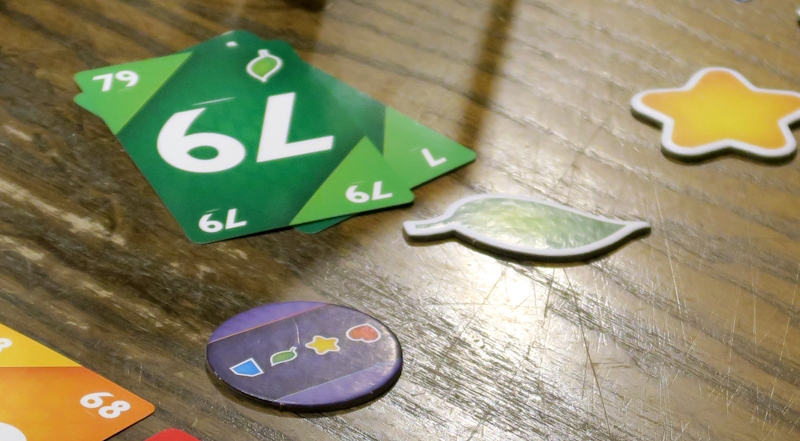
Forest Shuffle and SCOUT were both still going when the Courtisans finished, so they quickly set about playing a light filler that Jade had picked up from the Hachette UK stand that he had worked on at UKGELine-it, is another card game, played with a deck that consists of cards in four colors, numbered one to a hundred and six “Bet” cards (numbered three to five), which are shuffled together and laid out to create a market consisting of slightly more cards than there are players.  Players then take it in turns to take a card and either add it to their hand or add it to the row of cards in front of them (their Line).  There is a hand limit of two and the row must continue either increasing or decreasing.

Line-it
– Image by boardGOATS

If a player can’t add the card to their hand or their Line (because it would break the ascending/descending pattern), they have to score their Line, then play that card to start a new Line.  After drafting a card, players may choose to add one card from their hand to their Line and then score it. When scoring, if there is a Bet card in the Line, if there are more cards added since the Bet card than the value depicted on the Bet card, players get chips equal to the value of the Bet.  If the Bet is lost, the player takes negative points instead. Finally, three cards are discarded from the Line and the others turned over and placed in the player’s scoring pile.

Line-it
– Image by boardGOATS

Once each player has had a turn, all remaining Bet cards are discarded, and the other cards are placed under the Jackpot token that corresponds to their colour—these can be claimed whenever a player adds the third card of the respective color to their Line.  The game ends when the draw deck depleted, and each player plays one last card from their hand, then scores their line and tallies their points, the player with the most points is the winner.  As he had won the second game of Courtisans, Black went first.

Line-it
– Image by boardGOATS

Black and Purple both took (and completed) Bet cards early in the game, whereas Jade didn’t even take because his Lines weren’t right when the Bet cards were available because just didn’t make sense.  Purple won the first jackpot of the game which was a tidy little stack of blue Diamond cards and Sapphire also picked up Jackpot cards later in the game.  The game plays quite quickly and smoothly and this time out, it was close, well, close between Black, Jade and Purple—Sapphire was streets ahead, finishing with twenty-six points, a long way clear of Black in second with fifteen.

Line-it
– Image by boardGOATS

Learning Outcome: UK Games Expo is a good source of new games.

28th May 2024

When Blue, Pink and Cobalt arrived for food, the pub was really busy and they struggled to find a table, ending up in the Bar.  Their food had arrived by the time the others started to turn up, and although there was another free table by this time, it wasn’t conducive to playing games.  Green, who we’d been missing in recent weeks arrived with Lilac for the first time in absolutely ages so there was a lot of catching up to do.  It wasn’t long before more tables began to clear, and the group managed to find several together in the restaurant area, and once the feeders had bolted the remains of their supper they joined the group and everyone began to decide what they’d play.

Little Town
– Image by boardGOATS

First up was the “Feature Game“, Little Town, a resource management, worker placement and tile placement game where players take on the role of architects guiding teams building a small town.  There were two games of this—one with Blue, Pink and Teal, and the other with Black Purple and Lime.  It is quite a simple little game:  players start with a set number of Workers (four in the three-player game) and building Markers (six for three players).  On their turn, they can place a Worker in an empty space on the central player board/map, or spend resources and build a Construction, placing a Marker on it.

Little Town
– Image by boardGOATS

When they place a Worker, the player activates the eight spaces surrounding it.  These can include Woodland, Mountain, or Lake to get Wood, Rock or Fish.  Wood and Rock are useful to build, while Fish is important for players to feed their Workers at the end of the round (one Fish or Wheat per Worker, every round).  Players can also activate Constructions, their own for free, and another player’s by paying them one Coin.  There are twelve Buildings and five Wheat fields available for construction at the start of the game—once they are built, they are not replaced.

Little Town
– Image by boardGOATS

There are twenty-nine buildings in the base game which can be drawn at random, but this time, both groups used the basic set (marked with a robin).  This meant that some of the Objective cards which are Building dependent could not be used, so in the end, only the cards that didn’t require specific Buildings were used.  The Objectives therefore included things like “Gather at least five resources in the same turn” or “Have more Buildings than Workers”—these are scored during the game.  Buildings come in two types:  Those that give Resources when activated, and those that can be used to convert Resources into other Resources, Coins or Points.  The game lasts four rounds, after which players score for each of their Buildings and one point for any three unused Coins.

Little Town
– Image by boardGOATS

Once the rules had been outlined, both groups started playing.  Before they’d got more than a turn in, however, Cobalt commented that he was surprised that Blue hadn’t got metal coins to go with the game, at which point, Blue produced her utility set and both groups swiftly made the substitution.  Unfortunately, these new coins were a little slippery leading to a couple of rounds of “Hunt the Game Piece”.  Little Town is a really good little game though, accessible, but with meaningful decisions and one that doesn’t outstay its welcome.  Despite starting with essentially the same setup, the two games, progressed quite differently.

Little Town
– Image by boardGOATS

Pink and Blue built Points engines converting Coins and Wheat respectively, while Cobalt converted a Coin into Wheat and Fish, then and Wheat into lots of Coins.  On the neighbouring table, however, the Coin to Wheat and Wheat to Coins buildings were owned by different people, Black and Lime respectively while Purple was busy converting Wood into Points.  Both games were quite tight, with Lime’s forty-two beating Black into second place by just two points.  The other game was even tighter though.  Pink rolled back his final move following a suggestion by Blue to pick up an extra point, but she would have done better to keep her mouth shut as that extra point meant he tied for the lead with Blue on fifty-five.

Little Town
– Image by boardGOATS

It was as players were discussing the game and starting to pack away that Pink spotted a way of getting another extra point, but this was deemed too late and the game was deemed a tie.  Packing away, there was some confusion as the manifest indicated there should be twenty-nine Objective cards, whereas Blue’s copy had thirty.  Despite several recounts (and confirmation that there weren’t any in the Goodie Buildings mini expansion), the issue couldn’t be solved, and the group came to the conclusion that one more than expected was better than one less…

Little Town
– Image by boardGOATS

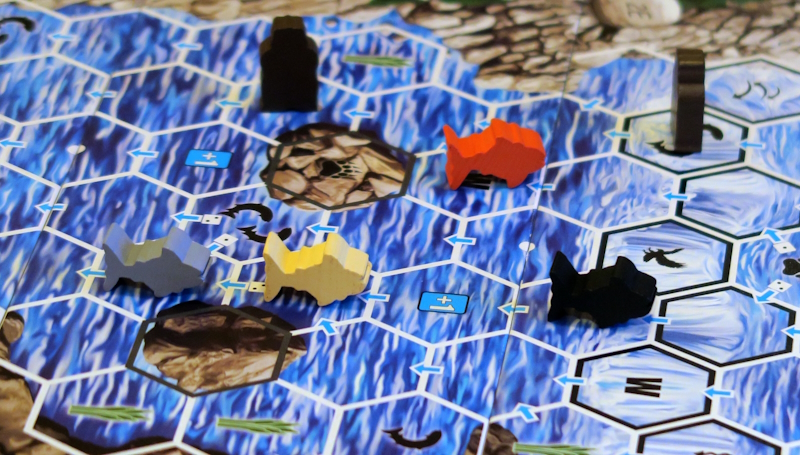
Meanwhile, on the next table Teal was leading a game of Salmon Run with Green, Pine and Lilac.  This is a game that was played quite a few times in the group some years ago when it was first released, but the last time it got an outing was in 2015—nearly ten years ago.  Teal had decided that his copy had been sitting on the shelf unplayed and unloved for too long and it was time for it to move on.  It got a stay of execution though, and as a result, it got a Tuesday night outing.  A fast paced, deck-building, race game, Salmon Run is a sort of cross between Dominion and Flamme Rouge.  Although the game is not particularly complex, the first game was a learning game.

Salmon Run
– Image by boardGOATS

The idea is players are Salmon, racing to be first to get to the Spawning Pool.  The board is modular and therefore the River can be changed to give variety and replayability.  Players start with a deck of cards containing three Swim Forward, three Swim Right, three Swim Left, one Wild and one Bear and draw four of these.  On their turn, players can play up to three cards, however, playing three means they will draw a Fatigue card.  These will ultimately reduce players’ choice and slow their Salmon down, so mostly players stick to playing two, replenishing their hand to four cards at the end of their turn.

Salmon Run
– Image by boardGOATS

Depending on the modules used, the River includes obstacles like Rocks, Currents and Rapids, as well as special spaces which allow players to pick up special cards (that can be used to counter Currents, Rapids and Eagles) to add to their Swim deck.  Teal began by moving a Bear onto the space with Pine’s Salmon, giving him a Fatigue card.  Then, much to Pine’s annoyance, Lilac and then Green did the same before fianally Lilac did it again.  Pine was very unimpressed—for one who loves wildlife, he really wasn’t happy about repeated visits from all those bears!

Salmon Run
– Image by boardGOATS

Green I played a Rapids card and there was some discussion where the card should be discarded to, but in the end there was no catching Teal, who was first to the Spawning Pool, and was some four spaces ahead Lilac, his closest challenger.  As Little Town was still going on both tables, the group decided to play a second time now they knew how to play as they thought they’d be quicker (which they were). The River was a changed a little to make it a bit more challenging and then the Salmon began their second run.  This time, Pine, Teal and Lilac went one way round the rapids, while Green went the other.

Salmon Run
– Image by boardGOATS

This time the bear was moved away from players by Teal so nobody got caught. As the River took a bend to the right, Green ended up with only Swim Left cards so had to just discard and bang his salmonny head against the rocks, falling behind. Teal and Pine had both picked up a lot of Fatigue cards, but they both got to the Spawning Pool.  As Pine had one less though, he was the winner of the second game.  It had been a lot of fun (despite the Bear attacks, and the headaches from banging against the rocky bank), so maybe the stay of execution deserves to be extended a while longer.

Salmon Run
– Image by boardGOATS

With both games finished and the late start, there wasn’t time for something long, so as is often the case in such circumstances, instead of lots of discussion, the group decided to play the old favourite, 6 Nimmt!.  With ten, the group decided to play the game over one round, which meant everyone started with ten cards, a lot more than usual.  This didn’t seem to improve the quality, however, a sentiment that was epitomised by one comment, “These are all bad with a capital F…”  The first few rounds were a little slower than usual as everyone had more cards to choose from than usual.

6 Nimmt!
– Image by boardGOATS

Once everyone had chosen their card, they were simultaneously revealed and added to the end of the appropriate row, with players picking up cards when theirs was the sixth card to be added.  Nobody managed to avoid picking up cards, but unusually, the scores were all quite close—so close that the winners, Green and Blue, tied with nine, while Pink took third place with eleven and Cobalt top-scored with twenty-three.  One game is rarely enough when it comes to 6 Nimmt!, and everyone was keen for another mad ten-player game.  This time the scores were more diverse: Lilac succeeded in avoiding the chaos and won with a clear round, while Teal added thirty-six to his first round twenty two to finish with the most points overall (Cobalt only took seventeen in the second game).

6 Nimmt!
– Image by boardGOATS

Blue took second place in the second game with five (giving her the best combined game total of fourteen), while Pine came in third with ten points.  Green was the most consistent with nine and eleven, but Lilac claimed the nearest to a “Mike Game” with one exceptional round and one awful one, though her bad wasn’t as bad as his usually were.  Everyone was just packing up when the evening came to a smashing end as the wine glass that Lime had carefully put safely to one side bit the dust.  Oh well, less washing up…

6 Nimmt!
– Image by boardGOATS

Learning Outcome:  Little Towns can give quite big games.