Tag Archives: Love Letter

3rd September 2013

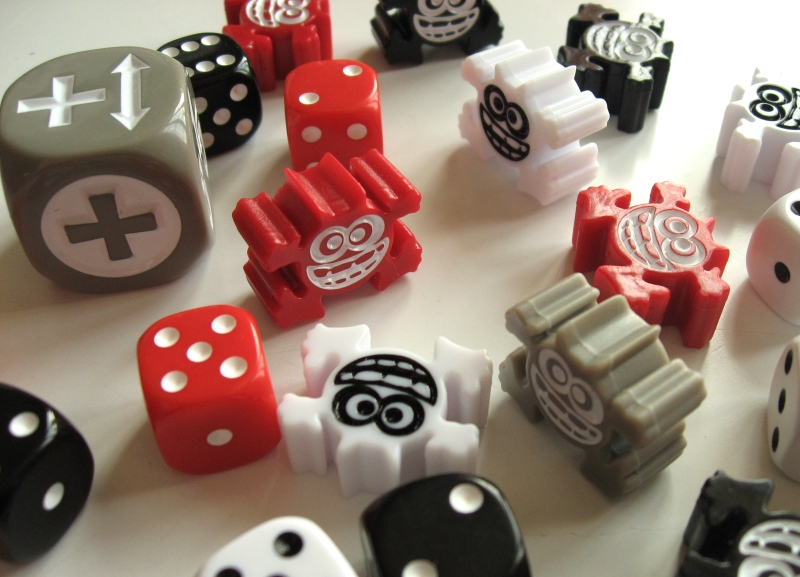
First up this week, while we waited for the others to arrive, was Toc Toc Woodman (aka Clack Clack Lumberjack).  This Is a dexterity game that consists of a segmented plastic tree where the am of the game is to knock bits of bark off with an axe, while not removing the core segments.  As the game progresses, the tree becomes increasingly unstable with the inevitable consequences…  Honours were just about even when we were saved from a tie-breaker by the last of the late arrivals.

– Image by BGG contributor EndersGame

Next we started our “Feature Game”, Keyflower.    Although we have played it before and it is a very popular game with most club members, we had one player who was unfamiliar with it, so we chose to play it without any of the additional tiles.

Keyflower
– Image by boardGOATS

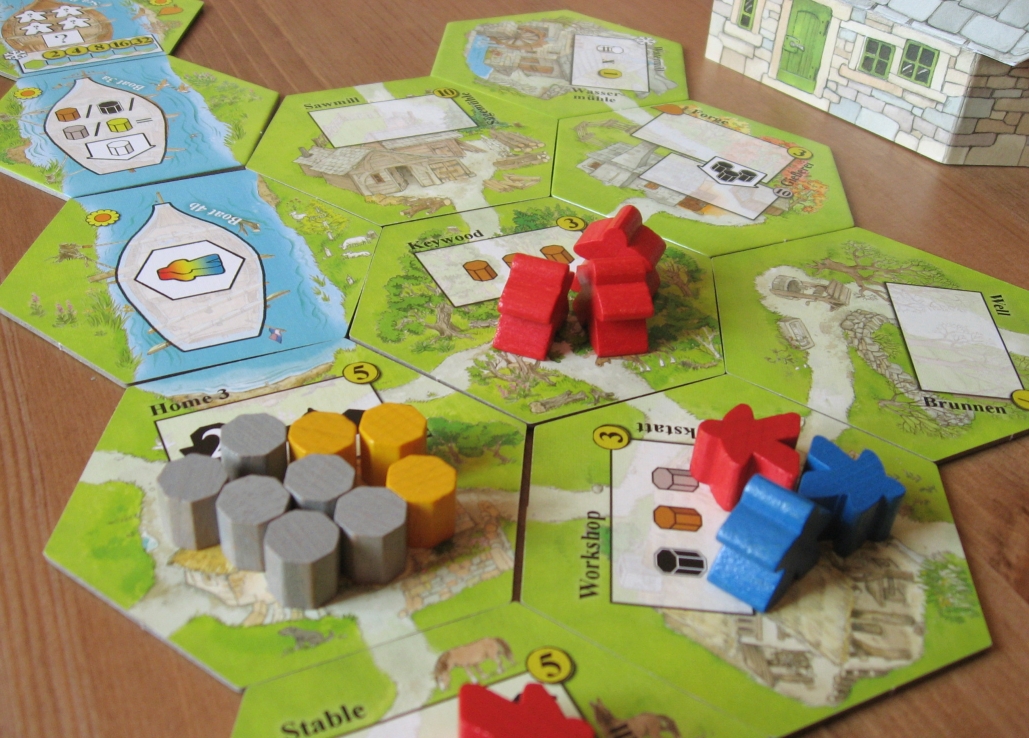
Keyflower is a worker-placement and auction game that is played over four seasons.  Each player begins the game with a home tile and eight worker meeples (or Keyples as they are known in this game).  At the beginning of each round there is a new stack of tiles that players can use and bid for.  The really unusual part of the game is the interplay between workers and bidding:  workers can operate on any tile, in a players own village, in another players village, or one that is still being auctioned.  At the end of the round, the workers go to the owner of the tile, thus, if you have a commodity that other players want, it can be a source of Keyples. On the other hand, if you chose to bid for a tile, presumably you wanted to use it, which means that you have competition for the resource, and so it proved.

Keyflower
– Image by boardGOATS

One player had been present at the drubbing we had received last time we played and tried the same strategy, i.e. to collect skill tiles.  Those of us that were aware of this approach started out with no real strategy except to prevent a second run-away victory by the same means.  Meanwhile the new player quietly got on with collecting gold and marshalling her Keyples.  Mixed based strategies gradually evolved for otherwise indecisive players with resources, the river and transport all featuring and it wasn’t long before we got to the final round, Winter.  Surprisingly, there wasn’t much competition for tiles to begin with as everyone concentrated on getting the resources and skill tiles they wanted to the place they needed them.  By this time, Keyples were in short supply, so there was only a token amount of scrapping for final tiles in what ended as a very, very closely fought game with first and second just one point apart, a tie for third and fourth, and everyone separated by only six points.
Keyflower
– Image by boardGOATS

The third game of the night was, the race game, Salmon Run.    We’ve played this a couple of times before, but still managed to have a couple of new players, so after a quick run through of the rules, off we went with board S1, 5E, 6E, 3M, 2M & F1.  White took an early lead, while Red and Black got in each others’ way and battled with bears.  Red and White both got sore heads bashing the bank, while Black got a bit stuck with mid-stream and trapped everyone else in the current.White made a dash for the finish, but got caught needing a right and straight to get across the last lot of rapids giving Red and Black a chance to catch up.  Red got closest, but White managed to make it across the line first and Red failed to quite make it to the Spawning pool on his last turn.  Even if Red and Black had made it home, Red’s nine fatigue cards and Black’s six dwarfed White’s two (thanks to the enforced wait before the last rapids where she had been able to ditch a lot of hers).

Salmon Run
– Image by BGG contributor kilroy_locke

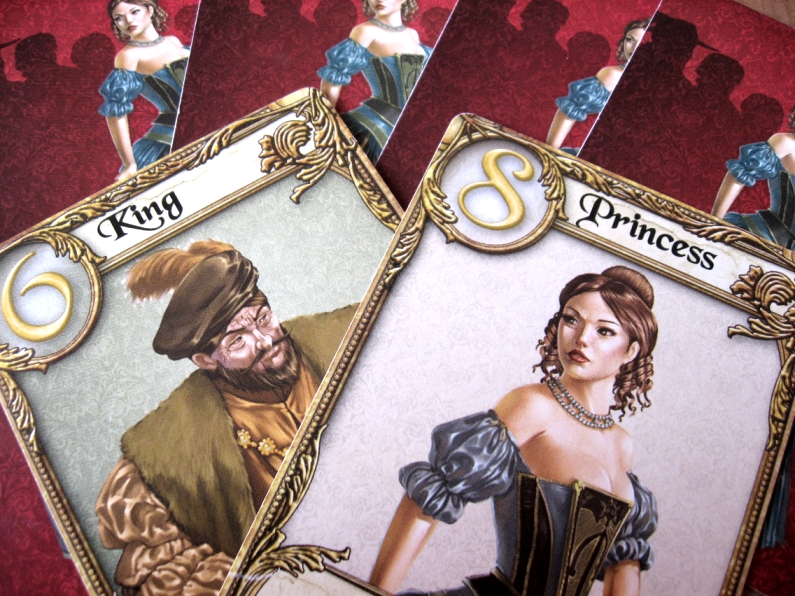
The last game of the night was an old favourite, Love Letter.  This is a really simple little duelling game played with just sixteen cards.  Each round only takes a couple of minutes and each player takes it in turns to draw a card and then play one of the two cards in their hand.  Cards allow players to look at another’s hand, force them to discard, give them the opportunity to try to assassinate other players etc. and the last player in, or (in the unusual case that all sixteen cards are drawn), the player with the highest card, wins the round.  Remarkably, one player managed a run of three rounds undefeated, and despite a desperate rear-guard action, this proved an unassailable lead.
Love Letter
– Image by boardGOATS

Learning Outcome:  A winning strategy doesn’t  always work…

30th April 2013

Like last time, we again started out with a quick game of Love Letter while we waited for late arrivals.  This time we found that players were winning rounds without getting very deep into the deck, which is strange.  However, one thing that didn’t change was that beginners luck again carried the day…

Love Letter

Next we quickly played a new game, Diavolo. This is a dice rolling game where players take it in turns to roll dice and depending on the outcome of the “Order” die, dive for a cute little imp.  If they fail to grab one (or get the wrong one), the player loses a gem and the last person to lose all their gems is the winner.  We all found this game very stressful so we had one quick round of an old favourite, No Thanks! as the last player arrived and went to the bar.

Diavolo

Once again, our less experienced players were otherwise engaged, so we decided to forego Ticket to Ride and play something we enjoyed a couple of months ago, namely The Speicherstadt.  This is a clever little auction game that is relatively quick to play and easy to teach, but has a lot of strategy.  In short, cards are turned over and players take it in turns to place one of their “Village People” next to the card they would like to buy:  contracts, ships (use to fulfil the contracts), firemen (to protect against inferno) etc..  The first player to bid for a card has first refusal for that card, but the price they must pay is equal to the total number of “Village People” next to the card.  If they decline, then the next player has the choice, and the cost has reduced by one.  Despite the fact that the different players seemed to employ quite different strategies it ended a very close game.  For example, Blue eschewed firemen and ended up taking nearly all the negative points due to fires.  Thus, Blue was some twenty points adrift at the back before the final accounting although they had a couple of valuable contracts and the warehouse.  In contrast, White invested heavily in firemen, and was way out in front, but had less to add in the final reckoning.  White and Blue ended level on points in last place, but only two points behind the winner who had engaged in more trading.

The Speicherstadt

Finally, we just managed to squeeze in a game of Keyflower.  This is a really beautiful resource management and bidding game where players use meeples (or “Keyples” as they are known here) both as currency for bidding and as workers to generate resources.  Played over four Seasons, with new tiles available at the start of each one, players take it in turns to bid for the different tiles.  However, the catch is that once a bid has been made, any subsequent bids for that tile must be both larger and made with the same colour.  In addition to the colour management, there are lots of other really elegant aspects to this game.  For example, players can place workers on tiles and use the products during that same Season, thus, if a player needs red for bidding, they may be able to use a worker to obtain the necessary Keyples.  This means you rarely find you can’t do anything, but you often can’t do exactly what you want. Although it was a new release at the end of last year, we had all played it before, so we just had a quick reminder of the rules as we set up and then launched into it.  In contrast to the last game, this was a bit of a white wash with the leader wining by some thirty points.  What was particularly interesting, however, was that this was based on a skill tile strategy which netted some sixty points at the end of the game.  None of us had ever found them all that useful before, presumably at least partly because the right tiles had never come up.

Keyflower

Learning Outcome:  In some games, you can be quite convinced you are losing and be very, very wrong.

16th April 2013

This week we started out with another new game called Love Letter.  This is a really cute little game that packs in a huge amount of deduction, risk, assassination, luck and bluffing, especially considering it comprises only sixteen cards and a handful of cubes.  Basically, each player has a hand of just one card and on a turn, players draw one card, and play one card, trying to expose others and knock them out of the game.  The winner of the round is the player with the highest value card or the last man standing.  We played four rounds, after which it was clear that beginners luck was ruling the day with the players who had played before all failing to win a round.

Love Letter

Due to work commitments and a stroppy horse our less experienced players were unable to attend, so we had a bit of a change of plan and decided to leave the “Feature Game” (Ticket to Ride) for another day.  Since we had another new (though experienced) gamer, we decided to play a new, deeper game called Village.  In this game, each player takes the reins of a family striving for fame and glory.  Village is full of difficult decisions, yet moves quite quickly.  However, what is particularly unique is the way the game uses the delicate subject of death as a natural and perpetual part of life in the village and a mechanism for dictating the flow and duration of the game.

The strategies players employed varied hugely, from exploring the outside world and going into the church, to remaining a penniless farmer, or even trying a bit of everything.  From the start it seemed that White was running away with victory as he left the Village and explored the shire.  Meanwhile Red decided that piety was the best option and sent his sons into the church, leaving Blue and Yellow splashing about in the mud on the farm.  However, towards the end it became apparent that Yellow was hatching a cunning plan in the council chamber and suddenly made a fortune trading in the market.  The final result hinged on Blue’s decision to sell a cow which started a market day giving White the opportunity he needed to effectively have an extra turn and win by two points, with Yellow, Blue and Red surprisingly close behind.

 Village

Learning Outcome:  When it comes to Village life, a single-minded strategy is often more effective than dabbling in everything.