Pine was already sitting outside marking his birthday, when Blue and and Pink rocked up and ordered their tea. Jade and Sapphire soon joined the group, ferried by newcomer, Tangerine who not only brought gamers, but also his shiny new copy of the “Feature Game“, Faraway, which he had won at Gweeplefest a few days earlier. This game is has been a bit of a hidden gem whose popularity is rapidly gaining traction as more people play it. It is quite a simple game, but one which really messes with the head. Some of the group played it a few weeks back and it was so popular that it seemed a good idea to Feature it so more of the group could try it.
 |
| – Image by boardGOATS |
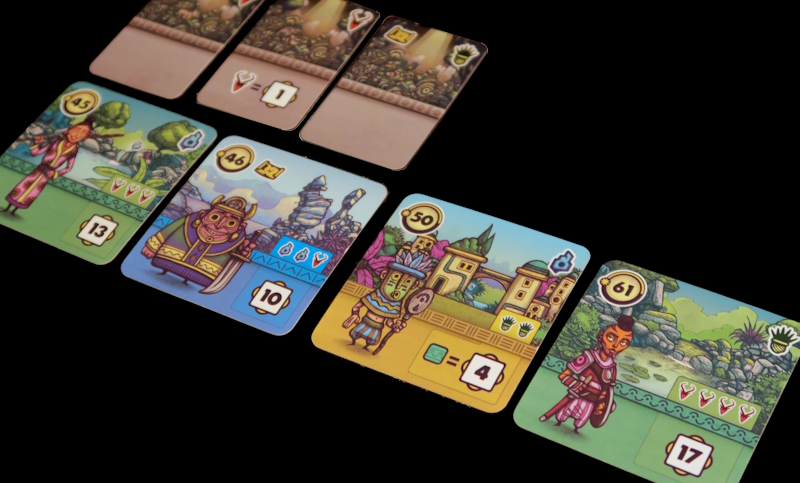
The story is that players are exploring the mysterious land of Alula in search of its secrets, meeting its inhabitants and listing its wonders in order to gain more fame than everyone else. In practice, however, it is a fairly simple little card game with a market with a trick-taking type element. Players simultaneously chose one of the numbered cards from their hand and starting with the the player that played the lowest card (similar to 6 Nimmt! or Kingdomino), everyone takes it in turns to choose one from the market to add to their hand. Players then simultaneously choose another card, and again, choose one to add to their hand. The game ends after everyone has played a total of eight cards, and then everyone scores.
 |
| – Image by boardGOATS |
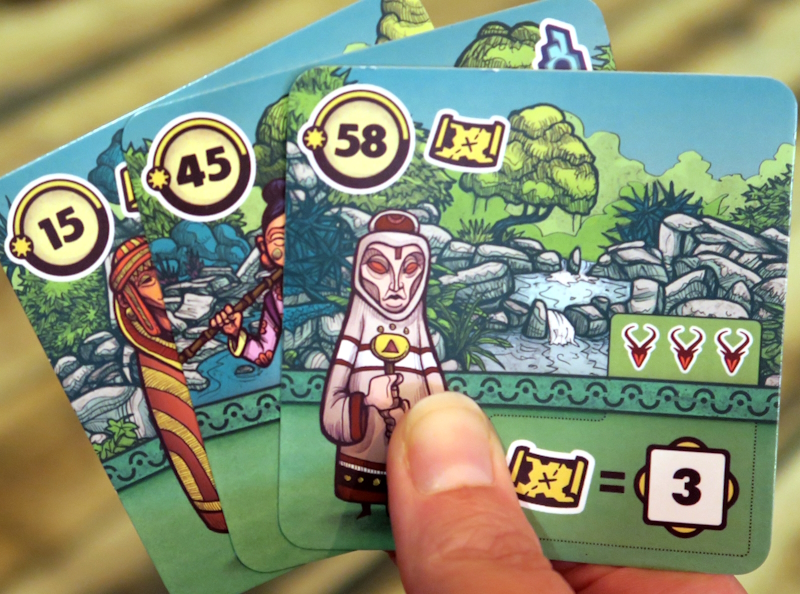
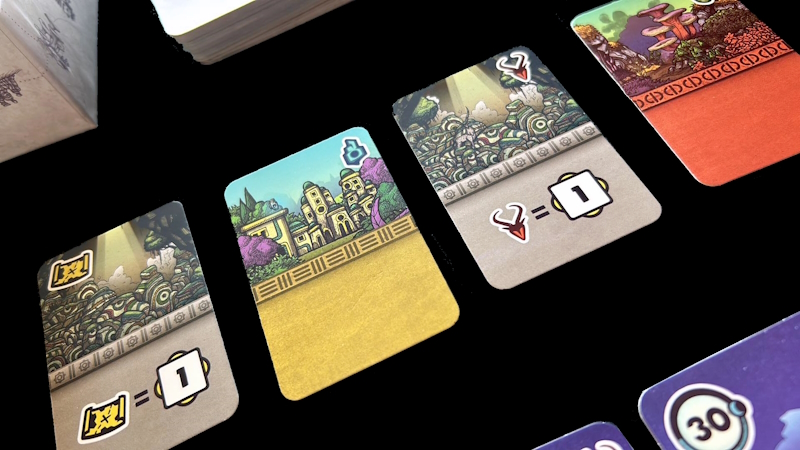
There are a couple of very clever things about the game. Firstly, if the card someone plays is numbered higher than their previous card, they take a card from the Sanctuary deck. These cards a really important because of the second clever element, the scoring. Each card has a number and a colour, while some also have resources and some have also have scoring conditions. The scoring is clever because the cards are played left to right, but the scoring is from right to left—at first glance, this looks like it makes things easy, because early in the game players find out what they need to get points and can then focus on getting the resources they need as the game progresses.
 |
| – Image by boardGOATS |
However, the scoring is tensioned against the ability to get Sanctuary bonus cards. This is because the scoring cards are generally those that have a higher number and are therefore the ones players want to play first (following them with resource cards which generally have a lower face value). To get a Sanctuary card though, players have to play a higher value card than the immediately preceding one, and Sanctuary cards are very useful because they are eligible for scoring regardless of when they are played. Thus, trying to play cards increasing and decreasing in value to score the most points backwards really messes with players’ heads!
 |
| – Image by boardGOATS |
Tangerine, started one game and explained the rules to half the group, comprising Plum, Byzantium, Blue, Pink and Pine, while he ate his supper. Meanwhile, Jade and Sapphire took their copy to a neighbouring table where they were joined by Teal, Black and Purple, and started a second game. Although it is a very simple game, the backwards forwards up and down thing got to several of the group at various points, including Blue (who lost the ability to count), Teal (who did all his scoring forwards instead of backwards), Pine (who struggled with the how maps worked) and Purple (who couldn’t get her head round the reverse scoring). Jade’s game was the first to finish, with Sapphire beating jade into second place by a single point and Black taking third.
 |
| – Image by boardGOATS |
There was a general appreciation of the art and the mechanism though the theme was a bit invisible. There had been such confusion, however, that the group decided to “do a Lime” and play again. This time, the finishing order was exactly the same, but the game wasn’t as close with Sapphire’s eighty-two being the highest score of the evening. On the other table, Plum was the victor with seventy, followed by Tangerine and Byzantium in third. This game had taken a little longer, and with six, there is a lot of downtime, so although everyone had enjoyed it, the group decided to split into two groups of three. Blue tempted Plum and Sapphire to a game of Calico with cries of “Kittens!”, while Pink and Pine lured Tangerine into a game of Ticket to Ride: San Francisco.
 |
| – Image by boardGOATS |
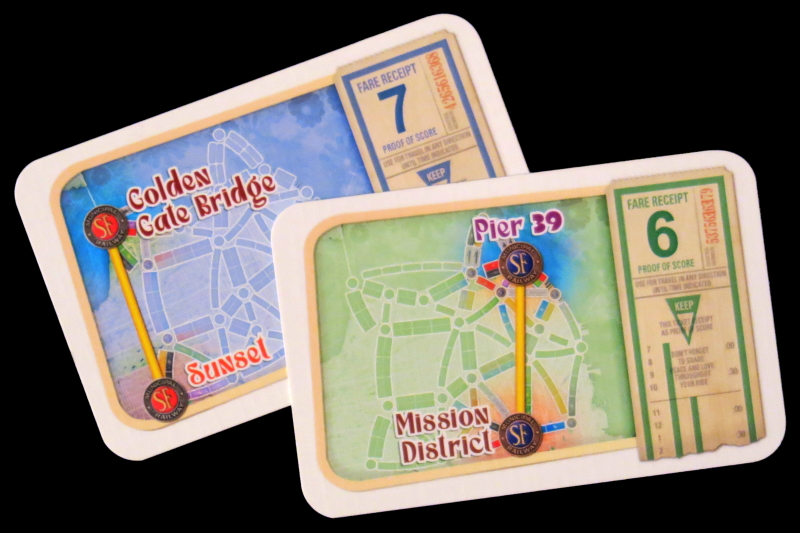
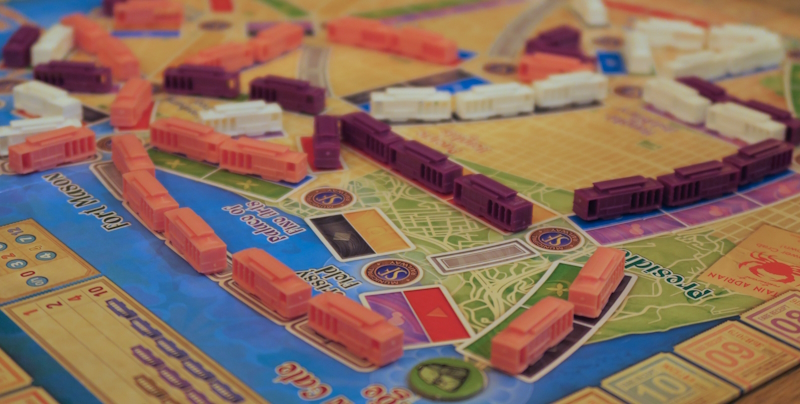
San Francisco is one of the smaller city versions of Ticket to Ride. The game play is much the same as the original, but the maps are smaller, players have fewer pieces and they only play a maximum of four. In all the games, players take it in turns to take coloured cards into their hand from the market, or play cards to place pieces on the board connecting locations to satisfy tickets and score points. Each version of the game has its own specific unique rules, and this one is no exception with players collecting Souvenirs which give points at the end of the game. Players collect these by building a route (in this case made of trolley cars rather than trains) to the cities where they are available.
 |
| – Image by boardGOATS |
Each player can only collect one of each Souvenir, but a full set of seven gives twelve points, which is a lot. Tickets are also always key though. This time, Pink escaped early from Alcatraz to Twin Peaks which gave him a high scoring eight points. Unlike Pine (who always seems to draw routes he’s already completed), Tangerine was unlucky and and instead picked up some negative points late in the game. It was very close between Pink and Pine though, but the Souvenirs made the difference and Pink (with five) just edged it, beating Pine (who only had two Souvenirs) by three points.
 |
| – Image by boardGOATS |
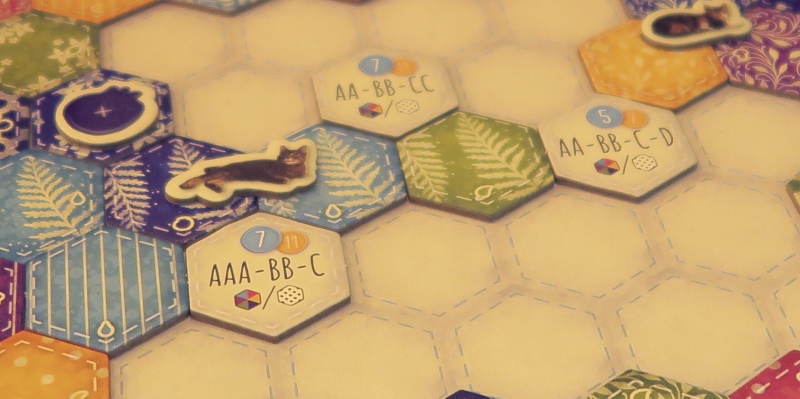
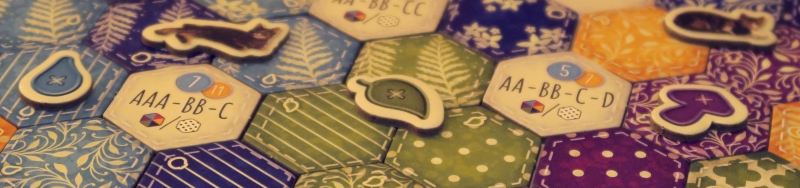
Meanwhile, the kitty-philes were playing the extremely frustrating game Calico, which is all about trying to entice cats to come and sleep on a patchwork quilt by making it with the patterns they like. In this game, players take it in turns to place a coloured, patterned tile from their hand into their quilt board before taking a replacement from the market. Everyone had played it before, but it had been a while, so the rules needed a bit of revision. Each player starts with three tiles in a fixed location with scoring criteria for the neighbouring tiles—satisfying these for either colour or pattern gives points, with more points for for those that satisfy both (which is not easy).
 |
| – Image by boardGOATS |
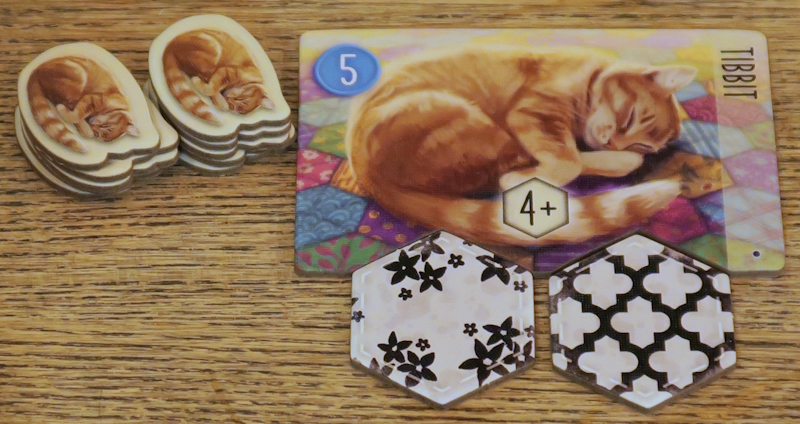
Players then also receive a coloured button for every group of three adjacent tiles of the same colour (with a bonus if they get all six possible colours). Finally, there are the cats that give Calico its name. This time the cats in question were Almond, Tibbit and Shop Cat (from the Kickstarter Promo). Almond was attracted by a group of five tiles of one of the patters in a close packed predefined shape while Tibbit found a set of four tiles of one of the given patterns in any shape most appealing. Shop Cat was lured to the player with the longest connected chain of tiles in one of the given patterns with the player with the second longest attracting a smaller cat (worth fewer points).
 |
| – Image by boardGOATS |
This last one was the subject of some debate as Byzantium ended up with both the longest and second longest chain and it was unclear from the rules whether he would get both. In the end he allowed the smaller Shop Cat to wander off, but fortunately it didn’t make any difference to the placings. Almond looked by far the most challenging kitty to attract and initially it looked impossible without failing on the fixed starting challenges. Plum thought she had made a mess of things, but Byzantium pointed out how Almond could be enticed using some of the partial tiles around the border of her player board and she was the only one to ultimately have that particular kitty to cuddle.
 |
| – Image by boardGOATS |
Blue started badly, and in this game, when that happens things usually only get worse, which they did. Byzantium and Plum both picked up twenty-seven points for their buttons, but in both starting tiles and kitties, Byzantium had the edge (even without the second Shop Cat). In the end his final score of sixty-one points gave him a significant margin of victory, by seven points. Everyone agreed that Calico is a good game, but a very frustrating one when players can’t get the tiles they need. So Byzantium echoed everyone’s feelings when he commented, “That was fun, but very frustrating—I’ll be ready to play it again in another eighteen months…”
 |
| – Image by boardGOATS |
As Faraway and Ticket to Ride had both finished, Tangerine took Jade and Sapphire home and Teal also headed off. That left Black, Purple, Pine and Pink to play a quick game of the old favourite, Coloretto. This is a very simple set collecting game, that makes a great filler. The idea is that players either take the top coloured chameleon card from the deck and place it on a cart, or take a card and add the cards to their collection. Players score points for their largest three sets (up to six cards, worth twenty-one points), while everything else scores negatively. The player with the most points is the winner. Playing with the Jubiläumsausgabe edition, as usual, there was a discussion about what the Golden Joker does and how it differs from the normal Joker.
 |
| – Image by boardGOATS |
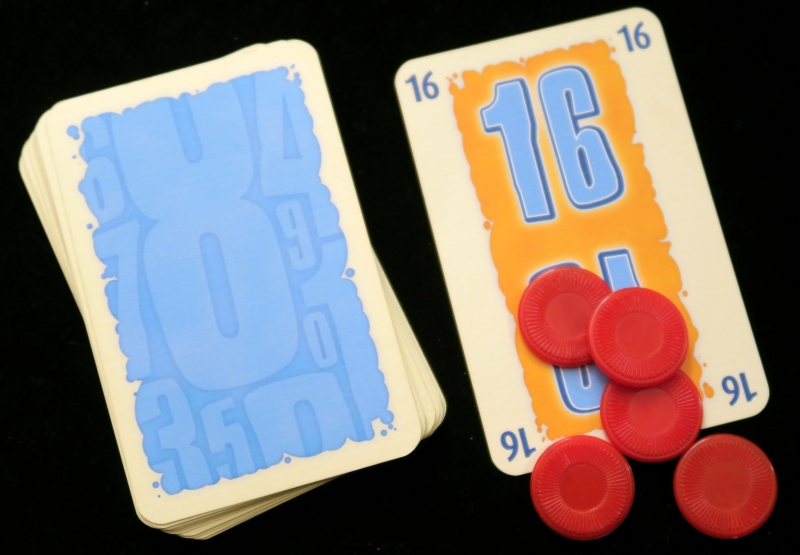
In the end, Pink was the victor and, for the second game in a row, pushed Pine into second place, this time with Black just behind. The evening looked to be ending there, when a couple of people from the bar came over and asked what we were doing. That led to a fairly wide-ranging discussion about Monopoly, Cluedo and Mystery of the Abbey amongst other games. The evening really did come to an end eventually, after Pink and Blue had dragged one of the interested parties into a quick game of No Thanks!. Unfortunately, there was a misunderstanding and he top-scored with ninety-three, but hopefully he understood that some of the games we play are not that complicated.
 |
| – Image by boardGOATS |
Learning Outcome: Playing forwards and backwards at the same time makes heads hurt.





 boardGOATS