Tag Archives: New York Zoo

9th July 2024

When Blue and Pink arrived, Crimson and Cyan were already there on their first visit, finishing their supper and playing a game of Molehill Meadows.  This is a new game by the designer of Zuuli, that they had picked up at the UK Games Expo (meeting the designer Chris Priscott and his delightful family in the process).  In Molehill Meadows, players take on the personality of Mika the Mole, who has an affinity for shiny things, a hunger for juicy worms and an innate desire to dig  A flip-and-write game, players dig tunnels using polyomino shapes to carefully expand their molehill home.

Molehill Meadow
– Image by boardGOATS

Their game was somewhat interrupted as people arrived and were introduced and they were surrounded by the general chatter of arrival and Blue and Pink munching their pizzas.  Crimson and Cyan carried on playing, flipping polyomino cards and then drawing the shapes on their map.  Extending their tunnel to find Worms gave both players four “Worm Powers”, and fining treasure gave them points.  Cyan collected twice as much treasure and picked up more than twice the number of bonus points than Crimson (for collecting all of the two sets of flowers on the Objective Cards) and thus was the eventual victor by something of a landslide (or should it have been a tunnel collapse?).

Molehill Meadow
– Image by boardGOATS

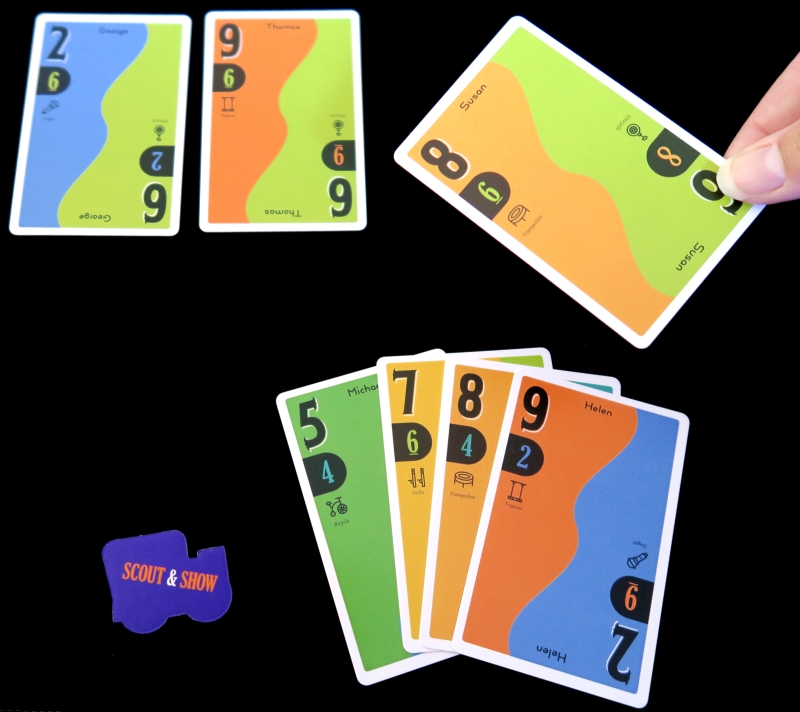
Then, while everyone else generally gossiped and caught up with the events of the last week or so, Jade and Sapphire joined Crimson and Cyan for a quick couple of rounds of the trick-taking, climbing game, SCOUT.  We’ve played this a few times on a Tuesday and everyone has always enjoyed it.  The game is simple in that on their turn, the active player either plays a set of cards to beat and replace the set on the table (a run or a meld), or take one card from either end of the set on the table and add it to their hand.  The round ends if a player plays the last card in their hand, or if it is a player’s turn and they played the current active set of cards on the table.
SCOUT
– Image by boardGOATS

At this point, player score for cards in their scoring pile (cards they have beaten during the round), for “chocolate bars” (rewards given when another player takes a card from their active set), and deducts a point for every card left in hand.  The clever part of the game is that, like Bohnanza, cards cannot be rearranged in hand, this with the fact that cards have different values depending which way up they are make this little card game really clever.  In the interests of time, the group only played two rounds, and although the scores can be very disparate, this time it was really tight with only five points between first and last and Sapphire taking the honours one point ahead of Crimson.

SCOUT
– Image by boardGOATS

By this time, Blue and Pink had just about finished eating and everyone else had mostly finished chatting, so with twelve, the group split into three groups of four, starting with Pine, Sapphire and Cyan who joined Jade in the “Feature Game“, Happy Home.  This is another polyomino game, with similarities to games like New York Zoo and Bärenpark, but with a theme of home decorating rather than building an animal park.  Like New York Zoo (or indeed Jokkmokk), the game has a central market, in this case representing a Store, which players move their Meeple round.
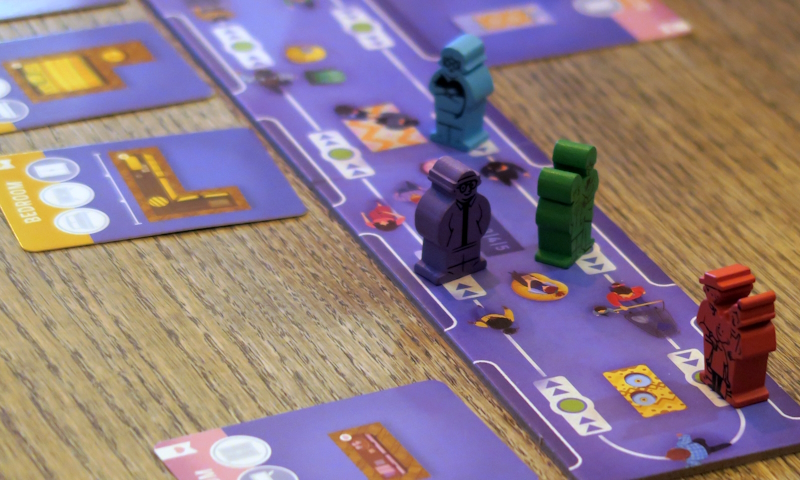
Happy Home
– Image by boardGOATS

On their turn, the active player moves their Meeple (or should that be Muman?) to an available space, takes the card and matching tile and then adds it to their home.  When all the cards are used up, players instead place a “Welcome Mat” on their doorstep to show they are ready to welcome visitors.  When everyone has finished , the game is over and players score their Home for Furniture, Colours, Pot Plants, their Welcome Mat and Design Objectives, losing points for any scratches still visible and not covered up by Furniture.
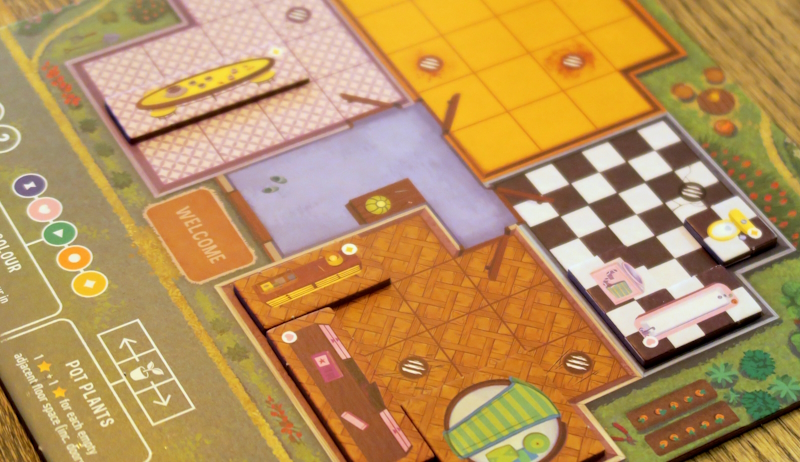
Happy Home
– Image by boardGOATS

There was a wee bit of misunderstanding on how the scoring worked even though Jade had done his best to explain it at the beginning.   Each Room scores one, three or six points if it has one, two or all three different core pieces of Furniture in it, and each Pot Plant is worth a point plus a bonus point for each empty space orthogonal to it.  That wasn’t where the problem was however, that was with the Colour scoring. Essentially players need to have the same Colour across at three different rooms to get two points and across four rooms to get five points, but somehow, this caused more confusion than it should have done.
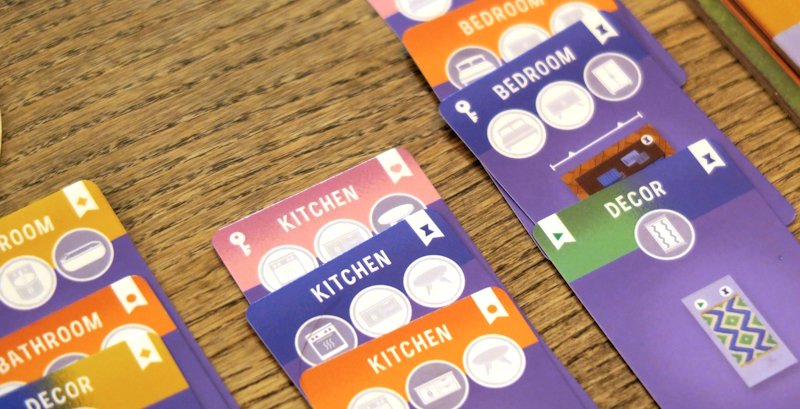
Happy Home
– Image by boardGOATS

The group also made life more difficult for themselves by shuffling the cards and removing twenty-four cards as per the rules for the four-player game, but somehow the bulk of those removed seemed to be Furniture for just one of the rooms, the Bathroom.  It was a good learning game as the value of Rugs, for example, became evident later on—players were a bit confused as they don’t score in their own right, but they add Colour to a Room and thus can score at the end of the game.
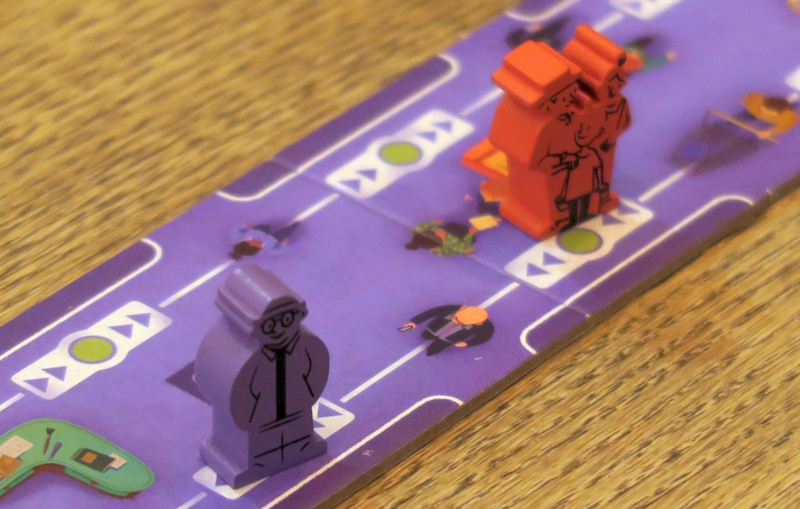
Happy Home
– Image by boardGOATS

This time the Design Objective was “Bigger is Better”, so players lost a point for each empty floor space in their Room with the most empty spaces.  The lack of Bathroom fittings, meant Pine didn’t have a loo in his house and had to resort to “wafflestomping“, but he did have what looked like two pink ironing boards furnishing his Lounge.  Next door, Sapphire filled his Living Room with a pink sofa and an enormous matching pink widescreen TV (that was the same size as the sofa!).  In the end, the victor was a bit of a runaway winner.
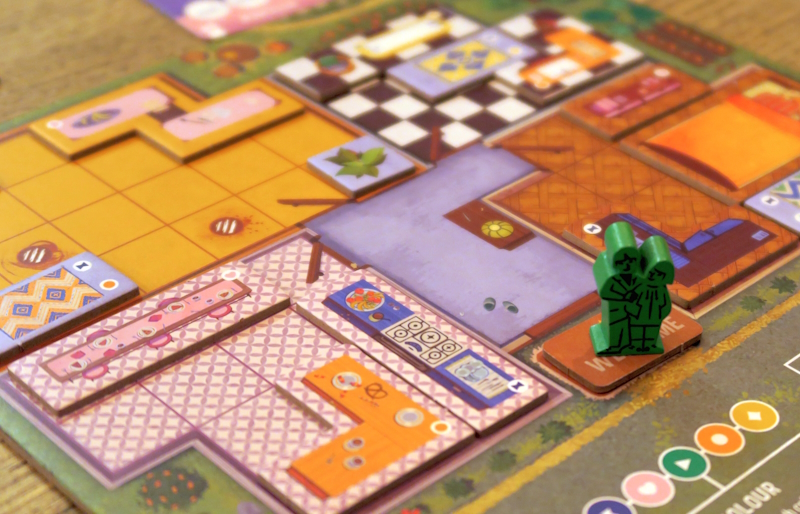
Happy Home
– Image by boardGOATS

In spite of his lack of toilet facilities, Pine finished with twenty-four points, some seven ahead of Sapphire in second, with Jade taking the last place on the podium.  Before the game, Pine had said he wasn’t sure about it from the description, but in the event he really enjoyed it, as indeed did everyone else.  Meanwhile, there were two other games underway.  The first of these was Keyflower—a very popular game with certain members of the group, but one that hasn’t had an outing for a long time, in fact the last time the group played it was online in 2020, and the much-missed Burgundy was involved.
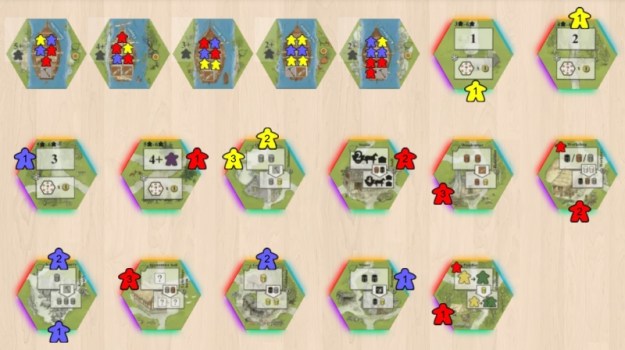
Keyflower on boardgamearena.com
– Image by boardGOATS from boardgamearena.com

This time, the four players were Blue, Pink, Black and Ivory, all of whom had played Keyflower before (albeit a while ago).  The game is fairly simple in terms of concepts, but like many good games, challenging to play well.  Each round, players take it in turns to bid on a tile, or activate a tile.  The clever part of the game is that both bidding and activating is done with red, blue, yellow or occasionally green Keyples (Meeple-shaped workers).  In each of the four rounds (or Seasons), a set number of tiles are put out for players to bid on.  Players take it in turns to bid or activate and when everyone passes in succession, any tiles won are added to the winner’s village, any losing bids and any Keyples used for activating return to their owner.

Keyflower: The Farmers
– Image by boardGOATS

At the end of each round, a boatload of new Keyples arrive in each village (players can bid to get the one of their choice), before the tiles for the next Season are set out.  In general, tiles are drawn at random, and in the first season, Spring, mostly provide Resources with Summer and Autumn tiles providing special powers and Autumn and Winter tiles providing scoring opportunities.  The Winter tiles are different to those for the other Seasons in that instead of being drawn at random at the start of the Season, they are dealt our to each player at the start of the game.  Then, at the start of Winter, players choose from their pile which ones they want to make available—in this way, the Winter tiles act as sort of objective tiles.
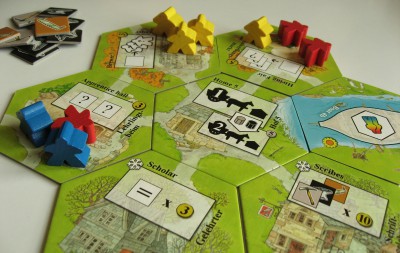
Keyflower
– Image by boardGOATS

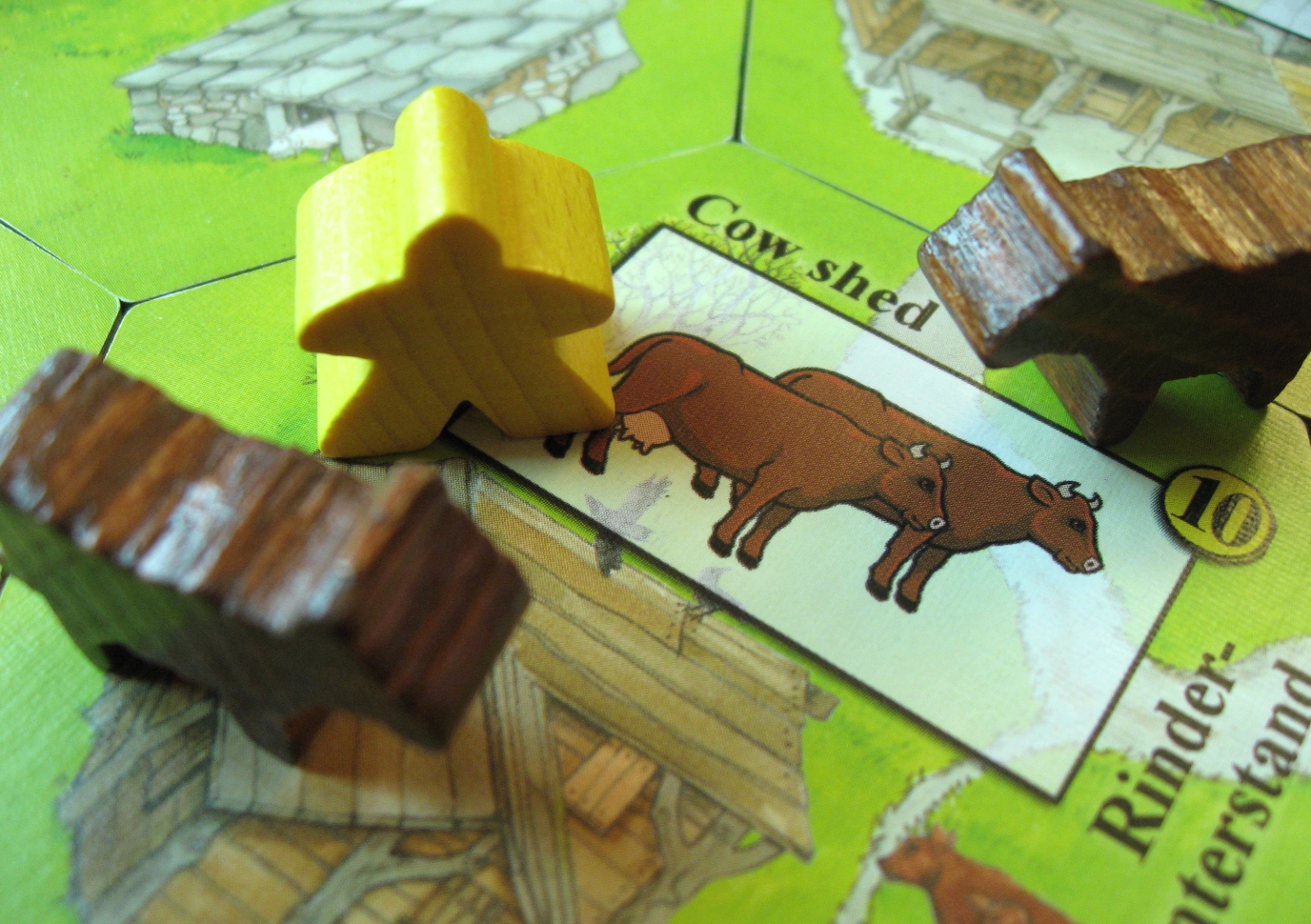
The Keyflower box also contained The Farmers expansion and the question arose whether to include it or not.  Blue, Pink and Ivory were on the fence until Black said he’d never played with the Farmers, so of course that was a problem they had to urgently fix.  In the base game, the different tiles are connected by roads which are used for transporting goods to places where they can be used to upgrade tiles or score points.  In The Farmers expansion, these roads now define fields where animals can be left to graze and with each occupied field scoring points at the end of the game.
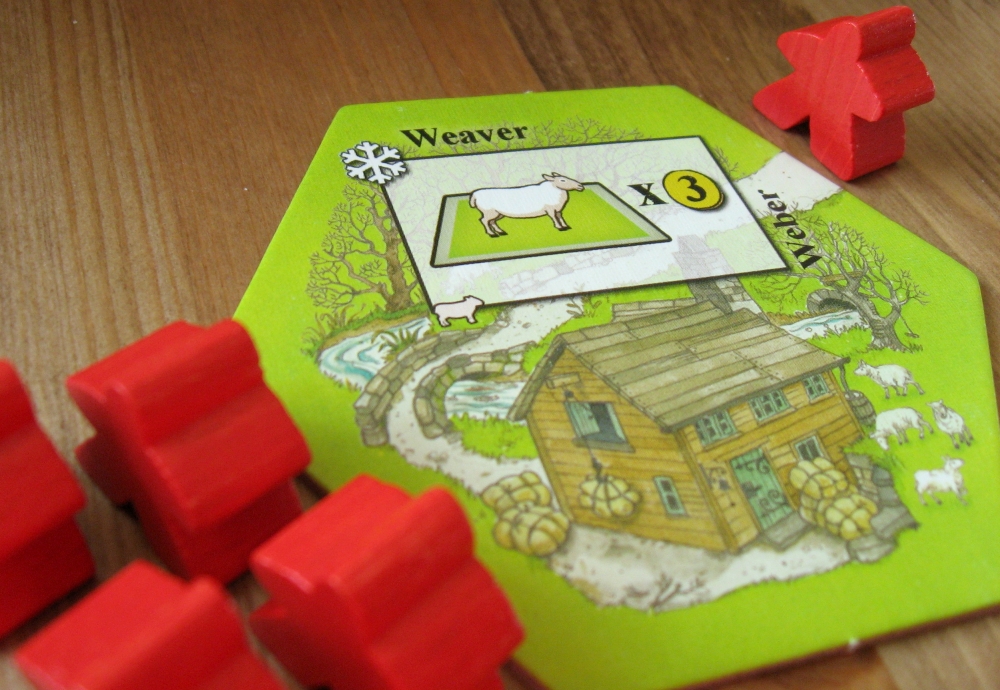
Keyflower: The Farmers
– Image by boardGOATS

Additionally, The Farmers expansion introduces wheat as a new resource, which can be used to add distance/quantity to the movement action, enabling players to move more animals and resources further.  There are several ways to set up the game with The Farmers expansion, but this time the group used The Farmers Variant, where all the tiles from the expansion are used and the number made up with tiles from the base game.  After setting up and explaining the additional rules to Black, Ivory went first, taking the waving purple start-player Keyple, and began the bidding.

Keyflower: The Farmers
– Image by boardGOATS

In Spring, Blue failed to get anything useful at the start of the game (or so she thought) taking just the Key Mine tile which gives Coal and didn’t match any of her Winter tiles.  Pink started off taking the Sheep Fold which gave him a source of sheep and the Paddock which gave him more Movement and upgrade ability together with some Wheat.  Then, he took the Workshop which gave him one resource of his choice from Wood, Coal or Stone, upgradeable to three resources, one of each, which matched his Winter tile, the Mercer’s Guild.  Ivory won the Quarryman, which gave him some very useful gold, and in Summer took the Shepherd’s Hut which gave him Wheat and Sheep and then embarked on a concerted breeding and movement programme.

Keyflower
– Image by boardGOATS

Black picked up a few tiles early in the game, which ultimately led to a lightly sprawling Village by the end of the game.  These included the Wheatfield in Spring and the Tavern, the Smelter and Boat 3a in the Summer.  By this time, Pink had decided that the sheep weren’t doing it for him so moved on to pigs, with the Pigsty.  Blue, having missed out on the Tavern which converts one Keyple into two, instead took the only tile that generated green Keyples, the Store which went well with one of her Winter tiles, the Key Market, but gave the added power of preventing other players from following if she was the first to Bid with Green, as they were highly unlikely to have any.

Keyflower: The Farmers
– Image by boardGOATS

In Autumn, Blue discovered the value of the Key Mine tile she had picked up in the first round, when the Blacksmith tile appeared which gave points for each Coal on the tile at the end of the game.  She added the Ranch to this which gave Cows and Wheat, and then began mining Coal in earnest and hoarding large numbers of sheaves for a super-movement move later in the game to get everything where it was needed as efficiently as possible.  Black got the Goldsmith which went well with his Smelter which gave him the Gold he needed to upgrade it and get ten points, while Ivory and Pink continued their procreation programmes.
Keyflower: The Farmers
– Image by boardGOATS

As the game progressed there were several visits from the other gamers in the room, many of whom, much to the people who were playing it’s surprise, had not played Keyflower. It is, of course, Blue’s favourite game and was a favourite of Burgundy’s, as well as being generally very popular with almost all of the regulars pre-2020.  So as the game continued into Winter, it was clear it would have to get another outing or two reasonably soon to rectify the situation. There is also The Merchants expansion which has not been played with the group, so that might be the “Feature Game” in the coming months.

Keyflower: The Farmers
– Image by boardGOATS

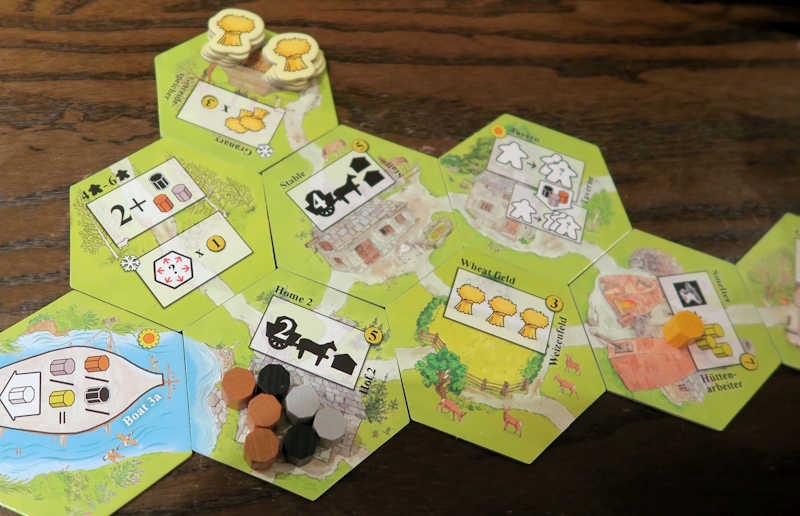
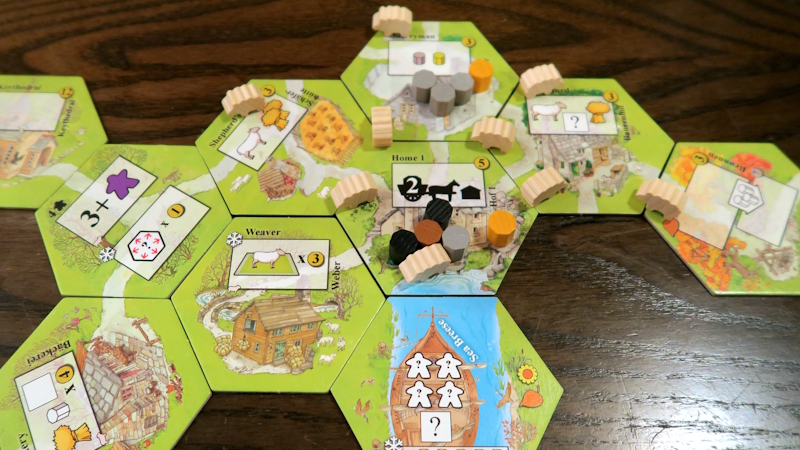
Only eight out of a possible sixteen Winter tiles were introduced by the players and the Scribes, which Ivory commented usually ensured victory was not there (it turned out nobody had started with it).  Black took the Granary which gave him points for his Wheat and Pink got his Mercer’s Guild that he’d been working towards.  Ivory won the Cathedral giving him a straight twelve points; the Weaver giving two extra points per sheep field, and the Bakery giving four points for each set of a Resource, a Skills tile and a Wheat Sheaf.  Blue had lots of options, so concentrated on building her piles of resources before bidding for her end of game scoring.
Keyflower: The Farmers
– Image by boardGOATS

This required a lot of nerve as Ivory had there wherewithal to take some of the tiles she obviously wanted.  Ivory hummed and hawed over it and as Black and Pink passed, twice he had the chance to begin a war, but decided not to as “that’s not very nice” and it can also backfire spectacularly.  Instead he generated the odd Gold for a point (“in case it was close”) and waited and watched.  In the end he passed and then Blue passed and that was that bar the counting.  And as it turned out, it was close, very close, but Blue just took victory, by a mere three points, with a total of ninety-five.
Keyflower: The Farmers
– Image by boardGOATS

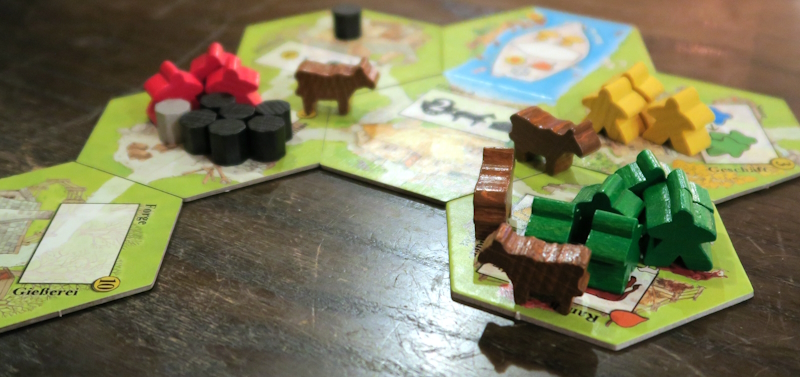
The jury is out as to whether it was Ivory’s kindness that cost him the game because Blue did, of course, have contingency plans if someone had tried to take some of the tiles she wanted, and she could have cost him a lot of points.  However, by the end, Blue had no Keyples left and Ivory had a couple that he could have used, so depending on how things had panned out, he might have just nicked it or still lost.  Instead, his kindness and generous good nature won him a lot more respect from his fellow gamers, especially given that everyone knew how fond Blue is of Keyflower successfully destroying her plans might have made her just a little bit sad.
Keyflower: The Farmers
– Image by boardGOATS

Finally, the third table began their evening with Azul: Summer Pavillion, the third in the series based on the essentially abstract game of tile collecting, Azul.  Crimson kindly obliged in offering to lead the game with Lime, Teal and Purple, none of whom had played this variant before.  This is more similar to the original than the second in the series (Stained Glass of Sintra), but is built on lozenge-shaped pieces that make up hexagons.  Like the original, players take tiles from a central market and add them to their player-boards claiming points as they do so.  In contrast to the original, players store the tiles and add them all to their board at the end of the round (taking it in turns to do so).
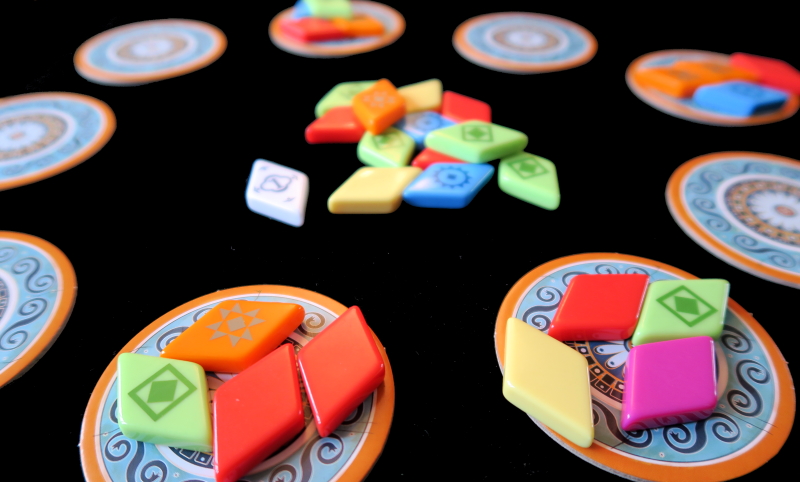
Azul: Summer Pavilion
– Image by boardGOATS

After some initial confusion caused by the additional bag and player boards from the Objective Tiles and Glazed Pavillion expansions, the game got underway.  Unfortunately, there was a bit of a rules malfunction:  initially it was thought that every time a tile was placed it scored one point for itself, two for one next to it and three for a third one in sequence (totalling six).  The group soon realised this wasn’t right though.  So they then thought you scored at the end of the round after playing all the tokens, however, they soon realised there was no way anyone could remember when a new tile that round had been placed.
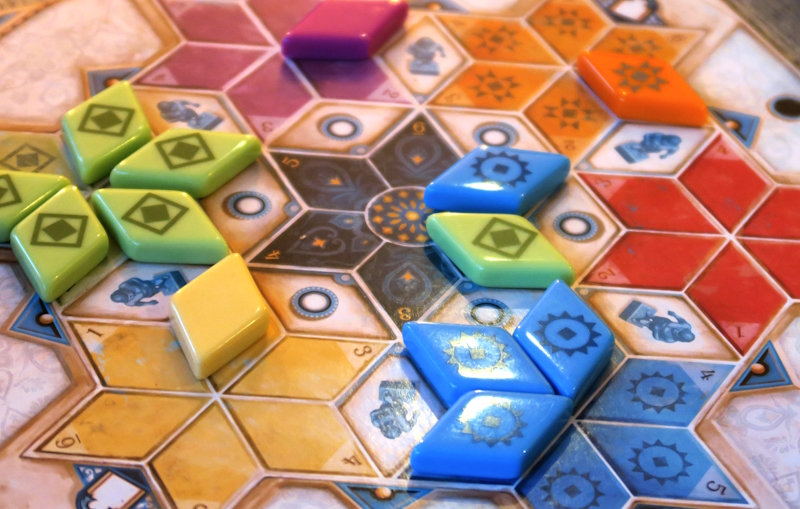
Azul: Summer Pavilion
– Image by boardGOATS

At this point, they then read the rules and from that decided players score one point for the tile and one for each tile it was adjacent to, thus scoring from one to three points per tile as they were placed and this is how they continued to play.  Cyan immediately identified they had come a cropper when he looked at the low end-game scores. He explained that they should have scored one point for the tile placed and one point for each tile connected to that group, so potentially up to six points could be scored for some tiles!
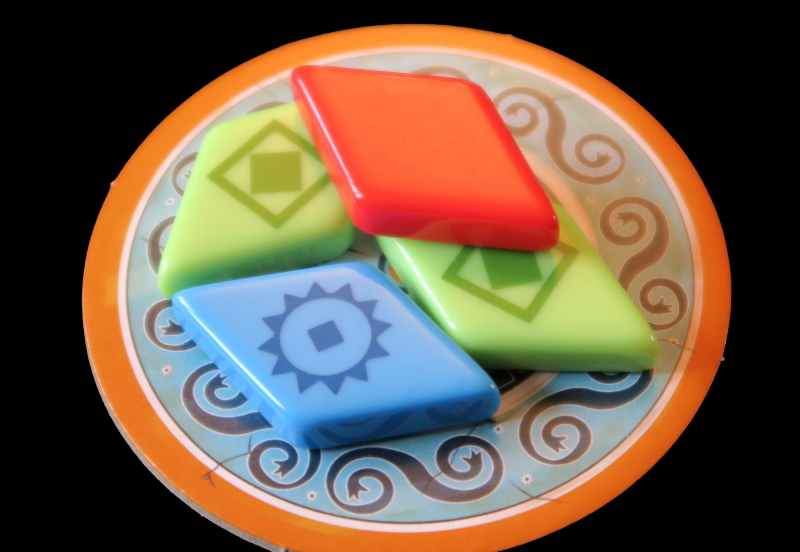
Azul: Summer Pavilion
– Image by boardGOATS

Although it wasn’t played by “the rules as written”, everyone had the same disadvantage, and the group resolved to give it another go again soon, but with the right rules next time.  As it was, it was a very close game with Crimson, beating Lime by a single point and Teal finishing some half a dozen points behind.  It is a very pretty game, and despite the issues, players had enjoyed making patterns and pushing the tactile bright tiles around, which was very therapeutic after a hard day at work.

Azul: Summer Pavilion
– Image by boardGOATS

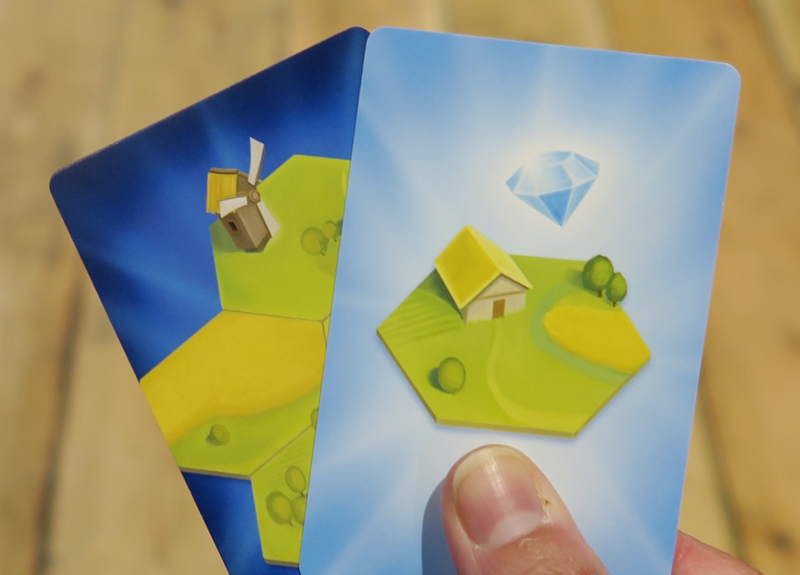
Keyflower was ongoing (and would be for the rest of the evening), but Happy Home had finished so there was a quick game of musical chairs and Purple began by leading Lime, Cyan and Pine in a game of the group’s currently popular filler, Rome in a Day.  This is a little tile laying game built round the “I divide, you choose” mechanism.  The idea is that players draw five land tiles at random and place two buildings on tiles one and two. They then divide the five tiles into two groups—a bigger and a smaller one (in any ratio), and add a Crystal Gem to the smaller land set before offering the choice to their neighbour.
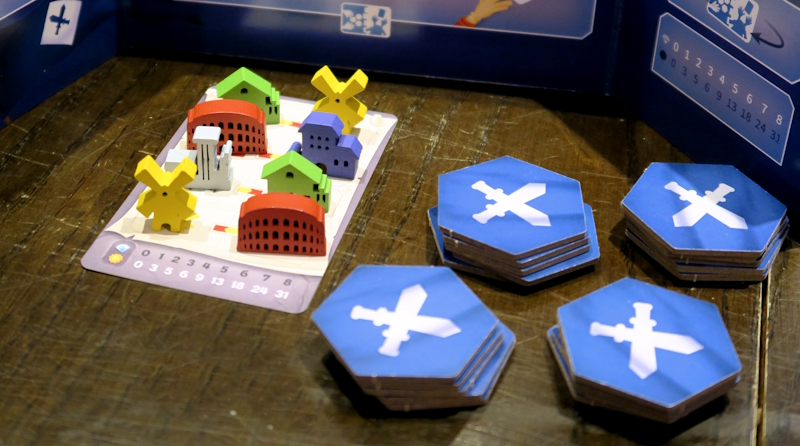
Rome in a Day
– Image by boardGOATS

During the four rounds that the game is played over this neighbour alternates, right, left, right, left. So, each round, players choose a set from their neighbour and these and the tiles they were left with are added to their domain.  At the end of the game, any building that stands on or adjacent to land of its own colour will score for each tile in the group and then players score for the diamonds they have collected—the player with the most points is the winner.  The game has had a couple of outings recently after Black and Purple picked it up at UK Games Expo a few weeks back.  Pine, Lime and Cyan had not been part of those games, so Purple explained the rules.
Rome in a Day
– Image by boardGOATS

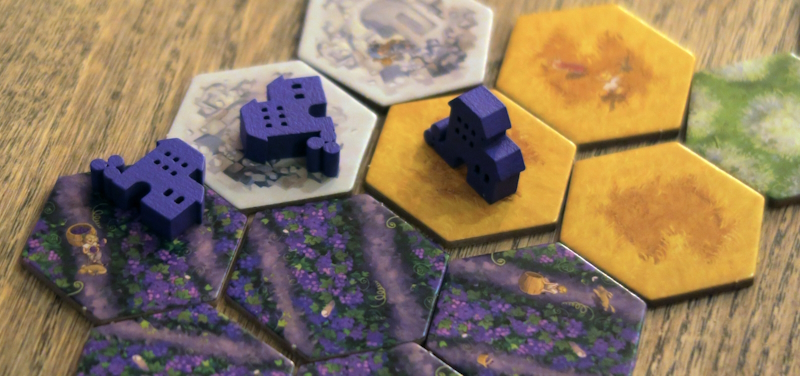
The game was a bit of a struggle, probably not helped by the fact that on both the previous occasions the rules have not been strictly adhered to.  This is partly because the rules are not the best written and partly because when the game was explained to Black and Purple at UK Games Expo they were different to those published online.  Although it wasn’t entirely clear to everyone during the game, it was actually very close.  In fact, Lime and Cyan finished tied for first place with forty-four points each despite quite different tactics with Cyan prioritising collecting Gems and Lime making hay in his Wheat fields and wine in his Vineyards.
Rome in a Day
– Image by boardGOATS

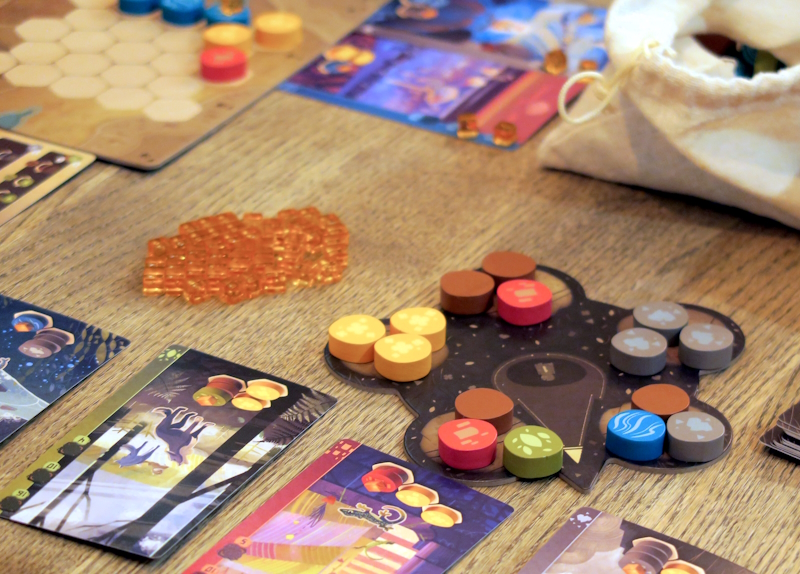
While the group were fighting their way through Rome in a Day and Keyflower was coming to an end, Jade led Sapphire and Crimson in the 2024 Spiel des Jahres recommended game, Harmonies.  This was described by Jade as a sort of cross between Splendor and Cascadia, with an Azul-type market.  On their turn, the active player takes three wooden Tokens from one of the spaces on the central player board and places them on their player board. These Tokens represent Mountains, Trees, Buildings, Water and Fields.  Some tokens can stack, others cannot: the reasons why are thematic (e.g. tall Mountains and Forests, no tall Rivers etc.), but otherwise Tokens can be placed on any empty space.

Harmonies
– Image by boardGOATS

Players may then take an Animal card from the central display—they can have a maximum of four at any one time and each has a number of Animal cubes on them.  Each time the pattern on an Animal card is fulfilled, one of these Animal cubes is removed and placed on the token indicated on the card.  At the end of the game, players score for the highest achieved Animal on each card and for each Mountain, Tree, Building, Field and River (or Island, depending on  which side of the board players are using).  Mountains are made of stacks of up to three Rock Tokens, while Trees are a green Leaf Token on zero, one or two Wood Tokens.
Harmonies
– Image by boardGOATS

Taller Mountains and Trees give more points (one, three or seven points), while Buildings (made of two Tokens, at least one Brick and a Wood, Rock or another Brick), and Fields (two adjacent Wheat Tokens) score five points each.  Finally, depending which side of the board is used, players score points for the length of their River, or five points for each Island they make.  This time, the group played with “Side A” which scores for Rivers.  It was a learning game for Crimson, but was quite close quite between Jade and Sapphire, but Sapphire’s one hundred and eight gave him victory in what is an interesting point-salad tile-placement game that deserves another outing soon.

Harmonies
– Image by boardGOATS

Learning Outcome:  You don’t need a toilet to have a Happy Home.
2nd May 2023

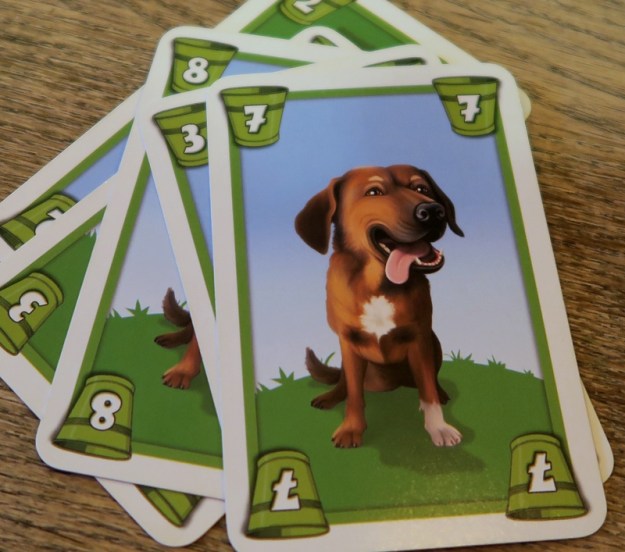
Blue and Pink were the first to arrive and were just finishing their supper when Magenta walked in—sadly not to join in the games as she was there for a Scout meeting.  After a quick chat, she left and as Blue recapped the rules for the “Feature Game“, Zoo Break, Teal arrived and then Purple and Black.  The group had just decided to play Alles im Eimer (aka The Bucket King), when Ivory rocked up to make the full compliment of six.  Purple explained the rules with help from Black.  The idea is very simple:  each player builds a pyramid of ten bucket tokens with two of each of five colours.

Alles im Eimer
– Image by boardGOATS

One player starts, playing a coloured, numbered, animal card and each player has to follow with the same colour and a higher number before picking up a card.  Players can play multiple cards to make the total, but they only ever receive a single replacement card.  If they can’t, or choose not to follow, they lose a bucket of that colour, and any buckets above it.  Worse, if they split their pile of buckets in two, they lose one part as players can only ever have one pile.  On the plus-side, if a player can’t play (or chooses not to), they then lead with a free choice of colour and number.  The last player with buckets still standing is the winner.  With Purple shuffling, Ivory was the first to play.

Alles im Eimer
– Image by boardGOATS

It turns out that there are two things that are really critical in this game.  Firstly, how players stack their buckets—it is not as simple as playing to their hand strengths; the smart player also spreads the colours out a bit so they aren’t forced to take buckets from low down when the unexpected happens.  Secondly, as Ivory pointed out, like 6 Nimmt!, it is all about timing, which is something players may not have control of.  A few rounds in, Black spotted that Pink to his left still had a complete stack where bucket piles had been falling all over the place everywhere else.  So, Black made it his business to make Pink’s life difficult.  From there, it was gloves off and the buckets really started to tumble.  Purple was the first player to kick the last of her buckets over which left Blue to do what she could to damage Ivory’s largely unscathed pile.
Alles im Eimer
– Image by boardGOATS

Black, then Blue, then Teal, all fell, leaving just Pink and Ivory to fight it out.  With Pink’s dwindling pile, it always looked an uphill task, and so it proved, with Ivory taking victory with five buckets still standing.  By this time though, Lime and Green had arrived and with eight, the group split into two tables of four, the first for the “Feature Game“, Zoo Break.  Pink was nearly lured away at the suggestion that the alternate might be Takenoko, but despite being very torn by his love of pandas, he stuck with his original panda driven choice and was joined by Blue, Lime and Black as Keepers at Bedlam Zoo.

Zoo Break
– Image by boardGOATS

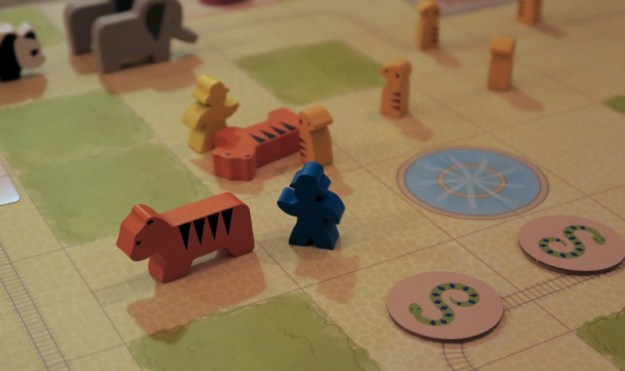
Zoo Break is an apparently light cooperative game where players are a team of zoo-keepers trying to prevent a mass break-out.  The mechanism is quite simple:  the active player rolls a die to decide how many Action Points they get, then they carry out actions, before drawing an Escape card and a Move card (to see what animals escape and move).  The game ends when either a dangerous animal (tiger, elephant, or dangerous snake) escapes, or when the fifth cute animal (panda, Capuchin monkey, meerkat or harmless snake) exits the zoo, or when there are no animals roaming about and all the cages are locked up.

Zoo Break
– Image by boardGOATS

Although the mechanism of Zoo Break is very straight-forward and the art-work implies it is a simple kiddies game, nothing could be further from the truth.  The rule book is twenty pages long, and there are a lot of details regarding escaping and recapturing animals.  For example, when an animal escapes, it doesn’t just move to the space immediately outside its Enclosure, it moves to the nearest “open” space.  Also, different animals are recaptured using different tools which have to be acquired from the supply by the Keepers.  For example, a Net can be used to capture meerkats or monkeys, while a Leash is required for pandas and elephants, and tigers need to be Tranquilised and Stretchered home (very carefully, obviously).

Zoo Break
– Image by boardGOATS

Each Keeper has a different skill.  This time, Blue had the ability to reveal snakes and capture animals from adjacent spaces (especially useful for dealing with snakes); Pink could run faster than anyone else, moving two spaces for each action point (instead of the usual one); Black, the Gardener, could move through and hide in bushes, and Lime could re-roll the die twice to try to get additional actions.  From experience with games like Forbidden Island and Forbidden Desert, the key is almost always to make good use of these special powers.  So Blue suggested she made it her business to concentrate on dealing with the snakes since she could do so without being bitten.

Zoo Break
– Image by boardGOATS

Pink with his Panda obsession, was always going to go after them, and everyone else was happy to let him get on with it.  Before any of that could happen though, the Keepers needed Supplies.  Pink started, and went straight to the Supply shed and started revealing tools.  These are drawn from a face down pile, but Keepers only have space to carry four tools in their backpack, so can choose only to take the ones they want.  This was probably the team’s first mistake:  instead of the few players just searching the whole Supply pile and making a discerning choice while taking as much as they could carry, players grabbed a couple of items and headed off.

Zoo Break
– Image by boardGOATS

This became a problem later in the game when the Keepers realised they didn’t have tools and were now on the other side of the board.  Black who had drawn the meerkat enclosure key headed off to the far corner to lock it quickly.  Lime captured the only roaming meerkat (which had been playing in the fountain) and Black was just about to lock the cage when another one escaped.  As he didn’t have a Net, despite being in the same space as it, he was left chasing about trying to grab it unsuccessfully.  And then more meerkats got out.  So Lime, Keeper without portfolio (but with both a Net and a Leash), waged war on the disobedient meerkats, while occasionally taking time out to catch an elephant or a monkey.

Zoo Break
– Image by boardGOATS

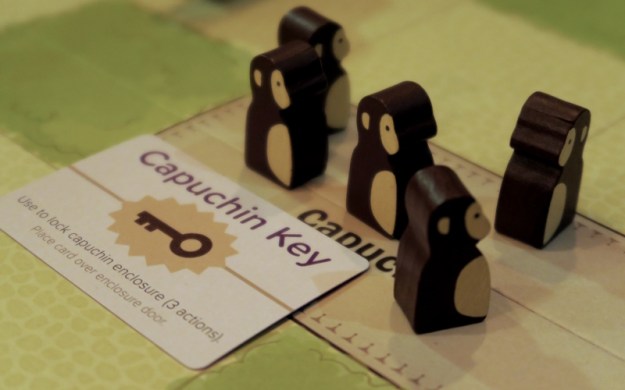
Pink, meanwhile, had his panda enclosure Key and a Leash and was trying to do something about them, but was inconvenienced by a pair of elephants, one of which knocked him flying necessitating a visit to the Medic.  Lime captured the last of the Capuchin monkeys and Blue who was close at hand with the enclosure Key managed to slam the door shut before any more got out—just as well, as the snakes were beginning to get out of hand, and as for the meerkats, well, these little blighters were causing mayhem.  Twice the Keepers had them under control before more escaped, and as they formed a long queue, the queue kept getting longer and longer as they marched inexorably towards the exit.

Zoo Break
– Image by boardGOATS

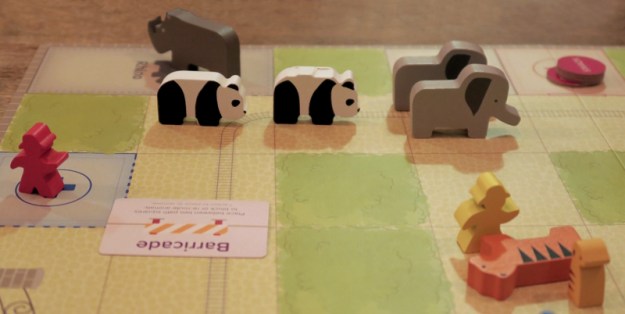
Pink used the Barricade to delay the escape of a couple of pandas and the pair marauding elephants, but it failed to hold when the Broken Barricade Move card appeared.  The rhino’s occasional charges weren’t much of an issue as they were very predictable, but once animals started to get close to the exit the rhino became more of a problem as players stayed out of its path wasting Action Points.  By this time, the tigers were becoming a problem, but Pink and Black put their Tranquiliser darts to good effect and soon the zoo was littered with sleeping tigers.  Lime had a Stretcher, but never actually used it, briefly loaning it to Blue for the only tiger returned to its enclosure (and left to peacefully sleep off the after-effects, as per one of the new variants).

Zoo Break
– Image by boardGOATS

There was a bit of a debate over whether it was more important to work on the rogue pandas or let them and meerkats escape and focus on the dangerous animals (in particular tigers and elephants).  Slowly but surely, however, the animals were taking over as there was a little procession of Keepers at the Medic’s tent, with only Lime avoiding injury.  Black was the only player to make use of the Train, because it didn’t really go where people wanted it to and players dealt with the issues nearest to them.  That was probably a good strategy; like it says in the advice, it is also important to lock stuff up early—the team didn’t.  They dealt with the monkeys, but the only other enclosure they managed to lock was the pandas, just before two meerkats and a cobra made a run for it in a single turn.

Zoo Break
– Image by boardGOATS

Although the mass escape had caused the zoo to be closed down and Pink hadn’t actually been cuddled by a panda, everyone had really enjoyed themselves.  On reflection, working in pairs might have worked better (as with Flash Point and Escape), because then the team can do things much quicker, get on top of things and lock cages making life easier all round.  Black was curious about the variants available.  The group had played on “Standard” difficulty with two “Phew!” Escape cards (where nothing gets out), but thanks to a rules malfunction, had also included the blank cards in the Move deck which provided quite a bit of respite, so everyone had a good laugh at the idea of making the game harder.

Zoo Break
– Image by boardGOATS

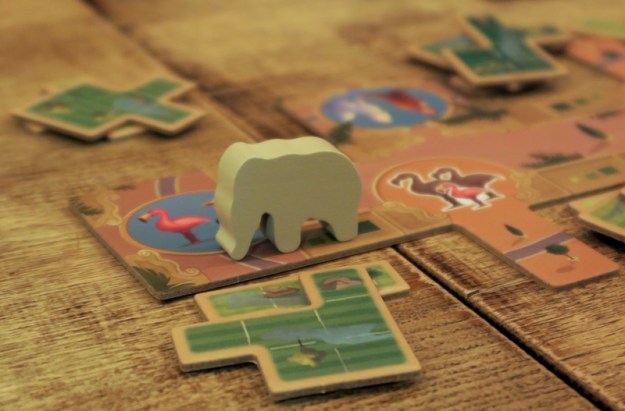
Despite the fact the group rarely plays cooperative games, everyone was keen to give Zoo Break another outing soon.  Zoos were popular elsewhere too—the next table had been playing New York Zoo.  This is a tile-laying game that got its first Tuesday outing only a few of weeks ago, but had been enjoyed by all.  In this game, players add pens to their zoo, populating them with animals, and building attractions.  Like Uwe Rosenberg‘s other similar games (including Cottage Garden, Spring Meadow, Indian Summer and Patchwork), it is Tetris-like but what makes this one unique and interesting is the Market.

New York Zoo
– Image by boardGOATS

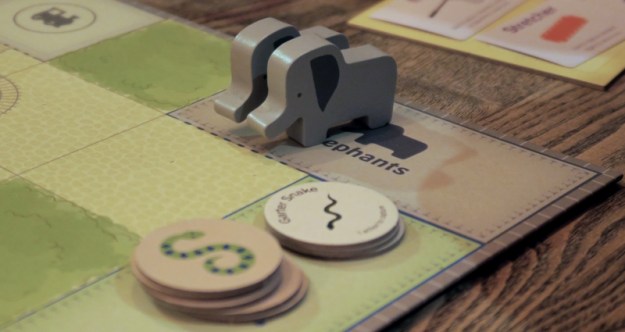
Players move the Marker Elephant one to four spaces round the Market, landing either on an Enclosure tile space (taking the top one and adding it to their zoo) or on an animal space (taking one or both of the animals depicted). Enclosure tiles can be placed anywhere in the player’s Zoo, then one or two identical Animals from elsewhere in their Zoo must be moved to occupy the Enclosure.  Each Enclosure can only hold one type of Animal.  When there are two or more Animals in an Enclosure together they breed when the Elephant passes the Market’s breeding spaces.

New York Zoo
– Image by boardGOATS

When an Enclosure is full, all the animals are removed and the player takes an Attraction tile of their choice and adds it to their Zoo.  Attraction tiles are useful because they fill additional spaces, and at its heart, New York Zoo is a race game—the winner is the first to fill all the spaces in their Zoo.  Purple had played last time, and Green had played elsewhere, however, Ivory and Teal were new to the game and the rules needed explanation.  That didn’t take long though, and the Elephant was soon touring the market and everyone was building their zoo and adding animals.

New York Zoo
– Image by boardGOATS

Purple was quick to get going, as was Green.  New York Zoo is really a tactical game, but there are a couple of broad strategies—fill the zoo with large Enclosures that are harder to fill, but occupy more space, or fill it with smaller Enclosures which are easier to fill with animals giving bonus Attraction tiles.  Purple went for the latter approach, getting some of the large attractions early in the game.  Teal however, opted for the former strategy, which is harder to get to work, but can be extremely effective, as indeed it was this time, making him the first to finish his zoo, and with no Attractions at all.  Purple was the best of the rest with for spaces left to fill, with Green a little way behind.

New York Zoo
– Image by boardGOATS

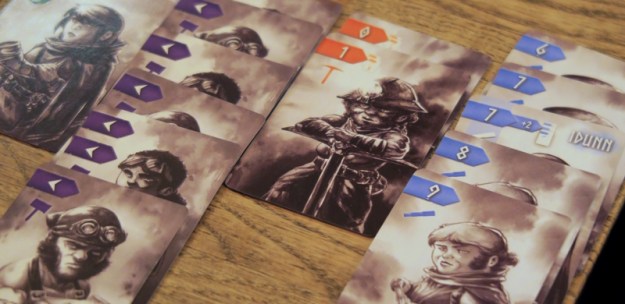
The Keepers in Bedlam Zoo on the next table were still trying to get the marauding beasts back in their pens (largely unsuccessfully) so the others had to decide what to play.  Green decided to go home, and couldn’t be persuaded to stay by the opportunity to play Nidavellir despite having been very keen to play it previously.  That left Purple, Ivory and Teal, who decided to play it anyhow.  Nidavellir is a card set-collection and bidding game inspired by Norse myths. The game was created by French designer Serge Laget (who sadly passed away in January this year after a lifetime of producing some great games) and the striking black and white artwork by Jean-Marie Minguez which nicely contrasts with the coloured cardboard components.

Nidavellir
– Image by boardGOATS

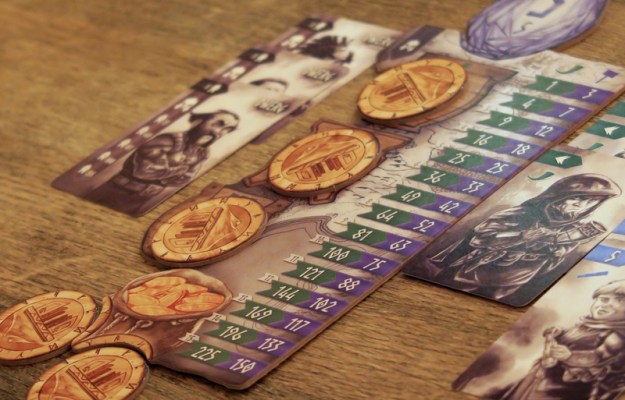
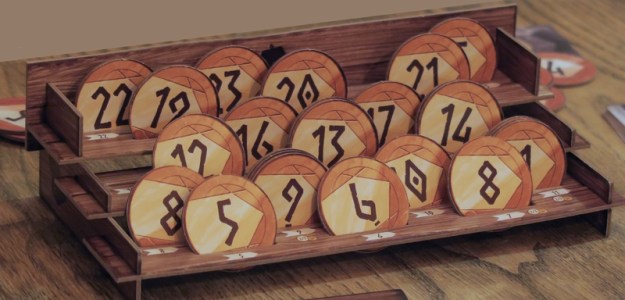
The story behind the game is that the kingdom of Nidavellir is under threat from the stirrings of the Dragon Fafnir and players are tasked by the King to recruit the best army to defeat it. Appropriately for our venue, the action takes places in three Dwarvish pubs where the players must use their coins to bid for the most skillful Dwarves (in a concealed auction), recruit the most prestigious Heroes, and build the best Battalion they can to defeat the Dragon.  Players hire five different professions of Dwarves into their growing army – Warriors, Hunters, Miners, Blacksmiths and Explorers.  Each player starts with five coins with the values: zero, two, three, four and five. Players place one of their coins against each pub space on their player mat.  The coins are revealed and cards are taken from each pub starting with the highest bidder.

Nidavellir
– Image by boardGOATS

Ties are broken in favour of the player with the the highest jewel token (randomised at the start) and then these players swap jewels so the losing player has an advantage next time there is a draw. Once the three pubs have been resolved, players take back their coins, and place their cards in their tableaux.  At the game end, points are awarded in different ways for each group of Dwarves.  For example, Hunters provide points based on the number of cards squared, Blacksmiths score according to the triangular sequence (as used in Coloretto), while the Navigators are simply a total of the number of points printed on the card, and so on.  Each round of the game, random face-up dwarf cards are lined up by each pub (equal to the number of players) and players bid for their order of selection.

Nidavellir
– Image by boardGOATS

If a player plays their “zero” coin, the values of the two unused coins are added together, the highest of the pair is discarded and a new coin of the same total is added to their stash from the Royal Treasure. Thus, players can gradually increase the value of their coins, which is useful for out-bidding others, but also adds value as the total coin hoard is added to their final score.  Hero cards, which supply additional points bonuses in a variety of ways are awarded when a player manages to have five cards of different type and then each time a new set of five is achieved. Heroes are selected from, a separate deck which allows for further point scoring combinations.  The start was a little slow as Purple and Ivory were both new to the game and had to figure out what to do.

Nidavellir
– Image by boardGOATS

Teal and Ivory both started by upgrading their coins.  Ivory was the first to get a set of five cards and claimed one of the Dwerg Brothers as his Hero giving him the target of collecting the other brothers which greatly crank up the points the more that are collected.  Teal, who had played the game before, chose more complex Heroes.  Half way through the game, Purple took the King’s Hand and the King’s Great Armourer Heroes for having the most Warrior and Blacksmith cards, while Teal took the Hunting Master and Crown Jeweler (for the most Hunters and Miners respectively), leaving Ivory just the Pioneer of the Kingdom (for the most Explorers).

Nidavellir
– Image by boardGOATS

The second age (played with a new deck of cards), was similar to the first, with particular tight battles around getting cards to complete sets.  Ivory had a slight advantage in this, having upgraded his coins more aggressively early in the game, and used this to get more of the Dwerg Brothers.  In contrast, Purple and Teal focused on collecting Dwarves of one kind with Teal using his Heroes to add to their “count” in particular colours when completing a set.  In the end, Purple and Teal scored best for Blacksmiths and Hunters, while Teal also took lots of points for his Miners—something he had focused on from the start.

Nidavellir
– Image by boardGOATS

Ivory however, had more Warriors and having the majority of them meant he could add the value of his most valuable coin to his score.  Despite that and over a hundred points for his Dwergs, Ivory finished just shy of Teal’s winning total of two-hundred and seventy-seven.  The downside of his victory—the winner has to face the Dragon Fafnir!  All agreed it was a good game, not overly complex, but with lots of decisions to make; a game that didn’t out stay its welcome finishing within the forty-five minutes advertised (even with two first-time players).

Nidavellir
– Image by boardGOATS

Learning outcome: Always keep a close eye on your meerkats.

7th March 2023

Plum and Blue were first to arrive and, by the time they had finished their enormous rack of ribs (or given up and had a doggy bag made up), almost everyone else had arrived.  There were a few people missing, but still enough for two games of four.  The first was the “Feature Game“, but nobody really wanted to commit to that until they knew what the other game was going to be.  As he had done the last couple of times, Green suggested Terraforming Mars.  Unlike previously, this time Ivory, Plum and Teal felt up to it, leaving Blue, Black, Purple and Lime to play their preferred choice of New York Zoo.

New York Zoo
– Image by boardGOATS

New York Zoo is a tile laying game by Uwe Rosenberg, designer of Agricola, Bohnanza, Patchwork and many other well-known games.  The idea is that players are building pens in their zoo, populating them with animals, and building attractions.  This is one of several polyomino, Tetris-like, tile-laying type games (including Cottage Garden, Spring Meadow, Indian Summer and Patchwork), but what makes this one unique and interesting is the Market.  Players move the Marker Elephant one to four spaces round the Market, landing either on an Enclosure tile space (taking the top one and adding it to their zoo) or on an animal space (taking one or both of the animals depicted).  Enclosure tiles can be placed anywhere in the player’s Zoo, then one or two identical Animals from elsewhere in their Zoo must be moved to occupy the Enclosure.

New York Zoo
– Image by boardGOATS

Each Enclosure can only hold one type of Animal, meercats, snow-foxes, kangaroos, penguins or flamingos, but when moving Animals, no pen can be left empty.  There is an advantage to pens having two or more Animals in them too—the Market also features breeding spaces, and when the Marker Elephant passes these, up to two pens containing two or more matching Animals get an extra one.  When a player moves the Elephant onto an Animal space, they take one of either or both the Animals depicted into Enclosures containing matching Animals (moving another from Storage if they can), or into the Storage space.  Moving animals is important, because when an Enclosure is completed the player removes all the animals putting one into Storage if they have space, and then takes an Attraction tile of their choice and adds it to their Zoo.

New York Zoo
– Image by boardGOATS

Attraction tiles are useful because they fill additional spaces, and at its heart, New York Zoo is a race game—the winner is the first to fill all the spaces in their Zoo.  Black and Purple had played this a few times, and once Black had explained the rules to Lime and Blue, Purple started.  Black and Purple prioritised completing Enclosures to get Attractions.  The Market is stacked so there are large tiles, heptominoes, on the top of each tile space, with hexominoes, then pentominoes and finally tetrominoes at the bottom of each pile.  Black and Purple prioritised getting breeding pairs of animals and as the Market dwindled, getting smaller enclosures because small Enclosures are easier to complete than large ones.

New York Zoo
– Image by boardGOATS

Blue, who had not played the game before, started off getting large Enclosures and fitting them tightly together.  As the game progressed, however, she realised her mistake as everyone else’s Animals were breeding and she didn’t have pairs because she was taking one out every time she added another Enclosure.  This had the additional consequence that she was starting to run out of Animals too, so she prioritised getting breeding pairs for a couple of rounds before continuing to take the biggest Enclosures she could get away with.  It was a tight game—Purple seemed to take an early lead, but it looked like Black and Lime over-took her towards the end and were in a tussle to finish the game first.

New York Zoo
– Image by boardGOATS

With everyone else concentrating on filling pens and taking Attractions, nobody was watching Blue.  So they were taken by surprise when her kangaroos bred filling their pen and she took her first Attraction.  That left one space which she promptly filled taking the only Enclosure that fitted, perfectly, and ended the game.  With everyone else so close to finishing, however, the rest of the group played on to see who would place where.  In the event, Black finished just ahead of Lime.  The group were just dissecting the different strategies when Pine arrived, fresh from his meeting teaching “cubbish-sized scouts” about waste.  Terraforming Mars was still going on, so the hunt was on for a five-player game, and the group settled on Kingdomino.

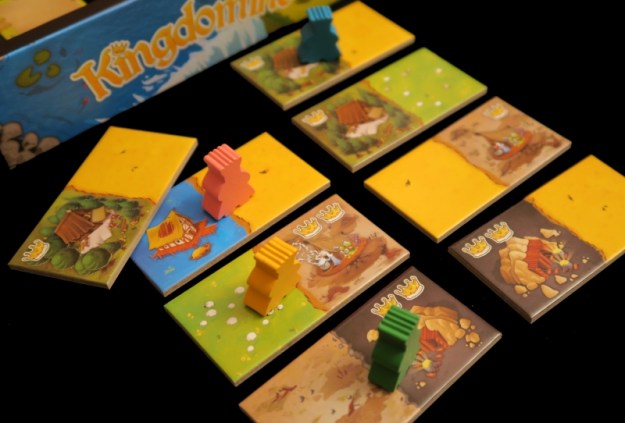
Kingdomino
– Image by boardGOATS

Native, Kingdomino is a four player game, however, with the Age of Giants expansion, it plays five.  The base game is simple enough, but it had been a while since most people last played it, so there was a quick run through of the rules.  On their turn, players add a terrain domino to their Kingdom; each domino comprises two squares of terrain and when placed at least one end must be adjacent to the same terrain type.  Like New York Zoo, the interesting and clever part of the game is the Market.  In Kingdomino, there are two parts, current and future—when a player takes their domino from the current market, they choose their next domino by placing their marker on it.

Kingdomino
– Image by boardGOATS

At the end of the game, players score each terrain region with points equal to the area of each region multiplied by the number of crowns on it.  The clever part is the timing of the Market.  The tiles are drawn at random from a set numbered from one to forty-eight.  The low numbers generally being the less desirable ones, those without crowns or those for terrain types where crowns are more scarce.  Since players take the tiles in numerical order (low to high), taking a low value tile in one round gives a better choice in the next.  Similarly, taking a high value tile means there will be less (or maybe no) choice in the following round.

Kingdomino: Age of Giants
– Image by boardGOATS

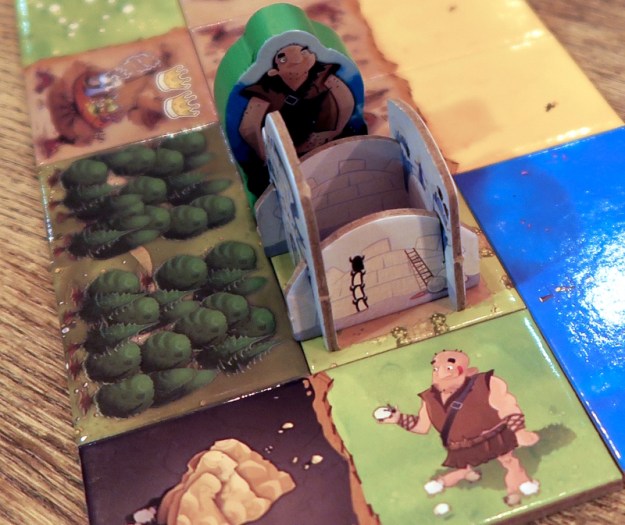
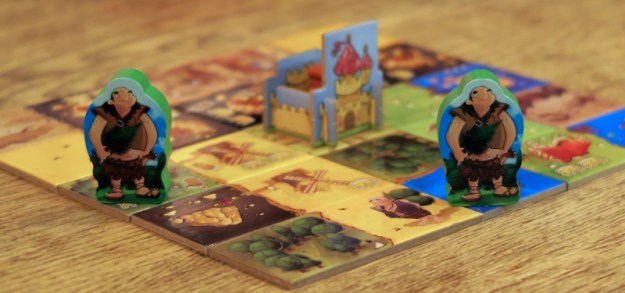
The Age of Giants expansion firstly adds twelve extra tiles (enough for a fifth player), six labeled with letters A to F and six numbered forty-nine to fifty-four.  These are ranked below one for the letters and after forty-eight for the high numbers, with the low ranking tiles featuring a Giant, and the high ranking ones featuring Footprints.  Players taking dominoes with a Giant on them, also take a Giant-eeple and place it over a crown in their Kingdom so that it doesn’t score.  Taking a Footprint domino allows the player to move a Giant from their Kingdom to a crown in someone else’s and this increase their score, making these tiles potentially very valuable.

Kingdomino: Age of Giants
– Image by boardGOATS

Unfortunately (especially for Lime and Blue who ended up with all the Giants), the Footprints seemed hard to come by in this game.  The other part of the Age of Giants expansion are the Quests.  The base game comes with two Quests, arrangement targets that give points.  These are “Middle Kingdom” and “Harmony” which respectively give ten points for a castle in the centre of a player’s Kingdom and five points for a complete five-by-five territory with no discarded tiles.  This time, the Quests drawn essentially at random were “Bleak King” and “Four Corners of the Kingdom”.  The first of these gave five points for each five square of terrain with no crowns while the second gave players five points for placing cornfields on all four corners of the five-by-five grid that defines their Kingdom.

Kingdomino: Age of Giants
– Image by boardGOATS

Although the Quests had been included in game play several times before, the Giants have only had an outing once and didn’t go down all that well.  Still, with five players all the extra tiles were needed and their values would have been unbalanced without including Giants, so the group thought they’d give it another try.  This time Blue and Purple had a really hard time getting crowns and things were so bad for Blue that she resorted to picking up twenty points, more than half her total, from the “Bleak King” Quest.  Black built a lot of sea and pasture, while Lime scored heavily for his mountains and Pine picked up lots of points for his large woodland.

Kingdomino: Age of Giants
– Image by boardGOATS

It was very close between the top three and both Lime and Pine scored forty-five points for their highest scoring terrain—Lime for nine crowns spread over five spaces, Pine for five crowns spread over nine spaces.  There were just two points between Lime and Pine in the end, but Pine’s sixty-eight points just edged Lime into second with Black four points behind that.  It had been a good game.  However, the group felt that the Giants took a positive constructive game and added a negative aspect.  Those that had been stuck with them hadn’t found that aspect particularly enjoyable, especially as it was easy to get lumbered largely through no fault of their own, so it is unlikely they’ll get another outing very soon.

Kingdomino: Age of Giants
– Image by boardGOATS

Meanwhile, on the next table, Green, Ivory, Plum and Teal were still playing Terraforming Mars.  To speed up the game they played with the Prelude start cards and also removed the Corporation cards—that turned out to be a good choice as the game only just finished before the pub closed.  In this game, players play corporations sponsored by the World Government working together in the terraforming process, but competing for victory points.  These are awarded not only for their contribution to the terraforming, but also for advancing human infrastructure throughout the solar system, and doing other generally commendable things.

Terraforming Mars
– Image by boardGOATS

The players acquire unique Project cards by buying them into their hand; these can represent anything from introducing plant life or animals, hurling asteroids at the surface, building cities, to mining the moons of Jupiter and establishing greenhouse gas industries to heat up the atmosphere. The Projects can give immediate bonuses, as well as increase production of different resources. Many cards also have requirements and become playable when the temperature, oxygen, or ocean coverage increases enough. Buying cards is costly, so there is a balance between buying cards (three MegaCredits per card) and actually playing them.

Terraforming Mars
– Image by boardGOATS

The game ends after the terraforming is complete when the three global parameters, temperature, oxygen, ocean have all reached their goal.  Players then score for their Terraform Rating with any other points they might have accrued.  This time, Green made his presence felt on the surface of Mars in the early stages with his initial starting forest, which grew a little, and seeded the oceans. He was the only one for a while.  Plum played a blue card which gave her a couple of extra Credits every time someone built a city.  This one really paid for itself in the four-player game as everyone wanted to build more than one city.  Green was first, but had mis-read the card and found himself colonizing Phobos instead.

Terraforming Mars: Prelude
– Image by boardGOATS

So, Teal was the first to actually build a city on the surface of Mars. He opted for the equator but on the other side from Green’s forests.  Later he played a blue city bonus card that gave him a Credit production bonus for each one. Although several cities had already been built by then, several more followed and he was able to enjoy the benefit of extra cash in later rounds.  Ivory meanwhile had made a different start to the game than his normal opening gambit (building a city), and completed the first Milestone: the Ecologist. However his cities did follow later as he extended down towards the south pole. Teal claimed the second milestone: the Specialist, helped on by his city Credit production bonus.

Terraforming Mars
– Image by boardGOATS

Plum was the last to claim a Milestone: the Generalist, as she was able to pay to increase her production one step each round.  She did not claim it straight away, but noticed it after Teal had claimed his, and thought she had better get in there quick.  Green was not able to claim any milestones, but instead was the first to fund an Award. A quick check around the player boards suggested he should fund Celebrity as he had three high value cards to Teal’s two, but neither Plum or Ivory had any cards over the value of twenty Credits. Later on Teal funded the second award and went for Estate Dealer as he clearly had more tiles next to oceans at this point (having planted his forests northwards around the oceans.

Terraforming Mars
– Image by boardGOATS

At the end of the game Green pulled out his wallet once more and funded Benefactor since he was ahead on the Terraform Rating track. Ivory was only one behind, but Green had a couple of options he could play on his last turn for a couple of extra Terraform Rating points. This prevented Ivory from funding the Dessert Settler award for which he had been building.  Green decided to go for outworld domination and also built Deimos city.  During the second half of the game Green realised he had forgotten his company bonus of a two MegaCredits reduction for each brown, Industrial tagged card.  He had built three, so put six Credits aside to be used in the event of a tie, (although had he remembered to claim them at the time, he may have been able to play more and better cards).

Terraforming Mars: Prelude
– Image by boardGOATS

In the final scoring it was very close indeed, although during the game Mars was regularly bombarded with meteors and nuclear bombs, so it was a wonder any one survived at all!  Ivory and Green tied for second with fifty-nine points. Even with his extra six Credits, Green still lost the tie to Ivory, who had more Credits left over from the final production.  At this point, Green realised he again had misread a card thinking he would get one point per ocean tile in the game for his capital city, but that would have given him a guaranteed nine points and would have been way too powerful. In the end, it was Teal who triumphed, but only just, with sixty-one points, in well deserved victory.

Terraforming Mars
– Image by boardGOATS

Learning Outcome:  Mama’s taking us to the zoo tomorrow, zoo tomorrow, zoo tomorrow… We can stay all day!