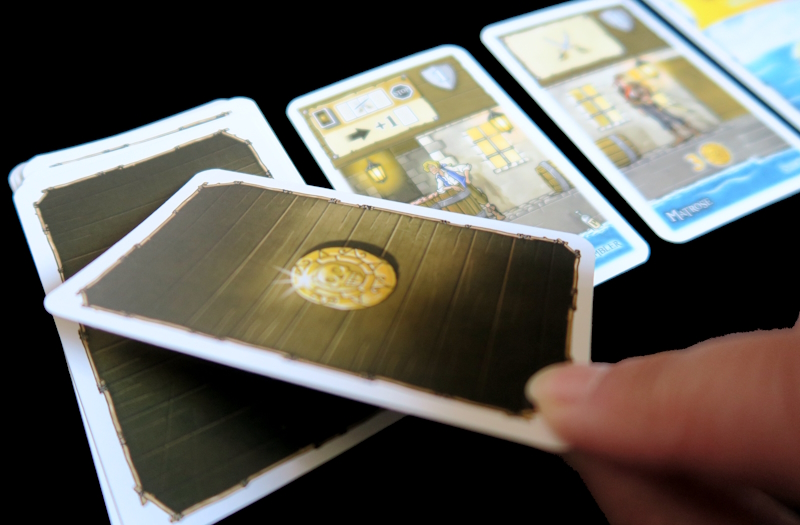
The evening began quietly and for a while Blue, Purple and Black wondered whether they were going to be the only ones and had got the wrong week, but before long, people trickled in. The hot weather seemed to have sapped a lot of the enthusiasm from everyone, but eventually, two groups began playing Port Royal. This is a fairly simple “Push-your-Luck” game where players are merchants in the Caribbean. It has an interesting history as it was originally released by the Österreichisches Spiele Museum, the Austrian Games Museum as Händler der Karibik (Traders of the Caribbean).
 |
| – Image by boardGOATS |
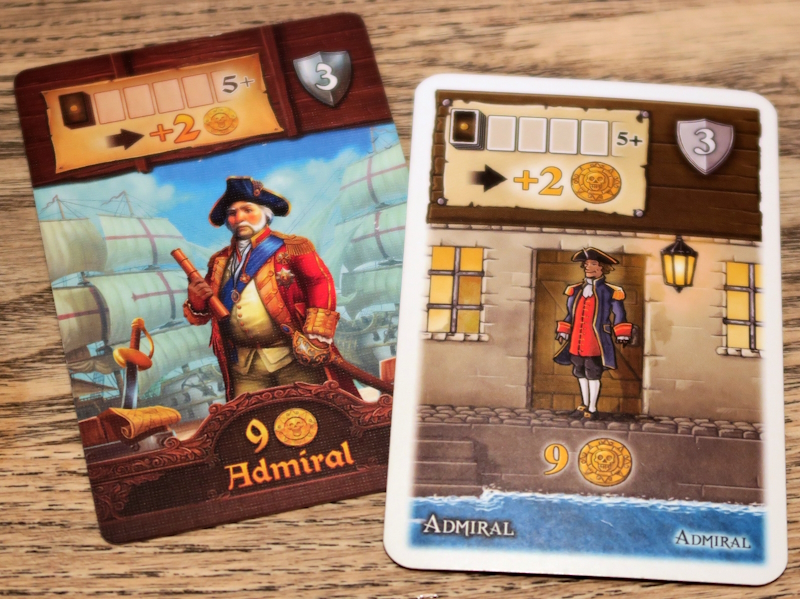
When it won the Austrian Game Designers Competition, the game was taken up by the publisher Pegasus Spiel in 2014, who added a few cards and tweaked the rules including adding a few cards so it works with five players. The artwork didn’t change significantly though, that happened much more recently, in 2022, when Pegasus brought out a Big Box edition which included both the Contracts and Campaign expansions, the Gambler promo and the lighter “expandalone” Unterwegs game. This time both the 2014 version and the Big Box edition got an outing, with Jade leading Lime, Ivory and Mint with the new edition, while Plum set up the older game in a much smaller box with Sapphire, Black and Flint.
 |
| – Image by boardGOATS |
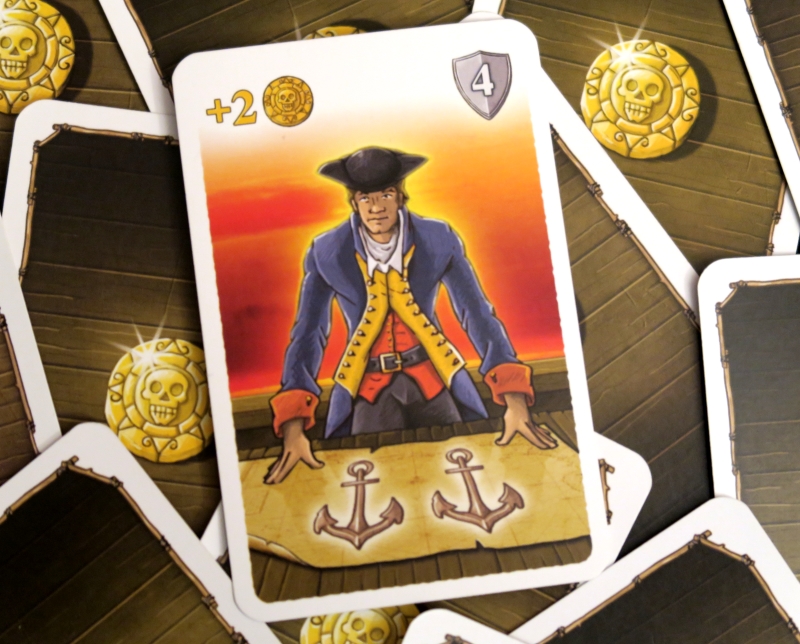
The basic game is quite simple: players draw cards, as many cards as they like until they choose to stop and take cards, or go bust by drawing a second Ship card of one colour. There are four different types of cards, but most are Ships or Characters. Ships come in different five colours and are worth Doubloons (like San Juan and Bohnanza, these are just cards that are stored face down to show the Coin on the reverse), whereas Characters generally give some sort of on-going power, are worth Points, and are paid for with Doubloons. Some of the Character cards (Pirates and Sailors) provide Cutlasses, which enable players to repel Ship cards that they don’t like, thus extending the number of opportunities to draw cards without going bust.
 |
| – Image by boardGOATS |
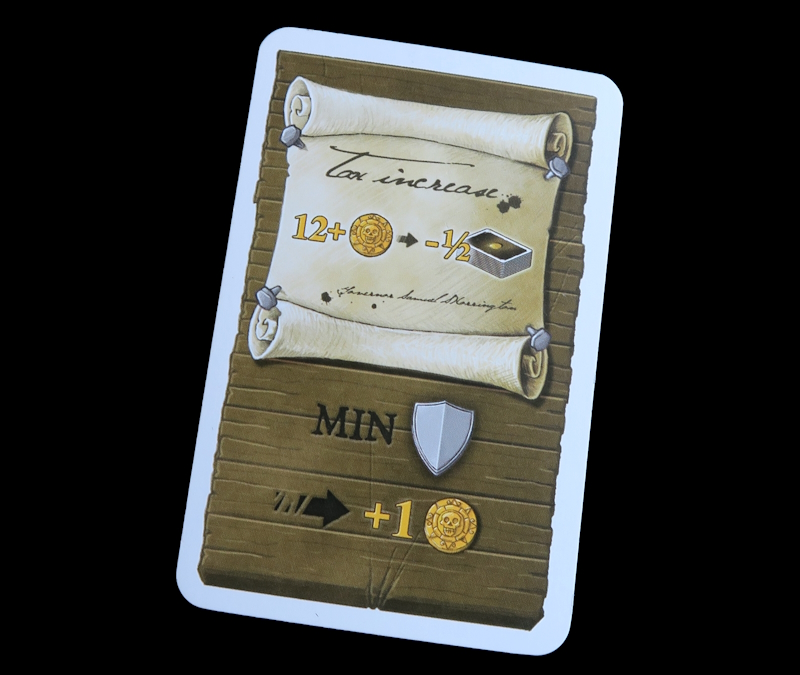
In addition to Ships and Characters, there are also two other types of cards in the deck: Expedition and Tax cards. Expedition cards, once drawn are placed in the centre to become communal objectives that give points, but once achieved by one player they are gone. In general, these involve collecting symbols shown on some of the cheaper Character cards. There are two Tax cards in the deck, and when one is drawn anybody with twelve or more Doubloons has to discard half their cash. Additionally, depending on which card, either the player with the fewest Points gains or the player with the most Cutlasses gains one Doubloon.
 |
| – Image by boardGOATS |
So, players draw and reveal cards until they go bust or decide to stop and take cards. The player can stop whenever they like, then take one card if there are three or fewer Ships in the Harbor display, take two cards if four ships are present, and three cards if five ships (one of each of the five colours) are present. Thematically, players either rob Ships (collecting the number of Doubloons depicted, then discarding the card) or hire Characters, paying from their stash. The game ends when one player has at least twelve Points, and the round is completed before scoring—the player with the most points is the winner.
 |
| – Image by boardGOATS |
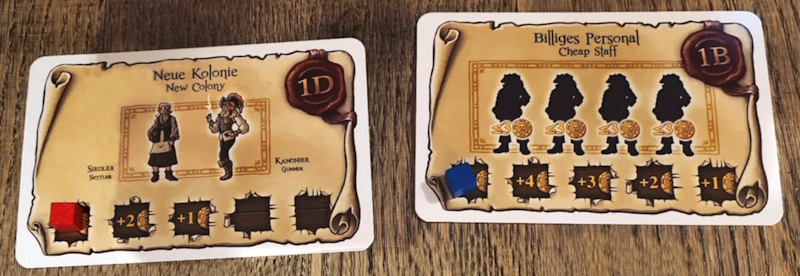
The Ein Auftrag geht noch expansion (aka Just One More Contract…) adds solo and cooperative modes, but aside from these it doesn’t change the game significantly, just adding a handful of cards and an alternative mechanism to gain Doubloons and score points. The new game element is “Contracts”, which provide additional ways to score victory points and get coins by meeting the listed conditions. At the start of the game, each player gets three tokens and four Contracts are revealed. If a player meets the requirements of a Contract at any time (including not on someone else’s turn) they can place one of their cubes on the leftmost spot on the contract taking the financial benefit.
 |
| – Image by boardGOATS |
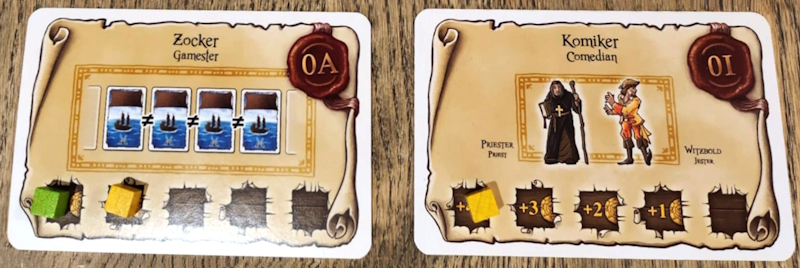
This reward decreases each time the Contract is subsequently completed. When the player completes their second contract they additionally receive one point taking a Contract card from the unused stack and keeping it face down to display the Point shown on the reverse. On completing their third Contract, players receive the financial reward and two additional Points. Plum led one group, comprising Sapphire, Black and Flint. The contracts they draw out were New Colony, Comedian, Cheap Staff, and Gamester. New Colony and Comedian required a a specific pair of Character cards (Settler/Gunner and Priest/Jester respectively), while Cheap Staff needed four Characters with a cost of three or less.
 |
| – Image by boardGOATS |
The Gamester Contract was a bit different as it was based on Ships, and could be claimed by the active player as soon as there were four of different coloured Ships in the Harbour at the same time. Early in the game, Plum and Flint claimed a Gunner, while Flint added and a Clerk from the expansion and Black took an Admiral. The Gunner and the Admiral provide benefits if conditions are met just before they take a card, respectively giving money if there are multiple ships available or two extra coins if there are more than five cards in the Harbour display. The Clerk gives the owner the option to take a second card if they take a ship of the right colour from the Harbour.
 |
| – Image by boardGOATS |
Sapphire took a slightly different approach. He collected Traders, getting one of each colour which meant that whenever he took a ship, whatever the colour, he always got an extra coin and together with his Vice Admiral (who gave an extra coin coin if there were three or four cards in the Harbour on his turn) meant he always had plenty of cash. Plum was the first to complete an expedition, the Gamester, but everyone completed one, although Black managed a second. Black, Plum, and Flint also completed an expedition giving more points, but the winner was Flint who finished with thirteen points while Plum and Black tied for second.
 |
| – Image by boardGOATS |
Elsewhere, there was a second game of Port Royal underway with Lime, Ivory and Mint, led by Jade. This group were playing with the 2022 Big Box editionwith the new artwork that includes both expansions. However, as they were playing with people who were new to the game, they chose to stick to the base game and spent a lot of time at the star sorting out cards. Once they got going a lot of hilarity ensued, particularly when Lime, who desperately needed some cash turned over twenty cards in succession without a single ship! The victor was Mint, however, with Jade and Ivory tying for second.
 |
| – Image by boardGOATS |
They had enjoyed it so much and with time left, the decided to “do a Lime” and give it another go. This time, the winners were tied with Ivory and Mint both finishing with twelve just ahead of Lime in third. With the winners tied, there was more interest in what the tie-breaker was. Both also had the same amount of money and the rules state that in such cases victory is shared. However, according to the rules there is a end of game variant which requires the winner to have an Expedition card. As Ivory had completed an Expedition and Mint had not that was assumed to be the tie breaker leaving Ivory the victor.
 |
| – Image by boardGOATS |
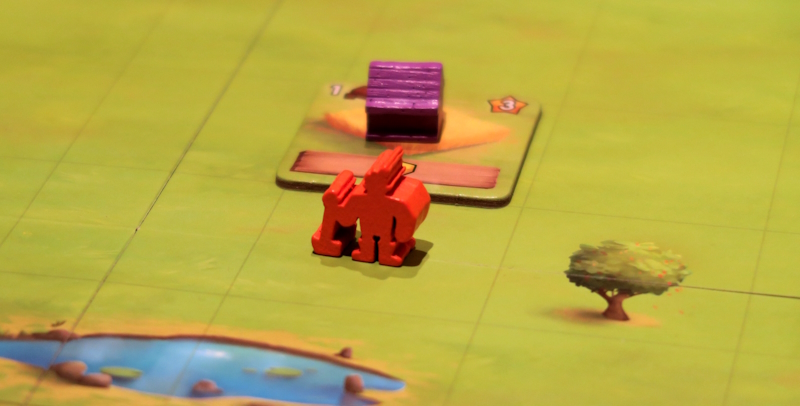
Meanwhile, Blue and Purple introduced Ruby to Little Town, another popular game within the group, but this time, one with much less luck. It is a fairly simple little worker placement and tile laying game based on a central board. The idea is that players have five workers and on their turn players can place them on the terrain area and activate the space, or in the build area and place a building on the board paying the costs and placing an ownership marker on it. When activating a space, players also activate the eight surrounding spaces. Some of these will be spaces printed on the board which allow players to collect resources (Wood, Stone or Fish), while others might be buildings tiles placed, by themselves or one of the other players.
 |
| – Image by boardGOATS |
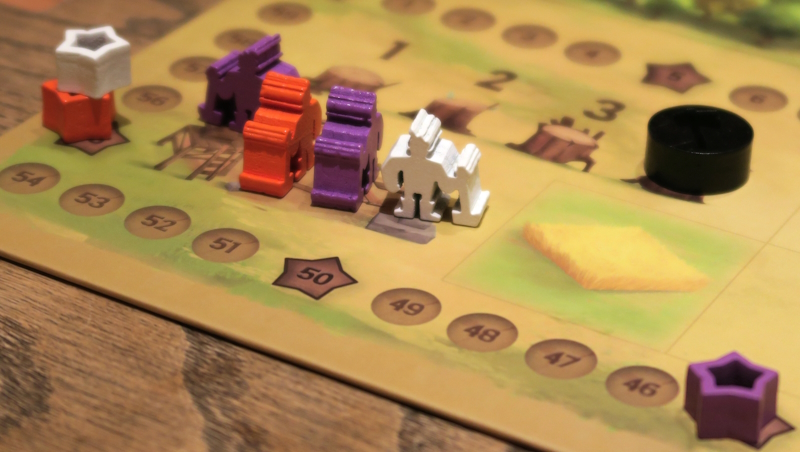
Players musty pay to use other players’ buildings, only one coin, but coins can be difficult to acquire. Players get points during the game by activating some buildings, lose points if they are unable to feed their workers. They also start with three personal objective cards which are scored as and when they are achieved. At the end of the game, after four rounds (just twenty actions per player), the player with the most points is the winner. The first draw of tiles included three from the Goodie Building promo set, but as the rules for these had gone walk-about, two were thrown back and re-drawn. Blue explained the rules, and then Purple started unfortunately, this meant that Ruby going last had fewer good placement options, and worse, was the only player to go last twice during the game.
 |
| – Image by boardGOATS |
Both Blue and Purple offered what help and advice they could they could and all three players were pretty much dead level for the first couple of rounds. Cash is often hard to come by in this game, but this time with the Gold Mine present, which was built early by Purple, there was enough to grease the wheels and keep the game moving. In addition to the Goldmine, other buildings included the Fishmonger which Ruby built and enabled players to sell fish, getting money. Blue began by building a little fish engine with a Pier and a Sushi Bar (from the Goodie Buildings) placed near a Lake, then Purple widdled on her bonfire a little, by turning one of the neighbouring spaces into a Wheat Field. Even so, with just two turns she could gain Fish and turn them into a total of six points, picking up a bit of Wood and some Wheat (at a cost of one coin) on the way.
 |
| – Image by boardGOATS |
It had been back and forth between Blue and Ruby until Blue nabbed the Statue from under Ruby’s nose giving her a straight ten points. That forced Ruby to switch tack and build the Church which allows players to convert Cash into points. Although there wasn’t really time to activate it more than once, it was also worth eight points in its own right. All three players managed to complete their Objectives, even Purple who had some tough ones. Before the game, Purple had made a comment, that nobody would need the Sixty Point Token, but as the end of the final round approached it looked like both Blue and Ruby might actually manage it. In the end, it was close, but Blue just managed it finishing with sixty-four, while Ruby didn’t quite make it in second place.
 |
| – Image by boardGOATS |
Learning outcome: Popular games are popular for a reason.



 boardGOATS