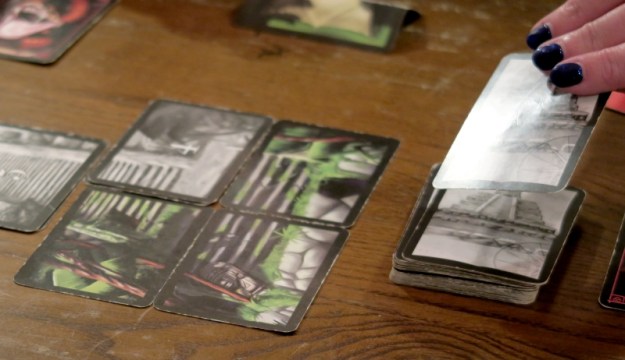
While Blue was off getting fish and chips for people, Pink chatted with Pine and Green and his family as they arrived. Green had just got out Incan Gold and was explaining the rules, when food arrived, so it was hastily put away while food was consumed, only to be got out again as soon as the chips had disapparated. Incan Gold is a very simple “push your luck” type game where players are exploring a mine and trying to get out with treasure before disaster strikes. Each round a card is revealed and players simultaneously choose whether to stay or leave and share what spoils they already have. There are three types of card: Treasure, Artifact, and Disaster.
 |
| – Image by boardGOATS |
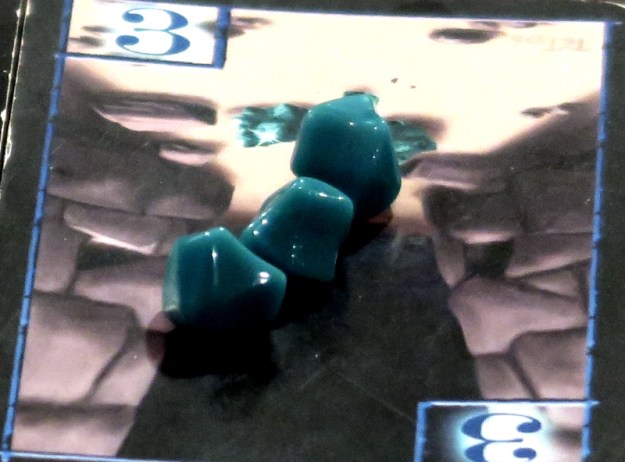
The contents of the Treasure cards are simply divided equally between players when they leave the mine, or as equally as possible leaving behind any left-overs. Artifacts can only be taken if there is only one player leaving the mine, all alone. Disaster cards are the problem—Spiders, Snakes, Zombies, Lava and Rock Falls. Each one is present in the deck three times, and when the third is drawn, the mine collapses leaving everyone in it without any treasure. This time, though, the group didn’t get off to a very auspicious start. The first card out was a Rock Fall, the second was Fire and the third was another Fire!
 |
| – Image by boardGOATS |
So the group decided it was such a bad start that they would shuffle and try again. On the second attempt, the first two cards out were again Disasters, but the third delivered some Treasure. It wasn’t very much and nobody felt it was worth leaving for. That was a good choice as there was a little more treasure to come. Still not very much, but more littered the floor of the tunnel, and it eventually proved too enticing for Emerald and Violet who managed to net about five gems each for their tents. For the rest of the group, they pushed it a little too far and promptly lost everything as they got caught in a devastating fire.
 |
| – Image by boardGOATS |
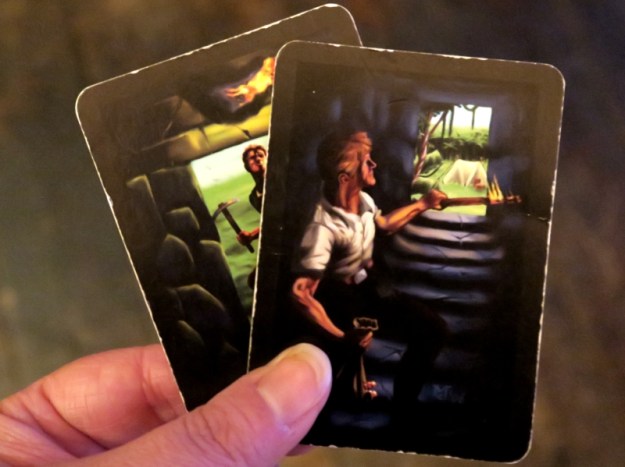
The second tunnel explored also lured in too many explorers before collapsing the ceiling on everyone. The third tunnel brought the first glint of Gold—an Artifact. Eying each other up everyone elected to stay, which was fine, but on the next turn, Lilac decided she would chance it and run. Luckily for her she was the only one and managed to net the Golden treasure on her way out, and left everyone else to die at the hands of a rather midget-like Zombie. Lilac managed to repeat the feat on the fourth tunnel, collecting the Gold treasure as she made a run for it, although everyone else managed to collect more treasure and eventually decided to save what they had found instead of dying a horrible death.
 |
| – Image by boardGOATS |
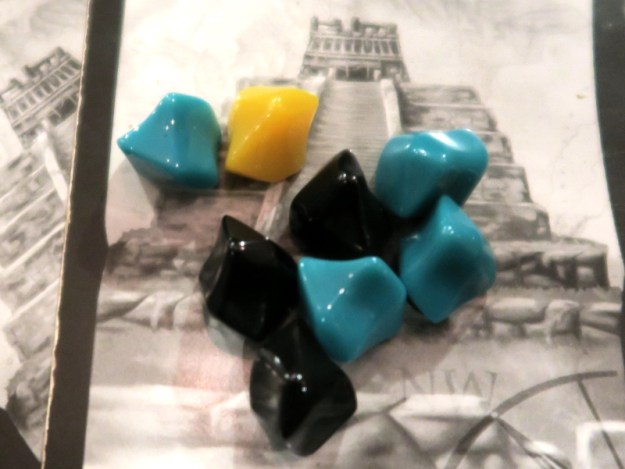
The final tunnel brought some nice treasure, and another Artifact, but with too many people leaving, they had to leave it where it lay. Pine was the one who held his nerve and safely collected the Golden treasure this time, before a Disaster as those remaining were overrun by Spiders. In the final reckoning it was neck & neck between Pine and Lilac on thirty-six points, but Lilac just edged it by dint of having two gold artifacts to Pine’s one. It was close for third, though Lime was the best of the rest with twenty-four, just ahead of Emerald and Violet. The least effective was Greedy Green, who’d stayed just too long just too often, eager for more treasure only to be bashed and burned and brutally murdered time after time.
 |
| – Image by boardGOATS |
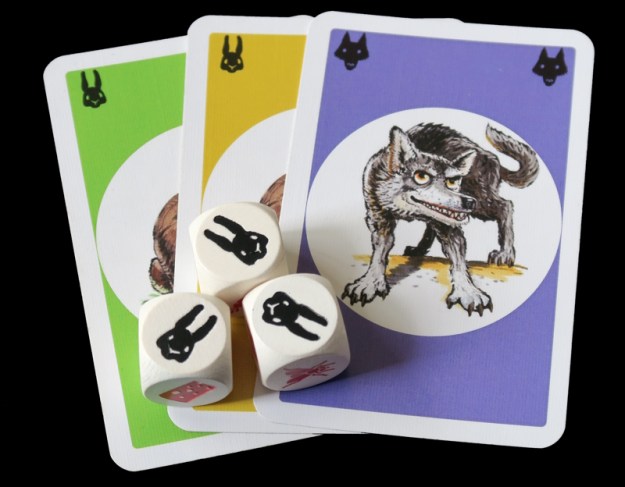
Meanwhile, everyone else played the “Feature Game“, the filler Om Nom Nom. This is a fun and light little game of think and double-think where players are trying to eat without getting eaten. The game is set up by seeding the board with cute dice, rolled to give cheese, carrots and flies for the bottom of the food chain, and mice, rabbits and frogs for the middle of the food chain. Players then receive a deck of six cards representing the animals for the middle of the food chain and the top of the food chain, cats, wolves and hedgehogs. With game play reminiscent of 6 Nimmt!, players simultaneously choose a card to play which are then evaluated.
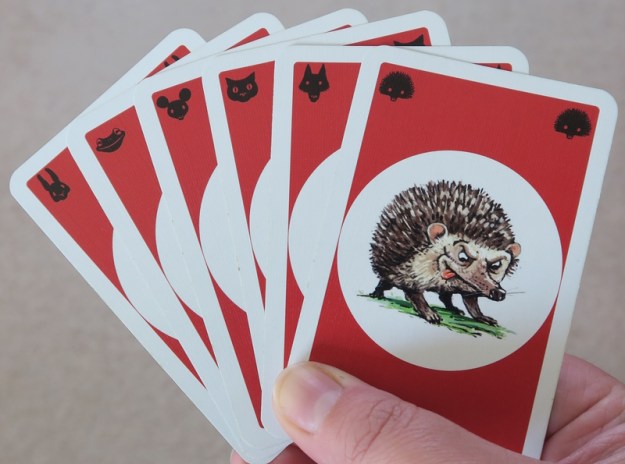 |
| – Image by boardGOATS |
Players who played cards at the top of the food chain eat anything below, so long as there is enough for everyone who played the same card. Thus, if there are four mice (including any cards played) and two cats, the owner of the cats take two cards each and get to keep their cat cards too with them all going on their scoring pile. If however, there was only one mouse, both cats go hungry and neither player scores anything. Cards played for the middle of the food chain eat the dice at the bottom of the food chain as long as there are enough dice for everyone who played the same card, but also as long as they don’t get eaten by anyone playing a card at the top of the food chain.
 |
| – Image by boardGOATS |
Thus, playing a card in the middle of a food chain is all about timing: there is a higher risk, but also a higher reward as the dice showing red faces are worth two points instead of the usual one for a card or a die showing a black middle of the food chain critter. Although we’ve played Om Nom Nom several times before, it was new to both Teal and Lime. Teal started off well though taking a massive fifteen points in his first round. Unfortunately for him, that turned out to be beginner’s luck and he didn’t do so well in the next round. Purple’s game, on the other hand, went the other way, starting with nothing in the first round and taking sixteen points in the second.
 |
| – Image by boardGOATS |
With others being more consistent, in particular Blue who scored a seven and an eight in each of her first two rounds, it was all down performances in the final round. In the event, Black and Pink both did well in the final round, and Teal improved on his score in the second round too. It was Purple that won the final, albeit low-scoring round, taking ten points, giving her a winning total of twenty-six, three more than Teal in second with Black and Blue tying for third place some six points behind him. It had been a quick fun game, one that is always good value and definitely deserves another outing soon.
 |
| – Image by boardGOATS |
Both games, Incan Gold and Om Nom Nom, finished at much the same time, so everyone decided what to play next. Teal had brought Nidvelilir at Green’s request, but this wasn’t the night for that. Eventually, Purple traded places with Pine and Lime leaving five players, in one group which picked out a lot of possible five-player games. Since Violet was here only for the a brief visit they let her choose. Her selection was Zooloretto or King of Tokyo, however Purple made a face at both choices and suggested Carcassonne instead. Violet was less keen as she felt she had played that a lot recently, so Green made an executive decision to play Boomtown—a fun little bidding game that hasn’t had an outing for a long time and doesn’t take too long.
 |
| – Image by boardGOATS |
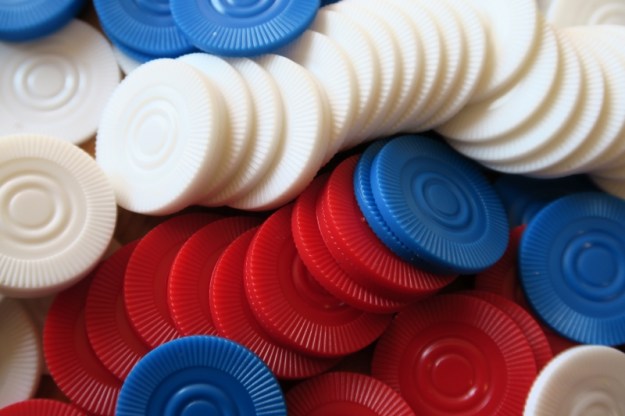
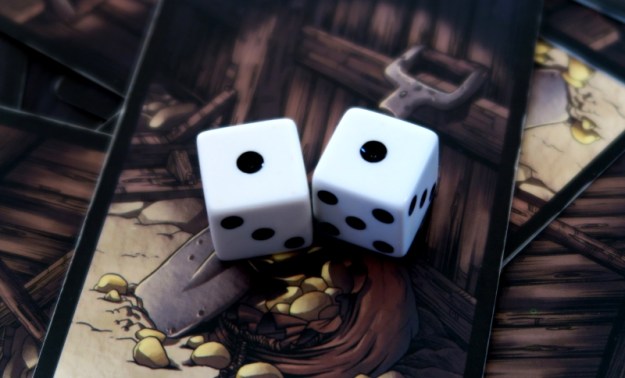
Unfortunately, at this point Emerald was really beginning to feel the heat of the pub and felt he couldn’t participate. He went off for a wander to get some fresh air, ironically just before the back door was opened to cool everyone down a little. As he had decided to sit this one out, the rest of the group revised the rules which were simple enough on the face of things. A deck of sixty cards is shuffled and placed face-down in the middle of the table, along with two dice, a pile of Mayor pawns (one in each of five different colors) and Town tokens (two each of the same colours). One card per person is turned face up and each player begins the game with $10 starting funds to bid for the card they want.
 |
| – Image by boardGOATS |
Each player has to increase the bid or pass, until there is one winner. And this is the clever bit of the game—the winner, pays the player to their right, who passes on half of the money to the player on their right and so on until either there is nothing left to give or the winner is reached (they don’t get any of their own money back). Everyone then gets a card in clockwise order. There are Mine, Dynamite, Saloon, Hold-up, Governor and Special cards, each of which has an effect. Mines and Saloons give players gold and the player with the most Mines in any Town/colour takes the matching Mayor token which forces others to give them money.
 |
| – Image by boardGOATS |
Dynamite cards allow players to destroy other players’ mines, while Hold-up cards allow players to steal from other and the Governor allows players to upgrade a Mayor so their mines are worth double. Once the cards have been allocated, the dice are rolled and players receive income for their mines. The game ends when the deck is depleted and all the cards have been sold. The player with the largest total from their their points, money, the production value of all the mines they control, and five bonus points for each Mayor, is the winner.
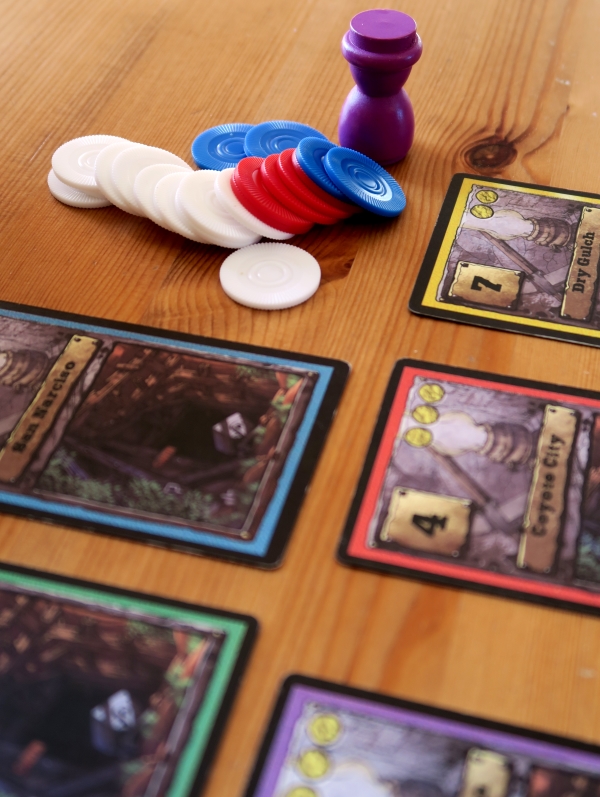 |
| – Image by boardGOATS |
Maybe it was the heat, but aside from Green, no-one was quite sure how Boomtown would play out, and it took a few rounds for everyone to get the hang of things. The group didn’t get off to a great start, even when they adjusted the draw deck to make sure there was enough mines for everyone by replacing the action cards that came out. The second round brought out two sets of Dynamite though, and both Green and Purple ended up destroying each others mine. The bidding never got very high in the first half of the game, mostly because nobody knew what they were doing, and did not necessarily want to choose first.
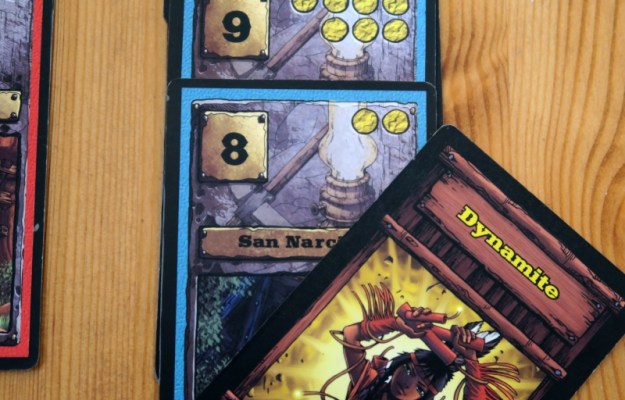 |
| – Image by boardGOATS |
However, by about half way and when the Mayor pieces had all been claimed and the Saloons were built everything started to hot up. Although Lilac had a lot of red Mines, which netted her a little money from players forced to take the last few remaining, every time they found gold, she had to pass most of her claim to Purple who had a red saloon along with Saloon girls! Violet managed to claim a couple of Mayors along the way, and although she lost one of them, she managed to avoid the attraction of the Saloon, so kept everything she collected. With some judicial rolling on the Card Shark Dice, she managed to rob some of the others blind.
 |
| – Image by boardGOATS |
By the time the last cards had been claimed and the final Mines had given up their gold, it was Purple who had become the master Miner, by something of a landslide. Violet was a respectable second with Lilac, having passed on so much of her wealth to Purple, just managing to stay whisker ahead of Green for third. Meanwhile, on the next table, with so many players Survive: Escape from Atlantis had seemed a good choice as it plays six with the expansion. This was released to mark the thirtieth anniversary of two very similar, much older games, Survive! and Escape from Atlantis, and is an agglomeration of them both.
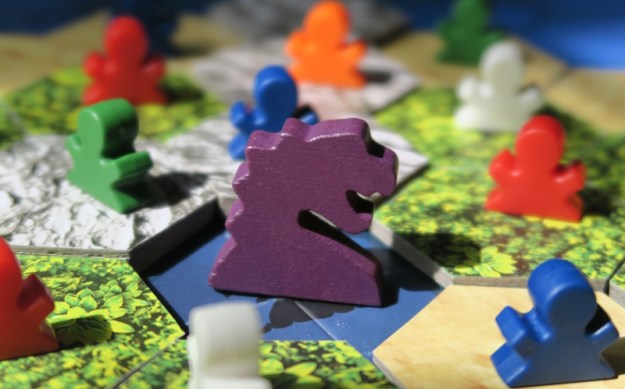 |
| – Image by boardGOATS |
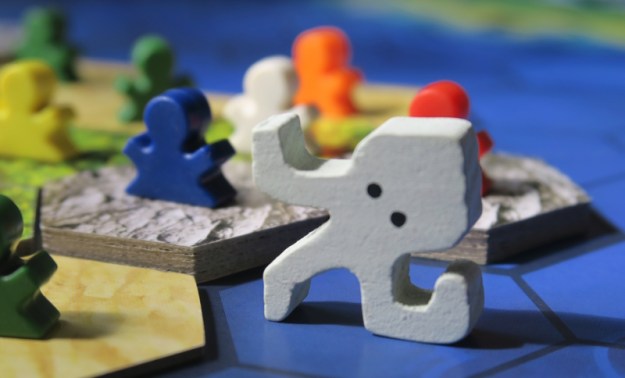
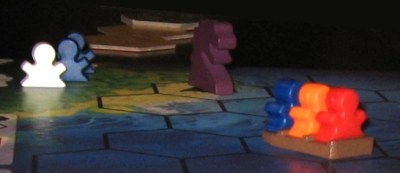
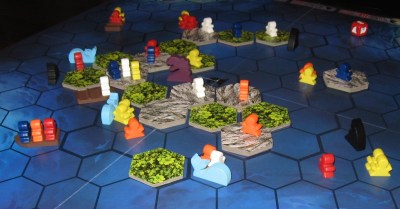
The idea is that players rescue their meeples from the central Island of Atlantis before it sinks beneath the waves. The original Escape from Atlantis had a fabulous sculpted plastic central Island, with lots of Sea Monster miniatures, however, although the thirtieth anniversary edition is arguably a nicer production, the Island is made up of thick card hex-tiles, and the Sea Monsters are made of wood. This version has safe land shown on the corners of the board each initially guarded by a Sea Monster, with randomly placed hexes forming the Island and a fifth Sea Monster in a central lagoon.
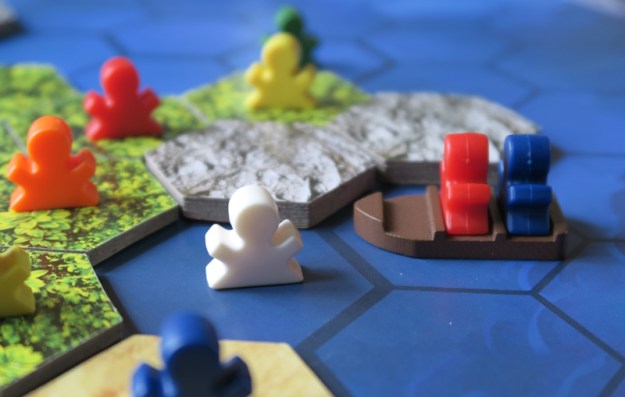 |
| – Image by boardGOATS |
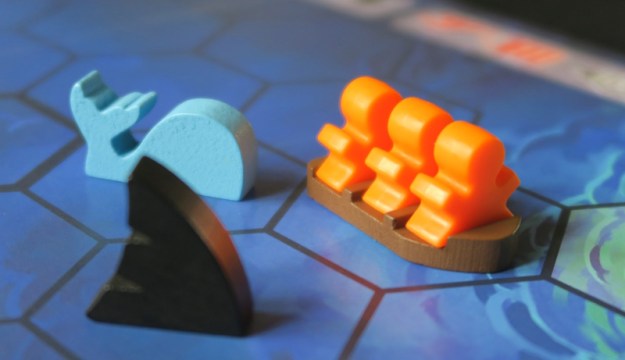
The new edition varies from its predecessors only a very little in game play. On their turn, the active player has three movement points, and then they remove one tile from the Island of Atlantis before rolling the Attack Die which dictates which of the Sharks, Whales or Sea Monsters the player moves. Sharks and Whales are introduced as the Island sinks: when players remove a hex from the Island, the underside has either an immediate effect (bordered with green) or a delayed effect with the tile stored, usually to be played before a later turn, though a small number can be used reactively.
 |
| – Image by boardGOATS |
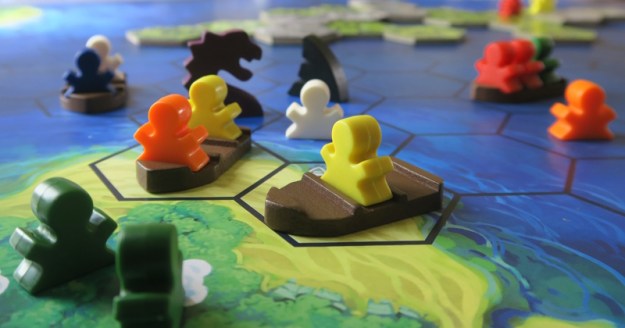
There was a lot of discussion about whether to include the Giant Squid and Dolphin mini expansions and what they did, but in the end, the group decided against it this time. In addition to placing their meeples on Atlantis, during the set up, players also place boats. These can hold a maximum of three meeples and are moved by whoever has the majority in the boat. It costs one movement point to climb into or out of a boat, either to or from a neighbouring land space or the water next to the boat. Meeples in the water can only swim one space per turn because it is tiring. Once in a boat, however, movement is easier and they can move as far as they want and are able.
 |
| – Image by boardGOATS |
Thus, the priority is to get meeples into boats, but the decision players have is whether to try to put all their meeples in one boat or whether to hedge their bets. Pine and Pink tried the former. Pine managed to get two of his meeples in one boat and then, before he could get any passengers, set sail. Being early in the game there weren’t many Whales or Sharks about, and with only a short distance to safety, Pine’s pair made it there safely. From there, the game got quite savage with players preferentially taking land tiles with meeples on them, turning them into Swimmers with a long way to safety—one was unlucky enough to end up in the drink when a Shark dropped into the space next to him and swallowed him whole.
 |
| – Image by boardGOATS |
Pink tried to emulate Pine’s success, but was a mite more greedy putting three of his meeples with a total value of eight in one boat. Although he had a plan to get the boat to shore, he reckoned without the appearance of a Whale which was promptly moved to the same space and proceeded to turn his boat into matchwood and transform his sailors into Swimmers. Whales aren’t interested in Swimmers though, so once his meeples were in the water, it left them alone. Pink then had ample opportunity to separate them out a little, and indeed was advised to by everyone else, but he choose not to. So, although everyone felt slightly sorry for him, it wasn’t long before the little clutch of Swimmers proved far too tempting a target and a Shark rocked up and ate them all.
 |
| – Image by boardGOATS |
From there, there was a steady trickle of boats making landfall, with players trying to work together without doing the lion’s share of the work themselves. For every boat that made it to safety, however, there was at least one Swimmer that was eaten by a Shark or boat that was attacked by a Whale or a Sea Monster making it a bit of a war of attrition. But with six players, the game moves quite quickly and players don’t get many turns so collaboration is essential if players are to get anyone to dry land. Blue and Black cooperated effectively to get a couple of Sailors each home, as did Teal and Pine. Although for a long time, Lime was the only one not to have any of his meeples eaten, he was also the last to get one safe.
 |
| – Image by boardGOATS |
With six players, the end of the game came round quite quickly. The game ends immediately when the Volcano is revealed under one of the last eight Mountain tiles and with so many players once the Woodland tiles have been exhausted the game can end any time, so one extra turn can make all the difference. And so it proved for many. It was Lime who turned over the Volcano tile, much to his disgust as he had a boat with two meeples ready to disembark on his next turn. Pink also had two in a boat near shore (total value nine) and Blue was equally unimpressed as it was her turn next and she needed just one move for her most valuable meeple to crawl up the beach.
 |
| – Image by boardGOATS |
With Atlantis gone beneath a combination of waves and lava and every meeple that had not made dry land perished in the boiling sea, it was time to score. Each meeple has a value printed on the bottom, and although players knew what these were when they were placed, they were not allowed to look at them again. Teal had attempted to codify which meeple was which in their location on the spaces they were placed on, however, Blue quickly called him on this and like everyone else, over the course of the game he had mostly lost track of which was where. Pink and Lime had only got one meeple ashore a piece, but although they were relatively high scoring ones, everyone else had a similar value one home and at least one additional one too.
 |
| – Image by boardGOATS |
Blue, Black and Teal managed to get three meeples ashore each, with Black totalling six points and Blue totalling seven. The winner was Teal, however, with a total of eight, though even one more turn or a slightly different turn of events earlier in the game would have made a huge difference to the final placings. It had been a lot of chaotic fun, but unquestionably, with so many players, there wasn’t much chance to plan and the game changed hugely between a player’s turns. With fewer players it is definitely a more strategic game, but with more, the onus is on players to work together more—indeed the players that did this this time, were the most successful.
 |
| – Image by boardGOATS |
Learning outcome: Just when you thought it was safe to fall into the water…




 boardGOATS