Tag Archives: Ticket to Ride Demo

29th April 2025

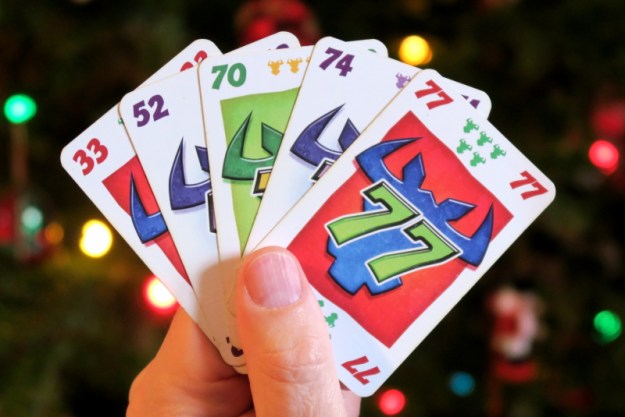
The evening began with a quick game of the popular Blackjack based game, Flip 7.  This is a quick, push-your-luck card game along the lines of Port Royal where players turn over cards and gamble on not revealing the same number twice taking it in turns to decide whether they want to “flip” or ” stick”. The catch is that each numbered card appears in the deck that number of times (i.e there is one one, two twos and so on). Flipping over seven different cards in a succession gives fifteen bonus points.  There are also some action cards in the deck, “Flip Three”, “Freeze”, “Second Chance” and modifier cards which give extra points. The game ends when players have reached the pre-agreed total.

Flip 7
– Image by boardGOATS

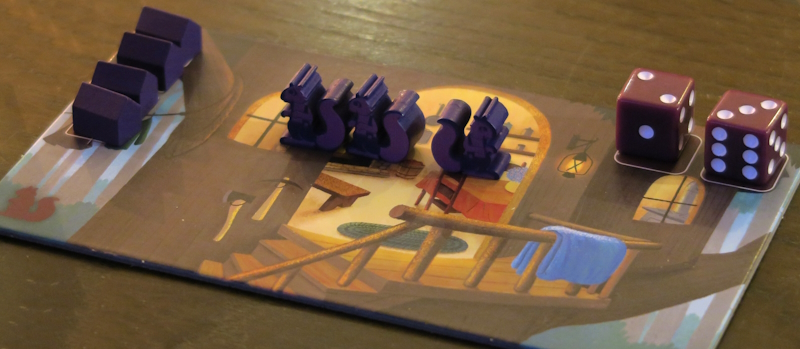
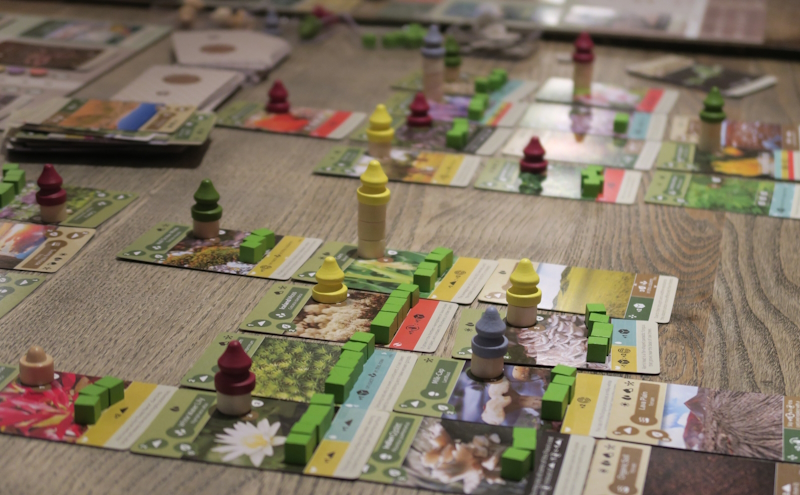
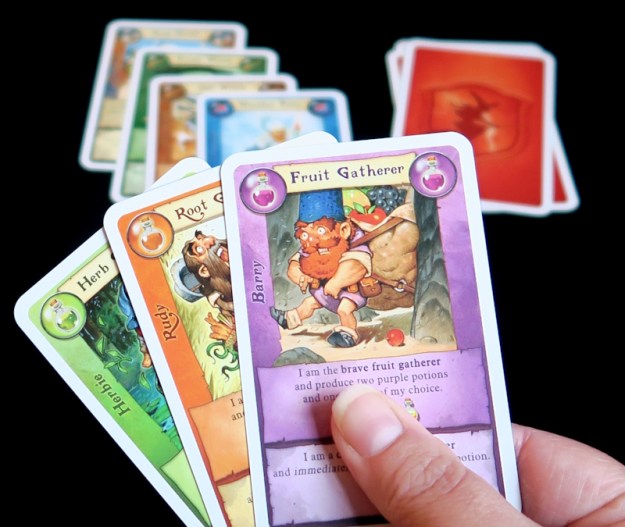
Ivory was keen to get in a little practice as “Little-Ivory” was getting it for his birthday in the next few days.  Although the game plays up to eight (with one box), there were just the four as Ivory was joined by Jade, Sapphire and Mint.  Mint went bust early and Sapphire started fast, but the victor was Ivory who didn’t go bust at all during the game.  With that over quite quickly Jade and Sapphire were joined by Pine, Plum and Byzantium to play the “Feature Game“, Creature Comforts.  In this game, players spend Spring, Summer, and Autumn gathering different resources from the forest and spending them to collect items that will home a more inviting place while the world outside is covered in a layer of snow in the Winter.

Creature Comforts
– Image by boardGOATS

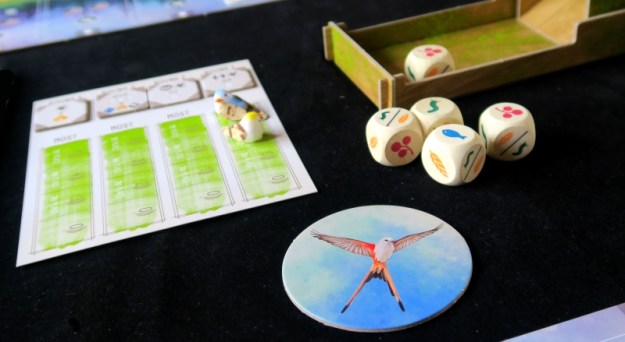
Creature Comforts is a worker placement game with a twist:  the workers can be placed at various locations, but dice of specific values (or sum-totals) are required to activate the locations. Thus, the players need access to dice of specific values when it comes to triggering those workers.  Jade explained the rules to Pine, Plum, Byzantium and Sapphire, some of whom were new to the game.  Played over twelve months, at the start of each month or round, a Traveler “event” card is revealed which either applies an instant effect or one that lasts the duration of the month.  Simultaneously, players then roll their two Family dice and place them on their Home Boards.

Creature Comforts
– Image by boardGOATS

Then, players simultaneously place their Workers at their choice of the twelve locations.  Although the locations can hold any number of Workers, players can only place a single worker at each one.  Each location will either require a dice of a specific value or multiple dice that add to a given sum (or have a particular requirement e.g. feature all odds or evens).  The catch is that at this point, players only know the values of the two dice that they have access to, their Family dice.  So, placing Workers requires some astute planning mixed with some luck when the four communal Village dice are rolled next, by the start player for the month.  Players then take it in turns to allocate the six dice at their disposal to activate as many of the locations their Workers are at as possible.

Creature Comforts
– Image by boardGOATS

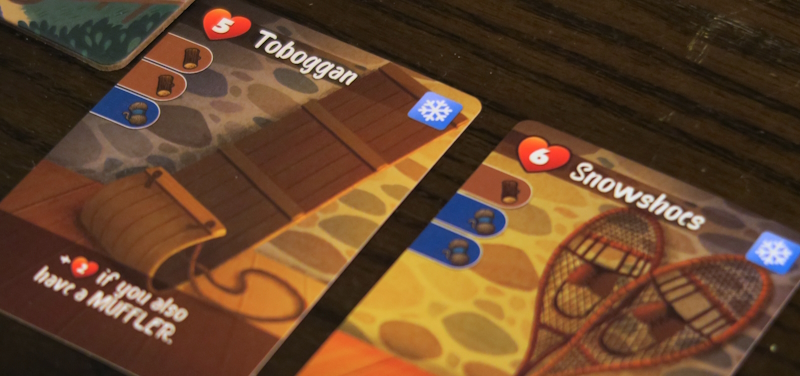
Each Worker that a player cannot activate gets them a Lesson token, which can be used to modify dice values in later turns (for only that player).  Finally, players finish their turn by crafting any creature comfort cards they can, keeping in mind that only three can be carried over to the next round.  After eight months (six if playing a shorter version of the game), players can craft any left-over cards they might have in their hand if they can afford to and then score for their Comfort Cards, Improvement Cards, for empty Cottage spaces and left-over resources.  The first problem was that there were a lot of locations to get to grips with.  Pine, who was new to the game, struggled initially, but by the end was wanting to play again soon!

Creature Comforts
– Image by boardGOATS

Sadly, although the game was a lot of fun and enjoyed by all, it was marred by the fact that “Last Orders” was called sooner than expected.  This meant the last couple of rounds were played at something of a rush and points were missed and some of the scores might not have been correctly counted.  There are a lots of odd points to be counted, but the bulk come from the eponymous Creature Comfort cards.  Byzantium top-scored for these with forty-three points, some ten more than anyone else, so it was no surprise that he ran out the winner by a sizeable margin, with everyone else left fighting for second.  That battle was won by Sapphire with Pine taking third.

Creature Comforts
– Image by BGG contributor hipopotam

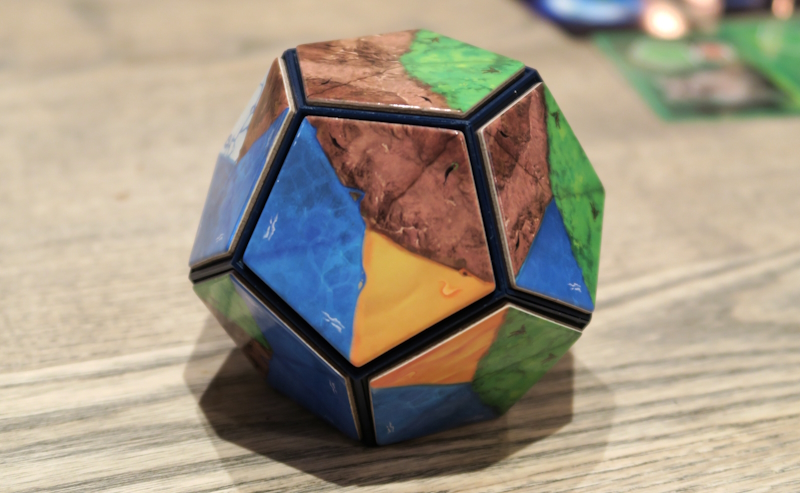
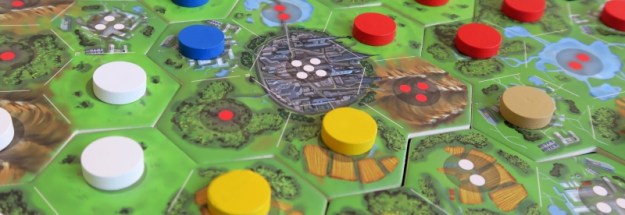
Meanwhile, Mint introduced Blue and Ivory to the really cool, three-dimensional game, Planet.  This is quite a simple game, but really clever:  each player receives a dodecahedral planet core with twelve pentagonal spaces and a magnet in the centre of each one.  On their turn, players choose a pentagonal tile with different terrains (Mountain, Ice, Forest and/or Desert) on them and stick it to their planet. The player who fulfills the most conditions for the appearance of certain animals gains its card.  There are public, animal objectives and each player has a private objective, their “Natural Habitat”.

Planet
– Image by boardGOATS

Players score points for the size of their Natural Habitat, and also for each animal card they claim.  Animals that live in an area that is not the player’s Natural Habitat score extra points which creates sort of opposing incentives to cover the planet with Natural Habitat tiles while also creating the right conditions to score animal cards.  And as the Planet fills up, this gets more and more complex.  Although everyone loved it, the game didn’t quite click for Blue, but it was close between Ivory and Mint.  There were only two points between them in the final totals, with Ivory taking his second victory of the night with twenty points.

Planet
– Image by boardGOATS

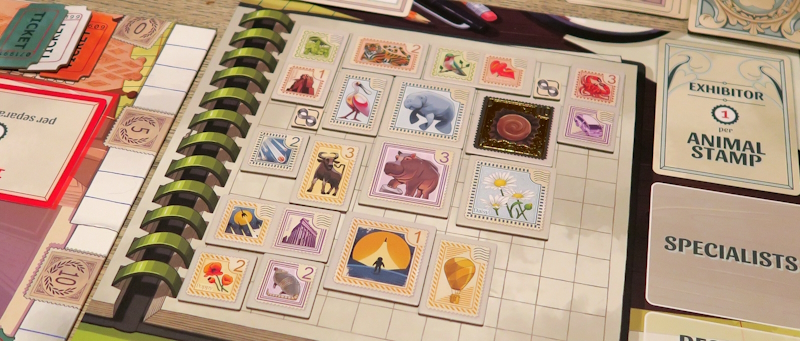
From there, the trio went on to play the Golden GOAT Award winning game, Stamp Swap.  In spite of the theme (which didn’t really set anybody’s imagination on fire), this has proved to be a really popular game within the group—it is just very smooth and doesn’t outstay its welcome.  Everyone had played it before, so there was only the barest minimum of a rules run-down.  The game takes place over three rounds, each split into two parts:  Firstly players take it in turns to choose from a central pool, then players divide their pile into two and the first player chooses one pile from another player to take, who keeps their other pile and chooses one from another play—and thus the piles of stamps are swapped.

Stamp Swap
– Image by boardGOATS

Players score points at the end of each round for their achievements and at the end of the game, for the face-value of the stamps and for end game objectives.  Despite everyone having played it before, there was a rules malfunction that might happened before and could have made a significant difference, to Mint and Blue especially.  Each player has an “Exhibitor” which gives players a point for each stamp they have of a given theme.  The group scored this at the end of the game, however, it is supposed to give points at the end of each round.  Everyone played by the same rules, so Ivory was the deserved winner with a hundred and eighteen points, but the scores would have been closer if the Exhibitors had been played correctly.

Stamp Swap
– Image by boardGOATS

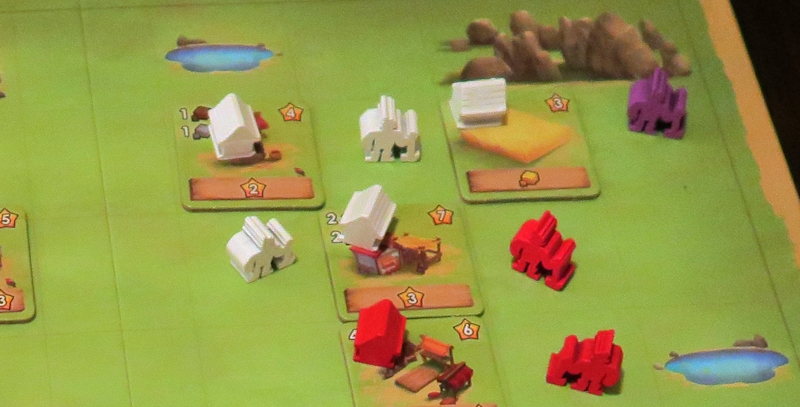
On a night when there were four tables, the third consisted of Pink, Black, Pine and Purple, started with a game of Little Town.  This is a really cute little game of Worker placement, resource collection and management, and building tile placement.  The game lasts for four rounds, during which players collect resources (wood, stones, fish, and wheat) from the eight surrounding squares by placing Workers on central map.  Players can then build buildings using these resources, players can then gain the effect of the building by placing a Worker next to it.  Placing a Worker next to a building owned by another has a cost though, and the player must pay a coin before you can collect resources.

Little Town
– Image by boardGOATS

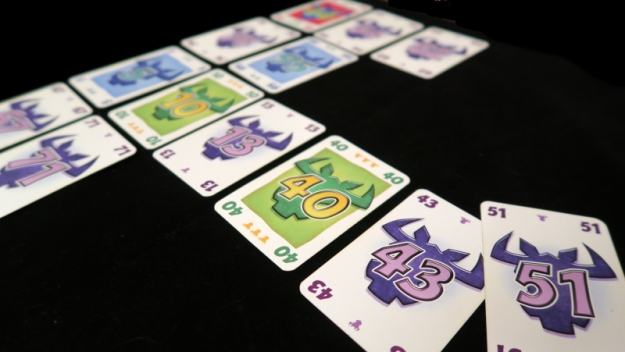
Players collect victory points using the powers of buildings, by constructing buildings, and by achieving objectives dealt at the beginning of the game. This time, Pink played a really pragmatic game essentially simply repeatedly activating the Well and the Bar (giving him two and three points each respectively).  As a result, the game was a bit of a land-slide with Pink taking victory with thirty-nine points, eleven ahead of Black in second with Pine a few points behind that.  With everyone else otherwise engaged, the group went on to play a quick game of Ticket to Ride: New York.  This is one of the first of the very small editions of Ticket to Ride, in fact, the first of the “Cities“, as it was preceded only by the Demo version.

Ticket to Ride: New York
– Image by boardGOATS

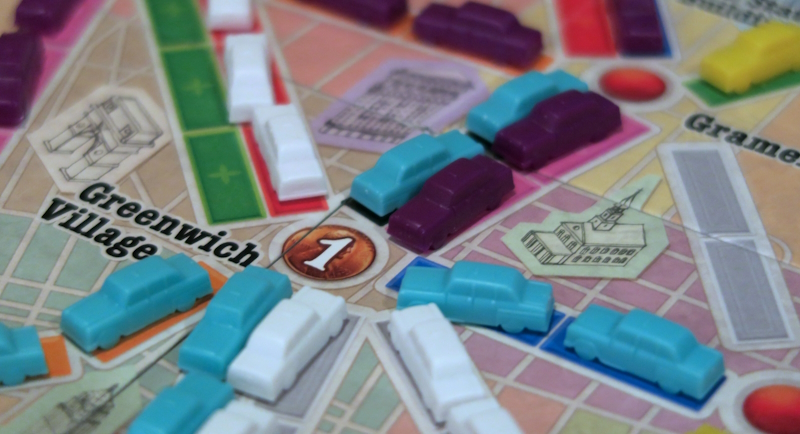
The game is played much the same as the full version of Ticket to Ride, with players taking coloured cards from the market and spending them to place pieces (in this case taxis) with the aim of completing tickets.  Black took the most points for the Tourist Attractions he made connections with, but had a bit of a ‘mare elsewhere, failing to complete a large pile of tickets which left him losing fifteen points.  This almost entirely wiped out the rest of his points, but it was relatively close between the others.  Pink was once again the victor though, taking the most points for placing taxis and for his tickets giving him a total of thirty-four points, with Pine taking second place just ahead of Purple.

Ticket to Ride: New York
– Image by boardGOATS

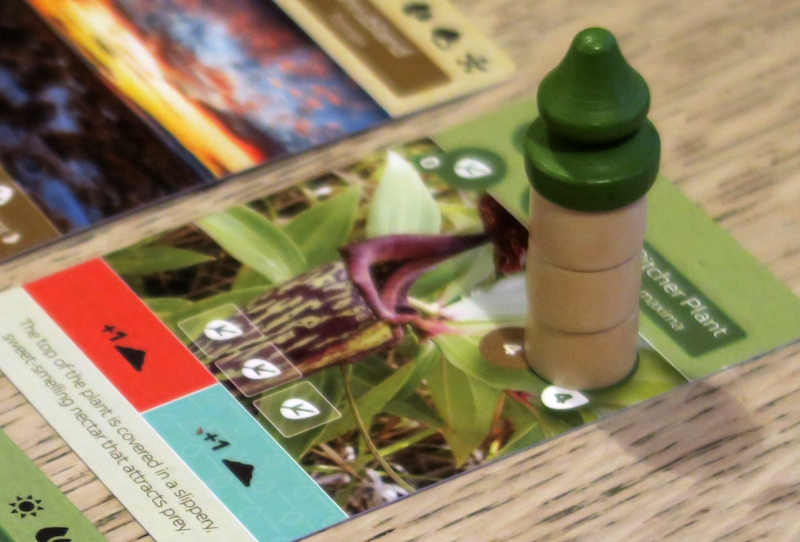
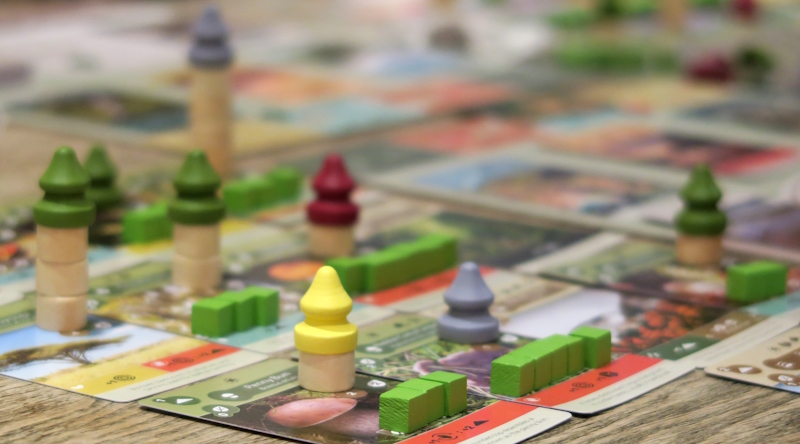
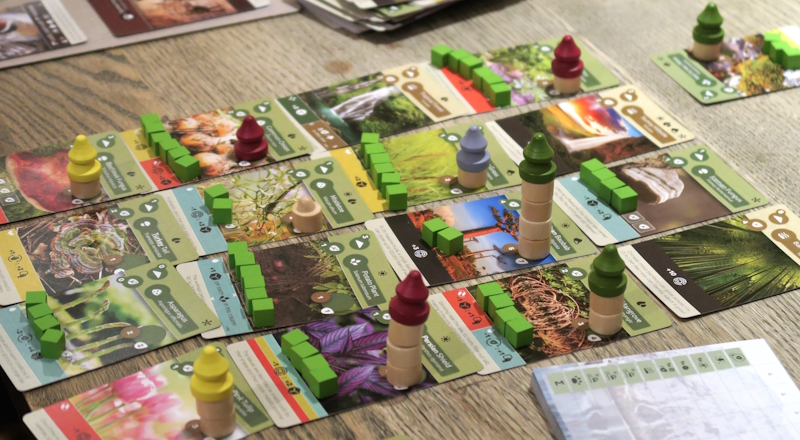
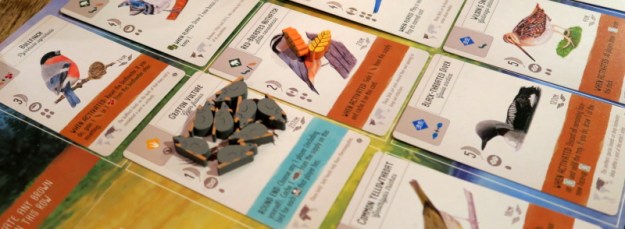
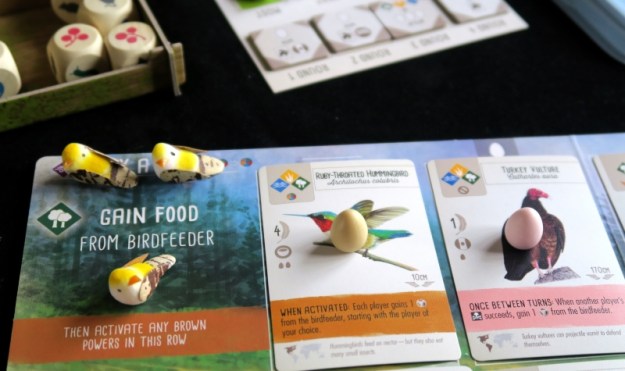
The fourth table consisting of Green, Teal, Salmon and Flint, only played the one game, but it was one of the most beautiful of recent times:  Earth.  This is a card-driven engine-builder where players are building themselves an ecosystem.  Often compared to Wingspan, although there is a lot to understand, the game itself is not actually all that complicated. Players are building a four by four grid of Flora and Terrain cards which represents their island; during the game they will plant flora, water it and allow it to grow.

Earth
– Image by boardGOATS

On their turn, players do one of four things: Planting (paying the cost in Soil tokens), Composting (gaining Soil and placing cards from the deck in their discard pile), Watering (place Sprouts and gain Soil) & Growing (draw new cards and place growth tokens).  A bit like Puerto Rico, once the active player has chosen which action they are taking, everyone else gets to do a subsidiary, slightly weaker version of the same action.  For example, when Planting, the active player plants two cards, draws four and keeps one, while the other players plant one and draw one.

Earth
– Image by boardGOATS

Once everyone has completed the action for the turn, everyone activates all the cards in their island that match the colour of the action chosen, starting with the card in the top left and working across each row in turn.  So, not only is it important which cards are played, but also where they are located in the player’s island.  At the end of the game (which is triggered when one player has completed their island), players score points for each Flora card, any Trunks and Canopies they have grown, their Sprouts and their pile of “Composted” or discarded cards.  Players also score points for achieving objectives on the Fauna cards revealed at the start of the game and for completing their island first.

Earth
– Image by boardGOATS

This was another game that turned out to be a bit of a land-slide.  The base scores for the islands was pretty consistent, but as with many games, it’s about what you do with the cards you get that makes the difference.  Green “Composted” fewer cards, but scored more for his Sprouts.  Players had ups and down, but otherwise it was fairly even.  The biggest difference, however, was the number of Leaf Tokens on the Fauna board—Green had more than twice as many as anyone else with sixty.  As a result, his total of two-hundred and forty-four was nearly fifty more than that of Teal who took second ahead of Flint in third.

Earth
– Image by boardGOATS

Learning outcome:  Rushing the end of a game can take the shine off it.

31st October 2023

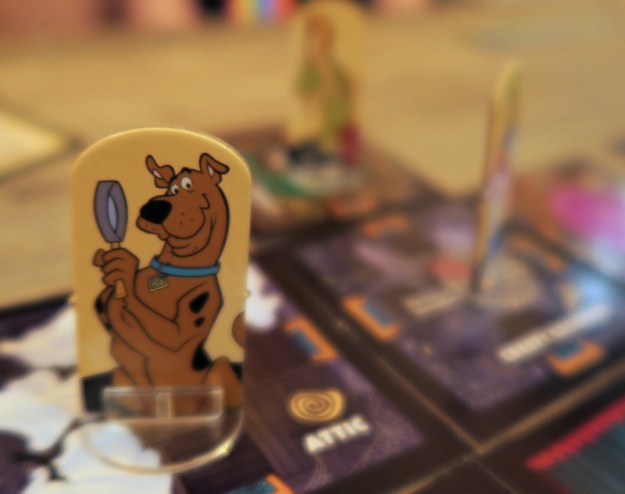
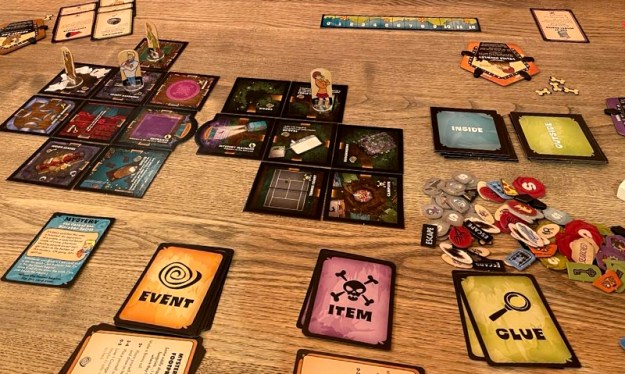
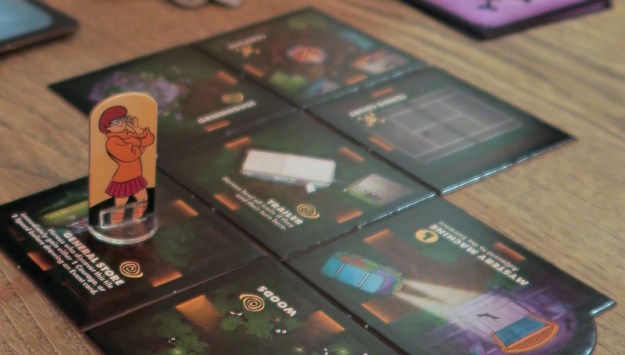
With it being Halloween, there were lots of treats and some very fine spooky-themed attire to go along with the “Feature Game“, Betrayal at Mystery Mansion.  This is a Scooby-Doo themed re-implementation of Betrayal at House on the Hill, a semi-cooperative game, where players work together until there is a haunting and one player takes on the role of the bad guy.  So, the first task for the evening was to decide who was going to take on the roles of Mystery Inc., which precipitated lots of discussion about which was the best character.  Scrappy got short-shift from Pink, though others were less dismissive.  In any case, Scrappy was not an option, and before long, Sapphire, Pink and Pine joined Jade to solve the mystery.

Betrayal at Mystery Mansion
– Image by boardGOATS

Jade, as the group leader, took the role of Fred, while Pink and Pine enthusiastically engaged in the game as Scooby Doo and Shaggy.  That left Sapphire to choose from Velma or Daphne and he went for brains over bimbette.  The group spent quite a bit of time exploring the mansion collecting clues and the like, before the haunt finally started.  As Sapphire was the one to trigger the haunt, Velma was “temporarily lost in the woods” as he took on the roles of the bad guys, a Spectre and a female character called Sharon who was being possessed and controlled by the Spectre.  As the game progressed, it became apparent that the Spectre was her great uncle who was trying to control her to gain access to documents that would enable him to take control of the family fortune.

Betrayal at Mystery Mansion
– Image by boardGOATS

The Scooby Gang (minus Scrappy Doo, Daphne and the now lost Velma) had to track down and battle the Spectre and try break the spell controlling Sharon.  As the villain, Sapphire rolled very well and it was very hard for the Gang to pin him down.  Fred ended up stunned at one point, but thankfully revived after missing a turn.  Shaggy scoffed piles of Scooby Snacks in order to re-roll, but the dice weren’t with him.  Scooby himself, however, did very well and survived his battle with the Spectre then was able to recharge in one of the special rooms of the mansion.  In the end the Mystery Inc. won the day and the great uncle was unmasked and announced that he “would’ve gotten away with it if it weren’t for you pesky kids”!

Betrayal at Mystery Mansion
– Image by boardGOATS

Meanwhile, there were two other games underway on the neighbouring tables.  Blue, Plum and Byzantium eschewed Witch’s Brew (which plays better with more people) and opted for the slightly bigger, beefier, boardgame version of the same game, Broom Service.  Both games rely on the players having a personal deck of Character cards and a lead and follow mechanism.  Each player starts by choosing a set number of Characters from their deck, each with different actions.  The first player then chooses one to lead with and announces that they are either “Brave” or “Cowardly”.  If they choose Cowardly, they can take the action straight away, whereas, if they choose Brave, they must wait until everyone has played to see if they can take the more powerful action.

Broom Service
– Image by boardGOATS

The next player must follow if they have the card in hand, and has the same decision to make—be a Coward and take the weaker action, or be Brave, and risk being gazumped by a later player, as there can only be one Brave player taking the powerful action.  The Brave player (or the most recent Brave player) then leads with another card.  In the card game, Witch’s Brew, players are collecting tokens to give them points, however, in Broom Service, there is an additional “Travelling Salesman” pick-up and deliver type of mechanism.  Players have two Witch-meeples which travel the land collecting potions and delivering them locations to get points.  This time, it was a really, really close game, despite everyone doing different things.

Broom Service
– Image by boardGOATS

Byzantium prioritised collecting Lightening Bolts and Blue concentrated on collecting potions and delivering them.  While they both headed south and contrived to get in each-other’s way, Plum headed north and fell foul of one of the events which left her stuck with no good move in the final round.  Blue kept forgetting about the “Bewitched Roles” which can be used but with a hefty three point penalty and lost six points as a result.  Byzantium assumed he would be the only one to consciously choose to take the hit and thus guarantee he could be Brave, but happened to do that exactly when Blue picked them as well and lost the advantage when he led with those roles.

Broom Service
– Image by boardGOATS

As the game came to a close, it was clear it was going to be close with Blue ahead by a single point with sixty points scored during the game.  She lots of resources left while Byzantium had none but lots of Lightening Bolts, and Plum had some of both.  Initially, Blue and Byzantium tied with seventy-three, just two points ahead of Plum.  That gave Blue victory with the tie break (the most left over resources), but that was only until the miss-count was spotted and Blue lost one point and with it her Winning Witch Medal, instead taking second place by a single point.

Broom Service
– Image by boardGOATS

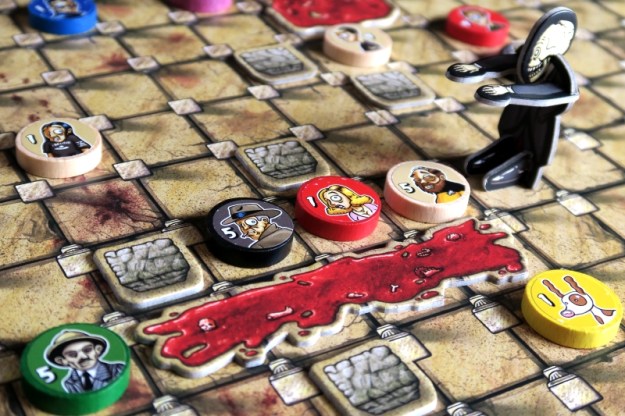
While the first two tables were playing spooky-themed games, Black and Purple led Teal and Cobalt in the monster-mad Finstere Flure (aka Fearsome Floors).  This is a game where players are trying to escape from Fürst Fieso before the castle collapses and without getting eaten.  The idea is very simple: first players move all their pieces the number of spaces shown on their visible side, then the Monster moves.  The Monster moves according to a stack of tiles, either moving a set number or moving until he eats.  The Monster moves one step forwards then looks straight ahead, left and then right. If he sees a player, he turns and moves towards them.

Finstere Flure
– Image by boardGOATS

Thus, the Monster looks, moves, looks, moves until he either runs out of spaces to move, or eats someone.  The game ends after fifteen rounds.  It is simple enough, but there are a few little elements that add to the fun.  Firstly, each player piece moves a total of seven spaces over two turns, but while some alternate three and four space moves, others are more variable, with the most extreme moving six spaces and then one space on the next turn; these different pieces require different tactics.  Players can’t land on another player, if they walk into a rock they push it and if you step in a pool of blood, they slide across it.

Finstere Flure
– Image by boardGOATS

Finally, if the Monster walks into a wall he appears elsewhere on the board adding a further layer of unpredictability.  The game opened with a bang when the first Monster tile revealed was a “Two Kill”, that is to say, the monster keeps moving until he’s eaten twice.  From there, it was carnage.  Everyone had someone eaten, with some multiple times.  There were people who managed to escape from Fürst Fieso, though it wasn’t easy of course.  Everyone managed to get at least one piece out of the castle, with Purple and Cobalt managing to get two pieces out.  The winner, however, was Black who liberated three of his people.

Finstere Flure
– Image by boardGOATS

They were the first to finish, so moved on to play the recent release, Ticket to Ride: Ghost Train.  This is really just a variant of First Journey, a simpler version of the group favourite, Ticket to Ride, aimed at children and non-gamers with super-sized pieces.  Like the original game, players take it in turns to either take “two parade float” cards (in this case blind), or pay cards to place trains on the map.  However, instead of scoring points for placing trains, the game is essentially a race game.  Players start with three Tickets and every time they complete one, they draw a replacement.  The winner is the player who completes the most Tickets.

Ticket to Ride: Ghost Train
– Image by boardGOATS

This time, Teal took an early night, but Black, Purple and Cobalt went at it with spooky enthusiasm.  As a different take on the original, they found this a very enjoyable alternative.  As well as Tickets, players can also win “Trick or Treat” bonuses for connecting the Dark Forest region to the Seashore region.  Black and Purple both took a “Trick or Treat” bonus, but the winner was Cobalt who finished with six Tickets, one more than Purple who would have taken another if she’d had just a little more time.  That wasn’t the only Ticket to Ride game of the night however, as the Scooby Gang played a quick game of Ticket to Ride: Berlin once they had solved their mystery.

Ticket to Ride: Ghost Train
– Image by boardGOATS

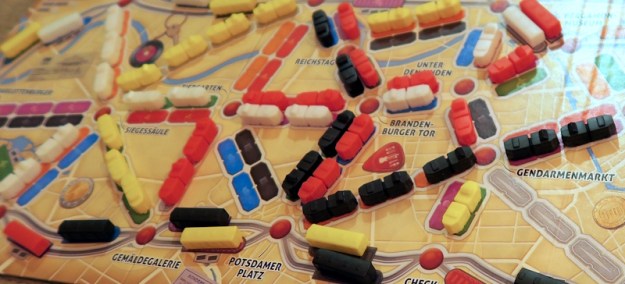
Ticket to Ride: Berlin is one of the mini versions, and there was a little chat about these and which ones people had played.  The first mini version was a “demo” game the publisher used to introduce people to the game at conventions.  Since then, there have been a series of City versions, with New York, London, Amsterdam and San Francisco all featuring and Berlin being the most recent (with Paris to come next year).  These all feature the same basic mechanism as the original game (including the scoring of points for placing trains unlike the First Journey type games), but they have fewer train pieces and a smaller map.  The Berlin map, is long and thin, but the big difference is that players have mixture of Trams and U-Bahn pieces.

Ticket to Ride: Berlin
– Image by boardGOATS

Tram and U-Bahn routes are paid for in similar ways, though only one U-Bahn piece is needed to mark them and they score slightly more points.  Once the differences had been highlighted by Pine and Pink (who played this together a few weeks back), everyone got down to business.  Jade and Sapphire dominated the West while Pink and Pine concentrated on the East, though the geography of the map meant everyone had to include East-West connections in their network.  It was a hard-faught close game with both Jade and Sapphire taking negative points due to incomplete Tickets.  Pine completed five Tickets and Pink finished six.

Ticket to Ride: Berlin
– Image by boardGOATS

Pine’s Tickets were more lucrative, however, and he took victory with sixty-one points, while Jade with forty-nine just pipped Pink by two points in the struggle for second place.  Everyone had enjoyed the game, and Jade commented that it was one of his favourite renditions of Ticket to Ride so far—indeed, the addition of a second set of transport seems to have been much more successful in this mini version than it was in the full-sized Rail & Sails where it made it longer and more fiddly without making it significantly better.  While everyone else was playing and then discussing the merits of different versions of Ticket to Ride, the Crafty Trio, Plum, Blue and Byzantium had finished Broom Service and squeezed in a quick game of Dinosaur Drafting with Draftosaurus.

Draftosaurus
– Image by boardGOATS

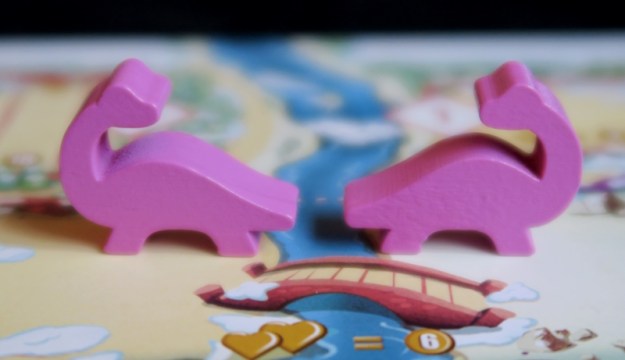
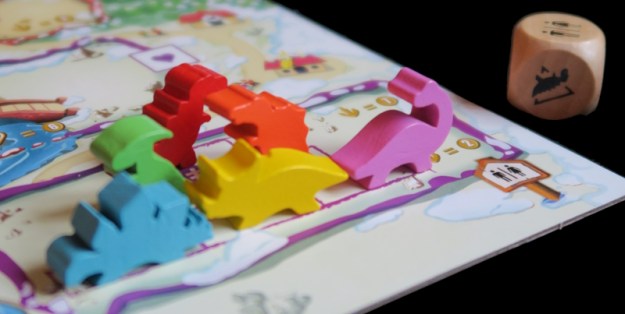
This is a fun little game that we play quite a bit, where players choose one Dinosaur from a handful, add it to their Park and then pass the rest on.  Dino-placement is slightly restricted by the roll of a die, with everyone getting points for how they occupy their pens.  Usually, the group plays with the Summer board, but with the cold weather, the group decided to play with the alternate, Winter board which introduces new and different pens.  These include the Well-Ordered Wood (Dinosaur types must alternate); Lovers’ Bridge (giving six points for each pair of Dinosaurs separated by the bridge); the Lookout (contains one Dinosaur and scores two points for each one of that type in their right neighbour’s pen).

Draftosaurus
– Image by boardGOATS

The most challenging, however is the Pyramid, which holds up to six Dinosaurs in a layered structure, but dinosaurs of the same species may not be placed adjacent to each other (horizontally or vertically).  Blue got into a mess with this, and was stuck with a Dinosaur she could not place at the end as a result.  Plum and Byzantium did slightly better and were able to capitalise more on the Quarantine Zone, which allows players to move the single occupant at the end of the game.  In the end, it was a tight game (though not as tight as Broom Service), in which Plum ran out the victor, three points ahead of Byzantium.

Draftosaurus
– Image by boardGOATS

Learning outcome: They’d have got away with it if it weren’t for those pesky kids!

9th August 2022

Pink, Blue, Orange and Lemon were the first to arrive, very soon followed by Plum and Jade.  While they were waiting for food, the group decided to play a couple of quick games.  First up was Moneybags, a game we played for the first time a few months ago.  This is a very quick social deduction game with a similar premise to Ca$h ‘n Guns:  players are a gang of thieves distributing their loot.  In Moneybags, the “Godfather” first distributes the loot and players then take it in turns to either steal from another player, pass, or close their money bag and recuse themselves from the rest of the game.
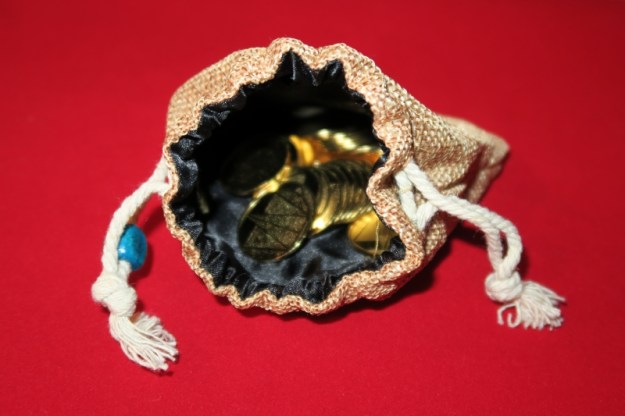
Moneybags
– Image by boardGOATS

If a player is robbed, the victim can challenge if they think the thief was too greedy.  If the victim has less than the robber, they win their challenge and take all the money for themselves, otherwise the thief wins and they take all the loot.  After two rounds, the players that have not been eliminated compare the height of their piles of cash, and the one with the tallest stack is the winner.  Pink started sharing out the cash while Blue explained the game.  Blue then started, robbing Pink to demonstrate how it is done.  It wasn’t long before the first player, Plum was eliminated, and everyone really understood how things worked.
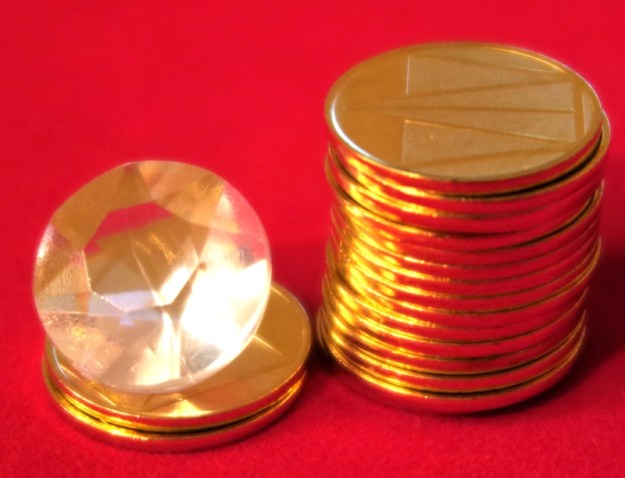
Moneybags
– Image by boardGOATS

When she was robbed, Lemon was unlucky to lose her challenge to Orange on a tie leaving only Blue, Pink and Orange left at the end of the round.  It was then a matter of comparing the three stacks to find that Orange was once again involved in a tie, but this time he lost to Pink on the tie-breaker (the winner being the player earliest in the turn-order).  Pink relinquished his right to being the Godfather though and gave it to Orange who filled the money bags for a second round.  Unfortunately, Orange failed to put any coins at all in Plum’s bag and put most of it in Lemon’s and Pink’s.  This made Lemon the first target and Pink the second.

Moneybags
– Image by boardGOATS

Ill-advised challenges left both Lemon and Blue eliminated in the first round and Orange by the end of the second.  Another three way comparison quickly pushed Pink into third leaving a close finish between Plum and Jade with Jade just sneaking in front.  Two games were enough, and Jade suggested the group move on to something new: MANTIS, a game from the same people as Exploding Kittens.  This is a simple set collecting game where, on their turn, players can choose to “Steal” or “Score”.  Players declare their plan (and their victim if they are stealing) before they turn over the top card of the deck.  When Stealing, if the colour matches cards belonging to their victim, then they take the cards and add them, face up to their array.
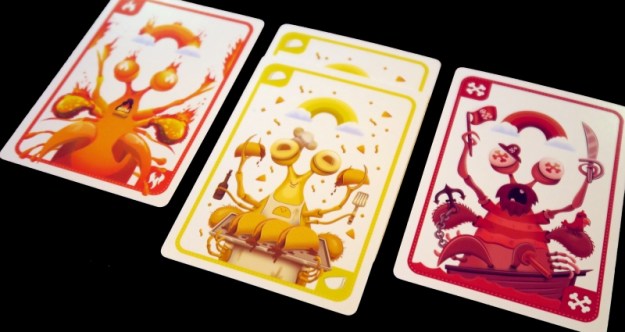
MANTIS
– Image by boardGOATS

When Scoring, if the colour matches any of their own cards, they turn over the cards and these become points—the first player to ten points is the winner.  While this sounds like pure chance, there is one thing that makes the game less random: the backs of the cards show three colours, one of which is the card colour while the others are red herrings (or herrings of another colour).  So whilst the game isn’t challenging, it rocks along nice and quickly.  Blue took points on her first turn to take an early lead, but everyone else soon caught up and overtook her.
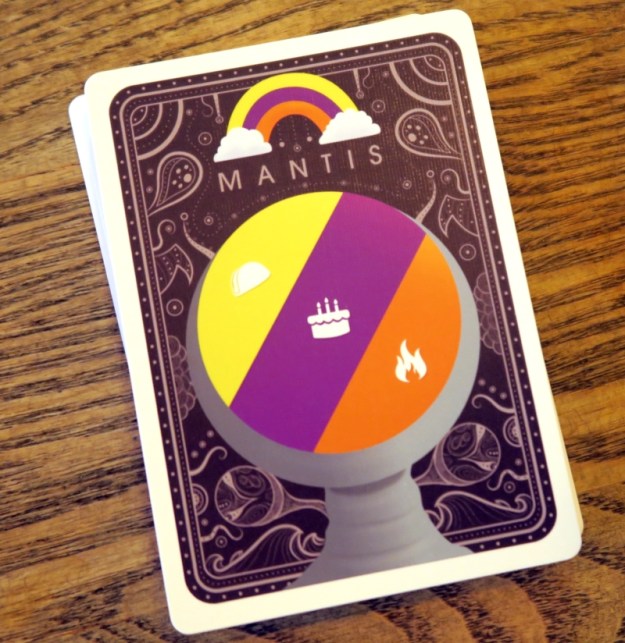
MANTIS
– Image by boardGOATS

Food started to arrive, and everyone tried (and failed) to finish before eating; it took a couple more rounds before Pink scored his tenth point.  It was very close for second with almost everyone else on six or seven, but Orange just nicked it with eight.  While everyone tucked in to their food, the rest of the group arrived.  There was some debate as to who would play the “Feature Game” which was to be Alubari: A Nice Cup of Tea, but in the end, Green and Ivory took themselves and the game to the other side of the room to set up a four player game where they were eventually joined by Black and Purple.

Alubari: A Nice Cup of Tea
– Image by boardGOATS

Alubari is a re-implementation of the popular worker-placement game, Snowdonia.  It had been a while since any of the group had played Snowdonia, so they needed a quick refresher of the rules and to learn the new aspects of Alubari. The underlying mechanisms are essentially the same, but it has a slightly smoother feel, and of course, the setting is Darjeeling (in the Indian state of West Bengal).  In this version of the game, players harvest Tea Estates and assist in the building of the Darjeeling and Himalayan Railway, from Siliguri Town to the summit at Ghum.  In addition, players use Chai (made from from harvested tea leaves) which increases the power of their actions.  Like the original game, players take it in turns to place their two workers on the action spaces available on the board.

Alubari: A Nice Cup of Tea
– Image by boardGOATS

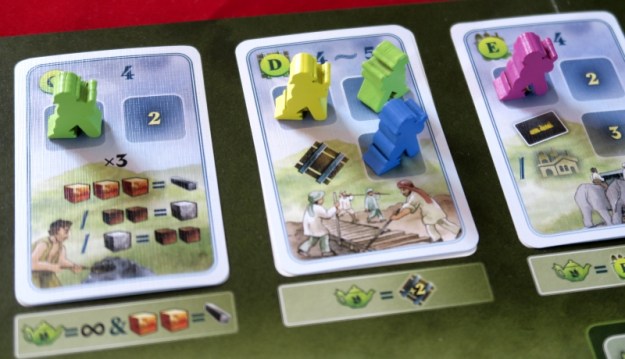
Once the workers have been placed, players carry out the actions in action order, that is to say, anyone who has a worker in Action A goes first, with the spaces within each Action numbered and activated in order.  The Actions are:  take Resources from the Stockyard; dig Rubble from the Tea Plantations; convert resources (Iron Ore into Iron Bars, Rubble into Stone or Stone into Rubble); lay Track; build Stations or buy Equipment; take Contract Cards, and finally, harvest Tea leaves or make Chai. Chai is very powerful because players can use it to to get an additional worker for the duration of one round.
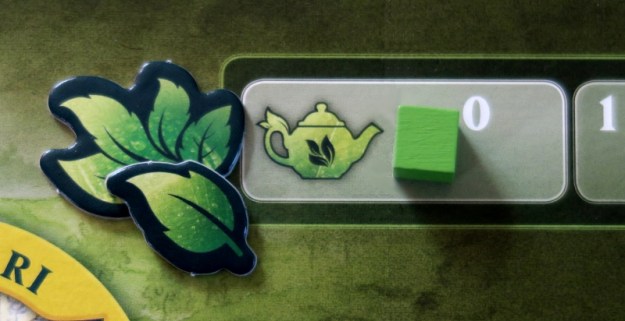
Alubari: A Nice Cup of Tea
– Image by boardGOATS

Chai can also be used to enhance actions.  For example, players can normally take three Resources from the Stockyard including one Chai; paying a Chai increases the number of Resources they can take to five with a maximum of two Chai. Some of this mirrors Coal in the original Snowdonia game, but initially, there was a little confusion amongst players over the differences between Tea and Chai.  There is a distinction here between Tea and Chai, with Tea being the raw leaf product (represented in the art by a leaf) and Chai being the refined product (represented by a teapot).  Tea Harvests are shown by a leaf with an arrow which mean players collect Tea leaves equal to the number of tea estates owned by player multiplied by the current value of the Tea Harvest Track.

Alubari: A Nice Cup of Tea
– Image by boardGOATS

The Tea Harvest Track works the same way as the Excavation Work (aka Dig) Rate and the Track Work Rate:  they depend on the Weather.  The back of the contract cards show the weather; at the start of each round the current Weather disk is removed, the other Weather disks shuffled forwards and the empty space filled with a disk that matches the back of the top card in the Contract deck.  Thus, players can see what the weather will do for the next few rounds and use that to plan when to take actions.  In general, the Excavation and Track Work Rates are increased by sun, decreased by rain and Work stops altogether when it is foggy;  in contrast, the Tea Harvest Rate increases with rain, decreases with fog and is unaffected by sun.

Alubari: A Nice Cup of Tea
– Image by boardGOATS

At the start of each round, the Stockyard is refilled with Resources which are drawn blind from a bag.  As well as Iron Ore and Stone, the bag also contains a small amount of Chai and five Event Cubes.  When one of these is drawn, from the bag, the game plays itself according to a Rondel.  This design feature is intended to prevent players from hoarding Resources and thus slowing the game—the fewer Resources there are in the bag, the more likely it is that a white Event Cube will be drawn out.  The Events include Excavate, produce Tea, build Stations and lay Track.  This last is particularly important because the game ends at the end of the round when the final Track space, on the approach to Darjeeling is completed—this could be by a player or an Event.
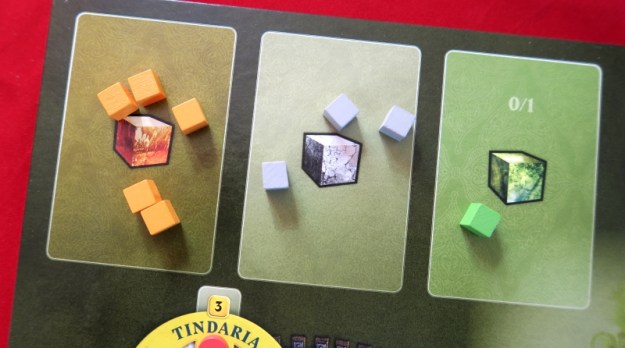
Alubari: A Nice Cup of Tea
– Image by boardGOATS

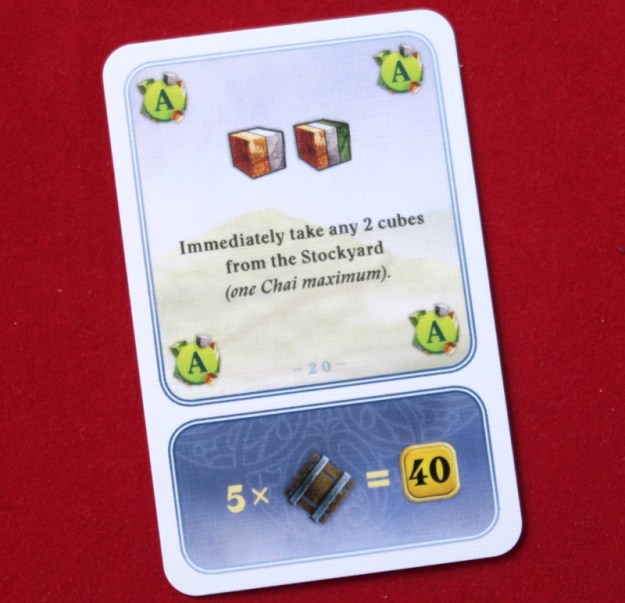
Once the rules had been run through, the game got underway.  Right from the outset Black pointed out that it was through Contracts that the big scores were really made. The Contract Cards come in two parts:  a Special Action part and an end game bonus.   The Action can be used in any round, but its use must be declared before any Actions are resolved.  Whether the Action is used or not, players can claim the bonus at the end of the game, and it was these to which Black was referring.  Ivory took note of Black’s advice and very early on went for a hefty contract which would give him forty points if he could get five rail tracks.
Alubari: A Nice Cup of Tea
– Image by boardGOATS

Considering that there are only fifteen tracks in the game, with four players and the game itself sometimes building track through the Events, the Contract for five rail segments looked like a tall order.  However, as nobody was really paying attention to Ivory’s plans, with the help of a Chai super-boost, it proved easier than it should have been.  Aside from that, Ivory, along with Black and Purple began with a fairly typical Snowdonia game approach, collecting building supplies.  Green on the other hand, decided to experiment with the new Tea/Chai mechanisms and started clearing the Tea Estates.  Although Green did get the first Tea Estate, everyone else also got one soon after.
Alubari: A Nice Cup of Tea
– Image by boardGOATS

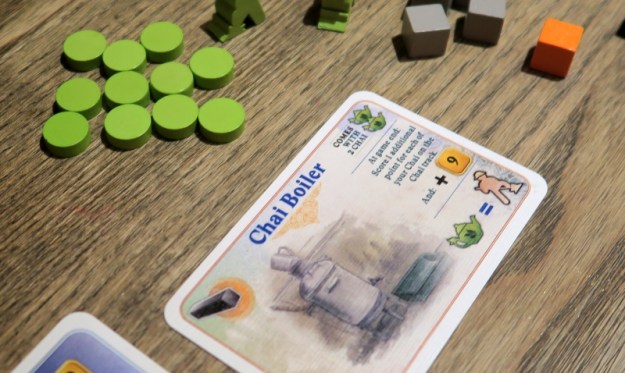
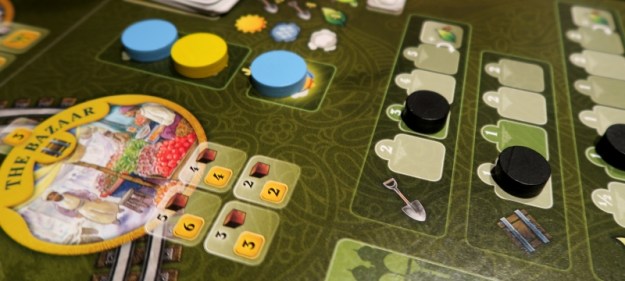
Green was able to continue this approach though, and by the first Tea Harvest, he had more estates than any one else.  Green was also the first to gain Equipment, going for a simple one, the Chai Boiler, from the Promo Pack, and gained two Chai with it. He was able to use those Chai to boost his later actions.  By halfway through the game he had built up quite a pile of Rubble, and only then realised that he could use this to build Stations.  This wasn’t the only game blunder made with Stations. It was only towards the end of the game that Black suddenly remembered the first town on the map, where players could use Tea leaves to pay to build the Station. The first space only cost three leaves, but gave a whopping twelve points and Purple make use of that as soon as it was pointed out.
Alubari: A Nice Cup of Tea
– Image by boardGOATS

Green took advantage of the Tea/Chai conversion after a very good Harvest, pushing himself to the top of the Chai track. He was then able to get a third worker and boost many of his actions the following round.  Through most of the game Ivory held the start player token, with Green and Black only taking it a couple of times with Ivory taking it back straight away.  The game was building nicely when suddenly, almost out of nowhere, it was over.  There were eight Tracks built when everyone except Purple chose to lay Tracks in the next round.  Green went first.  He needed to build two Tracks for his contract—he had the Steel but the Track Work Rate was one and he had run out of Chai so couldn’t increase it.
Alubari: A Nice Cup of Tea
– Image by boardGOATS

Next was Ivory who did have Chai, which allowed him to build two extra Track sections and he had the Steel to do it enabling him to build three in one go.  Black also had Chai, but only two steel. Seeing that he may not get another chance, he used the Chai, but still needed to lay one more track for his Contract.  So the game had gone from eight Track sections to fourteen in a single turn.  Green was primed to get his second Track section to complete his Contract, but unfortunately for him, the game had other ideas. With three white Event Cubes, the second event was Lay Track triggering the end of the game, but no Track left to be built. From there, it was just the usual calculations with players maximising points with the last workers and Chai.

Alubari: A Nice Cup of Tea
– Image by boardGOATS

Adding up the points, it turned out to be an incredibly close game. Purple and Green were within a whisker of Black who was the runner-up with sixty-nine and a half points (yes, this game does indeed give half points!).  It was Ivory who was the clear winner, however, with his five track Contract that shot his score to the dizzying heights of ninety-six.  In the post game discussion, the group agreed that some of the Chai boosts seemed more powerful than others, and the track laying bonus in particular seemed overly powerful. There also did not seem to be as many Tea Harvests as players expected (only three in the whole game including one from a Contract Card).  This was only one game though and it is highly likely that others will play out quite differently.
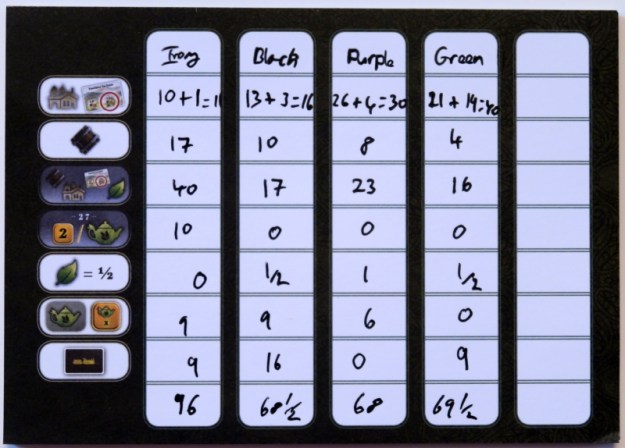
Alubari: A Nice Cup of Tea
– Image by boardGOATS

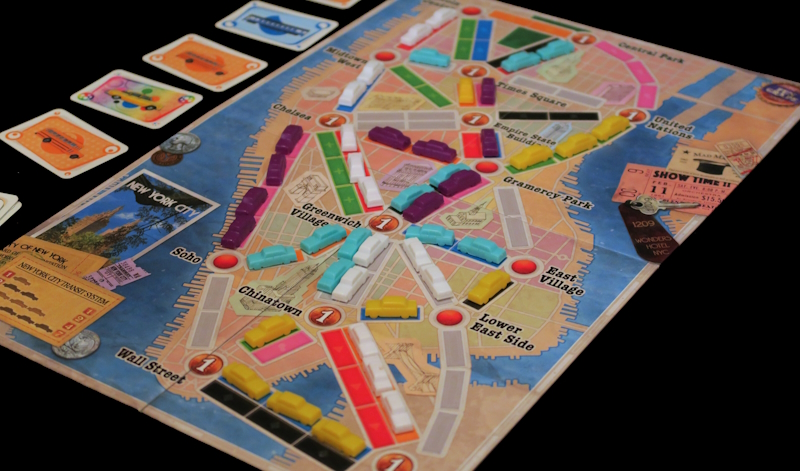
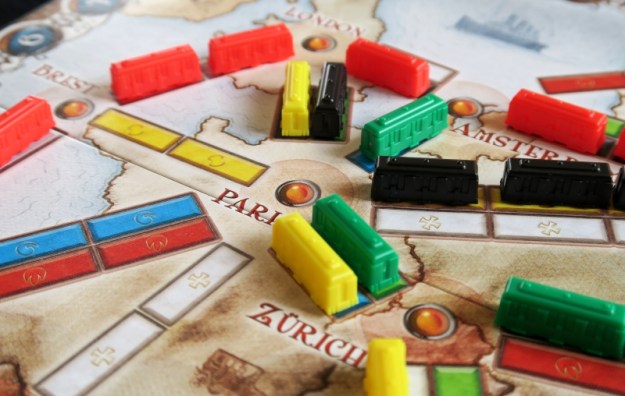
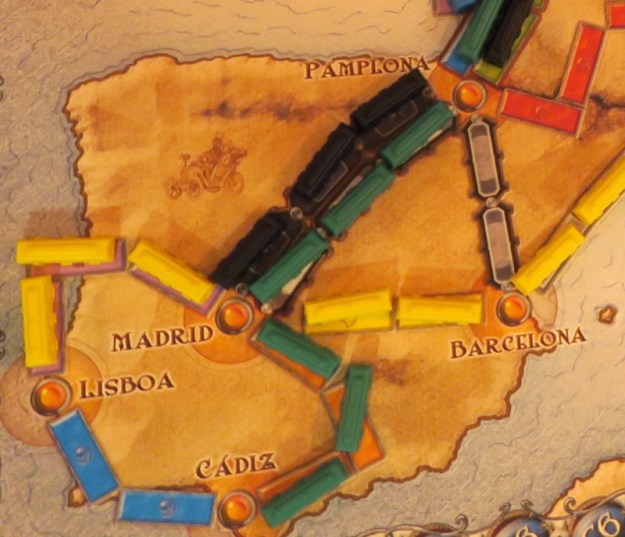
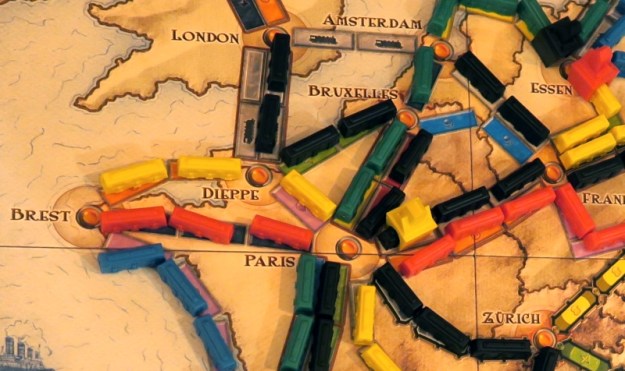
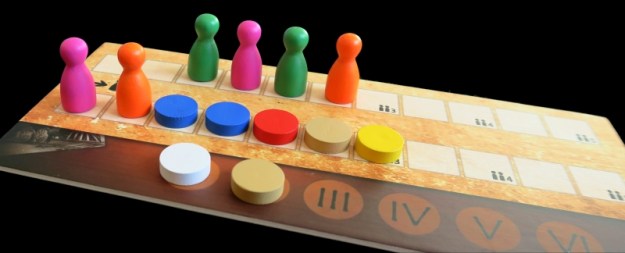
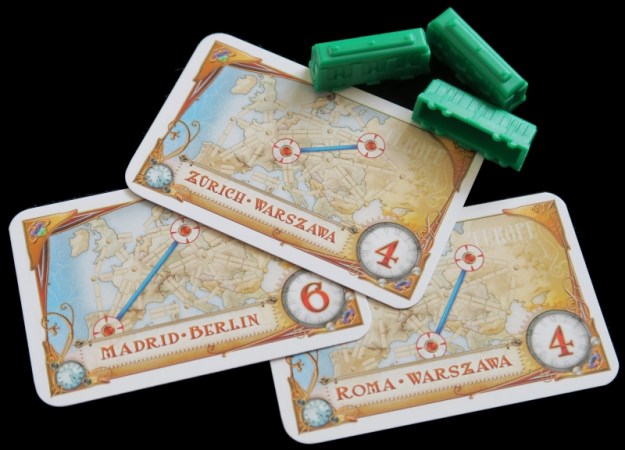
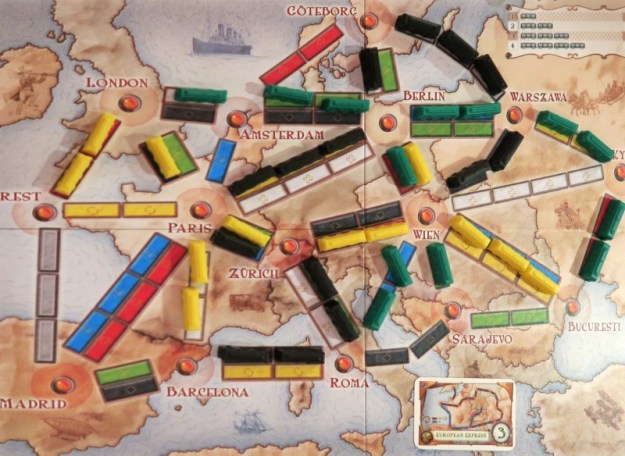
Meanwhile, on the other side of the room, after a bit of discussion, Blue swapped seats with Lime and he and Pink introduced Orange and Lemon to one of our favourite games:  Ticket to Ride.  We play this quite a bit in lots of different guises, so the plan was to start by playing a short game, the Demo edition, and then play a full sized version.  The game is very straight-forward and the basic play is the same across all editions:  on their turn, players can take train cards, build track by paying train cards, or take tickets which give end-game points.  While the basic mechanisms remain though, the map, the number of train pieces change and some editions add extra little rules.

Ticket to Ride Demo
– Image by boardGOATS

In the first, Demo game (played on the Europe map), Lemon managed to get lots of matching tickets which meant she gave everyone else a bit of a spanking.  Not being a native English speaker, Lemon queried the vernacular at which point Pink tried to explain that it was a sporting term, but everyone else including those on the next table insisted that he should explain it properly with all the meanings.  Lemon and Orange opted to spare his blushes by looking it up, only to blush themselves when they found it.  Much hilarity ensued and was shared with the neighbouring table.
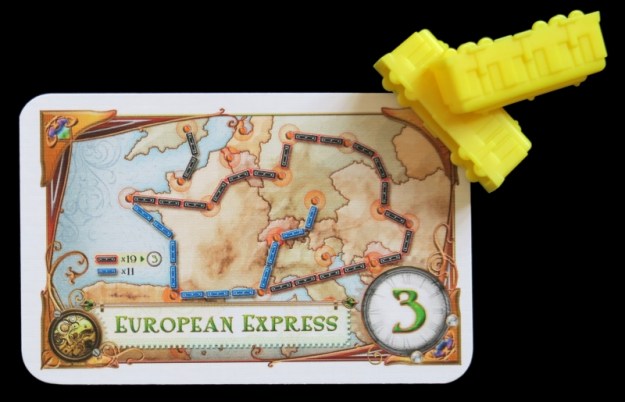
Ticket to Ride Demo
– Image by boardGOATS

After the introductory game, Pink and “the Citruses” moved onto a “full version”, but in an effort to avoid “special rules” the group played a house ruled version of Ticket to Ride: Germany.  This version of the game has its heritage in the Märklin limited edition that was the third game in the series and was published about fifteen years ago. Märklin make model railways, a bit like Hornby, but with German trains.  The Märklin version of Ticket to Ride had special art work with a different Märklin train depicted on each individual card in the deck.  More importantly, however, it introduced a passenger mechanism which made the game considerably more complex than the original.

Ticket to Ride: Märklin
– Image by boardGOATS

With the Märklin edition sold out, about ten years ago, Days of Wonder (presumably reluctant to renew the license for the Märklin branding) re-released the game for the German and Austrian market as Zug um Zug: Deutschland.  This was a simpler version that used the same map, but without the passengers, although the 1902 expansion was released a a couple of years later to reintroduce them with a new, simpler mechanism.  A few years after that, about five years ago, the German game was released for the worldwide market including both the Deutschland base game and the 1902 expansion—the only difference was the omission of two tickets.
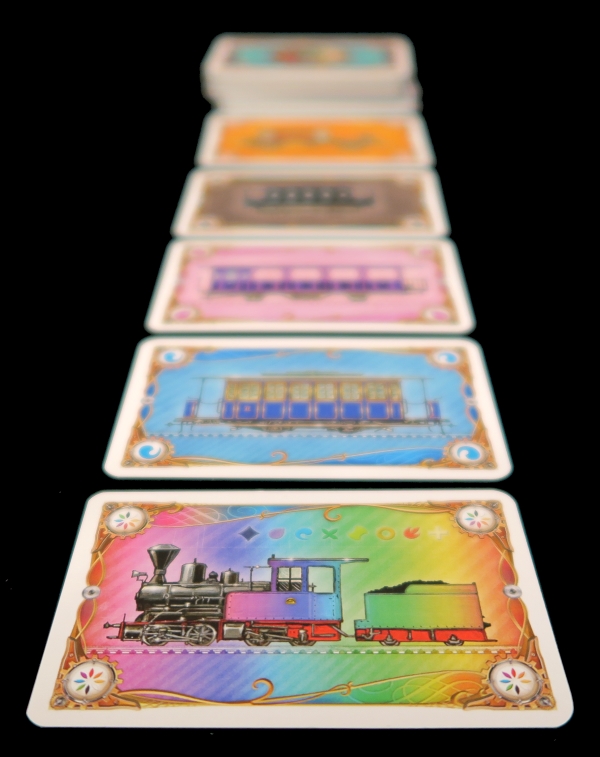
Ticket to Ride: Germany
– Image by boardGOATS

It was this newest Germany version of the game that the group played.  However, although the variant includes the passenger mechanism and there is no official variant in the rules “as written” to remove them, in order to keep things simple, the group omitted that part of the game, effectively playing Zug um Zug: Deutschland.  The game had just begun, when three rounds in, Pine arrived.  The others offered to include him, but he declined and, as a result, he didn’t play anything at all, all evening.  He did manage to recount the infamous game when he and Pink gave Blue and Burgundy a spanking over the Heart of Africa map as they got stuck in the middle blocking each other.
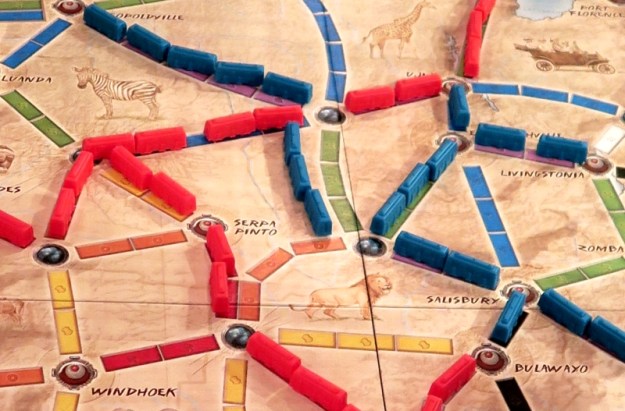
Ticket to Ride Map Collection: Volume 3 – The Heart of Africa
– Image by boardGOATS

The German version has two types of ticket:  long tickets (brown backed) and short tickets (blue backed).  At the start of the game, players choose four in any combination of the two types, but must first announce what combination of Tickets they are drawing.  Pink went for an almost exclusively long (brown) ticket strategy which he achieved with varied success, while the others went for a mixed ticket approach.  There was a little difficulty reading the tickets as the game uses a slightly gothic font which can be a little difficult to read, especially for those who’d forgotten their glasses.

Ticket to Ride: Germany
– Image by boardGOATS

Both Lemon and Lime claimed the long train line from Berlin to Hamburg which give them eighteen points, the equivalent of a long ticket.  And tickets were very important this time.  Pink began completing routes from Kiel to Switzerland and France (via Bremen and Köln) before taking more tickets.  To fulfill these, he extended his network to Hamburg in the north, but failed to get to Karlsruhe in the south which cost him eighteen points in failed tickets.  The game can be played in a relatively friendly way, or aggressively with players trying to shut each other out.  We play in the more self-focused, less confrontational way, so failed tickets are normally relatively unusual, as such, this game was remarkable in that it was a bit of a tale of missed tickets.
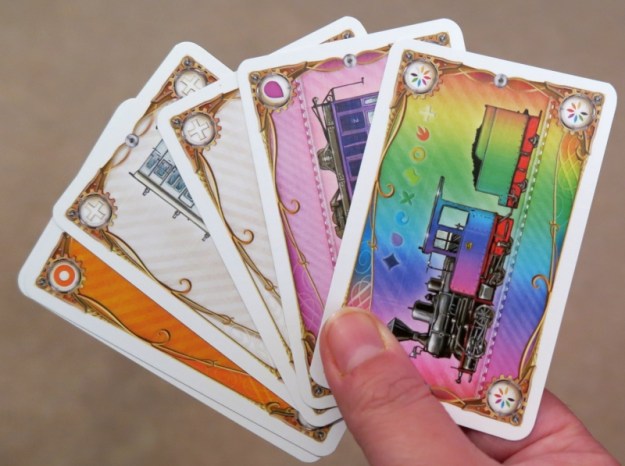
Ticket to Ride: Germany
– Image by boardGOATS

In addition to Pink, Orange was particularly unfortunate this time, failing to complete any tickets as he was unintentionally badly blocked.  The game was ended somewhat unexpectedly by Lime, partly because he picked up the long route (suddenly depleting his supply of trains), but mostly because people weren’t paying attention to the number of trains he had left.  He was more fortunate in his ticket draws as well and that contributed to his hundred and fifty-four points and him giving everyone else a serious trouncing (another word for Orange and Lemon to look up).  Lemon was the best of the rest finishing with ninety, over sixty points behind Lime.

Ticket to Ride: Germany
– Image by boardGOATS

While everyone else was playing with trains, on the next table, Jade introduced Lilac and Blue to his new acquisition that he picked up from UK Games Expo back in June, Old London Bridge.  This is a fairly typical Queen Games game, with lots of pieces, but not too challenging—just what everyone wanted on a warm night.  The game is set in 1136 after the great wooden bridge across the Thames was been consumed by fire.  Players are architects, each responsible for designing and building one section of the new bridge.  On their turn, players add one of the available buildings to their bridge section.  Each building has three attributes:  Location, Colour and Number.
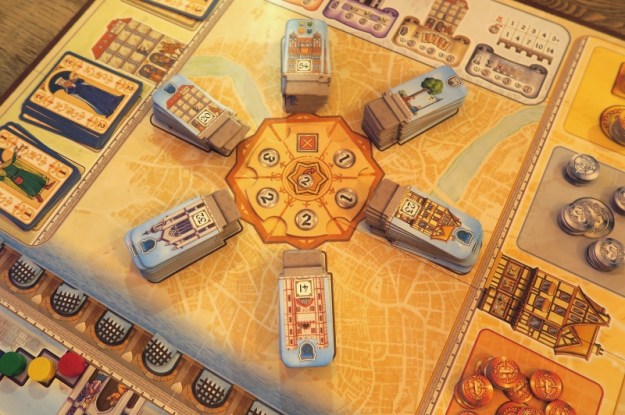
Old London Bridge
– Image by boardGOATS

There are six different types of building, each with a special “power”.  Thus, Haberdashers allow players to take money, the Purple Chapel buildings allow players to move along the associated track etc..  The colour is important because if that colour matches other buildings already on their bridge, they get a boost—for example, if a player takes a blue Haberdasher building, and already has two other blue buildings, they get to do that action effectively three times, taking three times as much money.  Finally, buildings must be built in descending Number order—to reset, players have to build a park, which has no additional “power”.
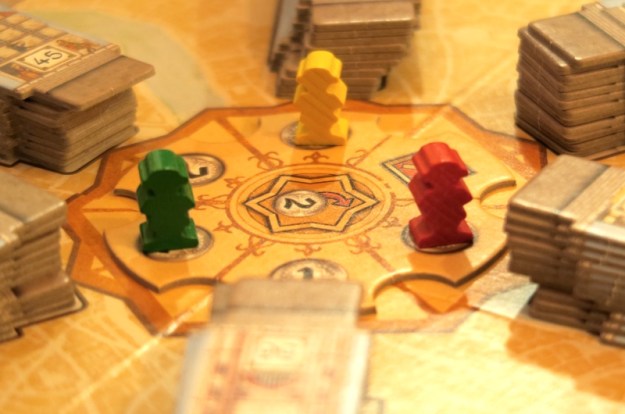
Old London Bridge
– Image by boardGOATS

There are six building spaces on a central Rondel, each associated with a different pile of buildings and each with a money bonus that changes as the Rondel rotates at the start of each round.  Each Rondel space can only hold one player’s marker, thus each building type can only be built once per round.  One space is always deactivated (which one also changes as the Rondel moves), but the seventh space, the centre of the of the Rondel costs money, but allows players to take any building, including one that is currently unavailable (either because it has already been taken or was deactivated at the start of the round).
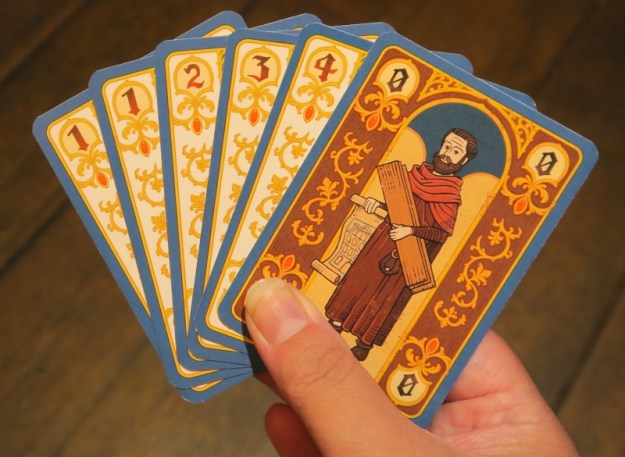
Old London Bridge
– Image by boardGOATS

Each round, players bid with Character Cards to see who gets to choose a building first.  Character Cards which have a numerical value, zero to four.  Where there is a tie, it is broken by players’ respective positions on the Purple Chapel track. Players start with a hand of Character Cards, but can add to these by building a Hostelry building—the higher the power, the more powerful the cards they can take.  At the end of the game, the players get bonus points depending on the value of the Characters they have left over.  In addition to the Haberdasher, the Hostelry and the Parks there are also two types of buildings in the Bridge Gate:  Purple Chapel Buildings and Red Gatehouse Buildings.

Old London Bridge
– Image by boardGOATS

Each of the Bridge Gate buildings have a track associated with them.  During the game, passing milestones on these tracks give money and break ties (Chapel Track) or give special tokens that allow players to bend the rules (Gatehouse Track).  Additionally, players get bonus points at the end of the game depending on their final position on these tracks.  The final building type is the Guild House.  These have no action associated with them, but are “Colour wild”, featuring all four colours, and as such, they boost every other building type.  At the end of the game, players add their residual money to bonus points for their finishing position on the Bridge Gate tracks, for unused Characters, and for having the fullest bridge (if a player can’t obey the Number rules, they may have been unable to build a building).
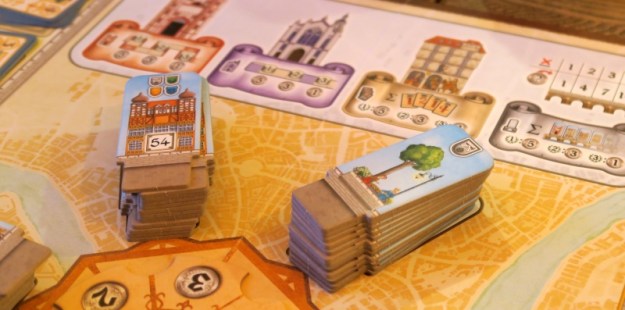
Old London Bridge
– Image by boardGOATS

Jade had only just started explaining the rules, when Plum announced that she had a “new religion”—Kittens, and shared photos.  From this point forward, every pause in the game became a “Kitty Paws” and was punctuated by more increasing levels of cuteness—definitely an improvement on the stuffed Pandas from last time.  Despite the undeniable distractions, everyone was still able to focus on the game and proceedings weren’t slowed at all.  Plum seemed to amass a vast amount of money in no time at all and after making a mess of her first turn, Blue got lots of orange buildings and lots of cards but was very slow to make any progress on the Purple Chapel track and lost every tie-breaker she was involved in as a result.

Plum's Kitty
– Image by Plum

Lilac was the first to run out of Character Cards and therefore ended up relying on her position on the Chapel track to ensure she didn’t get left with Hobson’s Choice every time.  In this she was helped by Jade who also ran out of cards.  Although Blue’s forest of Orange buildings meant she could get a lot each turn, her choice was often to do something she wanted but not get much of it, or take yet another orange building and to do something she didn’t really want and rely on probability to even things out in the end.  Things didn’t really even out, and as a result, Blue ended up with a lot of Character Cards.  Everyone else went for a much more balanced strategy focusing on one or two or maybe three Colours.  And Plum’s pile of loot grew ever larger.

Old London Bridge
– Image by boardGOATS

Towards the end of the game, Jade put on a massive spurt along the Red Gatehouse track and collected some Character Cards, while Blue finally made a move along the Purple Chapel track.  As a result, Jade who had led the Purple Chapel track for most of the game was pipped by Blue, and Blue who’d held a massive lead on the Red Gatehouse track was edged out by Jade.  Plum finished with the most cash with thirty, but in the end was only slightly ahead of Lilac and Jade.  Lilac who had just quietly got on with her game was the only player to fill all the spaces on her Bridge, despite running out of cards. In the ranking for players with the most buildings, there was a tie for second place.
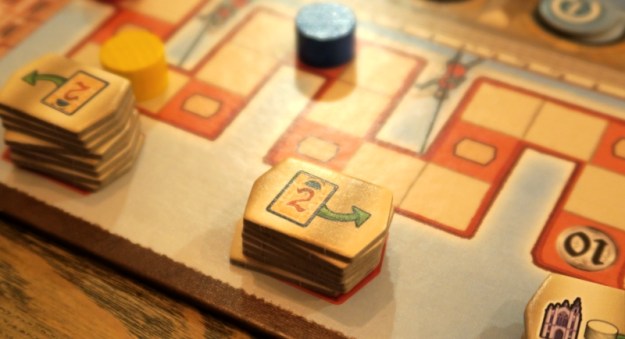
Old London Bridge
– Image by boardGOATS

Initially, the tie was resolved as a friendly tie with both Plum and Jade getting three points for their second place and Blue taking one.  On reading the rules later, it turned out that end-game ties are also broken by position on the Purple Chapel track, giving Jade three points and Plum one.  In general, bonus points are actually much less significant than money.  This is because money is absolute and turned directly into points, but the bonuses only reflect placings (not how successful someone is);  the bonuses therefore have a maximum of five points in each case whereas players can finish with as much money as they can.
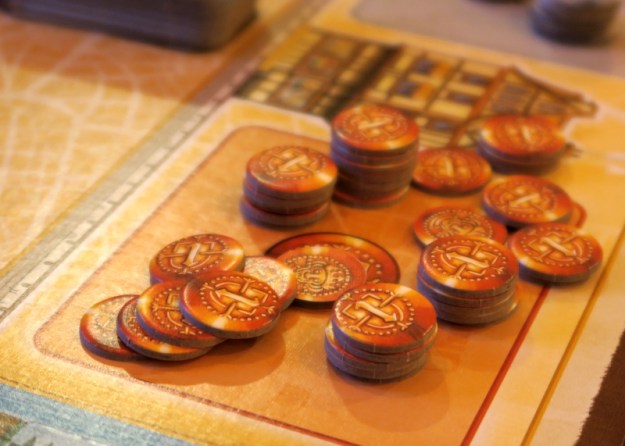
Old London Bridge
– Image by boardGOATS

In this case, however, it was very close for second place and the tie break for that bonus turned out to be critical:  Plum beat Jade on the friendly ties, but positions were reversed with the tie breaker from the rules as written.  Old London Bridge also includes alternate bonus conditions and had even one of these been in use, then the scores could have been quite different. There was no question about the winner though:  throughout, Lilac had just quietly got on with her own game doing everything well.  She was the only one to finish with all twelve buildings, finished with almost as much money as Plum, and had made good progress on both the Bridge Gate tracks.  With a final score of thirty-eight points, she was four points clear of whoever took second.  With time for just a few more “kitty pictures”, people started heading home.

Plum's Other Kitty
– Image by Plum

Learning Outcome:  Everyone Likes Train Games, and Kittens.

31st May 2022

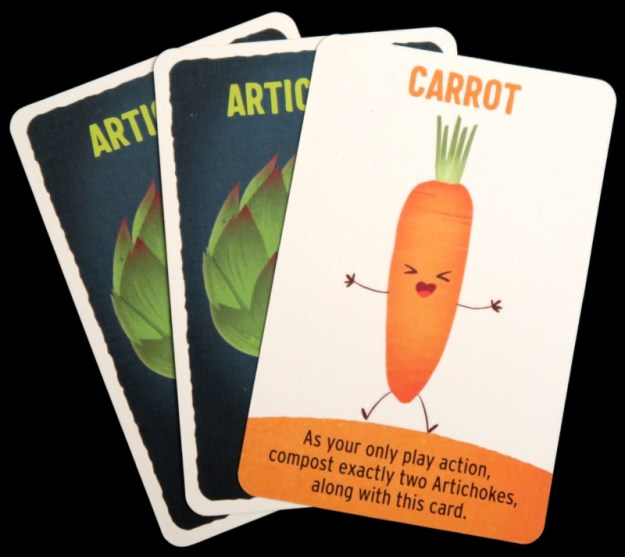
While they were waiting for their dinner to arrive, Blue and Pink squeezed in yet another in their on-going head-to-head series of Abandon All Artichokes matches.  The idea of the game is that players start with a deck of ten artichoke cards from which they draw a hand of five cards.  Then, on their turn, they take one card from the face up market, play as many cards as they can, before discarding their hand to their personal discard pile. When, on drawing their new hand of five cards a player has no artichokes, the game ends and that player wins. Pink and Blue have played this cute little “deck shredding” filler game a few times recently and, after an initial flurry of Blue winning, Pink got the hang of it and won a couple of games.

Abandon All Artichokes
– Image by boardGOATS

Last time, Blue got her revenge and Pink said that now Blue had won again, that would probably be that.  This game showed that was not so, and while this had all the potential for being a tight game, Blue claimed victory by carefully stacking the top of her deck ensuring an artichoke-free draw despite having three left.  With food over and everyone else rocking up, it was time to decide who was going to play what.  There was a lot of enthusiasm for Die Wandelnden Türme, which was the “Feature Game“, after people had seen it from a distance last time.

Die Wandelnden Türme
– Image by boardGOATS

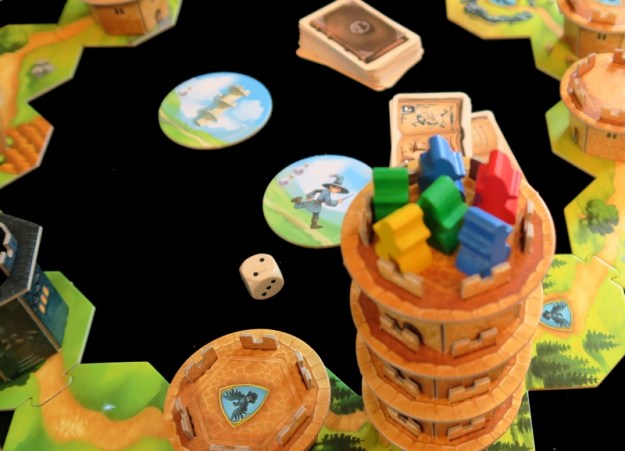
As it plays better with more people and there were only eight people in total, the group split into a five and a three, with Pine, Green, Black, and Lime joined by our special guest from Nottingham, Magnolia.  The game is a fun little family game where players start with a handful of Wizards placed on top of the little Towers arranged round the board, and a hand of three cards.  On their turn, the active player gets two actions: play a card or cast a spell. Playing a card which allows them to move one of their Wizards a set number of spaces forward, or move a tower a set number of spaces.  When Towers move, they take any resident Wizards with them but can also land on top of another Tower and trap any pieces that were on the roof.

Die Wandelnden Türme
– Image by boardGOATS

A player that catches other pieces in this way gets to fill a Potion Flask.  They can then spend the Potions to cast spells.  In the base game the spells available are “move a Wizard one space forward” or “move a Tower two spaces forward”, but others are available and change the feel of the game a little.  Players are trying to land all their Wizards in the black, Raven Castle and fill all their Potion Flasks—when someone succeeds, that triggers the end of the game.  It is a fun and entertaining game where players Wizards get variously trapped and if they have a bad memory, can find they lose them in the circus of dancing towers.

Die Wandelnden Türme
– Image by boardGOATS

Although Pine kept losing his wizards last time (captured under the towers), this week everyone managed to keep track of them most of the time.  Only Lime got muddled at one point when a tower was moved and he expected one of his wizards to be underneath, confusion only reigned until his next turn though, when he found it again. Lime was first to get a wizard into the Ravens’ Castle, quickly followed by Pine.  A little while later Pine and then Magnolia got their second wizards in the castle, by using two of their potions for an extra move, then Green got his first wizard “home”.  Black’s wizards still hadn’t caught up with the tower, and he wasn’t managing to fill any of his Potion vials either.

Die Wandelnden Türme
– Image by boardGOATS

With everyone too busy keeping track of their own game, Pine made up for last time’s confusions by filling his final potion vial and dropping his last wizard into the Ravens’ Castle to end the game.  Although there is no second place in this game unless you can get all your wizards into the Ravens’ Castle filled all their Potion vials, Green was closest with all four potions and none used. Magnolia took the last place on the podium, also finishing with four potions, but he had used two of them.  Aside from Pine, no-one had more than one wizard in the tower, in fact, everyone had exactly one.

Die Wandelnden Türme
– Image by boardGOATS

Black’s game was somewhat stymied by the fact all his wizards were trapped under towers so he couldn’t move them, and his cards didn’t allow him to move towers.  This is the downside of Die Wandelnden Türme:  there is some luck of the card draw and when that goes awry players can find themselves stuck, but as it is a short game it’s not too much of an issue and it is a fun little game.  Green remarked how Terry Pratchett-esq it felt with wizards chasing towers and towers chasing wizards.

Die Wandelnden Türme
– Image by boardGOATS

Die Wandelnden Türme is such a quick game that the others were still busy and the group of five looked round for something else to play.  At Pine’s suggestion, they decided to go for a popular classic:  Ticket to Ride: Europe.  This is a well known family of games that everyone was familiar with so there was no need to go through the rules at any length:  on their turn, players take two cards from the market, or spend cards to place trains on the central map.  Players score points for placing trains, but also completing route tickets.  Players receive these at the start of the game but can also draw more in lieu of a turn.  They must be careful though as any incomplete at the end of the game score negatively.

Ticket to Ride Demo
– Image by boardGOATS

There were some extra pieces and some unexpected cards in the box so Black perused the rules in the box trying to work out how they worked.  Blue piped up from the other table that they were for the Dice and Europa 1912 Expansions, but the group decided to leave them out and just stick with the base game.  A little kerfuffle broke out when Pine chose to play as Green for the second game in a row, which caused Green to be sad puppy dog.  Green decided that maybe he would use Pink’s special Pink set instead, only for Pine to relent and choose black, leaving green available for Green after all.  With Pine being black, Black chose Yellow, so Lime was blue and Magnolia was red…

Ticket to Ride Demo
– Image by boardGOATS

Green popped away for a couple of minutes and in his absence, Pine laid his first, two train route, to kick off the scoring.  Half way through the round Green noticed that Pine had laid his trains on a tunnel.  Although Stations had been clarified at the start of the game (they can be used to connect cities to avoid negative points from tickets), Tunnels hadn’t been mentioned.  So, Green brought the subject up and everyone realised they hadn’t noticed it was a Tunnel.  When a player chooses to “build” one of these, they turn over the top three cards of the draw deck and if any match the colour the player used to build it, they have to pay extras (the idea being that building tunnels is expensive and unpredictable).

Ticket to Ride: Europe
– Image by boardGOATS

It was felt that it wouldn’t be fair to force the tunnel check on Pine retrospectively as he may not have chosen to lay the train in the first place if he’d realised he might need more.  However, Lime was uncertain how Tunnels worked and the explanation didn’t seem to clear it up.  So, in the end, Pine drew the three train cards to demonstrate how this worked and on the last card found he needed an extra card. He had a Locomotive card (wild) so used that and thus, the turn was corrected and all was now clear. However, having seen the consequences, both Pine and Lime said they might have chosen different tickets had they realised how Tunnels work.

Ticket to Ride: Europe
– Image by boardGOATS

The next trains to go down were all around Germany—because one was placed it drew out the rest in order to secure routes that were rapidly filling up.  Pine was the first to lose out on this and used his first station to piggy back a route.  After this initial flurry, trains were placed at a more relaxed pace, but all around Western Europe. Eventually Magnolia broke out eastwards to Kyiv, quickly followed by Lime.  Lime didn’t stop there, however, he carried on to Kharkiv and thence to Rostov.  Magnolia and Lime had this area to themselves for much the rest of the game.

Ticket to Ride Demo
– Image by boardGOATS

Green was the first player to complete his routes and draw new tickets, but groaned as he looked at them commenting that they were awful and difficult to complete.  There was little sympathy for him round the table, however, he chose one card and pushed on.  Quietly he started collecting green cards and Locomotives.  After collecting his third Loco, Lime became suspicious of Green’s plans.  After yet another Loco Lime mentioned that it must have been his fifth one (he was in fact correct on that) and wondered out loud why he needed so many and whether he could be stopped.

Ticket to Ride: Europe
– Image by boardGOATS

By then everyone had twigged that Green (who’s route had taken him from Cadiz to Stockholm) was aiming for the big eight train Tunnel along the top from Stockholm to Petrograd.  When he went for it, no green cards or Loco’s turned up—most of them were in his hand so it was unlikely—and the twenty-one points he received took him from the back of the field to the front.  Soon after this Green and Black placed their first stations, which meant everyone had placed exactly one, and everyone all piggy-backed on each other in a daisy chain. The station usage didn’t stop there as Magnolia and Black would both use one more before the end.

Ticket to Ride: Europe
– Image by boardGOATS

As the game drew to a close it seemed to slow down as no one could get the colour cards they needed, until eventually Lime and Green gave up and just started placing random tracks just for points. These two were leading the points race as well, even though Lime had been complaining all the way through that things just weren’t going right for him and he didn’t know what he was doing really.  Despite all this, it was Lime who ended the game by placing four of his last five trains. Everyone then had their last chance shot and it was time for the final scoring.

Ticket to Ride: Europe
– Image by boardGOATS

A quick run through the route scores again to double check showed that the group had been pretty good at keeping them right.  It looked like Green had the longest set of connected trains and was ahead on points as well.  Working from the back of the pack to score the Tickets, Pine had several but he had discarded his long route and moved temporarily into second place having suffered from missing out on the Tunnels rule at the start.  Then Black and Magnolia both surpassed a hundred and then Lime leap-frogged to the front.  Lastly Green’s tickets looked to have sealed him victory only to realise that he had forgotten to connect to Berlin.

Ticket to Ride: Europe
– Image by boardGOATS

Green took the longest train, by a wide margin, which took him into third place, ruing his silly mistake without which he would have taken a narrow victory.  In the end, victory went to Lime, even though he claimed all the way through he did not know what he was doing and it was all going wrong—definitely shades of Burgundy!  Magnolia was second, but first to fourth were all withing about ten points of each other in what had been a close and quite epic game.  With that, Magnolia, Green and Lime took an early night while Black wondered over to see what Pink, Purple and Blue had been up to.

Ticket to Ride: Europe
– Image by boardGOATS

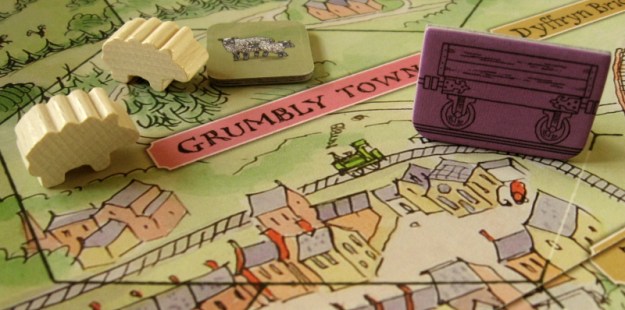
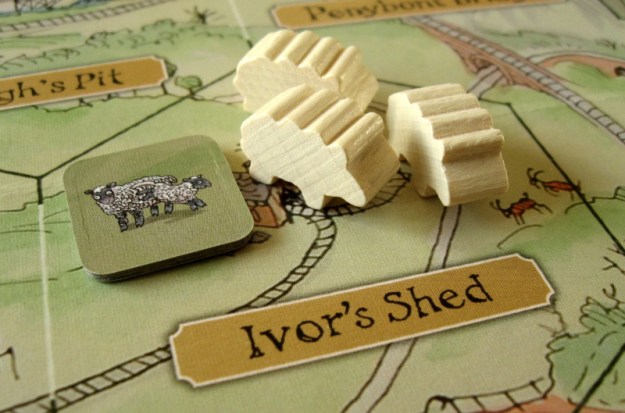
They had started out with Ivor the Engine, a charming little game that we used to play quite  a bit but hasn’t had an outing since before the global pandemic hit.  The idea is that the players are helping Ivor to collect lost sheep and complete tasks for his friends.  On their turn, the active player takes a sheep from their current location (if there is one) and then can move their wagon to an adjacent location and play Job cards.  The Job cards are the meat of the game: they can either provide a special action, such as extra moves and adding sheep to the board, or allow you to complete a Job if you are at a location where there are no sheep.

Ivor the Engine
– Image by boardGOATS

Once the active player has completed their movement and any card play, they take a Job card from the market. The catch is that jobs can only be carried out at the correct location and there is a hand limit of four cards, and taking a card is mandatory.  This makes the game very tight and some of the actions available on the cards have the potential to make the game quite vicious. The game ends when one player reaches a set number of sheep and then players count up their sheep, add any gold and any end-game bonuses they might have picked up, with the player with the most sheep-points named Ivor’s Best Friend Forever.

Ivor the Engine
– Image by boardGOATS

This time, Pink and Purple got in each other’s way in the west leaving Blue to collect sheep alone in the east.  The disadvantage of this is that it took a lot of turns to clear the locations of sheep so that she could play the nice set of Job cards she started with.  On the other hand, Pink was causing Purple all sorts of problems very effectively trapping her in Grumbly Town.  Purple tried to get her revenge at the end by dumping a load of sheep into the location he was at and thus stopping him from playing a Job card there.  However, he just played a different card to claim the sheep and ended the game anyhow, taking victory by seven points from Blue in second.

Ivor the Engine
– Image by boardGOATS

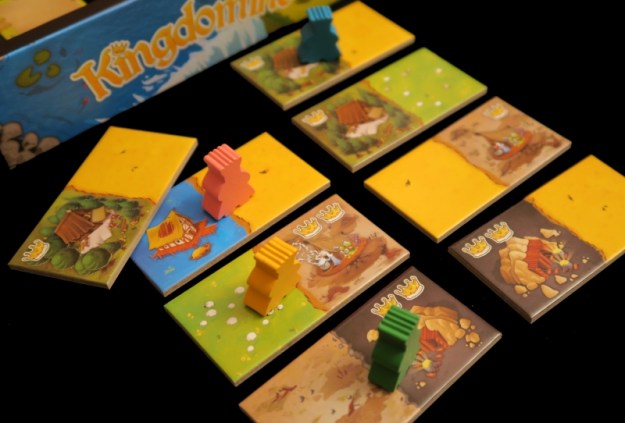
Once Ivor was over, the trio moved on to Kingdomino—another game we used to play quite a bit, but hasn’t had an outing since we returned to face-to-face games.  This is a very clever little game that won the Spiel des Jahres award five years ago.  The idea is that players take a numbered, double-ended tile and add it to their kingdom.  At least one end of each tile must extend an area of terrain or be placed adjacent to their central castle.  Additionally players’ kingdoms must fall within a five-by-five grid.  At the end of the game, each terrain scores for the number of spaces it occupies multiplied by the number of crowns depicted in it.

Kingdomino
– Image by boardGOATS

There are additional points available for objectives, but although there are some interesting objectives available in the Age of Giants expansion, the trio decided to stick with the originals:  ten extra points if their castle is in the centre of their kingdom and five if they manage to play all their tiles.  So far, so simple.  The clever part of the game is that the tiles are numbered according to value and chosen according to an ordered market.  In this way, players who choose the least exciting tiles get to choose first in the next round, while players who get the best tile will end up with no choice.

Kingdomino
– Image by boardGOATS

Unfortunately, playing with only three means that some tiles do not come out and a player can find they do very badly through no fault of their own if Lady Luck deserts them.  This time Blue was the unlucky one, though it wasn’t helped by some poor play (perhaps associated with the arrival of a certain puppy who delighted in chewing her ear).  Purple was did better, but the runaway winner with seventy-three points (more than twice as many as Blue), was Pink.  This was thanks to a large cornfield, which by itself scored almost as many points as Blue’s whole kingdom.

Kingdomino
– Image by boardGOATS

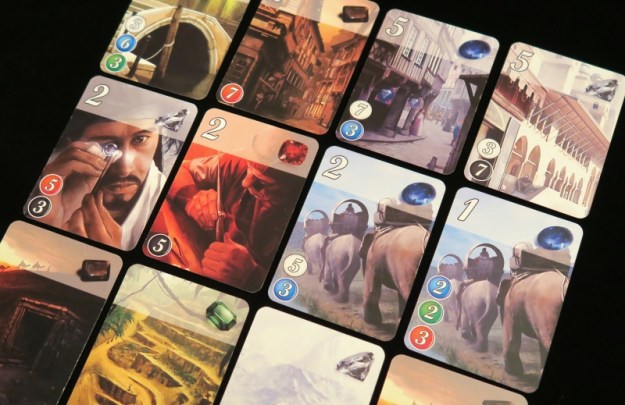
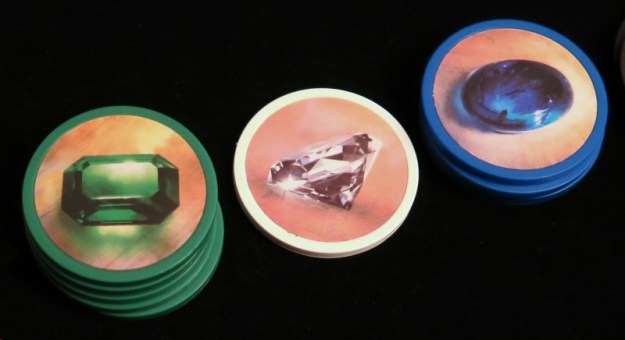
As the epic game of Ticket to Ride was still on-going on the neighbouring table, Blue, Purple and Pink felt there was time for one more game and, after a little discussion, they settled on Splendor.  This was the game Burgundy played extremely well and was almost unbeatable at, so we always remember him when we play it.  It is very simple:  on their turn, the active player takes gem chips, or uses chips to buy gem cards.  The cards act as permanent gem chips, allowing players to buy more expensive cards.  Some cards also give points with the most expensive cards giving the most points.

Splendor
– Image by boardGOATS

Players can also get bonus points for claiming “noble” tiles—these go to the first player who collects a certain combination of gem cards.  This time, Blue went first.  As always, some players struggled to get the cards they wanted, and while Pink had an awful lot of cards, somehow he wasn’t able to make anything of them.  The game ends when one player gets fifteen points and Blue, who had got a bit of a head start, could see that the other two were struggling.  So, when Black joined them, he was just in time to see her end the game, taking the only noble and a high value points card in the last couple of turns.

Splendor
– Image by boardGOATS

Learning Outcome:  Do not meddle in the affairs of Wizards, for they are subtle and quick to wander.

24th February 2022

Blue, Pink and Pine arrived early and while they waited for dinner to arrive, they had a quick game of Ticket to Ride Demo.  This is one of the “cut down” Ticket to Ride games which play in the same way as the full-sized versions, but are a lot shorter and often tighter.  As in the parent, players take it in turns to collect cards, or spend them to place trains on the board.  The Demo game has a double-sided map, but with events in Europe so much in the news, the Europe map was chosen.

Ticket to Ride Demo
– Image by boardGOATS

Pink and Pine began competing for the train-lines through the Benelux countries down to Bucharest, while Blue joined Warsaw to Madrid in the south east via a roundabout route. It was a really tight game, so much so that once the points for the tickets had been added, it was a three-way tie.  With just the Longest Continuous Path bonus to add, it was between Blue and Pine, with Blue just nicking it, to give her thirty-four points and victory.  There wasn’t time to dwell on it as Pine’s enormous platter of cheese had arrived and in that, he was definitely the victor.

Ticket to Ride Demo
– Image by boardGOATS

Sage was next to arrive, quickly followed by Purple and Black.  Expecting a quiet night (with lots of people away for half term) we were just deciding who was going to play what, when Lime arrived, so we split into two groups, a three and a four, with the larger group playing the “Feature Game“, PARKS.  The Nightfall expansion includes the seventeen National Parks cards that were omitted from the original base game, so these were added to the deck, though none of the other features were included in the game this time.  This is a game that Burgundy wanted to play, but sadly never quite managed to, so it we wanted to play it in his memory.

PARKS
– Image by boardGOATS

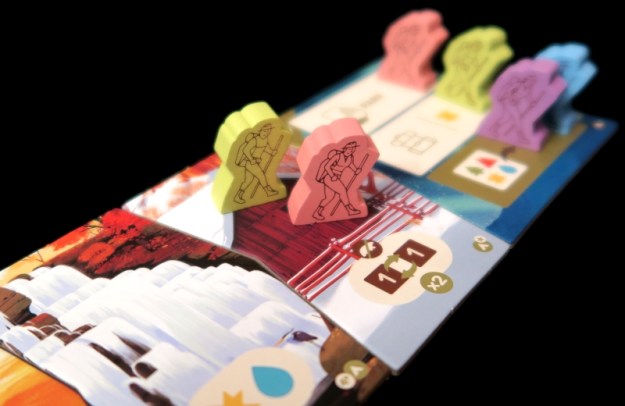
During the game, players take on the role of two hikers as they trek through the countryside over four rounds, or “hikes”.  Whilst on the trail, the hikers take actions and collect memories of the places they visit.  At the end of each hike, players can trade them in for a visit to a National Park.  Each round is set up with six basic trail tiles (five with fewer players) and one advanced trail tile shuffled together and laid out to make a path from the trail head to the trail end.  Players can move either of their hikers towards along the trail to any unoccupied space and then carry out the action on that space.

PARKS
– Image by boardGOATS

The basic locations are the mountains, forest, the valley, the sea, and a waterfall, visiting these give players wooden mountain, tree, sun or water tokens that can be exchanged for National Park cards at when their hiker reaches the end of the trek.  At the start of the round, the trail tiles are also seeded with additional tokens giving the first person to visit each one a bonus. The final basic location is the vista, which allows players to either take a new canteen card, or take the Camera token.  Canteen cards are special cards that players have that enable them to convert water into other resources or actions, once per round.

PARKS
– Image by boardGOATS

The Camera allows people to take photos, which are worth a point each at the end of the game.  When initially taking the Camera, a photo costs two wooden tokens, but thereafter, photos only cost the holder of the Camera one token, and the player holding the camera at the end of the round gains an additional photo opportunity. There are a couple of other “rule-breaking” rules, for example, each player has a single opportunity per round (or “hike”) to join another hiker at a location by putting out their campfire (turning the token over).  Additionally, players can also buy camping gear cards which alter actions or provide discounts when buying National Park cards at the end of the round.

PARKS
– Image by boardGOATS

There are additionally “Year Cards” which provide players with personal objectives, however, the group did not use these this time as Blue wasn’t making a great job of the rules explanation and it had taken quite long enough without adding more.  The round end is triggered when the penultimate hiker reaches the end of the trail.  The last hiker then moves directly to the trail end and, as usual can: reserve a National Park card from the market (and, if they are the first hiker to do so, take the First Hiker Marker); buy camping gear cards, or claim a National Park card (either from the market, or one reserved earlier in the game).  The game ends after four hikes, and players sum the total of their Parks points and photos to determine the winner.

PARKS
– Image by boardGOATS

The game started slowly as somehow it felt a little unintuitive.  Although play seemed very simple, it wasn’t immediately obvious how to excel and score lots of points.  Although they aren’t the only source, most points come from National Park cards.  As each player has two hikers and Parks cards are acquired at the end of each round, players have only eight opportunities to buy them.  With such a limited number of cards available, players have to try to maximise their takings by going for the most valuable cards.  If these are not reserved, however, there is a risk that someone else will take a desired/planned for card.  This is particularly perilous, as it can leave a player without a possible option and unable to take one of their very limited opportunities to take a Park card.

PARKS
– Image by boardGOATS

Pink started by asking what colour he was, and Blue pointed to the light purple campfire in front of him and explained it was the closest to pink.  Pointing to Lime’s “peach-coloured” pieces, he replied “Apart from the actual pink ones…”  And then there followed a heated debate as to which colour was “more pink”.  Eventually, Pine started tentatively, followed by Lime and then Pink (with his purple pieces) and finally Blue.  As the group felt their way, they realised that mountain tokens were valuable and difficult to come by.  So, after Lime had been unable to afford the camping gear card that gives a mountain discount, Blue snapped it up.  It took a while to understand the value of the Canteen cards, and some were definitely more useful than others.

PARKS
– Image by boardGOATS

Pink had a Canteen that gave him mountain tokens, which meant joining the battle for the mountain space wasn’t quite as necessary.  Lime had a canteen that allowed him to reserve Parks cards which was useful in terms of planning.  It also had the additional advantage of messing up other people’s plans, in particular, Pine’s who got caught several times.  During the second round, everyone started to get the hang of things, and began to work out what they were trying to do while keeping an eye on what everyone else was doing.  But then the “hand limit” of twelve tokens began to bite.  Some of the most valuable Parks cards need six or more tokens, so targeting these while keeping the ability to be flexible became increasingly difficult.

PARKS
– Image by boardGOATS

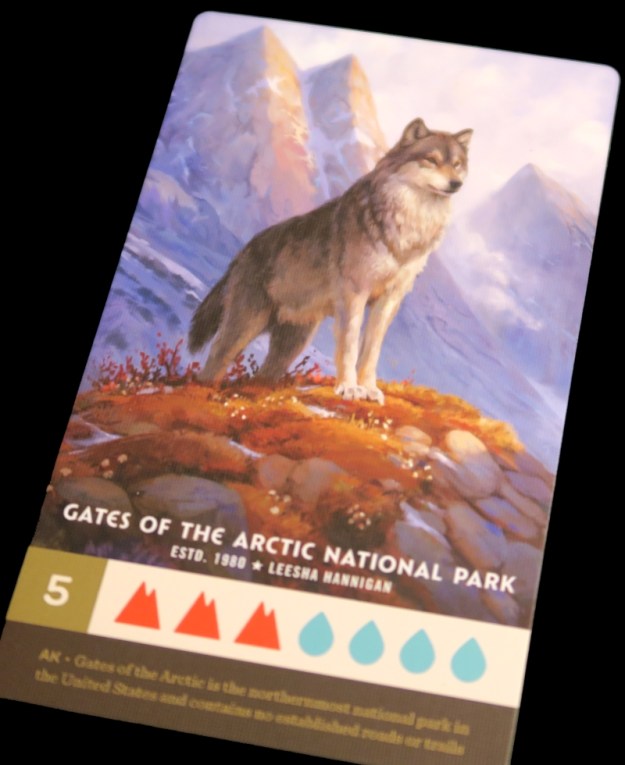
By the third round, Pink was questioning how Blue had managed to get “so many” cards, implying she was doing something that the others, in particular Pink, weren’t.  She had just managed to take every opportunity though, where others had been less fortunate.  Lime had a canteen that allowed him to reserve cards, which was a good use for excess water tokens.  Unfortunately, didn’t quite get the rest of his tokens right to make the most of it, and finished with lots of reserved, but unfulfilled National Parks cards.  Pine was unlucky and had Parks cards he was targeting taken at the last moment.  Still he managed to get a card with a nice picture of a wolf on it, which delighted him at the time.

PARKS
– Image by boardGOATS

It was close for second place with just two points separating three players—Pine, tied for second place with Pink, decreed that his lovely wolf card was the tie-breaker and gave him the edge.  There was no question that Blue was the winner though, with thirty-two points, eight more than Pine.  Meanwhile, on the next table, Sage, Purple and Black had been playing Puerto Rico.  This is a much older game, once ranked the best game on the BoardGameGeek website, but now often forgotten.  We’ve played it a few times, but not since the global pandemic hit, and Sage was keen to play it again.

Puerto Rico
– Image by boardGOATS

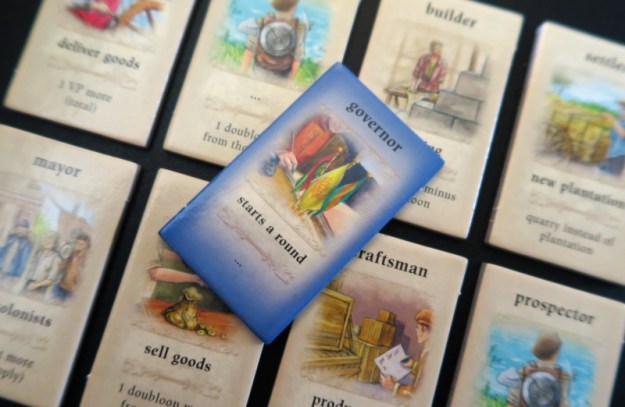
In many ways, Puerto Rico is the archetypal Euro game.  The idea of the game is quite simple in that on their turn, the active player chooses a “role” then everyone takes it in turns to carry out the action associated with that role.  Each role has a “privilege” which the active player gets which gives them a little bonus (as well as the opportunity to take the action first.  Once everyone has chosen a role, the remaining role cards are “improved” by the addition of money, the used role cards are returned to the pool and the start player (The Governor) moves one player to the left before the new Governor starts the next round.

Puerto Rico
– Image by boardGOATS

The aim of the game is to get victory points which are awarded for buildings and for shipping goods. However, to build, players need money, and before they can ship goods, players need to be able to produce the goods with a plantation (and where necessary process them in the appropriate building).  Each building/plantation has a special bonus, but for a player to receive this, the building needs to be occupied by a “colonist”. All these activities are carried out through the role cards. For example, the Builder enables players to construct a building, but the player who chooses the role gets the privilege of paying one doubloon less than they would have done otherwise.

Puerto Rico
– Image by boardGOATS

Other roles include the Craftsman (enables players to produce); the Captain (enables players to ship goods); the Trader (allows players to sell goods for money); the Settler (players can take a plantation tile and add it to their island); the Mayor (the ship of “colonists” arrives and they are divided amongst the players), and the Prospector (everyone does nothing except the person with the privilege who takes a doubloon from the bank).  The game ends when there are not enough colonists to fill the colonist ship, the supply of victory points is exhausted, or a player fills their twelfth building space in their city.

Puerto Rico
– Image by boardGOATS

Black was clearly an early front-runner, but while Sage was slightly slower to get his engine going, he was coming up fast on the inside rail when the game came to an end.  As a result, the end-game building scoring was critical.  Purple had built the Guild Hall giving her extra points for her production buildings while Sage built the Residence providing additional points for the plantations and quarries he had placed on his island.  Black had built and occupied a two large civic buildings:  a City Hall giving him points for his civic buildings, and a Customs House which increased his the victory points he had acquired during the game by twenty percent.

Puerto Rico
– Image by boardGOATS

Unfortunately for Sage, it turned out that the game had ended a few rounds too early for him to overtake Black who finished with sixty points, five more than Sage in second place.  It had been fun though, and demonstrated that while some older games show their age, others still have it.  Puerto Rico and PARKS finished at much the same time, and although Lime left to make sure he got across the river before the drawbridge was lifted (commenting he’d like to give PARKS another go some time), everyone else was keen to play something light and quick.

Puerto Rico
– Image by boardGOATS

Despite Blue’s inevitable enthusiasm, Pine ruled out Bohnanza as too long, and with six players, 6 Nimmt! was the obvious choice.  We played this loads online, but it doesn’t seem to have dampened our enthusiasm for it, though we’ve mostly played the simple version in person since.  The idea is that players simultaneously choose cards from their hand which are then added in sequence to the four rows on the table.  In the original version, cards are added to the end of the row with the highest card that is lower than the card played.  In the professional version, cards can also be played on the low end of rows, upsetting other players’ plans (if players can claim to have plans in this game).

6 Nimmt!
– Image by boardGOATS

Although we all decided that it was too late for the complex maths that comes with the professional version.  Pine and Blue immediately commented that they regretted that decision when they looked at their hands.  It seemed most people struggled a bit in that round as everyone picked up points.  Blue and Pine were high scorers, but Pink managed twenty-seven nimmts off just nine cards, albeit very colourful ones.  Pink did better in the second half with a clear round, but the damage had already been done.  Purple and Blue top scored overall, with thirty-seven and thirty-nine respectively, but the winner was the very constant Black with just five from each round.

6 Nimmt!
– Image by boardGOATS

Learning outcome:  Not all games are a walk in the PARK.

23rd September 2021

Burgundy and Blue were just finishing their supper when Teal introduced himself.  The three were chatting when Lime, who hadn’t been able to come for over a month, also joined the group.  It was expected to be a quiet night with Green and Lilac away on holiday, Pine working late, and Pink stuck somewhere on the Warwick bypass.  So, there was a lot of chat, but eventually, the group decided to play something and settled on Love Letter.

Love Letter
– Image by boardGOATS

This is a very simple little game that we’ve played a lot, but somehow Lime had missed out.  So, there was a very quick rules explanation:  players start with a hand of one card, draw a second and choose one to play and do the action on the card.  The cards are numbered and the aim of the game is to finish the round with the highest card, or more commonly, avoid being knocked out.  There are only sixteen cards in the deck (and one of those is removed at the start of the round), so it doesn’t take long.

Love Letter
– Image by boardGOATS

The group were only three rounds in when everyone else turned up (including Pink who had escaped the roadworks), so Lime was declared the winner with two tokens and everyone else was introduced to Teal and started to discuss what to play.  In the end, Burgundy took matters into his own hands and started a game of Wingspan, so while Pink waited for his pizza to arrive, Blue explained the “Feature Game“, Mini Rails.

Mini Rails
– Image by boardGOATS

Mini Rails is a very simple little stock-buying and track-laying train game that compresses a lot of the game play of long and complicated games like the 18xx series into under an hour.  Players have two turns in each round, on one they buy shares in one of the companies and on the other they extend the “track” of one of the networks.  If it is built on a white space, players with holdings in that colour increase their value by the marked amount.  If the network is built on a red space, the stocks in that company are decreased in value.

Mini Rails
– Image by boardGOATS

The game is very simple, but there are a couple of clever little tweaks.  Firstly, there are two “tracks”, one is the turn-order track, while the other holds train disks drawn at random from a bag.  On their turn, players choose one of tokens and decide which action to use it for, “build track”or “buy shares”.  The position of the token that is taken dictates where they will be in the turn order in the next round.  Manipulating this turn order is one key aspect of the game, as is deciding whether to buy and then build, or build and then buy.

Mini Rails
– Image by boardGOATS

Perhaps the most complicated aspect of the game is the end-game scoring.  At the start of each round train discs are drawn from a bag; one more than there are turns.  This means everyone always has a choice, but the token the last player does not use is put to one side indicating they have paid “taxes”.  For the companies that have “paid taxes” any negative dividends are erased and positive dividends are counted.  For those companies that have avoided paying their taxes the reverse is true and negative points will be scored while positive points are lost.
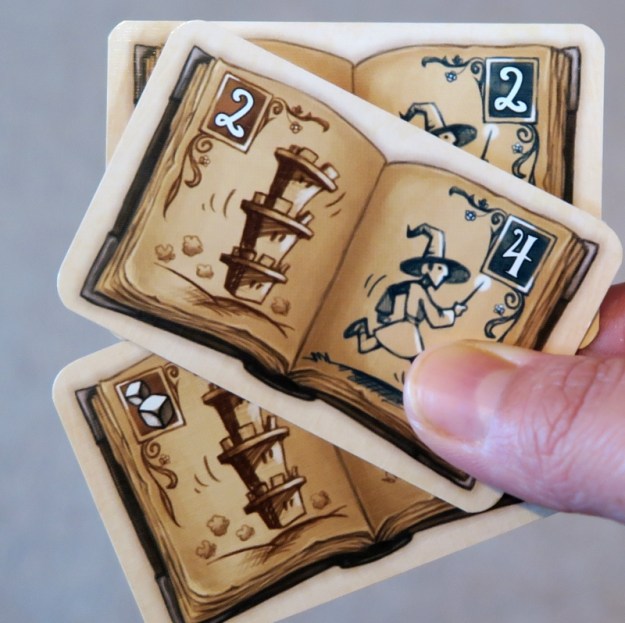
Mini Rails
– Image by boardGOATS

This means it is in the interest of players with both large positive or significant negative scores to forgo building track or buying shares and leave a potentially valuable token as taxes.  Similarly, if a player is left with a choice of two tokens, it may be in their interest to buy/build a relatively unfavourable track to deprive other players of points.  With three players, the game doesn’t take too long to play, and with more it would likely become quite random.
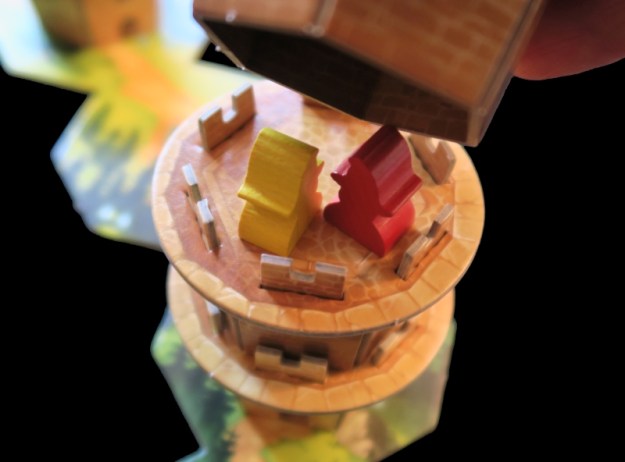
Mini Rails
– Image by boardGOATS

Lime took an early lead, though of course lots of early points are… pointless, if the company doesn’t pay taxes.  In the end it was extremely tight, but in the end, Blue just pipped Lime by a single point.  With just three there isn’t much downtime and the game rocks along nicely with plenty of interaction, though as Pink said, “That’s one hell of an abstraction for a train game.”  Blue pointed out that this was what a lot of gamers thought of when someone said “Train Game”.  Pink felt disappointed at the lack of actual trains and tracks so to make it up to him, the group moved on to play Ticket to Ride Demo.

Ticket to Ride Demo
– Image by boardGOATS

Ticket to Ride Demo is one of the small games based on the Spiel des Jahres winner, Ticket to Ride Europe.  The Demo game has an interesting history—it was designed as a sales tool and had only a small print run.  It was so popular though, that it ultimately spawned a new range of small “City” games, New York, London and Amsterdam.  These games are essentially played the same way as the full-sized versions, but with fewer pieces on a smaller map which means they typically take less than half the time.

Ticket to Ride Demo
– Image by boardGOATS

On their turn players can do one of three things:  take cards from the market, spend cards to place trains or take tickets.  Players score points for placing trains, but also for connecting the places on their tickets.  The catch is that any tickets that are not completed score negative points.  The small versions of the game are much tighter with less room for error.  Unlike the others, Ticket to Ride Demo has a double sided map, one USA and one Europe.  This time the group played the Europe map.

Ticket to Ride Demo
– Image by boardGOATS

Compared to the full-sized equivalents, all the little games are like a knife-fight in a phone-box, and this game was no exception.  Lime only completed three of his four tickets as Blue brought the game to a quick and sudden end.  Pink completed all four of his tickets and they were high-scoring too.  Blue’s tickets were less lucrative, but she managed to place all her trains and took the European Express bonus points for the longest continuous route, and with it victory, by just two points.

Ticket to Ride Demo
– Image by boardGOATS

Meanwhile, on the next table an epic, five-player game of Wingspan was underway.  We’ve played Wingspan quite a bit since it came out and always found it very enjoyable.  We’ve played it enough that we’ve also explored the European expansion, but thanks to the restrictions over the last year or so, this was the first opportunity to play the new Oceania expansion.  The base game is a reasonably light, card-driven, combination building game.  On their turn, players can place a bird card from their hand in one of the three habitats, or activate all their cards in one of the habitats and carry out the associated action.

Wingspan: Oceania Expansion
– Image by boardGOATS

The habitats are Woodland, Grassland and Wetland and the actions associated with them are collecting food, laying eggs or collecting cards (respectively).  Once the action has been carried out, the active player activates each card in the habitat in turn.  The game is played over four rounds, with a decreasing number of actions per round as the game progresses.  At the end of each round there are goals and each player also starts with a personal bonus card which is evaluated at the end of the game.

Wingspan
– Image by boardGOATS

The European expansion really only adds extra cards, though this includes a number of birds with abilities that are activated at the end of rounds, and others that increase player interaction.  The new Oceania expansion also adds more cards, but additionally mixes things up a little more with the addition of a new food type, nectar.  Nectar can be used as wild food type, although some of the new bird cards have nectar specified in the cost.  Whenever players spend nectar though, they don’t put it back in the supply, instead they store it in the habitat they spent it on.

Wingspan
– Image by boardGOATS

At the end of the game, the player with the most nectar stored in each habitat scores five points at the end of the game with the player coming second scoring two points.  Nectar is therefore a very important resource giving a potential fifteen points at the end of the game, although it requires some skill to use it effectively as it can’t be carried over between rounds.  Burgundy and Black really invested in nectar and managed to make good use of it during the game as well as take the lion’s share of the nectar points at the end of the game.

Wingspan: European Expansion
– Image by boardGOATS

Burgundy and Black also prioritised valuable birds and tried to ensure they stayed in the running for the end of round bonuses.  Three out of the four of these involved eggs, which fitted with Ivory and Teal’s strategies which focused on an end-of-game egg rush.  Ivory also picked up a lot of points from his Common Starling which enabled him to discard up to five bits of food and tuck a card for each one.  With a maximum of twenty points, Ivory did well to take eighteen during the game, but it was only enough for third place this time though.

Wingspan
– Image by boardGOATS

It was very close at the top between Black and Burgundy.  Burgundy had four bonus cards one of which proved quite lucrative.  The big difference was in the value of the bird cards, however, while Black edged it in many departments Burgundy had a ten point head start.  This wasn’t simply because he had high value birds, more that he had lots of them.  In the end, Burgundy finished five points ahead of Black with ninety-five, in a good game that had been enjoyed by everyone round the table.

– Image by boardGOATS

Wingspan was still only on its third round when Ticket to Ride Demo came to an end.  At around the same time, Pine pitched up, so the, now foursome settled down for something else which ended up being a game of Reiner Knitzia’s Botswana (aka Wildlife Safari).  This is an unusual auction-like game made all the better by the inclusion of plastic animals.  Played over several rounds, players are dealt a hand of cards and on their turn play a card and take an animal of their choice.  The cards are numbered zero to five and come in five different animal suits.

Botswana
– Image by boardGOATS

The cards are played in the centre of the table in suits and the game ends when all six cards of one suit have been played.  The top card in any suit is the current value of that animal.  Thus, if the top zebra card is a five, a player that has three zebras will earn fifteen points for them if the game ends.  However, if the zero just before the game ends, the zebras will become worthless.  It is a deceptively simple, yet fun little game.  Blue thought she’d won until a recount docked her ten points and she finished just two points behind a delighted Pink.

Botswana
– Image by boardGOATS

As Botswana came to an end, so did Wingspan, and although time was marching on, and Lime and Ivory took an early night, there was still time for everyone else to play one last game.  After a little discussion, we settled on 6 Nimmt!, a game we all know and love.  Players simultaneously choose a card and these are sequentially added to the end of four rows of cards, specifically the row with the highest number that is lower than the card itself.  If the card is the sixth card in the row, instead, the player takes other five and adds them to their scoring pile.  The player with the lowest score at the end of the game is the winner.

6 Nimmt!
– Image by boardGOATS

We’ve all played this a lot online over the last year, but doing the maths ourselves was a little daunting, so we decided to go back to playing the non-professional version.  We play over two rounds using half the deck in first and the other half in the second.  This time Teal top-scored in the first round with nineteen, while Burgundy kept a clean sheet with Pink just behind.  Blue’s killer thirty-three in the second round gave her a total of forty-eight, but the winner for the second time in the evening was Pink with just four points.  And with that, it was bedtime.

6 Nimmt!
– Image by boardGOATS

Learning Outcome:  Today’s railway industry is no longer about trains and tracks. ☹