Tag Archives: Ticket to Ride: Switzerland

24th January 2023

Blue and Pink were first to put in an appearance and availed themselves of the burger offerings at the Jockey before everyone else began to arrive.  Ivory turned up cradling his enormous copy of the Collectors’ Edition of Everdell, complete with its Bellfaire expansion (as well as pretty much everything else available).  And from then on, it was a matter of deciding who was going to play what.  As Ivory began building the Evertree, Green commented that he’d really enjoyed playing it last time and would like to play it again, but wanted to give everyone else the opportunity.  Everyone else similarly followed this gentlemanly gesture, but in the end Ivory took first Teal, then Green and finally Purple to the end of the table and started the mammoth task of unpacking.

Everdell
– Image by boardGOATS

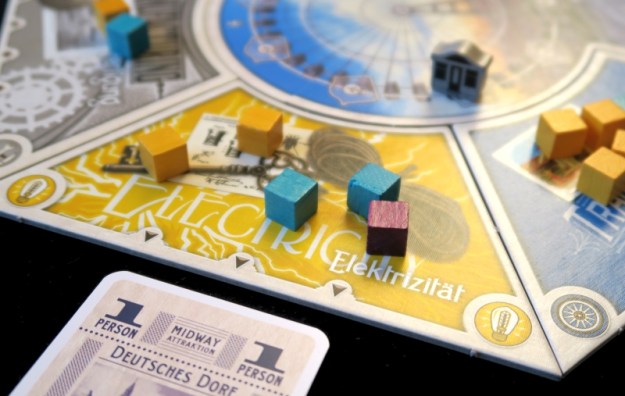
As they began setting up, the other four began deciding what to play.  After suggestions that largely fell on deaf ears, Blue eventually began unpacking World’s Fair 1893.  This is a clever little game that integrates area majority and set collecting mechanics.  The idea is that players choose a segment of the board and place a population marker in it before taking all the cards in that section.  Three cards are then added to the board, with the first added to the section cards have just been taken from and one each added to the next two segments.  Cards come in three types:  Character Cards, Midway Tickets and Exhibit Cards.
World's Fair 1893
– Image by boardGOATS

Character cards can be used to move cubes about or add extra cubes and are played by the active player between placing their token and taking the cards from that section.  When the Ferris wheel car has travelled all the way round there is an interim scoring stage.  Midway tickets are exchanged for one point, with the player who has the most earning bonus points.  Exhibit Cards are exchanged for tokens:  each of the five segments of the board are evaluated and the player with the most population tokens gains a couple of bonus points and the opportunity to trade up to three exhibit cards for matching coloured tokens. The player who comes second also gets points and can exchange fewer Exhibit Cards for tokens.
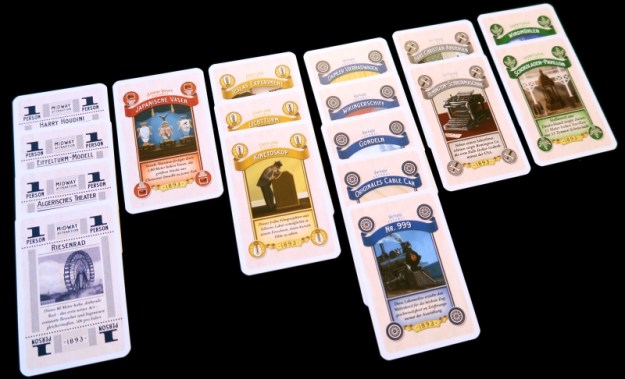
World's Fair 1893
– Image by boardGOATS

The tokens are combined into sets at the end of the game with the larger sets worth more points; sets containing all five different coloured tokens are worth fifteen points, with sets of four worth ten, and three, two and one worth six, three and one point respectively.  Played over the three rounds, the winner is the player with the most points at the end of the game.  Blue didn’t do a great job of explaining the point of tokens, so in the first round, Lime focused on collecting Midway Tickets, lots and lots of Midway Tickets taking lots of points and the bonus too.
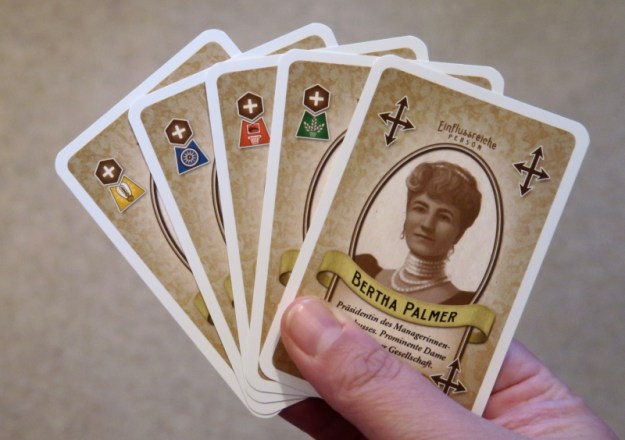
World's Fair 1893
– Image by boardGOATS

Pink, on the other hand, had played it before and better understood the relationship between Exhibit Cards, Tokens and points at the end of the game.  That said, he seemed to have a bit of a mental block on how to use the his character cards (after placing a population token, but before taking cards).  Bertha Palmer seemed to cause a particular problem and her function had to be explained at least three times before the message got through.  Through the second and third round, Lime continued to collect Midway Tickets while Blue, Pink and Pine tried to manipulate the majorities in the areas for which they wanted tokens for.
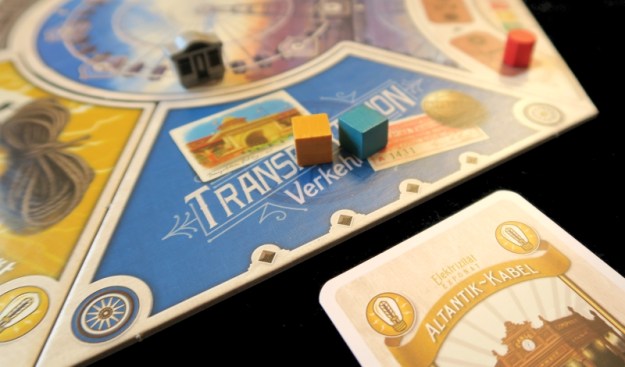
World's Fair 1893
– Image by boardGOATS

Lime kept doing well in the green Agricultural region, but was unable to get the cards to match.  This is the catch with the game:  in order to obtain tokens in a specific colour, players need the majority of population markers in that region, but also need to gain Exhibit cards to match, which quite likely are only available from other segments.  Pine commented that he thought this game should be played with ties cancelling each other out like in Las Vegas—funny, that that would have left him in pole position in several key areas that he needed…

World's Fair 1893
– Image by boardGOATS

As the game came to an end, the question was whether anyone would have enough sets of tokens to catch Lime with his huge pile of coins from his Midway Tickets.  It looked like Pink might make it with his two sets of five giving him thirty points, but he fell two points short.  Blue however did slightly better with sets of five, four, three and two and finished with sixty-two points, five more than Lime.  When Pine asked how Pink collected so many tokens, Pink’s response was, “Never underestimate the value of coming second…”
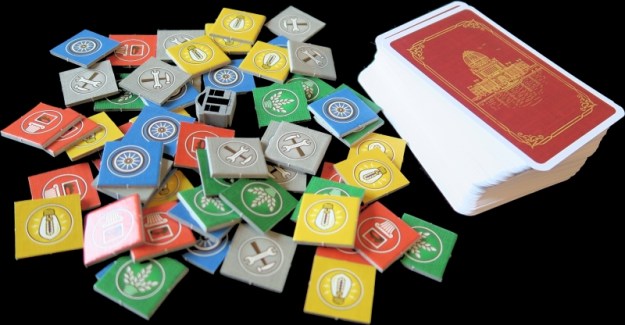
World's Fair 1893
– Image by boardGOATS

Everdell was very much still underway and although time was marching on, there was still time to play something else.  So a decision was made very quickly as Blue got out Les Aventuriers du Rail Express.  “Les Aventuriers du Rail” is the french name for Ticket to Ride, and this “Express” version originally released only in French and Italian, was a “light” version of the game, positioned somewhere between the “City” editions (like New York, London, Amsterdam etc.) and the full sized games.  Thus it plays quicker than the full sized game, but is longer than the City editions, and has a maximum of four players like the smaller games

Ticket to Ride: Switzerland
– Image by boardGOATS

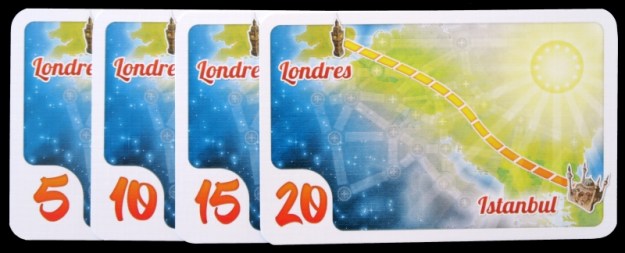
The basic principle of all the games is the same however:  on their turn players either take two coloured carriage cards from the market, pay sets of cards to claim a route and place plastic pieces on the map, or draw tickets giving cities that players need to connect to score points.  Each edition has its own special rules and this one has a shared ticket:  London to Istanbul.  The first player to connect these cities gains twenty points with the second getting fifteen and so on.
Les Aventuriers du Rail Express
– Image by boardGOATS

Additionally, instead of Locomotive (Wild) Cards being included in the Carriage Card market, they are always available from a separate face up deck with players taking one card on their turn instead of two).  It didn’t take long before the group had checked they had the right number of trains and had identified the special rules for this version of the game.  Blue went first, but Pine was the first to place trains on the map, at which point everyone else realised they were going to have to go hard and fast to compete.

Ticket to Ride: Europe
– Image by boardGOATS

Blue also placed an early train, but Pink opted for the “expert strategy” espoused by Black, to pick up tickets early.  The idea is that knowing the destinations you need to connect early is an advantage, but this is offset of course, by the fact that it gives everyone else an extra turn to claim some of the routes you might need.  This time, unbeknownst to the others, Pink got lucky with long overlapping routes and, as a result picked up another batch of tickets.  Pine tried to follow the ticket strategy, but got less lucky.
Les Aventuriers du Rail Express
– Image by boardGOATS

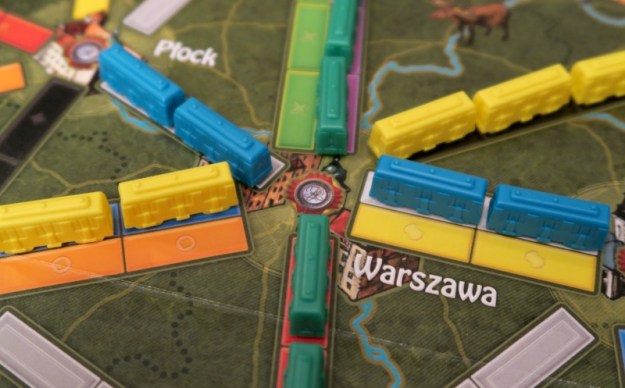
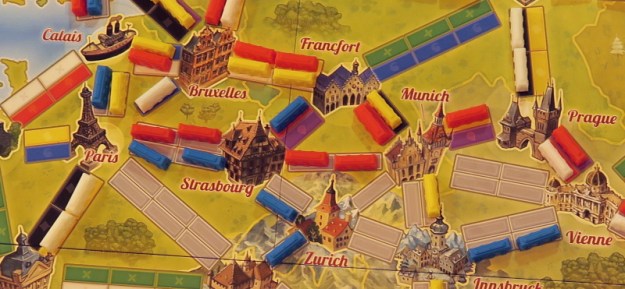
Blue thought the London to Istanbul ticket was quite a good option as it was almost zero risk since it wouldn’t cost her if she failed to complete it, it was also relatively complementary to her starting tickets.  This strategy meant she had to go through the middle of Europe and, as a result, got caught up in the three-way punch-up with Lime and Pine centred on Strasbourg.  Pine came off worst, but unquestionably, Pink came off best as he eschewed central Europe, instead focusing on taking the route to Warsaw via Berlin which also included two slightly more lucrative five car connections.

Les Aventuriers du Rail Express
– Image by boardGOATS

Blue claimed the London to Istanbul route first and with it twenty points, followed by Lime who had completely forgotten about it in his tussle to make his other tickets.  Blue was then left with a choice:  pick up tickets or try to end the game quickly.  Knowing Pink and Pine in particular had a lot of tickets to complete and with plastic trains beginning to run low, she opted for the latter.  Unfortunately for her, Pink had already nearly finished his tickets and was able to complete his last one on his final turn.  That just left the scoring, and it wasn’t really close with Pink finishing with eighty-two and Blue the best of the rest some fifteen points behind.

Les Aventuriers du Rail Express
– Image by boardGOATS

On the next table, Ivory, Green, Teal and Purple played the “Feature Game“, the Bellfaire expansion to Everdell, the winner of the Golden GOAT just before Christmas.  Everdell is a fairly simple game in principle, with players either placing a worker to collect resources or then using the resources to pay to play cards from their hand into their tableau.  The game is very smooth to play, well balanced and has beautiful artwork.  One of the things that makes it different to many other games is that when a player runs out of actions (or earlier if they choose), they can end their season and reclaim all workers and start again.  This is important because some of the action spaces can only be occupied by one critter at any one time.

Everdell
– Image by boardGOATS

The cards come in different types, but one of the key aspects is that critter cards can be played by paying their cost or as a bonus for playing the associated construction card.  For example, if a player builds a Courthouse, they can play the Judge at the same time if they have it in their hand.  Cards give players special powers, extra resources, actions and points at the end of the game.  Each player’s tableau can only hold a maximum of fifteen cards; when a player cannot perform any more actions (or does not wish to) they pass and their tableau is completed.  Everyone else carries on playing and the game continues until everyone has passed with the winner being the player with the most points.

Everdell
– Image by boardGOATS

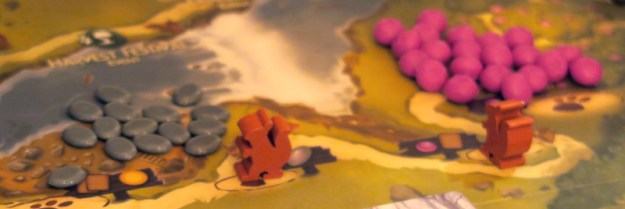
The Bellfaire expansion adds a little bit of variety to the game, in particular the Market, a Bonus for one of each card category, and a randomly selected Beauty Bonus for the most purple flower cards.  The group also included the Extra! Extra! and Legends cards with the Corrin Evertail cards (from the Mistwood expansion).  One of the joys of Everdell is selecting playing pieces. With sixteen different creature meeples to choose from there is something for everyone.  Ivory  was quick to nab the purple coloured Platypus, Teal selected grey Hedgehogs, Purple chose red Squirrels and Green wanted the green Lizards.
Everdell
– Image by boardGOATS

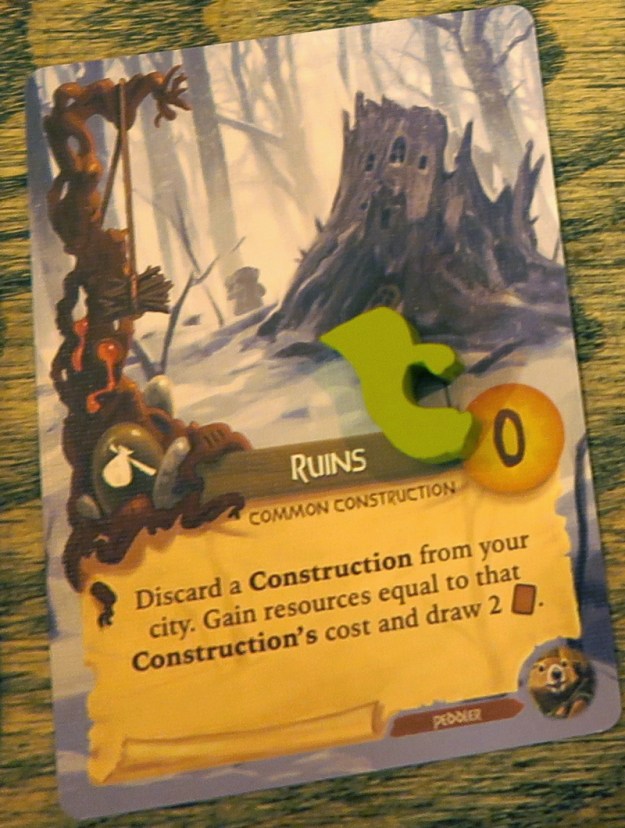
On pulling out all the Lizards from the Box, Green declared that one of his meeples was disabled. It was missing the bottom half, its legs and its tail, poor thing!  To give this one an easy ride green selected it for later use as part of the Autumn cache.  As expected Ivory got off to a flying start.  While Purple was the first to leave winter and head into spring, Green and Teal were not far behind. Ivory, however, seemed to be able to keep going in Winter for many turns after everyone else had left.  He had been quite lucky with the card draw and was able to pair critters with his buildings to a much greater extent than everyone else.
Everdell
– Image by boardGOATS

Teal noticed that Ivory had completed all the card categories and could claim the bonus tile, but he kept quiet and instead was the first to claim a bonus tile: for having three forest tags.  A short while later Green also noticed that Ivory could claim the bonus, but he, perhaps due to silliness or perhaps innate honesty, did not keep quiet.  Ivory had not noticed, so promptly claimed it on his next turn.  No-one else was able to fulfill that requirement for quite some turns.

Everdell: Bellfaire
– Image by boardGOATS

The Bellfaire Market allows players to choose to either gain resources, or to trade them.  When gaining resources, players choose one token, gain the resources and cards, then move that token to the “trade” side of the market.  When trading, players pay resources and discard cards to gain three points and any two resources, before moving the token back to the “gain” side.  This time, players used the market to collect initial resources, but once they had all been used, no-one seemed to show much interest in trading to bring them back into play.  Trading did happen a couple of times later in the game, but no-one could really see the benefit of the trading versus collecting resources outright, especially since two of the randomly drawn extra forest spaces included the ability to trade cards or wood for “any” resource.

Everdell
– Image by boardGOATS

The pattern of Purple going into the next season first and Ivory going last remained all the way through Spring and Summer.  Ivory did slow down somewhat though, and did not enter Autumn much later than Teal and Green.  By this time, most the group had managed to play at least one of their Legends cards and were beginning to use them to good effect.  Green’s Ranger Strey Softpaw which enabled him to use two already used forest action spaces for one worker was generally remarked as a very useful legend card.  Maybe that was how he was able to catch up a little, but one of the key challenges he struggled with was being able to get the Critter and Construction pairs.

Everdell
– Image by boardGOATS

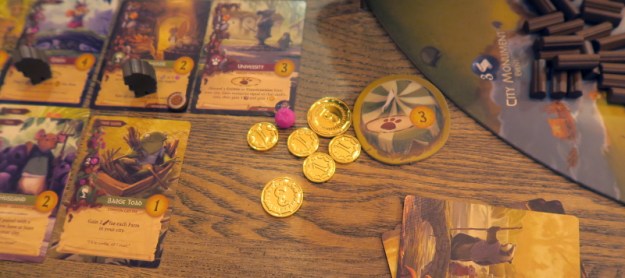
Once Autumn came round, it was time for the poor disabled lizard to play a part on Green’s behalf.  That part was, to cries of being cruel, to go straight to the Cemetery so he could select a card to play for free—unfortunate critter!  Although Ivory kept going longer than anyone, he already had all fifteen cards played, and found himself unable to do much else, even though he still had workers left.  Purple finished early with a similar problem, although she was unable to afford any more cards even with gathering from her last worker.
Everdell
– Image by boardGOATS

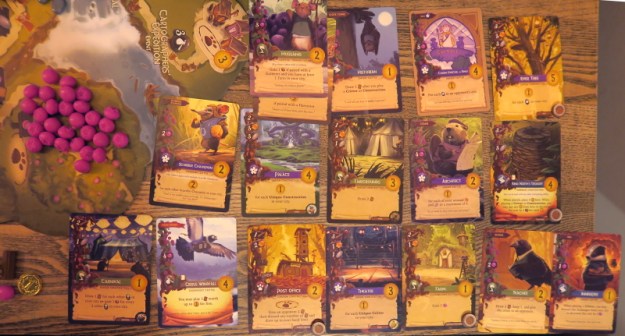
Eventually, everyone finished their final season and in the final scoring, Ivory scored big on the card totals.  Green did quite well and finished a few points ahead of Teal, though Purple suffered as she had not been able to play as many cards.  Ivory also scored well on other bonuses and Teal and Green were similarly matched with several bonuses, except that Teal managed to accrue more coins and score Journey points.  As a result, Teal took second, though Ivory was way ahead of everyone else.
Everdell
– Image by boardGOATS

Learning outcome:  We’ll have to brush up the Everdell skills if we ever want a chance of beating Ivory in future.

6th September 2022

Plum and Pine were the first to arrive, shortly followed by Blue with Orange and Lemon.  With nobody eating, the group were in a position to start thinking about games straight away.  Plum had offered to lead Wingspan, with Lime in mind as he had recently acquired a copy of Wingspan and was keen to give it another go.  Pine commented that although he loves birds, he’d never really got on with the game-play of Wingspan so, sadly he’d prefer to play something else.  The “Feature Game” was to be Project L, a sort of Tetris-like, engine-building game and it sounded much more his thing.

Project L
– Image by boardGOATS

So, Plum took herself off to the other side of the pub to set up Wingspan with the European expansion.  The European expansion adds more cards including end of round cards, but doesn’t add any extra mechanisms (like the Oceania expansion), so it was felt that including it wouldn’t cause too much confusion.  As the others rolled up, there was much surprise as Teal and Ivory said they would rather give Project L a go.  Then Pine changed his mind and joined Wingspan (along with Purple and Lime), allowing Black to play the “Feature Game” as he had played Wingspan recently at Burgundy’s Birthday Event.  That left six to play Project L: Orange, Lemon, Blue, Ivory, Teal and Black.

Project L
– Image by boardGOATS

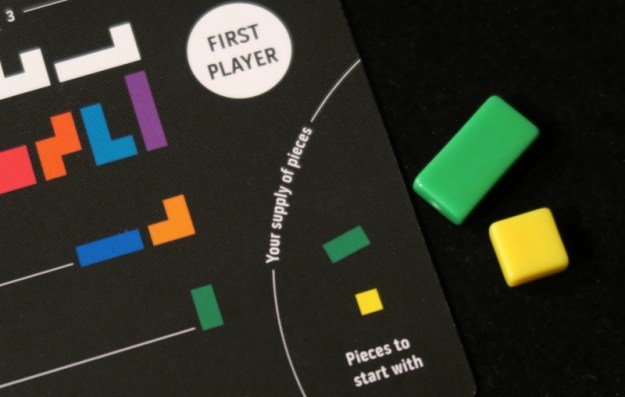
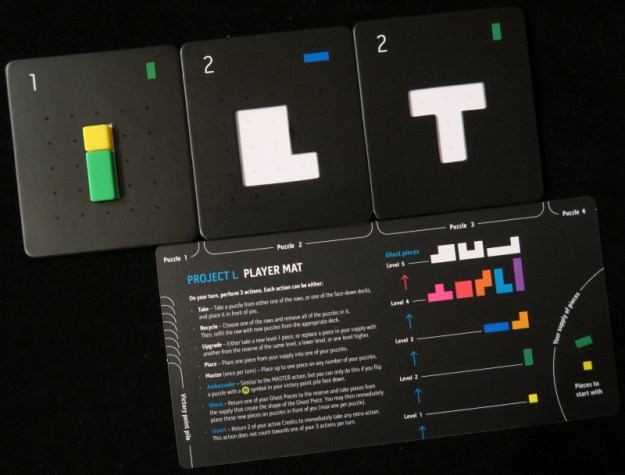
Project L is a very simple game:  players start with two small plastic pieces and use them to complete Puzzles winning more pieces enabling them to complete more complex Puzzles and thus build an engine.  On their turn the active player can do three actions from a list of five things:  upgrade a piece to a larger one, take a Puzzle from the display, recycle the Puzzle display, place a piece in a Puzzle they own, or place one piece in each of their Puzzles (or in as many different Puzzles as they can).  This last, “Master Action” can only be carried out once per turn, and is clearly very powerful once players can get it going, however, to make it work they need lots of Puzzles and lots of pieces.

Project L
– Image by boardGOATS

With six, to reduce the amount of down time there is the “Line Clear Variant” available.  In the normal game, there are two rows of four Puzzles, one of White backed Puzzles and one of slightly more advanced and therefore more rewarding, Black backed Puzzles.  In addition to winning pieces for completing Puzzles, players can also get  points—the player with the most points at the end of the game is the winner.  The game end is triggered when the draw deck of Black backed Puzzles is exhausted at which point the round is then finished and one more, final, round is played.  In the Ticket to Ride: Switzerland, there are two rows of each colour, each containing three Puzzles.  One pair of Black and White Puzzle rows are marked with a dark stone and the other pair with a colourless stone.

Project L
– Image by boardGOATS

The idea of the Line Clear Variant is that two players play simultaneously with the active players marked by a dark and a colourless stone that are passed round.  When it is their turn, players can only recycle or take Puzzles from the rows that match the colour of their their stone.  Ivory was picked as the start player (he drew the player aid marked with the start player symbol) and he began with the dark stone, so Orange, sitting opposite, started with the light stone.  Everyone began a little tentatively, but before long players were filling their Puzzles with gay abandon.  The game end is slightly less clear with the Line Clear Variant.  Still triggered by exhausting the Black Puzzle Deck, the game continues until the first player has been passed both of the markers again, in any order).

Project L
– Image by boardGOATS

The Black Puzzles ran out quite quickly—Project L really is just a “Filler Game“, but players still had to finish things off.  The start player was Ivory, which meant that Orange was a little caught out.  Once the game has finished, everyone can place any pieces they have left, but at the cost of a point for each one.  Orange was unlucky, and unable to complete any of his remaining Puzzles, neither could could Lemon.  Teal had managed to finish off all his Puzzles in his last turn, but everyone else placed three of their pieces to finish things off.  It was quite close for a first game:  Blue finished with eighteen points, but Ivory and Black tied with fifteen apiece with Ivory sneaking second place on the tie breaker (the player with the most completed Puzzles).

Project L
– Image by boardGOATS

A lot of the comment was about how nicely produced the game is and it had been enjoyable to play too although not very memorable.  It was time to move on to something else though and with six, the obvious and usual choice would be Bohnanza, but Ivory had other ideas and suggested New York Slice.  This is a reimplementation of …aber bitte mit Sahne which we played recently, but with a pizza theme instead of a cake theme.  In both games, the idea is that one player makes the cake (or pizza) and divides it up into segments equal to the number of players, then players take it in turns to choose one of the segments.

New York Slice
– Image by boardGOATS

When a player takes a segment, they can either eat slices or store them for later.  Those they will eat are worth points at the end of the game with the number dependent on the number of blobs of cream (or pepperoni slices) on top.  The pieces players keep are scored depending on who has the most of each type at the end of the game.  Each piece of cake (or pizza) has a number on it which tells players the number of that type in the game and also what the player with the most will score at the end of the game.  There are a few things that are different about New York Slice, however, which make it a little more competitive and slightly more of a “Gamers’ Game”.

New York Slice
– Image by boardGOATS

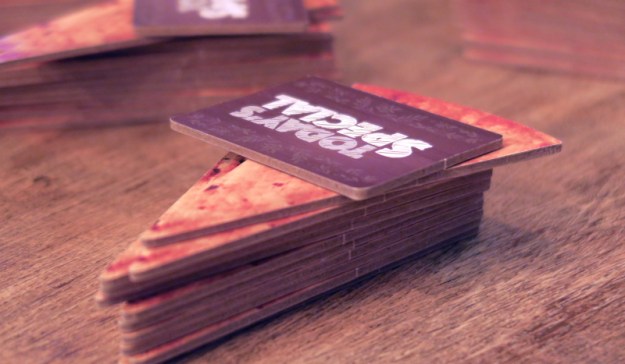
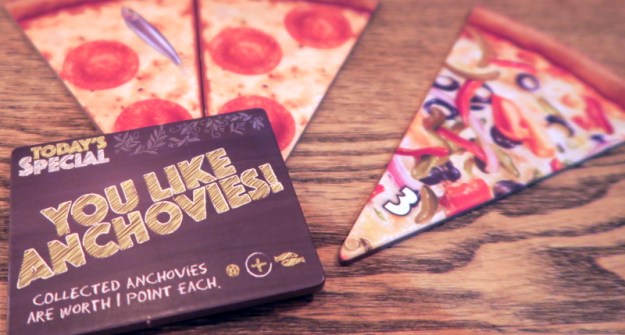
Firstly, in the case of a tie for who has the most pieces of a type of pizza, in …aber bitte mit Sahne all players score points whereas in New York Slice nobody gets anything.  Secondly, some of the pizza slices have anchovies on them and any of these that are visible at the end of the game are worth minus one (because everyone hates anchovies on pizzas right?  Well, everyone except Teal it seems…).  Probably the biggest change though, is that in New York Slice, each pizza is served with a Special—a bonus tile with rule-breaking powers.  In most cases, these are added to one of the segments for players to choose. They can be enticing and helpful, or they can be unhelpful and make players’ lives more difficult.

New York Slice
– Image by boardGOATS

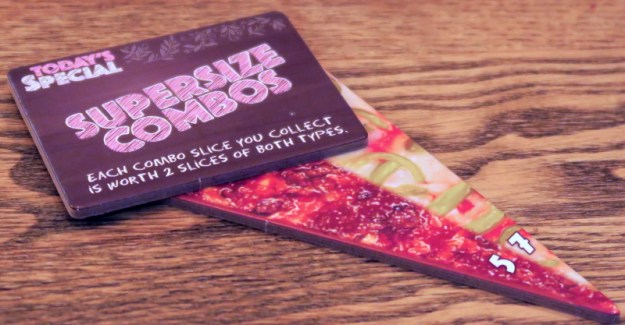
Ivory cut the first pizza, leaving Blue to be the first to choose.  The first Special was “Cut in Line”, which Blue took straight away and then promptly forgot about it until the final round.  Ivory went into battle for mushroom pizza, but lost out to Teal.  The front-runner looked to be Black who stored the most BBQ and veggie pizza slices, largely thanks to his “Supersize Combos” Special which meant his two half slices became two whole slices of each type.  That only gave him joint second however, with Lemon who turned out to be quite the carnivore and finished with the most beef and meat feast pizzas.

New York Slice
– Image by boardGOATS

The winner, however, and by a single point, was Blue who picked up a lot of anchovies along with her “You Like Anchovies” Special and coupled that with winning the most lucrative pizza (pepperoni).  Full of pizza, Teal and Ivory decided it was time, leaving Black and Blue with Orange and Lime and a decision to make as to what to play next.  With Wingspan something over half-way through, they were looking for something substantial to play, but not too long.  Blue’s suggestion was Wsiąść do Pociągu: Polska, the Poland map for Ticket to Ride.  This was one that nobody around the table had played before though it had been played in the group two and a half years ago, shortly after it was released at Essen.

Wsiąść do Pociągu: Polska
– Image by boardGOATS

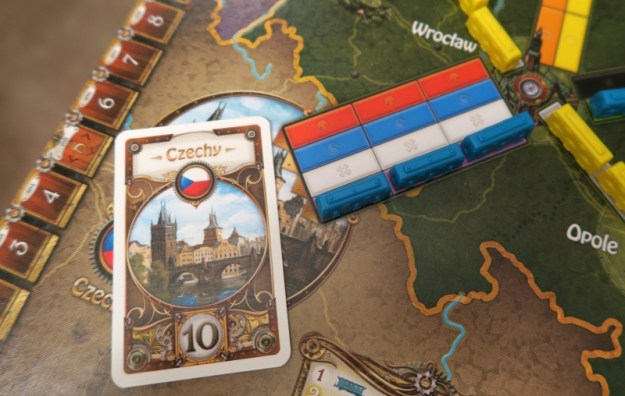
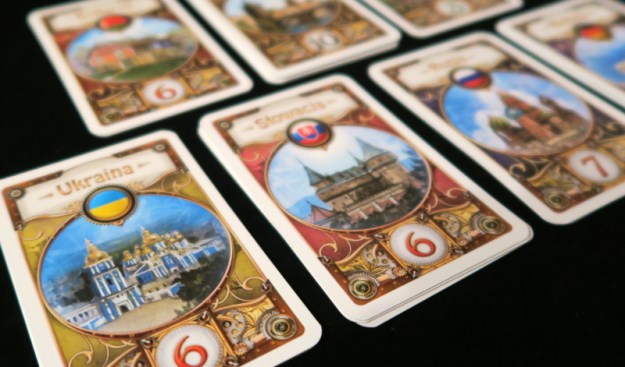
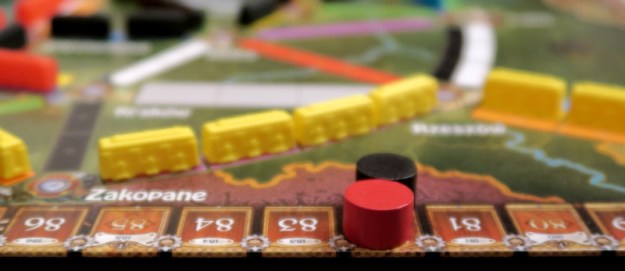
The Poland map works in much the same way as all the Ticket to Ride games; players collect coloured train cards and spend them to place plastic train pieces on the central map scoring points for placing trains, but also completing the route “Ticket” cards that they chose at the start of the game and maybe later too.  In addition to the usual rules, the base game maps all have a little something extra.  As well as the usual city locations, the Poland map also has countries, but unlike the Swiss map, these are not simply locations to connect to.  Instead when a player connects two countries, they collect one Country Card corresponding to each.  These are worth points at the end of the game.

Wsiąść do Pociągu: Polska
– Image by boardGOATS

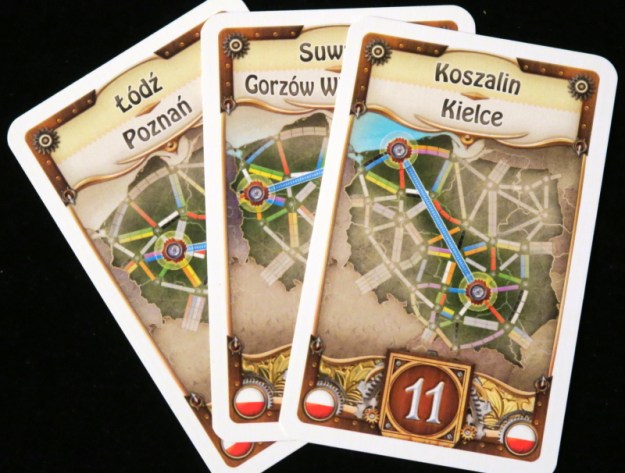
When a third country is added to the “network”, the player again collects Country Cards, one for each country in the network. When Blue explained the rules, Black commented that that aspect was interesting and he was curious to see how it affected the game.  Blue started and was followed by Orange, Lemon and then Black.  Black started by collecting more Tickets—this was a tactic that was discussed briefly at Burgundy’s Birthday Memorial event.  Black had commented then that this was the way all the best players did it.  The idea is that by collecting Tickets early, players are best placed to make the most efficient use of their trains and know what coloured cards they might need.

Wsiąść do Pociągu: Polska
– Image by boardGOATS

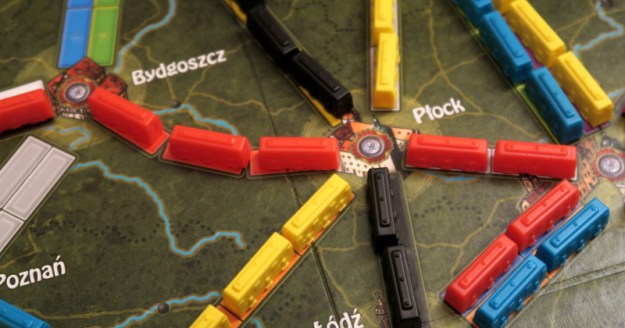
However, it is a bit of a “Go Big or Go Home” strategy because if something critical goes wrong early, the player could get left with an armful of unfulfilled Tickets leaving them with lots of negative points.  And with the Poland map, this was far from impossible as it turned out to be quite a scrap for the centre of the board.  Lemon asked what she should do when someone had just taken a track she wanted, clearly meaning Orange who had just nabbed a critical route from Bydgoszcz to Płock.  “Kill them,” was the instant reply to much hilarity.  Lemon commented that she would get her revenge, though it was unclear whether that was planned for the game or sometime later…

Wsiąść do Pociągu: Polska
– Image by boardGOATS

Eventually, Blue claimed the first Country Cards, connecting Belarus to Germany.  When she added Russia and Lithuania, it was clear how these could add significant points to a player’s tally.  Further, the repeated nature of collecting Country Cards each time the network grew provided a good source of points of a similar magnitude to those gained from Tickets, but without the associated jeopardy.  The Country Cards are stacked in descending order of value so that the ones earnt early in the game are worth more, but although the value decreases, as more countries are added to  player’s network more tickets are picked up.  As a result, value of each additional card pick up (and therefore each country when added) remains fairly constant depending on how many players are fighting for Country Cards.

Wsiąść do Pociągu: Polska
– Image by boardGOATS

This time, Blue stole a bit of an early march on the Country Cards in the north, while Black acquired loads of Tickets and Orange got in everyone’s way.  While Blue’s primary route was in the north running east-west, Black and Orange focused on north-south and Lemon had two separate smaller networks which she unfortunately failed to connect together.  As everyone else saw how lucrative Country Cards could be, they joined in, connecting countries to the south.  Lemon pointed out the route they had taken from Ukraine through south Poland to Warsaw where they got a flight to the UK.  It was about then that the pub became an attraction in itself when one of the locals pointed out that the lease was for sale once more.

Wsiąść do Pociągu: Polska
– Image by boardGOATS

The game came to a slightly sudden end when Lemon ran out of trains—the Poland map is played with just thirty-five trains per player instead of the more usual forty-five.  Actual game play time isn’t much shorter than usual because, like the India map, there are fewer longer routes so players have to take more turns placing trains.  At the end of the game though, it was close with Lemon in the lead thanks largely to the fact she had concentrated on the lucrative long routes where possible.  Orange and Black had completed a lot of Tickets though, and when they were added on together with the Country Cards, they tied for second place with eighty-two points.  The winner was Blue, however, thanks to the huge pile of Country Cards.

Wsiąść do Pociągu: Polska
– Image by boardGOATS

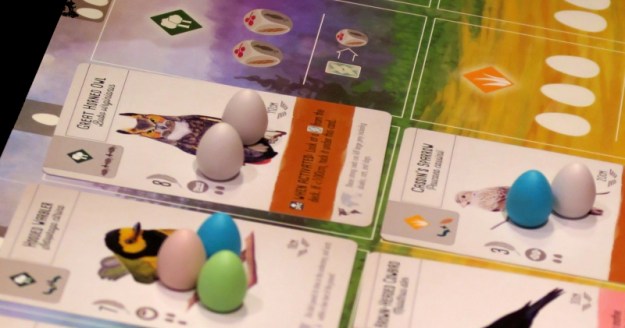
Meanwhile, over the other side of the room, Plum, Pine, Lime and Purple were playing Wingspan with Blue’s pimped out set.  Wingspan is a beautiful bird-themed game where players are collecting birds in three different habitats.  On their turn, they can “plant” a bird card in one of these habitats, or activate one of the three habitats to collect food, lay eggs or collect more cards.  The clever part of the game is that when players activate a habitat, they also activate any birds within that habitat—in this way, the game is card driven. Played over four rounds, there are bonus points at the end of each round (dependent on tiles drawn at the start of the game).  Otherwise, players score for birds, eggs, tucked cards, and personal bonus cards at the end of the game.

Wingspan
– Image by boardGOATS

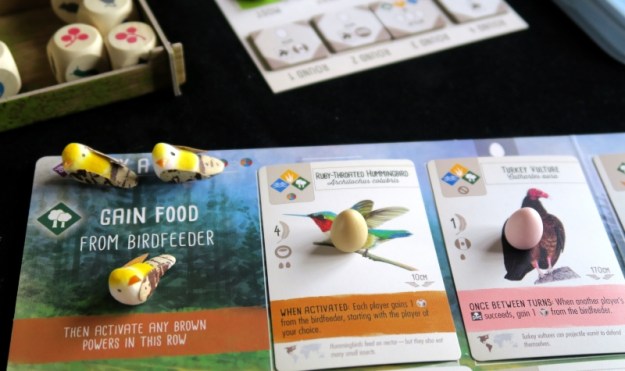
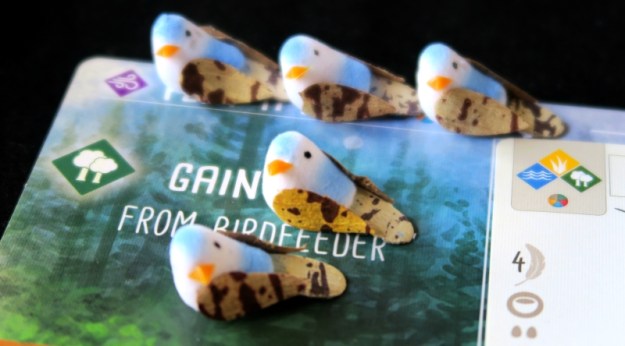
Players start with eight actions in the first round, but that decreases by one each round as the game progresses.  However, because players add birds to their habitats during the game, although they get fewer turns in later rounds, they are actually doing more things in each turn as they are activating more cards.  In Blue’s pimped out copy, she had replaced the wooden action cubes with little fluffy birds which are cute, but led to some initial confusion with the phrase “playing a bird” meaning variously take an action (playing a fluffy little bird) or play a bird card into a habitat.

Wingspan
– Image by boardGOATS

This time, everyone was slow to start—the start is almost always slow in Wingspan as players need cards to play and food so they can pay the cost, but this time it was especially true as players found their feet.  Lime began with a woodland bird that gave an extra food after re-setting the bird-feeder, which really helped him out throughout the game.  He also had a once-between-turns card which was triggered when another player tucked a card.   Since Purple had a bird with a tucking action, that looked like a good call.  Considerable merriment was derived from the tucking action:  who was tucking the most, watching out for people tucking etc..  Unfortunately however, Purple’s action required the tucked card to be taken from Purple’s hand so she often passed up the chance meaning she was not the most prolific tucker…

Wingspan
– Image by boardGOATS

Plum’s first two were wetland birds with one-off powers.  As her bonus card rewarded her for having cards left in hand at the end of the game, the fact these early birds increased her card drawing powers from the very start meant they could help towards that too.  Pine’s bonus card rewarded him for having birds with geographical names which he pretty much had in his starting hand. Lime’s bonus was for birds with tucked cards, but he only realised later that it meant multiple birds with tucked cards not the number of cards tucked.  He was able to pick up another bonus card later in the game, which worked slightly better for him though.

Wingspan
– Image by boardGOATS

Pine’s bird hunting for rodents largely went hungry in the early part of the game, though it did better in the later rounds.  Plum, instead of sharing her latest kitty pictures, mimicked her favourite kitty behaviour, and watched hawk-like for a successful hunt to trigger once-between-turns action.   She had a killer “three birds in one go move” set up ready to go—two birds both with a “play a second bird in the grasslands” action.  Although she was a little disappointed to have been unable to deploy it in time for the worms they ate to count towards the second round goal of most eaten worms.  This increased her egg laying power though and the final third bird allowed her to a sacrifice an egg for two new bird cards ensuring she achieved her bonus in the final round.

Wingspan
– Image by boardGOATS

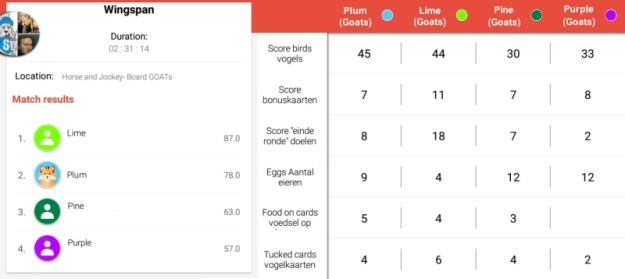
With the game finally coming to an end, all that was left was the scores.  Plum and Lime took the most points for their birds while Purple and Pine had the most eggs.  While everything else was fairly close, Lime had his nose in front in most areas and this showed in the final scores which were moderately spread out.  Lime’s score of eighty-seven points was some ten points ahead of Plum in second, who was similarly ahead of Pine.  As always with Wingspan, it had been fun, though it had sadly confirmed to Pine that while he adores the theme, the game play just isn’t for him.  And on that sad note, with everyone else also finished, it was time for home.

Wingspan
– Image by boardGOATS

Learning Outcome:  Everyone loves Pizza.