The evening began with Plum explaining the “Feature Game” to Indigo and Navy, despite the fact they had already decided they were unlikely to play it. Still, there was time to fill as people finished eating and the stragglers, and that was as good a way as any. The game in question was Underwater Cities, which is a sort of worker-placement and network-building game. Although the game is quite complex, the underlying mechanism is quite simple: players start their turn with a hand of three Cards and, on their turn choose an Action space and pay a Card to use it. The Action spaces and the Cards come in three different colours, green, red and orange.
 |
| – Image by boardGOATS |
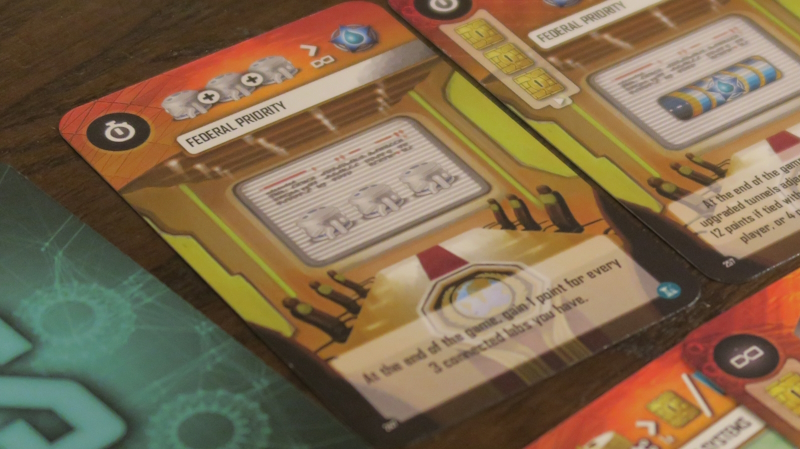
If the colour of the Card played matches the colour of the Action space chosen, then the player gets to activate the Card, most of which have an instant effect (though for some, the effect is delayed). In general, the orange Action spaces are quite powerful and the green Action spaces are weak, whereas the green Cards have powerful effects and the orange cards are weaker, thus the Cards and Actions together are balanced. Each Action space can only be activated by one person per round and the game takes place over ten rounds (though the group used the Quick Start variant from the New Discoveries expansion which replaces the first round) with each player taking three actions per round and production phases after the fourth, seventh and final rounds.
 |
| – Image by boardGOATS |
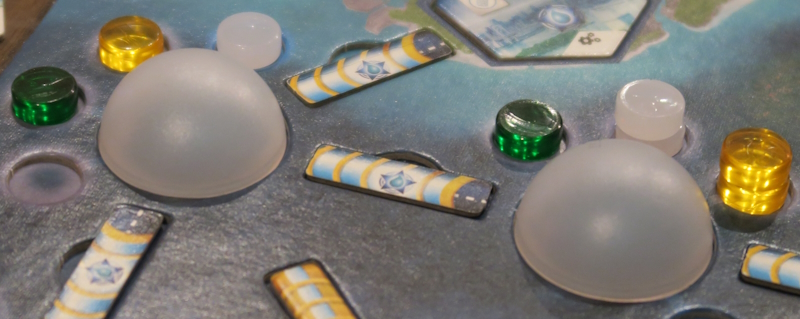
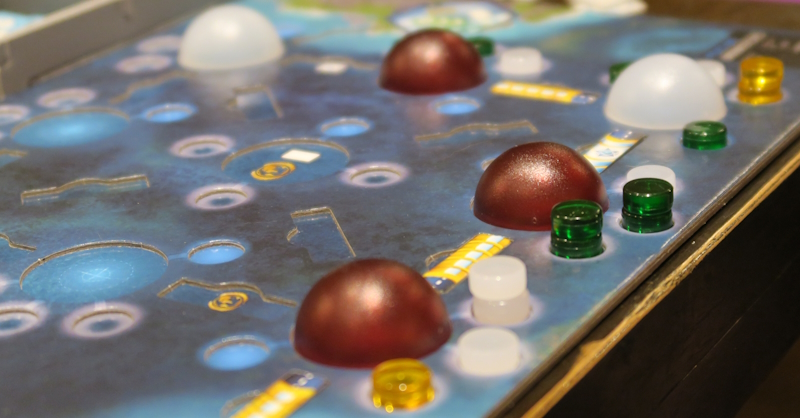
The aim of the game is to build a network on players’ personal player board, connecting Cities together with Tunnels and adding and Upgrading Buildings to provide production capabilities. There are four Resources, Kelp, Steelplast, Science and Biomatter together with money, or Credits; these are produced by Farms (Kelp), Desalination plants (money) and Laboratories (Steelplast and Science). Biomatter is essential for building symbiotic cities and can also be a universal building material (can be used instead of Kelp or Steelplast), but is a rare Resource that can only be acquired through Cards, Actions and by connecting some Metropolises to a player’s network.
 |
| – Image by boardGOATS |
Players score points during the game and in the production phases after the fourth and seventh rounds, but most of the points are scored at the end of the game after the final production phase. At this point, players score for the number of different Buildings next to each connected city in their network, for any end-game scoring cards, for their final scoring Metropolis and for any Resources they have left. Indigo and Navy showed some appreciation as Plum explained, but ultimately decided it wasn’t for them, and were replaced by Cobalt and Ivory, both of whom had an idea of how the game played from watching run-through videos.
 |
| – Image by boardGOATS |
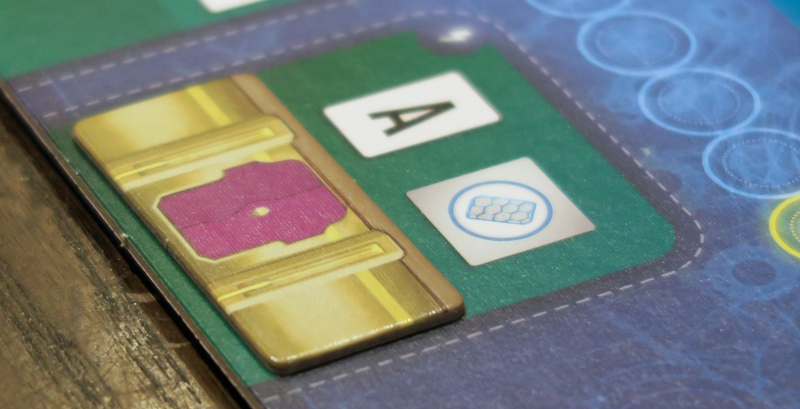
The Quick Start gave everyone an Enhanced Assistant so Plum started with the ability to get Biomatter on production, so she was able to build purple Symbiotic Cities (which score more points) right from the beginning. Cobalt’s also helped him when building Cities, giving him one Credit or Steelplast discount, although he didn’t really take advantage of this until the final Era. In contrast, Ivory focused on the end-game scoring from his Metropolis which required him to build seven Cities to get the maximum number of points. By the first production phase, he had already built three and connected them to his network with Tunnels, but all those people needed a lot of feeding which was costly and slowed him down a lot.
 |
| – Image by boardGOATS |
Plum focused on building a robust food engine with two upgraded green Buildings attached to one City (her end-game Metropolis also gave points for sets of upgraded structures) while Cobalt focused on getting his engine online and started on his objective to connect all his Metropolises and Cities with Tunnels in the second and third Eras. He was aided by an ongoing ability that triggered whenever he used an Assistant (draw a Card and gain a Point), which he used heavily, getting four Assistants early in the game and activating them all in every Era. The extra Card draw ensured he was always able to play a matching coloured card with every Action which also helped.
 |
| – Image by boardGOATS |
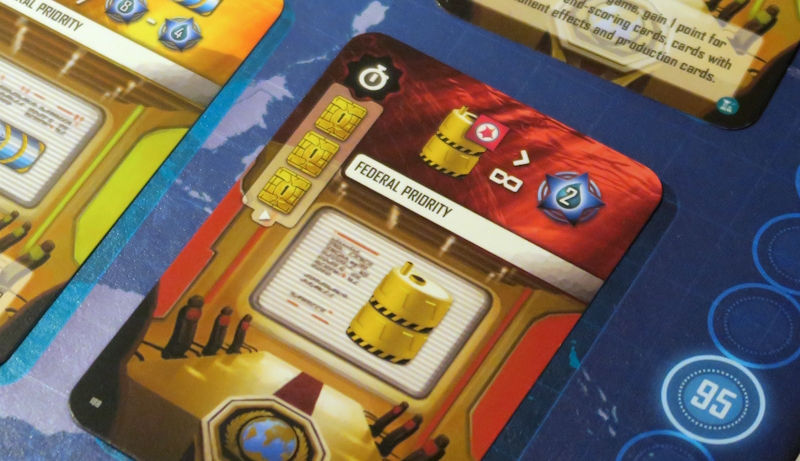
Plum pointed out that a friend who she plays with and often wins says, “Don’t always let me get the Special Cards—they are powerful!” So after the first production phase, there was a focus on the special cards in middle, all of us grabbing some quite powerful abilities. Ivory got an additional tile that gave him points every production phase and Plum got a heavily discounted City. Cobalt’s engine was working very effectively by this time giving him lots of Resources and discounted Actions. Despite her Special Cards, Plum was struggling as the main upgrade slot which she needed for her end-game Metropolis was denied to me when she had the Resources to use it. Instead she ended up focusing on Symbiotic Cities and ended up with only the one regular City.
 |
| – Image by boardGOATS |
After the second production phase, there was a big focus on how to maximize points. Ivory took a risk, taking the end game scoring card that gave twelve points for the player with the most upgraded Tunnels. When he took it, he had the most upgraded Tunnels, but it was clear that Cobalt could challenge this. Cobalt on the other hand had grabbed a couple of Special Cards giving three points per upgraded Tunnel plus one point per Card in his tableau. For Ivory to score his Card it was critical that he denied Cobalt the ability to upgrade in the last turn and Ivory was able to make sure he took his first in the final round—this was fairly ironic as the majority of the rounds he had been the last player!
 |
| – Image by boardGOATS |
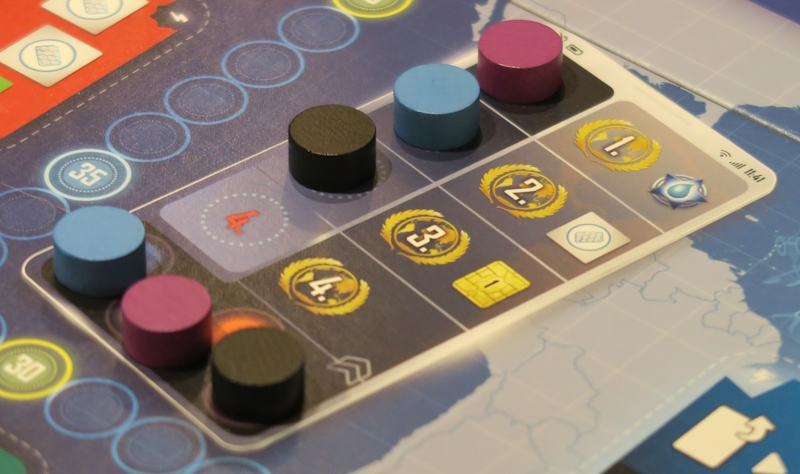
This scuppered Cobalt’s plans and gave a twenty-four point swing in Ivory’s favour, but since he had increased his hand limit to four and was drawing multiple cards, he was able to pivot and build a City sharing two upgraded Farms and us Cards that provided points when played. This also produced quite a few resources in the final production phase. Plum was struggling towards the end of the game as she couldn’t get the final Resources she needed to build the last two Tunnels to connect her end-game scoring Metropolis. Despite it failing to score, it had still been a good focus for her game as the upgraded structures had given her extra production during the game and those Metropolis points would only be critical if the game was close.
 |
| – Image by boardGOATS |
And close it was. Plum had a slight lead going into the end game scoring and and-game scoring cards gave points fairly evenly too. Cobalt and Ivory had the same number of Cities with three different Buildings, slightly more than Plum, but she more than made up for it with her Cities with her Cities with two different Buildings. The Metropolis she failed to connect proved critical in her scoring though and although she just edged Ivory by two points, Cobalt ultimately took victory, also by just two points as he finished with ninety-seven. It had been a very thinky game, and with three players was reasonably tight with people taking Actions others wanted. It was very enjoyable when players were so evenly matched which was reflected in the scores despite very different strategies.
 |
| – Image by boardGOATS |
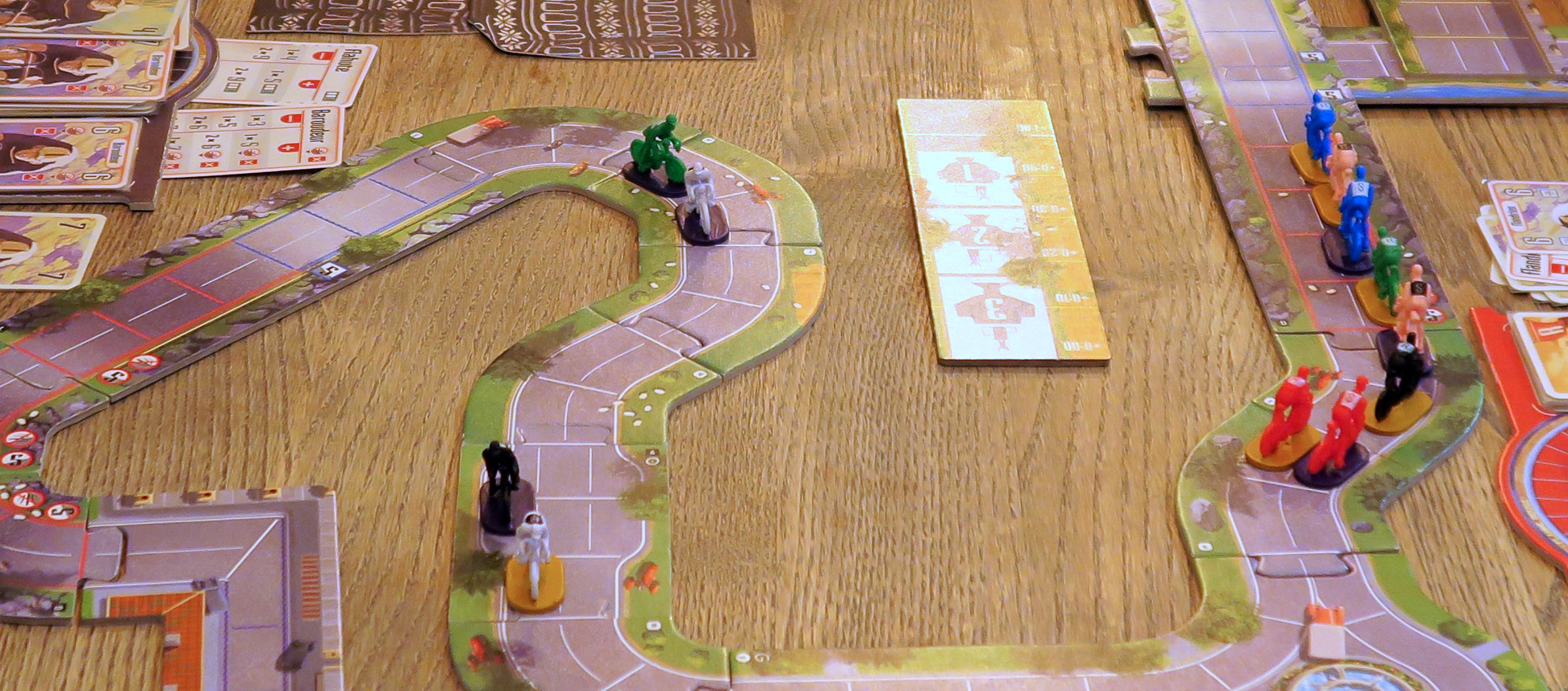
Black and Blue had been interested in joining the game of Underwater Cities, however, as it was, it was the last game to finish by some mile and would have taken a lot longer with a fourth player. There wasn’t a sixth player interested in making a second game, so in the end, Black joined Pink who was very keen to give Teal’s new acquisition that he’d been toting about since Pink and Blue had brought it back from Essen for him. This was the Grand Tour expansion to Flamme Rouge. This is a cycle racing game where players move their two riders forward by drawing and playing cards from that riders specific deck, depleting it as they go.
 |
| – Image by boardGOATS |
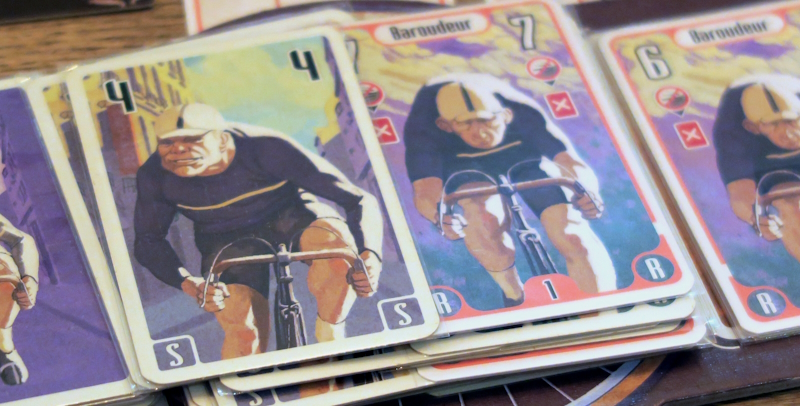
As in real cycle races, players use slipstreaming to avoid exhaustion, in the game, these are cards that block up players’ hands making dealing with obstacles and moving through the peloton more challenging. A large part of the new expansion is a campaign mode and there was only time for one game, however, there are some additional features, including some new hilly track and a double right-angle hairpin bend. These added more interesting features to the parcours. Like all race games, players usually do best if they can start fast and stay at the front of the pack. In Flamme Rouge, this is mitigated by the fact that once a card is played it is discarded so players have to make their good cards last the duration of the race while avoiding too much exhaustion.
 |
| – Image by boardGOATS |
Teal managed to crash both his bikes, while Black and Purple crashed one each. Indigo and Navy led for most of the game while Pink tried to maintain a position in the front four or five. Navy faded as the sprinters wound up for a lunge for the line, with Indigo as Marcel Kittel and Pink as Mark Cavendish. This time, victory went to the German and the Manx Missile with just piped into second with Navy rolling home in third. The game had been a lot of fun and the general consensus was that the Grand Tour expansion added some nice new features even when multiple games for a campaign weren’t appropriate. It hadn’t out-stayed its welcome either, and although Teal headed home, there was time for everyone else to play one more quick game.
 |
| – Image by boardGOATS |
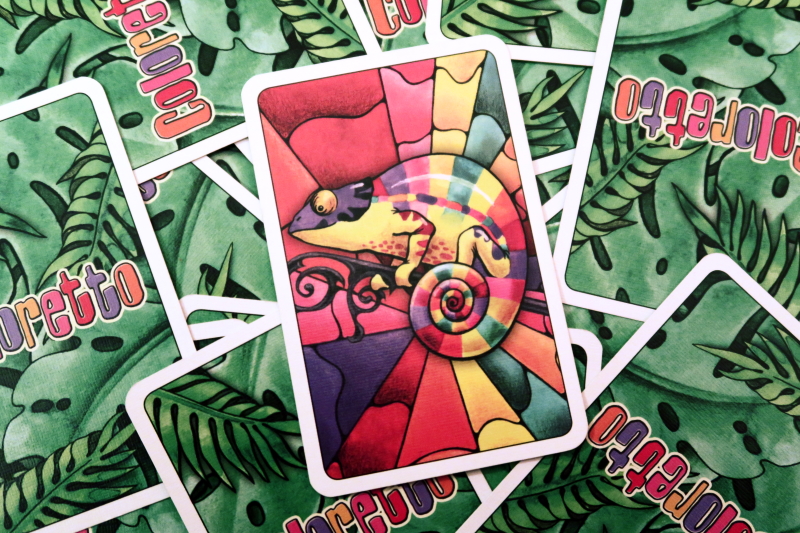
The game of choice was Coloretto—something of an old favourite. This is a really quick game to teach and start playing, with players taking it in turns to either draw a card and add it to one of the trucks, or taking a truck and adding the Chameleons on it to their collection. The clever part is that largest three sets score positive points following the Triangular series, while any other sets score negative points. Purple drew the Golden Joker which was picked up by Pink, while Black took the other Joker. The game was really tight, well, amongst the top three anyhow. Navy managed to only score positive points, but his thirty-four points was one less than Indigo who took second and who, in turn, scored one point less than the victor, Black.
 |
| – Image by boardGOATS |
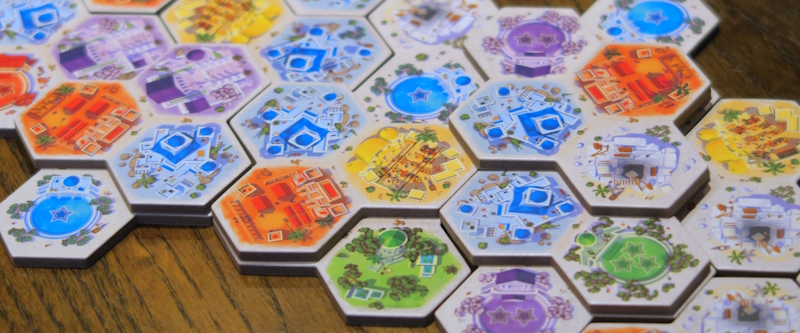
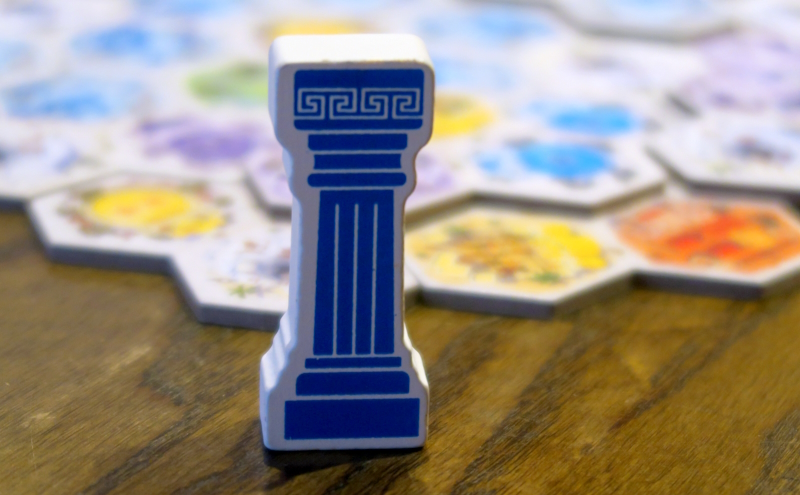
The final table consisted of Pine, Blue, Jade and Sapphire. After a bit of chit-chat, this group settled on playing Akropolis. This is a fairly light abstract tile laying game in a similar vein to Taluva or NMBR 9, where tiles placed on higher levels score more points. In this game, players take a tile from the Market and place it in their City. The first tile in the market display is always free, the one after costs one stone (the only resource in the game) the next one two stone and so on. The tiles comprise three conjoined hexes each either a Quarry (which provide Stone when built over), a Plaza, or a District tile. Tiles can be placed on top of others, but must cover more than one other tile and cannot leave gaps.
 |
| – Image by boardGOATS |
At the end of the game, tiles that meet the scoring requirements for that colour are multiplied by their height. As in Kingdomino where the area is multiplied by the number of crowns in it, this District score in Akropolis is multiplied by the number of Plazas in that colour; these totals are added together to give a final total. This time, Blue scored heavily for her Houses and although Jade almost matched her with his Barracks, he didn’t score much for anything else and Blue had picked up a lot of points for her Markets too. Together these gave her a bit of a landslide with a total of one hundred and nineteen. Sapphire and Pine that by the end they had got the hang of things, and fancied giving it another go.
 |
| – Image by boardGOATS |
The game was punctuated by a discussion about orange juice and lemonade, which is apparently called a “Henry” in these parts though nobody but Jade was aware of it. Pine commented that where he came from it was more likely to be used to order cocaine. This time, Blue tried a totally different strategy this time focusing entirely on Houses. Sapphire’s Markets gave him forty points and Pine’s gave him thirty-four. These were dwarfed by Jade’s Gardens that gave him sixty points, but they all paled into insignificance compared to Blue’s Houses which gave her one hundred and eight. Sadly though, with nothing else but a pile of rocks, this left her with exactly the same score as last time—and a tie with Jade, while Sapphire, the most improved player finished in third, just four points behind.
 |
| – Image by boardGOATS |
Learning Outcome: The underwater world has a lot of potential.


 boardGOATS