The evening began with Green and Purple arriving to find Plum and Cobalt sitting outside the pub chatting. This was partly because the weather was warm, but also because someone else was sitting at our usual table and we had been relegated to another long table on the other side of the room. Pine arrived soon after and once introductions between Cobalt and those who had not been about last time were concluded, the group decided to play a short intro game while they waited for everyone else to arrive. The game settled on was Coloretto, which had only just begun when Ivory arrived, but he was happy to watch.
 |
| – Image by boardGOATS |
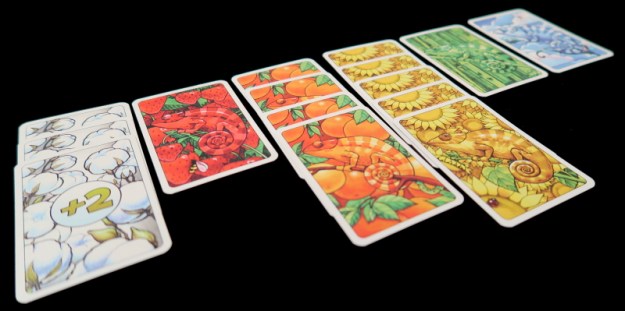
Coloretto is a quick and simple game that is very popular with the group. Players either turn over the top card and add it to a “Truck”, or take a Truck and add it’s contents to their collection, sitting out until everyone else has taken a Truck. Players are collecting coloured sets of Chameleon cards, but the key is that only three sets score positive points, with the others scoring negatively. Thus players are trying to get as many cards in three colour suits, and as few as possible in each of the rest. This time, everyone started with a different colour, so there were no obvious clashes. As is usual for this game, it took a few turns for each players position to become clearer.
 |
| – Image by boardGOATS |
By this time Plum was keeping the number of colour sets she had low with only two, but also had a couple of +2 bonus point cards and a Rainbow Chameleon (a wild) . Purple’s set was similar but with three colours. Green was making steady progress and Cobalt was low on any particular colour, but only had four sets and a Rainbow Chameleon, so was poised for a good score if the cards fell in his favour. Pine meanwhile seemed to be in the process of collecting at least one of each colour! By the end of the game, Plum had managed to collect Chameleons in just three colours and so scored no negatives, while Pine just seemed to have sets of everything. Purple had three extra colours, but with only one of each; her Rainbow Chameleon and +2 cards helped to give her a good score.
 |
| – Image by boardGOATS |
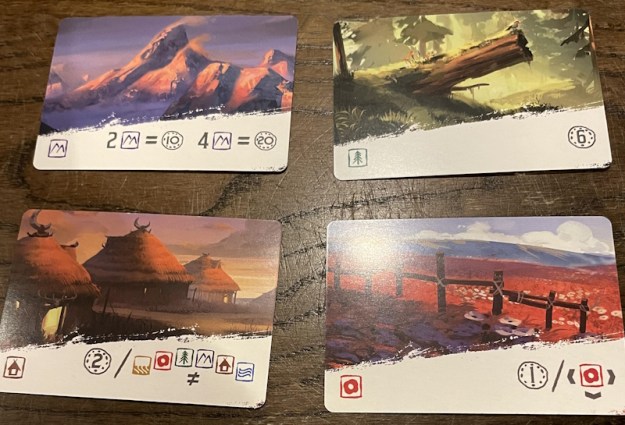
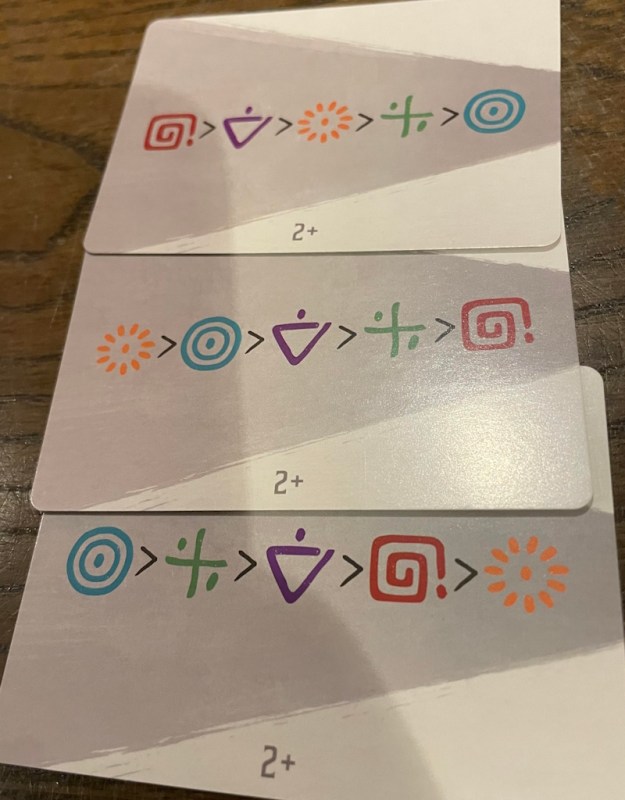
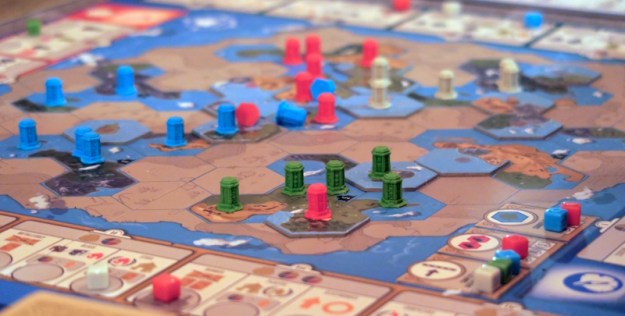
Green managed only one negative point, but had no bonuses, while Cobalt had his cards fall right and ended with a couple of good colour sets and with it, victory. By the conclusion of Coloretto, Jade and Sapphire had arrived bringing with them the feature game, Vaalbara. In this game, each player is a clan leader trying to take over some territories with game-play which is vaguely reminiscent of Libertalia/Winds of Galecrest. Players all have the same deck of twelve cards representing the members of their tribe. Each turn, players choose secretly one card, then in the order of initiative of the revealed Characters, players activate their powers and take over one of the available Territories. Each type of Territory has its own way of scoring points (Collection, Pair, Diversity, Risk etc.).
 |
| – Image by boardGOATS |
Thus the game is about timing and playing the best powers and the high initiatives at the most opportune moments. After nine rounds, the player with the most points wins. Jade and Sapphire had played Vaalbara about a dozen times together, and Green had played a similar number of games on Board Game Arena with reasonable success. Pine was entirely new to it the game and joined the other three. Jade and Pine took the Mountains in the first round, and then Jade managed to snatch the only one on offer in the second round. Green ended up with the final card in the first round—the All Rounder, so scored poorly with it.
 |
| – Image by boardGOATS |
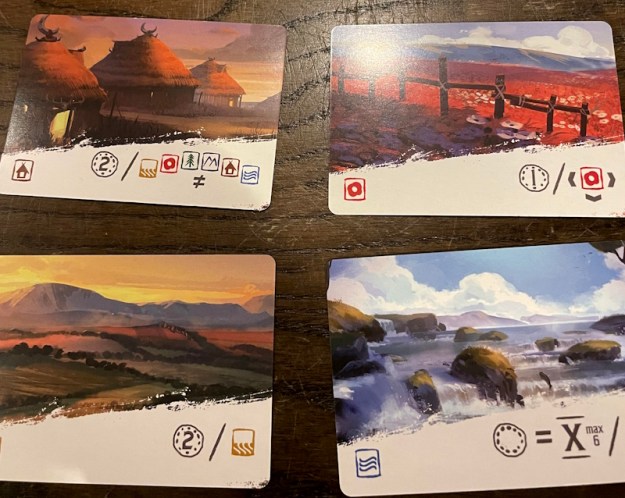
By the middle of the game Sapphire was going all out for Fields, Jade was on to his third Mountain and Pine was beginning to get the hang of things. Green was struggling with his all rounder strategy: all he could get was a River and several Forests and even after he’d swapped one of those for something else (he’d mixed up the cards and instead of swapping a card between first and second row, it was any card with the top card of the deck) it didn’t work out. Pine managed to complete his second Mountain, but Jade amazingly managed all four which catapulted his score. It was only then that Pine and Green realised that the fourth Mountain was twenty points on top of the ten for the first three (i.e. a very thirty in total from four cards).
 |
| – Image by boardGOATS |
By the end of the game the Poppy Fields were coming out in profusion and started to really score a lot of points. Unfortunately for Green, Jade managed to nab the Field card ahead of him for a five type bonus and Green was still only on four terrain types. Once the dust had settled and the final scores were compiled, it was quite close with Jade and Pine were tied for first on seventy points, and Green only three points behind and just ahead of Sapphire. Pine joked that maybe the tie-break would be the player position on the last card back, thinking that would about as arbitrary as some of the other tie breaks had been recently. A quick check of the rules confirmed it and ultimately gave victory to Jade.
 |
| – Image by boardGOATS |
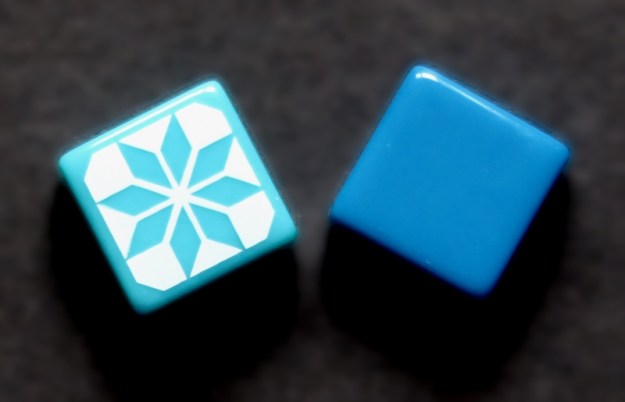
From there, the quartet moved on to play an old favorite, Azul. In this game, players are tile-laying artists challenged to embellish the walls of the Royal Palace of Evora. On their turn, players draft colored tiles from the marketplace onto their player board. At the end of the round, players score points based on how they’ve placed their tiles to decorate the palace with wasted tiles scoring negative points. Bonuses are awarded at the end of the game for completing rows and columns and sets of the same colour, and then player with the most points is the winner. A pretty game, the group started with a short discussion about what colour one of the tiles really was.
 |
| – Image by boardGOATS |
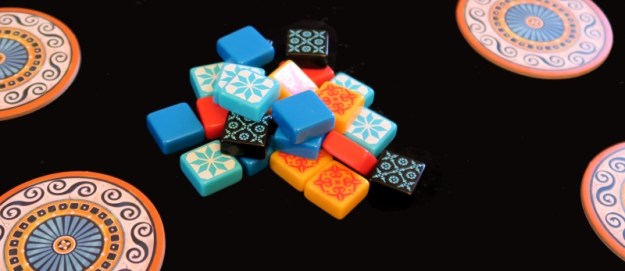
People wanted to call it blue, but there is already a fully blue tile, and this one was a little more turquoise with a white pattern—they did not come up with answer to the problem. The game played much as it always does with complaints about the tiles that were not coming out of the bag when needed and at one point there was one Marketplace with four tiles all the same colour (that colour that we could not quite pin a name on). Mid-way through the game no-one seemed to want the orange tiles, and it ended up with about eight of them in the middle of the table. It finally fell to Pine to take them, but he could not place any of them and they all had to go on his negative score line!
 |
| – Image by boardGOATS |
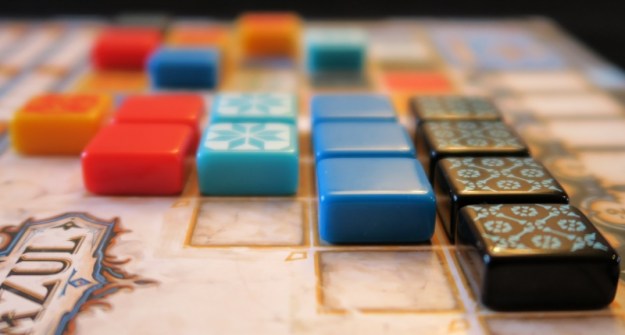
The game was reluctantly brought to a conclusion by Sapphire, at the urging of everyone else. He did not want to complete his row, wanting to hold out and complete a different colour later, but if he hadn’t taken the tile he would have ended up with a larger negative score and it had already not been possible to fully populate market. After final scoring, Jade and Sapphire shared the lead with ninety-five points with Green, who’d had a much better game than he usually has in third. Tie break time again, but this time Sapphire won it because he was the only player to have completed a full row (the tile he hadn’t wanted to take).
 |
| – Image by boardGOATS |
There was still time for something else, and the group settled on Nimalia, a new, interesting card-laying game where players are designing the best Animal Sanctuary. Each card has four “Biome” squares on it of potentially different terrain, and different animals. Players start each round with three cards and draft them, placing the chosen card partly (or wholly) on top the already laid cards in a simlar way to Sprawlopolis or Honshū. The Sanctuary must remain within a six by six grid made of the squares (not the cards). The game is played over a series of five rounds, where two or three different conditions are scored at the end of each drafting round. This time, the first round would score for the largest area of Savannah and for connected Polar Bears and in the second round the scoring switched to Polar Bears and Gorillas next to Water.
 |
| – Image by boardGOATS |
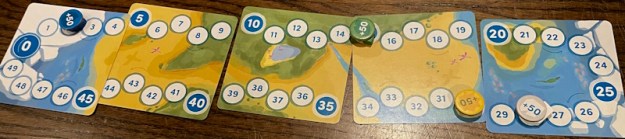
In the third round it returned to the largest Savannah, but with the complication of scoring maximum for no Giraffes down to scoring nothing with three or more giraffes—of course giraffes live in the Savannah! Rounds four and five used both the Giraffes and the Gorillas to score while adding in the Savannahs in the fourth round and polar bears in the fifth. The nature of the scoring meant that any cards with Giraffes were quickly passed on leaving some players with a double giraffe card to lay as the last card on a giraffe scoring round. Since it wasn’t possible to lay a new card underneath an old one, those giraffes caused scores to tumble!
 |
| – Image by boardGOATS |
In the first round Pine roared into the lead while everyone else stayed within a point or two of each other. After the second round, Sapphire was the one who lost out, with Pine retaining his significant advantage. During the third and fourth rounds Jade and Green managed to catch Pine, with Jade pulling into the lead. Sapphire managed a good score in the fourth round, but he had a lot of ground to make up and he’d left his charge to the finish a little too late. In the final scoring, Jade and Green pulled ahead in a tight battle, which Jade won by just two points with his total of eighty. Pine was third after flailing around in the final round and having been left with a double giraffe.
 |
| – Image by boardGOATS |
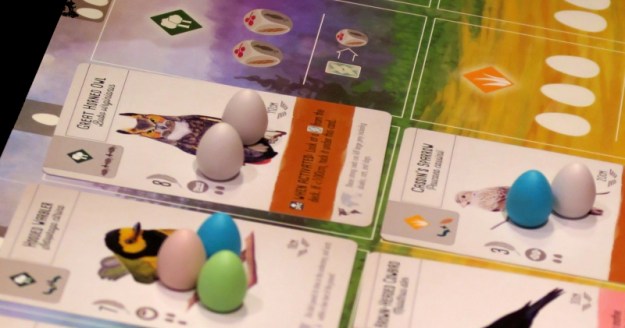
While all that was on-going, the rest of the group, Plum, Ivory, Purple and Cobalt, opted for a club favourite, Wingspan, enhanced by the European Expansion. This is a card-driven engine-building game where players choose one of four possible actions (activating their Woodland, Grassland or Wetland areas or placing a bird card in one of those locations). Points come from each individual card end of round goals, and eggs left at the end. The game is all about building combinations of cards that work together efficiently, so the it took all night as everyone wanted to do their absolute best.
 |
| – Image by boardGOATS |
Ivory as always was very good at this, but was also quite generous giving everyone food each time he activated his Woodland area. Cobalt was the first to get three bird cards in his Reserve, though Ivory ended up with the most valuable birds on his board, with Plum’s next highest. One of Plums birds moved at the end of each round though, which was very useful for saving costs and improving yields. It was Ivory and Cobalt who tended to come out best with the end of round goals. As is often the case Ivory continued to score well with a good haul of bonus card points too.
 |
| – Image by boardGOATS |
Purple failed to complete any of her bonus cards, but did make sure all her birds laid purple eggs. Cobalt finished the game with the most eggs, however, inevitably followed by Ivory. As for cached food and cards, Plum got the most food, but Purple had the most Tucked cards. With all the scores added up, Ivory was the almost inevitable winner on ninety-three with Cobalt not far behind with eighty-three and Plum taking the battle for third by just three points in what was a hard-fought game.
 |
| – Image by boardGOATS |
Learning outcome: Goats love playing with colours.












 boardGOATS