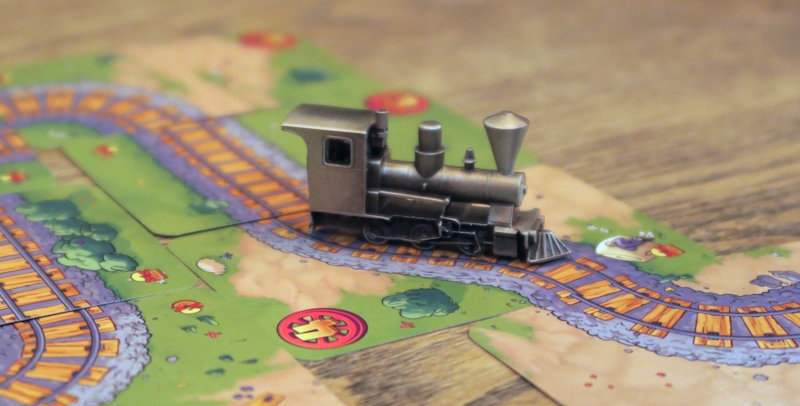
Blue and Pink began the evening, while they waited for their supper to arrive, messing about with a little card game called Rollecate which is about a historic steam locomotive built in 1967 by a famous Dutch engineer. The idea of this little game is that players take it in turns to play Track cards to extend Rollecate’s line by placing cards. They can play as many cards as they want, as long as they all have the same number. When laying new track, the difference between the numbers on the last card and the first new card placed must not have a difference of two (thus one cannot be followed by three and four cannot be followed by two etc.). Cards must not overlap when played and cannot force impossible play.
 |
| – Image by boardGOATS |
Once the Track cards have been played, the active player rolls dice equal to the sum of all numbers on the cards they played, and Rollecate moves forward one step for each Wheel rolled on the dice. Thus, if a player places two threes, they roll six dice. If Rollecate reaches the end of the track, she hits the brakes. For every step she’s short, the player take one card from behind the train places them on their penalty pile one by one in any order they want. Any time the card placed matches the number of the top card on the pile, both are removed from the deck. At the end of the game the everyone adds up the face value of their cards and the player with the lowest total wins.
 |
| – Image by boardGOATS |
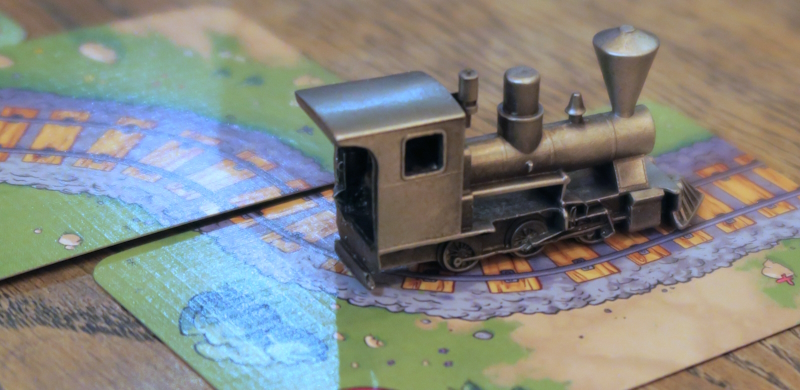
By the time Blue had explained the rules to Pink, their food had arrived, and by the time they had finished their supper, Cobalt had joined them. Blue was just finishing explaining the rules when Pine joined them and eventually they all finally managed to play the game. There were a few “teething issues”, but before long the delightful little metal miniature was progressing along the track. Blue and Pink got unlucky and picked up a lot of cards, some high scoring, and weren’t able to remove them. Cobalt and Pin did rather better with Pine finishing with five penalty points and Cobalt with four.
 |
| – Image by boardGOATS |
By this time, almost everyone had arrived, and Pink began to set up the “Feature Game” which was to be Viticulture World, the cooperative expansion to the popular wine-producing worker placement game, Viticulture. This is one of Pink’s and Teal’s favourite games, but also very popular with other members of the group. No-one had played the cooperative expansion, however, but despite some apprehension that the changes might spoil a favourite, there were a lot of interested parties. In the end, Pink was joined by Teal, Ivory, Plum and Cobalt, all of whom were very familiar with the base game.
 |
| – Image by boardGOATS |
There isn’t really anything particularly special about the base game, it is just a worker-placement game where players are growing grapes and making and selling wine. However, it is just done very, very well. In general, there are two types of worker spaces—restricted, that only a limited number of workers can use per round, and open spaces which can be used by as many workers as players want. Each player also has one Grande worker who can be placed anywhere, even on fully occupied spaces. The cooperative game is essentially much the same as the original Viticulture, with some small rules changes and a different target: players have six years to goal: each player must reach twenty-five victory points and the shared influence token must reach the end of the influence track.
 |
| – Image by boardGOATS |
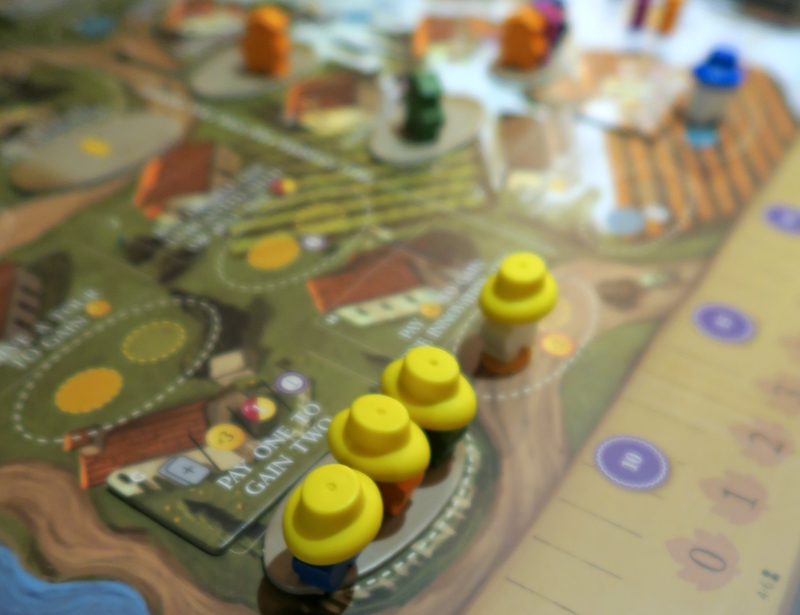
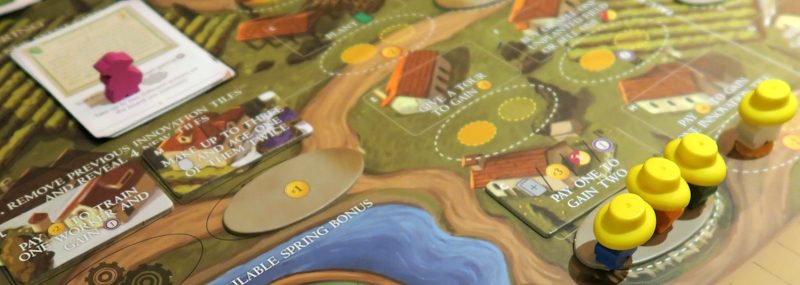
There are seven different packs of cards and the group began this time with the easiest, Green Gully, which as advertised, is a very good introduction to Viticulture World. This is designed to make sure everyone is successful on their first time out (though it may be easier with more players). Each player has four workers plus one Grande and unlike the original, there is no mechanism to get more. Two of these workers have yellow hats to indicate they are summer workers and two have blue hats and these can only operate in winter, training however, allows them to remove their hat and play in other seasons. There was a little concern prior to play that as only certain types of workers are able to claim certain bonuses it might make the game a touch fiddly, but this was not the case.
 |
| – Image by boardGOATS |
As the game progresses, there are Event cards which give special action and also increase the number of workers that can be placed on some locations. There was some confusion at the start of the game as to whether the Grande worker could be used to claim the special actions. It was felt this would make the game way too easy though, because if everyone was able to take advantage of the bonus with their Grande this would make the game too easy; a quick online check confirmed that this was not allowed. The group found the game fairly straight-forward, though everyone was quit experienced and therefore knew where the areas of tension were, in particular making wine, harvesting grapes and fulfilling orders, so made a point of upgrading these early.
 |
| – Image by boardGOATS |
The group had a lot of fun, and as is not uncommon with this game, there were lots of “getting my cock out now” comments (especially from Ivory), when it came to claiming the turn-order. Ivory was the first to achieve his required twenty-five points, but he went on to get thirty in order to claim an extra influence point for the team. Cobalt was next to make his target and everyone else followed the next round. Despite the initial reservations, everyone enjoyed the game and would be keen to try some of the more challenging regions on another occasion in the not too distant future.
 |
| – Image by boardGOATS |
While the oenophiles were playing Viticulture, the other four were revisiting Kavango. This is a medium weight card drafting and tableau building game which has something of the feel of Wingspan. This was the “Feature Game” last September, when it went down well with those that played it, one of whom was Pine. It had a second outing two weeks ago, when Blue promised Pine and others it would come back. Pine was keen to give it another go, and this time they were joined by Purple and Black. The game is fairly straightforward to play, though a monumental table-hog, so the group started by moving to a larger table on the other side of the room. Blue outlined the rules: Players start with a hand of twelve cards and choose one before putting the rest to one side.
 |
| – Image by boardGOATS |
This card is then either added to the player’s tableau if it is an animal card, or activated if it is an action card. Once the card has been played, players have the opportunity to invest in protection or claim rewards (money and points) for completing targets. In the early part of the game, the cards that are dealt are mostly from the bottom of the food chain, what the game refers to as “Producers”, rodents and the like. As the game progresses, the creatures get bigger and require the presence of other animal types or terrain as food and protection (Habitat, Poaching and Climate). This time, Blue (who was playing the game for the third time) stole a bit of a march, picking up more points during the game than anyone else.
 |
| – Image by boardGOATS |
Pine who was on his second play, did a god job of collecting valuable animals and finished with a massive one hundred and twenty-six points, but failed to pick up the bonuses for the protection. Purple didn’t do so well with her animals, but had every type and picked up all the bonus points available for protection too, while Black didn’t take any points for that, but did well on his personal objectives. The winner, (unsurprisingly given her extra experience) was Blue followed by Pine with Purple in third. The consensus from Purple and Black was that the game (like Wingspan) felt a too random, though Blue and Pine commented that it felt less so after multiple plays.
 |
| – Image by boardGOATS |
Learning outcome: Making wine is just as much fun as a team.

:strip_icc()/pic6895245.jpg)

 boardGOATS